Timber
Mohd. Zameeruddin
Mohd. Saleemuddin
Assistant professor,
Department of Civil Engineering,
MGM’s College of Engineering, Nanded (m.s)
© mzs engineering technologies
email@ zameerstd1@hotmail.com;
md_zameeruddin@mgmcen.ac.in
TIMBER
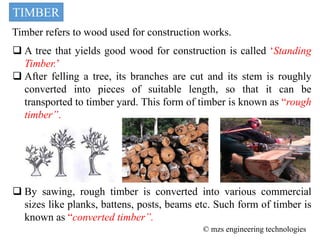
Timber refers to wood used for construction works.
 A tree that yields good wood for construction is called ‘Standing
Timber.’
 After felling a tree, its branches are cut and its stem is roughly
converted into pieces of suitable length, so that it can be
transported to timber yard. This form of timber is known as “rough
timber”.
 By sawing, rough timber is converted into various commercial
sizes like planks, battens, posts, beams etc. Such form of timber is
known as “converted timber”.
© mzs engineering technologies
Classification of Timber
The following are the important basis for
classification;
(i) Mode of growth
(ii) Modulus of elasticity
(iii) Durability
(iv) Grading
(v) Availability.
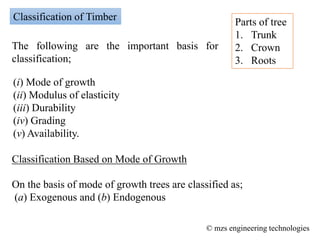
Classification Based on Mode of Growth
On the basis of mode of growth trees are classified as;
(a) Exogenous and (b) Endogenous
Parts of tree
1. Trunk
2. Crown
3. Roots
© mzs engineering technologies
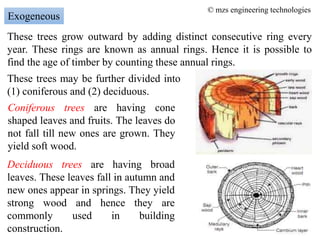
These trees grow outward by adding distinct consecutive ring every
year. These rings are known as annual rings. Hence it is possible to
find the age of timber by counting these annual rings.
Exogeneous
These trees may be further divided into
(1) coniferous and (2) deciduous.
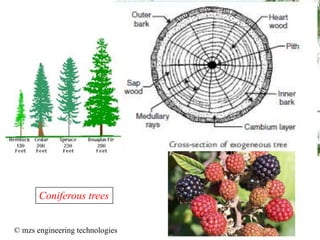
Coniferous trees are having cone
shaped leaves and fruits. The leaves do
not fall till new ones are grown. They
yield soft wood.
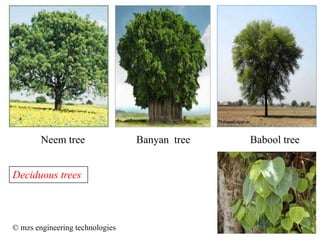
Deciduous trees are having broad
leaves. These leaves fall in autumn and
new ones appear in springs. They yield
strong wood and hence they are
commonly used in building
construction.
© mzs engineering technologies
Coniferous trees
© mzs engineering technologies
Deciduous trees
Neem tree Babool treeBanyan tree
© mzs engineering technologies
Endogenous
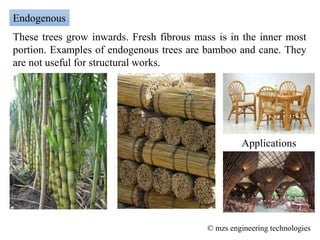
These trees grow inwards. Fresh fibrous mass is in the inner most
portion. Examples of endogenous trees are bamboo and cane. They
are not useful for structural works.
Applications
© mzs engineering technologies
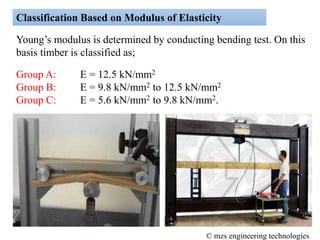
Classification Based on Modulus of Elasticity
Young’s modulus is determined by conducting bending test. On this
basis timber is classified as;
Group A: E = 12.5 kN/mm2
Group B: E = 9.8 kN/mm2 to 12.5 kN/mm2
Group C: E = 5.6 kN/mm2 to 9.8 kN/mm2.
© mzs engineering technologies
Classification Based on Durability
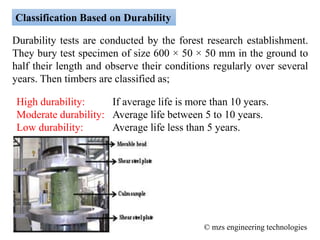
Durability tests are conducted by the forest research establishment.
They bury test specimen of size 600 × 50 × 50 mm in the ground to
half their length and observe their conditions regularly over several
years. Then timbers are classified as;
High durability: If average life is more than 10 years.
Moderate durability: Average life between 5 to 10 years.
Low durability: Average life less than 5 years.
© mzs engineering technologies
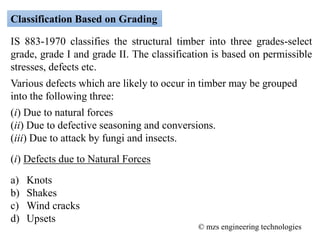
Classification Based on Grading
IS 883-1970 classifies the structural timber into three grades-select
grade, grade I and grade II. The classification is based on permissible
stresses, defects etc.
Various defects which are likely to occur in timber may be grouped
into the following three:
(i) Due to natural forces
(ii) Due to defective seasoning and conversions.
(iii) Due to attack by fungi and insects.
(i) Defects due to Natural Forces
a) Knots
b) Shakes
c) Wind cracks
d) Upsets
© mzs engineering technologies
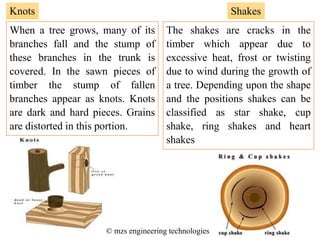
When a tree grows, many of its
branches fall and the stump of
these branches in the trunk is
covered. In the sawn pieces of
timber the stump of fallen
branches appear as knots. Knots
are dark and hard pieces. Grains
are distorted in this portion.
Knots Shakes
The shakes are cracks in the
timber which appear due to
excessive heat, frost or twisting
due to wind during the growth of
a tree. Depending upon the shape
and the positions shakes can be
classified as star shake, cup
shake, ring shakes and heart
shakes
© mzs engineering technologies
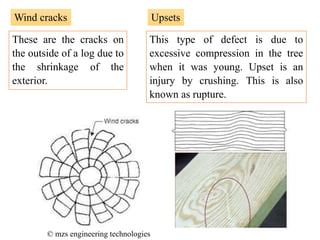
These are the cracks on
the outside of a log due to
the shrinkage of the
exterior.
Wind cracks
This type of defect is due to
excessive compression in the tree
when it was young. Upset is an
injury by crushing. This is also
known as rupture.
Upsets
© mzs engineering technologies
Classification Based on Availability
Forest departments classify timbers based on the availability as;
X—Most common. 1415 m3 or more per year
Y—Common. 355 m3 to 1415 m3 per year
Z—Less common. Less than 355 m3 per year.
© mzs engineering technologies
Properties of Timber
Properties of good timbers are;
Color: It should be uniform.
Odour: It should be pleasant when cut freshly.
Soundness: A clear ringing sound when struck indicates the timber is
good.
Texture: Texture of good timber is fine and even.
Grains: In good timber grains are close.
Density: Higher the density stronger is the timber.
Hardness: Harder timbers are strong and durable.
© mzs engineering technologies
Warping: Good timber do not warp under changing environmental
conditions.
Toughness: Timber should be capable of resisting shock loads.
Abrasion: Good timber do not deteriorate due to wear. This property
should be looked into, if timber is to be used for flooring.
Strength: Timber should have high strength in bending, shear and direct
compression.
Modulus of Elasticity: Timber with higher modulus of elasticity are
preferred in construction.
Properties of Timber
© mzs engineering technologies
Fire resistance: A good timber should have high resistance to fire.
Permeability: Good timber has low water permeability.
Workability: Timber should be easily workable. It should not clog the
saw.
Durability: Good timber is one which is capable of resisting the
action of fungi and insects attack
Defects: Good timber is free from defects like dead knots, shakes
and cracks.
Properties of Timber
© mzs engineering technologies
Uses of Timber
Timber is used for the following works;
1. For heavy construction works like columns, trusses, piles.
2. For light construction works like doors, windows, flooring and
roofing.
3. For other permanent works like for railway sleepers, fencing
poles, electric poles and gates.
4. For temporary works in construction like scaffolding, centering,
shoring and strutting, packing
of materials.
5. For decorative works like showcases and furniture's.
6. For body works of buses, lorries, trains and boats
7. For industrial uses like pulps (used in making papers), card
boards, wall papers
8. For making sports goods and musical instruments.
© mzs engineering technologies

Timber

  • 1.
    Timber Mohd. Zameeruddin Mohd. Saleemuddin Assistantprofessor, Department of Civil Engineering, MGM’s College of Engineering, Nanded (m.s) © mzs engineering technologies email@ zameerstd1@hotmail.com; md_zameeruddin@mgmcen.ac.in
  • 2.
    TIMBER Timber refers towood used for construction works.  A tree that yields good wood for construction is called ‘Standing Timber.’  After felling a tree, its branches are cut and its stem is roughly converted into pieces of suitable length, so that it can be transported to timber yard. This form of timber is known as “rough timber”.  By sawing, rough timber is converted into various commercial sizes like planks, battens, posts, beams etc. Such form of timber is known as “converted timber”. © mzs engineering technologies
  • 3.
    Classification of Timber Thefollowing are the important basis for classification; (i) Mode of growth (ii) Modulus of elasticity (iii) Durability (iv) Grading (v) Availability. Classification Based on Mode of Growth On the basis of mode of growth trees are classified as; (a) Exogenous and (b) Endogenous Parts of tree 1. Trunk 2. Crown 3. Roots © mzs engineering technologies
  • 4.
    These trees growoutward by adding distinct consecutive ring every year. These rings are known as annual rings. Hence it is possible to find the age of timber by counting these annual rings. Exogeneous These trees may be further divided into (1) coniferous and (2) deciduous. Coniferous trees are having cone shaped leaves and fruits. The leaves do not fall till new ones are grown. They yield soft wood. Deciduous trees are having broad leaves. These leaves fall in autumn and new ones appear in springs. They yield strong wood and hence they are commonly used in building construction. © mzs engineering technologies
  • 5.
    Coniferous trees © mzsengineering technologies
  • 6.
    Deciduous trees Neem treeBabool treeBanyan tree © mzs engineering technologies
  • 7.
    Endogenous These trees growinwards. Fresh fibrous mass is in the inner most portion. Examples of endogenous trees are bamboo and cane. They are not useful for structural works. Applications © mzs engineering technologies
  • 8.
    Classification Based onModulus of Elasticity Young’s modulus is determined by conducting bending test. On this basis timber is classified as; Group A: E = 12.5 kN/mm2 Group B: E = 9.8 kN/mm2 to 12.5 kN/mm2 Group C: E = 5.6 kN/mm2 to 9.8 kN/mm2. © mzs engineering technologies
  • 9.
    Classification Based onDurability Durability tests are conducted by the forest research establishment. They bury test specimen of size 600 × 50 × 50 mm in the ground to half their length and observe their conditions regularly over several years. Then timbers are classified as; High durability: If average life is more than 10 years. Moderate durability: Average life between 5 to 10 years. Low durability: Average life less than 5 years. © mzs engineering technologies
  • 10.
    Classification Based onGrading IS 883-1970 classifies the structural timber into three grades-select grade, grade I and grade II. The classification is based on permissible stresses, defects etc. Various defects which are likely to occur in timber may be grouped into the following three: (i) Due to natural forces (ii) Due to defective seasoning and conversions. (iii) Due to attack by fungi and insects. (i) Defects due to Natural Forces a) Knots b) Shakes c) Wind cracks d) Upsets © mzs engineering technologies
  • 11.
    When a treegrows, many of its branches fall and the stump of these branches in the trunk is covered. In the sawn pieces of timber the stump of fallen branches appear as knots. Knots are dark and hard pieces. Grains are distorted in this portion. Knots Shakes The shakes are cracks in the timber which appear due to excessive heat, frost or twisting due to wind during the growth of a tree. Depending upon the shape and the positions shakes can be classified as star shake, cup shake, ring shakes and heart shakes © mzs engineering technologies
  • 12.
    These are thecracks on the outside of a log due to the shrinkage of the exterior. Wind cracks This type of defect is due to excessive compression in the tree when it was young. Upset is an injury by crushing. This is also known as rupture. Upsets © mzs engineering technologies
  • 13.
    Classification Based onAvailability Forest departments classify timbers based on the availability as; X—Most common. 1415 m3 or more per year Y—Common. 355 m3 to 1415 m3 per year Z—Less common. Less than 355 m3 per year. © mzs engineering technologies
  • 14.
    Properties of Timber Propertiesof good timbers are; Color: It should be uniform. Odour: It should be pleasant when cut freshly. Soundness: A clear ringing sound when struck indicates the timber is good. Texture: Texture of good timber is fine and even. Grains: In good timber grains are close. Density: Higher the density stronger is the timber. Hardness: Harder timbers are strong and durable. © mzs engineering technologies
  • 15.
    Warping: Good timberdo not warp under changing environmental conditions. Toughness: Timber should be capable of resisting shock loads. Abrasion: Good timber do not deteriorate due to wear. This property should be looked into, if timber is to be used for flooring. Strength: Timber should have high strength in bending, shear and direct compression. Modulus of Elasticity: Timber with higher modulus of elasticity are preferred in construction. Properties of Timber © mzs engineering technologies
  • 16.
    Fire resistance: Agood timber should have high resistance to fire. Permeability: Good timber has low water permeability. Workability: Timber should be easily workable. It should not clog the saw. Durability: Good timber is one which is capable of resisting the action of fungi and insects attack Defects: Good timber is free from defects like dead knots, shakes and cracks. Properties of Timber © mzs engineering technologies
  • 17.
    Uses of Timber Timberis used for the following works; 1. For heavy construction works like columns, trusses, piles. 2. For light construction works like doors, windows, flooring and roofing. 3. For other permanent works like for railway sleepers, fencing poles, electric poles and gates. 4. For temporary works in construction like scaffolding, centering, shoring and strutting, packing of materials. 5. For decorative works like showcases and furniture's. 6. For body works of buses, lorries, trains and boats 7. For industrial uses like pulps (used in making papers), card boards, wall papers 8. For making sports goods and musical instruments. © mzs engineering technologies