
Wood as construction material Types,
Structure, Processing
• Wood is one of the most used natural building materials in the
world. A number of valuable properties such as low heat
conductivity, small bulk density, relatively high strength, amenability
to mechanical working etc. makes wood as famous building
material.
• Timber can be used in most economical way without wasting any of
the derivative of it. Even the saw dust obtained during wood sawing
can also be used to make fiber boards, paper etc.
• In this article, we are going to discuss about the Classification and
structure of tree and also about the Processing of timber from
felling of tree to preservation of timber.
Types of Trees for Timber
Production
• The trees are classified into following types based on
their mode of growth.
• Exogenous
• Endogenous
1. Exogenous
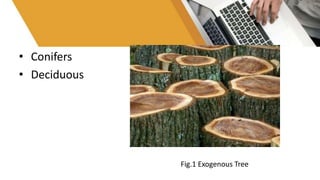
• Exogenous trees are outward growing trees.
Horizontal section of such tree contains several rings
which are nothing but annual rings. These rings can
be used to predict the age of tree. Most of the
exogenous trees are useful for many engineering
purposes.
• Exogenous trees are sub classified into following
types.
• Conifers
• Deciduous
Fig.1 Exogenous Tree
Conifers
• Conifers are nothing but soft wood
producing trees which are also called as
ever green trees. The timber of these trees
is light colored, light in weight, low dense
and poor against fire.
• Examples: Pine, Fir, redwood, spruce,
deodar, cedar etc.
Deciduous
• Deciduous trees are hard wood producing
trees. The leaves of this type of trees are
generally broad in size and they fall in autumn
and grow in spring. Deciduous trees are most
suitable for constructional purposes. Timber
of deciduous trees is dark colored, dense,
heaviest and good against fire.
• Examples: Maple, Mahogany, Oak, teak,
walnut, babul etc.
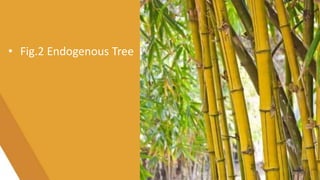
2. Endogenous
•
Endogenous trees are inward growing
trees which contains fibrous mass in their
longitudinal section. The timber from
these trees is useful in some limited
engineering purposes.
• Examples: bamboo, palm, cane etc.
• Fig.2 Endogenous Tree
Structure of a Tree
• The structure of tree can be divided in to
two categories as follows
• Macrostructure
• Microstructure
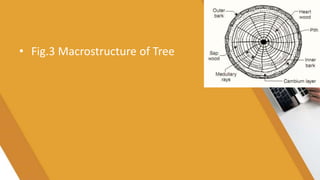
1. Macrostructure
• The structure of a tree which is visible to the naked eye is
called macro structure of tree. Macrostructure of tree
contains following components
• Pith
• Heart wood
• Sap wood
• Cambium Layer
• Inner bark
• Outer bark
• Medullary rays
• Fig.3 Macrostructure of Tree
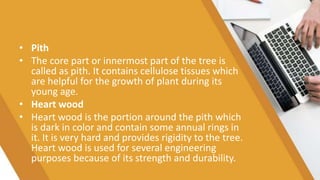
• Pith
• The core part or innermost part of the tree is
called as pith. It contains cellulose tissues which
are helpful for the growth of plant during its
young age.
• Heart wood
• Heart wood is the portion around the pith which
is dark in color and contain some annual rings in
it. It is very hard and provides rigidity to the tree.
Heart wood is used for several engineering
purposes because of its strength and durability.
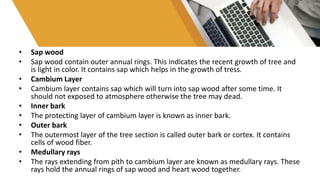
• Sap wood
• Sap wood contain outer annual rings. This indicates the recent growth of tree and
is light in color. It contains sap which helps in the growth of tress.
• Cambium Layer
• Cambium layer contains sap which will turn into sap wood after some time. It
should not exposed to atmosphere otherwise the tree may dead.
• Inner bark
• The protecting layer of cambium layer is known as inner bark.
• Outer bark
• The outermost layer of the tree section is called outer bark or cortex. It contains
cells of wood fiber.
• Medullary rays
• The rays extending from pith to cambium layer are known as medullary rays. These
rays hold the annual rings of sap wood and heart wood together.
2. Microstructure
• Micro structure of a tree can only be visible with
great magnifications. It contains cells of different
shapes and sizes. These cells are responsible for
many actions like nutrients transport to branches
from stem, strength of tree etc.
Processing of Timber
• Processing of Timber contains following steps
• Felling of Trees
• Seasoning of Timber
• Conversion of Timber
• Preservation of Timber
1. Felling of Trees
• Felling of trees is nothing but cutting of trees which are suitable for engineering
purposes. Felling should be done when the tree is matured. Then only it contains
more amount of heart wood than sap wood. The perfect age of trees for felling
varies from 50 to 100 years. The best season for felling of trees is Mid-winter for
plain areas and mid-summer for hilly areas.
• Firstly a cut is made at the lower most part of the trunk on a side where tree is
expected to fell. The cut should be beyond center of gravity of tree. Then provide
parallel cut which is exactly opposite to the first cut. Then tie up the tree top with
4 ropes on 4 sides.
• Now pull the rope of first cut side and loosen the rope on the opposite side. Using
other two ropes swing the tree slowly. Then the tree starts breaking along the cuts
and gently fall on the ground. The branches are chopped off, bark is removed and
is cut into required sizes.
• Fig.4 Felling of a Tree
2. Seasoning of Timber
• Seasoning of timber means removal of moisture content from
timber. A newly fell tree contains water up to 50% of its dry
weight. The timber contains free moisture and bound
moisture.
• Free moisture is present in timber as water vapor while bound
moisture is present in cell walls. When it is allowed to
seasoning, free moisture evaporated first and this point is
called as fiber saturation point.
• After Fiber saturation point, the timber will shrink on drying
which is nothing but evaporation of bound moisture.
• There are two methods of seasoning are there
namely
• Natural seasoning
• Artificial Seasoning
Fig.5
Seasoning of
Timber
3. Conversion of Timber
• Conversion of timber is the process of cutting of timber
into required sections. This can be done by using power
machines. Skilled persons should be required for
economic conversion of timber. The conversion can be
done by four types as follows
• Ordinary sawing
• Tangential sawing
• Quarter awing
• Radial sawing
Ordinary sawing
• It is the most used and easy method of sawing. The
cutting is done through the section of timber piece at
perpendicular to the annual rings. Wastage of timber
is minimum in this case.
• The obtained planks are not of equal strength. The
outer planks contain sap wood and shrinks more
while the inner portion planks contain heart wood
which shrinks less.
• Fig.6 Ordinary Sawing
Tangential sawing
• In this type of sawing the cuts are tangential to
annual rings and they meet each other at right
angles. This method is suitable when the annual rings
are very distinct with each other.
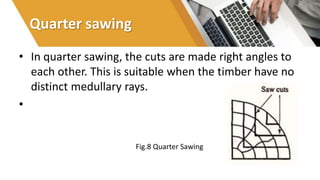
Quarter sawing
• In quarter sawing, the cuts are made right angles to
each other. This is suitable when the timber have no
distinct medullary rays.
•
Fig.8 Quarter Sawing
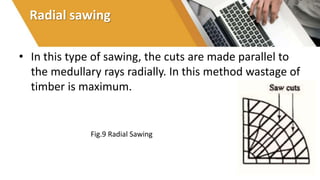
Radial sawing
• In this type of sawing, the cuts are made parallel to
the medullary rays radially. In this method wastage of
timber is maximum.
Fig.9 Radial Sawing
4. Preservation of Timber
• The final stage of timber processing is preservation
which is carried out to increase the durability of
timber and also to resist the attacks of fungi, insects
etc. on timber. In general ASCU, Coal tar, Oil paints,
Solignum paints etc. are used as preservatives.
THE END

Wood structure as a Building material

  • 1.
    Wood as constructionmaterial Types, Structure, Processing
  • 2.
    • Wood isone of the most used natural building materials in the world. A number of valuable properties such as low heat conductivity, small bulk density, relatively high strength, amenability to mechanical working etc. makes wood as famous building material. • Timber can be used in most economical way without wasting any of the derivative of it. Even the saw dust obtained during wood sawing can also be used to make fiber boards, paper etc. • In this article, we are going to discuss about the Classification and structure of tree and also about the Processing of timber from felling of tree to preservation of timber.
  • 3.
    Types of Treesfor Timber Production • The trees are classified into following types based on their mode of growth. • Exogenous • Endogenous
  • 4.
    1. Exogenous • Exogenoustrees are outward growing trees. Horizontal section of such tree contains several rings which are nothing but annual rings. These rings can be used to predict the age of tree. Most of the exogenous trees are useful for many engineering purposes. • Exogenous trees are sub classified into following types.
  • 5.
  • 6.
    Conifers • Conifers arenothing but soft wood producing trees which are also called as ever green trees. The timber of these trees is light colored, light in weight, low dense and poor against fire. • Examples: Pine, Fir, redwood, spruce, deodar, cedar etc.
  • 7.
    Deciduous • Deciduous treesare hard wood producing trees. The leaves of this type of trees are generally broad in size and they fall in autumn and grow in spring. Deciduous trees are most suitable for constructional purposes. Timber of deciduous trees is dark colored, dense, heaviest and good against fire. • Examples: Maple, Mahogany, Oak, teak, walnut, babul etc.
  • 8.
    2. Endogenous • Endogenous treesare inward growing trees which contains fibrous mass in their longitudinal section. The timber from these trees is useful in some limited engineering purposes. • Examples: bamboo, palm, cane etc.
  • 9.
  • 10.
    Structure of aTree • The structure of tree can be divided in to two categories as follows • Macrostructure • Microstructure
  • 11.
    1. Macrostructure • Thestructure of a tree which is visible to the naked eye is called macro structure of tree. Macrostructure of tree contains following components • Pith • Heart wood • Sap wood • Cambium Layer • Inner bark • Outer bark • Medullary rays
  • 12.
  • 13.
    • Pith • Thecore part or innermost part of the tree is called as pith. It contains cellulose tissues which are helpful for the growth of plant during its young age. • Heart wood • Heart wood is the portion around the pith which is dark in color and contain some annual rings in it. It is very hard and provides rigidity to the tree. Heart wood is used for several engineering purposes because of its strength and durability.
  • 14.
    • Sap wood •Sap wood contain outer annual rings. This indicates the recent growth of tree and is light in color. It contains sap which helps in the growth of tress. • Cambium Layer • Cambium layer contains sap which will turn into sap wood after some time. It should not exposed to atmosphere otherwise the tree may dead. • Inner bark • The protecting layer of cambium layer is known as inner bark. • Outer bark • The outermost layer of the tree section is called outer bark or cortex. It contains cells of wood fiber. • Medullary rays • The rays extending from pith to cambium layer are known as medullary rays. These rays hold the annual rings of sap wood and heart wood together.
  • 15.
    2. Microstructure • Microstructure of a tree can only be visible with great magnifications. It contains cells of different shapes and sizes. These cells are responsible for many actions like nutrients transport to branches from stem, strength of tree etc.
  • 16.
    Processing of Timber •Processing of Timber contains following steps • Felling of Trees • Seasoning of Timber • Conversion of Timber • Preservation of Timber
  • 17.
    1. Felling ofTrees • Felling of trees is nothing but cutting of trees which are suitable for engineering purposes. Felling should be done when the tree is matured. Then only it contains more amount of heart wood than sap wood. The perfect age of trees for felling varies from 50 to 100 years. The best season for felling of trees is Mid-winter for plain areas and mid-summer for hilly areas. • Firstly a cut is made at the lower most part of the trunk on a side where tree is expected to fell. The cut should be beyond center of gravity of tree. Then provide parallel cut which is exactly opposite to the first cut. Then tie up the tree top with 4 ropes on 4 sides. • Now pull the rope of first cut side and loosen the rope on the opposite side. Using other two ropes swing the tree slowly. Then the tree starts breaking along the cuts and gently fall on the ground. The branches are chopped off, bark is removed and is cut into required sizes.
  • 18.
  • 19.
    2. Seasoning ofTimber • Seasoning of timber means removal of moisture content from timber. A newly fell tree contains water up to 50% of its dry weight. The timber contains free moisture and bound moisture. • Free moisture is present in timber as water vapor while bound moisture is present in cell walls. When it is allowed to seasoning, free moisture evaporated first and this point is called as fiber saturation point. • After Fiber saturation point, the timber will shrink on drying which is nothing but evaporation of bound moisture.
  • 20.
    • There aretwo methods of seasoning are there namely • Natural seasoning • Artificial Seasoning
  • 21.
  • 22.
    3. Conversion ofTimber • Conversion of timber is the process of cutting of timber into required sections. This can be done by using power machines. Skilled persons should be required for economic conversion of timber. The conversion can be done by four types as follows • Ordinary sawing • Tangential sawing • Quarter awing • Radial sawing
  • 23.
    Ordinary sawing • Itis the most used and easy method of sawing. The cutting is done through the section of timber piece at perpendicular to the annual rings. Wastage of timber is minimum in this case. • The obtained planks are not of equal strength. The outer planks contain sap wood and shrinks more while the inner portion planks contain heart wood which shrinks less.
  • 24.
  • 25.
    Tangential sawing • Inthis type of sawing the cuts are tangential to annual rings and they meet each other at right angles. This method is suitable when the annual rings are very distinct with each other.
  • 27.
    Quarter sawing • Inquarter sawing, the cuts are made right angles to each other. This is suitable when the timber have no distinct medullary rays. • Fig.8 Quarter Sawing
  • 28.
    Radial sawing • Inthis type of sawing, the cuts are made parallel to the medullary rays radially. In this method wastage of timber is maximum. Fig.9 Radial Sawing
  • 29.
    4. Preservation ofTimber • The final stage of timber processing is preservation which is carried out to increase the durability of timber and also to resist the attacks of fungi, insects etc. on timber. In general ASCU, Coal tar, Oil paints, Solignum paints etc. are used as preservatives.
  • 30.