Examination of Thyroid
History
• Name
• Age
• Occupation
• Address
Presenting Complaints
• Swelling in front of neck
• Pain
• Hoarseness
• Difficulty in swallowing/breathing
• Tremor
• Weakness
• palpitation
History Of Presenting Illness
• Swelling
• Duration, onset, progression
• Swelling whether single or multiple
• Pain
• Duration onset progression
• Character of pain
• Pressure symptoms
• Dysphagia
• Dyspnoea
• Stridor
• Hoarseness
• Horners syndrome
• Features of Toxicity
• Hyperthyroidism
• Loss of weight inspite of good appetite
• Diarrhoea
• Chest pain
• palpitation
• Heat intolerance
• Amenorrhea
• Irritability, nervousness, tremors
• Proximal muscle weakness
• Features of hypothyroidism
• Lethargy, weight gain, poor appetite
• Cold Intolerance
• Menorrhagia constipation
• Loss of hair
• Dry skin
Past History
• Irradiation for benign conditions – papillary carcinoma
• Thyroglossal cyst-infected-fistula
• Previous surgery
•
Personal history
• Smoking alcohol
• Drugs which can alter thyroid function
• Dietary habits- brassica family vegetables
• Iodized salt
• Family hisory
• Menstrual history
• Treatment history
General examination
• To be followed as in other cases
• Level of consciousness orientation
• P I C C L E
• Pulse Rate( atrial fibrillation, sleeping PR)
• BP
Specific for thyroid examination
• Face of the patient
• Is the patient anxious or worried- hyperthyroidism
• Dull lethargic expressionless – hypothyroidism
• Look for eye signs- lid retraction, exophthalmos, ophthalmoplegia,
chemosis
Exophthalmos
• Von Graefes sign
• Joffroys sign
• Stellwags sign
• Moebius sign
• Dalrymples sign
Examination contd
• Skin is wet warm in hyperthyroidism
• Both legs and ankle should be inspected for pretibial myxedema
• Tremor of hands and tongue
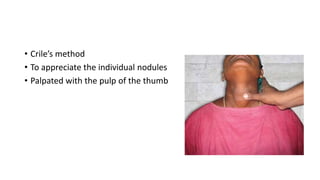
Local examination
• INSPECTION
• Swelling
• Location, size, shape
• Extend – between Sternomastoid and trachea if one lobe
or between 2 sternomastoids if both lobes
Upper extend is usually upto thyroid cartillage
• Lower border visible or not
• Movement – with deglutition
with protrusion of tongue
Inspection contd
• Scars
• Dilated veins
• Pulsations
• Surface
• Pemberton’s sign- retrosternal goitre
PALPATION
• Swelling
• Temperature
• Tenderness
• Extent, position, shape and exact size surface
• Consistency
• Margins
• Plane of the swelling- deep to deep fascia
deep to sternomastoid
• Movement with deglutition and lower border of the gland
• Thrill is checked in the upper pole of the gland
Method of palpation of thyroid gland
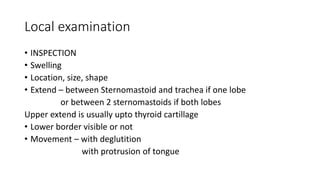
• Gland palpated from the
back while patient in sitting
position with neck partially
flexed
• Each lobe is palpated in
whole and isthmus
• Assess for nodules, surface
and the consistency of
each lobe
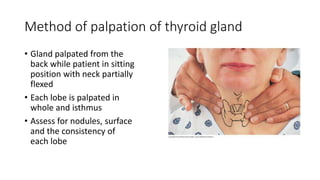
• Lahey’s method
• For assessing individual lobes
• The lobe to be palpated is made
prominent by pushing from
opposite side and palpated with
the palmar aspect of the hand
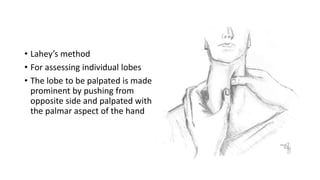
• Crile’s method
• To appreciate the individual nodules
• Palpated with the pulp of the thumb
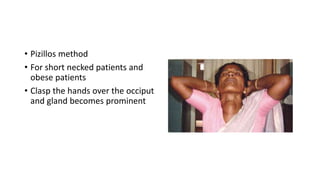
• Pizillos method
• For short necked patients and
obese patients
• Clasp the hands over the occiput
and gland becomes prominent
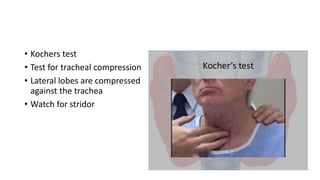
• Kochers test
• Test for tracheal compression
• Lateral lobes are compressed
against the trachea
• Watch for stridor
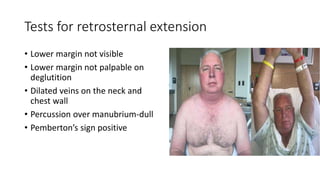
Tests for retrosternal extension
• Lower margin not visible
• Lower margin not palpable on
deglutition
• Dilated veins on the neck and
chest wall
• Percussion over manubrium-dull
• Pemberton’s sign positive
• Position of trachea
• Tracheal deviation is common
in long standing goitres
• May contribute to
compression
• Trail sign
• Carotid pulsation
• Should be checked for its presence and normal position
• Berry sign: absence of carotid pulsation in advanced carcinoma due to
infitration of carotid sheath
• Long standing large goitres can push the carotid away from its normal
position
Palpation of regional neck nodes
• Enlarged in case of carcinoma of
thyroid usually in papillary ca
thyroid and lymphoma
• All regions of the neck node
should be examined
• Carcinoma usually spreads to
level2,3,4 LN
Examination of other systems
• Cardiovascular system especially in case of secondary thyrotoxicosis
• Tachycardia ectopics extrasystole atrial fibrillation
• Neurological system and reflexes
• Respiratory system for pleural effusion in case of secondaries
• Abdominal examination for hepatomegaly in case of follicular ca
splenomegaly in lymphoma
• Skull and spine

Thyroid.pptx

  • 1.
  • 2.
    History • Name • Age •Occupation • Address
  • 3.
    Presenting Complaints • Swellingin front of neck • Pain • Hoarseness • Difficulty in swallowing/breathing • Tremor • Weakness • palpitation
  • 4.
    History Of PresentingIllness • Swelling • Duration, onset, progression • Swelling whether single or multiple
  • 5.
    • Pain • Durationonset progression • Character of pain
  • 6.
    • Pressure symptoms •Dysphagia • Dyspnoea • Stridor • Hoarseness • Horners syndrome
  • 7.
    • Features ofToxicity • Hyperthyroidism • Loss of weight inspite of good appetite • Diarrhoea • Chest pain • palpitation • Heat intolerance • Amenorrhea • Irritability, nervousness, tremors • Proximal muscle weakness
  • 8.
    • Features ofhypothyroidism • Lethargy, weight gain, poor appetite • Cold Intolerance • Menorrhagia constipation • Loss of hair • Dry skin
  • 9.
    Past History • Irradiationfor benign conditions – papillary carcinoma • Thyroglossal cyst-infected-fistula • Previous surgery •
  • 10.
    Personal history • Smokingalcohol • Drugs which can alter thyroid function • Dietary habits- brassica family vegetables • Iodized salt
  • 11.
    • Family hisory •Menstrual history • Treatment history
  • 12.
    General examination • Tobe followed as in other cases • Level of consciousness orientation • P I C C L E • Pulse Rate( atrial fibrillation, sleeping PR) • BP
  • 13.
    Specific for thyroidexamination • Face of the patient • Is the patient anxious or worried- hyperthyroidism • Dull lethargic expressionless – hypothyroidism • Look for eye signs- lid retraction, exophthalmos, ophthalmoplegia, chemosis
  • 14.
    Exophthalmos • Von Graefessign • Joffroys sign • Stellwags sign • Moebius sign • Dalrymples sign
  • 15.
    Examination contd • Skinis wet warm in hyperthyroidism • Both legs and ankle should be inspected for pretibial myxedema • Tremor of hands and tongue
  • 16.
    Local examination • INSPECTION •Swelling • Location, size, shape • Extend – between Sternomastoid and trachea if one lobe or between 2 sternomastoids if both lobes Upper extend is usually upto thyroid cartillage • Lower border visible or not • Movement – with deglutition with protrusion of tongue
  • 17.
    Inspection contd • Scars •Dilated veins • Pulsations • Surface • Pemberton’s sign- retrosternal goitre
  • 18.
    PALPATION • Swelling • Temperature •Tenderness • Extent, position, shape and exact size surface • Consistency • Margins • Plane of the swelling- deep to deep fascia deep to sternomastoid • Movement with deglutition and lower border of the gland • Thrill is checked in the upper pole of the gland
  • 19.
    Method of palpationof thyroid gland • Gland palpated from the back while patient in sitting position with neck partially flexed • Each lobe is palpated in whole and isthmus • Assess for nodules, surface and the consistency of each lobe
  • 20.
    • Lahey’s method •For assessing individual lobes • The lobe to be palpated is made prominent by pushing from opposite side and palpated with the palmar aspect of the hand
  • 21.
    • Crile’s method •To appreciate the individual nodules • Palpated with the pulp of the thumb
  • 22.
    • Pizillos method •For short necked patients and obese patients • Clasp the hands over the occiput and gland becomes prominent
  • 23.
    • Kochers test •Test for tracheal compression • Lateral lobes are compressed against the trachea • Watch for stridor
  • 24.
    Tests for retrosternalextension • Lower margin not visible • Lower margin not palpable on deglutition • Dilated veins on the neck and chest wall • Percussion over manubrium-dull • Pemberton’s sign positive
  • 25.
    • Position oftrachea • Tracheal deviation is common in long standing goitres • May contribute to compression • Trail sign
  • 26.
    • Carotid pulsation •Should be checked for its presence and normal position • Berry sign: absence of carotid pulsation in advanced carcinoma due to infitration of carotid sheath • Long standing large goitres can push the carotid away from its normal position
  • 27.
    Palpation of regionalneck nodes • Enlarged in case of carcinoma of thyroid usually in papillary ca thyroid and lymphoma • All regions of the neck node should be examined • Carcinoma usually spreads to level2,3,4 LN
  • 29.
    Examination of othersystems • Cardiovascular system especially in case of secondary thyrotoxicosis • Tachycardia ectopics extrasystole atrial fibrillation • Neurological system and reflexes • Respiratory system for pleural effusion in case of secondaries • Abdominal examination for hepatomegaly in case of follicular ca splenomegaly in lymphoma • Skull and spine