Neck
Swelling
Neck triangles .
 Neck tumour.
        Cyst .
        Sinus .
        Fistulas .
        Ulcer.
 Thyroglosal cyst.
 Cystic hygroma.
 Lymph nodes of the neck.
Anatomic
landmarks
     of the neck
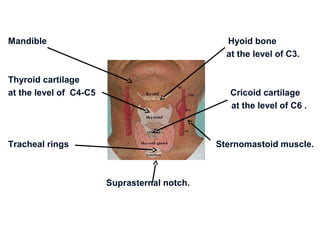
Mandible                                        Hyoid bone
                                                at the level of C3.

Thyroid cartilage
at the level of C4-C5                            Cricoid cartilage
                                                 at the level of C6 .


Tracheal rings                                Sternomastoid muscle.


                        Suprasternal notch.
Anatomy
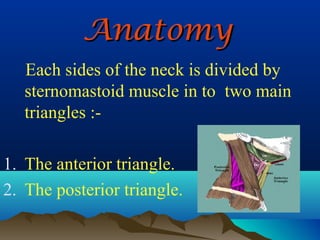
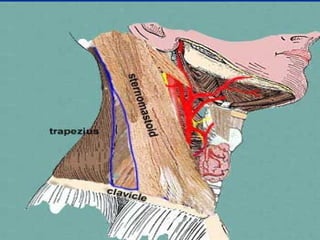
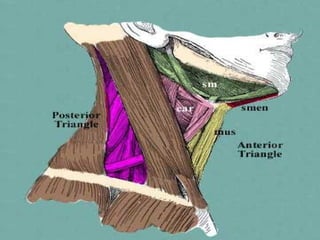
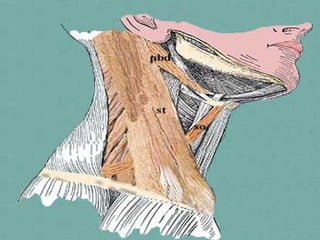
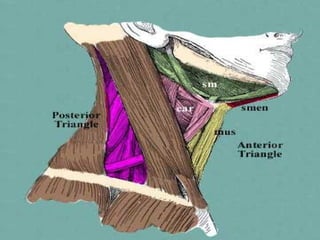
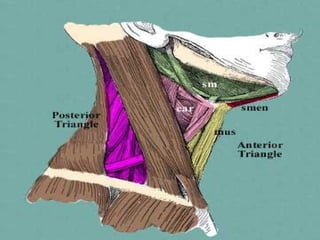
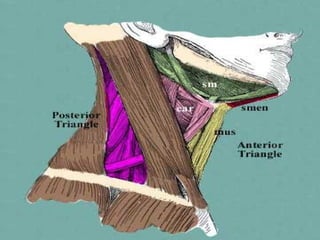
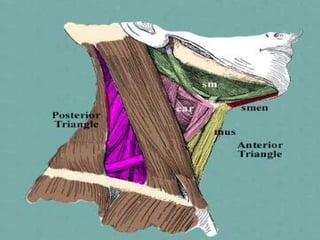
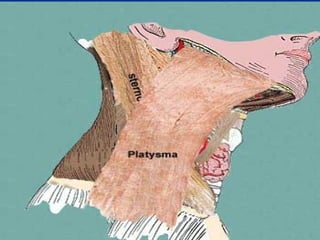
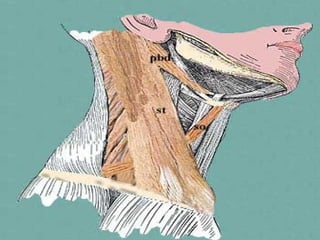
   Each sides of the neck is divided by
   sternomastoid muscle in to two main
   triangles :-

1. The anterior triangle.
2. The posterior triangle.
Anterior
Triangle
 of the Neck
Anterior triangle of the neck

Boundaries :

Anterior border of sternomastoid muscle.
The midline.
The inferior margin of the mandible
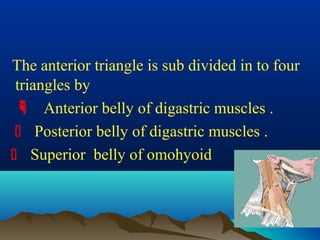
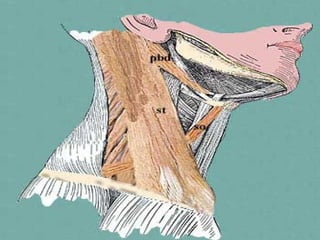
The anterior triangle is sub divided in to four
 triangles by
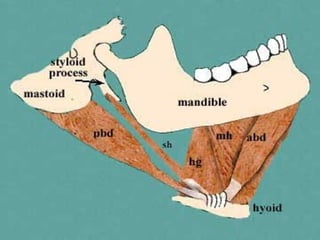
  Anterior belly of digastric muscles .
  Posterior belly of digastric muscles .
 Superior belly of omohyoid
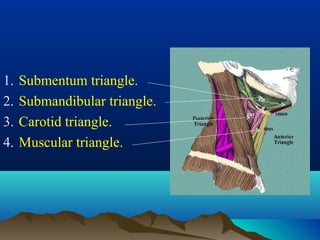
1.   Submentum triangle.
2.   Submandibular triangle.
3.   Carotid triangle.
4.   Muscular triangle.
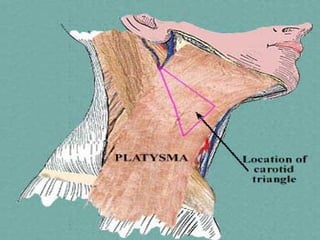
Boundaries of Carotid Triangle
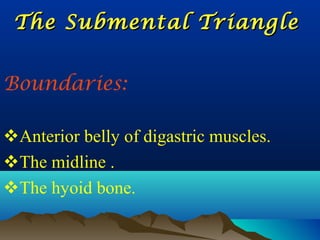
The Submental Triangle


Boundaries:

Anterior belly of digastric muscles.
The midline .
The hyoid bone.
Triangles of the Neck   Anterior Triangle   Posterior Triangle
• Anterior Triangle of the Neck
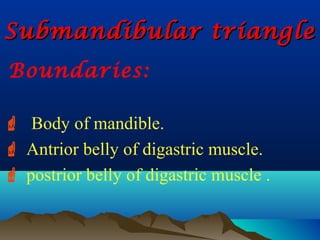
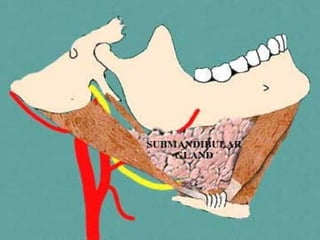
Submandibular triangle
Boundaries:

 Body of mandible.
 Antrior belly of digastric muscle.
 postrior belly of digastric muscle .
Triangles of the Neck   Anterior Triangle   Posterior Triangle
• Anterior Triangle of the Neck
The Submandibular Triangle
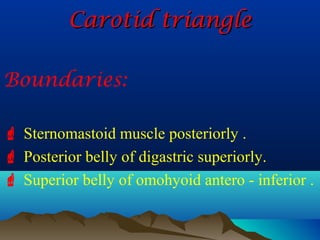
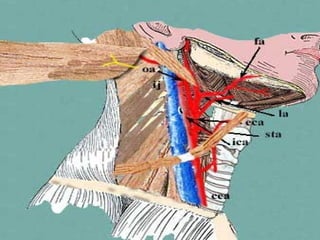
Carotid triangle

Boundaries:

 Sternomastoid muscle posteriorly .
 Posterior belly of digastric superiorly.
 Superior belly of omohyoid antero - inferior .
Boundaries of Carotid Triangle
Carotid triangle
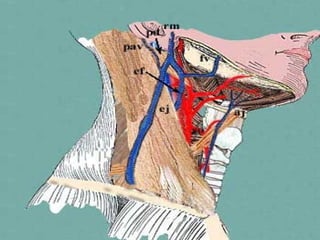
• Vein of the carotid triangle


  Vein of the carotid triangle
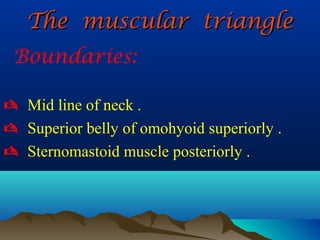
The muscular triangle
 Boundaries:

 Mid line of neck .
 Superior belly of omohyoid superiorly .
 Sternomastoid muscle posteriorly .
Boundaries of Carotid Triangle
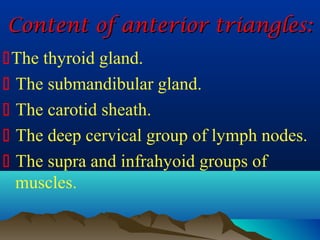
Content of anterior triangles:
The thyroid gland.
 The submandibular gland.
 The carotid sheath.
 The deep cervical group of lymph nodes.
 The supra and infrahyoid groups of
  muscles.
Posterior
triangle
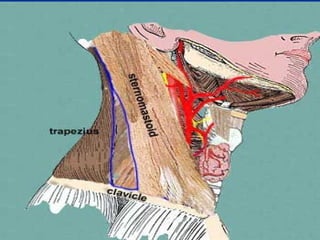
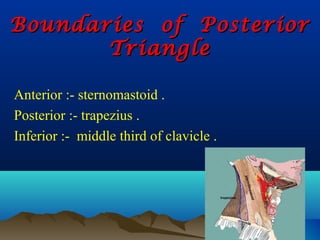
Boundaries of Posterior
       Triangle

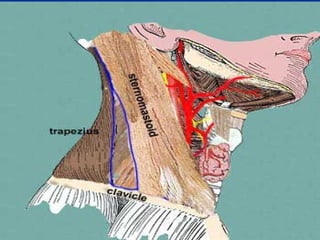
Anterior :- sternomastoid .
Posterior :- trapezius .
Inferior :- middle third of clavicle .
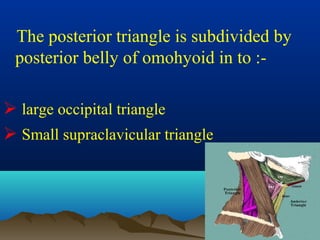
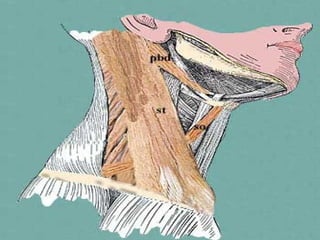
The posterior triangle is subdivided by
 posterior belly of omohyoid in to :-

 large occipital triangle
 Small supraclavicular triangle
Boundaries of Carotid Triangle
CYST
 Means a swelling consisting of a
collection of fluid in a sac which is
lined by epithelium or endothelium
FISTULA

Is an abnormal communication
between two epithelial surface
SINUS
 Is a blind track lined with
granulations leading from an
epithelial surface in to the
surrounding tissues .
ULCER
Is a discontinuity of an epithelial
 surface.
Tumour

Is a new growth of tissue (mass) which can
 refer to an inflammatory or neoplastic growth .

A neoplastic mass is an uncontrolled
proliferation of a clon of cells without useful
function
Diagnosis
Depends on :

 Age of patient .
 Clinical course.
 Site.
 Solid or cystic.
Midline swelling
 Solid swelling :
 Submental lymph node enlargement.
 Nodule in isthmus.
 Cystic swelling :
 Thyroglossal cyst.
 Dermoid cyst.
 Laryngocoele.
 Cyst of thyroid.
 Cold abscess.
Submandibular triangle
           swelling
 Enlarged Submandibular lymph node:
    Multiple
    Rolled over the edge of mandible
    Not felt in the floor of mouth


 Enlarged Submandibular salivary gland
Swelling in the carotid
            triangle
Solid :
 Deep cervical L.Node.
 Enlarge lateral lobe of thyroid gland.
 Carotid body tuomour.

 Cystic:
  Cold abscess.
  Brancheal cyst.
Swelling in the posterior triangle
Solid :
 L.Node enlargement .
 Neurofibroma.
 Cervical rib.
 Cystic:
 Cystic hygroma.
 Cold abscess.
 Pneumatocele.
Others
 Swelling of skin & subcutaneous
 tissues:
 As lipoma .
 Sebaceous cyst .
 haemangioma.
Carotid body tuomour

Rare .
 Slow growing malignant tuomour.
 Arise from the chemoreceptor at the bifurcation of
 carotid artey.
 Usually occur at middle age .
 Usually smooth but may be lobular.
 Move side to side but not vertically.
 Exhibit transmitted pulsation from underlying
 carotid artery.
Thyroglossal duct cyst
The thyroglossal duct cyst

It is a remnant of the diverticulum formed by
migration of thyroid tissue from foramen cecum at
the base of the tongue through the hyoid bone to
its final position around the tracheal cartilage .
The thyroglossal duct cyst


 Failure of subsequent closure and obliteration of this tract
predisposes to thyroglossal cyst formation.

 Is a rare but occasional cause of a benign neck mass.

 Almost always in the midline.
 site:
  20% are suprahyoid.
  15% occur at the hyoid .
  65% are infrahyoid.

 Present by the age of 10 in 50% of cases. but
  may be found in the older population as well.

 No sex predominance .
Racial predominance in whites.

 size:
  It measure about 0.5-5cm in diameter, and
  gradually ↑ in size.

 It is painful if increase in size or became
  infected
 Asymptomatic
 Hot , red & tender if infection present.
 Consistency:
    Firm to hard
 Movement:
   Upward by deglutition, & protrusion
   of the tongue.
 Diagnosis is usually made clinically.
Thyroglossal fistula
Are almost always the result of infection with
spontaneous or surgical drainage.

It can drain internally , externally or both.

 Discharge of mucus & recurrent attack of
inflamation is the clinical finding.
Treatment
 Before thyroglossal duct cysts are excised,
it is important to demonstrate that normally
functioning thyroid tissue is in its usual
location.

Thyroid scans and thyroid function studies
are ordered preoperatively.
Treatment
Total surgical excision (sistrunk procedure)
 including:-
   The cyst and sinus to the base of the tongue.
   Whole fistula.
   Middle third of hyoid bone.
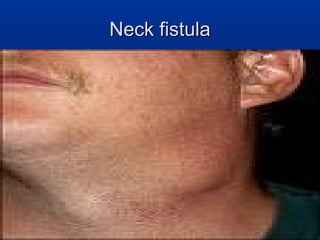
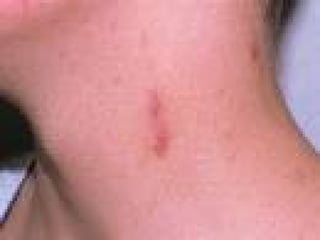
Neck fistula
Cystic hygroma

• Also called (cavernous lymphangioma) .

• It occurs due to sequestration of a portion of a
  jugular lymph sac from lymphatic systems .

• It occupies the lower third of the neck and as it
  enlarges it pass upwards towards the ear.
Cystic hygroma

 Usually it manifests itself during early
  infancy.
 occasionally it is present at birth .
 Exceptionally it is so larges as to obstruct
   labour.
Lymphatic drainage
Lymphatic drainage of head and neck are
particularly important when locating and
working up a "neck mass" or possible
malignancy.
Lymphatic drainage:

 Superficial nodes:
Are few nodes lies superficial to the deep fascia :
1. The anterior cervical node along the anterior jugular vein.
2. The superficial cervical nodes along the external jugular
   vein.
  Deep nodes:
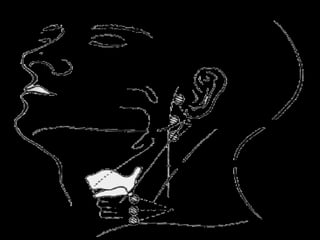
1. Vertical chain.
2. Circular chain.
Vertical chain Deep nodes
 Is closely related to internal jugular vein.

   Types of vertical chains:

1. Superior deep cervical (jugulo-digastric nodes ).
2. Inferior deep cervical (jugulo-omohyoid nodes ).
3. Few nodes in the root of the neck called supraclavicular
   nodes (virchow’s nodes ), (Troisier’s sign).
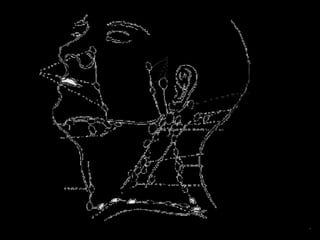
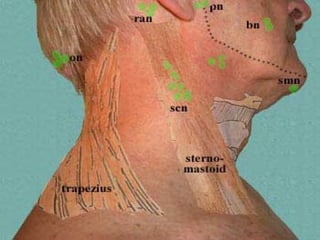
 Circular chain
 Submental nodes .
  Submandibular nodes .
  Buccal or facial nodes .
  Preauricular (parotid ) nodes .
  Posterior auricular nodes .
  Occipital nodes .
  Retropharyngeal , pretracheal nodes .
Neck swelling
Neck swelling
Neck swelling
Neck swelling

Neck swelling

  • 1.
  • 2.
    Neck triangles . Neck tumour. Cyst . Sinus . Fistulas . Ulcer.  Thyroglosal cyst.  Cystic hygroma.  Lymph nodes of the neck.
  • 3.
  • 4.
    Mandible Hyoid bone at the level of C3. Thyroid cartilage at the level of C4-C5 Cricoid cartilage at the level of C6 . Tracheal rings Sternomastoid muscle. Suprasternal notch.
  • 5.
    Anatomy Each sides of the neck is divided by sternomastoid muscle in to two main triangles :- 1. The anterior triangle. 2. The posterior triangle.
  • 7.
  • 8.
    Anterior triangle ofthe neck Boundaries : Anterior border of sternomastoid muscle. The midline. The inferior margin of the mandible
  • 10.
    The anterior triangleis sub divided in to four triangles by  Anterior belly of digastric muscles .  Posterior belly of digastric muscles .  Superior belly of omohyoid
  • 11.
    1. Submentum triangle. 2. Submandibular triangle. 3. Carotid triangle. 4. Muscular triangle.
  • 12.
  • 13.
    The Submental Triangle Boundaries: Anteriorbelly of digastric muscles. The midline . The hyoid bone.
  • 14.
    Triangles of theNeck Anterior Triangle Posterior Triangle • Anterior Triangle of the Neck
  • 15.
    Submandibular triangle Boundaries:  Bodyof mandible.  Antrior belly of digastric muscle.  postrior belly of digastric muscle .
  • 16.
    Triangles of theNeck Anterior Triangle Posterior Triangle • Anterior Triangle of the Neck
  • 17.
  • 19.
    Carotid triangle Boundaries:  Sternomastoidmuscle posteriorly .  Posterior belly of digastric superiorly.  Superior belly of omohyoid antero - inferior .
  • 21.
  • 24.
    Carotid triangle • Veinof the carotid triangle Vein of the carotid triangle
  • 26.
    The muscular triangle Boundaries:  Mid line of neck .  Superior belly of omohyoid superiorly .  Sternomastoid muscle posteriorly .
  • 29.
  • 30.
    Content of anteriortriangles: The thyroid gland.  The submandibular gland.  The carotid sheath.  The deep cervical group of lymph nodes.  The supra and infrahyoid groups of muscles.
  • 31.
  • 32.
    Boundaries of Posterior Triangle Anterior :- sternomastoid . Posterior :- trapezius . Inferior :- middle third of clavicle .
  • 34.
    The posterior triangleis subdivided by posterior belly of omohyoid in to :-  large occipital triangle  Small supraclavicular triangle
  • 35.
  • 36.
    CYST Means aswelling consisting of a collection of fluid in a sac which is lined by epithelium or endothelium
  • 37.
    FISTULA Is an abnormalcommunication between two epithelial surface
  • 38.
    SINUS Is ablind track lined with granulations leading from an epithelial surface in to the surrounding tissues .
  • 39.
    ULCER Is a discontinuityof an epithelial surface.
  • 40.
    Tumour Is a newgrowth of tissue (mass) which can refer to an inflammatory or neoplastic growth . A neoplastic mass is an uncontrolled proliferation of a clon of cells without useful function
  • 41.
    Diagnosis Depends on : Age of patient .  Clinical course.  Site.  Solid or cystic.
  • 42.
    Midline swelling  Solidswelling :  Submental lymph node enlargement.  Nodule in isthmus.  Cystic swelling :  Thyroglossal cyst.  Dermoid cyst.  Laryngocoele.  Cyst of thyroid.  Cold abscess.
  • 43.
    Submandibular triangle swelling  Enlarged Submandibular lymph node: Multiple Rolled over the edge of mandible Not felt in the floor of mouth  Enlarged Submandibular salivary gland
  • 44.
    Swelling in thecarotid triangle Solid :  Deep cervical L.Node.  Enlarge lateral lobe of thyroid gland.  Carotid body tuomour.  Cystic:  Cold abscess.  Brancheal cyst.
  • 45.
    Swelling in theposterior triangle Solid : L.Node enlargement . Neurofibroma. Cervical rib.  Cystic: Cystic hygroma. Cold abscess. Pneumatocele.
  • 46.
    Others Swelling ofskin & subcutaneous tissues:  As lipoma .  Sebaceous cyst .  haemangioma.
  • 47.
    Carotid body tuomour Rare.  Slow growing malignant tuomour.  Arise from the chemoreceptor at the bifurcation of carotid artey.  Usually occur at middle age .  Usually smooth but may be lobular.  Move side to side but not vertically.  Exhibit transmitted pulsation from underlying carotid artery.
  • 48.
  • 49.
    The thyroglossal ductcyst It is a remnant of the diverticulum formed by migration of thyroid tissue from foramen cecum at the base of the tongue through the hyoid bone to its final position around the tracheal cartilage .
  • 50.
    The thyroglossal ductcyst  Failure of subsequent closure and obliteration of this tract predisposes to thyroglossal cyst formation.  Is a rare but occasional cause of a benign neck mass.  Almost always in the midline.
  • 51.
     site: 20% are suprahyoid. 15% occur at the hyoid . 65% are infrahyoid.  Present by the age of 10 in 50% of cases. but may be found in the older population as well.  No sex predominance .
  • 52.
    Racial predominance inwhites.  size: It measure about 0.5-5cm in diameter, and gradually ↑ in size.  It is painful if increase in size or became infected
  • 53.
     Asymptomatic  Hot, red & tender if infection present.  Consistency: Firm to hard  Movement: Upward by deglutition, & protrusion of the tongue.  Diagnosis is usually made clinically.
  • 54.
    Thyroglossal fistula Are almostalways the result of infection with spontaneous or surgical drainage. It can drain internally , externally or both. Discharge of mucus & recurrent attack of inflamation is the clinical finding.
  • 55.
    Treatment  Before thyroglossalduct cysts are excised, it is important to demonstrate that normally functioning thyroid tissue is in its usual location. Thyroid scans and thyroid function studies are ordered preoperatively.
  • 56.
    Treatment Total surgical excision(sistrunk procedure) including:-  The cyst and sinus to the base of the tongue.  Whole fistula.  Middle third of hyoid bone.
  • 57.
  • 59.
    Cystic hygroma • Alsocalled (cavernous lymphangioma) . • It occurs due to sequestration of a portion of a jugular lymph sac from lymphatic systems . • It occupies the lower third of the neck and as it enlarges it pass upwards towards the ear.
  • 60.
    Cystic hygroma  Usuallyit manifests itself during early infancy.  occasionally it is present at birth .  Exceptionally it is so larges as to obstruct labour.
  • 61.
  • 62.
    Lymphatic drainage ofhead and neck are particularly important when locating and working up a "neck mass" or possible malignancy.
  • 63.
    Lymphatic drainage:  Superficialnodes: Are few nodes lies superficial to the deep fascia : 1. The anterior cervical node along the anterior jugular vein. 2. The superficial cervical nodes along the external jugular vein.  Deep nodes: 1. Vertical chain. 2. Circular chain.
  • 64.
  • 65.
     Is closelyrelated to internal jugular vein.  Types of vertical chains: 1. Superior deep cervical (jugulo-digastric nodes ). 2. Inferior deep cervical (jugulo-omohyoid nodes ). 3. Few nodes in the root of the neck called supraclavicular nodes (virchow’s nodes ), (Troisier’s sign).
  • 66.
     Circular chain Submental nodes .  Submandibular nodes .  Buccal or facial nodes .  Preauricular (parotid ) nodes .  Posterior auricular nodes .  Occipital nodes .  Retropharyngeal , pretracheal nodes .