PARANEOPLASTIC
SYNDROMES
Dr. ABHILASH GAVARRAJU
JR-II
Introduction
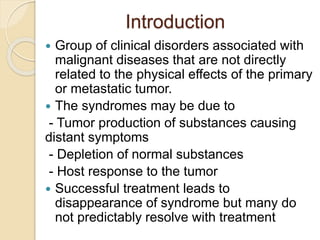
 Group of clinical disorders associated with
malignant diseases that are not directly
related to the physical effects of the primary
or metastatic tumor.
 The syndromes may be due to
- Tumor production of substances causing
distant symptoms
- Depletion of normal substances
- Host response to the tumor
 Successful treatment leads to
disappearance of syndrome but many do
not predictably resolve with treatment
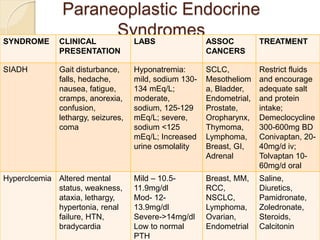
Paraneoplastic Endocrine
SyndromesSYNDROME CLINICAL
PRESENTATION
LABS ASSOC
CANCERS
TREATMENT
SIADH Gait disturbance,
falls, hedache,
nausea, fatigue,
cramps, anorexia,
confusion,
lethargy, seizures,
coma
Hyponatremia:
mild, sodium 130-
134 mEq/L;
moderate,
sodium, 125-129
mEq/L; severe,
sodium <125
mEq/L; Increased
urine osmolality
SCLC,
Mesotheliom
a, Bladder,
Endometrial,
Prostate,
Oropharynx,
Thymoma,
Lymphoma,
Breast, GI,
Adrenal
Restrict fluids
and encourage
adequate salt
and protein
intake;
Demeclocycline
300-600mg BD
Conivaptan, 20-
40mg/d iv;
Tolvaptan 10-
60mg/d oral
Hyperclcemia Altered mental
status, weakness,
ataxia, lethargy,
hypertonia, renal
failure, HTN,
bradycardia
Mild – 10.5-
11.9mg/dl
Mod- 12-
13.9mg/dl
Severe->14mg/dl
Low to normal
PTH
Breast, MM,
RCC,
NSCLC,
Lymphoma,
Ovarian,
Endometrial
Saline,
Diuretics,
Pamidronate,
Zoledronate,
Steroids,
Calcitonin
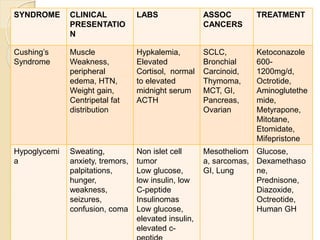
SYNDROME CLINICAL
PRESENTATIO
N
LABS ASSOC
CANCERS
TREATMENT
Cushing’s
Syndrome
Muscle
Weakness,
peripheral
edema, HTN,
Weight gain,
Centripetal fat
distribution
Hypkalemia,
Elevated
Cortisol, normal
to elevated
midnight serum
ACTH
SCLC,
Bronchial
Carcinoid,
Thymoma,
MCT, GI,
Pancreas,
Ovarian
Ketoconazole
600-
1200mg/d,
Octrotide,
Aminoglutethe
mide,
Metyrapone,
Mitotane,
Etomidate,
Mifepristone
Hypoglycemi
a
Sweating,
anxiety, tremors,
palpitations,
hunger,
weakness,
seizures,
confusion, coma
Non islet cell
tumor
Low glucose,
low insulin, low
C-peptide
Insulinomas
Low glucose,
elevated insulin,
elevated c-
Mesotheliom
a, sarcomas,
GI, Lung
Glucose,
Dexamethaso
ne,
Prednisone,
Diazoxide,
Octreotide,
Human GH
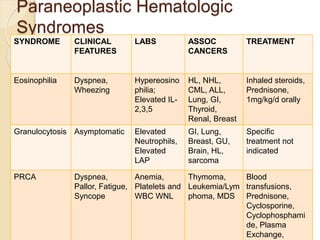
Paraneoplastic Hematologic
Syndromes
SYNDROME CLINICAL
FEATURES
LABS ASSOC
CANCERS
TREATMENT
Eosinophilia Dyspnea,
Wheezing
Hypereosino
philia;
Elevated IL-
2,3,5
HL, NHL,
CML, ALL,
Lung, GI,
Thyroid,
Renal, Breast
Inhaled steroids,
Prednisone,
1mg/kg/d orally
Granulocytosis Asymptomatic Elevated
Neutrophils,
Elevated
LAP
GI, Lung,
Breast, GU,
Brain, HL,
sarcoma
Specific
treatment not
indicated
PRCA Dyspnea,
Pallor, Fatigue,
Syncope
Anemia,
Platelets and
WBC WNL
Thymoma,
Leukemia/Lym
phoma, MDS
Blood
transfusions,
Prednisone,
Cyclosporine,
Cyclophosphami
de, Plasma
Exchange,
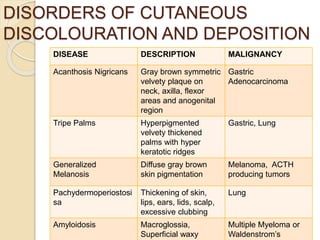
DISORDERS OF CUTANEOUS
DISCOLOURATION AND DEPOSITION
DISEASE DESCRIPTION MALIGNANCY
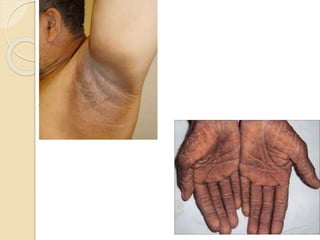
Acanthosis Nigricans Gray brown symmetric
velvety plaque on
neck, axilla, flexor
areas and anogenital
region
Gastric
Adenocarcinoma
Tripe Palms Hyperpigmented
velvety thickened
palms with hyper
keratotic ridges
Gastric, Lung
Generalized
Melanosis
Diffuse gray brown
skin pigmentation
Melanoma, ACTH
producing tumors
Pachydermoperiostosi
sa
Thickening of skin,
lips, ears, lids, scalp,
excessive clubbing
Lung
Amyloidosis Macroglossia,
Superficial waxy
Multiple Myeloma or
Waldenstrom’s
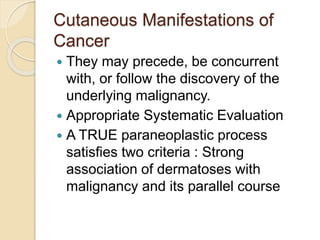
Cutaneous Manifestations of
Cancer
 They may precede, be concurrent
with, or follow the discovery of the
underlying malignancy.
 Appropriate Systematic Evaluation
 A TRUE paraneoplastic process
satisfies two criteria : Strong
association of dermatoses with
malignancy and its parallel course
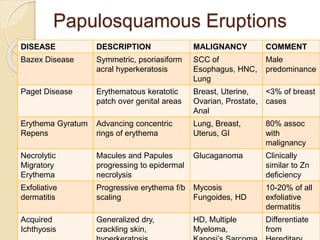
Papulosquamous Eruptions
DISEASE DESCRIPTION MALIGNANCY COMMENT
Bazex Disease Symmetric, psoriasiform
acral hyperkeratosis
SCC of
Esophagus, HNC,
Lung
Male
predominance
Paget Disease Erythematous keratotic
patch over genital areas
Breast, Uterine,
Ovarian, Prostate,
Anal
<3% of breast
cases
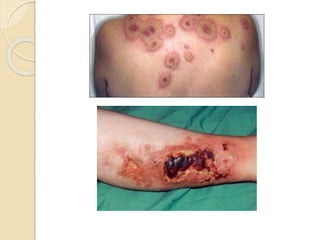
Erythema Gyratum
Repens
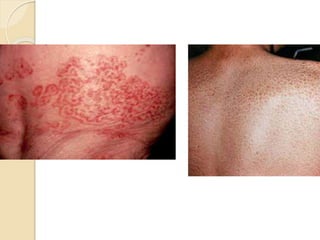
Advancing concentric
rings of erythema
Lung, Breast,
Uterus, GI
80% assoc
with
malignancy
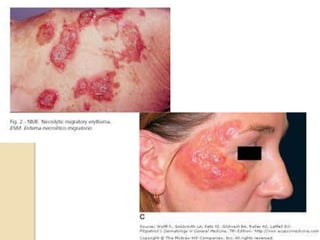
Necrolytic
Migratory
Erythema
Macules and Papules
progressing to epidermal
necrolysis
Glucaganoma Clinically
similar to Zn
deficiency
Exfoliative
dermatitis
Progressive erythema f/b
scaling
Mycosis
Fungoides, HD
10-20% of all
exfoliative
dermatitis
Acquired
Ichthyosis
Generalized dry,
crackling skin,
HD, Multiple
Myeloma,
Differentiate
from
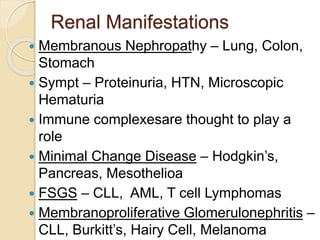
Renal Manifestations
 Membranous Nephropathy – Lung, Colon,
Stomach
 Sympt – Proteinuria, HTN, Microscopic
Hematuria
 Immune complexesare thought to play a
role
 Minimal Change Disease – Hodgkin’s,
Pancreas, Mesothelioa
 FSGS – CLL, AML, T cell Lymphomas
 Membranoproliferative Glomerulonephritis –
CLL, Burkitt’s, Hairy Cell, Melanoma
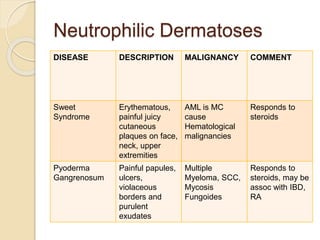
Neutrophilic Dermatoses
DISEASE DESCRIPTION MALIGNANCY COMMENT
Sweet
Syndrome
Erythematous,
painful juicy
cutaneous
plaques on face,
neck, upper
extremities
AML is MC
cause
Hematological
malignancies
Responds to
steroids
Pyoderma
Gangrenosum
Painful papules,
ulcers,
violaceous
borders and
purulent
exudates
Multiple
Myeloma, SCC,
Mycosis
Fungoides
Responds to
steroids, may be
assoc with IBD,
RA
Vascular Abnormalities
 Vasculitis observed in 4.5 – 8%
malignancies.
 NSCLC, SCC of esophagus, Prostate,
Hematological malignancies
 Purpura – Thrombocytopenia, DIC,
vascular injury, vasculitis
 Multifocal migratory thrombophlebitis -
<50 yrs, GI, lung, prostate, ovarian
cancer
 Mondor disease – Cordlike
thrombophlebitis of anterior chest seen
Endocrine and Metabolic
DisordersDISEASE DESCRIPTION MALIGNANCY COMMENT
Systemic Nodular
Panniculitis
Violaceous
Nodules,
Polyarthralgia,
Fever,Eosinophilia
Adenocarcinoma
Pancreas
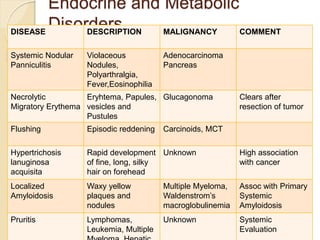
Necrolytic
Migratory Erythema
Eryhtema, Papules,
vesicles and
Pustules
Glucagonoma Clears after
resection of tumor
Flushing Episodic reddening Carcinoids, MCT
Hypertrichosis
lanuginosa
acquisita
Rapid development
of fine, long, silky
hair on forehead
Unknown High association
with cancer
Localized
Amyloidosis
Waxy yellow
plaques and
nodules
Multiple Myeloma,
Waldenstrom’s
macroglobulinemia
Assoc with Primary
Systemic
Amyloidosis
Pruritis Lymphomas,
Leukemia, Multiple
Unknown Systemic
Evaluation
Bullous disorders
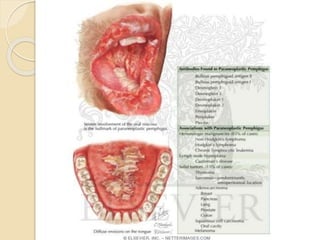
 Paraneoplastic Pemphigus is most frequently
seen in B-cell lymphopriferative disorders in
cluding lymphomas, CLL, Castleman disease,
thymoma, Waldenstrom’s macroglobulinemia and
Spindle cell neoplasms.
 Painful oral stomatitis, conjunctival ulcers and
erosive skin lesions.

 Internal organ involvement is common with 30%
patients having respiratory failure.
 Severe mucosal involvement and pathology
reminiscent of erythema multiforme –
HALLMARK OF PARANEOPLASTIC
PEMPHIGUS
 Rx – Steroids, Cyclosporine, Mycophenolate
mofetil
Collagen Vascular Diseases
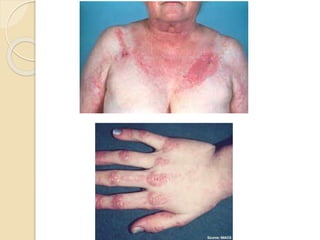
 Dermatomyositis (DM) linked to
malignancy in 25% cases.
 Heliotrope rash of periorbital skin, Shawl
Sign, V neck erythema and Gottron Sign,
proximal muscle weakness.
 MC associated with cancers of
reproductive organs in women (MC
Breast) and Lung, respiratory tract in
both genders.
 Most frequent pattern is onset of cancer
within 1 year of diagnosis of DM.
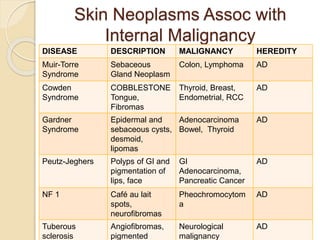
Skin Neoplasms Assoc with
Internal Malignancy
DISEASE DESCRIPTION MALIGNANCY HEREDITY
Muir-Torre
Syndrome
Sebaceous
Gland Neoplasm
Colon, Lymphoma AD
Cowden
Syndrome
COBBLESTONE
Tongue,
Fibromas
Thyroid, Breast,
Endometrial, RCC
AD
Gardner
Syndrome
Epidermal and
sebaceous cysts,
desmoid,
lipomas
Adenocarcinoma
Bowel, Thyroid
AD
Peutz-Jeghers Polyps of GI and
pigmentation of
lips, face
GI
Adenocarcinoma,
Pancreatic Cancer
AD
NF 1 Café au lait
spots,
neurofibromas
Pheochromocytom
a
AD
Tuberous
sclerosis
Angiofibromas,
pigmented
Neurological
malignancy
AD
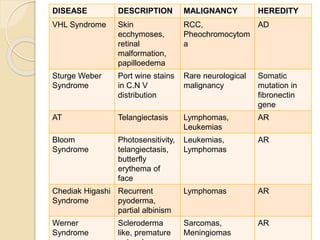
DISEASE DESCRIPTION MALIGNANCY HEREDITY
VHL Syndrome Skin
ecchymoses,
retinal
malformation,
papilloedema
RCC,
Pheochromocytom
a
AD
Sturge Weber
Syndrome
Port wine stains
in C.N V
distribution
Rare neurological
malignancy
Somatic
mutation in
fibronectin
gene
AT Telangiectasis Lymphomas,
Leukemias
AR
Bloom
Syndrome
Photosensitivity,
telangiectasis,
butterfly
erythema of
face
Leukemias,
Lymphomas
AR
Chediak Higashi
Syndrome
Recurrent
pyoderma,
partial albinism
Lymphomas AR
Werner
Syndrome
Scleroderma
like, premature
Sarcomas,
Meningiomas
AR
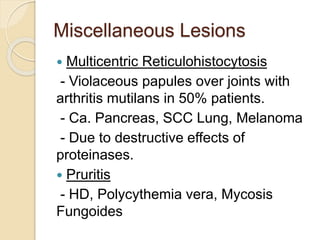
Miscellaneous Lesions
 Multicentric Reticulohistocytosis
- Violaceous papules over joints with
arthritis mutilans in 50% patients.
- Ca. Pancreas, SCC Lung, Melanoma
- Due to destructive effects of
proteinases.
 Pruritis
- HD, Polycythemia vera, Mycosis
Fungoides
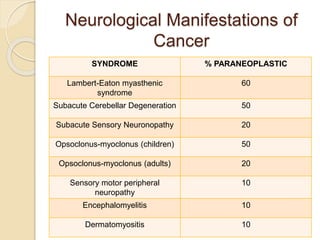
Neurological Manifestations of
Cancer
SYNDROME % PARANEOPLASTIC
Lambert-Eaton myasthenic
syndrome
60
Subacute Cerebellar Degeneration 50
Subacute Sensory Neuronopathy 20
Opsoclonus-myoclonus (children) 50
Opsoclonus-myoclonus (adults) 20
Sensory motor peripheral
neuropathy
10
Encephalomyelitis 10
Dermatomyositis 10
Approach to a patient with
Paraneoplastic Neurological
Disease
 Complete history and Neurological examination
 MRI with and without contrast
 MRI and FDG-PET – Monitor response to
therapy
 PET-CT – Most sensitive to identify occult
tumors
 CSF Examination
 Effective tumor ablation either with surgery or
systemic therapies is more effective then
immunosuppression.
 Immunosuppression with steroids, plasma
exchange, IvIg (frequent choice),
Limbic Encephalitis
 Clinical symptoms range from rapid onset
psychotic symptoms to status epilepticus
 May be mistaken for Herpes Simplex
Encephalitis.
 MRI – Mesial temporal contrast
enhancement or T2 signal hyper intensities.
 CSF – Elevated protein, lymphocytic
pleocytosis.
 SCLC, Testicular Cancer, Breast Cancer,
HL, NHL.
 Treatable forms of CNS Paraneoplasms
 Rx – Treatment of Primary +
Immunosuppression
Autonomic Neuropathy
 25% patients with anti-Hu syndrome
and SSN-EMN have autonomic
dysfunstion
 Usually associated with SCLC
 Autonomic dysfuction may occur in
patients with Myasthenia Gravis
 GI dysmotility is usually a core
complaint with orthostatic hypotension,
hypoventilation, sleep apnea and
cardiac dysrhythmias.
 Treatment may stabilize disease but
usually unable to reverse
Progressive Cerebellar
Degenaration (PCD)
 Difficulty with walking, diplopia,
vertigo, loss of dexterity, dysarthria,
oscillopsia
 CSF – lymphocytic pleocytosis, mild
elevated protein, oligoclonal bands
 Breast Cancer, Ovarian Cancer,
Hodgkin’s Disease
 Antibody negative PCD may occur in
conjunction with Lambert-Eaton
syndrome. MC associated tumor is
Paraneoplastic Visual Loss
 Photoreceptor degeneration causes
night blindness, photopsias, and blurred
vision. Colour perception loss if cones
are involved. ERG is abnormal.
 MC antibody – anti carcinoma
associated retinal antigen antibody;
target antigen is recoverin.
 SCLC, NSCLC, Breast Cancer
 Progressive vision loss with retinal
pigment changes – Melanoma or
Adenocarcinoma of gut
 Melanoma associated retinopathy
Opsoclonus-Myoclonus
 Disorder of ocular motility and
multifocal myoclonus.
 Described in children with
Neuroblastoma
 No one antigen seems to be common
 Anti-Ri  Breast or Gynecological
Cancer
 Paraneoplastic OM without Ri
antibodies assoc with Hodgkin’s
Lymphoma
Paraneoplastic MND
 Separated into three groups in a
series by MSKCC
1. Anti-Hu antibodies
2. Assoc with Breast cancer
3. Assoc with underlying solid tumors
 Patients with HL and NHL also
reported
 Patients present with multifocal motor
weakness
Paraneoplastic Peripheral
Neuropathies
 Subacute sensorimotor neuropathy usually
presents with progressive distal, symmetric
sensory loss and weakness in legs. Lung
Cancer is MC associated
 Nerve Biopsy – Axonal injury and
demyelination
 Can also occur in women with breast cancer.
 Demyelinating neuropathies may respond to
therapy but axonal neuropathies respond
poorly to immunosuppresion
 Acute polyradiculoneuropathy (APN) increased
frequency with Hodgkin’s lymphoma which
responds to plasmapharesis and IvIg.
Contd..
 Secondary amyloidosis may also
cause painful sensorimotor
neuropathy in patients
 Waldenstrom’s – Rx is Fludarabine,
Rituximab, Stem Cell Transplant
 Myeloma – POEMS Syndrome
 Painful mononeuritis multiplex –
SCLC, Prostate, Endometrial,
Lymphoma, RCC
 Inflammatory Brachial Neuritis - HL
Neuromuscular Junction
Disorders
 Typical myasthenia assoc with
Thymoma in 15% cases. All patients
to undergo CT chest to rule out
thymoma.
 Lambert Eaton syndrome assoc with
SCLC – Proximal weakness,
paresthesias, erectile dysfunction;
Most patients benefit from
plasmapharesis and
immunosuppressants
 Augmentation of compound motor
action potential with repetitive
Paraneoplastic Syndrome with
Muscle Rigidity
 Stiff-person syndrome
- stiffness and rigidity in paraspinal and
abdominal muscles
- Breast, HL, Colon
- Antibodies against amphiphysin or glutamic
acid decarboxylase
 Neuromyotonia
- spontaneous and continuous muscle fiber
activity of peripheral origin
- Myasthenia in thymoma, HL, Plasma cell
dyscrasia, SCLC
 Peripheral nerve hyper excitability
disorders
Movement Disorders
 Hyperkinetic syndromes predominate
 Chorea – SCLC, ALL, RCC, HL
 Parkinson’s – extremely rare; reported
in a man with multiple myeloma;
mechanism unclear.
 Hypokinetic parkinsonism like features
reported in testicular seminoma
 Movement disorders also reported in a
patient of B-cell lymphoma.
Paraneoplastic syndromes

Paraneoplastic syndromes

  • 1.
  • 2.
    Introduction  Group ofclinical disorders associated with malignant diseases that are not directly related to the physical effects of the primary or metastatic tumor.  The syndromes may be due to - Tumor production of substances causing distant symptoms - Depletion of normal substances - Host response to the tumor  Successful treatment leads to disappearance of syndrome but many do not predictably resolve with treatment
  • 3.
    Paraneoplastic Endocrine SyndromesSYNDROME CLINICAL PRESENTATION LABSASSOC CANCERS TREATMENT SIADH Gait disturbance, falls, hedache, nausea, fatigue, cramps, anorexia, confusion, lethargy, seizures, coma Hyponatremia: mild, sodium 130- 134 mEq/L; moderate, sodium, 125-129 mEq/L; severe, sodium <125 mEq/L; Increased urine osmolality SCLC, Mesotheliom a, Bladder, Endometrial, Prostate, Oropharynx, Thymoma, Lymphoma, Breast, GI, Adrenal Restrict fluids and encourage adequate salt and protein intake; Demeclocycline 300-600mg BD Conivaptan, 20- 40mg/d iv; Tolvaptan 10- 60mg/d oral Hyperclcemia Altered mental status, weakness, ataxia, lethargy, hypertonia, renal failure, HTN, bradycardia Mild – 10.5- 11.9mg/dl Mod- 12- 13.9mg/dl Severe->14mg/dl Low to normal PTH Breast, MM, RCC, NSCLC, Lymphoma, Ovarian, Endometrial Saline, Diuretics, Pamidronate, Zoledronate, Steroids, Calcitonin
  • 4.
    SYNDROME CLINICAL PRESENTATIO N LABS ASSOC CANCERS TREATMENT Cushing’s Syndrome Muscle Weakness, peripheral edema,HTN, Weight gain, Centripetal fat distribution Hypkalemia, Elevated Cortisol, normal to elevated midnight serum ACTH SCLC, Bronchial Carcinoid, Thymoma, MCT, GI, Pancreas, Ovarian Ketoconazole 600- 1200mg/d, Octrotide, Aminoglutethe mide, Metyrapone, Mitotane, Etomidate, Mifepristone Hypoglycemi a Sweating, anxiety, tremors, palpitations, hunger, weakness, seizures, confusion, coma Non islet cell tumor Low glucose, low insulin, low C-peptide Insulinomas Low glucose, elevated insulin, elevated c- Mesotheliom a, sarcomas, GI, Lung Glucose, Dexamethaso ne, Prednisone, Diazoxide, Octreotide, Human GH
  • 5.
    Paraneoplastic Hematologic Syndromes SYNDROME CLINICAL FEATURES LABSASSOC CANCERS TREATMENT Eosinophilia Dyspnea, Wheezing Hypereosino philia; Elevated IL- 2,3,5 HL, NHL, CML, ALL, Lung, GI, Thyroid, Renal, Breast Inhaled steroids, Prednisone, 1mg/kg/d orally Granulocytosis Asymptomatic Elevated Neutrophils, Elevated LAP GI, Lung, Breast, GU, Brain, HL, sarcoma Specific treatment not indicated PRCA Dyspnea, Pallor, Fatigue, Syncope Anemia, Platelets and WBC WNL Thymoma, Leukemia/Lym phoma, MDS Blood transfusions, Prednisone, Cyclosporine, Cyclophosphami de, Plasma Exchange,
  • 6.
    DISORDERS OF CUTANEOUS DISCOLOURATIONAND DEPOSITION DISEASE DESCRIPTION MALIGNANCY Acanthosis Nigricans Gray brown symmetric velvety plaque on neck, axilla, flexor areas and anogenital region Gastric Adenocarcinoma Tripe Palms Hyperpigmented velvety thickened palms with hyper keratotic ridges Gastric, Lung Generalized Melanosis Diffuse gray brown skin pigmentation Melanoma, ACTH producing tumors Pachydermoperiostosi sa Thickening of skin, lips, ears, lids, scalp, excessive clubbing Lung Amyloidosis Macroglossia, Superficial waxy Multiple Myeloma or Waldenstrom’s
  • 8.
    Cutaneous Manifestations of Cancer They may precede, be concurrent with, or follow the discovery of the underlying malignancy.  Appropriate Systematic Evaluation  A TRUE paraneoplastic process satisfies two criteria : Strong association of dermatoses with malignancy and its parallel course
  • 9.
    Papulosquamous Eruptions DISEASE DESCRIPTIONMALIGNANCY COMMENT Bazex Disease Symmetric, psoriasiform acral hyperkeratosis SCC of Esophagus, HNC, Lung Male predominance Paget Disease Erythematous keratotic patch over genital areas Breast, Uterine, Ovarian, Prostate, Anal <3% of breast cases Erythema Gyratum Repens Advancing concentric rings of erythema Lung, Breast, Uterus, GI 80% assoc with malignancy Necrolytic Migratory Erythema Macules and Papules progressing to epidermal necrolysis Glucaganoma Clinically similar to Zn deficiency Exfoliative dermatitis Progressive erythema f/b scaling Mycosis Fungoides, HD 10-20% of all exfoliative dermatitis Acquired Ichthyosis Generalized dry, crackling skin, HD, Multiple Myeloma, Differentiate from
  • 11.
    Renal Manifestations  MembranousNephropathy – Lung, Colon, Stomach  Sympt – Proteinuria, HTN, Microscopic Hematuria  Immune complexesare thought to play a role  Minimal Change Disease – Hodgkin’s, Pancreas, Mesothelioa  FSGS – CLL, AML, T cell Lymphomas  Membranoproliferative Glomerulonephritis – CLL, Burkitt’s, Hairy Cell, Melanoma
  • 12.
    Neutrophilic Dermatoses DISEASE DESCRIPTIONMALIGNANCY COMMENT Sweet Syndrome Erythematous, painful juicy cutaneous plaques on face, neck, upper extremities AML is MC cause Hematological malignancies Responds to steroids Pyoderma Gangrenosum Painful papules, ulcers, violaceous borders and purulent exudates Multiple Myeloma, SCC, Mycosis Fungoides Responds to steroids, may be assoc with IBD, RA
  • 14.
    Vascular Abnormalities  Vasculitisobserved in 4.5 – 8% malignancies.  NSCLC, SCC of esophagus, Prostate, Hematological malignancies  Purpura – Thrombocytopenia, DIC, vascular injury, vasculitis  Multifocal migratory thrombophlebitis - <50 yrs, GI, lung, prostate, ovarian cancer  Mondor disease – Cordlike thrombophlebitis of anterior chest seen
  • 15.
    Endocrine and Metabolic DisordersDISEASEDESCRIPTION MALIGNANCY COMMENT Systemic Nodular Panniculitis Violaceous Nodules, Polyarthralgia, Fever,Eosinophilia Adenocarcinoma Pancreas Necrolytic Migratory Erythema Eryhtema, Papules, vesicles and Pustules Glucagonoma Clears after resection of tumor Flushing Episodic reddening Carcinoids, MCT Hypertrichosis lanuginosa acquisita Rapid development of fine, long, silky hair on forehead Unknown High association with cancer Localized Amyloidosis Waxy yellow plaques and nodules Multiple Myeloma, Waldenstrom’s macroglobulinemia Assoc with Primary Systemic Amyloidosis Pruritis Lymphomas, Leukemia, Multiple Unknown Systemic Evaluation
  • 17.
    Bullous disorders  ParaneoplasticPemphigus is most frequently seen in B-cell lymphopriferative disorders in cluding lymphomas, CLL, Castleman disease, thymoma, Waldenstrom’s macroglobulinemia and Spindle cell neoplasms.  Painful oral stomatitis, conjunctival ulcers and erosive skin lesions.  Internal organ involvement is common with 30% patients having respiratory failure.  Severe mucosal involvement and pathology reminiscent of erythema multiforme – HALLMARK OF PARANEOPLASTIC PEMPHIGUS  Rx – Steroids, Cyclosporine, Mycophenolate mofetil
  • 19.
    Collagen Vascular Diseases Dermatomyositis (DM) linked to malignancy in 25% cases.  Heliotrope rash of periorbital skin, Shawl Sign, V neck erythema and Gottron Sign, proximal muscle weakness.  MC associated with cancers of reproductive organs in women (MC Breast) and Lung, respiratory tract in both genders.  Most frequent pattern is onset of cancer within 1 year of diagnosis of DM.
  • 21.
    Skin Neoplasms Assocwith Internal Malignancy DISEASE DESCRIPTION MALIGNANCY HEREDITY Muir-Torre Syndrome Sebaceous Gland Neoplasm Colon, Lymphoma AD Cowden Syndrome COBBLESTONE Tongue, Fibromas Thyroid, Breast, Endometrial, RCC AD Gardner Syndrome Epidermal and sebaceous cysts, desmoid, lipomas Adenocarcinoma Bowel, Thyroid AD Peutz-Jeghers Polyps of GI and pigmentation of lips, face GI Adenocarcinoma, Pancreatic Cancer AD NF 1 Café au lait spots, neurofibromas Pheochromocytom a AD Tuberous sclerosis Angiofibromas, pigmented Neurological malignancy AD
  • 22.
    DISEASE DESCRIPTION MALIGNANCYHEREDITY VHL Syndrome Skin ecchymoses, retinal malformation, papilloedema RCC, Pheochromocytom a AD Sturge Weber Syndrome Port wine stains in C.N V distribution Rare neurological malignancy Somatic mutation in fibronectin gene AT Telangiectasis Lymphomas, Leukemias AR Bloom Syndrome Photosensitivity, telangiectasis, butterfly erythema of face Leukemias, Lymphomas AR Chediak Higashi Syndrome Recurrent pyoderma, partial albinism Lymphomas AR Werner Syndrome Scleroderma like, premature Sarcomas, Meningiomas AR
  • 23.
    Miscellaneous Lesions  MulticentricReticulohistocytosis - Violaceous papules over joints with arthritis mutilans in 50% patients. - Ca. Pancreas, SCC Lung, Melanoma - Due to destructive effects of proteinases.  Pruritis - HD, Polycythemia vera, Mycosis Fungoides
  • 24.
    Neurological Manifestations of Cancer SYNDROME% PARANEOPLASTIC Lambert-Eaton myasthenic syndrome 60 Subacute Cerebellar Degeneration 50 Subacute Sensory Neuronopathy 20 Opsoclonus-myoclonus (children) 50 Opsoclonus-myoclonus (adults) 20 Sensory motor peripheral neuropathy 10 Encephalomyelitis 10 Dermatomyositis 10
  • 25.
    Approach to apatient with Paraneoplastic Neurological Disease  Complete history and Neurological examination  MRI with and without contrast  MRI and FDG-PET – Monitor response to therapy  PET-CT – Most sensitive to identify occult tumors  CSF Examination  Effective tumor ablation either with surgery or systemic therapies is more effective then immunosuppression.  Immunosuppression with steroids, plasma exchange, IvIg (frequent choice),
  • 26.
    Limbic Encephalitis  Clinicalsymptoms range from rapid onset psychotic symptoms to status epilepticus  May be mistaken for Herpes Simplex Encephalitis.  MRI – Mesial temporal contrast enhancement or T2 signal hyper intensities.  CSF – Elevated protein, lymphocytic pleocytosis.  SCLC, Testicular Cancer, Breast Cancer, HL, NHL.  Treatable forms of CNS Paraneoplasms  Rx – Treatment of Primary + Immunosuppression
  • 27.
    Autonomic Neuropathy  25%patients with anti-Hu syndrome and SSN-EMN have autonomic dysfunstion  Usually associated with SCLC  Autonomic dysfuction may occur in patients with Myasthenia Gravis  GI dysmotility is usually a core complaint with orthostatic hypotension, hypoventilation, sleep apnea and cardiac dysrhythmias.  Treatment may stabilize disease but usually unable to reverse
  • 28.
    Progressive Cerebellar Degenaration (PCD) Difficulty with walking, diplopia, vertigo, loss of dexterity, dysarthria, oscillopsia  CSF – lymphocytic pleocytosis, mild elevated protein, oligoclonal bands  Breast Cancer, Ovarian Cancer, Hodgkin’s Disease  Antibody negative PCD may occur in conjunction with Lambert-Eaton syndrome. MC associated tumor is
  • 29.
    Paraneoplastic Visual Loss Photoreceptor degeneration causes night blindness, photopsias, and blurred vision. Colour perception loss if cones are involved. ERG is abnormal.  MC antibody – anti carcinoma associated retinal antigen antibody; target antigen is recoverin.  SCLC, NSCLC, Breast Cancer  Progressive vision loss with retinal pigment changes – Melanoma or Adenocarcinoma of gut  Melanoma associated retinopathy
  • 30.
    Opsoclonus-Myoclonus  Disorder ofocular motility and multifocal myoclonus.  Described in children with Neuroblastoma  No one antigen seems to be common  Anti-Ri  Breast or Gynecological Cancer  Paraneoplastic OM without Ri antibodies assoc with Hodgkin’s Lymphoma
  • 31.
    Paraneoplastic MND  Separatedinto three groups in a series by MSKCC 1. Anti-Hu antibodies 2. Assoc with Breast cancer 3. Assoc with underlying solid tumors  Patients with HL and NHL also reported  Patients present with multifocal motor weakness
  • 32.
    Paraneoplastic Peripheral Neuropathies  Subacutesensorimotor neuropathy usually presents with progressive distal, symmetric sensory loss and weakness in legs. Lung Cancer is MC associated  Nerve Biopsy – Axonal injury and demyelination  Can also occur in women with breast cancer.  Demyelinating neuropathies may respond to therapy but axonal neuropathies respond poorly to immunosuppresion  Acute polyradiculoneuropathy (APN) increased frequency with Hodgkin’s lymphoma which responds to plasmapharesis and IvIg.
  • 33.
    Contd..  Secondary amyloidosismay also cause painful sensorimotor neuropathy in patients  Waldenstrom’s – Rx is Fludarabine, Rituximab, Stem Cell Transplant  Myeloma – POEMS Syndrome  Painful mononeuritis multiplex – SCLC, Prostate, Endometrial, Lymphoma, RCC  Inflammatory Brachial Neuritis - HL
  • 34.
    Neuromuscular Junction Disorders  Typicalmyasthenia assoc with Thymoma in 15% cases. All patients to undergo CT chest to rule out thymoma.  Lambert Eaton syndrome assoc with SCLC – Proximal weakness, paresthesias, erectile dysfunction; Most patients benefit from plasmapharesis and immunosuppressants  Augmentation of compound motor action potential with repetitive
  • 35.
    Paraneoplastic Syndrome with MuscleRigidity  Stiff-person syndrome - stiffness and rigidity in paraspinal and abdominal muscles - Breast, HL, Colon - Antibodies against amphiphysin or glutamic acid decarboxylase  Neuromyotonia - spontaneous and continuous muscle fiber activity of peripheral origin - Myasthenia in thymoma, HL, Plasma cell dyscrasia, SCLC  Peripheral nerve hyper excitability disorders
  • 36.
    Movement Disorders  Hyperkineticsyndromes predominate  Chorea – SCLC, ALL, RCC, HL  Parkinson’s – extremely rare; reported in a man with multiple myeloma; mechanism unclear.  Hypokinetic parkinsonism like features reported in testicular seminoma  Movement disorders also reported in a patient of B-cell lymphoma.