The examination consists of three portions:
 Inspection,

 Palpation, and
 Synthesis of data from these techniques
AGE:

Puberty- simple goitre,papillary
    carcinoma,

Middle age- multinodular goitre,colloid goitre,
follicular carcinoma.

Old age- Anaplastic carcinoma
SEX:
Simple goitre is more common in Females
  thyrotoxicosis is 8 times more common in females.
  Thyroid carcinoma is more often seen in females
  3:1.

OCCUPATION:
Thyrotoxicosis is common in people working under
  stress and strain.
.
RESIDENCE:
Goitre belts in india like Himalayas, Vindyas,
  Satpuda ranges. Areas producing chalk or lime
  stone like Derbyshire
SWELLING;

DURATION;

 ASSOCIATED PAIN;
1.DESCRIBE IN DETAILS ONSET AND
  PROGRESSION OF THE SWELLING,

2.PRESSURE EFFECTS;

3.SYMPOTOMS OF HYPOTHYROIDISM

4.SYMPOTOMS OF HYPERTHYROIDISM;

5.SYMPTOMS OF MALIGANANCY.
   Tilt the patients head back a bit

   Use tangential lighting from the tip of the
    patients chin

   Ask for swallowing

   Observe the thyroid cartilage, cricoid cartilage
    and the thyroid gland raising with swallowing
Inspection: Anterior Approach
   The patient should be seated or standing in a
    comfortable position with the neck in a neutral or
    slightly extended position.
   Cross-lighting increases shadows, improving the
    detection of masses.
   To enhance visualization of the thyroid, you can:
      Extending the neck, which stretches overlying
        tissues
      Have the patient swallow a sip of water, watching
        for the upward movement of the thyroid gland.
Inspection: Lateral Approach
 After completing anterior inspection of the
  thyroid, observe the neck from the side.
 Estimate the smooth, straight contour from
  the cricoid cartilage to the suprasternal notch.
 Measure any prominence beyond this
  imagined contour, using a ruler placed in the
  area of prominence.
•   Size : ……X………..
•   Shape : Ovoid / Spherical / Irregular
•   Location: One side / mid line / both sides of
    mid line
•   Extent: Horizontal from Sternomastoid…
    Vertical from Suprasternal Notch…
    The swelling is: Under Sternomastoid / Not
    under sternum
•   Surface: Smooth / Nodular / Bosselated
•   Skin over the swelling:Redness and edema, Scars
    of previous surgery, Sinuses, Dilated veins

•   Pulsatility : Present / Absent

•   Movement with Deglutition: Present / Absent

•   Protrusion of Tongue (For midline swellings):
    Present / Absent
Do not press to
much the thyroid


You can loose the
sensitivity of your
fingers


Try     to     not
strangle      your
patient
The following information could be obtained

   volume
   consistency
   mobility             of the thyroid gland
   surface
   temperature
   Palpate the thyroid gland from behind

   Localize anatomic boundaries

   Thyroid isthmus is often palpable

   Thyroid lobes are barely or not palpable

   The consistency is rubbery, similar to that of sternomastoid
    muscle
 Temperature: Normal / Raised
 Tenderness : Present / Absent

 Size: … X …

 Shape: Ovoid / Spherical / Irregular

 Extent: Horizontal from Sternomastoid…
  Vertical from Suprasternal Notch…
 Plane of the swelling : Under Sternomastoid /
  Under Strap muscles/ Deep to deep fascia.
A) In case of affection of entire gland,
• i) Surface : Smooth / Bosselated
• ii) Consistency : Uniform (Soft / Firm / Hard) /
  Variable
• iii) Retrosternal Extension : Present / Absent

B)In case of Single Nodule Or One Lobe affection
• i) Location : Lobe / Isthmus
• ii)Consistency: Soft / Firm
• iii) Is the rest of the gland palpable ? Yes / No
•   Stand behind the pt.

•   Place your hands around the neck with the thumbs over the
    occiput and tips of the other fingers over the front of the neck.

•   Flex the neck to relax deep cervical fascia.

•   Ask the pt to swallow to look for lower border and nodules.

•   To palpate anterior surface, incline the head to the side being
    examined to relax overlying sternomastoid muscle.
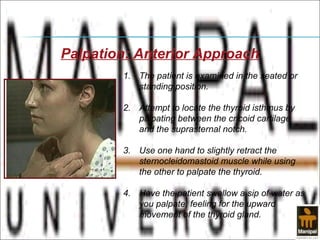
Palpation: Anterior Approach
        1. The patient is examined in the seated or
           standing position.

        2. Attempt to locate the thyroid isthmus by
           palpating between the cricoid cartilage
           and the suprasternal notch.

        3. Use one hand to slightly retract the
           sternocleidomastoid muscle while using
           the other to palpate the thyroid.

        4. Have the patient swallow a sip of water as
           you palpate, feeling for the upward
           movement of the thyroid gland.
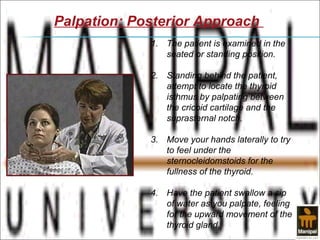
Palpation: Posterior Approach
             1. The patient is examined in the
                seated or standing position.

             2. Standing behind the patient,
                attempt to locate the thyroid
                isthmus by palpating between
                the cricoid cartilage and the
                suprasternal notch.

             3. Move your hands laterally to try
                to feel under the
                sternocleidomstoids for the
                fullness of the thyroid.

             4. Have the patient swallow a sip
                of water as you palpate, feeling
                for the upward movement of the
                thyroid gland.
   Stand in front of the patient.
   Extend the neck slightly.
   Keep a thumb over the lobe to be examined.
   Ask the pt to swallow. Feel for small nodules.
•   In short and flat neck ————Pizillo’s Method
    makes gland prominent
•   Ask pt to clasp his hands over the occiput
•    Push the head backwards against the resistance
    of the clasped hand
    Done to palpate deep or postero medial surface
    of the gland.
    Stand in front of the patient.
    Extend the neck slightly.
    Push the thyroid gland laterally to displace it
    from tracheo esophageal groove.
    Palpate the posterior surface for nodules with
    other hand.
•    Done in large, bilateral goiter to rule out tracheal
    narrowing.
•    Extend the neck.
•    Ask the patient to take deep breaths through the
    mouth.
•    Compress the swelling from both the sides.
•   Appearance of stridor with slight compression of
    lateral lobes due to Narrowing of trachea ( Scabbard
    trachea).it is seen in case of large and longstanding
    multinodular goiter and Ca thyroid infiltrating
    trachea.
   Lahey’s Method of Palpation of Thyroid: Nodules
    Present / Absent,If present consistency of nodule
   Crile’s Method of Palpation of Thyroid: Nodules
    Present / Absent
   Palpabale Thrill : Present / Absent
   Fixity to skin : Fixed / Not Fixed
   Mobility : Horizontally Mobile / Fixed ;Vertically
    Mobile / Fixed
   Palpation of Trachea : Palpable / Not Palpable,
    Deviated / Not deviated
   Kocher’s Test : Positive / Negative
   Palpation of carotids : Berry’s Sign Positive / Negative
Percussion over sternum : Resonant / Dull


Ascultaion of gland : where to ascultate?   Lower
  pole or Upper pole? why?
  Hoarseness of voice : Present / Absent
 Edema of face and legs: Present / Absent

 Delayed relaxation of deep reflexes : Ankle
  jerk ,Knee jerk
 History of lethargy: Present / Absent
    Dilated veins : Present / Absent
    Congestion and puffiness of face: Present / Absent
    Palpate for tracheal rings: Present / Absent
    Percuss over sternum: Resonant / Dull
    Pemberton’s sign: Positive / Negative
    Horners syndrome: (Ptosis,Constricted pupil,
    Enophthalmos, Absent cilio-spinal reflex, Anhydrosis)
    : Present / Absent
   Eye signs
   Lid retraction : Dalrymple’s sign : Present / Absent
   Lid lag : Von Graeffe’s sign: Present / Absent
   Incomplete, infrequent blinking: Stellwag’s sign : Present /
    Absent
   Exophthalmos : strip of sclera under inf limbus: Present /
    Absent
   Naffziger’s Method : Present / Absent
   Wrinkling of forehead : Joffroy’s sign : Present / Absent
   Eversion of upper eye lid : Gifford’s sign: Positive / Negative
   Convergence : Mobius’ sign : Present / Absent
   Chemosis: Congestion and edema of conjunctiva,
   Corneal ulcers, diminished vision , Ophthalmoplegia
  To note the amount and the degree of
  exophthalmos.
 Stand behind the patient.

 See from above.

 Observe the eyes in supraorbital plane,if corneal
  limbus is visible then it is exophthalmos.
 Tremors : Outstretched Hand : Present / Absent
 Protruded tongue: Present / Absent

 Tachycardia : Heart rate = …. Bounding pulse:
  Present / Absent
 Warm and moist skin : Present / Absent

 Pretibial Myxoedema : Present / Absent

 Bruit, Thrill: Present / Absent
 Neck : Enlarged and hard lymph nodes.
 Skull surface : Hard nodules.

 Long bones : Deformity and tenderness.

 Chest : Effusion and consolidation.

 Abdomen : Nodular Liver and ascites.
 Berry’s sign: Palpate the Carotid pulsations
  against the transverse process of the 6th cervical
  vertebra b/w post border of thyroid and
  sternomastiod.
 In Ca thyroid, Carotid pulsations is weak or
  absent. Due to Infiltration of carotid sheath .
 In benign goiter pulsations are well felt as carotid
  sheath pushed backwards.
Thyroid gland

Thyroid gland

  • 2.
    The examination consistsof three portions:  Inspection,  Palpation, and  Synthesis of data from these techniques
  • 3.
    AGE: Puberty- simple goitre,papillary carcinoma, Middle age- multinodular goitre,colloid goitre, follicular carcinoma. Old age- Anaplastic carcinoma
  • 4.
    SEX: Simple goitre ismore common in Females thyrotoxicosis is 8 times more common in females. Thyroid carcinoma is more often seen in females 3:1. OCCUPATION: Thyrotoxicosis is common in people working under stress and strain. .
  • 5.
    RESIDENCE: Goitre belts inindia like Himalayas, Vindyas, Satpuda ranges. Areas producing chalk or lime stone like Derbyshire
  • 6.
  • 7.
    1.DESCRIBE IN DETAILSONSET AND PROGRESSION OF THE SWELLING, 2.PRESSURE EFFECTS; 3.SYMPOTOMS OF HYPOTHYROIDISM 4.SYMPOTOMS OF HYPERTHYROIDISM; 5.SYMPTOMS OF MALIGANANCY.
  • 8.
    Tilt the patients head back a bit  Use tangential lighting from the tip of the patients chin  Ask for swallowing  Observe the thyroid cartilage, cricoid cartilage and the thyroid gland raising with swallowing
  • 9.
    Inspection: Anterior Approach  The patient should be seated or standing in a comfortable position with the neck in a neutral or slightly extended position.  Cross-lighting increases shadows, improving the detection of masses.  To enhance visualization of the thyroid, you can:  Extending the neck, which stretches overlying tissues  Have the patient swallow a sip of water, watching for the upward movement of the thyroid gland.
  • 10.
    Inspection: Lateral Approach After completing anterior inspection of the thyroid, observe the neck from the side.  Estimate the smooth, straight contour from the cricoid cartilage to the suprasternal notch.  Measure any prominence beyond this imagined contour, using a ruler placed in the area of prominence.
  • 11.
    Size : ……X……….. • Shape : Ovoid / Spherical / Irregular • Location: One side / mid line / both sides of mid line • Extent: Horizontal from Sternomastoid… Vertical from Suprasternal Notch… The swelling is: Under Sternomastoid / Not under sternum • Surface: Smooth / Nodular / Bosselated
  • 12.
    Skin over the swelling:Redness and edema, Scars of previous surgery, Sinuses, Dilated veins • Pulsatility : Present / Absent • Movement with Deglutition: Present / Absent • Protrusion of Tongue (For midline swellings): Present / Absent
  • 13.
    Do not pressto much the thyroid You can loose the sensitivity of your fingers Try to not strangle your patient
  • 14.
    The following informationcould be obtained  volume  consistency  mobility of the thyroid gland  surface  temperature
  • 15.
    Palpate the thyroid gland from behind  Localize anatomic boundaries  Thyroid isthmus is often palpable  Thyroid lobes are barely or not palpable  The consistency is rubbery, similar to that of sternomastoid muscle
  • 16.
     Temperature: Normal/ Raised  Tenderness : Present / Absent  Size: … X …  Shape: Ovoid / Spherical / Irregular  Extent: Horizontal from Sternomastoid… Vertical from Suprasternal Notch…  Plane of the swelling : Under Sternomastoid / Under Strap muscles/ Deep to deep fascia.
  • 17.
    A) In caseof affection of entire gland, • i) Surface : Smooth / Bosselated • ii) Consistency : Uniform (Soft / Firm / Hard) / Variable • iii) Retrosternal Extension : Present / Absent B)In case of Single Nodule Or One Lobe affection • i) Location : Lobe / Isthmus • ii)Consistency: Soft / Firm • iii) Is the rest of the gland palpable ? Yes / No
  • 18.
    Stand behind the pt. • Place your hands around the neck with the thumbs over the occiput and tips of the other fingers over the front of the neck. • Flex the neck to relax deep cervical fascia. • Ask the pt to swallow to look for lower border and nodules. • To palpate anterior surface, incline the head to the side being examined to relax overlying sternomastoid muscle.
  • 19.
    Palpation: Anterior Approach 1. The patient is examined in the seated or standing position. 2. Attempt to locate the thyroid isthmus by palpating between the cricoid cartilage and the suprasternal notch. 3. Use one hand to slightly retract the sternocleidomastoid muscle while using the other to palpate the thyroid. 4. Have the patient swallow a sip of water as you palpate, feeling for the upward movement of the thyroid gland.
  • 20.
    Palpation: Posterior Approach 1. The patient is examined in the seated or standing position. 2. Standing behind the patient, attempt to locate the thyroid isthmus by palpating between the cricoid cartilage and the suprasternal notch. 3. Move your hands laterally to try to feel under the sternocleidomstoids for the fullness of the thyroid. 4. Have the patient swallow a sip of water as you palpate, feeling for the upward movement of the thyroid gland.
  • 21.
    Stand in front of the patient.  Extend the neck slightly.  Keep a thumb over the lobe to be examined.  Ask the pt to swallow. Feel for small nodules.
  • 22.
    In short and flat neck ————Pizillo’s Method makes gland prominent • Ask pt to clasp his hands over the occiput • Push the head backwards against the resistance of the clasped hand
  • 23.
    Done to palpate deep or postero medial surface of the gland.  Stand in front of the patient.  Extend the neck slightly.  Push the thyroid gland laterally to displace it from tracheo esophageal groove.  Palpate the posterior surface for nodules with other hand.
  • 24.
    Done in large, bilateral goiter to rule out tracheal narrowing. • Extend the neck. • Ask the patient to take deep breaths through the mouth. • Compress the swelling from both the sides. • Appearance of stridor with slight compression of lateral lobes due to Narrowing of trachea ( Scabbard trachea).it is seen in case of large and longstanding multinodular goiter and Ca thyroid infiltrating trachea.
  • 25.
    Lahey’s Method of Palpation of Thyroid: Nodules Present / Absent,If present consistency of nodule  Crile’s Method of Palpation of Thyroid: Nodules Present / Absent  Palpabale Thrill : Present / Absent  Fixity to skin : Fixed / Not Fixed  Mobility : Horizontally Mobile / Fixed ;Vertically Mobile / Fixed  Palpation of Trachea : Palpable / Not Palpable, Deviated / Not deviated  Kocher’s Test : Positive / Negative  Palpation of carotids : Berry’s Sign Positive / Negative
  • 26.
    Percussion over sternum: Resonant / Dull Ascultaion of gland : where to ascultate? Lower pole or Upper pole? why?
  • 27.
     Hoarsenessof voice : Present / Absent  Edema of face and legs: Present / Absent  Delayed relaxation of deep reflexes : Ankle jerk ,Knee jerk  History of lethargy: Present / Absent
  • 28.
    Dilated veins : Present / Absent  Congestion and puffiness of face: Present / Absent  Palpate for tracheal rings: Present / Absent  Percuss over sternum: Resonant / Dull  Pemberton’s sign: Positive / Negative  Horners syndrome: (Ptosis,Constricted pupil, Enophthalmos, Absent cilio-spinal reflex, Anhydrosis) : Present / Absent
  • 29.
    Eye signs  Lid retraction : Dalrymple’s sign : Present / Absent  Lid lag : Von Graeffe’s sign: Present / Absent  Incomplete, infrequent blinking: Stellwag’s sign : Present / Absent  Exophthalmos : strip of sclera under inf limbus: Present / Absent  Naffziger’s Method : Present / Absent  Wrinkling of forehead : Joffroy’s sign : Present / Absent  Eversion of upper eye lid : Gifford’s sign: Positive / Negative  Convergence : Mobius’ sign : Present / Absent  Chemosis: Congestion and edema of conjunctiva,  Corneal ulcers, diminished vision , Ophthalmoplegia
  • 30.
     Tonote the amount and the degree of exophthalmos.  Stand behind the patient.  See from above.  Observe the eyes in supraorbital plane,if corneal limbus is visible then it is exophthalmos.
  • 31.
     Tremors :Outstretched Hand : Present / Absent  Protruded tongue: Present / Absent  Tachycardia : Heart rate = …. Bounding pulse: Present / Absent  Warm and moist skin : Present / Absent  Pretibial Myxoedema : Present / Absent  Bruit, Thrill: Present / Absent
  • 32.
     Neck :Enlarged and hard lymph nodes.  Skull surface : Hard nodules.  Long bones : Deformity and tenderness.  Chest : Effusion and consolidation.  Abdomen : Nodular Liver and ascites.
  • 33.
     Berry’s sign:Palpate the Carotid pulsations against the transverse process of the 6th cervical vertebra b/w post border of thyroid and sternomastiod.  In Ca thyroid, Carotid pulsations is weak or absent. Due to Infiltration of carotid sheath .  In benign goiter pulsations are well felt as carotid sheath pushed backwards.