Thyroid Examination
Sana Rasheed
Akhtar Saeed Medical and Dental College
ANATOMY
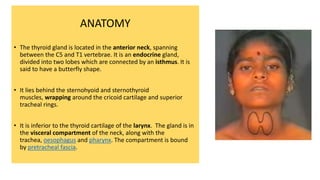
• The thyroid gland is located in the anterior neck, spanning
between the C5 and T1 vertebrae. It is an endocrine gland,
divided into two lobes which are connected by an isthmus. It is
said to have a butterfly shape.
• It lies behind the sternohyoid and sternothyroid
muscles, wrapping around the cricoid cartilage and superior
tracheal rings.
• It is inferior to the thyroid cartilage of the larynx. The gland is in
the visceral compartment of the neck, along with the
trachea, oesophagus and pharynx. The compartment is bound
by pretracheal fascia.
Greetings
Always do the following steps before proceeding towards the examination.
1. Greetings
2. Introduce yourself and also ask the name of patient
3. Consent
4. Privacy – ask for female attendant or chaperon
5. Exposure of patient ( Dupatta off )
Proceed towards General Examination and Relevant History.
General Appearance:
May be caused by Thyroid neoplasms
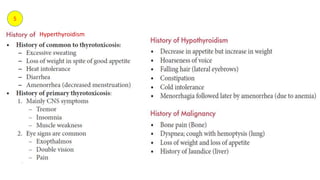
Relevant questions to be asked?
About anti thyroid medication
1
2
3
(Gargarahat)
Awaz ka beth jana
4
5
Hyperthyroidism
1st Step : Inspection
• Examination of thyroid should be done in 3 positions.
• i. Front
• ii. Back
• iii. Front
I. EXAMINATION FROM FRONT
Make the patient sit comfortably on a stool and inspect the thyroid with neck
slightly hyperextended and inspect the thyroid from the front.
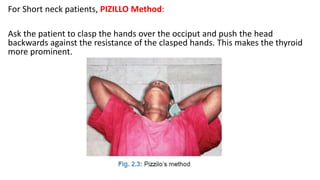
For Short neck patients, PIZILLO Method:
Ask the patient to clasp the hands over the occiput and push the head
backwards against the resistance of the clasped hands. This makes the thyroid
more prominent.
1. First, notice shape of the swelling, and it’s situation.
2. Shape Oval/globular/spherical pear or irregular – diffuse or localised
3. Location Whether it is on one side of the midline, IN the midline, or it
extends on both the sides.
One side of Midline
In the midline
Extends on both sides of midline
Now notice the EXTENT of the swelling.
Particularly the lateral border in relation
to sternomastoid.
And the lower border in relation to the
suprasternal notch of the sternum
A thyroid swelling always lies deep to the
sternomastoid muscles.
Demonstrated by contracting the sternomastoids.
Then note whether the lower border ends above the
suprasternal notch or it extends behind the suprasternal
notch.
Both the borders are to be appreciated.
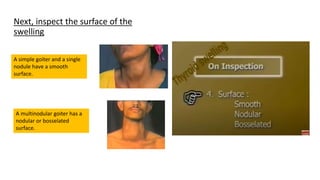
Next, inspect the surface of the
swelling
A simple goiter and a single
nodule have a smooth
surface.
A multinodular goiter has a
nodular or bosselated
surface.
Then, Inspect the Skin over the swelling.
1. Redness and edema : suggestive of
inflammation
2. Scars of previous surgery
3. Sinuses
4. Dilated veins
5. Pigmentation/ulceration
• A scar from previous thyroid surgery tells us this is a recurrent thyroid swelling
• A sinus in middle of the neck may discharge mucus like fluid is thyroglossal fistula
Pulsatility : watch the swelling
for a few seconds quietly for
pulsatility. Pulsatility shows
presence of an artery.
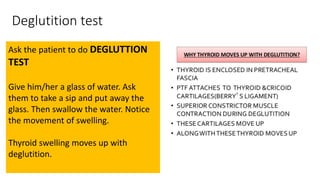
Deglutition test
Ask the patient to do DEGLUTTION
TEST
Give him/her a glass of water. Ask
them to take a sip and put away the
glass. Then swallow the water. Notice
the movement of swelling.
Thyroid swelling moves up with
deglutition.
• Other Swellings that move up on
degluttition
A swelling that is not attached to the pretracheal fascia like
LIPOMA will not move upwards during deglutition
Thyroid cartilage may move upward but not the swelling
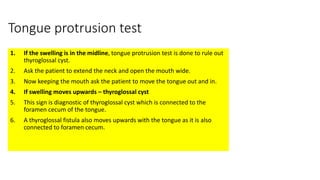
Tongue protrusion test
1. If the swelling is in the midline, tongue protrusion test is done to rule out
thyroglossal cyst.
2. Ask the patient to extend the neck and open the mouth wide.
3. Now keeping the mouth ask the patient to move the tongue out and in.
4. If swelling moves upwards – thyroglossal cyst
5. This sign is diagnostic of thyroglossal cyst which is connected to the
foramen cecum of the tongue.
6. A thyroglossal fistula also moves upwards with the tongue as it is also
connected to foramen cecum.
Pemberton sign: to diagnose retrosternal goiter compression:
••Raise both arm over head, until they touch the ears
••Maintain the position for a while
••Congestion of face and distress occurs due to obstruction of great veins
of thorax
Facial flushing seen
PAMBERTON’S SIGN for retrosternal goiter.
Retrosternal goiter
Multinodular goiter can become so much enlarged resulting in the
extension of the enlarged gland into the thoracic region and can
cause Superior Vena Cava compression Dilatation of subcutaneous
veins over anterior part of upper thorax.
PALPATION
Let the patient sit in comfortable
position seating with neck extended.
Ask for consent.
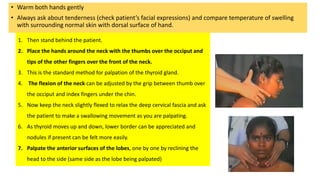
• Warm both hands gently
• Always ask about tenderness (check patient’s facial expressions) and compare temperature of swelling
with surrounding normal skin with dorsal surface of hand.
1. Then stand behind the patient.
2. Place the hands around the neck with the thumbs over the occiput and
tips of the other fingers over the front of the neck.
3. This is the standard method for palpation of the thyroid gland.
4. The flexion of the neck can be adjusted by the grip between thumb over
the occiput and index fingers under the chin.
5. Now keep the neck slightly flexed to relax the deep cervical fascia and ask
the patient to make a swallowing movement as you are palpating.
6. As thyroid moves up and down, lower border can be appreciated and
nodules if present can be felt more easily.
7. Palpate the anterior surfaces of the lobes, one by one by reclining the
head to the side (same side as the lobe being palpated)
Check:
PALPATE TRACHEA AND CAROTID PALPATIONS
1. To palpate the trachea, first note position of the larynx
then palpate the trachea downwards.
2. May be easy to appreciate its displacement to opp.
Side in unilateral goiter.
3. In bilateral goiter, trachea may not be palpable. So
first note the position of the larynx, and the position
of the trachea over the suprasternal notch.
• Palpate tracheal rings in the suprasternal notch. If they are not present,
retrosternal extension is suspected.
LAHEY’S METHOD for deep surface of the gland
Now stand in front of the patient.
Extend the neck slightly
To palpate right lobe push the right lobe with your right hand to right side and
palpate with left hand.
Repeat on left side.
Crile’s method for palpation of small nodules
Place the thumb on the thyroid while the patient
swallows; this method is used to diagnose doubtful
nodules
• Fixity to skin Pinch the skin over
the swelling to look for fixity to
skin and (fixity suggests
malignant infiltration)
• Test the mobility of the skin in
vertical and horizontal direction.
Kocher’s test (for scabbered trachea)
• To rule out tracheal narrowing.
• Ask the patient to extend neck and take
deep breaths.
• Compress swelling from both sides.
• Stridor on compression of lateral lobes
indicates narrowing of the trachea.
• It may also be seen in a malignant thyroid
infiltrating the trachea.
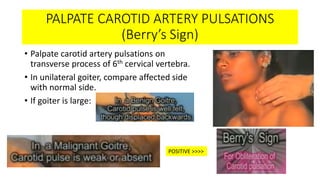
PALPATE CAROTID ARTERY PULSATIONS
(Berry’s Sign)
• Palpate carotid artery pulsations on
transverse process of 6th cervical vertebra.
• In unilateral goiter, compare affected side
with normal side.
• If goiter is large:
POSITIVE >>>>
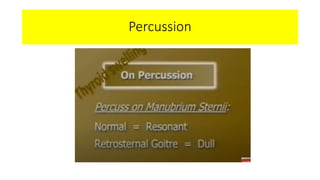
Percussion
Auscultate for carotid and thyroid bruit
Bruit – increased vascularity
SIGNS OF THYROTOXICOSIS
Features of Primary Thyrotoxicosis
1. Eye signs
2. Tachycardia
3. Tremors
4. Moist skin
5. Thyroid bruit
EYE SIGNS
• Lid retraction –Stellwag’s sign - upper lid raised & lower lid normal --
Starring look with infrequent blinking and wide palpebral fissures.
• von Graefe’s sign - Lid lag sign. Tested by asking the patient to look up
and down many times fixing the
EYE SIGNS
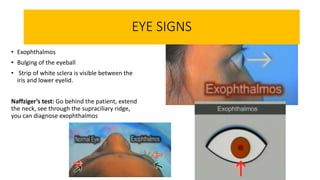
• Exophthalmos
• Bulging of the eyeball
• Strip of white sclera is visible between the
iris and lower eyelid.
Naffziger’s test: Go behind the patient, extend
the neck, see through the supraciliary ridge,
you can diagnose exophthalmos
EYE SIGNS
• Joffroy’s sign - Absence of wrinkling of forehead. The patient looks
the roof of the room without forehead wrinkling.
• MÖbius sign - Inability to converge the eyeball.
• Jellinek’s sign - Increased pigmentation of eyelids.
• Check for pretibial myxedema- hypothyroidism
EYE SIGNS
Ophthalmoplegia (malignant exophthalmos)
• – Weakness of ocular muscles due to edema and cellular infiltration of
these muscles.
• – Paralysis of superior rectus, inferior oblique and lateral rectus.
• – On paralysis of these muscles, patient is unable to look upwards and
outwards.
EYE SIGNS
Chemosis
– Due to obstruction of venous and
lymphatic drainage of conjunctiva by
increased retro-orbital pressure.
EYE SIGNS
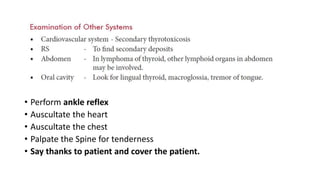
• Perform ankle reflex
• Auscultate the heart
• Auscultate the chest
• Palpate the Spine for tenderness
• Say thanks to patient and cover the patient.
References
• Dr Muhammad Shahid Mehmood – Akhtar Saeed Medical and Dental
College.
• https://teachmeanatomy.info/
• Dr Ghanshyam Vaidya - Youtube
• Long Cases in GENERAL SURGERY - R Rajamahendran

Thyroid Examination - General Surgery

  • 1.
    Thyroid Examination Sana Rasheed AkhtarSaeed Medical and Dental College
  • 2.
    ANATOMY • The thyroidgland is located in the anterior neck, spanning between the C5 and T1 vertebrae. It is an endocrine gland, divided into two lobes which are connected by an isthmus. It is said to have a butterfly shape. • It lies behind the sternohyoid and sternothyroid muscles, wrapping around the cricoid cartilage and superior tracheal rings. • It is inferior to the thyroid cartilage of the larynx. The gland is in the visceral compartment of the neck, along with the trachea, oesophagus and pharynx. The compartment is bound by pretracheal fascia.
  • 3.
    Greetings Always do thefollowing steps before proceeding towards the examination. 1. Greetings 2. Introduce yourself and also ask the name of patient 3. Consent 4. Privacy – ask for female attendant or chaperon 5. Exposure of patient ( Dupatta off ) Proceed towards General Examination and Relevant History.
  • 4.
  • 5.
    May be causedby Thyroid neoplasms Relevant questions to be asked? About anti thyroid medication 1 2 3 (Gargarahat) Awaz ka beth jana 4
  • 6.
  • 7.
    1st Step :Inspection • Examination of thyroid should be done in 3 positions. • i. Front • ii. Back • iii. Front I. EXAMINATION FROM FRONT Make the patient sit comfortably on a stool and inspect the thyroid with neck slightly hyperextended and inspect the thyroid from the front.
  • 8.
    For Short neckpatients, PIZILLO Method: Ask the patient to clasp the hands over the occiput and push the head backwards against the resistance of the clasped hands. This makes the thyroid more prominent.
  • 9.
    1. First, noticeshape of the swelling, and it’s situation. 2. Shape Oval/globular/spherical pear or irregular – diffuse or localised 3. Location Whether it is on one side of the midline, IN the midline, or it extends on both the sides.
  • 10.
    One side ofMidline In the midline Extends on both sides of midline
  • 11.
    Now notice theEXTENT of the swelling. Particularly the lateral border in relation to sternomastoid. And the lower border in relation to the suprasternal notch of the sternum A thyroid swelling always lies deep to the sternomastoid muscles. Demonstrated by contracting the sternomastoids. Then note whether the lower border ends above the suprasternal notch or it extends behind the suprasternal notch. Both the borders are to be appreciated.
  • 12.
    Next, inspect thesurface of the swelling A simple goiter and a single nodule have a smooth surface. A multinodular goiter has a nodular or bosselated surface.
  • 13.
    Then, Inspect theSkin over the swelling. 1. Redness and edema : suggestive of inflammation 2. Scars of previous surgery 3. Sinuses 4. Dilated veins 5. Pigmentation/ulceration • A scar from previous thyroid surgery tells us this is a recurrent thyroid swelling • A sinus in middle of the neck may discharge mucus like fluid is thyroglossal fistula
  • 14.
    Pulsatility : watchthe swelling for a few seconds quietly for pulsatility. Pulsatility shows presence of an artery.
  • 15.
    Deglutition test Ask thepatient to do DEGLUTTION TEST Give him/her a glass of water. Ask them to take a sip and put away the glass. Then swallow the water. Notice the movement of swelling. Thyroid swelling moves up with deglutition.
  • 16.
    • Other Swellingsthat move up on degluttition A swelling that is not attached to the pretracheal fascia like LIPOMA will not move upwards during deglutition Thyroid cartilage may move upward but not the swelling
  • 17.
    Tongue protrusion test 1.If the swelling is in the midline, tongue protrusion test is done to rule out thyroglossal cyst. 2. Ask the patient to extend the neck and open the mouth wide. 3. Now keeping the mouth ask the patient to move the tongue out and in. 4. If swelling moves upwards – thyroglossal cyst 5. This sign is diagnostic of thyroglossal cyst which is connected to the foramen cecum of the tongue. 6. A thyroglossal fistula also moves upwards with the tongue as it is also connected to foramen cecum.
  • 18.
    Pemberton sign: todiagnose retrosternal goiter compression: ••Raise both arm over head, until they touch the ears ••Maintain the position for a while ••Congestion of face and distress occurs due to obstruction of great veins of thorax Facial flushing seen PAMBERTON’S SIGN for retrosternal goiter. Retrosternal goiter Multinodular goiter can become so much enlarged resulting in the extension of the enlarged gland into the thoracic region and can cause Superior Vena Cava compression Dilatation of subcutaneous veins over anterior part of upper thorax.
  • 20.
    PALPATION Let the patientsit in comfortable position seating with neck extended. Ask for consent.
  • 21.
    • Warm bothhands gently • Always ask about tenderness (check patient’s facial expressions) and compare temperature of swelling with surrounding normal skin with dorsal surface of hand. 1. Then stand behind the patient. 2. Place the hands around the neck with the thumbs over the occiput and tips of the other fingers over the front of the neck. 3. This is the standard method for palpation of the thyroid gland. 4. The flexion of the neck can be adjusted by the grip between thumb over the occiput and index fingers under the chin. 5. Now keep the neck slightly flexed to relax the deep cervical fascia and ask the patient to make a swallowing movement as you are palpating. 6. As thyroid moves up and down, lower border can be appreciated and nodules if present can be felt more easily. 7. Palpate the anterior surfaces of the lobes, one by one by reclining the head to the side (same side as the lobe being palpated)
  • 22.
  • 24.
    PALPATE TRACHEA ANDCAROTID PALPATIONS 1. To palpate the trachea, first note position of the larynx then palpate the trachea downwards. 2. May be easy to appreciate its displacement to opp. Side in unilateral goiter. 3. In bilateral goiter, trachea may not be palpable. So first note the position of the larynx, and the position of the trachea over the suprasternal notch.
  • 25.
    • Palpate trachealrings in the suprasternal notch. If they are not present, retrosternal extension is suspected. LAHEY’S METHOD for deep surface of the gland Now stand in front of the patient. Extend the neck slightly To palpate right lobe push the right lobe with your right hand to right side and palpate with left hand. Repeat on left side.
  • 26.
    Crile’s method forpalpation of small nodules Place the thumb on the thyroid while the patient swallows; this method is used to diagnose doubtful nodules
  • 27.
    • Fixity toskin Pinch the skin over the swelling to look for fixity to skin and (fixity suggests malignant infiltration) • Test the mobility of the skin in vertical and horizontal direction.
  • 28.
    Kocher’s test (forscabbered trachea) • To rule out tracheal narrowing. • Ask the patient to extend neck and take deep breaths. • Compress swelling from both sides. • Stridor on compression of lateral lobes indicates narrowing of the trachea. • It may also be seen in a malignant thyroid infiltrating the trachea.
  • 29.
    PALPATE CAROTID ARTERYPULSATIONS (Berry’s Sign) • Palpate carotid artery pulsations on transverse process of 6th cervical vertebra. • In unilateral goiter, compare affected side with normal side. • If goiter is large: POSITIVE >>>>
  • 30.
  • 31.
    Auscultate for carotidand thyroid bruit Bruit – increased vascularity
  • 33.
    SIGNS OF THYROTOXICOSIS Featuresof Primary Thyrotoxicosis 1. Eye signs 2. Tachycardia 3. Tremors 4. Moist skin 5. Thyroid bruit
  • 34.
    EYE SIGNS • Lidretraction –Stellwag’s sign - upper lid raised & lower lid normal -- Starring look with infrequent blinking and wide palpebral fissures.
  • 35.
    • von Graefe’ssign - Lid lag sign. Tested by asking the patient to look up and down many times fixing the EYE SIGNS
  • 36.
    • Exophthalmos • Bulgingof the eyeball • Strip of white sclera is visible between the iris and lower eyelid. Naffziger’s test: Go behind the patient, extend the neck, see through the supraciliary ridge, you can diagnose exophthalmos EYE SIGNS
  • 37.
    • Joffroy’s sign- Absence of wrinkling of forehead. The patient looks the roof of the room without forehead wrinkling. • MÖbius sign - Inability to converge the eyeball. • Jellinek’s sign - Increased pigmentation of eyelids. • Check for pretibial myxedema- hypothyroidism EYE SIGNS
  • 38.
    Ophthalmoplegia (malignant exophthalmos) •– Weakness of ocular muscles due to edema and cellular infiltration of these muscles. • – Paralysis of superior rectus, inferior oblique and lateral rectus. • – On paralysis of these muscles, patient is unable to look upwards and outwards. EYE SIGNS
  • 39.
    Chemosis – Due toobstruction of venous and lymphatic drainage of conjunctiva by increased retro-orbital pressure. EYE SIGNS
  • 40.
    • Perform anklereflex • Auscultate the heart • Auscultate the chest • Palpate the Spine for tenderness • Say thanks to patient and cover the patient.
  • 41.
    References • Dr MuhammadShahid Mehmood – Akhtar Saeed Medical and Dental College. • https://teachmeanatomy.info/ • Dr Ghanshyam Vaidya - Youtube • Long Cases in GENERAL SURGERY - R Rajamahendran