` Cervical fascia
Investing layer of deep cervical fascia
 Attachments:
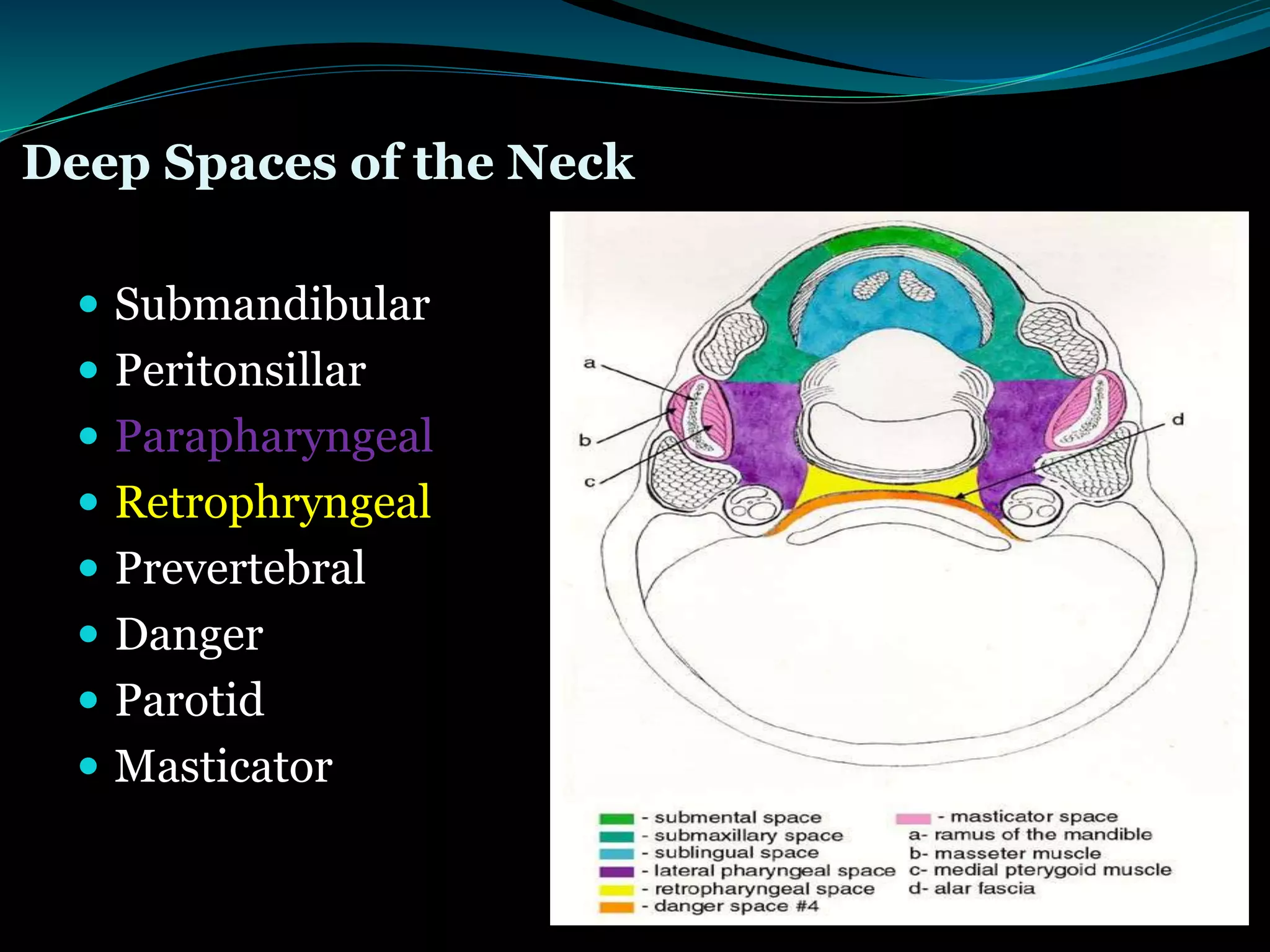
Deep Spaces of the Neck
 Submandibular
 Peritonsillar
 Parapharyngeal
 Retrophryngeal
 Prevertebral
 Danger
 Parotid
 Masticator
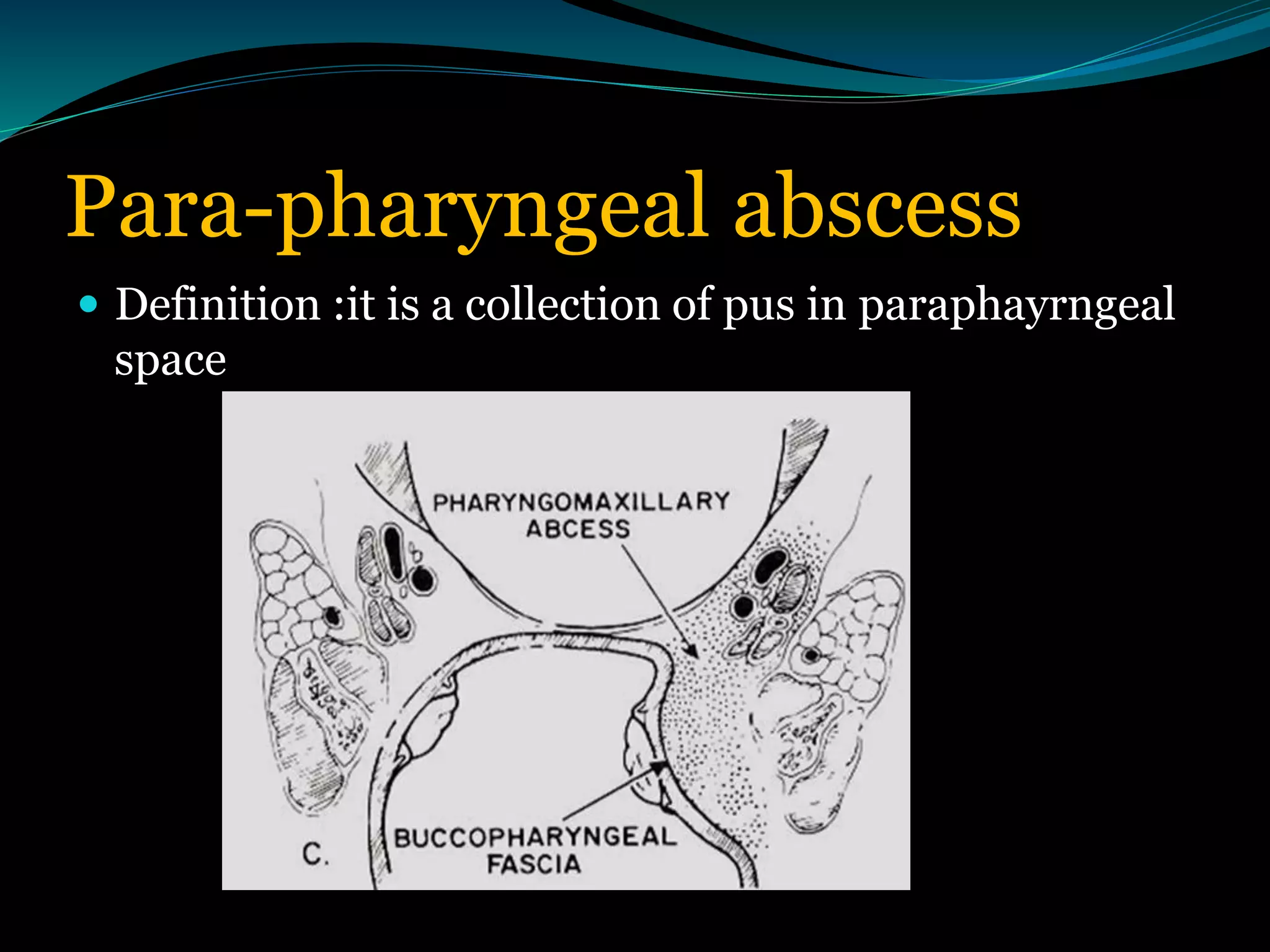
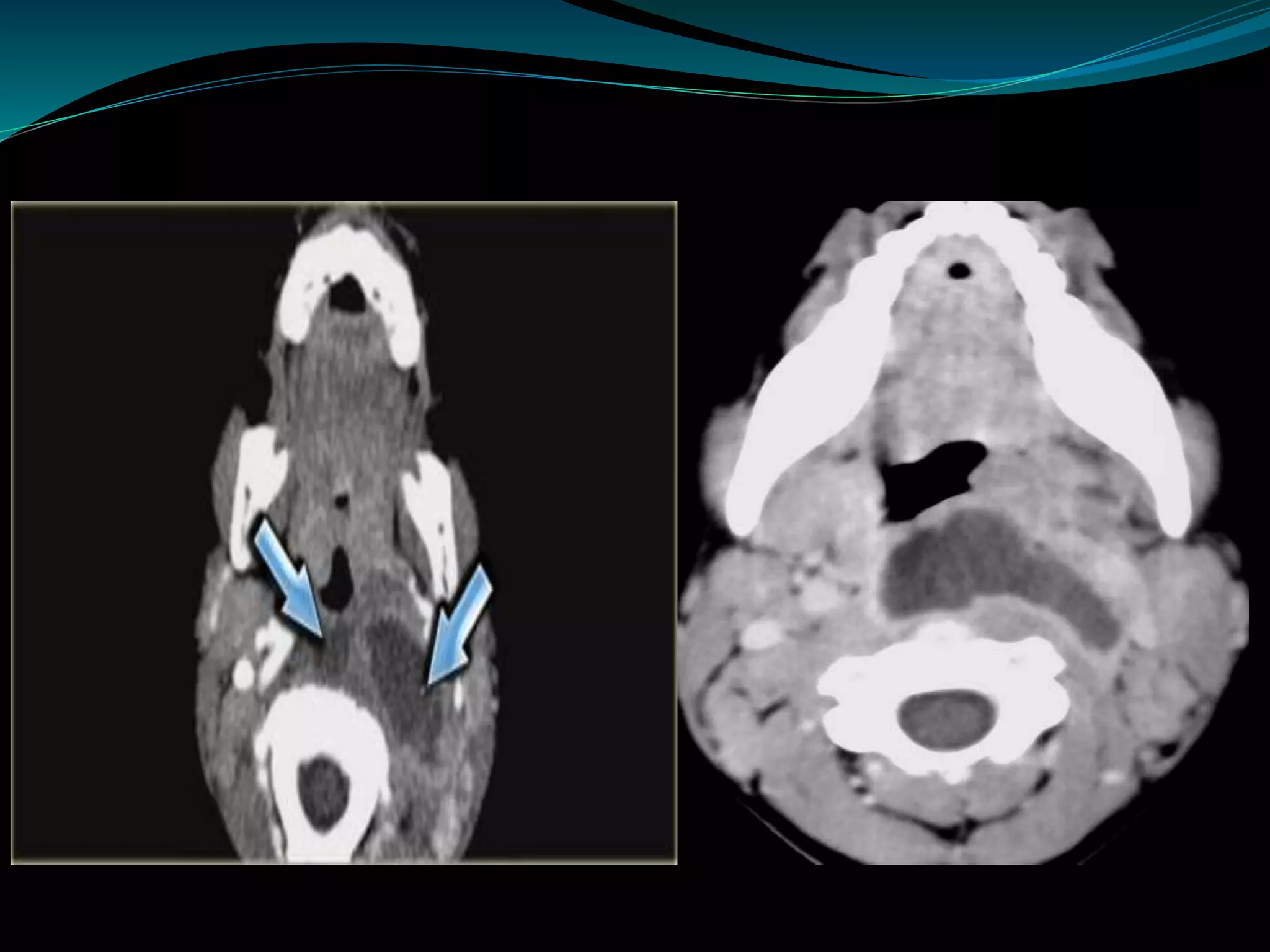
Para-pharyngeal abscess
 Definition :it is a collection of pus in paraphayrngeal
space
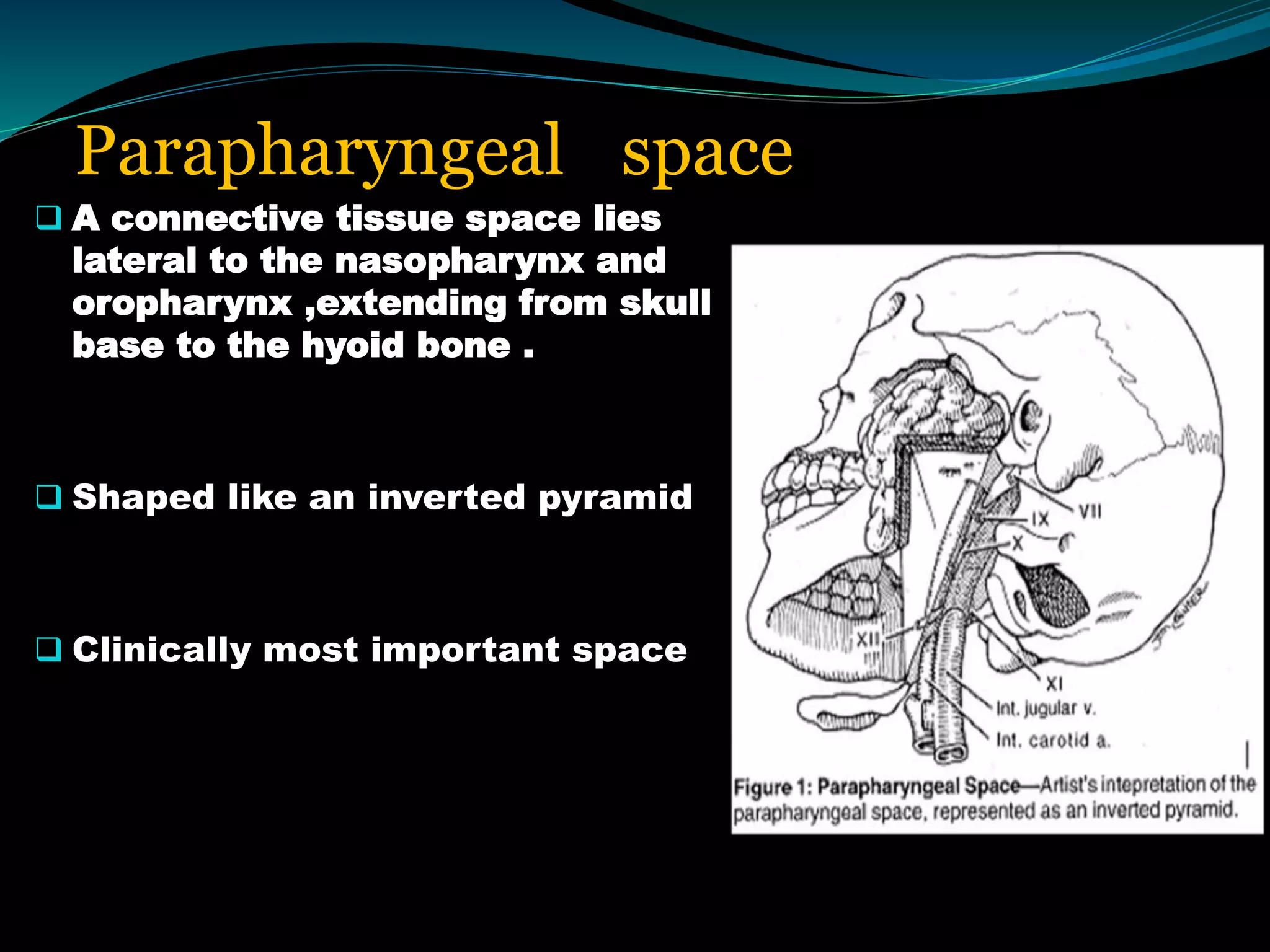
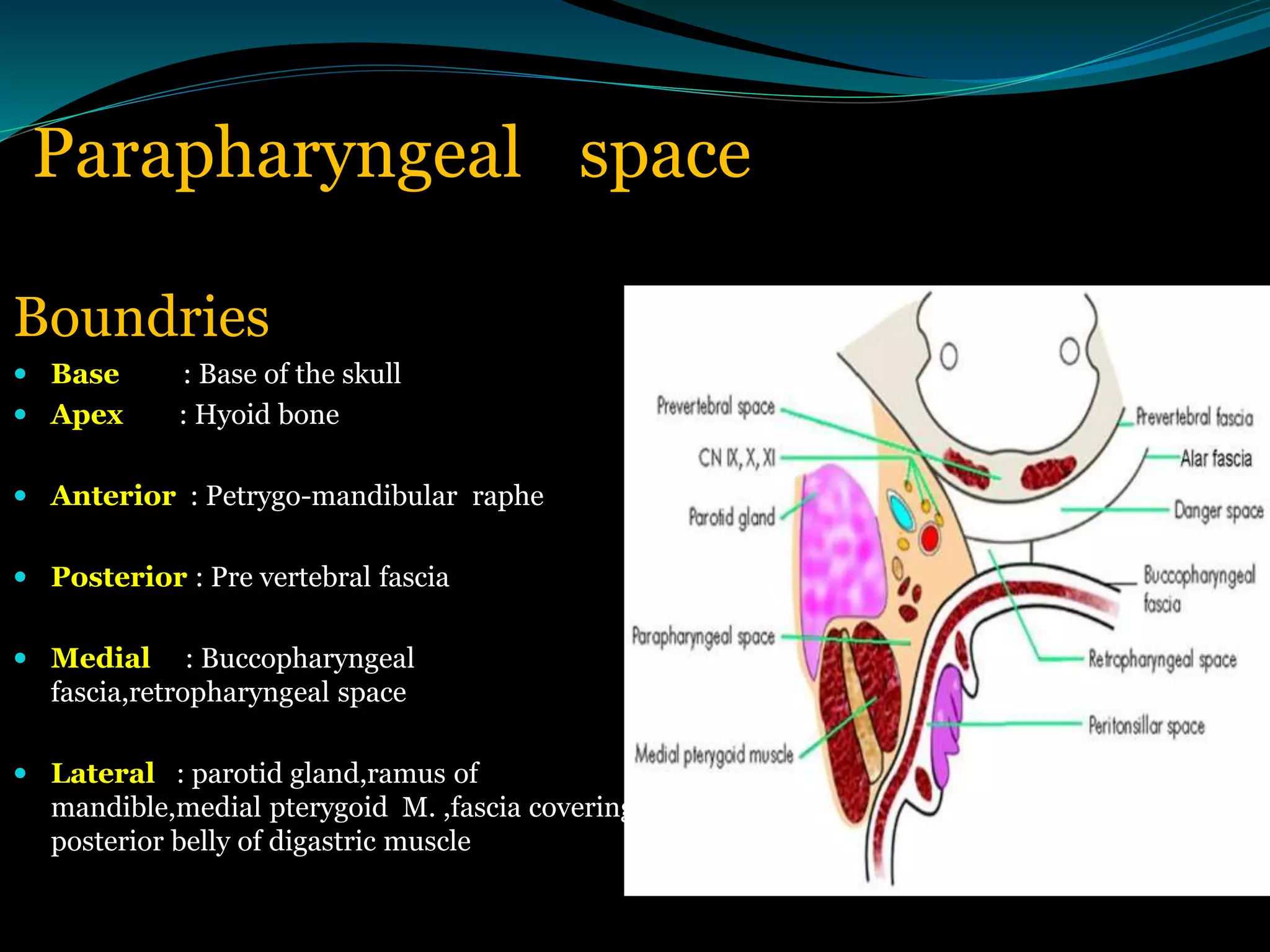
Parapharyngeal space
 A connective tissue space lies
lateral to the nasopharynx and
oropharynx ,extending from skull
base to the hyoid bone .
 Shaped like an inverted pyramid
 Clinically most important space
Parapharyngeal space
Boundries
 Base : Base of the skull
 Apex : Hyoid bone
 Anterior : Petrygo-mandibular raphe
 Posterior : Pre vertebral fascia
 Medial : Buccopharyngeal
fascia,retropharyngeal space
 Lateral : parotid gland,ramus of
mandible,medial pterygoid M. ,fascia covering
posterior belly of digastric muscle
Parapharyngeal space
 It communicates directly
with other deep neck
spaces including the
retropharyngeal space,
parotid space,
submandibular space
and the carotid sheath.
Parapharyngeal space
 It is divided by styloid process and its attachments
into prestyloid and poststyloid space
 Prestyloid space contains parapharyngeal fat,
lymph nodes and the deep lobe of the parotid
gland.
 Poststyloid space contains the internal jugular
vein, internal carotid artery, cranial nerves IX, X,
XIand XII, sympathetic trunk and superior
sympathetic ganglion, ascending pharyngeal artery
and lymph nodes
Parapharyngeal abscess
ETIOLOGY:-
 Acute/Chronic infections of tonsils and
adenoid, bursting of the peritonsillar
abscess.
 Dental infection usually from the lower
last molar.
 From Bezold abscess or Petrositis.
 Infections of parotid, retropharyngeal
and submaxillary spaces.
 Penetrating injuries of neck, injection of
L.A for mandibular nerve block or for
tonsillectomy.
Parapharyngeal abscess
Clinical features
depend on the compartment involved.
Anterior Compartment:-
 Prolapse of tonsil and tonsillar fossa.
 Trismus(due to spasm of medial pterygoid).
 External swelling behind the angle of jaw
associated with marked Odynophagia.
Posterior Compartment:-
 Bulge of pharynx behind the posterior pillar.
 Paralysis of CN 9,10,11,12 and sympathetic chain.
 Swelling of parotid region.
Fever, Odynophagia, Sore throat, Torticollis and signs
of toxaemia are common to both compartments.
Complications
Spread to
- Skull base  meningitis
- carotid sheaththrombosis of IJV and
rupture of carotid artery
- Mediastinum Mediastinitis
- Larynx laryngeal edema
Rupture into the pharynx aspiration
Bronchopneumonia
Parapharyngeal abscess
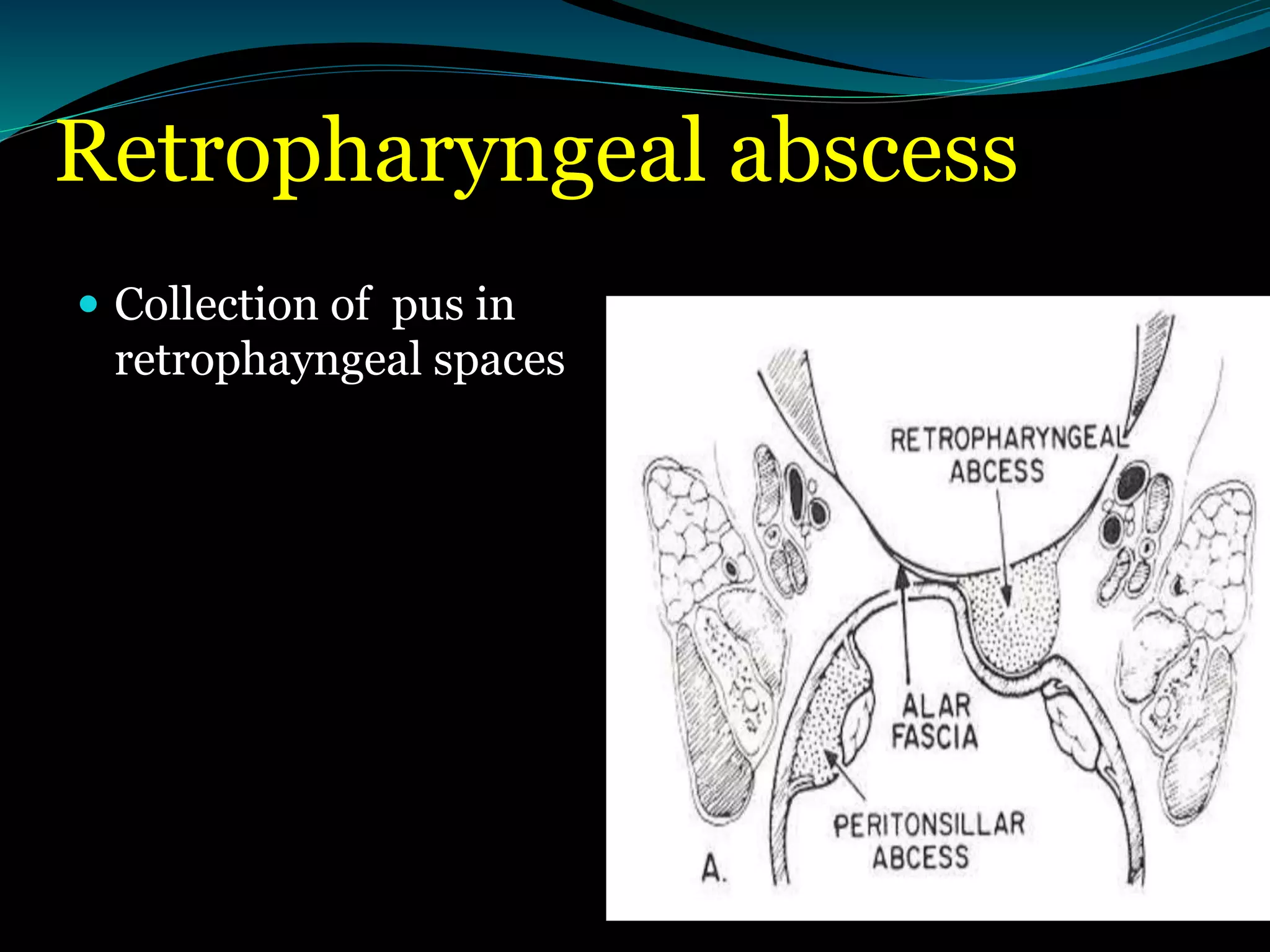
Retropharyngeal abscess
 Collection of pus in
retrophayngeal spaces
Retropharyngeal space
• It is a connective tissue
space between :
 the buccopharyngeal
fascia & pre-vertebral fascia
• The two fasciae are attached
to each side by median
raphe.
• It extends from the skull
base to the posterior
mediastinum
• It contains retropharyngeal
lymph node one on each
side
• The Retropharyngeal LN
regresses at the age of 5
BuccoPharyngeal
Fascia
The Retropharyngeal
Prevertebral fascia
Retropharyngeal abscess
 More common in children
 Aetiology:
• In infants occurs due to lymphadenitis secondary
to an upper respiratory tract infection
• In adults it is likely to be secondary to TB of
cervical spine
• Other causes in adults include trauma,
instrumentation, extension from adjoining deep
neck spaces
 Can extend to mediastinum, danger space and
parapharyngeal space
Retropharyngeal abscess
 Clinical features in infants:
• Elevated temperature
• Difficulty in breathing
• Stiff neck
• Asymmetric swelling of posterior pharyngeal wall
 Clinical features in adults:
• Slow onset
• Pharyngeal discomfort
• Dysphagia
• Cervical motion limitation
• Noisy breathing
Retropharyngeal abscess
complications
 posterior extension to pre-vertebral space, osteomyelitis,
epidural abscess
 lateral extension involving carotid artery (haemorrhage,
pseudoaneurysm, thrombosis) and jugular vein (thrombosis)
 anterior compression and compromise of the airway
 inferior extension into the mediastinum resulting in
mediastinitis
 systemic dissemination and development of sepsis
 Grisel syndrome
 Lemierre syndrome
Investigations
• CBC
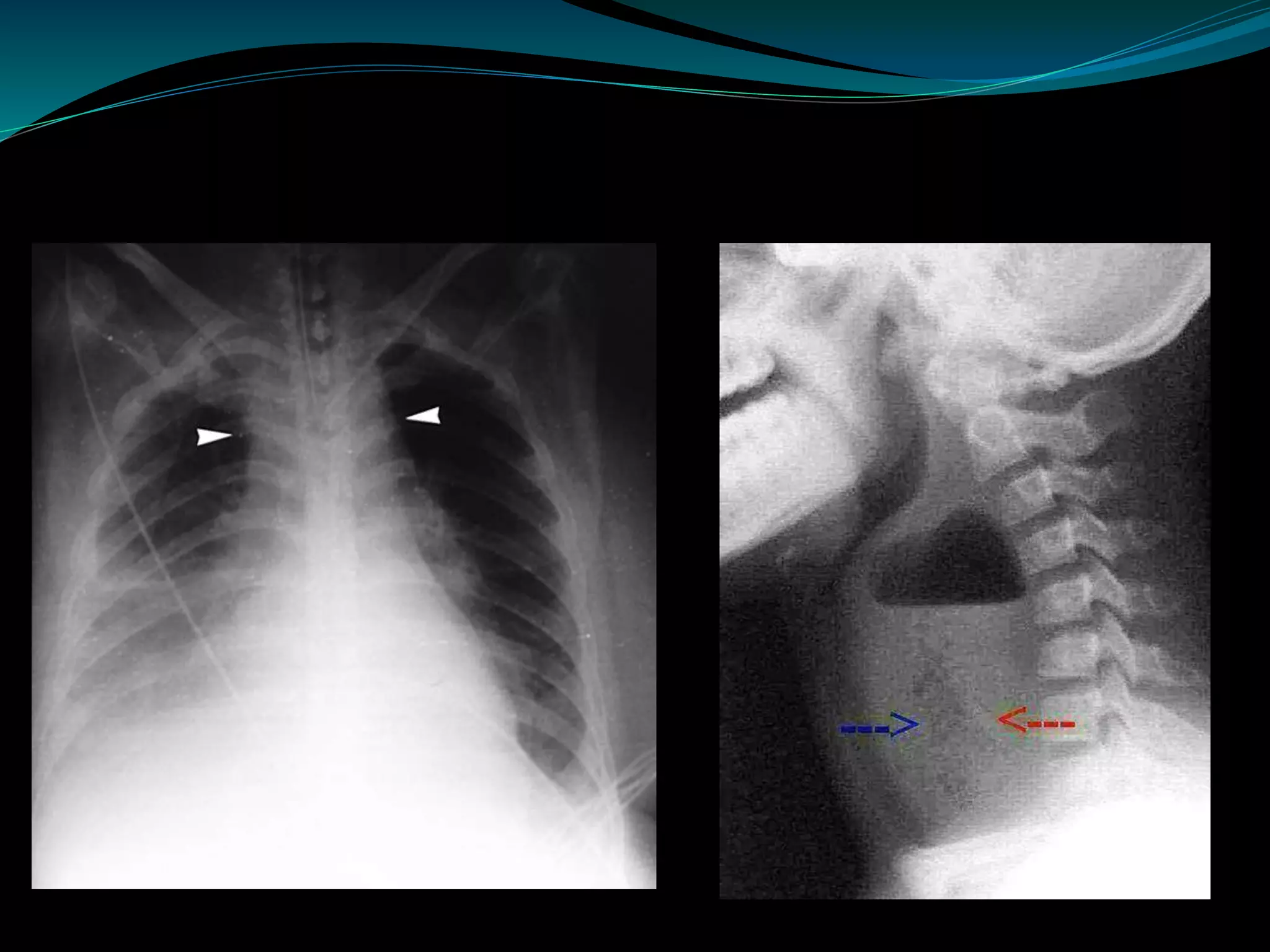
• X -ray ( neck ,chest )
• USG
• Needle aspiration and culture and sensitivity
• CT.SCAN
Treatment
 Educate the patient and take consent for surgical
interventions that may arise
 Airway management
 IV antibiotic (pinicillin-
sulbactum,clindamycin,ceftriaxon+metronidazole)
 Surgical drainage
Surgical drainage
 Done under GA
 Intubation
 Trans-oral or trans-cervical approach
• Oral intubation
• Fiberoptic intubation
• Tracheostomy under LA
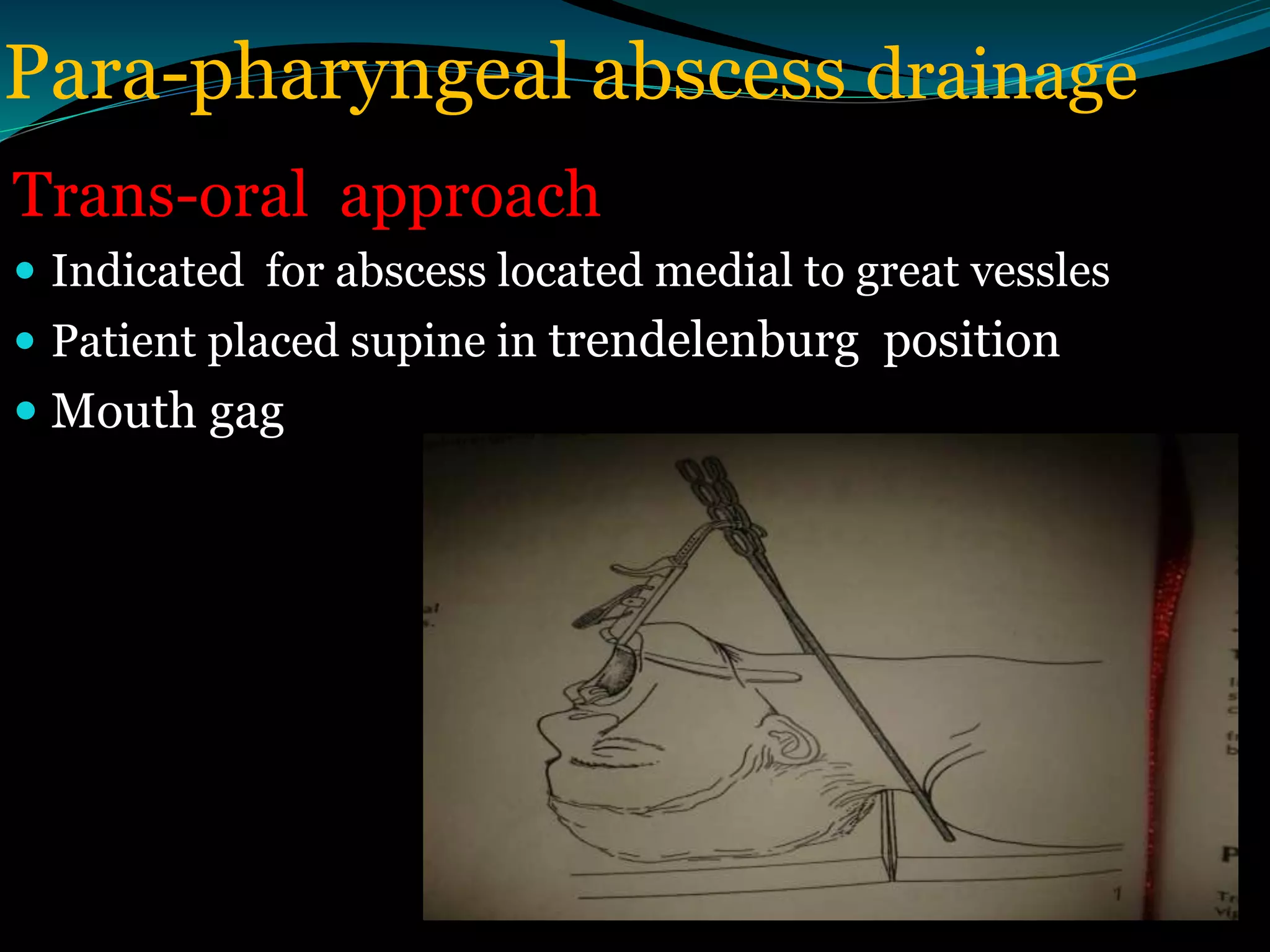
Para-pharyngeal abscess drainage
Trans-oral approach
 Indicated for abscess located medial to great vessles
 Patient placed supine in trendelenburg position
 Mouth gag
Para-pharyngeal abscess drainage
 Palpate the swelling to localize the abscess
 Insert 14 gauge needle and aspirate
 Aspirated pus should be sent for culture
 Vertical incision given in the fluctuant areal(over mucosa
only)
 Long clamp used to dilate the opening and allow for
further drainage
• A rubber catheter attached to a 60cc syringe can be employed to
irrigate the cavity
• The incision remains open to allow further drainage,
• Suction must be at hand
Para-pharyngeal abscess drainage
Transcervical
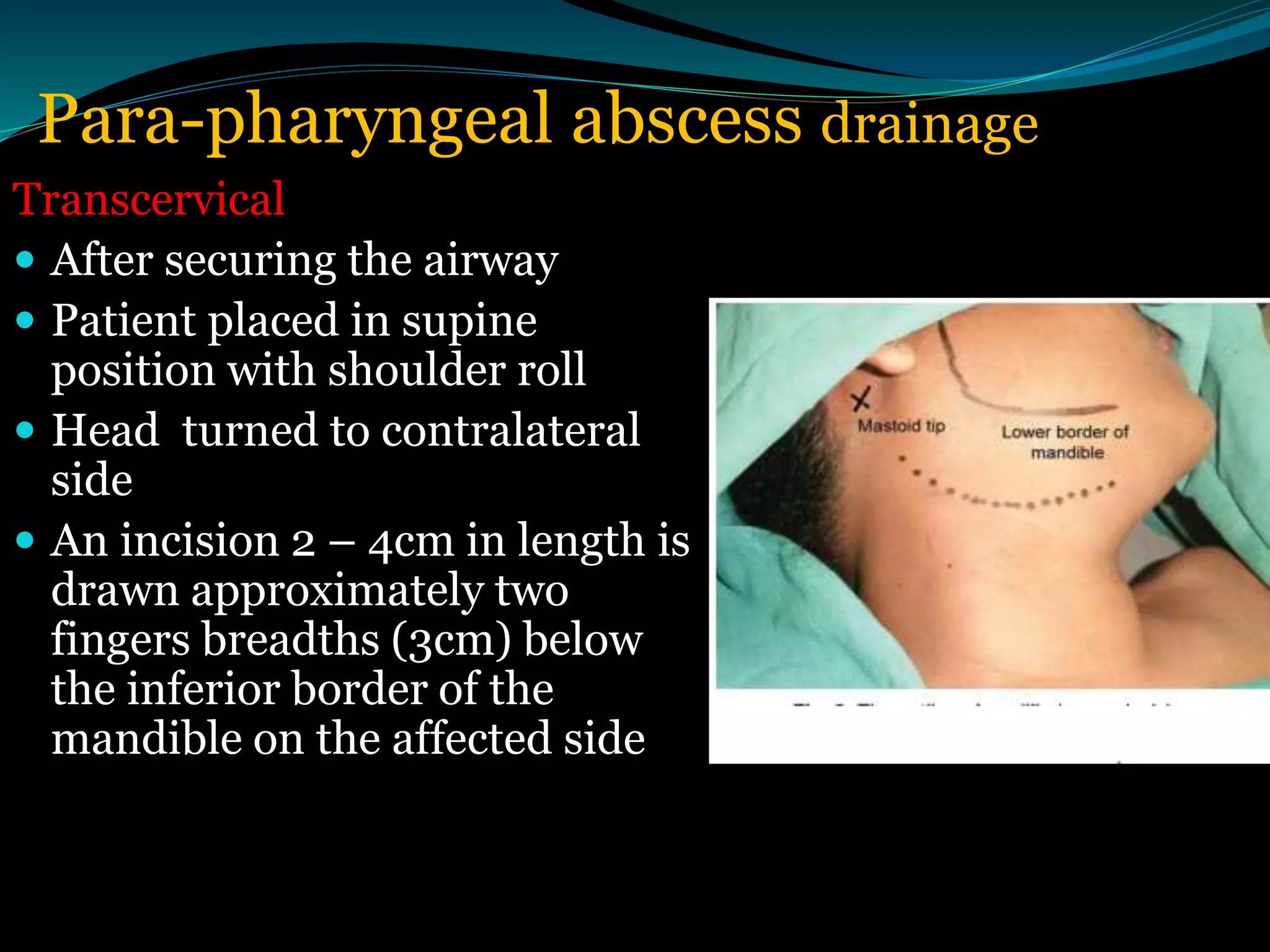
 After securing the airway
 Patient placed in supine
position with shoulder roll
 Head turned to contralateral
side
 An incision 2 – 4cm in length is
drawn approximately two
fingers breadths (3cm) below
the inferior border of the
mandible on the affected side
 Infiltrate with lidocain and adrenalin
 The neck, face up to the oral commissure and
shoulder are prepped
 The patient is then draped , exposing the neck,
clavicles, ear lobe, midline neck and the oral
commissure
 The skin and subcutaneous tissues are then sharply
incised.
 The platysma can be incised sharply or with
electrocautery.
 The submandibular gland should be identified and
dissected along its inferior border.
 The gland and its overlying fascia can then be
retracted superiorly thus protecting the marginal
mandibular nerve
 Next, the anterior border of the sternoclidomastoid
muscle and great vessels are retracted posteriorly
 the greater cornu of the hyoid is a particularly
important landmark to identify next
 Once identified, the posterior belly of the digrastric
muscle should be apparent
 the surgeons finger can be used to bluntly dissect
along the medial border of the posterior belly of the
digastric muscle towards the styoid process and skull
base.
 Blunt dissection is continued to break up any
remaining loculations
 Abscess is drained
 wound bed is copiously irrigated with at least one
liter of warm saline.
 A drain should be placed into the abscess cavity and
exit the incision
 skin partially closed, leaving an opening for the
drain,
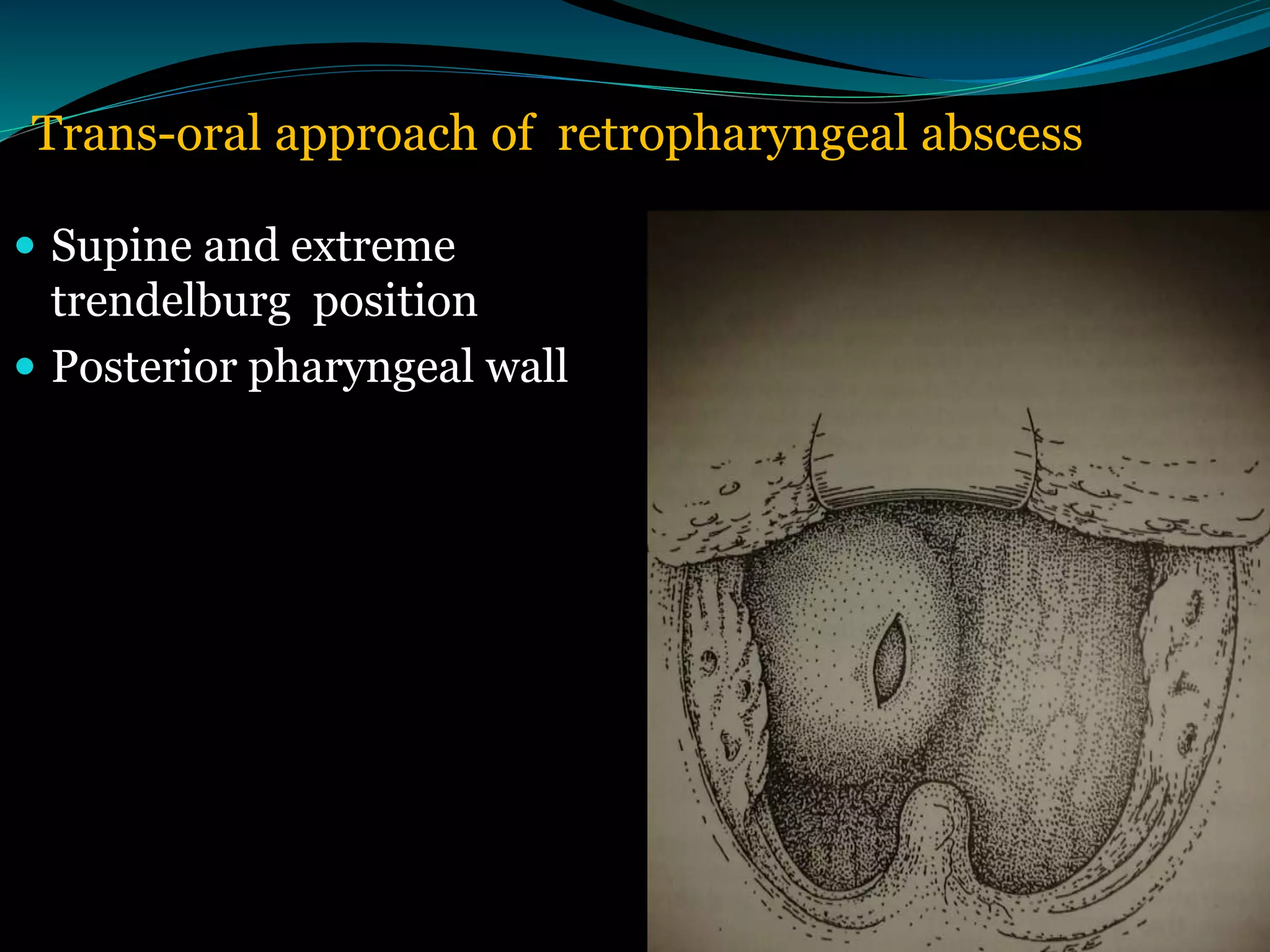
Trans-oral approach of retropharyngeal abscess
 Supine and extreme
trendelburg position
 Posterior pharyngeal wall
Trans-cervical approach of retropharyngeal abscess
 Low abscess: along anterior border of
sternocleidomastoid muscle
 Transverse cervical skin incision is given
 Raising subplatysmal flaps to expose the neck and dissecting
along the anterior border of the sternomastoid
 The sternocleidomastoid muscle and carotid sheath are then
retrac-ted laterally
 blunt dissection is done up to the level of hypopharynx to open
the retro-pharyngeal space abscess.
 Deep drain placed and maintain
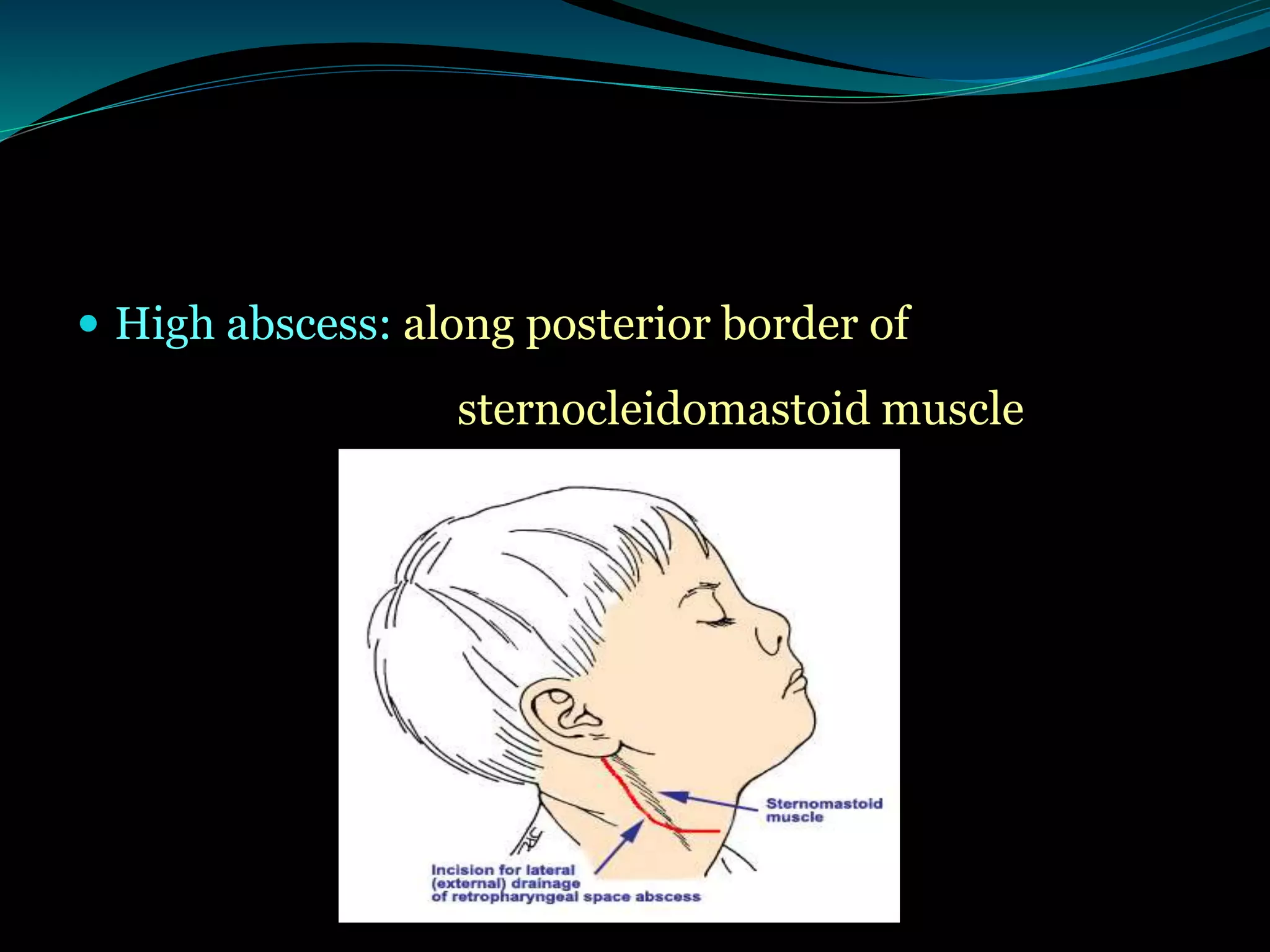
 High abscess: along posterior border of
sternocleidomastoid muscle
Principles for neck abscess drainage
 Ensuring a secure airway is the first priority in
the management of a deep neck infection
 Therefore, intubation with direct
laryngoscopy or tracheotomy should always
be considered
 An important principle of surgical drainage of
a deep neck abscess is wide exposure
 Identify landmarks
 Blunt dissection should be used whenever
possible.
 Identifying the carotid sheath early is crucial
for avoiding inadvertent damage to it and to
the major neurovascular structures it
contains.
 The abscess should be completely drained,
including blunt avulsion of any loculations
Surgical treatment of paraphyrngeal and retropharyngeal abscesses

Surgical treatment of paraphyrngeal and retropharyngeal abscesses

  • 2.
  • 3.
    Investing layer ofdeep cervical fascia  Attachments:
  • 4.
    Deep Spaces ofthe Neck  Submandibular  Peritonsillar  Parapharyngeal  Retrophryngeal  Prevertebral  Danger  Parotid  Masticator
  • 5.
    Para-pharyngeal abscess  Definition:it is a collection of pus in paraphayrngeal space
  • 6.
    Parapharyngeal space  Aconnective tissue space lies lateral to the nasopharynx and oropharynx ,extending from skull base to the hyoid bone .  Shaped like an inverted pyramid  Clinically most important space
  • 7.
    Parapharyngeal space Boundries  Base: Base of the skull  Apex : Hyoid bone  Anterior : Petrygo-mandibular raphe  Posterior : Pre vertebral fascia  Medial : Buccopharyngeal fascia,retropharyngeal space  Lateral : parotid gland,ramus of mandible,medial pterygoid M. ,fascia covering posterior belly of digastric muscle
  • 8.
    Parapharyngeal space  Itcommunicates directly with other deep neck spaces including the retropharyngeal space, parotid space, submandibular space and the carotid sheath.
  • 9.
    Parapharyngeal space  Itis divided by styloid process and its attachments into prestyloid and poststyloid space  Prestyloid space contains parapharyngeal fat, lymph nodes and the deep lobe of the parotid gland.  Poststyloid space contains the internal jugular vein, internal carotid artery, cranial nerves IX, X, XIand XII, sympathetic trunk and superior sympathetic ganglion, ascending pharyngeal artery and lymph nodes
  • 10.
    Parapharyngeal abscess ETIOLOGY:-  Acute/Chronicinfections of tonsils and adenoid, bursting of the peritonsillar abscess.  Dental infection usually from the lower last molar.  From Bezold abscess or Petrositis.  Infections of parotid, retropharyngeal and submaxillary spaces.  Penetrating injuries of neck, injection of L.A for mandibular nerve block or for tonsillectomy.
  • 11.
    Parapharyngeal abscess Clinical features dependon the compartment involved. Anterior Compartment:-  Prolapse of tonsil and tonsillar fossa.  Trismus(due to spasm of medial pterygoid).  External swelling behind the angle of jaw associated with marked Odynophagia. Posterior Compartment:-  Bulge of pharynx behind the posterior pillar.  Paralysis of CN 9,10,11,12 and sympathetic chain.  Swelling of parotid region. Fever, Odynophagia, Sore throat, Torticollis and signs of toxaemia are common to both compartments.
  • 12.
    Complications Spread to - Skullbase  meningitis - carotid sheaththrombosis of IJV and rupture of carotid artery - Mediastinum Mediastinitis - Larynx laryngeal edema Rupture into the pharynx aspiration Bronchopneumonia Parapharyngeal abscess
  • 13.
    Retropharyngeal abscess  Collectionof pus in retrophayngeal spaces
  • 14.
    Retropharyngeal space • Itis a connective tissue space between :  the buccopharyngeal fascia & pre-vertebral fascia • The two fasciae are attached to each side by median raphe. • It extends from the skull base to the posterior mediastinum • It contains retropharyngeal lymph node one on each side • The Retropharyngeal LN regresses at the age of 5 BuccoPharyngeal Fascia The Retropharyngeal Prevertebral fascia
  • 15.
    Retropharyngeal abscess  Morecommon in children  Aetiology: • In infants occurs due to lymphadenitis secondary to an upper respiratory tract infection • In adults it is likely to be secondary to TB of cervical spine • Other causes in adults include trauma, instrumentation, extension from adjoining deep neck spaces  Can extend to mediastinum, danger space and parapharyngeal space
  • 16.
    Retropharyngeal abscess  Clinicalfeatures in infants: • Elevated temperature • Difficulty in breathing • Stiff neck • Asymmetric swelling of posterior pharyngeal wall  Clinical features in adults: • Slow onset • Pharyngeal discomfort • Dysphagia • Cervical motion limitation • Noisy breathing
  • 17.
  • 18.
    Retropharyngeal abscess complications  posteriorextension to pre-vertebral space, osteomyelitis, epidural abscess  lateral extension involving carotid artery (haemorrhage, pseudoaneurysm, thrombosis) and jugular vein (thrombosis)  anterior compression and compromise of the airway  inferior extension into the mediastinum resulting in mediastinitis  systemic dissemination and development of sepsis  Grisel syndrome  Lemierre syndrome
  • 19.
    Investigations • CBC • X-ray ( neck ,chest ) • USG • Needle aspiration and culture and sensitivity • CT.SCAN
  • 24.
    Treatment  Educate thepatient and take consent for surgical interventions that may arise  Airway management  IV antibiotic (pinicillin- sulbactum,clindamycin,ceftriaxon+metronidazole)  Surgical drainage
  • 25.
    Surgical drainage  Doneunder GA  Intubation  Trans-oral or trans-cervical approach • Oral intubation • Fiberoptic intubation • Tracheostomy under LA
  • 26.
    Para-pharyngeal abscess drainage Trans-oralapproach  Indicated for abscess located medial to great vessles  Patient placed supine in trendelenburg position  Mouth gag
  • 27.
    Para-pharyngeal abscess drainage Palpate the swelling to localize the abscess  Insert 14 gauge needle and aspirate  Aspirated pus should be sent for culture  Vertical incision given in the fluctuant areal(over mucosa only)  Long clamp used to dilate the opening and allow for further drainage
  • 28.
    • A rubbercatheter attached to a 60cc syringe can be employed to irrigate the cavity • The incision remains open to allow further drainage, • Suction must be at hand
  • 29.
    Para-pharyngeal abscess drainage Transcervical After securing the airway  Patient placed in supine position with shoulder roll  Head turned to contralateral side  An incision 2 – 4cm in length is drawn approximately two fingers breadths (3cm) below the inferior border of the mandible on the affected side
  • 30.
     Infiltrate withlidocain and adrenalin  The neck, face up to the oral commissure and shoulder are prepped  The patient is then draped , exposing the neck, clavicles, ear lobe, midline neck and the oral commissure  The skin and subcutaneous tissues are then sharply incised.
  • 31.
     The platysmacan be incised sharply or with electrocautery.  The submandibular gland should be identified and dissected along its inferior border.  The gland and its overlying fascia can then be retracted superiorly thus protecting the marginal mandibular nerve  Next, the anterior border of the sternoclidomastoid muscle and great vessels are retracted posteriorly
  • 32.
     the greatercornu of the hyoid is a particularly important landmark to identify next  Once identified, the posterior belly of the digrastric muscle should be apparent  the surgeons finger can be used to bluntly dissect along the medial border of the posterior belly of the digastric muscle towards the styoid process and skull base.  Blunt dissection is continued to break up any remaining loculations
  • 33.
     Abscess isdrained  wound bed is copiously irrigated with at least one liter of warm saline.  A drain should be placed into the abscess cavity and exit the incision  skin partially closed, leaving an opening for the drain,
  • 34.
    Trans-oral approach ofretropharyngeal abscess  Supine and extreme trendelburg position  Posterior pharyngeal wall
  • 35.
    Trans-cervical approach ofretropharyngeal abscess  Low abscess: along anterior border of sternocleidomastoid muscle  Transverse cervical skin incision is given  Raising subplatysmal flaps to expose the neck and dissecting along the anterior border of the sternomastoid  The sternocleidomastoid muscle and carotid sheath are then retrac-ted laterally  blunt dissection is done up to the level of hypopharynx to open the retro-pharyngeal space abscess.  Deep drain placed and maintain
  • 36.
     High abscess:along posterior border of sternocleidomastoid muscle
  • 37.
    Principles for neckabscess drainage  Ensuring a secure airway is the first priority in the management of a deep neck infection  Therefore, intubation with direct laryngoscopy or tracheotomy should always be considered  An important principle of surgical drainage of a deep neck abscess is wide exposure  Identify landmarks
  • 38.
     Blunt dissectionshould be used whenever possible.  Identifying the carotid sheath early is crucial for avoiding inadvertent damage to it and to the major neurovascular structures it contains.  The abscess should be completely drained, including blunt avulsion of any loculations