GOITRE
PRESENTERS:
 HAMISI MKINDI,MD5
 SHIJA CHARLES,MD5
 THERESIA LUFYO,MD5
MODERATORS
 Dr.FASSIL G.
 Dr.MAYOKA R.
 Dr.Fr.GINGO
Learning objectives
 Definition
 Surgical anatomy
and embryology of
thyroid gland
 Etiology
 Classification
 Pathophysiology
 Clinical
presentation
 Workup
 Treatment
 Complications
 Prevention
DEFINITION
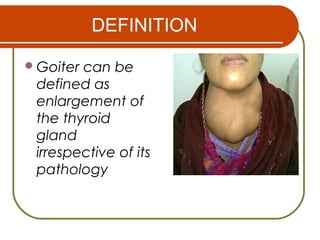
Goiter can be
defined as
enlargement of
the thyroid
gland
irrespective of its
pathology
THYROID
 Derives its name from thyroid cartilage
 Anterior part of neck
 20-25gm
 Functional unit=lobule
 Each lobule =24-40 follicles
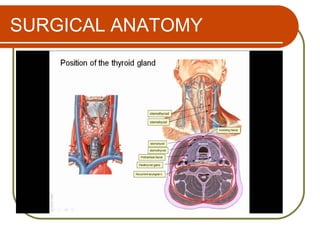
SURGICAL ANATOMY
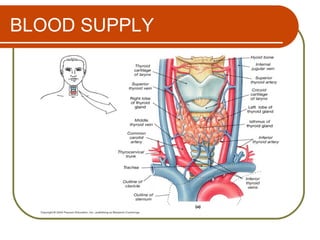
BLOOD SUPPLY
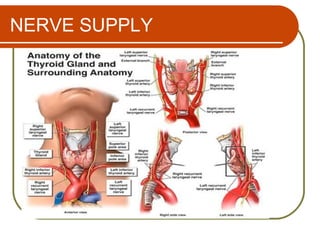
NERVE SUPPLY
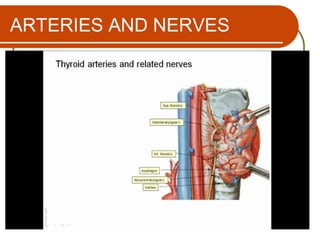
ARTERIES AND NERVES
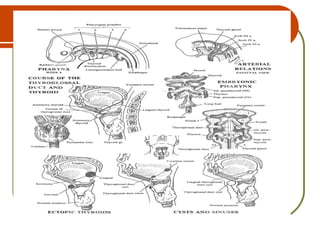
EMBRYOLOGY
Dv from TGD(median bud of pharynx)which
passes from foramen caecum at base of the
tongue to thyroid isthmus
First of the body's endocrine glands to
develop, on approximately the 24th day of
gestation.
2 main structures: the primitive pharynx and
the neural crest.
EMBRYOLOGY
The inferior parathyroid glands arise from
the dorsal wing of the third pharyngeal
pouch.
The initial descent of the thyroid gland
follows the primitive heart and occurs
anterior to the pharyngeal gut. At this point,
the thyroid is still connected to the tongue
via the thyroglossal duct.
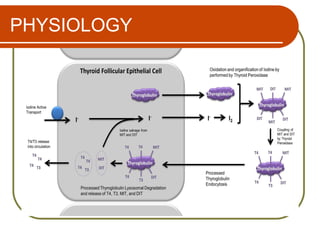
PHYSIOLOGY
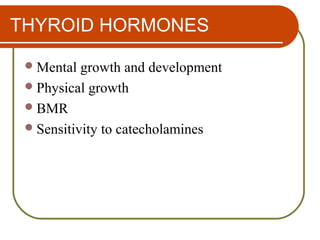
THYROID HORMONES
Mental growth and development
Physical growth
BMR
Sensitivity to catecholamines
ETIOLOGY OF GOITRE
Factors associated with goiter formation
can be classified as follows:-
Hereditary factors
Hormonal factors
Dietary factors
Pharmacological factors
Physiological factors
Environmental factors
Pathological factors
Hereditary factors
Inherited defect of thyroid hormone
synthesis
 Enzymatic defect deficiency
 Dyshormonogenesis
→Familial goitre
Hormonal factors
Thyroid hormone dysfunction
Hyperthyroidism (overproduction of thyroid
hormones)
Hypothyroidism (underproduction of thyroid
hormones)
Dietary factors
Dietary iodine deficiency
Goitrogens:-
Cabbage
→ endemic goitre
Pharmacological factors
Use of goitrogen drugs like para-
aminosalicylic acid (PAS),
thiocyanate and antithyroid drugs
[e.g. thiouracil, carbimazole] →
hypothyroidism
Physiological factors
Increased metabolic demand of
thyroid hormones e.g. during
pregnancy or puberty →
physiological goitre
Environmental factors
Exposure to radiations → Thyroid cancer
→ Hypothyroidism
Pathological factors
Intrinsic thyroid gland diseases
Inflammatory goitres
Neoplastic goitres
-Benign adenoma(follicular adenoma)
-Malignant
A.Primary
Well differentiated, Poorly
differentiated, Arising from
parafollicular cells
B.Secondary
CLASSIFICATION
Etiological classification
Epidemiological classification
Anatomical classification
Pathological classification
Functional classification
Morphological classification
Etiological classification
Physiological goitre
Goitres resulting from increased metabolic
demand of thyroid hormones e.g. during
pregnancy or puberty
Pathological goitre
Goitres resulting from diseases affecting the
thyroid gland e.g. Neoplastic or
inflammatory conditions
Epidemiological classification
Familial goitres
goitres that run in families as a result of
Inherited defect of thyroid hormone
synthesis
Endemic goitres
defined as thyroid enlargement affecting a
significant number of inhabitants of a
particular locality
Sporadic goitres
goitres that run sporadically
Anatomical classification
Cervical goitre
Goitre situated on the anterior aspect of the
neck
Retrosternal goitre
Goitre extends downward and get situated
behind the sternum
Intrathoracic goitre
The type of goitre which extends into thoracic
cavity
Pathological classification
Simple goitres
Toxic goitres
Neoplastic goitres
Inflammatory goitres
Miscellaneous (Other rare types)
Functional classification
Toxic goitre
Type of goitre associated with thyroid
hyperfunction (hyperthyroidism)
Non-toxic
Type of goitre associated with thyroid
hypofunction (hypothyroidism) or normal
thyroid function (Euthyroid)
Morphological classification
According to the texture of the
gland
Diffuse goitre
Nodular goitre
Solitary nodular goitre
Multinodular goitre
PATHOPHYSIOLOGY
The pathophysiological
consequences of goitres results from
one of the following:-
The effect of thyroid hormone
dysfunction
The effect of enlarged thyroid gland
The effect of primary disease causing
goitre
Effect of thyroid hormone
dysfunction
Thyroid hyperfunction (hyperthyroidism)
→Features of hyperthyroidism
Thyroid hypofunction (hypothyroidism)
→ Features of hypothyroidism
Effect of enlarged thyroid
gland
Effect on the trachea→ dyspnea
Effect on the esophagus
→dysphagia
Effect on the superior venacava →
distended neck veins
Effect on the recurrent laryngeal
nerve → horsiness of voice
Effect of primary disease
causing goitre
The effect depends on the
underlying disease
CLINICAL PRESENTATION
History (Symptoms)
Physical examination (Signs)
History (Symptoms)
Age
Sex
Main complaints
Anterior neck swelling
Duration
Mode of onset
Rate of growth
Associated pain
History (Symptoms)…
 Pressure-related symptoms
Dysphagia, dyspnoea, hoarseness of
voice, neck vein engorgement etc
 Review of systems to assess toxicity
CNS- tremors, irritability, mental
disturbance
CVS- palpitation, dyspnoea, orthopnoea
GI- change of appetite, constipation,
diarrhoea
MSS- bone pain, weight change, heat or
cold preference, excessive sweating
History (Symptoms)……..
 Past medical history
Previous medication, previous h/o
irradiation
 Family and social history
H/o goitre in the family or in the
community
Physical examination
General examination
Local examination
Systemic examination
General examination
Look for four cardinal features of
toxicity namely:-
Exophthalmosis
Tachycardia
Tremor
Moist skin
Local examination
Inspection
Palpation
Percussion
Auscultation
Systemic examination
Centro nervous system
Cardiovascular System
Respiratory system
WORK UP
Laboratory studies
Imaging studies
Endoscopic studies
Histopathology
Laboratory studies
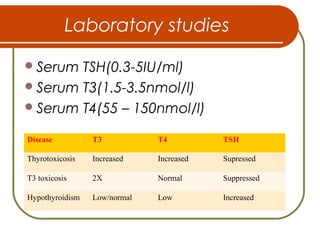
Serum TSH(0.3-5IU/ml)
Serum T3(1.5-3.5nmol/l)
Serum T4(55 – 150nmol/l)
Disease T3 T4 TSH
Thyrotoxicosis Increased Increased Supressed
T3 toxicosis 2X Normal Suppressed
Hypothyroidism Low/normal Low Increased
Labs cont…
Serum thyroglobulin
Serum cholesterol
Thyroid autoantibody levels
Thyroid scintigraphy
Imaging studies
Plain x-ray of the neck
Thyroid ultrasound
Thyroid radioisotope scan
CT scan/MRI
Barium swallow
Plain x-ray of the neck
Plain radiography of the neck may
reveal the following:-
Tracheal deviation or compression
Calcification within the goitre
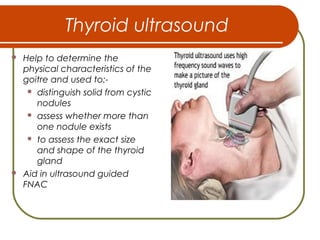
Thyroid ultrasound
 Help to determine the
physical characteristics of the
goitre and used to:-
 distinguish solid from cystic
nodules
 assess whether more than
one nodule exists
 to assess the exact size
and shape of the thyroid
gland
 Aid in ultrasound guided
FNAC
Thyroid radioisotope scan
 Used to determine the functional activiity by
distinguishing a nodule as hot, warm, or cold,
based on the relative amount of uptake of
radioactive isotope
 Hot nodules take up excessive amounts of
isotope and indicate autonomously functioning
nodules
 Cold nodules does not radioactive isotope and
therefore indicate hypofunctional or
nonfunctional thyroid tissue
 Warm nodules appear gray and suggest normal
thyroid function
 The radioactive isotopes that are most commonly
include 123-Iodine, 99m-Technetium and 131-
Iodine
CT scan/MRI
Give excellent anatomical detail of
thyroid swelling but have no role in
the first line of investigation
Help to assess recurrence and
intrathoracic or retrosternal goitres
Barium swallow
To assess compression of the
esophagus
Endoscopic studies
Indirect laryngoscopy
To assess the mobility of the vocal
cord
Histopathology
Fine needle aspiration cytology (FNAC)
Open biopsy
TREATMENT
Medical treatment
Radioiodine
Surgery
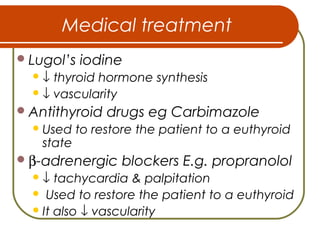
Medical treatment
Lugol’s iodine
↓ thyroid hormone synthesis
↓ vascularity
Antithyroid drugs eg Carbimazole
Used to restore the patient to a euthyroid
state
β-adrenergic blockers E.g. propranolol
↓ tachycardia & palpitation
 Used to restore the patient to a euthyroid
It also ↓ vascularity
Radioiodine
Thyroiodine destroys thyroid cells and
as in thyroidectomy reduces the
mass of functioning
Surgery
Indications
Preoperative care
Intraoperative care
Postoperative care
Indications
Cosmetic purpose
Suspected malignancy
Toxic goitre
Pressure symptoms
Preoperative care
Correct anemia, mobilize blood donor
Treatment of intercurent disease or
infections
The thyroid functional status should be
determined
The patient should be made euthyroid
Preoperative care……
Admit the patient a day before
operation
Anesthetic visit
An informed written consent for
operation and anaesthesia
Intraoperative care
Types of surgery (Thyroidectomy)
Subtotal thyroidectomy
Near-total thyroidectomy
Total thyroidectomy
Thyroid nodulectomy
Postoperative care
Iv fluid
Analgesics
Antibiotics
Monitor vital signs
COMPLICATIONS
Complications related to enlarged gland
Complications related to thyroidectomy
Complications related to
enlarged gland
Tracheal obstruction → airway
obstruction
Secondary thyrotoxicosis
Malignant transformation
Complications related to
thyroidectomy
 Haemorrhage
 Respiratory obstruction
 Recurrent laryngeal nerve palsy
 Thyroid storm
 Thyroid insufficiency
 Parathyroid insufficiency
 Wound infection
 Hypertrophic scar
 Keloids
PREVENTION
Primary
Secondary
Tertiary

Goitres

Editor's Notes

  • #11 The thyroid gland forms as a proliferation of endodermal epithelial cells on the median surface of the developing pharyngeal floor The rudimentary lateral thyroid develops from neural crest cells, while the median thyroid, which forms the bulk of the gland, arises from the primitive pharynx. The site of this development lies between 2 key structures, the tuberculum impar and the copula, and is known as the foramen cecum. The thyroid initially arises caudal to the tuberculum impar, which is also known as the median tongue bud. This embryonic swelling develops from the first pharyngeal arch and occurs midline on the floor of the developing pharynx, eventually helping form the tongue as the two lateral lingual swellings overgrow it.
  • #12 The tubular duct later solidifies into a cord of cells that will form the follicular elements. The proximal segment retracts and subsequently obliterates entirely, leaving only the foramen cecum at the posterior aspect of the tongue. Nonetheless, in some individuals, remnants of this duct may still persist. The foramen cecum represents the opening of the thyroglossal duct into the tongue; its remains may be observed as a small blind pit in the midline between the anterior two thirds and the posterior third of the tongue. A pyramidal lobe of the thyroid may be observed in as many as 50% of patients. This lobe represents a persistence of the inferior end of the thyroglossal duct that has failed to obliterate.[1] As such, the pyramidal lobe itself may be attached to the hyoid bone, similar to a thyroglossal duct cyst, or may be incorporated into a thyroglossal duct cyst.
  • #23 Follicular carcinoma: Arise from multinodular goitre in cases of endemic goitre,suspect when MNG grows rapidly. Classified into invasive(angioinvasion and capsular) and non invasive. Tumor cells line BV and get dislodge into systemic circulation producing secondaries in the bones. CP: Solitary nodule,US microcalcification,Peak age 40 years,hard or restricted mobility. Pts with a thyroid swelling presenting with metastasis in the bone in the form of bone swelling or pathological fractures,common flat bones:skull,ribs,sternum,vertebral column. Investigations: Routine investigations. US scan. FNAC of nodule. CT scan Alkaline phosphatase Plain x ray reveals osteolytic lesions Rx: Surgery:thyroidectomy Rx mets Post op thyroxine
  • #24 Anaplastic carcinoma: Common older women 60-70. Majority rapid growing thyroid swelling of shrt duration,surface is irregular and consistency is hard Stridor Infiltration of carotic sheath:Berry side positive Early fixity Dx: FNAC and CT MEDULLARY CARCINOMA OF THE THYROID Arise from parafollicular C cells which are derived from ultimobranchial bodies and not from thyroid follicle Hormones produced by MCT -Calcitonin,prostaglandin and serotonin(5HT),ACTH Rx:Surgery
  • #44 T3 produced by deiodination of T4 in liver,muscle,kidney and anterior pituitary T3 is 3x to 4x than T4 Half life of t3 is 24hrs and t4 is 7days Free t3 is diadnostic of erly hyperthyroidism T4: In euthyroid state t4 is a predominant,total t4 reflect output from thyroid gland