Prof. Dr. Emam Fakhr
Prof. of general surgery AIN SHAMS
UNIVERSITY
Thyroid case sheet
Personal history
Name
Age : Age of the patient can aid to the provisional clinical diagnosis.
i.e. Thyroid swelling
Since birth e.g. cretinism with goitre.
Puberty e.g. physiological goitre, solitary nodule (papillary carcinoma)
25-35 years e.g. diffuse toxic goitre, SMNG
40-45 e.g. multinodular goitre ,follicular carcinoma, autoimmune.
50-60 e.g. anaplastic carcinoma.
Sex : Goitre is more common in female than male.
Residence : Nodular goitre is common in some localities than others.
Complaint
1-Swelling. (in the lower front part of the neck, either
painful or painless)
2-Toxic symptoms.
3-Pressure symptoms .
4-Metastesis (chest, bone,..)
History of present illness
Analysis of complaint & leading questions
1-Thyroid swelling
Onset
Sudden = hemorrhage in nodule in simple nodular goitre.
Acute = inflammation.
Gradual onset = simple nodular goitre, toxic goitre & malignant goitre.
Course
Progressive in (simple nodular goitre, toxic goitre).
Rapidly progressive in malignant goitre.
Stationary =physiological goitre.
Duration
Few months or even weeks in physiological goitre.
Relative long duration in simple nodular goitre.
Short duration in malignant goitre.
History of present illness
Relation of pain to swelling.
Pain then swelling=inflammation.
Swelling then pain= malignancy.
Painful thyroid swelling
Hemorrhage occurs within a nodule of nodular goitre.
Malignant goitre (local and referred pain).
Thyroiditis.
The presence of any apparent causes:
psychic trauma.
Drugs .
Residence of patient.
The effect on general condition. Malignant cachexia
,tiredness with toxicity.
Other swelling of the body. Metastasis in skull-ribs-sturnum-iliac
bones-lumber spine.
History of present illness
2-toxic symptoms:
Metabolic symptoms:
Increase appetite together with progressive loss of weight.
Nervous symptoms: (may be lacking due to antithyroid drugs)
More common in young age.
Insomnia.
Tremor.
Anxiety.
Disorientation.
Psychosis.
Thyrotoxic neuropathy (rare).
Acute thyrotoxic encephalopathy (very rare).
Seizures (with or without an underlying abnormality).
Neuropathy secondary to nerve entrapment by lesions of pretibial myxedema
Chorea and athetoid movements (rare).
Myopathy.
(Myasthenia gravis -- associated).
History of present illness
Cardiovascular symptoms:
More common in old age or cardiac patient.
Tachycardia.
Premature atrial and ventricular contractions.
Atrial fibrillation.
Congestive heart failure. (resistant to drugs)
Angina with (or without) coronary artery disease.
Myocardial infarction.
Systemic embolization.
Death from cardiovascular collapse.
Resistance to some drug effects (digoxin, coumadin).
Residual cardiomegaly .
History of present illness
Muscular symptoms:
The muscular symptoms vary from mild myasthenia to profound
muscular weakness and atrophy, especially of proximal muscle
groups.
Commonest muscle affected are
extra-occular muscles
quadriceps femoris
temporalis muscle
muscles of the back
History of present illness
Eye symptoms:
Staring or frightened expression
Lid reaction.
Diplopia.
Blurred vision due to inadequate convergence and
accommodation.
Chemosis, corneal injection, or ulceration.
Irritation of the eye or pain in the globe.
Exophthalmos (also produces mechanically a wide palpebral
fissure) .
Decreased visual acuity due to papilledema, retinal edema, retinal
hemorrhages, or optic nerve damage.
History of present illness
Vasomotor symptoms:
Cutaneous manifestations are nearly always present when hypermetabolism is significant.
The patient feels hot and prefers a cold environment.
The hand of the thyrotoxic person is erythematous, hot, and moist (sometimes actually dripping
wet), in a state of hot hyperhydrosis.
Flushing is also very common.
Occasionally diffuse pruritis or urticaria occurs.
Gastrointestinal symptoms:
The appetite is characteristically increased.
loss of weight.
Colic and intestinal hurry (diarrhea).
Indeed, the pattern of weight loss with increased appetite is nearly pathognomonic of
thyrotoxicosis
although it may occur in diabetes mellitus and malabsorption or intestinal parasitism.
History of present illness
Urinary symptoms:
Polyuria and occasionally glycosuria are seen in uncomplicated thyrotoxicosis.
Sexual symptoms:
In female : menorrhagia at first and oligomenorrhea and finally amenorrhea.
In males : impotence. (late)
History of present illness
3-pressure symptoms
More in malignant swelling
2 tubes (a)Esophagus: dysphagia
Rare in large goitre but in malignant goitre is common due to infiltration, here dysphagia is
persistent and progressive. And retrosternal doitre.
(b) Trachea: dyspnea
Large goitre which lead to pressure from one side or from both sides or from the front of
the trachea as in retrosternal goitre. or infiltration of trachea.
3 nerves (a) Recurrent laryngeal nerve (hoarseness of voice) in malignant and
retrosternal goitre
(b) Sympathatic chain (horner syndrome)rare, dry nose
(c) Internal laryngeal nerve (malignant chocking),
2 vessels (a) Carotid arteries –syncopal attack
(b) Internal jugular vein
-congestion of the face
-congestion of neck veins
-black out: fainting attacks on stooping forwards.
Past history
1. Psychic trauma.
2. History of treatment of thyroid disease.
3. History of thyroid operation.
4. History of previous radiotherapy.
5. History of goitrogenic drug.
Family history
Of similar condition
Examination
1-General examination
Fasces (starring look, sweaty, irritable) in toxicity
Built-attitude-facial expression.
Blood pressure.
Pulse : Rate
Tachycardia in toxic goiter
Bradicardia in myxodema
Rhythm (regular, extra systole, regular irregularity , AF)
Character (WATER HAMMER PULSE)
Equality on both sides
Temperature: Hot hands and sweaty(in psychosis sweaty, cold)
Subnormal in myxodema
Examination
1-General examination
The scalp:
Metastasis (character of thyroid metastasis).
Parietal-solitary-fleshy-pulsating-functioning
Temporalis muscle atrophy in toxic goiter.
Hair loss in myxodema.
The face:
Eye brow: loss of outer 1/3 in myxodema.
Upper eye lid: buffness- ptosis.
Special eye signs.
Examination
1-General examination
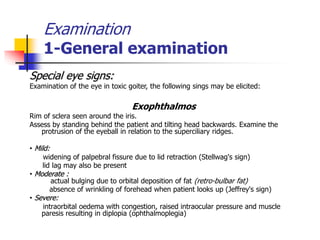
Special eye signs:
Examination of the eye in toxic goiter, the following sings may be elicited:
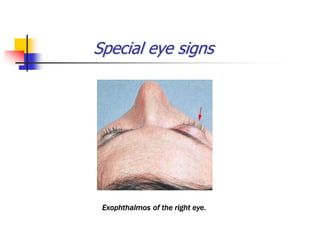
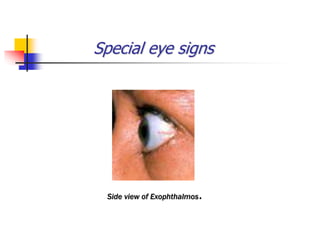
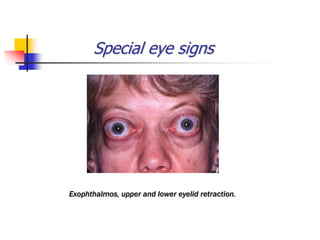
Exophthalmos
Rim of sclera seen around the iris.
Assess by standing behind the patient and tilting head backwards. Examine the
protrusion of the eyeball in relation to the superciliary ridges.
• Mild:
widening of palpebral fissure due to lid retraction (Stellwag's sign)
lid lag may also be present
• Moderate :
actual bulging due to orbital deposition of fat (retro-bulbar fat)
absence of wrinkling of forehead when patient looks up (Jeffrey's sign)
• Severe:
intraorbital oedema with congestion, raised intraocular pressure and muscle
paresis resulting in diplopia (ophthalmoplegia)
Special eye signs
Exophthalmos of the right eye.
Special eye signs
Side view of Exophthalmos.
Special eye signs
Exophthalmos, upper and lower eyelid retraction.
Examination
1-General examination
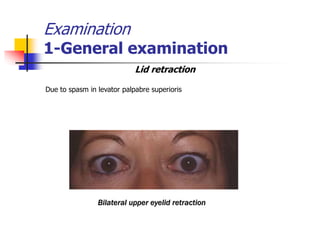
Lid retraction
Due to spasm in levator palpabre superioris
Bilateral upper eyelid retraction
Examination
1-General examination
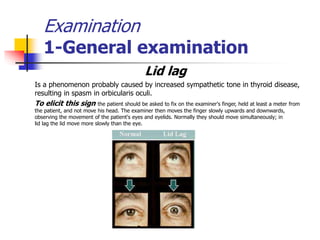
Lid lag
Is a phenomenon probably caused by increased sympathetic tone in thyroid disease,
resulting in spasm in orbicularis oculi.
To elicit this sign the patient should be asked to fix on the examiner's finger, held at least a meter from
the patient, and not move his head. The examiner then moves the finger slowly upwards and downwards,
observing the movement of the patient's eyes and eyelids. Normally they should move simultaneously; in
lid lag the lid move more slowly than the eye.
Examination
1-General examination
Mobius sign
Weakness of convergence of the eye on looking to a very near object.
Stellwag sign (staring look)
Infrequent blinking.
Joffroy sign (rosenbach)
Absence of wrinkling of forehead skin as the patient looks upward.
Examination
1-General examination
Lip:
Pallor
Cyanosis
Oral cavity:
Tongue (tremors-lingual thyroid in posterior 1/3 of tongue)
Upper limb:
Skin
Pulse (to evaluate the degree of toxicity)
Palm (moist and warm)
Fingers (tremors)
Nails (pallor- cyanosis)
Examination
1-General examination
Chest and heart:
Dullness of the superior mediastinum.
Metastasis.
Malignant pleural effusion.
Abdomen:
Liver and/ or spleen enlargement in thyroiditis and lymphoma.
Lower limb:
Edema (pretibial myxodema-heart failure) .
Back and skeleton:
To exclude metastasis.
2-Local examination
Inspection
The normal gland is not visible. Inspection should never be hurried,
for it is a highly important method of obtaining information
regarding swellings of the gland
Site: In the lower front part of the neck.
Size:
Shape: diffuse-symmetrical
Irregular
Skin over :Skin moves with and on thyroid, if fixed to thyroid = cancer
scar-dilated-veins- ulceration or fungation
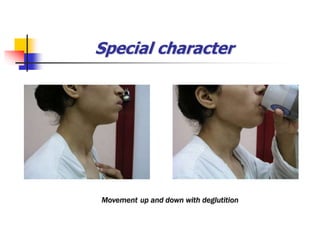
Special character:
Movement up and down with deglutition
Limited mobility in neoplastic infiltration or inflammation.
Pulsation: in the lower border
2-Local examination
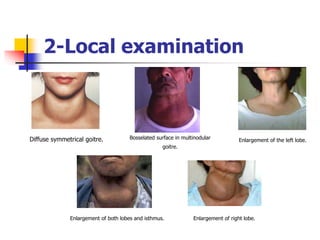
Diffuse symmetrical goitre. Bosselated surface in multinodular
goitre.
Enlargement of the left lobe.
Enlargement of right lobe.Enlargement of both lobes and isthmus.
Special character
Movement up and down with deglutition
2-Local examination
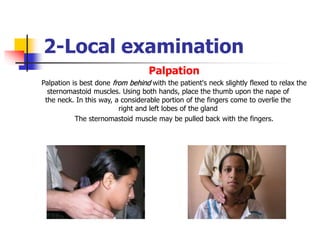
Palpation
Palpation is best done from behind with the patient's neck slightly flexed to relax the
sternomastoid muscles. Using both hands, place the thumb upon the nape of
the neck. In this way, a considerable portion of the fingers come to overlie the
right and left lobes of the gland
The sternomastoid muscle may be pulled back with the fingers.
2-Local examination
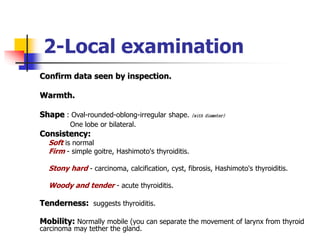
Confirm data seen by inspection.
Warmth.
Shape : Oval-rounded-oblong-irregular shape. (with diameter)
One lobe or bilateral.
Consistency:
Soft is normal
Firm - simple goitre, Hashimoto's thyroiditis.
Stony hard - carcinoma, calcification, cyst, fibrosis, Hashimoto's thyroiditis.
Woody and tender - acute thyroiditis.
Tenderness: suggests thyroiditis.
Mobility: Normally mobile (you can separate the movement of larynx from thyroid
carcinoma may tether the gland.
2-Local examination
Surface:
When the gland is enlarged, determine whether its surface is smooth (as
is found in primary thyrotoxicosis and colloidal goitre) or bosselated
(nodularity)(characteristic of multinodular goitre).
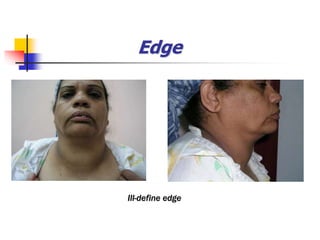
Edge:
Try to determine definitely the shape and position of the lower limits of
an enlarged thyroid gland. (retrosternal goitre).
Well-define
Ill-define
Relation to the surrounding structures:
Skin
Muscle
Blood vessels
Trachea
Thrill on the upper pole of the gland.
Edge
Well-define edge
Edge
Ill-define edge
2-Local examination
Percussion
Percussion over the manubrium sterni, normally it is resonant. If
dull it indicats the presence of retrosternal goitre or mediastinal
lymph nodes.
Auscultation
Put a stethoscope on the gland, a systolic or even a machinary
murmur may be heared in case of highly vascular thyrotoxic
gland. Specially on the superior pole.
Arterial bruit & venous hump.
Diagnosis
Diagnosis
1- Anatomical diagnosis:
A) Is it thyroid swelling or not?
-anatomical site of thyroid
-move up-and-down with deglutition.
b) The swelling is located to one portion of the
gland or diffuse.
c) Solitary nodule or multinodular goitre.
Diagnosis
2- Pathological diagnosis:
The clinician must answer the following questions:
-Is it simple or toxic goitre?
-if simple, is it diffuse or nodular?
- if toxic , is it primary or secondary toxic goitre?
b) Is it malignant goitre or not?
c) Is it Thyroiditis?
d) Does the swelling extend behind the sternum?
Retrosternal goitre.
e) Is the swelling obstructing the trachea?
f) Is there is evidence of myxodema?
3- Associated conditions:
- heart failure (thyro-cardia)in toxic goitre.
- Signs and symptoms of metastasis:
In chest, bones, liver and in porta-hepatis.
Retrosternal goitre
Clinical data in retrosternal goitre:
1-Fullness in the suprasternal notch.
2-I cannot get below the lower edge of the swelling.
3-Dull manubrum sterni on percussion.
4-Dilated veins crossing the upper part of the sternum.
5-In severe cases dilated non-pulsating neck veins.
6-Fainting attacks on stopping forward.
7-X-ray soft tissue shadow in the neck and superior
mediastinum.
8-signs and symptoms of tracheal obstruction:(sense of
suffocation)
Malignant thyroid
Criteria of malignant thyroid:
1. age of the patient
2. Course and duration: increase rate of growth in short
duration.
3. Pain locally in thyroid and referred to the ear.
4. Hardness of part or whole of the swelling.
5. Loss of mobility of the gland.
6. Berry sign: the carotid tree not displaced backwards but
actual infiltration of the blood vessels.
7. Local pressure and infiltration:
1. hoarseness of voice
2. Horner syndrome
3. tracheal obstruction
4. dysphagia
8. lymph nodes enlargement
9. symptoms of metastasis
Investigation:
1-Thyroid function tests
To detect functional (hormonal) status of the gland.
↑T3, ↑ T4, ↓ TSH → toxic.
↓T3, ↓ T4, ↑ TSH → hypothyroid.
Normal T3, T4, TSH → euothyroid
Investigation:
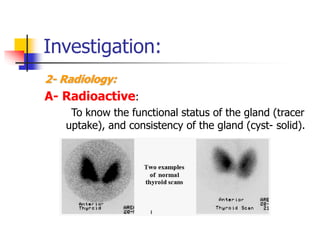
2- Radiology:
A- Radioactive:
To know the functional status of the gland (tracer
uptake), and consistency of the gland (cyst- solid).
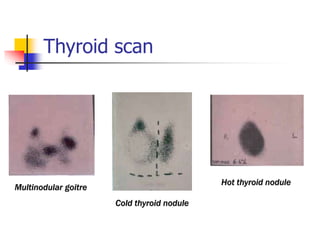
Thyroid scan
Multinodular goitre
Cold thyroid nodule
Hot thyroid nodule
Investigation:
B- Ultrasound:
Sonography detects the internal structure of the thyroid
gland and the regional anatomy and pathology without using
ionizing radiation or iodine containing contrast medium. The
procedure is safe, does not cause damage to tissue.
If cyst → aspirate
If solid → FNA biopsy.
Investigation:
3- Fine Needle Aspiration Biopsy of the
Thyroid Gland
Fine-needle aspiration (FNA) biopsy of the thyroid gland
is now an established, accurate diagnostic test that is
routinely used as the first step in the evaluation of
nodular thyroid disease.
Can differentiate simple from malignant thyroid
(papillary carcinoma- anaplastic carcinoma-
medullary carcinoma). But can not differentiate
follicular carcinoma from follicular adenoma.
Investigation:
General investigation:
Routine preoperative (CBC-liver function tests-kidney
function tests)
ENT examination: assessment of vocal cords mobility.
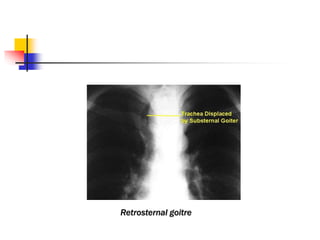
Chest X-ray: to see position of the trachea and retrosternal
goitre.
Retrosternal goitre

Thyroid case sheet

  • 1.
    Prof. Dr. EmamFakhr Prof. of general surgery AIN SHAMS UNIVERSITY Thyroid case sheet
  • 2.
    Personal history Name Age :Age of the patient can aid to the provisional clinical diagnosis. i.e. Thyroid swelling Since birth e.g. cretinism with goitre. Puberty e.g. physiological goitre, solitary nodule (papillary carcinoma) 25-35 years e.g. diffuse toxic goitre, SMNG 40-45 e.g. multinodular goitre ,follicular carcinoma, autoimmune. 50-60 e.g. anaplastic carcinoma. Sex : Goitre is more common in female than male. Residence : Nodular goitre is common in some localities than others.
  • 3.
    Complaint 1-Swelling. (in thelower front part of the neck, either painful or painless) 2-Toxic symptoms. 3-Pressure symptoms . 4-Metastesis (chest, bone,..)
  • 4.
    History of presentillness Analysis of complaint & leading questions 1-Thyroid swelling Onset Sudden = hemorrhage in nodule in simple nodular goitre. Acute = inflammation. Gradual onset = simple nodular goitre, toxic goitre & malignant goitre. Course Progressive in (simple nodular goitre, toxic goitre). Rapidly progressive in malignant goitre. Stationary =physiological goitre. Duration Few months or even weeks in physiological goitre. Relative long duration in simple nodular goitre. Short duration in malignant goitre.
  • 5.
    History of presentillness Relation of pain to swelling. Pain then swelling=inflammation. Swelling then pain= malignancy. Painful thyroid swelling Hemorrhage occurs within a nodule of nodular goitre. Malignant goitre (local and referred pain). Thyroiditis. The presence of any apparent causes: psychic trauma. Drugs . Residence of patient. The effect on general condition. Malignant cachexia ,tiredness with toxicity. Other swelling of the body. Metastasis in skull-ribs-sturnum-iliac bones-lumber spine.
  • 6.
    History of presentillness 2-toxic symptoms: Metabolic symptoms: Increase appetite together with progressive loss of weight. Nervous symptoms: (may be lacking due to antithyroid drugs) More common in young age. Insomnia. Tremor. Anxiety. Disorientation. Psychosis. Thyrotoxic neuropathy (rare). Acute thyrotoxic encephalopathy (very rare). Seizures (with or without an underlying abnormality). Neuropathy secondary to nerve entrapment by lesions of pretibial myxedema Chorea and athetoid movements (rare). Myopathy. (Myasthenia gravis -- associated).
  • 7.
    History of presentillness Cardiovascular symptoms: More common in old age or cardiac patient. Tachycardia. Premature atrial and ventricular contractions. Atrial fibrillation. Congestive heart failure. (resistant to drugs) Angina with (or without) coronary artery disease. Myocardial infarction. Systemic embolization. Death from cardiovascular collapse. Resistance to some drug effects (digoxin, coumadin). Residual cardiomegaly .
  • 8.
    History of presentillness Muscular symptoms: The muscular symptoms vary from mild myasthenia to profound muscular weakness and atrophy, especially of proximal muscle groups. Commonest muscle affected are extra-occular muscles quadriceps femoris temporalis muscle muscles of the back
  • 9.
    History of presentillness Eye symptoms: Staring or frightened expression Lid reaction. Diplopia. Blurred vision due to inadequate convergence and accommodation. Chemosis, corneal injection, or ulceration. Irritation of the eye or pain in the globe. Exophthalmos (also produces mechanically a wide palpebral fissure) . Decreased visual acuity due to papilledema, retinal edema, retinal hemorrhages, or optic nerve damage.
  • 10.
    History of presentillness Vasomotor symptoms: Cutaneous manifestations are nearly always present when hypermetabolism is significant. The patient feels hot and prefers a cold environment. The hand of the thyrotoxic person is erythematous, hot, and moist (sometimes actually dripping wet), in a state of hot hyperhydrosis. Flushing is also very common. Occasionally diffuse pruritis or urticaria occurs. Gastrointestinal symptoms: The appetite is characteristically increased. loss of weight. Colic and intestinal hurry (diarrhea). Indeed, the pattern of weight loss with increased appetite is nearly pathognomonic of thyrotoxicosis although it may occur in diabetes mellitus and malabsorption or intestinal parasitism.
  • 11.
    History of presentillness Urinary symptoms: Polyuria and occasionally glycosuria are seen in uncomplicated thyrotoxicosis. Sexual symptoms: In female : menorrhagia at first and oligomenorrhea and finally amenorrhea. In males : impotence. (late)
  • 12.
    History of presentillness 3-pressure symptoms More in malignant swelling 2 tubes (a)Esophagus: dysphagia Rare in large goitre but in malignant goitre is common due to infiltration, here dysphagia is persistent and progressive. And retrosternal doitre. (b) Trachea: dyspnea Large goitre which lead to pressure from one side or from both sides or from the front of the trachea as in retrosternal goitre. or infiltration of trachea. 3 nerves (a) Recurrent laryngeal nerve (hoarseness of voice) in malignant and retrosternal goitre (b) Sympathatic chain (horner syndrome)rare, dry nose (c) Internal laryngeal nerve (malignant chocking), 2 vessels (a) Carotid arteries –syncopal attack (b) Internal jugular vein -congestion of the face -congestion of neck veins -black out: fainting attacks on stooping forwards.
  • 13.
    Past history 1. Psychictrauma. 2. History of treatment of thyroid disease. 3. History of thyroid operation. 4. History of previous radiotherapy. 5. History of goitrogenic drug.
  • 14.
  • 15.
    Examination 1-General examination Fasces (starringlook, sweaty, irritable) in toxicity Built-attitude-facial expression. Blood pressure. Pulse : Rate Tachycardia in toxic goiter Bradicardia in myxodema Rhythm (regular, extra systole, regular irregularity , AF) Character (WATER HAMMER PULSE) Equality on both sides Temperature: Hot hands and sweaty(in psychosis sweaty, cold) Subnormal in myxodema
  • 16.
    Examination 1-General examination The scalp: Metastasis(character of thyroid metastasis). Parietal-solitary-fleshy-pulsating-functioning Temporalis muscle atrophy in toxic goiter. Hair loss in myxodema. The face: Eye brow: loss of outer 1/3 in myxodema. Upper eye lid: buffness- ptosis. Special eye signs.
  • 17.
    Examination 1-General examination Special eyesigns: Examination of the eye in toxic goiter, the following sings may be elicited: Exophthalmos Rim of sclera seen around the iris. Assess by standing behind the patient and tilting head backwards. Examine the protrusion of the eyeball in relation to the superciliary ridges. • Mild: widening of palpebral fissure due to lid retraction (Stellwag's sign) lid lag may also be present • Moderate : actual bulging due to orbital deposition of fat (retro-bulbar fat) absence of wrinkling of forehead when patient looks up (Jeffrey's sign) • Severe: intraorbital oedema with congestion, raised intraocular pressure and muscle paresis resulting in diplopia (ophthalmoplegia)
  • 18.
  • 19.
    Special eye signs Sideview of Exophthalmos.
  • 20.
    Special eye signs Exophthalmos,upper and lower eyelid retraction.
  • 21.
    Examination 1-General examination Lid retraction Dueto spasm in levator palpabre superioris Bilateral upper eyelid retraction
  • 22.
    Examination 1-General examination Lid lag Isa phenomenon probably caused by increased sympathetic tone in thyroid disease, resulting in spasm in orbicularis oculi. To elicit this sign the patient should be asked to fix on the examiner's finger, held at least a meter from the patient, and not move his head. The examiner then moves the finger slowly upwards and downwards, observing the movement of the patient's eyes and eyelids. Normally they should move simultaneously; in lid lag the lid move more slowly than the eye.
  • 23.
    Examination 1-General examination Mobius sign Weaknessof convergence of the eye on looking to a very near object. Stellwag sign (staring look) Infrequent blinking. Joffroy sign (rosenbach) Absence of wrinkling of forehead skin as the patient looks upward.
  • 24.
    Examination 1-General examination Lip: Pallor Cyanosis Oral cavity: Tongue(tremors-lingual thyroid in posterior 1/3 of tongue) Upper limb: Skin Pulse (to evaluate the degree of toxicity) Palm (moist and warm) Fingers (tremors) Nails (pallor- cyanosis)
  • 25.
    Examination 1-General examination Chest andheart: Dullness of the superior mediastinum. Metastasis. Malignant pleural effusion. Abdomen: Liver and/ or spleen enlargement in thyroiditis and lymphoma. Lower limb: Edema (pretibial myxodema-heart failure) . Back and skeleton: To exclude metastasis.
  • 26.
    2-Local examination Inspection The normalgland is not visible. Inspection should never be hurried, for it is a highly important method of obtaining information regarding swellings of the gland Site: In the lower front part of the neck. Size: Shape: diffuse-symmetrical Irregular Skin over :Skin moves with and on thyroid, if fixed to thyroid = cancer scar-dilated-veins- ulceration or fungation Special character: Movement up and down with deglutition Limited mobility in neoplastic infiltration or inflammation. Pulsation: in the lower border
  • 27.
    2-Local examination Diffuse symmetricalgoitre. Bosselated surface in multinodular goitre. Enlargement of the left lobe. Enlargement of right lobe.Enlargement of both lobes and isthmus.
  • 28.
    Special character Movement upand down with deglutition
  • 29.
    2-Local examination Palpation Palpation isbest done from behind with the patient's neck slightly flexed to relax the sternomastoid muscles. Using both hands, place the thumb upon the nape of the neck. In this way, a considerable portion of the fingers come to overlie the right and left lobes of the gland The sternomastoid muscle may be pulled back with the fingers.
  • 30.
    2-Local examination Confirm dataseen by inspection. Warmth. Shape : Oval-rounded-oblong-irregular shape. (with diameter) One lobe or bilateral. Consistency: Soft is normal Firm - simple goitre, Hashimoto's thyroiditis. Stony hard - carcinoma, calcification, cyst, fibrosis, Hashimoto's thyroiditis. Woody and tender - acute thyroiditis. Tenderness: suggests thyroiditis. Mobility: Normally mobile (you can separate the movement of larynx from thyroid carcinoma may tether the gland.
  • 31.
    2-Local examination Surface: When thegland is enlarged, determine whether its surface is smooth (as is found in primary thyrotoxicosis and colloidal goitre) or bosselated (nodularity)(characteristic of multinodular goitre). Edge: Try to determine definitely the shape and position of the lower limits of an enlarged thyroid gland. (retrosternal goitre). Well-define Ill-define Relation to the surrounding structures: Skin Muscle Blood vessels Trachea Thrill on the upper pole of the gland.
  • 32.
  • 33.
  • 34.
    2-Local examination Percussion Percussion overthe manubrium sterni, normally it is resonant. If dull it indicats the presence of retrosternal goitre or mediastinal lymph nodes. Auscultation Put a stethoscope on the gland, a systolic or even a machinary murmur may be heared in case of highly vascular thyrotoxic gland. Specially on the superior pole. Arterial bruit & venous hump.
  • 35.
    Diagnosis Diagnosis 1- Anatomical diagnosis: A)Is it thyroid swelling or not? -anatomical site of thyroid -move up-and-down with deglutition. b) The swelling is located to one portion of the gland or diffuse. c) Solitary nodule or multinodular goitre.
  • 36.
    Diagnosis 2- Pathological diagnosis: Theclinician must answer the following questions: -Is it simple or toxic goitre? -if simple, is it diffuse or nodular? - if toxic , is it primary or secondary toxic goitre? b) Is it malignant goitre or not? c) Is it Thyroiditis? d) Does the swelling extend behind the sternum? Retrosternal goitre. e) Is the swelling obstructing the trachea? f) Is there is evidence of myxodema? 3- Associated conditions: - heart failure (thyro-cardia)in toxic goitre. - Signs and symptoms of metastasis: In chest, bones, liver and in porta-hepatis.
  • 37.
    Retrosternal goitre Clinical datain retrosternal goitre: 1-Fullness in the suprasternal notch. 2-I cannot get below the lower edge of the swelling. 3-Dull manubrum sterni on percussion. 4-Dilated veins crossing the upper part of the sternum. 5-In severe cases dilated non-pulsating neck veins. 6-Fainting attacks on stopping forward. 7-X-ray soft tissue shadow in the neck and superior mediastinum. 8-signs and symptoms of tracheal obstruction:(sense of suffocation)
  • 38.
    Malignant thyroid Criteria ofmalignant thyroid: 1. age of the patient 2. Course and duration: increase rate of growth in short duration. 3. Pain locally in thyroid and referred to the ear. 4. Hardness of part or whole of the swelling. 5. Loss of mobility of the gland. 6. Berry sign: the carotid tree not displaced backwards but actual infiltration of the blood vessels. 7. Local pressure and infiltration: 1. hoarseness of voice 2. Horner syndrome 3. tracheal obstruction 4. dysphagia 8. lymph nodes enlargement 9. symptoms of metastasis
  • 39.
    Investigation: 1-Thyroid function tests Todetect functional (hormonal) status of the gland. ↑T3, ↑ T4, ↓ TSH → toxic. ↓T3, ↓ T4, ↑ TSH → hypothyroid. Normal T3, T4, TSH → euothyroid
  • 40.
    Investigation: 2- Radiology: A- Radioactive: Toknow the functional status of the gland (tracer uptake), and consistency of the gland (cyst- solid).
  • 41.
    Thyroid scan Multinodular goitre Coldthyroid nodule Hot thyroid nodule
  • 42.
    Investigation: B- Ultrasound: Sonography detectsthe internal structure of the thyroid gland and the regional anatomy and pathology without using ionizing radiation or iodine containing contrast medium. The procedure is safe, does not cause damage to tissue. If cyst → aspirate If solid → FNA biopsy.
  • 43.
    Investigation: 3- Fine NeedleAspiration Biopsy of the Thyroid Gland Fine-needle aspiration (FNA) biopsy of the thyroid gland is now an established, accurate diagnostic test that is routinely used as the first step in the evaluation of nodular thyroid disease. Can differentiate simple from malignant thyroid (papillary carcinoma- anaplastic carcinoma- medullary carcinoma). But can not differentiate follicular carcinoma from follicular adenoma.
  • 44.
    Investigation: General investigation: Routine preoperative(CBC-liver function tests-kidney function tests) ENT examination: assessment of vocal cords mobility. Chest X-ray: to see position of the trachea and retrosternal goitre.
  • 45.