Case 7.1
Breast Cancer
BY: Abdullatiff Sami AL-Rashed
1
Objectives
2
1. What Is Breast Cancer.
2. Types of Breast Cancer.
3. Etiology of breast cancer.
4. Risk factors.
5. Signs and symptoms.
6. Investigations.
7. Treatment.
8. Prevention.
9. Screening.
10. Question asked by my colleagues.
What Is Breast Cancer
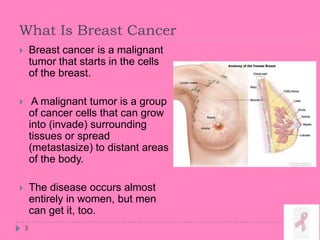
 Breast cancer is a malignant
tumor that starts in the cells
of the breast.
 A malignant tumor is a group
of cancer cells that can grow
into (invade) surrounding
tissues or spread
(metastasize) to distant areas
of the body.
 The disease occurs almost
entirely in women, but men
can get it, too.
3
What Is Breast Cancer
 Most commonly from the inner
lining of milk ducts or the lobules
that supply the ducts with milk.
 Cancers originating from ducts
are known as ductal carcinomas,
while those originating from
lobules are known as lobular
carcinomas.
4
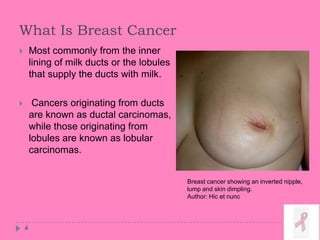
Breast cancer showing an inverted nipple,
lump and skin dimpling.
Author: Hic et nunc
Types of Breast Cancer
5
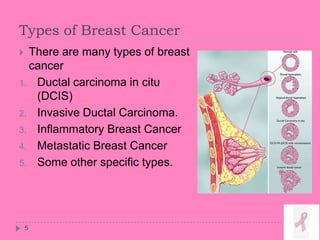
 There are many types of breast
cancer
1. Ductal carcinoma in citu
(DCIS)
2. Invasive Ductal Carcinoma.
3. Inflammatory Breast Cancer
4. Metastatic Breast Cancer
5. Some other specific types.
Types of Breast Cancer
6
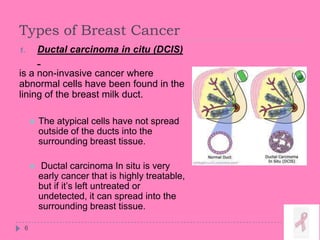
1. Ductal carcinoma in citu (DCIS)
is a non-invasive cancer where
abnormal cells have been found in the
lining of the breast milk duct.
 The atypical cells have not spread
outside of the ducts into the
surrounding breast tissue.
 Ductal carcinoma In situ is very
early cancer that is highly treatable,
but if it’s left untreated or
undetected, it can spread into the
surrounding breast tissue.
Types of Breast Cancer
7
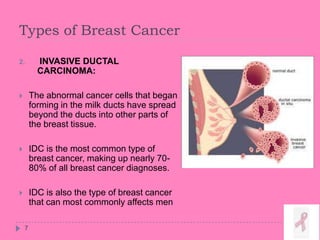
2. INVASIVE DUCTAL
CARCINOMA:
 The abnormal cancer cells that began
forming in the milk ducts have spread
beyond the ducts into other parts of
the breast tissue.
 IDC is the most common type of
breast cancer, making up nearly 70-
80% of all breast cancer diagnoses.
 IDC is also the type of breast cancer
that can most commonly affects men
8
Types of Breast Cancer
9
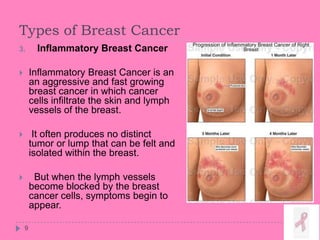
3. Inflammatory Breast Cancer
 Inflammatory Breast Cancer is an
an aggressive and fast growing
breast cancer in which cancer
cells infiltrate the skin and lymph
vessels of the breast.
 It often produces no distinct
tumor or lump that can be felt and
isolated within the breast.
 But when the lymph vessels
become blocked by the breast
cancer cells, symptoms begin to
appear.
Types of Breast Cancer
10
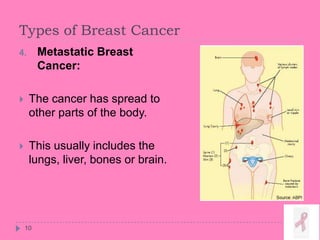
4. Metastatic Breast
Cancer:
 The cancer has spread to
other parts of the body.
 This usually includes the
lungs, liver, bones or brain.
11
Etiology
12
 When you're told that someone have
breast cancer, it’s natural to wonder
what may have caused the disease.
 But no one knows the exact causes
of breast cancer.
 Doctors seldom know why one
woman develops breast cancer and
another doesn’t, and most women
who have breast cancer will never be
able to pinpoint an exact cause.
 What we do know is that breast
cancer is always caused by damage
to a cell's DNA.
Etiology Cont..
13
 But doctors have known
some risk factors that
increase the chance to
get a breast cancer.
 Women with certain risk
factors are more likely
than others to develop
breast cancer.
Risk Factors
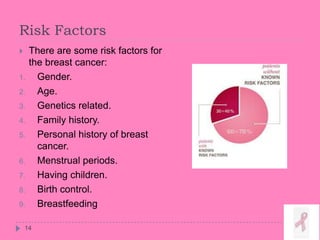
 There are some risk factors for
the breast cancer:
1. Gender.
2. Age.
3. Genetics related.
4. Family history.
5. Personal history of breast
cancer.
6. Menstrual periods.
7. Having children.
8. Birth control.
9. Breastfeeding
14
Risk Factors
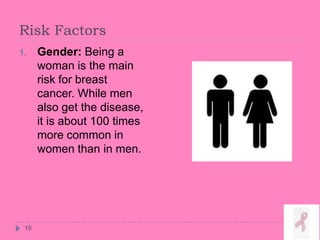
1. Gender: Being a
woman is the main
risk for breast
cancer. While men
also get the disease,
it is about 100 times
more common in
women than in men.
15
Risk Factors
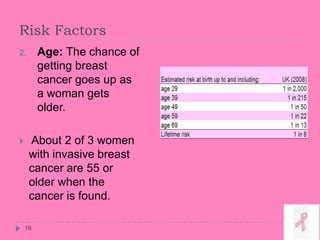
2. Age: The chance of
getting breast
cancer goes up as
a woman gets
older.
 About 2 of 3 women
with invasive breast
cancer are 55 or
older when the
cancer is found.
16
Risk Factors
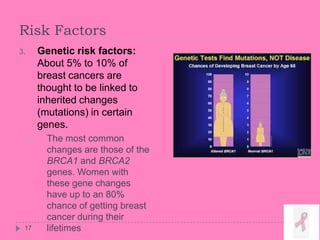
3. Genetic risk factors:
About 5% to 10% of
breast cancers are
thought to be linked to
inherited changes
(mutations) in certain
genes.
3. The most common
changes are those of the
BRCA1 and BRCA2
genes. Women with
these gene changes
have up to an 80%
chance of getting breast
cancer during their
lifetimes17
Risk Factors
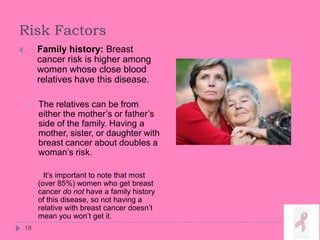
4. Family history: Breast
cancer risk is higher among
women whose close blood
relatives have this disease.
 The relatives can be from
either the mother’s or father’s
side of the family. Having a
mother, sister, or daughter with
breast cancer about doubles a
woman’s risk.
 It’s important to note that most
(over 85%) women who get breast
cancer do not have a family history
of this disease, so not having a
relative with breast cancer doesn’t
mean you won’t get it.
18
Risk Factors
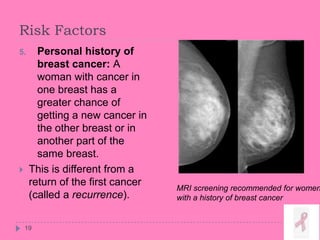
5. Personal history of
breast cancer: A
woman with cancer in
one breast has a
greater chance of
getting a new cancer in
the other breast or in
another part of the
same breast.
 This is different from a
return of the first cancer
(called a recurrence).
19
MRI screening recommended for women
with a history of breast cancer
Risk Factors
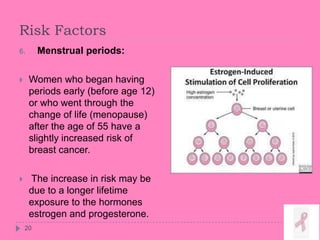
6. Menstrual periods:
 Women who began having
periods early (before age 12)
or who went through the
change of life (menopause)
after the age of 55 have a
slightly increased risk of
breast cancer.
 The increase in risk may be
due to a longer lifetime
exposure to the hormones
estrogen and progesterone.
20
Risk Factors
21
7. Having Children:
 Women who have had no
children or who had their
first child after age 30 have
a slightly higher breast
cancer risk.
 Having many pregnancies
and becoming pregnant at a
young age reduce breast
cancer risk.
Risk Factors
22
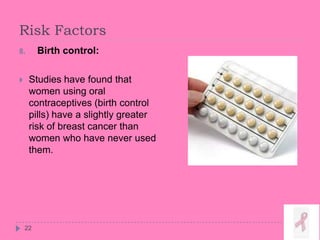
8. Birth control:
 Studies have found that
women using oral
contraceptives (birth control
pills) have a slightly greater
risk of breast cancer than
women who have never used
them.
Risk Factors
23
9. Breastfeeding:
 Some studies suggest
that breastfeeding may
slightly lower breast
cancer risk, especially if
breastfeeding is
continued for 1½ to 2
years.
24
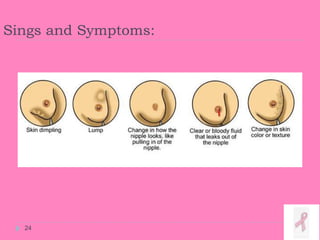
Sings and Symptoms:
Investigations
25
 Doctors can investigate the
breast cancer by doing:
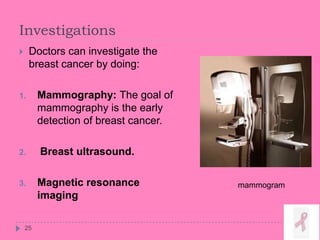
1. Mammography: The goal of
mammography is the early
detection of breast cancer.
2. Breast ultrasound.
3. Magnetic resonance
imaging
mammogram
Investigations
26
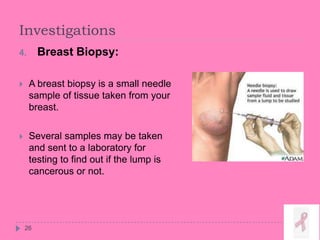
4. Breast Biopsy:
 A breast biopsy is a small needle
sample of tissue taken from your
breast.
 Several samples may be taken
and sent to a laboratory for
testing to find out if the lump is
cancerous or not.
Treatment
27
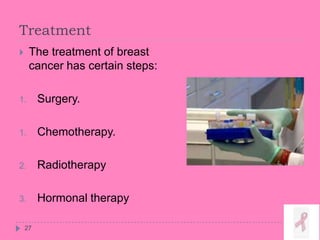
 The treatment of breast
cancer has certain steps:
1. Surgery.
1. Chemotherapy.
2. Radiotherapy
3. Hormonal therapy
Treatment Cont..
28
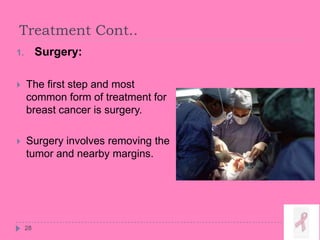
1. Surgery:
 The first step and most
common form of treatment for
breast cancer is surgery.
 Surgery involves removing the
tumor and nearby margins.
Treatment Cont..
29
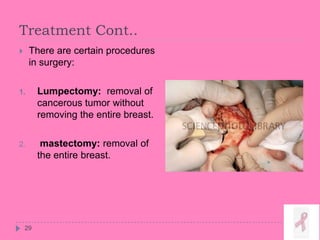
 There are certain procedures
in surgery:
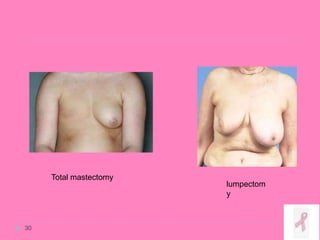
1. Lumpectomy: removal of
cancerous tumor without
removing the entire breast.
2. mastectomy: removal of
the entire breast.
30
lumpectom
y
Total mastectomy
Treatment Cont..
31
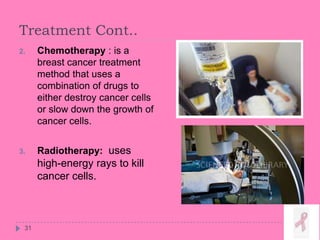
2. Chemotherapy : is a
breast cancer treatment
method that uses a
combination of drugs to
either destroy cancer cells
or slow down the growth of
cancer cells.
3. Radiotherapy: uses
high-energy rays to kill
cancer cells.
Treatment Cont..
32
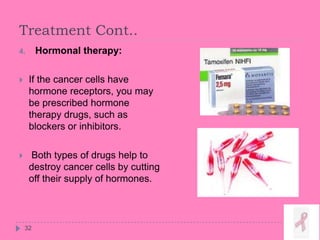
4. Hormonal therapy:
 If the cancer cells have
hormone receptors, you may
be prescribed hormone
therapy drugs, such as
blockers or inhibitors.
 Both types of drugs help to
destroy cancer cells by cutting
off their supply of hormones.
Prevention
33
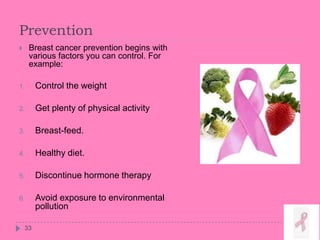
 Breast cancer prevention begins with
various factors you can control. For
example:
1. Control the weight
2. Get plenty of physical activity
3. Breast-feed.
4. Healthy diet.
5. Discontinue hormone therapy
6. Avoid exposure to environmental
pollution
Screening
34
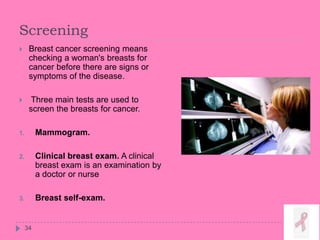
 Breast cancer screening means
checking a woman's breasts for
cancer before there are signs or
symptoms of the disease.
 Three main tests are used to
screen the breasts for cancer.
1. Mammogram.
2. Clinical breast exam. A clinical
breast exam is an examination by
a doctor or nurse
3. Breast self-exam.
Why women are more common to have breast
cancer than men?
35
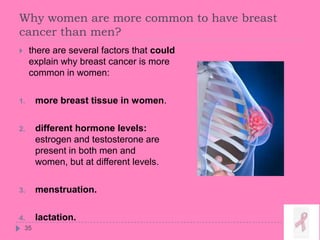
 there are several factors that could
explain why breast cancer is more
common in women:
1. more breast tissue in women.
2. different hormone levels:
estrogen and testosterone are
present in both men and
women, but at different levels.
3. menstruation.
4. lactation.
How we can repair the breast after
mastectomy?
36
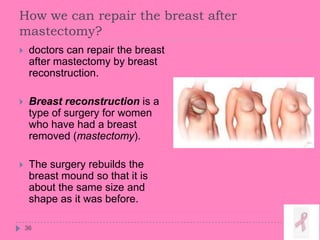
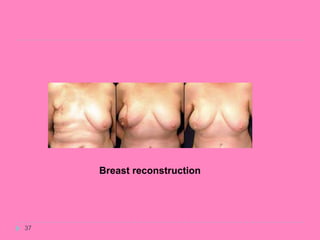
 doctors can repair the breast
after mastectomy by breast
reconstruction.
 Breast reconstruction is a
type of surgery for women
who have had a breast
removed (mastectomy).
 The surgery rebuilds the
breast mound so that it is
about the same size and
shape as it was before.
37
Breast reconstruction
References
 http://www.cancer.org/Cancer/BreastCancer/Detailed
Guide/breast-cancer-what-is-breast-cancer
 http://www.nationalbreastcancer.org
 http://www.cancer.org/cancer/breastcancer/moreinfor
mation/breastreconstructionaftermastectomy/breast-
reconstruction-after-mastectomy-what-is-br-recon
38
39

Breast Cancer

  • 1.
    Case 7.1 Breast Cancer BY:Abdullatiff Sami AL-Rashed 1
  • 2.
    Objectives 2 1. What IsBreast Cancer. 2. Types of Breast Cancer. 3. Etiology of breast cancer. 4. Risk factors. 5. Signs and symptoms. 6. Investigations. 7. Treatment. 8. Prevention. 9. Screening. 10. Question asked by my colleagues.
  • 3.
    What Is BreastCancer  Breast cancer is a malignant tumor that starts in the cells of the breast.  A malignant tumor is a group of cancer cells that can grow into (invade) surrounding tissues or spread (metastasize) to distant areas of the body.  The disease occurs almost entirely in women, but men can get it, too. 3
  • 4.
    What Is BreastCancer  Most commonly from the inner lining of milk ducts or the lobules that supply the ducts with milk.  Cancers originating from ducts are known as ductal carcinomas, while those originating from lobules are known as lobular carcinomas. 4 Breast cancer showing an inverted nipple, lump and skin dimpling. Author: Hic et nunc
  • 5.
    Types of BreastCancer 5  There are many types of breast cancer 1. Ductal carcinoma in citu (DCIS) 2. Invasive Ductal Carcinoma. 3. Inflammatory Breast Cancer 4. Metastatic Breast Cancer 5. Some other specific types.
  • 6.
    Types of BreastCancer 6 1. Ductal carcinoma in citu (DCIS) is a non-invasive cancer where abnormal cells have been found in the lining of the breast milk duct.  The atypical cells have not spread outside of the ducts into the surrounding breast tissue.  Ductal carcinoma In situ is very early cancer that is highly treatable, but if it’s left untreated or undetected, it can spread into the surrounding breast tissue.
  • 7.
    Types of BreastCancer 7 2. INVASIVE DUCTAL CARCINOMA:  The abnormal cancer cells that began forming in the milk ducts have spread beyond the ducts into other parts of the breast tissue.  IDC is the most common type of breast cancer, making up nearly 70- 80% of all breast cancer diagnoses.  IDC is also the type of breast cancer that can most commonly affects men
  • 8.
  • 9.
    Types of BreastCancer 9 3. Inflammatory Breast Cancer  Inflammatory Breast Cancer is an an aggressive and fast growing breast cancer in which cancer cells infiltrate the skin and lymph vessels of the breast.  It often produces no distinct tumor or lump that can be felt and isolated within the breast.  But when the lymph vessels become blocked by the breast cancer cells, symptoms begin to appear.
  • 10.
    Types of BreastCancer 10 4. Metastatic Breast Cancer:  The cancer has spread to other parts of the body.  This usually includes the lungs, liver, bones or brain.
  • 11.
  • 12.
    Etiology 12  When you'retold that someone have breast cancer, it’s natural to wonder what may have caused the disease.  But no one knows the exact causes of breast cancer.  Doctors seldom know why one woman develops breast cancer and another doesn’t, and most women who have breast cancer will never be able to pinpoint an exact cause.  What we do know is that breast cancer is always caused by damage to a cell's DNA.
  • 13.
    Etiology Cont.. 13  Butdoctors have known some risk factors that increase the chance to get a breast cancer.  Women with certain risk factors are more likely than others to develop breast cancer.
  • 14.
    Risk Factors  Thereare some risk factors for the breast cancer: 1. Gender. 2. Age. 3. Genetics related. 4. Family history. 5. Personal history of breast cancer. 6. Menstrual periods. 7. Having children. 8. Birth control. 9. Breastfeeding 14
  • 15.
    Risk Factors 1. Gender:Being a woman is the main risk for breast cancer. While men also get the disease, it is about 100 times more common in women than in men. 15
  • 16.
    Risk Factors 2. Age:The chance of getting breast cancer goes up as a woman gets older.  About 2 of 3 women with invasive breast cancer are 55 or older when the cancer is found. 16
  • 17.
    Risk Factors 3. Geneticrisk factors: About 5% to 10% of breast cancers are thought to be linked to inherited changes (mutations) in certain genes. 3. The most common changes are those of the BRCA1 and BRCA2 genes. Women with these gene changes have up to an 80% chance of getting breast cancer during their lifetimes17
  • 18.
    Risk Factors 4. Familyhistory: Breast cancer risk is higher among women whose close blood relatives have this disease.  The relatives can be from either the mother’s or father’s side of the family. Having a mother, sister, or daughter with breast cancer about doubles a woman’s risk.  It’s important to note that most (over 85%) women who get breast cancer do not have a family history of this disease, so not having a relative with breast cancer doesn’t mean you won’t get it. 18
  • 19.
    Risk Factors 5. Personalhistory of breast cancer: A woman with cancer in one breast has a greater chance of getting a new cancer in the other breast or in another part of the same breast.  This is different from a return of the first cancer (called a recurrence). 19 MRI screening recommended for women with a history of breast cancer
  • 20.
    Risk Factors 6. Menstrualperiods:  Women who began having periods early (before age 12) or who went through the change of life (menopause) after the age of 55 have a slightly increased risk of breast cancer.  The increase in risk may be due to a longer lifetime exposure to the hormones estrogen and progesterone. 20
  • 21.
    Risk Factors 21 7. HavingChildren:  Women who have had no children or who had their first child after age 30 have a slightly higher breast cancer risk.  Having many pregnancies and becoming pregnant at a young age reduce breast cancer risk.
  • 22.
    Risk Factors 22 8. Birthcontrol:  Studies have found that women using oral contraceptives (birth control pills) have a slightly greater risk of breast cancer than women who have never used them.
  • 23.
    Risk Factors 23 9. Breastfeeding: Some studies suggest that breastfeeding may slightly lower breast cancer risk, especially if breastfeeding is continued for 1½ to 2 years.
  • 24.
  • 25.
    Investigations 25  Doctors caninvestigate the breast cancer by doing: 1. Mammography: The goal of mammography is the early detection of breast cancer. 2. Breast ultrasound. 3. Magnetic resonance imaging mammogram
  • 26.
    Investigations 26 4. Breast Biopsy: A breast biopsy is a small needle sample of tissue taken from your breast.  Several samples may be taken and sent to a laboratory for testing to find out if the lump is cancerous or not.
  • 27.
    Treatment 27  The treatmentof breast cancer has certain steps: 1. Surgery. 1. Chemotherapy. 2. Radiotherapy 3. Hormonal therapy
  • 28.
    Treatment Cont.. 28 1. Surgery: The first step and most common form of treatment for breast cancer is surgery.  Surgery involves removing the tumor and nearby margins.
  • 29.
    Treatment Cont.. 29  Thereare certain procedures in surgery: 1. Lumpectomy: removal of cancerous tumor without removing the entire breast. 2. mastectomy: removal of the entire breast.
  • 30.
  • 31.
    Treatment Cont.. 31 2. Chemotherapy: is a breast cancer treatment method that uses a combination of drugs to either destroy cancer cells or slow down the growth of cancer cells. 3. Radiotherapy: uses high-energy rays to kill cancer cells.
  • 32.
    Treatment Cont.. 32 4. Hormonaltherapy:  If the cancer cells have hormone receptors, you may be prescribed hormone therapy drugs, such as blockers or inhibitors.  Both types of drugs help to destroy cancer cells by cutting off their supply of hormones.
  • 33.
    Prevention 33  Breast cancerprevention begins with various factors you can control. For example: 1. Control the weight 2. Get plenty of physical activity 3. Breast-feed. 4. Healthy diet. 5. Discontinue hormone therapy 6. Avoid exposure to environmental pollution
  • 34.
    Screening 34  Breast cancerscreening means checking a woman's breasts for cancer before there are signs or symptoms of the disease.  Three main tests are used to screen the breasts for cancer. 1. Mammogram. 2. Clinical breast exam. A clinical breast exam is an examination by a doctor or nurse 3. Breast self-exam.
  • 35.
    Why women aremore common to have breast cancer than men? 35  there are several factors that could explain why breast cancer is more common in women: 1. more breast tissue in women. 2. different hormone levels: estrogen and testosterone are present in both men and women, but at different levels. 3. menstruation. 4. lactation.
  • 36.
    How we canrepair the breast after mastectomy? 36  doctors can repair the breast after mastectomy by breast reconstruction.  Breast reconstruction is a type of surgery for women who have had a breast removed (mastectomy).  The surgery rebuilds the breast mound so that it is about the same size and shape as it was before.
  • 37.
  • 38.
    References  http://www.cancer.org/Cancer/BreastCancer/Detailed Guide/breast-cancer-what-is-breast-cancer  http://www.nationalbreastcancer.org http://www.cancer.org/cancer/breastcancer/moreinfor mation/breastreconstructionaftermastectomy/breast- reconstruction-after-mastectomy-what-is-br-recon 38
  • 39.