Thyroid and parathyroid
By Laura Bond
Objectives
• Understand what the thyroid and parathyroid
do and how
• Get to grips with calcium homeostasis
• Learn the features of thyroid and parathyroid
disease
• Understand how these diseases are treated
Hypothalamic-pituitary-thyroid axis
Thyroid
Thyroid
peroxidase
Thyroglobulin
Thyroid disease
• Hyper or hypo
• Primary or secondary
• Many different causes
Hyperthyroidism - causes
– Autoimmune = Graves disease
– Infective = De Quervain’s thyroiditis
– Neoplastic = toxic adenoma
– Iatrogenic = drugs such as amiodarone or lithium.
Also from over treating hypothyroidism
Hyperthyroidism - symptoms
– Increased metabolismweight loss and increased
appetite
– Heat intolerance
– Sweating
– Diarrhoea
– Tremor
– Irritability/restlessness
– Psychosis
– Itch
– Oligomenorrhoea
Hyperthyroidism - signs
– Increased pulse rate
– atrial fibrillation
– palmar erythema
– hair thinning
– lid retraction
– goiter, nodules or
bruites
Graves disease
1. Eye signs – exomphalos,
ophthalmoplegia, lid lag
and lid retraction
2. Pretibial myxoedema
3. Thyroid acropachy
Diagnosis
• TSH, free T4 and T3
• Thyroid autoantibodies – antithyroid
peroxidase and antithyroglobulin antibodies.
• TSH receptor antibodies (Graves)
• US
• Isotope scan
Thyroid function tests
Test Cause
TSH, T4 Hypothyroidism
TSH, normal T4 Treated/subclinical hypothyroidism
TSH, T4 TSH tumour or hormone resistance
TSH, T4 Hyperthyroidism
TSH, normal T4 Subclinical hyperthyroidism
TSH,  T4 Sick euthyroidism
Hyperthyroidism - treatment
• Medical
– Beta blockers
– Carbimazole
– Propylthiouracil
– Thyroid ablation with radioactive iodine
• Surgery
– Subtotal thyroidectomy
Hypothyroidism - causes
• Autoimmune
– Hashimoto’s thyroiditis
– primary mxoedema (or primary atrophic
hypothyroidism)
• Dietary – iodine deficiency
• Iatrogenic
• Congenital
Hypothyroidism - symptoms
– Tiredness
– Lethargy
– Depression
– Cold intolerance
– Weight gain
– Constipation
– Menorrhagia
– Hoarse voice
- Dementia
Hypothyroidism - signs
– Bradycardia
– Dry skin and hair
– Ataxia
– Slow reflexes
– Peripheral neuropathy
– Goitre
– Proximal myopathy
Hypothyroidism - treatment
• levothyroxine
The parathyroid gland
Hyperparathyroidism - symptoms
– bones = pain, fractures, osteopaenia and lytic
lesions from  bone reabsorption
– stones = kidney stones
– moans = feeling crap due to depression, tiredness,
weakness
– groans = abdo pain and acute abdomen
(pancreatitis, duodenal ulcers, constipation)
Hyperparathyroidism
PTH Calcium Cause
Primary   solitary adenoma, hyperplasia, carcinoma
Secondary   normal response to a low
Tertiary   in response to long standing secondary
hyperparathyroidism glands become hyperplasic
Malignant   parathyroid related protein (PTrP) released by
squamous cell carcinoma of lung which mimics
PTH. PTrP not detected by PTH assay
Hyperparathyroidism - tests
– calcium and PTH
– ALP would be increased because of bone activity
– DEXA scan shows osteoporosis
– 24 hour urinary calcium
Hyperparathyroidism - treatment
• Mild – fluids, avoid drugs, diet, review
• Severe - surgery
Hypoparathyroidism – signs and
symptoms
• Tetany
• Depression
• Carpo-pedal spasms
• Trousseau’s sign
• Chvostek’s sign
• ECG changes –
Increased Q-T interval
Hypoparathyroidism
PTH Calcium Cause
Primary   Gland failure – autoimmune eg DiGeorge
syndrome
Secondary   Radiation or surgery or hypomagnesia
Pseudo   Failure of target cell response to PTH.
Genetic.
pseudopseudo - - Similar to pseudo but normal biochemistry
SBAs
1. A 23-year-old woman presents with sweating and
tremor. Her thyroid function tests are as follows:
TSH - <0.05 mU/l
Free T4 - 25 pmol/l
What is the most common cause of this presentation?
A. Hashimoto's thyroiditis
B. Graves' disease
C. Toxic nodular goitre
D. De Quervain's thyroiditis
E. Toxic adenoma
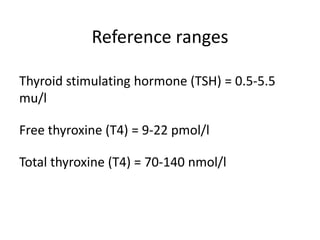
Reference ranges
Thyroid stimulating hormone (TSH) = 0.5-5.5
mu/l
Free thyroxine (T4) = 9-22 pmol/l
Total thyroxine (T4) = 70-140 nmol/l
2. A 33-year-old female is referred by her GP
with thyrotoxicosis. Following a discussion of
management options she elects to have
radioiodine therapy. Which one of the following
is the most likely adverse effect?
A. Hypothyroidism
B. Thyroid malignancy
C. Agranulocytosis
D. Oesophagitis
E. Precipitation of thyroid eye disease
3. A 36-year-old woman presents with feeling tired and
cold all the time. On examination a firm, non-tender
goitre is noted. Blood tests reveal the following:
TSH - 34.2 mU/l
Free T4 - 5.4 pmol/l
What is the most likely diagnosis?
A. Primary atrophic hypothyroidism
B. Pituitary failure
C. De Quervain's thyroiditis
D. Iodine deficiency
E. Hashimoto's thyroiditis
4. A 43-year-old woman presents for follow-up in
clinic. She was diagnosed with Hashimoto's
thyroiditis four months ago and is currently being
treated with levothyroxine 75 mcg od. What is the
single most important blood test to assess her
response to treatment?
A. ESR
B. TSH
C. Free T4
D. Total T4
E. Free T3
5. A 40-year-old woman complains of feeling tired all the time and
putting on weight. On examination a diffuse, non-tender goitre is
noted. Blood tests are ordered:
TSH - 15.1 mU/l
Free T4 - 7.1 pmol/l
ESR - 14 mm/hr
Anti-TSH receptor stimulating antibodies - Negative
Anti-thyroid peroxidase antibodies - Positive
What is the most likely diagnosis?
A. Pituitary failure
B. Primary atrophic hypothyroidism
C. De Quervain's thyroiditis
D. Hashimoto's thyroiditis
E. Grave's disease
6. A 52-year-old woman who was diagnosed as having
primary atrophic hypothyroidism 12 months ago is
reviewed following recent thyroid function tests (TFTs):
TSH - 12.5 mU/l
Free T4 - 14 pmol/l
She is currently taking 75mcg of levothyroxine once a day.
How should these results be interpreted?
A. Poor compliance with medication
B. Taking extra thyroxine
C. Evidence of recent systemic steroid therapy
D. Keep on same dose
E. T4 to T3 conversion disorder

Thyroid and Parathyroid

  • 1.
  • 2.
    Objectives • Understand whatthe thyroid and parathyroid do and how • Get to grips with calcium homeostasis • Learn the features of thyroid and parathyroid disease • Understand how these diseases are treated
  • 3.
  • 4.
  • 5.
    Thyroid disease • Hyperor hypo • Primary or secondary • Many different causes
  • 6.
    Hyperthyroidism - causes –Autoimmune = Graves disease – Infective = De Quervain’s thyroiditis – Neoplastic = toxic adenoma – Iatrogenic = drugs such as amiodarone or lithium. Also from over treating hypothyroidism
  • 7.
    Hyperthyroidism - symptoms –Increased metabolismweight loss and increased appetite – Heat intolerance – Sweating – Diarrhoea – Tremor – Irritability/restlessness – Psychosis – Itch – Oligomenorrhoea
  • 8.
    Hyperthyroidism - signs –Increased pulse rate – atrial fibrillation – palmar erythema – hair thinning – lid retraction – goiter, nodules or bruites
  • 9.
    Graves disease 1. Eyesigns – exomphalos, ophthalmoplegia, lid lag and lid retraction 2. Pretibial myxoedema 3. Thyroid acropachy
  • 10.
    Diagnosis • TSH, freeT4 and T3 • Thyroid autoantibodies – antithyroid peroxidase and antithyroglobulin antibodies. • TSH receptor antibodies (Graves) • US • Isotope scan
  • 11.
    Thyroid function tests TestCause TSH, T4 Hypothyroidism TSH, normal T4 Treated/subclinical hypothyroidism TSH, T4 TSH tumour or hormone resistance TSH, T4 Hyperthyroidism TSH, normal T4 Subclinical hyperthyroidism TSH,  T4 Sick euthyroidism
  • 12.
    Hyperthyroidism - treatment •Medical – Beta blockers – Carbimazole – Propylthiouracil – Thyroid ablation with radioactive iodine • Surgery – Subtotal thyroidectomy
  • 13.
    Hypothyroidism - causes •Autoimmune – Hashimoto’s thyroiditis – primary mxoedema (or primary atrophic hypothyroidism) • Dietary – iodine deficiency • Iatrogenic • Congenital
  • 14.
    Hypothyroidism - symptoms –Tiredness – Lethargy – Depression – Cold intolerance – Weight gain – Constipation – Menorrhagia – Hoarse voice - Dementia
  • 15.
    Hypothyroidism - signs –Bradycardia – Dry skin and hair – Ataxia – Slow reflexes – Peripheral neuropathy – Goitre – Proximal myopathy
  • 16.
  • 18.
  • 19.
    Hyperparathyroidism - symptoms –bones = pain, fractures, osteopaenia and lytic lesions from  bone reabsorption – stones = kidney stones – moans = feeling crap due to depression, tiredness, weakness – groans = abdo pain and acute abdomen (pancreatitis, duodenal ulcers, constipation)
  • 20.
    Hyperparathyroidism PTH Calcium Cause Primary  solitary adenoma, hyperplasia, carcinoma Secondary   normal response to a low Tertiary   in response to long standing secondary hyperparathyroidism glands become hyperplasic Malignant   parathyroid related protein (PTrP) released by squamous cell carcinoma of lung which mimics PTH. PTrP not detected by PTH assay
  • 21.
    Hyperparathyroidism - tests –calcium and PTH – ALP would be increased because of bone activity – DEXA scan shows osteoporosis – 24 hour urinary calcium
  • 22.
    Hyperparathyroidism - treatment •Mild – fluids, avoid drugs, diet, review • Severe - surgery
  • 23.
    Hypoparathyroidism – signsand symptoms • Tetany • Depression • Carpo-pedal spasms • Trousseau’s sign • Chvostek’s sign • ECG changes – Increased Q-T interval
  • 24.
    Hypoparathyroidism PTH Calcium Cause Primary  Gland failure – autoimmune eg DiGeorge syndrome Secondary   Radiation or surgery or hypomagnesia Pseudo   Failure of target cell response to PTH. Genetic. pseudopseudo - - Similar to pseudo but normal biochemistry
  • 26.
    SBAs 1. A 23-year-oldwoman presents with sweating and tremor. Her thyroid function tests are as follows: TSH - <0.05 mU/l Free T4 - 25 pmol/l What is the most common cause of this presentation? A. Hashimoto's thyroiditis B. Graves' disease C. Toxic nodular goitre D. De Quervain's thyroiditis E. Toxic adenoma
  • 27.
    Reference ranges Thyroid stimulatinghormone (TSH) = 0.5-5.5 mu/l Free thyroxine (T4) = 9-22 pmol/l Total thyroxine (T4) = 70-140 nmol/l
  • 28.
    2. A 33-year-oldfemale is referred by her GP with thyrotoxicosis. Following a discussion of management options she elects to have radioiodine therapy. Which one of the following is the most likely adverse effect? A. Hypothyroidism B. Thyroid malignancy C. Agranulocytosis D. Oesophagitis E. Precipitation of thyroid eye disease
  • 29.
    3. A 36-year-oldwoman presents with feeling tired and cold all the time. On examination a firm, non-tender goitre is noted. Blood tests reveal the following: TSH - 34.2 mU/l Free T4 - 5.4 pmol/l What is the most likely diagnosis? A. Primary atrophic hypothyroidism B. Pituitary failure C. De Quervain's thyroiditis D. Iodine deficiency E. Hashimoto's thyroiditis
  • 30.
    4. A 43-year-oldwoman presents for follow-up in clinic. She was diagnosed with Hashimoto's thyroiditis four months ago and is currently being treated with levothyroxine 75 mcg od. What is the single most important blood test to assess her response to treatment? A. ESR B. TSH C. Free T4 D. Total T4 E. Free T3
  • 31.
    5. A 40-year-oldwoman complains of feeling tired all the time and putting on weight. On examination a diffuse, non-tender goitre is noted. Blood tests are ordered: TSH - 15.1 mU/l Free T4 - 7.1 pmol/l ESR - 14 mm/hr Anti-TSH receptor stimulating antibodies - Negative Anti-thyroid peroxidase antibodies - Positive What is the most likely diagnosis? A. Pituitary failure B. Primary atrophic hypothyroidism C. De Quervain's thyroiditis D. Hashimoto's thyroiditis E. Grave's disease
  • 32.
    6. A 52-year-oldwoman who was diagnosed as having primary atrophic hypothyroidism 12 months ago is reviewed following recent thyroid function tests (TFTs): TSH - 12.5 mU/l Free T4 - 14 pmol/l She is currently taking 75mcg of levothyroxine once a day. How should these results be interpreted? A. Poor compliance with medication B. Taking extra thyroxine C. Evidence of recent systemic steroid therapy D. Keep on same dose E. T4 to T3 conversion disorder

Editor's Notes

  • #4 T4 has a negative feedback effect on TSH release
  • #7 De Quervain’s thyroiditis - A self limiting, acute, severe post viral hyperthyroidism (coxsackie, adenovirus or URTI). Causes a painful goitre Hashimoto’s can cause a hyperthyroidism in the acute phase Toxic adenoma is just an active hormone producing adenoma.
  • #9 Goitre – typically tender in De Quervain’s Bruites almost pathognemonic of Graves
  • #10 Eyelid retraction is the most common sign of ophthalmopathy. There is a immobility or lagging of the upper eyelid on downward rotation of the eye. Abnormal wideness of the eye due to retraction of both lids is noticed due to large area of whiteness above and below the iris (particularly above). In moderate active disease, the signs and symptoms are persistent and increasing and include myopathy. The inflammation and edema of the extraocular muscles lead to gaze abnormalities. The inferior rectus muscle is the most commonly affected muscle and patient may experience vertical diplopia on upgaze and limitation of elevation of the eyes due to fibrosis of the muscle There are lots of descriptive words for eye disease associated with thyroid problems. Chemosis is non secific and refers to conjunctival inflammation/irritation. Protosis is a description of bulging eyes Pretibial myxoedema - It usually presents itself as a waxy, discolored induration of the skin—classically described as having a so-called peau d'orange (orange peel) appearance Thyroid acropachy is an extreme manifestation of autoimmune thyroid disease. It presents with digital clubbing, swelling of digits and toes, and periosteal reaction of extremity bones
  • #11 Thyroid autoantibodies – antithyroid peroxidase and antithyroglobulin antibodies. Maybe increased in autoimmune disease (Hashimotos or Graves). Present in 75% of people with Graves and and can be tested for with ELISA/immunofluorescence US – determines cystic (usually benign) from solid nodules Isotope scan – can detect ectopic thyroid tissue or carcinoma. Hot (increased uptake), cold and neutral nodules – hot and neutral nodules are usually not malignant.
  • #12 Sick euthyroidism = deranged TFTs in illness (usually everything becomes low) High TSH and high T4 could also be due to poor compliance with thyroxine treatment for hypothyroidism
  • #13 Antithyroid medicines inhibit thyroid peroxidase Carbimazole can be titrated or use a block and replace approach. Side effects are agranulocytosis Radioactive iodine can lead to thyroid storm, and cant be used in pregnancy or lactation. Thyroid storm is an acute, life-threatening, hypermetabolic state induced by excessive release of thyroid hormones (THs) in individuals with thyrotoxicosis
  • #14 Hashimoto’s thyroiditis – goiter. Destruction of thyroid tissue, mechanism not understood. May start as hyperthyroidism. HLA DR4 and 3. Acute phase may be hyperthyroidism. Primary myxedema – no goiter, atrophy. Blocking of TSH receptor with autoantibodies (same as Grave’s but opposite effect). HLA DR4
  • #16 Hashimotos causes a diffuse non-tender goitre
  • #19 The main action of vitamin D is to assist in calcium absorption in he gut Calcitonin is the opposite of PTH and decreases calcium
  • #20 Usually an incidental finding
  • #22 calcium and PTH (differentials that give similar results are – familial hypocalcaemia, tertiary hyperparathyroidism and certain drugs like thiazides and lithium)
  • #24 The main symptoms of hypoparathyroidism are the result of the low blood calcium level, which interferes with normal muscle contraction and nerve conduction. As a result, people with hypoparathyroidism can experience paresthesia, an unpleasant tingling sensation around the mouth and in the hands and feet, as well as muscle cramps and severe spasms known as "tetany" that affect the hands and feet.[2] Many also report a number of subjective symptoms such as fatigue, headaches, bone pain and insomnia.[1] Crampy abdominal pain may occur.[3] Physical examination of someone with hypocalcemia may show tetany
  • #25 Pseudo - short 4th/5th metacarpals, short stature, mental retardation
  • #27 Thyroid stimulating hormone (TSH) = 0.5-5.5 mu/l Free thyroxine (T4) = 9-22 pmol/l Total thyroxine (T4) = 70-140 nmol/l
  • #32 this patient has Hashimoto's thyroiditis, as evidenced by the hypothyroidism, goitre and anti-thyroid peroxidase antibodies. De Quervain's thyroiditis typically causes a painful goitre and a raised ESR. Around 90% of patients with Grave's disease have anti-TSH receptor stimulating antibodies.