BLOOD PRESSURE
BLOOD  PRESSURE Dr shabeel pn
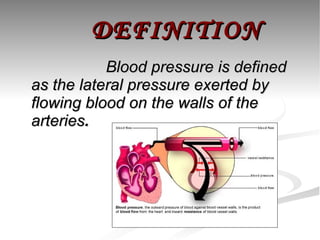
DEFINITION Blood pressure is   defined as the lateral pressure exerted by flowing blood on the walls of the arteries .
TYPES OF BLOOD PRESSURE Depending on the  NATURE OF   BLOOD   VESSEL  –  Arterial   B.P Venous B.P Capillary B.P
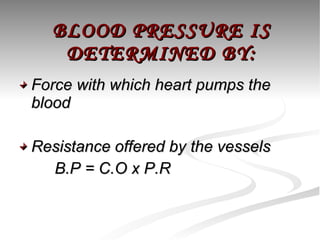
BLOOD PRESSURE IS DETERMINED BY: Force with which heart pumps the blood Resistance offered by the vessels B.P = C.O x P.R
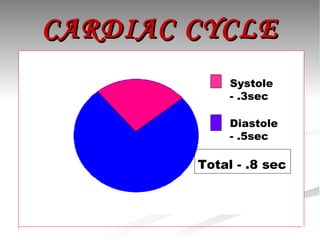
CARDIAC CYCLE Systole - .3sec Diastole - .5sec Total - .8 sec
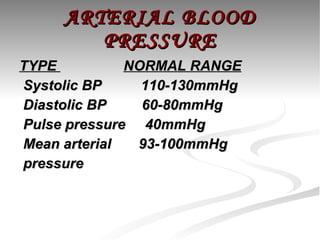
ARTERIAL BLOOD PRESSURE TYPE  NORMAL RANGE Systolic BP  110-130mmHg Diastolic BP  60-80mmHg Pulse pressure  40mmHg Mean arterial  93-100mmHg pressure
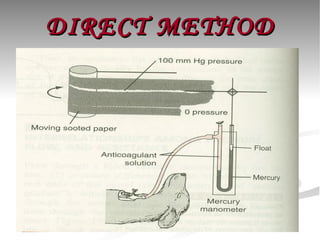
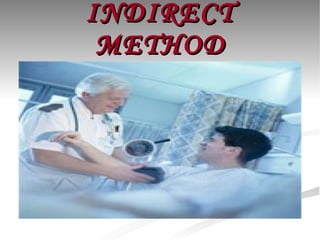
MEASUREMENT OF BP DIRECT METHOD INDIRECT METHOD Palpatory method Auscultatory method
DIRECT METHOD
INDIRECT METHOD
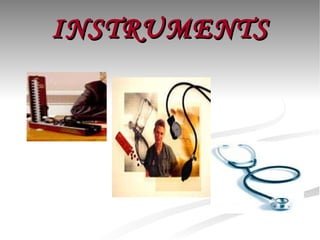
INSTRUMENTS
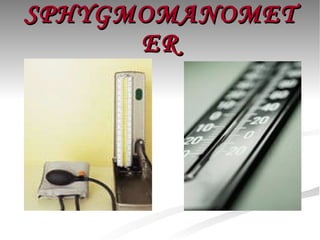
SPHYGMOMANOMETER
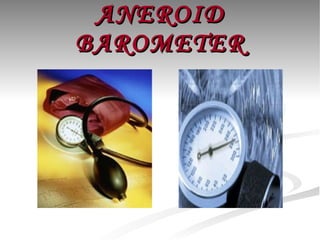
ANEROID BAROMETER
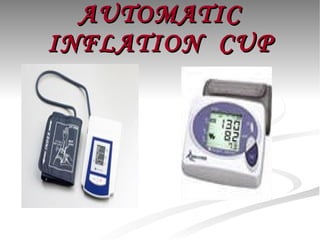
AUTOMATIC INFLATION  CUP
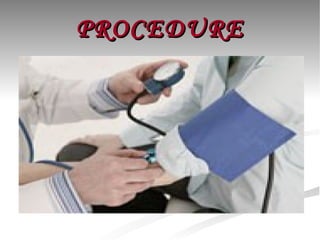
PROCEDURE
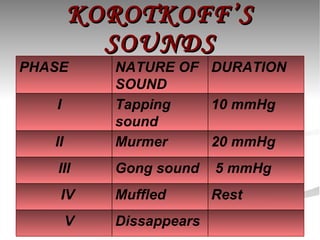
KOROTKOFF’S SOUNDS Dissappears V Rest Muffled IV 5 mmHg Gong sound III 20 mmHg Murmer II  10 mmHg Tapping sound I DURATION NATURE OF SOUND PHASE
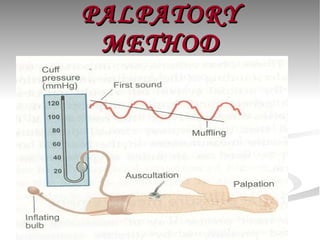
PALPATORY METHOD
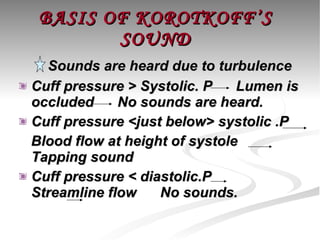
BASIS OF KOROTKOFF’S SOUND Sounds are heard due to turbulence  Cuff pressure > Systolic. P  Lumen is occluded  No sounds are heard. Cuff pressure <just below> systolic .P Blood flow at height of systole  Tapping sound Cuff pressure < diastolic.P  Streamline flow  No sounds.
AUSCULTATORY GAP A gap present after tapping sound Seen in hypertensive patients .
VARIATIONS PHYSIOLOGICAL PATHOLOGICAL
PHYSIOLOGICAL AGE :  in B.P Old age  Lipid deposition in lamina propria  Loss of windkessel effect SEX:   Males > Females upto menopause. After menopause  Equal. Plasma cholesterol Estrogen  Vasodialator  NO [ERF]
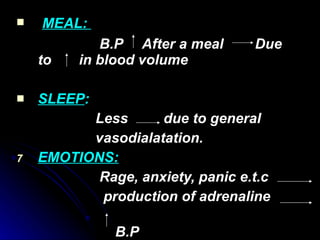
MEAL:  B.P  After a meal  Due to  in blood volume SLEEP : Less  due to general vasodialatation. EMOTIONS: Rage, anxiety, panic e.t.c production of adrenaline  B.P
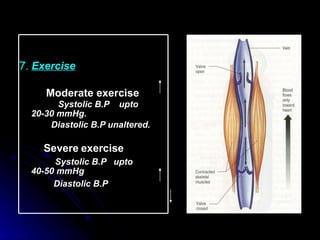
7.  Exercise Moderate exercise   Systolic B.P  upto 20-30 mmHg. Diastolic B.P unaltered. Severe   exercise Systolic B.P  upto  40-50 mmHg Diastolic B.P
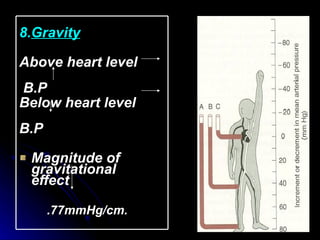
8. Gravity Above heart level  B.P  Below heart level  B.P  Magnitude of gravitational effect  .77mmHg/cm.   .
PATHOLOGICAL Hypertension Persistent  increase in systemic arterial B.P is known as hypertension. According to JNC VII Normal  -  120/80 mmHg. Pre hypertension – 120-139/80-90mmHg Stage I Hypertension-140-159/90-99 mmHg Stage II Hypertension->/160/100mmHg
Benign Primary   Hypertension  Malignant Secondary -Atherosclerosis -Pheochromocytoma -Cushing syndrome -Glomerulonephritis -Gestational -Drug induced White coat hypertension
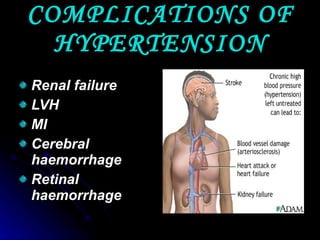
COMPLICATIONS OF HYPERTENSION Renal failure LVH MI Cerebral haemorrhage Retinal haemorrhage
COMPLICATIONS OF UNCONTROLLED HYPERTENTION DURING SURGERY Reflects cardiac status  Anaesthetic risk of the patient. Excessive bleeding from operation site  Blood loss.
PRE-OPERATIVE INVESTIGATION Chest x-ray ECG USG of kidney Ophthalmic evaluation for retinal haemorrhage RFT
MANAGEMENT OF HYPERTENSION Non drug therapy Stop smoking Control obesity Regular exercise Decrease salt intake Drug therapy Beta blockers Calcium channel blockers Vasodialators Diuretics ACE inhibitors VMC depressors
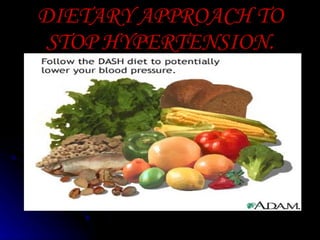
DIETARY APPROACH TO STOP HYPERTENSION.
During surgical procedures : B.P should be monitored and controlled before,during and after treatment. Antihypertensives should be continued. LA solution without adrenaline or bupivacaine should be given.
HYPOTENSION Fall in B.P below normal range is known as hypotension. TYPES Primary/Essential hypotension. Secondary hypotension. -MI  -Hypoactivity of pituitary gland -Hypoactivity of adrenal gland -Tuberculosis Orthostatic hypotension
TREATMENT OF HYPOTENSION Correct the underlying etiology.  Orthostatic hypotension  Change to supine position with head below the heart level & leg raised .
REGULATON OF ARTERIAL RAPIDLY ACTING INTERMEDIATE ACTING LONG TERM ACTING B.P
RAPIDLY ACTING MECHANISM Baroreceptor reflex Chemoreceptor reflex CNS ischeamic response
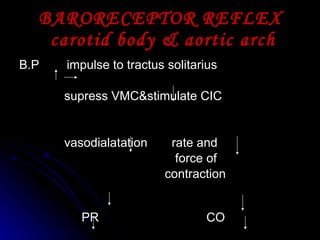
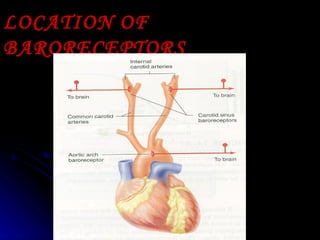
BARORECEPTOR REFLEX  carotid body & aortic arch B.P  impulse to tractus solitarius supress VMC&stimulate CIC vasodialatation  rate and  force of contraction  PR  CO
LOCATION OF BARORECEPTORS
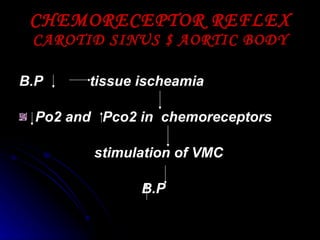
CHEMORECEPTOR REFLEX CAROTID SINUS $ AORTIC BODY B.P  tissue ischeamia Po2 and  Pco2 in  chemoreceptors stimulation of VMC B.P
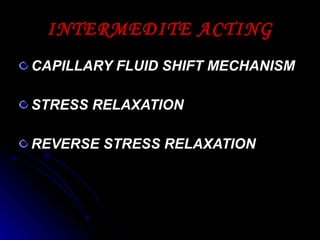
INTERMEDITE ACTING CAPILLARY FLUID SHIFT MECHANISM STRESS RELAXATION REVERSE STRESS RELAXATION
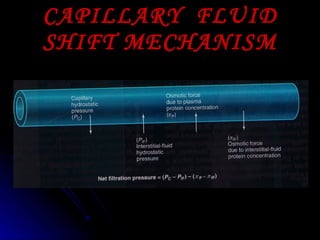
CAPILLARY  FLUID SHIFT MECHANISM
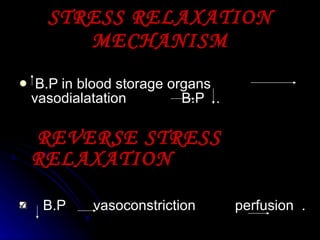
STRESS RELAXATION MECHANISM B.P in blood storage organs  vasodialatation  B.P  . REVERSE STRESS RELAXATION B.P  vasoconstriction  perfusion  .
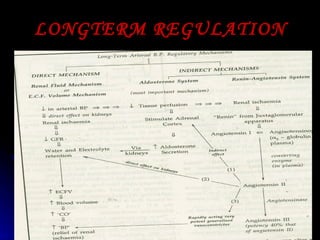
LONGTERM REGULATION
Survey conducted among 120 inmates of ladies hostel of RDC
CONCLUSION

blood pressure