THE THYROID AND PARATHYROID GLANDS
EMBRYOLOGY The thyroglossal of the  duct develops from the median bud of the pharynx. The foramen caecum at the base of tongue is the vestigial remnant of the duct. The parathyroid glands develop from the 3 rd  and 4 th  pharyngeal pouches. The thymus develops from the 3 rd  pouch. The developing thyroid lobes amalgamate with the structures arising in the 4 th  pharyngeal pouch i.e. the superior parathyroid gland and ultimobrachial body. Parafollicular cells ( C cells ) from the neural crest reach the thyroid via ultimobrachial body.
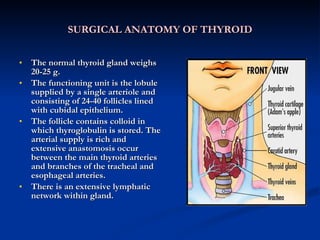
SURGICAL ANATOMY OF THYROID The normal thyroid gland weighs 20-25 g. The functioning unit is the lobule supplied by a single arteriole and consisting of 24-40 follicles lined with cubidal epithelium. The follicle contains colloid in which thyroglobulin is stored. The arterial supply is rich and extensive anastomosis occur between the main thyroid arteries and branches of the tracheal and esophageal arteries. There is an extensive lymphatic network within gland.
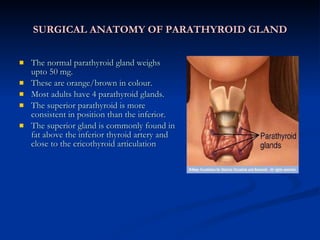
SURGICAL ANATOMY OF PARATHYROID GLAND The normal parathyroid gland weighs upto 50 mg. These are orange/brown in colour. Most adults have 4 parathyroid glands. The superior parathyroid is more consistent in position than the inferior. The superior gland is commonly found in fat above the inferior thyroid artery and close to the cricothyroid articulation
PHYSIOLOGY The hormones T3 and T4 are bound to the thyroglobulin with in the colloid . Synthesis with in the thyroglobulin complex is controlled by several enzymes in distinct steps: - Trapping of inorganic iodide from the blood. - Oxidation of iodide to the iodine. - Binding of iodine with tyrosine to form iodotyrosines. - Coupling of monoiodotyrosines and di-iodotyrosines to  form T3 and T4
The metabolic effects of the thyroid hormones are due to unbound freeT3 and T4. T3 and T4 are 0.3% and 0.03% of the total circulating hormones respectively. T3 is more important physiological hormone. It is quick acting( with in few hours) where as T4 acts more slowly ( 4-14 days )
PARATHYROID HORMONE It is 84-amino acid peptide. It controls the level of serum calcium or high serum magnesium level. It activates osteoclasts to resorb bone and increases calcium reabsorption from urine and renal activation of vitamin D.
CALCITONIN Parafollicular cells of thyroid are neuroendocrine origin and arrive in the thyroid via ultimobrachial body. These produce calcitonin which is serum marker for recurrence of medullary thyroid cancer.
THE PITUITARY –THYROID AXIS The synthesis and liberation of thyroid hormones from the thyroid is controlled by TSH from anterior pituitary gland. Secretion of TSH depends upon the level of circulating thyroid hormones and is modified in a classic negative feedback manner. Regulation of TSH secretion also results from the action of TRH produced in the hypothalamus.
TESTS OF THYROID FUNCTION SERUM TSH: Normal value: o.3-3.3 mU/L. In euthyroid state T3,T4 and TSH levels will all be within normal range. Incipient or developing thyroid failure is characterised by low normal values of T3 and T4 and elevation of TSH. In toxic states the TSH level is suppressed and undetectable. SERUM T3 and T4: Normal values:T3=3.5-7.5 mic mol/L  T4=10-30 n mol/L. Highly accurate radioimmunoassay of free T3 and T4 are now routine.
CHEST AND THORACIC INLET RADIOGRAPHY It shows presences of significant retrosternal goiter. It is clinically important for degree of tracheal deviation and compression. Pulmonary metastasis may also be detected.
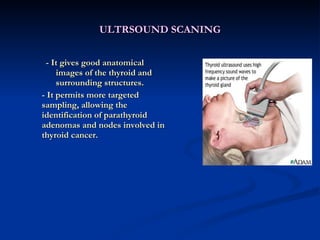
ULTRSOUND SCANING - It gives good anatomical images of the thyroid and surrounding structures. - It permits more targeted sampling, allowing the identification of parathyroid adenomas and nodes involved in thyroid cancer.
ISOTOPE SCANNING It distinguish benign from malignant lesions. 80% of cold swellings are benign and 5% functioning or warm swellings are malignant. Localization of overactivity in the gland will differentiate between a toxic nodule with suppression of the remainder of the gland and toxic multinodular goitre
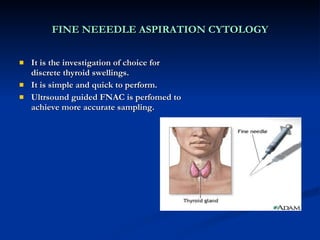
FINE NEEEDLE ASPIRATION CYTOLOGY It is the investigation of choice for discrete thyroid swellings. It is simple and quick to perform. Ultrsound guided FNAC is perfomed to achieve more accurate sampling.
HYPOTHYROIDISM CLASSSIFICATION OF HYPOTHYROIDISM: Autoimmune thyroiditis Non-goitrous: primary myxoedema Goitrous: Hashimoto’s  Iatrogenic After thyroidectomy After radioiodine therapy Drug induced( anti thyroid drugs,para aminosalicylic acid and iodides in excess) Dyshormonogenesis Goitrogens Secondary to pituitary or hypothalamic disease Thyroid agenesis Endmic cretinism Often goitrois and due to iodine deficiency.
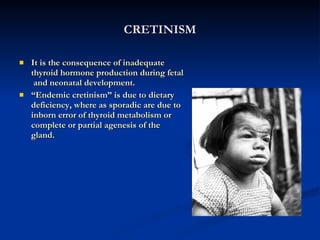
CRETINISM It is the consequence of inadequate thyroid hormone production during fetal  and neonatal development. “ Endemic cretinism” is due to dietary deficiency, where as sporadic are due to inborn error of thyroid metabolism or complete or partial agenesis of the gland.
CLINICAL FEATURES: A hoarse cry Macroglossia Umbilical hernia TREATMENT: Thyroxine with in few days of birth are essential to prevent damage in utero progressing and if physical and mental development are to be normal.
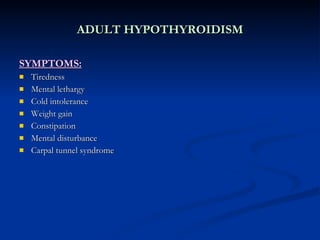
ADULT HYPOTHYROIDISM SYMPTOMS: Tiredness Mental lethargy Cold intolerance Weight gain Constipation Mental disturbance Carpal tunnel syndrome
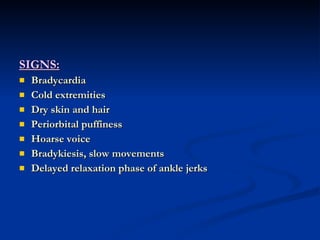
SIGNS: Bradycardia Cold extremities Dry skin and hair  Periorbital puffiness Hoarse voice Bradykiesis, slow movements Delayed relaxation phase of ankle jerks
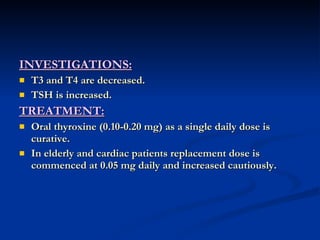
INVESTIGATIONS: T3 and T4 are decreased. TSH is increased. TREATMENT: Oral thyroxine (0.10-0.20 mg) as a single daily dose is curative. In elderly and cardiac patients replacement dose is commenced at 0.05 mg daily and increased cautiously.

The thyroid and parathyroid glands

  • 1.
    THE THYROID ANDPARATHYROID GLANDS
  • 2.
    EMBRYOLOGY The thyroglossalof the duct develops from the median bud of the pharynx. The foramen caecum at the base of tongue is the vestigial remnant of the duct. The parathyroid glands develop from the 3 rd and 4 th pharyngeal pouches. The thymus develops from the 3 rd pouch. The developing thyroid lobes amalgamate with the structures arising in the 4 th pharyngeal pouch i.e. the superior parathyroid gland and ultimobrachial body. Parafollicular cells ( C cells ) from the neural crest reach the thyroid via ultimobrachial body.
  • 3.
    SURGICAL ANATOMY OFTHYROID The normal thyroid gland weighs 20-25 g. The functioning unit is the lobule supplied by a single arteriole and consisting of 24-40 follicles lined with cubidal epithelium. The follicle contains colloid in which thyroglobulin is stored. The arterial supply is rich and extensive anastomosis occur between the main thyroid arteries and branches of the tracheal and esophageal arteries. There is an extensive lymphatic network within gland.
  • 4.
    SURGICAL ANATOMY OFPARATHYROID GLAND The normal parathyroid gland weighs upto 50 mg. These are orange/brown in colour. Most adults have 4 parathyroid glands. The superior parathyroid is more consistent in position than the inferior. The superior gland is commonly found in fat above the inferior thyroid artery and close to the cricothyroid articulation
  • 5.
    PHYSIOLOGY The hormonesT3 and T4 are bound to the thyroglobulin with in the colloid . Synthesis with in the thyroglobulin complex is controlled by several enzymes in distinct steps: - Trapping of inorganic iodide from the blood. - Oxidation of iodide to the iodine. - Binding of iodine with tyrosine to form iodotyrosines. - Coupling of monoiodotyrosines and di-iodotyrosines to form T3 and T4
  • 6.
    The metabolic effectsof the thyroid hormones are due to unbound freeT3 and T4. T3 and T4 are 0.3% and 0.03% of the total circulating hormones respectively. T3 is more important physiological hormone. It is quick acting( with in few hours) where as T4 acts more slowly ( 4-14 days )
  • 7.
    PARATHYROID HORMONE Itis 84-amino acid peptide. It controls the level of serum calcium or high serum magnesium level. It activates osteoclasts to resorb bone and increases calcium reabsorption from urine and renal activation of vitamin D.
  • 8.
    CALCITONIN Parafollicular cellsof thyroid are neuroendocrine origin and arrive in the thyroid via ultimobrachial body. These produce calcitonin which is serum marker for recurrence of medullary thyroid cancer.
  • 9.
    THE PITUITARY –THYROIDAXIS The synthesis and liberation of thyroid hormones from the thyroid is controlled by TSH from anterior pituitary gland. Secretion of TSH depends upon the level of circulating thyroid hormones and is modified in a classic negative feedback manner. Regulation of TSH secretion also results from the action of TRH produced in the hypothalamus.
  • 10.
    TESTS OF THYROIDFUNCTION SERUM TSH: Normal value: o.3-3.3 mU/L. In euthyroid state T3,T4 and TSH levels will all be within normal range. Incipient or developing thyroid failure is characterised by low normal values of T3 and T4 and elevation of TSH. In toxic states the TSH level is suppressed and undetectable. SERUM T3 and T4: Normal values:T3=3.5-7.5 mic mol/L T4=10-30 n mol/L. Highly accurate radioimmunoassay of free T3 and T4 are now routine.
  • 11.
    CHEST AND THORACICINLET RADIOGRAPHY It shows presences of significant retrosternal goiter. It is clinically important for degree of tracheal deviation and compression. Pulmonary metastasis may also be detected.
  • 12.
    ULTRSOUND SCANING -It gives good anatomical images of the thyroid and surrounding structures. - It permits more targeted sampling, allowing the identification of parathyroid adenomas and nodes involved in thyroid cancer.
  • 13.
    ISOTOPE SCANNING Itdistinguish benign from malignant lesions. 80% of cold swellings are benign and 5% functioning or warm swellings are malignant. Localization of overactivity in the gland will differentiate between a toxic nodule with suppression of the remainder of the gland and toxic multinodular goitre
  • 14.
    FINE NEEEDLE ASPIRATIONCYTOLOGY It is the investigation of choice for discrete thyroid swellings. It is simple and quick to perform. Ultrsound guided FNAC is perfomed to achieve more accurate sampling.
  • 15.
    HYPOTHYROIDISM CLASSSIFICATION OFHYPOTHYROIDISM: Autoimmune thyroiditis Non-goitrous: primary myxoedema Goitrous: Hashimoto’s Iatrogenic After thyroidectomy After radioiodine therapy Drug induced( anti thyroid drugs,para aminosalicylic acid and iodides in excess) Dyshormonogenesis Goitrogens Secondary to pituitary or hypothalamic disease Thyroid agenesis Endmic cretinism Often goitrois and due to iodine deficiency.
  • 16.
    CRETINISM It isthe consequence of inadequate thyroid hormone production during fetal and neonatal development. “ Endemic cretinism” is due to dietary deficiency, where as sporadic are due to inborn error of thyroid metabolism or complete or partial agenesis of the gland.
  • 17.
    CLINICAL FEATURES: Ahoarse cry Macroglossia Umbilical hernia TREATMENT: Thyroxine with in few days of birth are essential to prevent damage in utero progressing and if physical and mental development are to be normal.
  • 18.
    ADULT HYPOTHYROIDISM SYMPTOMS:Tiredness Mental lethargy Cold intolerance Weight gain Constipation Mental disturbance Carpal tunnel syndrome
  • 19.
    SIGNS: Bradycardia Coldextremities Dry skin and hair Periorbital puffiness Hoarse voice Bradykiesis, slow movements Delayed relaxation phase of ankle jerks
  • 20.
    INVESTIGATIONS: T3 andT4 are decreased. TSH is increased. TREATMENT: Oral thyroxine (0.10-0.20 mg) as a single daily dose is curative. In elderly and cardiac patients replacement dose is commenced at 0.05 mg daily and increased cautiously.