
Anatomy
-THYMUS GLAND
THYMUS GLAND
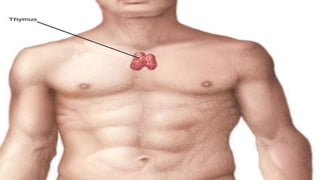
It is located behind sternum and between
lungs, is only active until puberty.
After puberty, the thymus starts to slowly
shrink and become replaced by fat.
THYMOSIN
This is the hormone secreted by the thymus
gland
and is required for the development of T-
lymphocytes for cell mediated immunity .
THANKING YOU
LOCAL
HORMONES
LOCAL HORMONES
A number of body tissues not normally
described as endocrine glands secrete
substances that act locally.
HISTAMINE
This hormone is synthesized by mast cells in the
tissues and basophils in blood.
It is released as part of the inflammatory
process,
increasing capillary permeability and
dilatation.
It also causes contraction of smooth muscle
of the bronchi and alimentary tract and
stimulates the secretion of gastric juice.
SEROTONIN
(5-HYDROXYTRYPTAMINE, 5-HT)
This is present in platelets, in the brain
and in the intestinal wall.

It causes intestinal secretion
and contraction of smooth muscle
and its role in haemostasis (blood clotting) .
PROSTAGLANDINS (PGS)
These are lipid substances that act as local
hormones
and have wide-ranging physiological effects
in:
The inflammatory response
potentiating pain
fever
regulating blood pressure
blood clotting
uterine contractions during
labour.
Other chemically similar compounds include
leukotrienes and thromboxanes.
They are active substances found in only
small amounts,
as they are rapidly degraded.
ERYTHROPOIETIN
This hormone is synthesised by the
kidneys and increases erythropoiesis
(the rate of red blood cell formation.
GASTROINTESTINAL
HORMONES
Several local hormones,
including gastrin, secretin and
cholecystokinin (CCK), influence the
secretion of digestive juices.
THANKING YOU

Anatomy -Thymus gland