CHOLESTEROL
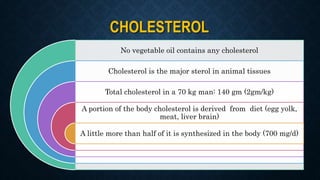
No vegetable oil contains any cholesterol
Cholesterol is the major sterol in animal tissues
Total cholesterol in a 70 kg man: 140 gm (2gm/kg)
A portion of the body cholesterol is derived from diet (egg yolk,
meat, liver brain)
A little more than half of it is synthesized in the body (700 mg/d)
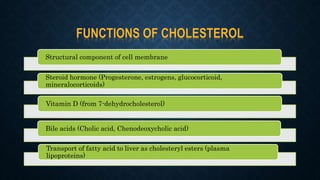
Structural component of cell membrane
Steroid hormone (Progesterone, estrogens, glucocorticoid,
mineralocorticoids)
Vitamin D (from 7-dehydrocholesterol)
Bile acids (Cholic acid, Chenodeoxycholic acid)
Transport of fatty acid to liver as cholesteryl esters (plasma
lipoproteins)
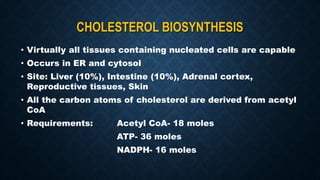
CHOLESTEROL BIOSYNTHESIS
• Virtually all tissues containing nucleated cells are capable
• Occurs in ER and cytosol
• Site: Liver (10%), Intestine (10%), Adrenal cortex,
Reproductive tissues, Skin
• All the carbon atoms of cholesterol are derived from acetyl
CoA
• Requirements: Acetyl CoA- 18 moles
ATP- 36 moles
NADPH- 16 moles
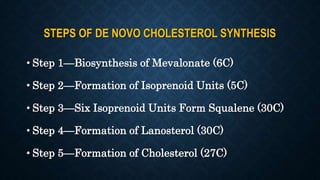
STEPS OF DE NOVO CHOLESTEROL SYNTHESIS
• Step 1—Biosynthesis of Mevalonate (6C)
• Step 2—Formation of Isoprenoid Units (5C)
• Step 3—Six Isoprenoid Units Form Squalene (30C)
• Step 4—Formation of Lanosterol (30C)
• Step 5—Formation of Cholesterol (27C)
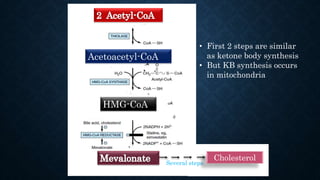
Acetoacetyl-CoA
HMG-CoA
Several steps
Cholesterol
• First 2 steps are similar
as ketone body synthesis
• But KB synthesis occurs
in mitochondria
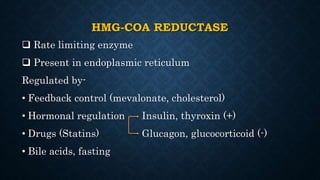
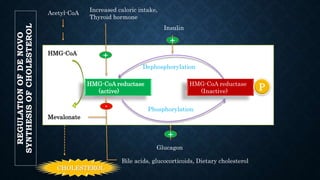
HMG-COA REDUCTASE
 Rate limiting enzyme
 Present in endoplasmic reticulum
Regulated by-
• Feedback control (mevalonate, cholesterol)
• Hormonal regulation Insulin, thyroxin (+)
• Drugs (Statins) Glucagon, glucocorticoid (-)
• Bile acids, fasting
HMG-CoA reductase
(active)
HMG-CoA reductase
(Inactive)
Acetyl-CoA
HMG-CoA
Mevalonate
CHOLESTEROL
Insulin
Glucagon
Increased caloric intake,
Thyroid hormone
Bile acids, glucocorticoids, Dietary cholesterol
P
Dephosphorylation
Phosphorylation
+
+
+
-
REGULATION
OF
DE
NOVO
SYNTHESIS
OF
CHOLESTEROL
EXCRETION OF CHOLESTEROL
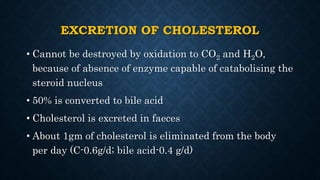
• Cannot be destroyed by oxidation to CO2 and H2O,
because of absence of enzyme capable of catabolising the
steroid nucleus
• 50% is converted to bile acid
• Cholesterol is excreted in faeces
• About 1gm of cholesterol is eliminated from the body
per day (C-0.6g/d; bile acid-0.4 g/d)
BLOOD CHOLESTEROL
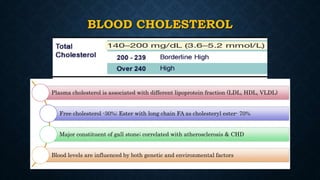
Plasma cholesterol is associated with different lipoprotein fraction (LDL, HDL, VLDL)
Free cholesterol -30%; Ester with long chain FA as cholesteryl ester- 70%
Major constituent of gall stone; correlated with atherosclerosis & CHD
Blood levels are influenced by both genetic and environmental factors
FACTORS AFFECTING SERUM
CHOLESTEROL LEVEL
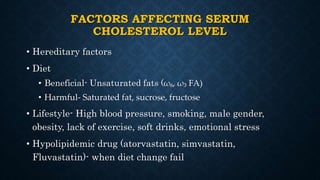
• Hereditary factors
• Diet
• Beneficial- Unsaturated fats (ω₆, ω₃ FA)
• Harmful- Saturated fat, sucrose, fructose
• Lifestyle- High blood pressure, smoking, male gender,
obesity, lack of exercise, soft drinks, emotional stress
• Hypolipidemic drug (atorvastatin, simvastatin,
Fluvastatin)- when diet change fail
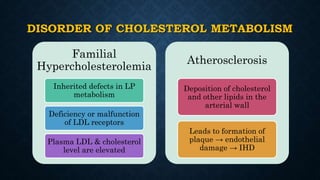
DISORDER OF CHOLESTEROL METABOLISM
Familial
Hypercholesterolemia
Inherited defects in LP
metabolism
Deficiency or malfunction
of LDL receptors
Plasma LDL & cholesterol
level are elevated
Atherosclerosis
Deposition of cholesterol
and other lipids in the
arterial wall
Leads to formation of
plaque → endothelial
damage → IHD
Thank You

Cholesterol Metabolism

  • 2.
    CHOLESTEROL No vegetable oilcontains any cholesterol Cholesterol is the major sterol in animal tissues Total cholesterol in a 70 kg man: 140 gm (2gm/kg) A portion of the body cholesterol is derived from diet (egg yolk, meat, liver brain) A little more than half of it is synthesized in the body (700 mg/d)
  • 3.
    Structural component ofcell membrane Steroid hormone (Progesterone, estrogens, glucocorticoid, mineralocorticoids) Vitamin D (from 7-dehydrocholesterol) Bile acids (Cholic acid, Chenodeoxycholic acid) Transport of fatty acid to liver as cholesteryl esters (plasma lipoproteins)
  • 5.
    CHOLESTEROL BIOSYNTHESIS • Virtuallyall tissues containing nucleated cells are capable • Occurs in ER and cytosol • Site: Liver (10%), Intestine (10%), Adrenal cortex, Reproductive tissues, Skin • All the carbon atoms of cholesterol are derived from acetyl CoA • Requirements: Acetyl CoA- 18 moles ATP- 36 moles NADPH- 16 moles
  • 6.
    STEPS OF DENOVO CHOLESTEROL SYNTHESIS • Step 1—Biosynthesis of Mevalonate (6C) • Step 2—Formation of Isoprenoid Units (5C) • Step 3—Six Isoprenoid Units Form Squalene (30C) • Step 4—Formation of Lanosterol (30C) • Step 5—Formation of Cholesterol (27C)
  • 7.
    Acetoacetyl-CoA HMG-CoA Several steps Cholesterol • First2 steps are similar as ketone body synthesis • But KB synthesis occurs in mitochondria
  • 8.
    HMG-COA REDUCTASE  Ratelimiting enzyme  Present in endoplasmic reticulum Regulated by- • Feedback control (mevalonate, cholesterol) • Hormonal regulation Insulin, thyroxin (+) • Drugs (Statins) Glucagon, glucocorticoid (-) • Bile acids, fasting
  • 9.
    HMG-CoA reductase (active) HMG-CoA reductase (Inactive) Acetyl-CoA HMG-CoA Mevalonate CHOLESTEROL Insulin Glucagon Increasedcaloric intake, Thyroid hormone Bile acids, glucocorticoids, Dietary cholesterol P Dephosphorylation Phosphorylation + + + - REGULATION OF DE NOVO SYNTHESIS OF CHOLESTEROL
  • 10.
    EXCRETION OF CHOLESTEROL •Cannot be destroyed by oxidation to CO2 and H2O, because of absence of enzyme capable of catabolising the steroid nucleus • 50% is converted to bile acid • Cholesterol is excreted in faeces • About 1gm of cholesterol is eliminated from the body per day (C-0.6g/d; bile acid-0.4 g/d)
  • 11.
    BLOOD CHOLESTEROL Plasma cholesterolis associated with different lipoprotein fraction (LDL, HDL, VLDL) Free cholesterol -30%; Ester with long chain FA as cholesteryl ester- 70% Major constituent of gall stone; correlated with atherosclerosis & CHD Blood levels are influenced by both genetic and environmental factors
  • 12.
    FACTORS AFFECTING SERUM CHOLESTEROLLEVEL • Hereditary factors • Diet • Beneficial- Unsaturated fats (ω₆, ω₃ FA) • Harmful- Saturated fat, sucrose, fructose • Lifestyle- High blood pressure, smoking, male gender, obesity, lack of exercise, soft drinks, emotional stress • Hypolipidemic drug (atorvastatin, simvastatin, Fluvastatin)- when diet change fail
  • 13.
    DISORDER OF CHOLESTEROLMETABOLISM Familial Hypercholesterolemia Inherited defects in LP metabolism Deficiency or malfunction of LDL receptors Plasma LDL & cholesterol level are elevated Atherosclerosis Deposition of cholesterol and other lipids in the arterial wall Leads to formation of plaque → endothelial damage → IHD
  • 14.

Editor's Notes

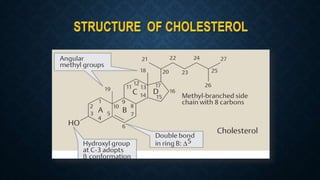
  • #5 All steroids have a similar cyclic nucleus resembling phenanthrene (rings A, B, and C) to which a cyclopentane ring (D) is attached. The carbon positions on the steroid nucleus are numbered as shown in Figure 15–14. It is important to realize that in structural formulas of steroids, a simple hexagonal ring denotes a completely saturated six-carbon ring with all valences satisfied by hydrogen bonds unless shown otherwise; ie, it is not a benzene ring. All double bonds are shown as such. Methyl side chains are shown as single bonds unattached at the farther (methyl) end. These occur typically at positions 10 and 13 (constituting C atoms 19 and 18). A side chain at position 17 is usual (as in cholesterol). If the compound has one or more hydroxyl groups and no carbonyl or carboxyl groups, it is a sterol,and the name terminates in -ol.