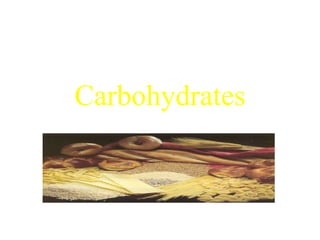
Carbohydrates
General characteristics
• The term carbohydrate is derived from the french:
hydrate de carbone
• compounds composed of C, H, and O
• empirical formula: (CH2O)n
General characteristics
• Most carbohydrates are found naturally in bound
form rather than as simple sugars
• Polysaccharides (starch, cellulose, inulin, gums)
• Glycoproteins and proteoglycans (hormones, blood
group substances, antibodies)
• Glycolipids (cerebrosides, gangliosides)
• Glycosides
• Mucopolysaccharides (hyaluronic acid)
• Nucleic acids
Functions
• sources of energy
• intermediates in the biosynthesis of other basic
biochemical entities (fats and proteins)
• associated with other entities such as glycosides,
vitamins and antibiotics)
• form structural tissues in plants and in
microorganisms (cellulose, lignin, murein)
• participate in biological transport, cell-cell
recognition, activation of growth factors,
modulation of the immune system
Classification of carbohydrates
• Monosaccharides- glucose, fructose
• Oligosaccharides
• Di, tri, tetra, penta, up to 9 or 10
• Most important are the disaccharides-lactose,
sucrose
• Polysaccharides or glycans
• Homopolysaccharides-starch, glycogen, cellulose
• Heteropolysaccharides
• Complex carbohydrates
Monosaccharides
• also known as simple sugars
• classified by 1. the number of carbons and 2.
whether aldoses or ketoses
• Examples-glucose (blood sugar), fructose(sweetest
sugar) are principal monosaccharides in food
Oligosaccharides
• Most common are the disaccharides
• Sucrose, lactose, and maltose
• Maltose ( 2 molecules of D-glucose)
• Lactose (a molecule of glucose and a molecule of
galactose)
• Sucrose (a molecule of glucose and a molecule of
fructose)
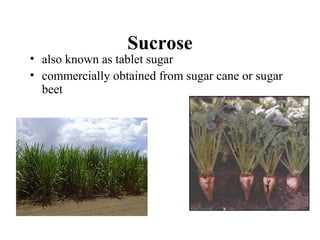
Sucrose
• also known as tablet sugar
• commercially obtained from sugar cane or sugar
beet
Lactose
∀ β-D-galactose joined to α−D-glucose via β (1,4)
linkage
• Called Milk sugar
∀ β-lactose is sweeter and more soluble than
ordinary α- lactose
Maltose
• 2-glucose molecules joined via α(1,4) linkage
• known as malt sugar
• produced by the partial hydrolysis of starch (either
salivary amylase or pancreatic amylase)
• Found in beer and malt liquors
• used as a nutrient (malt extract; Hordeum
vulgare); as a sweetener and as a fermentative
reagent
Polysaccharides(complex
carbohydrates)
• homoglycans (starch, cellulose, glycogen, inulin)
• heteroglycans (gums, mucopolysaccharides)
• characteristics:
• polymers (MW from 200,000)
• White and amorphous products (glassy)
• not sweet
• not reducing; do not give the typical aldose or ketose
reactions)
• form colloidal solutions or suspensions
Starch
• most common storage polysaccharide in
plants
• composed of 10 – 30% α−amylose and 70-
90% amylopectin depending on the source
• Common sources are grains , potatoes, peas,
beans, wheat
Glycogen
• also known as animal starch
• stored in muscle and liver
• present in cells as granules (high MW)
• contains both α(1,4) links and α(1,6) branches at
every 8 to 12 glucose unit
• complete hydrolysis yields glucose
Fibers
• Found in food derived from plants
• Includes polysaccharides such as cellulose,
hemicellulose, pectins, gums and mucilages
• Also includes non-polysaccharides such as lignin,
cutins and tannins
• Fibers are not a source of energy because Human
digestive enzymes cannot break down fibers
• The bacteria in human GI tract can breakdown
some fibers.
classification of fibers based on
their solubilities in water
(1)Soluble fibers: includes gum,pectin, some
hemicellulose and mucilages found in fruits, oats,
barley and legumes .
Actions on body:
(i) Delay GI transit(benefits digestive disorders)
(ii) Delay glucose absorption 9benefits diabetes)
(iii) Lowers blood cholesterol(benefits heart disease)
classification of fibers based on
their solubilities in water
(2) Insoluble fibers: includes cellulose, many
hemicellulose, lignin found in wheat bran , corn
bran, whole grain bread, cereals and vegetables
(carrot, cabbage)
Actions in body:
(i)Accelerates GI transit and increases fecal
weight(promotes bowel movement)
(ii) Slows starch hydrolysis and delays glucose
absorption(Benefits diabetes)
Dietary Carbohydrates and
Blood Glucose
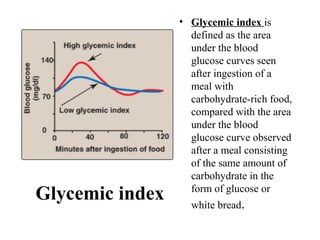
• Some carbohydrate-containing foods
produce a rapid rise followed by a steep fall
in blood glucose concentration, whereas
others result in a gradual rise followed by a
slow decline.
• Food with a low glycemic index tends to
create a sense of satiety over a longer
period of time, and may be helpful in
limiting caloric intake.
Glycemic index
• Glycemic index is
defined as the area
under the blood
glucose curves seen
after ingestion of a
meal with
carbohydrate-rich food,
compared with the area
under the blood
glucose curve observed
after a meal consisting
of the same amount of
carbohydrate in the
form of glucose or
white bread.
Requirements for carbohydrate
• Carbohydrates are not essential nutrients,
because the carbon skeletons of amino acids
can be converted into glucose .
• However, the absence of dietary
carbohydrate leads to ketone body
production ,and degradation of body protein
whose constituent amino acids provide
carbon skeletons for gluconeogenesis .
Requirements for carbohydrate
• The RDA for carbohydrate is set at 130 g/day for
adults and children, based on the amount of
glucose used by carbohydrate-dependent tissues,
such as the brain and erythrocytes.
• Adults should consume 45–65 percent of their
total calories from carbohydrates.
• It is recommended that added sugar represent no
more than 25% of total energy because of
concerns that sugar may displace nutrient-rich
foods from the diet, potentially leading to
deficiencies of certain micronutrients.
Simple sugars and disease
• There is no direct evidence that the
consumption of simple sugars is harmful.
Contrary to folklore, diets high in
sucrose do not lead to diabetes or
hypoglycemia.
• Carbohydrates are not inherently
fattening, and result in fat synthesis only
when consumed in excess of the body's
energy needs.
• However, there is an association between
sucrose consumption and dental caries.
Preview of Carbohydrate
Metabolism
Storing glucose as glycogen
• 1/3rd
of total glycogen is stored in liver and
2/3rd
in muscle.
• When blood glucose falls liver cells break
down glycogen into single molecules of
glucose, which becomes available to supply
energy to central nervous system and other
organs .
• During exercise the muscle cell themselves
use up the glycogen they store.
Using glucose as energy
Glycolysis (“glucose-splitting”)
Glucose (6C) is split into two
pyruvate/pyruvic acid (3C) molecules.
– does not require oxygen (gas O2)
– Amount of energy harvested from 1
glucose:
2 ATP
2 NADH (actively transported into
mitochondria of eukaryotic cells)
Making glucose from proteins
• Glycogen stores only last for some hours , if
a person does not replenish the depleted
glycogen stores, body protein are broken
down to make glucose by a process called
• “gluconeogenesis”
• Taking adequate amount of carbohydrate
prevents the use of protein for energy, this
role of carbohydrate is called protein
sparing action.
Making ketone bodies from fat
fragments
• Inadequate supply of carbohydrates causes
break down of body fat reserves. This not
only supplies energy but also produces
ketone bodies.
• Some ketone bodies are used by muscle and
other tissues for energy, but when produced
in excess they accumulate in blood and
cause ketosis (disturbance of bodies normal
acis-base balance)
Converting glucose to fats
• Excess carbohydrates can be converted
to fats when glycogen stores are filled to
capacity.
• However storing carbohydrates as fats is
an energetically expensive process. So,
body fats mainly come from dietary fats.
Maintaining glucose
homeostasis
• Blood glucose homeostasis is regulated
mainly by two hormones:
(i)Insulin- secreted when blood glucose is
high. Controls transport of glucose from
blood to muscle and fat cells
(ii) Glugagon- secreted when blood glucose
is low. Helps in release of glucose from
storage.
Diabetes
• Blood glucose remains high because insulin
is inadequate (type 1 diabetes) or
ineffective
(type 2 diabetes).
Type 2 diabetes is more common (cells fail to
respond to insulin) and occurs as a
consequence of obesity.
Hypoglycemia
• Blood glucose level in very low.
• Is rare in healthy people. Mostly seen as a
consequence of poorly managed diabetes.
• Symptoms are : weakness, rapid heart beat,
hunger, sweating, anxiety, trembling.
Health effects of starch and
fibers
• Weight control: Food rich in complex
carbohydrates provides less energy per bite
and also provides satiety.
• Heart disease:diets high in soluble fibers
and low in animal fats and cholesterol is
associated with lower risk of heart disease.
• Cancer: high carbohydrate diet protects
against some types of cancer (eg. Colon
cancer).
Health effects of starch and
fibers
• Diabetes: High carbohydrate low fat diet
helps in weight control , and this is the most
effective way to prevent diabetes type 2.
• GI health: dietary fibers enhance health of
GI tract and hence blocks absorption of
unwanted constituents of food. Insoluble
fibers (cellulose) enlarge stool and prevents
constipation.
Glucose and the nervous
system
• Glucose is the only fuel normally used by
brain cells. Because neurons cannot store
glucose, they depend on the bloodstream
to deliver a constant supply of this
precious fuel.
Brain metabolism
• High energy requirements (~1.0
mg/kg/min)
• Low energy reserves
• The energy is needed to maintain the
ionic gradient across nerve membranes.
Brain metabolism
• Oxidation of non-glucose substrates:
ketones/lactate during prolonged fasting;
not in everyday life.
• Glucose oxidation: provides more than
90% of the energy needed.
• Brain function almost totally dependent
on a continuous supply of glucose from
the arterial circulation.
Transporters of glucose
• GLUT1 (55 kd form):
• localized in microvessels of the blood-
brain barrier. Moves glucose from the
capillary lumen to the brain interstitium.
• GLUT3 / GLUT1 (45 kd form):
• transport glucose from interstitium into
neurons and glial cells.
Brain metabolism
• Glycogen---stored exclusively in glial cells
(astrocytes). Metabolize to lactate that can be
taken up and used as fuel by neurons.
• Low content in brain (~3 mmol/kg). Unable to
sustain brain metabolism for more than 4 to 5
minutes.

Carbohydrate

  • 1.
  • 2.
    General characteristics • Theterm carbohydrate is derived from the french: hydrate de carbone • compounds composed of C, H, and O • empirical formula: (CH2O)n
  • 3.
    General characteristics • Mostcarbohydrates are found naturally in bound form rather than as simple sugars • Polysaccharides (starch, cellulose, inulin, gums) • Glycoproteins and proteoglycans (hormones, blood group substances, antibodies) • Glycolipids (cerebrosides, gangliosides) • Glycosides • Mucopolysaccharides (hyaluronic acid) • Nucleic acids
  • 4.
    Functions • sources ofenergy • intermediates in the biosynthesis of other basic biochemical entities (fats and proteins) • associated with other entities such as glycosides, vitamins and antibiotics) • form structural tissues in plants and in microorganisms (cellulose, lignin, murein) • participate in biological transport, cell-cell recognition, activation of growth factors, modulation of the immune system
  • 5.
    Classification of carbohydrates •Monosaccharides- glucose, fructose • Oligosaccharides • Di, tri, tetra, penta, up to 9 or 10 • Most important are the disaccharides-lactose, sucrose • Polysaccharides or glycans • Homopolysaccharides-starch, glycogen, cellulose • Heteropolysaccharides • Complex carbohydrates
  • 6.
    Monosaccharides • also knownas simple sugars • classified by 1. the number of carbons and 2. whether aldoses or ketoses • Examples-glucose (blood sugar), fructose(sweetest sugar) are principal monosaccharides in food
  • 7.
    Oligosaccharides • Most commonare the disaccharides • Sucrose, lactose, and maltose • Maltose ( 2 molecules of D-glucose) • Lactose (a molecule of glucose and a molecule of galactose) • Sucrose (a molecule of glucose and a molecule of fructose)
  • 8.
    Sucrose • also knownas tablet sugar • commercially obtained from sugar cane or sugar beet
  • 9.
    Lactose ∀ β-D-galactose joinedto α−D-glucose via β (1,4) linkage • Called Milk sugar ∀ β-lactose is sweeter and more soluble than ordinary α- lactose
  • 10.
    Maltose • 2-glucose moleculesjoined via α(1,4) linkage • known as malt sugar • produced by the partial hydrolysis of starch (either salivary amylase or pancreatic amylase) • Found in beer and malt liquors • used as a nutrient (malt extract; Hordeum vulgare); as a sweetener and as a fermentative reagent
  • 11.
    Polysaccharides(complex carbohydrates) • homoglycans (starch,cellulose, glycogen, inulin) • heteroglycans (gums, mucopolysaccharides) • characteristics: • polymers (MW from 200,000) • White and amorphous products (glassy) • not sweet • not reducing; do not give the typical aldose or ketose reactions) • form colloidal solutions or suspensions
  • 12.
    Starch • most commonstorage polysaccharide in plants • composed of 10 – 30% α−amylose and 70- 90% amylopectin depending on the source • Common sources are grains , potatoes, peas, beans, wheat
  • 13.
    Glycogen • also knownas animal starch • stored in muscle and liver • present in cells as granules (high MW) • contains both α(1,4) links and α(1,6) branches at every 8 to 12 glucose unit • complete hydrolysis yields glucose
  • 14.
    Fibers • Found infood derived from plants • Includes polysaccharides such as cellulose, hemicellulose, pectins, gums and mucilages • Also includes non-polysaccharides such as lignin, cutins and tannins • Fibers are not a source of energy because Human digestive enzymes cannot break down fibers • The bacteria in human GI tract can breakdown some fibers.
  • 15.
    classification of fibersbased on their solubilities in water (1)Soluble fibers: includes gum,pectin, some hemicellulose and mucilages found in fruits, oats, barley and legumes . Actions on body: (i) Delay GI transit(benefits digestive disorders) (ii) Delay glucose absorption 9benefits diabetes) (iii) Lowers blood cholesterol(benefits heart disease)
  • 16.
    classification of fibersbased on their solubilities in water (2) Insoluble fibers: includes cellulose, many hemicellulose, lignin found in wheat bran , corn bran, whole grain bread, cereals and vegetables (carrot, cabbage) Actions in body: (i)Accelerates GI transit and increases fecal weight(promotes bowel movement) (ii) Slows starch hydrolysis and delays glucose absorption(Benefits diabetes)
  • 17.
    Dietary Carbohydrates and BloodGlucose • Some carbohydrate-containing foods produce a rapid rise followed by a steep fall in blood glucose concentration, whereas others result in a gradual rise followed by a slow decline. • Food with a low glycemic index tends to create a sense of satiety over a longer period of time, and may be helpful in limiting caloric intake.
  • 18.
    Glycemic index • Glycemicindex is defined as the area under the blood glucose curves seen after ingestion of a meal with carbohydrate-rich food, compared with the area under the blood glucose curve observed after a meal consisting of the same amount of carbohydrate in the form of glucose or white bread.
  • 19.
    Requirements for carbohydrate •Carbohydrates are not essential nutrients, because the carbon skeletons of amino acids can be converted into glucose . • However, the absence of dietary carbohydrate leads to ketone body production ,and degradation of body protein whose constituent amino acids provide carbon skeletons for gluconeogenesis .
  • 20.
    Requirements for carbohydrate •The RDA for carbohydrate is set at 130 g/day for adults and children, based on the amount of glucose used by carbohydrate-dependent tissues, such as the brain and erythrocytes. • Adults should consume 45–65 percent of their total calories from carbohydrates. • It is recommended that added sugar represent no more than 25% of total energy because of concerns that sugar may displace nutrient-rich foods from the diet, potentially leading to deficiencies of certain micronutrients.
  • 21.
    Simple sugars anddisease • There is no direct evidence that the consumption of simple sugars is harmful. Contrary to folklore, diets high in sucrose do not lead to diabetes or hypoglycemia. • Carbohydrates are not inherently fattening, and result in fat synthesis only when consumed in excess of the body's energy needs. • However, there is an association between sucrose consumption and dental caries.
  • 22.
  • 23.
    Storing glucose asglycogen • 1/3rd of total glycogen is stored in liver and 2/3rd in muscle. • When blood glucose falls liver cells break down glycogen into single molecules of glucose, which becomes available to supply energy to central nervous system and other organs . • During exercise the muscle cell themselves use up the glycogen they store.
  • 24.
    Using glucose asenergy Glycolysis (“glucose-splitting”) Glucose (6C) is split into two pyruvate/pyruvic acid (3C) molecules. – does not require oxygen (gas O2) – Amount of energy harvested from 1 glucose: 2 ATP 2 NADH (actively transported into mitochondria of eukaryotic cells)
  • 25.
    Making glucose fromproteins • Glycogen stores only last for some hours , if a person does not replenish the depleted glycogen stores, body protein are broken down to make glucose by a process called • “gluconeogenesis” • Taking adequate amount of carbohydrate prevents the use of protein for energy, this role of carbohydrate is called protein sparing action.
  • 26.
    Making ketone bodiesfrom fat fragments • Inadequate supply of carbohydrates causes break down of body fat reserves. This not only supplies energy but also produces ketone bodies. • Some ketone bodies are used by muscle and other tissues for energy, but when produced in excess they accumulate in blood and cause ketosis (disturbance of bodies normal acis-base balance)
  • 27.
    Converting glucose tofats • Excess carbohydrates can be converted to fats when glycogen stores are filled to capacity. • However storing carbohydrates as fats is an energetically expensive process. So, body fats mainly come from dietary fats.
  • 28.
    Maintaining glucose homeostasis • Bloodglucose homeostasis is regulated mainly by two hormones: (i)Insulin- secreted when blood glucose is high. Controls transport of glucose from blood to muscle and fat cells (ii) Glugagon- secreted when blood glucose is low. Helps in release of glucose from storage.
  • 29.
    Diabetes • Blood glucoseremains high because insulin is inadequate (type 1 diabetes) or ineffective (type 2 diabetes). Type 2 diabetes is more common (cells fail to respond to insulin) and occurs as a consequence of obesity.
  • 30.
    Hypoglycemia • Blood glucoselevel in very low. • Is rare in healthy people. Mostly seen as a consequence of poorly managed diabetes. • Symptoms are : weakness, rapid heart beat, hunger, sweating, anxiety, trembling.
  • 31.
    Health effects ofstarch and fibers • Weight control: Food rich in complex carbohydrates provides less energy per bite and also provides satiety. • Heart disease:diets high in soluble fibers and low in animal fats and cholesterol is associated with lower risk of heart disease. • Cancer: high carbohydrate diet protects against some types of cancer (eg. Colon cancer).
  • 32.
    Health effects ofstarch and fibers • Diabetes: High carbohydrate low fat diet helps in weight control , and this is the most effective way to prevent diabetes type 2. • GI health: dietary fibers enhance health of GI tract and hence blocks absorption of unwanted constituents of food. Insoluble fibers (cellulose) enlarge stool and prevents constipation.
  • 33.
    Glucose and thenervous system • Glucose is the only fuel normally used by brain cells. Because neurons cannot store glucose, they depend on the bloodstream to deliver a constant supply of this precious fuel.
  • 34.
    Brain metabolism • Highenergy requirements (~1.0 mg/kg/min) • Low energy reserves • The energy is needed to maintain the ionic gradient across nerve membranes.
  • 35.
    Brain metabolism • Oxidationof non-glucose substrates: ketones/lactate during prolonged fasting; not in everyday life. • Glucose oxidation: provides more than 90% of the energy needed. • Brain function almost totally dependent on a continuous supply of glucose from the arterial circulation.
  • 36.
    Transporters of glucose •GLUT1 (55 kd form): • localized in microvessels of the blood- brain barrier. Moves glucose from the capillary lumen to the brain interstitium. • GLUT3 / GLUT1 (45 kd form): • transport glucose from interstitium into neurons and glial cells.
  • 37.
    Brain metabolism • Glycogen---storedexclusively in glial cells (astrocytes). Metabolize to lactate that can be taken up and used as fuel by neurons. • Low content in brain (~3 mmol/kg). Unable to sustain brain metabolism for more than 4 to 5 minutes.