Darwin’s Theory of EvolutionDarwin’s Theory of Evolution
as a Mechanistic Processas a Mechanistic Process
• Darwin’s Idea of Common DescentDarwin’s Idea of Common Descent
• Darwin’s Idea of GradualismDarwin’s Idea of Gradualism
• Darwin’s Idea of Multiplication ofDarwin’s Idea of Multiplication of
SpeciesSpecies
• Darwin’s Idea of Natural SelectionDarwin’s Idea of Natural Selection
Darwin’s Idea ofDarwin’s Idea of
COMMON DESCENTCOMMON DESCENT
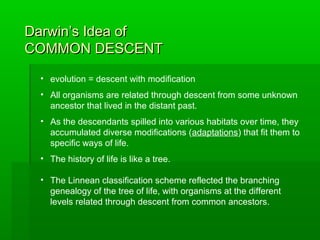
• evolution = descent with modification
• All organisms are related through descent from some unknown
ancestor that lived in the distant past.
• As the descendants spilled into various habitats over time, they
accumulated diverse modifications (adaptations) that fit them to
specific ways of life.
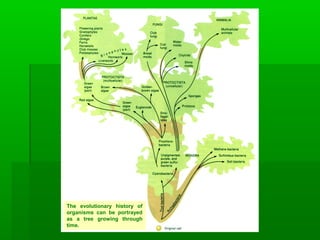
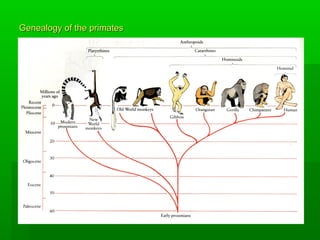
• The history of life is like a tree.
• The Linnean classification scheme reflected the branching
genealogy of the tree of life, with organisms at the different
levels related through descent from common ancestors.
The evolutionary history of
organisms can be portrayed
as a tree growing through
time.
Genealogy of the primatesGenealogy of the primates
Darwin’s Idea ofDarwin’s Idea of
GRADUALISMGRADUALISM
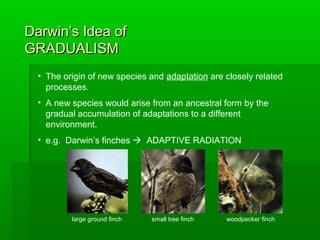
• The origin of new species and adaptation are closely related
processes.
• A new species would arise from an ancestral form by the
gradual accumulation of adaptations to a different
environment.
• e.g. Darwin’s finches  ADAPTIVE RADIATION
large ground finch small tree finch woodpecker finch
Darwin’s Idea ofDarwin’s Idea of
MULTIPLICATION of SPECIESMULTIPLICATION of SPECIES
 The existence of an enormous number of species
 some species are very similar (not as distinct from
each other!)
 gradual changes in various characteristics as
organisms became modified according to the
conditions in which they lived
Darwin’s Idea of NATURAL SELECTIONDarwin’s Idea of NATURAL SELECTION
as the Mechanism for Evolutionas the Mechanism for Evolution
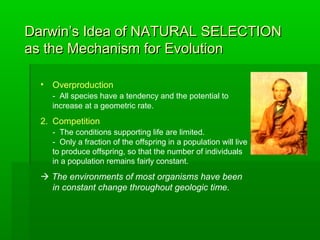
• Overproduction
- All species have a tendency and the potential to
increase at a geometric rate.
2. Competition
- The conditions supporting life are limited.
- Only a fraction of the offspring in a population will live
to produce offspring, so that the number of individuals
in a population remains fairly constant.
 The environments of most organisms have been
in constant change throughout geologic time.
3. Variation
- Individuals in a population vary greatly in their
characteristics.
4. Adaptation
- Some variations enable individuals to produce more
offspring than other individuals.
5. Natural Selection
- Individuals having favorable traits will produce more
offspring, and those with unfavorable traits will produce
fewer offspring.
• Speciation
- Given time, natural selection leads to the accumulation of
changes that differentiate groups from one another, such
that a new species may arise.
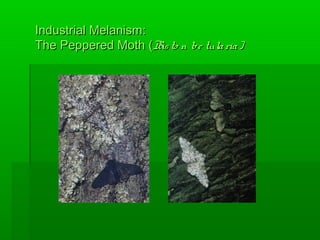
Industrial Melanism:Industrial Melanism:
The Peppered Moth (The Peppered Moth (Bisto n be tularia)Bisto n be tularia)
 Natural Selection  Survival of the Fittest
Other examples:
1. Insecticide resistance
2. Drug resistance in bacteria
 A population is the smallest unit that can
evolve.
 Natural selection acts on individuals, but
individuals do not evolve.
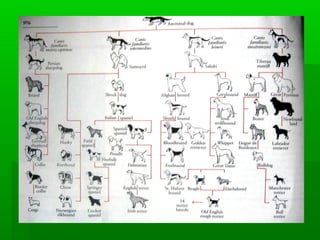
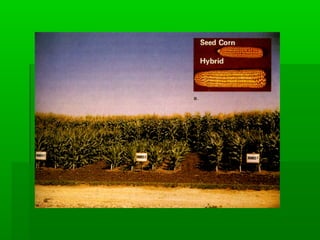
 Natural vs. Artificial Selection
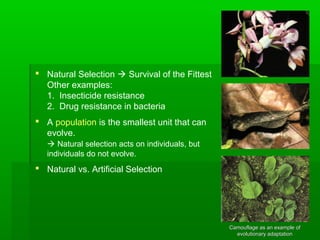
Camouflage as an example ofCamouflage as an example of
evolutionary adaptationevolutionary adaptation
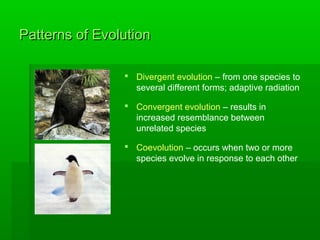
Patterns of EvolutionPatterns of Evolution
 Divergent evolution – from one species to
several different forms; adaptive radiation
 Convergent evolution – results in
increased resemblance between
unrelated species
 Coevolution – occurs when two or more
species evolve in response to each other
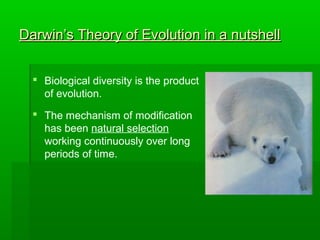
Darwin’s Theory of Evolution in a nutshellDarwin’s Theory of Evolution in a nutshell
 Biological diversity is the product
of evolution.
 The mechanism of modification
has been natural selection
working continuously over long
periods of time.
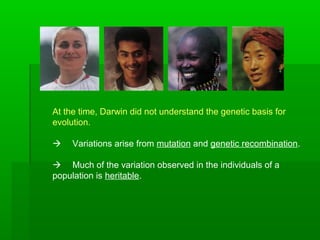
At the time, Darwin did not understand the genetic basis for
evolution.
 Variations arise from mutation and genetic recombination.
 Much of the variation observed in the individuals of a
population is heritable.
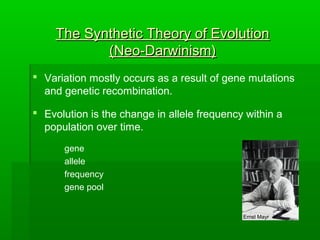
The Synthetic Theory of EvolutionThe Synthetic Theory of Evolution
(Neo-Darwinism)(Neo-Darwinism)
 Variation mostly occurs as a result of gene mutations
and genetic recombination.
 Evolution is the change in allele frequency within a
population over time.
gene
allele
frequency
gene pool
Ernst Mayr
Drawins theory of evolution powerpoint

Drawins theory of evolution powerpoint

  • 1.
    Darwin’s Theory ofEvolutionDarwin’s Theory of Evolution as a Mechanistic Processas a Mechanistic Process • Darwin’s Idea of Common DescentDarwin’s Idea of Common Descent • Darwin’s Idea of GradualismDarwin’s Idea of Gradualism • Darwin’s Idea of Multiplication ofDarwin’s Idea of Multiplication of SpeciesSpecies • Darwin’s Idea of Natural SelectionDarwin’s Idea of Natural Selection
  • 2.
    Darwin’s Idea ofDarwin’sIdea of COMMON DESCENTCOMMON DESCENT • evolution = descent with modification • All organisms are related through descent from some unknown ancestor that lived in the distant past. • As the descendants spilled into various habitats over time, they accumulated diverse modifications (adaptations) that fit them to specific ways of life. • The history of life is like a tree. • The Linnean classification scheme reflected the branching genealogy of the tree of life, with organisms at the different levels related through descent from common ancestors.
  • 3.
    The evolutionary historyof organisms can be portrayed as a tree growing through time.
  • 4.
    Genealogy of theprimatesGenealogy of the primates
  • 5.
    Darwin’s Idea ofDarwin’sIdea of GRADUALISMGRADUALISM • The origin of new species and adaptation are closely related processes. • A new species would arise from an ancestral form by the gradual accumulation of adaptations to a different environment. • e.g. Darwin’s finches  ADAPTIVE RADIATION large ground finch small tree finch woodpecker finch
  • 6.
    Darwin’s Idea ofDarwin’sIdea of MULTIPLICATION of SPECIESMULTIPLICATION of SPECIES  The existence of an enormous number of species  some species are very similar (not as distinct from each other!)  gradual changes in various characteristics as organisms became modified according to the conditions in which they lived
  • 7.
    Darwin’s Idea ofNATURAL SELECTIONDarwin’s Idea of NATURAL SELECTION as the Mechanism for Evolutionas the Mechanism for Evolution • Overproduction - All species have a tendency and the potential to increase at a geometric rate. 2. Competition - The conditions supporting life are limited. - Only a fraction of the offspring in a population will live to produce offspring, so that the number of individuals in a population remains fairly constant.  The environments of most organisms have been in constant change throughout geologic time.
  • 8.
    3. Variation - Individualsin a population vary greatly in their characteristics. 4. Adaptation - Some variations enable individuals to produce more offspring than other individuals. 5. Natural Selection - Individuals having favorable traits will produce more offspring, and those with unfavorable traits will produce fewer offspring. • Speciation - Given time, natural selection leads to the accumulation of changes that differentiate groups from one another, such that a new species may arise.
  • 9.
    Industrial Melanism:Industrial Melanism: ThePeppered Moth (The Peppered Moth (Bisto n be tularia)Bisto n be tularia)
  • 10.
     Natural Selection Survival of the Fittest Other examples: 1. Insecticide resistance 2. Drug resistance in bacteria  A population is the smallest unit that can evolve.  Natural selection acts on individuals, but individuals do not evolve.  Natural vs. Artificial Selection Camouflage as an example ofCamouflage as an example of evolutionary adaptationevolutionary adaptation
  • 13.
    Patterns of EvolutionPatternsof Evolution  Divergent evolution – from one species to several different forms; adaptive radiation  Convergent evolution – results in increased resemblance between unrelated species  Coevolution – occurs when two or more species evolve in response to each other
  • 14.
    Darwin’s Theory ofEvolution in a nutshellDarwin’s Theory of Evolution in a nutshell  Biological diversity is the product of evolution.  The mechanism of modification has been natural selection working continuously over long periods of time.
  • 15.
    At the time,Darwin did not understand the genetic basis for evolution.  Variations arise from mutation and genetic recombination.  Much of the variation observed in the individuals of a population is heritable.
  • 16.
    The Synthetic Theoryof EvolutionThe Synthetic Theory of Evolution (Neo-Darwinism)(Neo-Darwinism)  Variation mostly occurs as a result of gene mutations and genetic recombination.  Evolution is the change in allele frequency within a population over time. gene allele frequency gene pool Ernst Mayr