ADAPTIVE RADIATION IN MAMMALS
SAMBIT KUMAR DWIBEDY
ROLL NO-8
PG 1ST YEAR
CONTENTS
1. Introduction
2. What is Adaptive Radiation?
3. Causes
4. Types
5. Characteristics
6. Mechanism
7. The rise of Mammals
8. Examples of adaptive radiation in Class-Mammalia
9. Significance
10.Conclusion
INTRODUCTION
“Where do new species come from?” This is the key question that biology have
been asking for more than 200 years.
Charles Darwin Gave us part of the answer in his explanation of natural selection.
Now we know that new species are formed by evolution .Evolution occur in 2
different patterns.
Successive Speciation
Adaptive Radiation
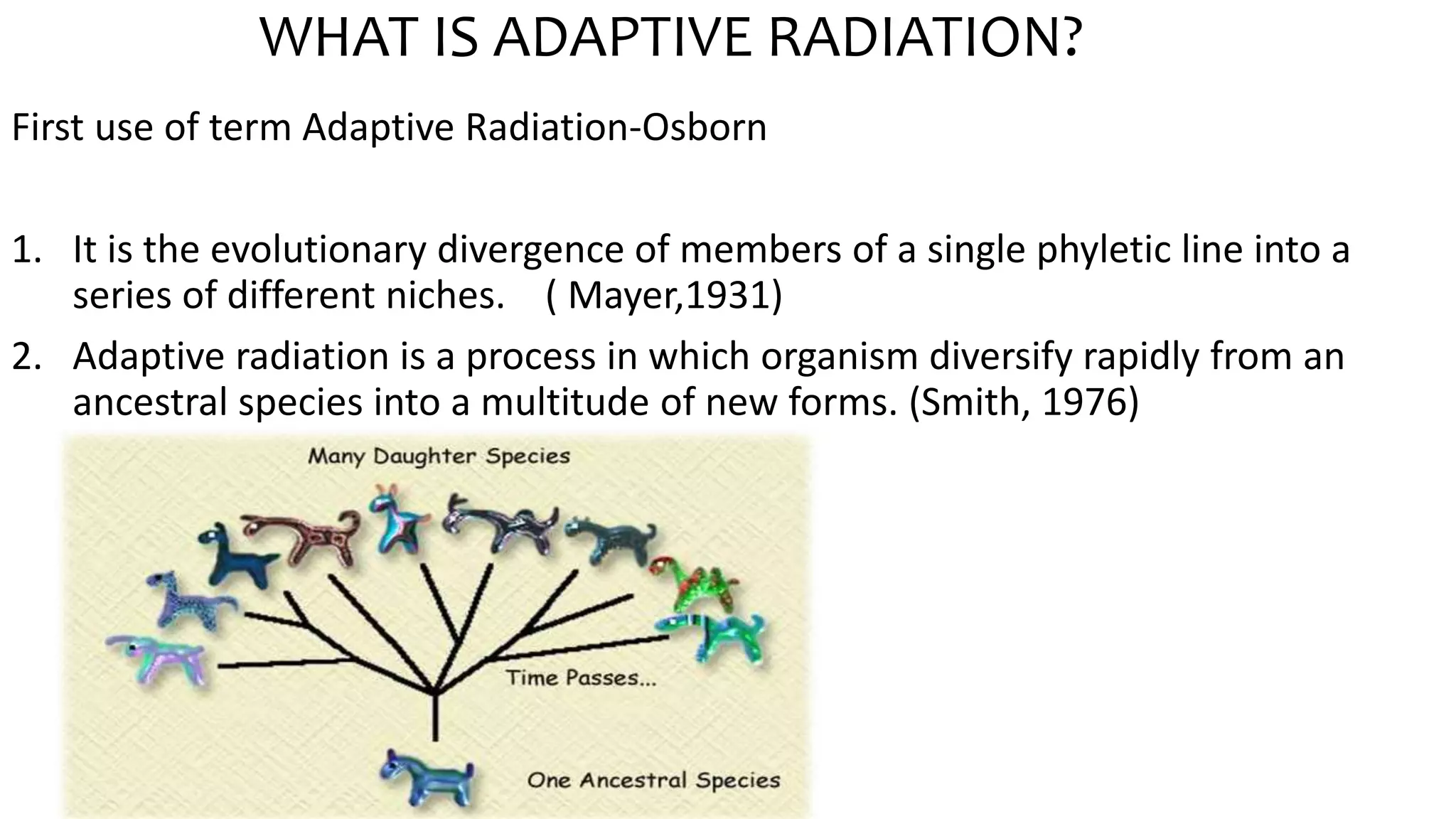
WHAT IS ADAPTIVE RADIATION?
First use of term Adaptive Radiation-Osborn
1. It is the evolutionary divergence of members of a single phyletic line into a
series of different niches. ( Mayer,1931)
2. Adaptive radiation is a process in which organism diversify rapidly from an
ancestral species into a multitude of new forms. (Smith, 1976)
LAW OF ADAPTIVE RADIATION
An isolated region, if large and sufficiently varied in its topography, soil, climate and
vegetation, will give rise to a diversified fauna from primitive types. Branches will
spring off in all directions to take advantage of every possible opportunity of
securing food.”
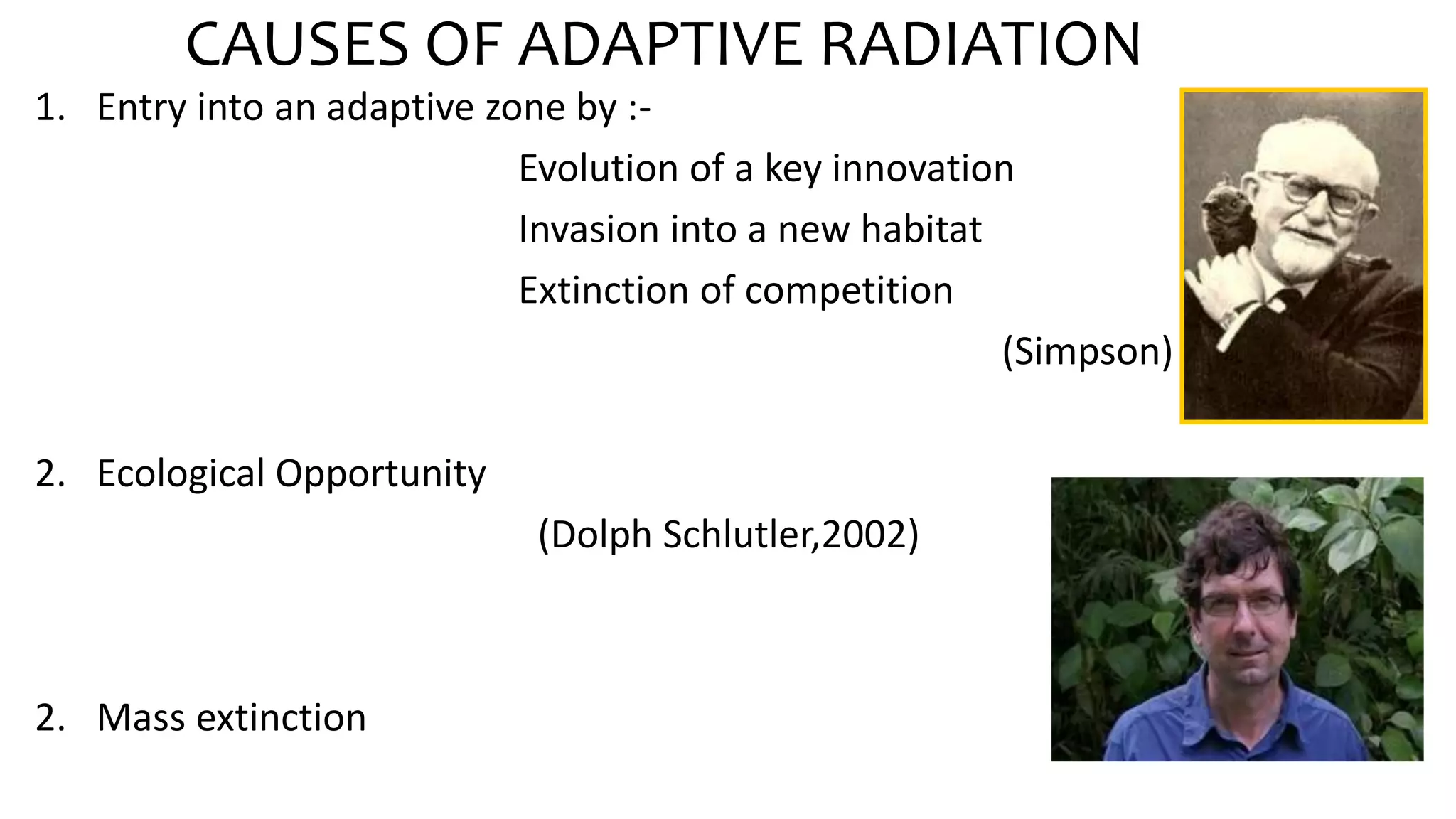
CAUSES OF ADAPTIVE RADIATION
1. Entry into an adaptive zone by :-
Evolution of a key innovation
Invasion into a new habitat
Extinction of competition
(Simpson)
2. Ecological Opportunity
(Dolph Schlutler,2002)
2. Mass extinction
THE AMNIOTIC EGG:
 Perhaps one of the
greatest key
innovations of all
time
ANOTHER KEY INNOVATION:
WINGS
TYPES
3 types
1. General Adaptive Radiation
2. Adaptive radiation by environmental change
3. Adaptive radiation in Archipelagos
CHARACTERISTICS
1. Common ancestry
2. Phenotype –Environment correlation
3. Trait utility
4. Rapid speciation
MECHANISMS
ECOLOGICAL OPPORTUNITY
RELEASE FROM NATURAL SELECTION
ECOLOGICAL RELEASE
RAPID SPECIATION & MORPHOLOGICAL
DIVERSIFICATION
ADAPTIVE RADIATION
THE RISE OF MAMMALS
 Mammals are amniotes that have hair and mammary glands.
 5300 species in class Mammalia
 Mammals evolved from synapsids.
 Mammals originated in the Mesozoic era. They were mouse like
with quadrupedal locomotion.
 Mesozoic Mammals remained small till Cretaceous due to the
presence of Dinosaurs.
 65 million years ago , after the extinction of Dinosaurs ,in the early
Coenozoic era the number and diversity of mammals exploded.
SMALL SIZED MAMMALS IN THE
MESOZOIC ERA IN THE PRESENCE
OF DINOSAURS
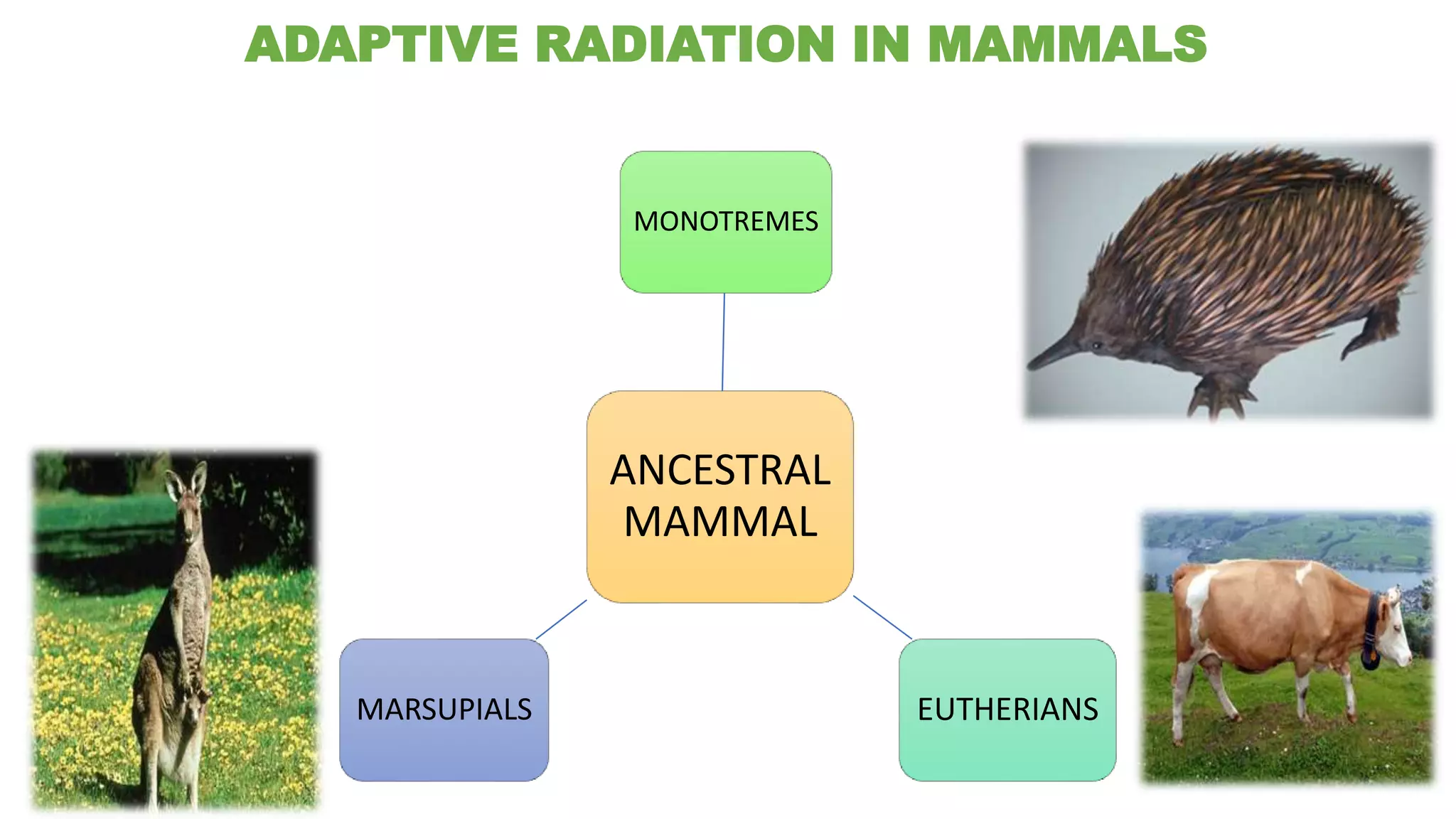
ADAPTIVE RADIATION IN MAMMALS
ANCESTRAL
MAMMAL
MONOTREMES
EUTHERIANSMARSUPIALS
ADAPTIVE RADIATION IN PLACENTAL MAMMAL BASED
ON LOCOMOTION
The limb structure (mode of locomotion) of placental mammal provides an
classical example of adaptive radiation.
The ancestor of the present day placental mammal was a five-toed short legged
terrestrial insectivore.
From such stem mammals, various modern types of mammals have evolved by the
modification of limbs
• Flying placental mammal
• Climbing placental mammal
• Swimming placental mammal
• Cursorial placental mammal
• Fussorial placental mammal
AUSTRALIAN MARSUPIALS DEMONSTRATE AN
ADAPTIVE RADIATION IN THE ABSENSE OF
COMPETITIVE INTERACTIONS WITH PLACENTAL
PLACENTAL MAMMALS
KANGAROO
WOMBAT
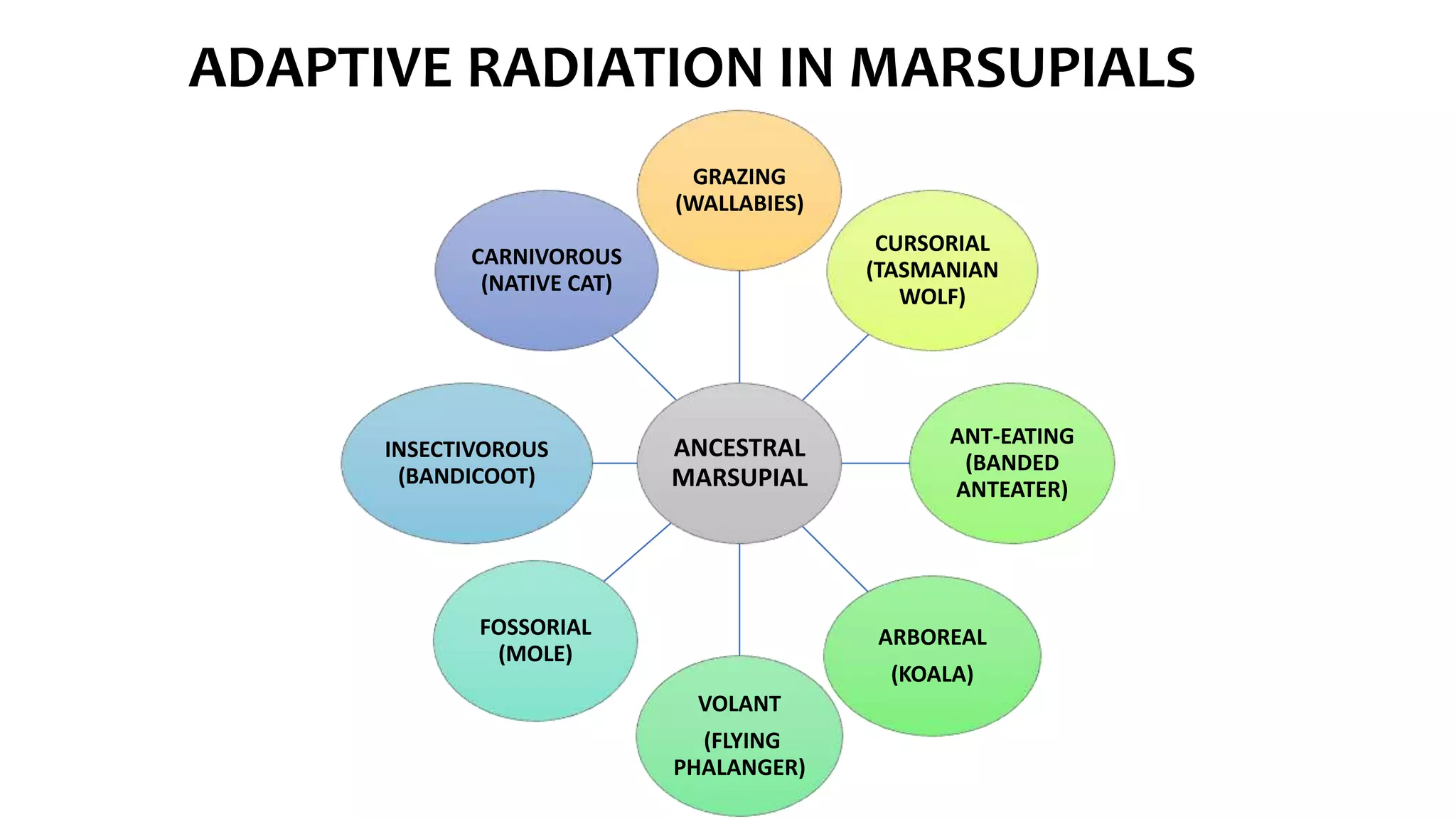
ADAPTIVE RADIATION IN MARSUPIALS
ANCESTRAL
MARSUPIAL
GRAZING
(WALLABIES)
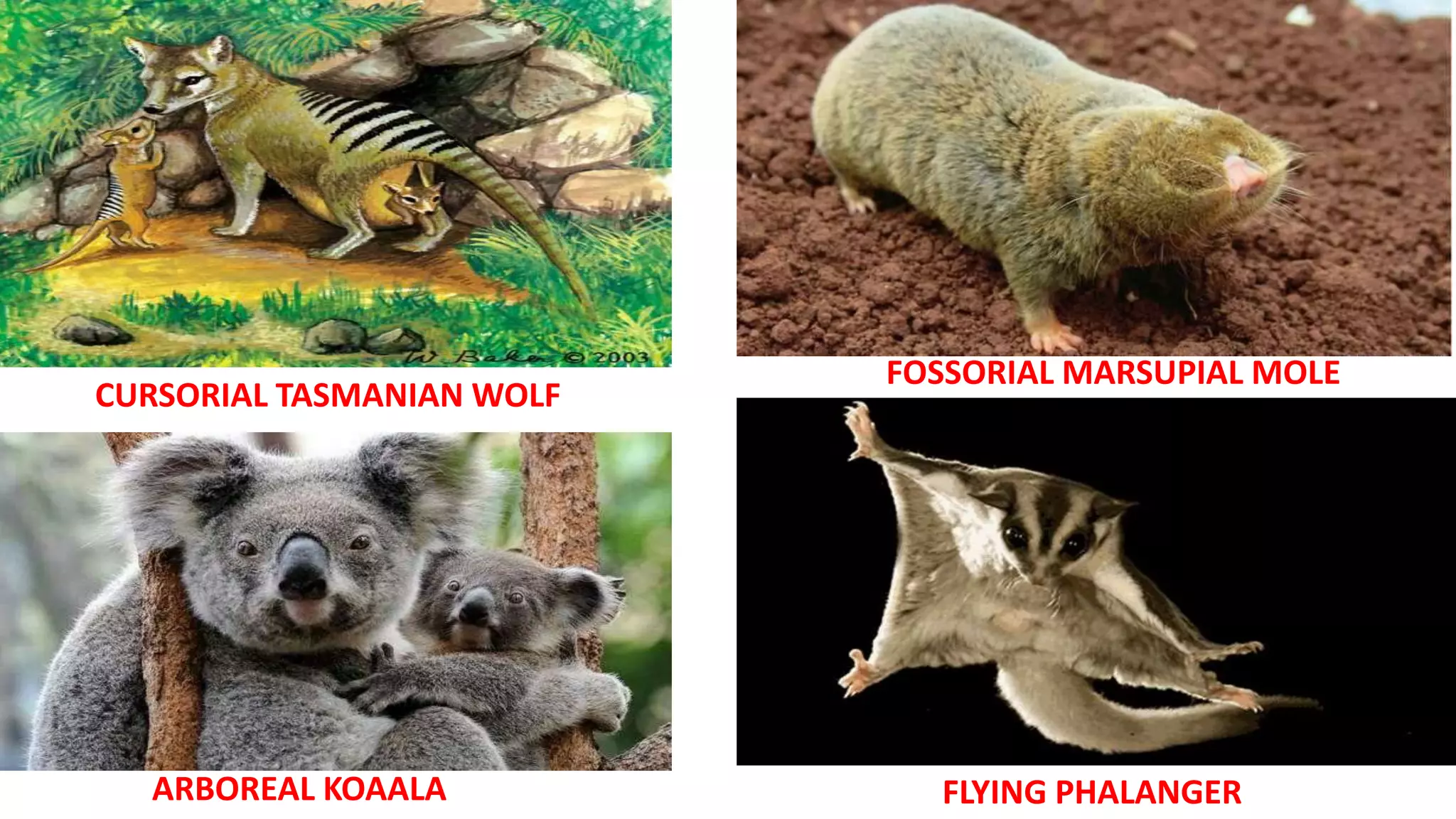
CURSORIAL
(TASMANIAN
WOLF)
ANT-EATING
(BANDED
ANTEATER)
ARBOREAL
(KOALA)
VOLANT
(FLYING
PHALANGER)
FOSSORIAL
(MOLE)
INSECTIVOROUS
(BANDICOOT)
CARNIVOROUS
(NATIVE CAT)
GRAZING WALLABIES
INSECTIVOROUS BANDICOOT
CARNIVORUS NATIVE CAT
BANDED ANT-EATER
ARBOREAL KOAALA
CURSORIAL TASMANIAN WOLF
FLYING PHALANGER
FOSSORIAL MARSUPIAL MOLE
FUTURE ASPECTS
There is a single living species of genus Homo. Adaptive radiation in
humans has not occurred yet but there is a chance of occurrence of
adaptive radiation in humans when the homo species will be diverged
into different lineages.
CHINA CARRIBEAN INDIAN AFRICAN AUSTRALIA
SIGNIFICANCE
1.Diversification of organisms
2.Origin of new species
3.Acquisition of novel adaptive traits
4.Less competition
5.Less chance of extinction
CONCLUSION
The highly advanced mammals are the result of adaptive radiation.
Much research has been done on adaptive radiation of Mammals due to its
dramatic effects on mammalian diversity. However more research is needed
especially to fully understand the many factors affecting adaptive radiation.
REFERENCE
1.Rastogi , V. B. “Evolutionary biology”,Kedar Nath Ram Nath Publication,(U.P) India, pp. 333-347.
2. Dobzhansky , T. (1973) “Evolution”, Surjeet Publication, Delhi, India, pp.150-170.
3.Chattopadhyay S.,(2008).’Evolution Adaptation & Ethology’ pp.332-338.
4.Schluter, D. (1996) “Ecological causes of adaptive radiation.” American Naturalist 148:540-564.
.
5..Simpson, G. G. (1953). The Major Features of Evolution. New York: Columbia University Press.
6..Meyer J. R., Schoustra S., Lachapelle J.and Kassen R. (2011).
Overshooting dynamics in a model adaptive radiation. Proceedings of the Royal Society PP.392–
398.
7..Losos, J. B. (2010) “Adaptive radiation, ecological opportunity and evolutionary Determinism”
American Naturalist 175(6):623-39
Adaptive radiation in mammals

Adaptive radiation in mammals

  • 1.
    ADAPTIVE RADIATION INMAMMALS SAMBIT KUMAR DWIBEDY ROLL NO-8 PG 1ST YEAR
  • 2.
    CONTENTS 1. Introduction 2. Whatis Adaptive Radiation? 3. Causes 4. Types 5. Characteristics 6. Mechanism 7. The rise of Mammals 8. Examples of adaptive radiation in Class-Mammalia 9. Significance 10.Conclusion
  • 3.
    INTRODUCTION “Where do newspecies come from?” This is the key question that biology have been asking for more than 200 years. Charles Darwin Gave us part of the answer in his explanation of natural selection. Now we know that new species are formed by evolution .Evolution occur in 2 different patterns. Successive Speciation Adaptive Radiation
  • 4.
    WHAT IS ADAPTIVERADIATION? First use of term Adaptive Radiation-Osborn 1. It is the evolutionary divergence of members of a single phyletic line into a series of different niches. ( Mayer,1931) 2. Adaptive radiation is a process in which organism diversify rapidly from an ancestral species into a multitude of new forms. (Smith, 1976)
  • 5.
    LAW OF ADAPTIVERADIATION An isolated region, if large and sufficiently varied in its topography, soil, climate and vegetation, will give rise to a diversified fauna from primitive types. Branches will spring off in all directions to take advantage of every possible opportunity of securing food.”
  • 6.
    CAUSES OF ADAPTIVERADIATION 1. Entry into an adaptive zone by :- Evolution of a key innovation Invasion into a new habitat Extinction of competition (Simpson) 2. Ecological Opportunity (Dolph Schlutler,2002) 2. Mass extinction
  • 7.
    THE AMNIOTIC EGG: Perhaps one of the greatest key innovations of all time
  • 8.
  • 9.
    TYPES 3 types 1. GeneralAdaptive Radiation 2. Adaptive radiation by environmental change 3. Adaptive radiation in Archipelagos
  • 10.
    CHARACTERISTICS 1. Common ancestry 2.Phenotype –Environment correlation 3. Trait utility 4. Rapid speciation
  • 11.
    MECHANISMS ECOLOGICAL OPPORTUNITY RELEASE FROMNATURAL SELECTION ECOLOGICAL RELEASE RAPID SPECIATION & MORPHOLOGICAL DIVERSIFICATION ADAPTIVE RADIATION
  • 12.
    THE RISE OFMAMMALS  Mammals are amniotes that have hair and mammary glands.  5300 species in class Mammalia  Mammals evolved from synapsids.  Mammals originated in the Mesozoic era. They were mouse like with quadrupedal locomotion.  Mesozoic Mammals remained small till Cretaceous due to the presence of Dinosaurs.  65 million years ago , after the extinction of Dinosaurs ,in the early Coenozoic era the number and diversity of mammals exploded.
  • 13.
    SMALL SIZED MAMMALSIN THE MESOZOIC ERA IN THE PRESENCE OF DINOSAURS
  • 14.
    ADAPTIVE RADIATION INMAMMALS ANCESTRAL MAMMAL MONOTREMES EUTHERIANSMARSUPIALS
  • 15.
    ADAPTIVE RADIATION INPLACENTAL MAMMAL BASED ON LOCOMOTION The limb structure (mode of locomotion) of placental mammal provides an classical example of adaptive radiation. The ancestor of the present day placental mammal was a five-toed short legged terrestrial insectivore. From such stem mammals, various modern types of mammals have evolved by the modification of limbs • Flying placental mammal • Climbing placental mammal • Swimming placental mammal • Cursorial placental mammal • Fussorial placental mammal
  • 18.
    AUSTRALIAN MARSUPIALS DEMONSTRATEAN ADAPTIVE RADIATION IN THE ABSENSE OF COMPETITIVE INTERACTIONS WITH PLACENTAL PLACENTAL MAMMALS KANGAROO WOMBAT
  • 19.
    ADAPTIVE RADIATION INMARSUPIALS ANCESTRAL MARSUPIAL GRAZING (WALLABIES) CURSORIAL (TASMANIAN WOLF) ANT-EATING (BANDED ANTEATER) ARBOREAL (KOALA) VOLANT (FLYING PHALANGER) FOSSORIAL (MOLE) INSECTIVOROUS (BANDICOOT) CARNIVOROUS (NATIVE CAT)
  • 20.
  • 21.
    ARBOREAL KOAALA CURSORIAL TASMANIANWOLF FLYING PHALANGER FOSSORIAL MARSUPIAL MOLE
  • 22.
    FUTURE ASPECTS There isa single living species of genus Homo. Adaptive radiation in humans has not occurred yet but there is a chance of occurrence of adaptive radiation in humans when the homo species will be diverged into different lineages. CHINA CARRIBEAN INDIAN AFRICAN AUSTRALIA
  • 23.
    SIGNIFICANCE 1.Diversification of organisms 2.Originof new species 3.Acquisition of novel adaptive traits 4.Less competition 5.Less chance of extinction
  • 24.
    CONCLUSION The highly advancedmammals are the result of adaptive radiation. Much research has been done on adaptive radiation of Mammals due to its dramatic effects on mammalian diversity. However more research is needed especially to fully understand the many factors affecting adaptive radiation.
  • 25.
    REFERENCE 1.Rastogi , V.B. “Evolutionary biology”,Kedar Nath Ram Nath Publication,(U.P) India, pp. 333-347. 2. Dobzhansky , T. (1973) “Evolution”, Surjeet Publication, Delhi, India, pp.150-170. 3.Chattopadhyay S.,(2008).’Evolution Adaptation & Ethology’ pp.332-338. 4.Schluter, D. (1996) “Ecological causes of adaptive radiation.” American Naturalist 148:540-564. . 5..Simpson, G. G. (1953). The Major Features of Evolution. New York: Columbia University Press. 6..Meyer J. R., Schoustra S., Lachapelle J.and Kassen R. (2011). Overshooting dynamics in a model adaptive radiation. Proceedings of the Royal Society PP.392– 398. 7..Losos, J. B. (2010) “Adaptive radiation, ecological opportunity and evolutionary Determinism” American Naturalist 175(6):623-39