Planning an Integrated Thematic Curriculum Unit Who am I in the Lives of Children? Feeney, Christensen, Moravcik Prepared by Dr. Carla Piper
Thematic Planning Organize curriculum around a theme Umbrella overarching interest area  Integrates different developmental and subject areas Contributes to child’s growing awareness and understanding Provides opportunities for child to learn by doing and have direct experiences with the world Helps children understand that learning is connected to life.
Children’s Experiences Reflect on and recreate experiences through : Dramatic play Block building Discussions Art Music Movement Measuring Graphing and Mapping Children develop skills through: Sensing Moving Thinking Problem solving Communicating Creating Working Playing with others
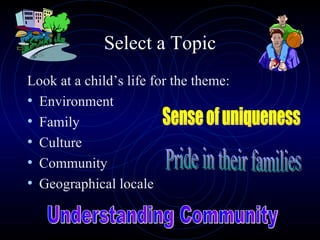
Select a Topic Look at a child’s life for the theme: Environment Family Culture Community Geographical locale Sense of uniqueness Pride in their families Understanding Community
Appropriate Themes Primary Question:  Can I give children direct experience of this topic? Should reflect children’s interests, abilities and issues of concern Should involve concepts and skills at the right level of challenge for the age group Topic should be complex and interesting enough to be explored at some depth Plan to focus on topic for several weeks to several months
Criteria for Theme Selection The topic can be taught through direct experience. Children can explore it with their senses. Concept is developmentally appropriate for young children. Concept can be organized to move from: Simple to complex Concrete to abstract Interesting, meaningful, and worth knowing about. Helps children acquire understanding and appreciation of themselves, others, and the world in which they live. Page 346
More Criteria for Theme Selection Many things can be experienced and learned  Generates a variety of activities and learning in all areas of development and in a broad range of subject areas. Harmonizes with program philosophy and goals and is interesting to the staff. Realistic in terms of resources (funds, materials, people, places that are available) Allows for and encourages family input and participation. Consistent with family and community values.
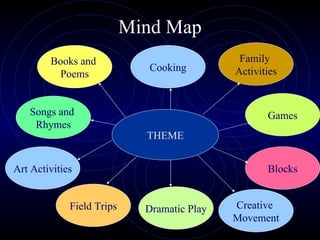
“ Major Understanding” of the Theme The important ideas you wish children to acquire Brainstorm the purpose and goals Gather the resources and materials Create a mind map or curriculum web Ask the children: What do you want to know? What would you like to learn?
Mind Map Creative  Movement Field Trips Dramatic Play Blocks Family  Activities Games Songs and  Rhymes Books and  Poems Art Activities Cooking THEME
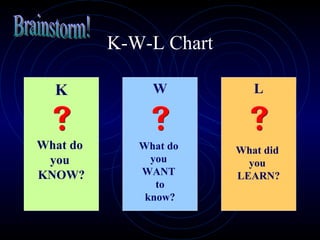
K-W-L Chart K What do  you  KNOW? W What do  you  WANT  to know? L What did  you  LEARN? Brainstorm!
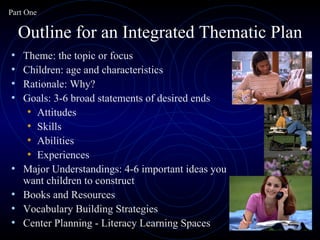
Outline for an Integrated Thematic Plan Theme: the topic or focus Children: age and characteristics Rationale: Why? Goals: 3-6 broad statements of desired ends Attitudes Skills Abilities Experiences Major Understandings: 4-6 important ideas you want children to construct Books and Resources Vocabulary Building Strategies  Center Planning - Literacy Learning Spaces  Part One
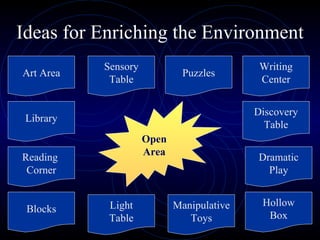
Environmental Additions and Trips List of materials to add to each learning center  Support awareness of theme Help develop the ‘big ideas’ Include ideas for: Blocks, manipulative toys, puzzles, games Dramatic play, art, writing center, library, science area Outdoor areas Learning trips
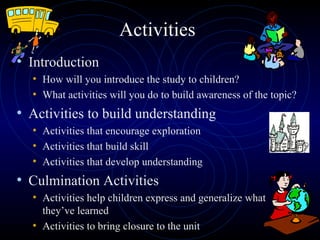
Activities Introduction How will you introduce the study to children? What activities will you do to build awareness of the topic? Activities to build understanding Activities that encourage exploration Activities that build skill  Activities that develop understanding Culmination Activities Activities help children express and generalize what they’ve learned Activities to bring closure to the unit
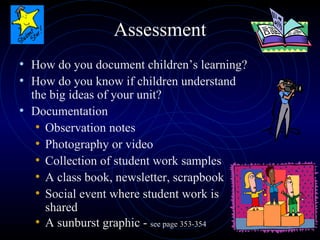
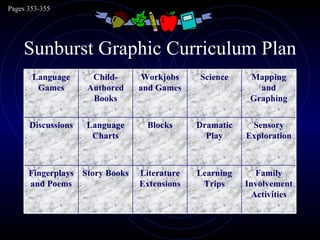
Assessment How do you document children’s learning? How do you know if children understand the big ideas of your unit? Documentation Observation notes Photography or video Collection of student work samples A class book, newsletter, scrapbook Social event where student work is shared A sunburst graphic -  see page 353-354
Sunburst Graphic Curriculum Plan Pages 353-355 Family Involvement Activities Learning Trips Literature Extensions Story Books Fingerplays and Poems Sensory Exploration Dramatic Play Blocks Language Charts Discussions Mapping and Graphing Science Workjobs and Games Child-Authored Books Language Games
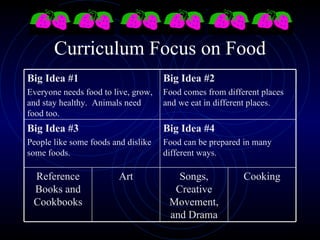
Curriculum Focus on Food Cooking Songs, Creative Movement, and Drama Art Reference Books and Cookbooks Big Idea #4 Food can be prepared in many different ways. Big Idea #3 People like some foods and dislike some foods. Big Idea #2 Food comes from different places and we eat in different places. Big Idea #1 Everyone needs food to live, grow, and stay healthy.  Animals need food too.
Ideas for Enriching the Environment Art Area Library Reading  Corner Blocks Manipulative Toys Dramatic Play Writing Center Puzzles Hollow Box Discovery Table Light Table Sensory Table Open Area
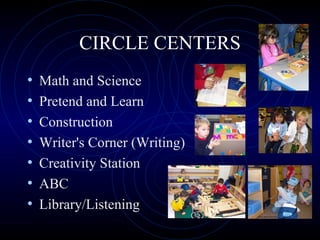
CIRCLE CENTERS Math and Science  Pretend and Learn  Construction  Writer's Corner (Writing)  Creativity Station  ABC  Library/Listening
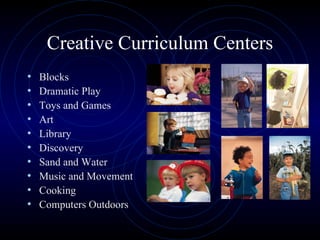
Creative Curriculum Centers Blocks Dramatic Play Toys and Games Art  Library  Discovery  Sand and Water  Music and Movement  Cooking  Computers Outdoors

Thematicplan

  • 1.
    Planning an IntegratedThematic Curriculum Unit Who am I in the Lives of Children? Feeney, Christensen, Moravcik Prepared by Dr. Carla Piper
  • 2.
    Thematic Planning Organizecurriculum around a theme Umbrella overarching interest area Integrates different developmental and subject areas Contributes to child’s growing awareness and understanding Provides opportunities for child to learn by doing and have direct experiences with the world Helps children understand that learning is connected to life.
  • 3.
    Children’s Experiences Reflecton and recreate experiences through : Dramatic play Block building Discussions Art Music Movement Measuring Graphing and Mapping Children develop skills through: Sensing Moving Thinking Problem solving Communicating Creating Working Playing with others
  • 4.
    Select a TopicLook at a child’s life for the theme: Environment Family Culture Community Geographical locale Sense of uniqueness Pride in their families Understanding Community
  • 5.
    Appropriate Themes PrimaryQuestion: Can I give children direct experience of this topic? Should reflect children’s interests, abilities and issues of concern Should involve concepts and skills at the right level of challenge for the age group Topic should be complex and interesting enough to be explored at some depth Plan to focus on topic for several weeks to several months
  • 6.
    Criteria for ThemeSelection The topic can be taught through direct experience. Children can explore it with their senses. Concept is developmentally appropriate for young children. Concept can be organized to move from: Simple to complex Concrete to abstract Interesting, meaningful, and worth knowing about. Helps children acquire understanding and appreciation of themselves, others, and the world in which they live. Page 346
  • 7.
    More Criteria forTheme Selection Many things can be experienced and learned Generates a variety of activities and learning in all areas of development and in a broad range of subject areas. Harmonizes with program philosophy and goals and is interesting to the staff. Realistic in terms of resources (funds, materials, people, places that are available) Allows for and encourages family input and participation. Consistent with family and community values.
  • 8.
    “ Major Understanding”of the Theme The important ideas you wish children to acquire Brainstorm the purpose and goals Gather the resources and materials Create a mind map or curriculum web Ask the children: What do you want to know? What would you like to learn?
  • 9.
    Mind Map Creative Movement Field Trips Dramatic Play Blocks Family Activities Games Songs and Rhymes Books and Poems Art Activities Cooking THEME
  • 10.
    K-W-L Chart KWhat do you KNOW? W What do you WANT to know? L What did you LEARN? Brainstorm!
  • 11.
    Outline for anIntegrated Thematic Plan Theme: the topic or focus Children: age and characteristics Rationale: Why? Goals: 3-6 broad statements of desired ends Attitudes Skills Abilities Experiences Major Understandings: 4-6 important ideas you want children to construct Books and Resources Vocabulary Building Strategies Center Planning - Literacy Learning Spaces Part One
  • 12.
    Environmental Additions andTrips List of materials to add to each learning center Support awareness of theme Help develop the ‘big ideas’ Include ideas for: Blocks, manipulative toys, puzzles, games Dramatic play, art, writing center, library, science area Outdoor areas Learning trips
  • 13.
    Activities Introduction Howwill you introduce the study to children? What activities will you do to build awareness of the topic? Activities to build understanding Activities that encourage exploration Activities that build skill Activities that develop understanding Culmination Activities Activities help children express and generalize what they’ve learned Activities to bring closure to the unit
  • 14.
    Assessment How doyou document children’s learning? How do you know if children understand the big ideas of your unit? Documentation Observation notes Photography or video Collection of student work samples A class book, newsletter, scrapbook Social event where student work is shared A sunburst graphic - see page 353-354
  • 15.
    Sunburst Graphic CurriculumPlan Pages 353-355 Family Involvement Activities Learning Trips Literature Extensions Story Books Fingerplays and Poems Sensory Exploration Dramatic Play Blocks Language Charts Discussions Mapping and Graphing Science Workjobs and Games Child-Authored Books Language Games
  • 16.
    Curriculum Focus onFood Cooking Songs, Creative Movement, and Drama Art Reference Books and Cookbooks Big Idea #4 Food can be prepared in many different ways. Big Idea #3 People like some foods and dislike some foods. Big Idea #2 Food comes from different places and we eat in different places. Big Idea #1 Everyone needs food to live, grow, and stay healthy. Animals need food too.
  • 17.
    Ideas for Enrichingthe Environment Art Area Library Reading Corner Blocks Manipulative Toys Dramatic Play Writing Center Puzzles Hollow Box Discovery Table Light Table Sensory Table Open Area
  • 18.
    CIRCLE CENTERS Mathand Science Pretend and Learn Construction Writer's Corner (Writing) Creativity Station ABC Library/Listening
  • 19.
    Creative Curriculum CentersBlocks Dramatic Play Toys and Games Art Library Discovery Sand and Water Music and Movement Cooking Computers Outdoors