Common Core Overview for EDMU 523
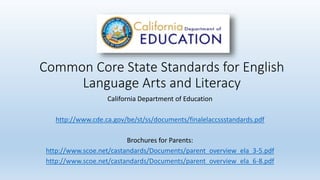
Common Core State Standards for English
Language Arts and Literacy
California Department of Education
http://www.cde.ca.gov/be/st/ss/documents/finalelaccssstandards.pdf
Brochures for Parents:
http://www.scoe.net/castandards/Documents/parent_overview_ela_3-5.pdf
http://www.scoe.net/castandards/Documents/parent_overview_ela_6-8.pdf
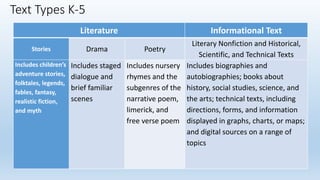
Literature Informational Text
Stories Drama Poetry
Literary Nonfiction and Historical,
Scientific, and Technical Texts
Includes children’s
adventure stories,
folktales, legends,
fables, fantasy,
realistic fiction,
and myth
Includes staged
dialogue and
brief familiar
scenes
Includes nursery
rhymes and the
subgenres of the
narrative poem,
limerick, and
free verse poem
Includes biographies and
autobiographies; books about
history, social studies, science, and
the arts; technical texts, including
directions, forms, and information
displayed in graphs, charts, or maps;
and digital sources on a range of
topics
Text Types K-5
Literature Informational Text
Stories Drama Poetry Literary Nonfiction
Includes the
subgenres of
adventure stories,
historical fiction,
mysteries, myths,
science fiction,
realistic fiction,
allegories,
parodies, satire,
and graphic novels.
Includes classical
through
contemporary one-
act and multi-act
plays, both in written
form and on film, and
works by writers
representing a broad
range of literary
periods and cultures.
CA
Includes classical
through
contemporary works
and the subgenres of
narrative poems,
lyrical poems, free
verse poems,
sonnets, odes,
ballads, and epics by
writers representing
a broad range of
literary periods and
cultures. CA
Includes the subgenres of
exposition, argument, and
functional text in the form
of personal essays,
speeches, opinion pieces,
essays about art or
literature, biographies,
memoirs, journalism, and
historical, scientific,
technical, or economic
accounts (including digital
sources) written for a broad
audience.
Text Types 6-8
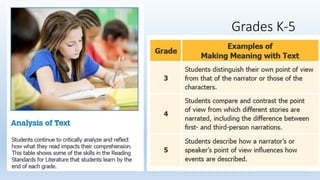
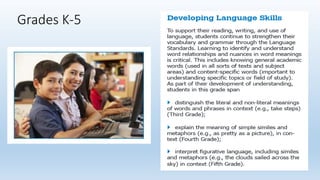
Grades K-5
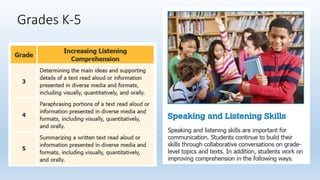
Grades K-5
Grades K-5
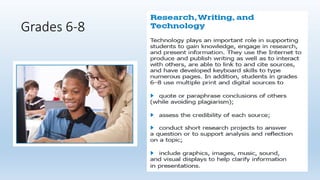
Grades 6-8
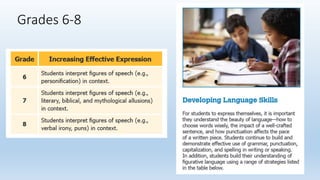
Grades 6-8
Grades 6-8
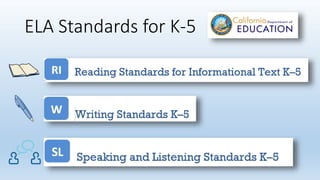
ELA Standards for K-5
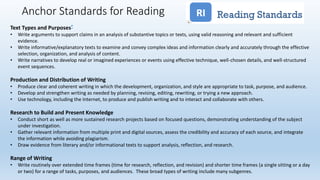
Text Types and Purposes*
• Write arguments to support claims in an analysis of substantive topics or texts, using valid reasoning and relevant and sufficient
evidence.
• Write informative/explanatory texts to examine and convey complex ideas and information clearly and accurately through the effective
selection, organization, and analysis of content.
• Write narratives to develop real or imagined experiences or events using effective technique, well-chosen details, and well-structured
event sequences.
Production and Distribution of Writing
• Produce clear and coherent writing in which the development, organization, and style are appropriate to task, purpose, and audience.
• Develop and strengthen writing as needed by planning, revising, editing, rewriting, or trying a new approach.
• Use technology, including the Internet, to produce and publish writing and to interact and collaborate with others.
Research to Build and Present Knowledge
• Conduct short as well as more sustained research projects based on focused questions, demonstrating understanding of the subject
under investigation.
• Gather relevant information from multiple print and digital sources, assess the credibility and accuracy of each source, and integrate
the information while avoiding plagiarism.
• Draw evidence from literary and/or informational texts to support analysis, reflection, and research.
Range of Writing
• Write routinely over extended time frames (time for research, reflection, and revision) and shorter time frames (a single sitting or a day
or two) for a range of tasks, purposes, and audiences. These broad types of writing include many subgenres.
Anchor Standards for Reading
Grade 3 Students: Grade 4 Students: Grade 5 Students:
IntegrationofKnowledgeandIdeas
7. Use information gained from
illustrations (e.g., maps, photographs)
and the words in a text to
demonstrate understanding of the
text (e.g., where, when, why, and
how key events occur).
7. Interpret information presented visually,
orally, or quantitatively (e.g., in charts,
graphs, diagrams, time lines, animations,
or interactive elements on Web pages) and
explain how the information contributes to
an understanding of the text in which it
appears.
7. Draw on information from multiple
print or digital sources, demonstrating
the ability to locate an answer to a
question quickly or to solve a problem
efficiently.
8. Describe the logical connection
between particular sentences and
paragraphs in a text (e.g.,
comparison, cause/effect,
first/second/third in a sequence).
8. Explain how an author uses reasons and
evidence to support particular points in a
text.
8. Explain how an author uses reasons
and evidence to support particular
points in a text, identifying which
reasons and evidence support which
point(s).
9. Compare and contrast the most
important points and key details
presented in two texts on the same
topic.
9. Integrate information from two texts on
the same topic in order to write or speak
about the subject knowledgeably
9. Integrate information from several
texts on the same topic in order to
write or speak about the subject
knowledgeably.
RangeofReading
andLevelofText
Complexity
10. By the end of the year, read and
comprehend informational texts,
including history/social studies,
science, and technical texts, at the
high end of the grades 2–3 text
complexity band independently and
proficiently.
10. By the end of year, read and comprehend
informational texts, including
history/social studies, science, and
technical texts, in the grades 4–5 text
complexity band proficiently, with
scaffolding as needed at the high end of
the range.
10. By the end of the year, read and
comprehend informational texts,
including history/social studies, science,
and technical texts, at the high end of
the grades 4–5 text complexity band
independently and proficiently.
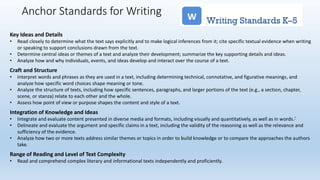
Key Ideas and Details
• Read closely to determine what the text says explicitly and to make logical inferences from it; cite specific textual evidence when writing
or speaking to support conclusions drawn from the text.
• Determine central ideas or themes of a text and analyze their development; summarize the key supporting details and ideas.
• Analyze how and why individuals, events, and ideas develop and interact over the course of a text.
Craft and Structure
• Interpret words and phrases as they are used in a text, including determining technical, connotative, and figurative meanings, and
analyze how specific word choices shape meaning or tone.
• Analyze the structure of texts, including how specific sentences, paragraphs, and larger portions of the text (e.g., a section, chapter,
scene, or stanza) relate to each other and the whole.
• Assess how point of view or purpose shapes the content and style of a text.
Integration of Knowledge and Ideas
• Integrate and evaluate content presented in diverse media and formats, including visually and quantitatively, as well as in words.*
• Delineate and evaluate the argument and specific claims in a text, including the validity of the reasoning as well as the relevance and
sufficiency of the evidence.
• Analyze how two or more texts address similar themes or topics in order to build knowledge or to compare the approaches the authors
take.
Range of Reading and Level of Text Complexity
• Read and comprehend complex literary and informational texts independently and proficiently.
Anchor Standards for Writing
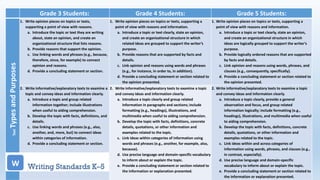
Grade 3 Students: Grade 4 Students: Grade 5 Students:TextTypesandPurposes
1. Write opinion pieces on topics or texts,
supporting a point of view with reasons.
a. Introduce the topic or text they are writing
about, state an opinion, and create an
organizational structure that lists reasons.
b. Provide reasons that support the opinion.
c. Use linking words and phrases (e.g., because,
therefore, since, for example) to connect
opinion and reasons.
d. Provide a concluding statement or section.
1. Write opinion pieces on topics or texts, supporting a
point of view with reasons and information.
a. Introduce a topic or text clearly, state an opinion,
and create an organizational structure in which
related ideas are grouped to support the writer’s
purpose.
b. Provide reasons that are supported by facts and
details.
c. Link opinion and reasons using words and phrases
(e.g., for instance, in order to, in addition).
d. Provide a concluding statement or section related to
the opinion presented.
1. Write opinion pieces on topics or texts, supporting a
point of view with reasons and information.
a. Introduce a topic or text clearly, state an opinion,
and create an organizational structure in which
ideas are logically grouped to support the writer’s
purpose.
b. Provide logically ordered reasons that are supported
by facts and details.
c. Link opinion and reasons using words, phrases, and
clauses (e.g., consequently, specifically).
d. Provide a concluding statement or section related to
the opinion presented.
2. Write informative/explanatory texts to examine a
topic and convey ideas and information clearly.
a. Introduce a topic and group related
information together; include illustrations
when useful to aiding comprehension.
b. Develop the topic with facts, definitions, and
details.
c. Use linking words and phrases (e.g., also,
another, and, more, but) to connect ideas
within categories of information.
d. Provide a concluding statement or section.
2. Write informative/explanatory texts to examine a topic
and convey ideas and information clearly.
a. Introduce a topic clearly and group related
information in paragraphs and sections; include
formatting (e.g., headings), illustrations, and
multimedia when useful to aiding comprehension.
b. Develop the topic with facts, definitions, concrete
details, quotations, or other information and
examples related to the topic.
c. Link ideas within categories of information using
words and phrases (e.g., another, for example, also,
because).
d. Use precise language and domain-specific vocabulary
to inform about or explain the topic.
e. Provide a concluding statement or section related to
the information or explanation presented.
2. Write informative/explanatory texts to examine a topic
and convey ideas and information clearly.
a. Introduce a topic clearly, provide a general
observation and focus, and group related
information logically; include formatting (e.g.,
headings), illustrations, and multimedia when useful
to aiding comprehension.
b. Develop the topic with facts, definitions, concrete
details, quotations, or other information and
examples related to the topic.
c. Link ideas within and across categories of
information using words, phrases, and clauses (e.g.,
in contrast, especially).
d. Use precise language and domain-specific
vocabulary to inform about or explain the topic.
e. Provide a concluding statement or section related to
the information or explanation presented.
Anchor Standards for Speaking and Listening
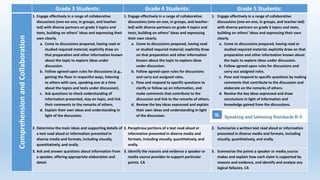
Comprehension and Collaboration
1. Prepare for and participate effectively in a range of conversations and collaborations with diverse
partners, building on others’ ideas and expressing their own clearly and persuasively.
2. Integrate and evaluate information presented in diverse media and formats, including visually,
quantitatively, and orally.
3. Evaluate a speaker’s point of view, reasoning, and use of evidence and rhetoric.
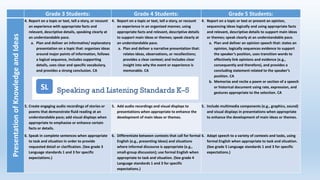
Presentation of Knowledge and Ideas
1. Present information, findings, and supporting evidence such that listeners can follow the line of
reasoning and the organization, development, and style are appropriate to task, purpose, and audience.
2. Make strategic use of digital media and visual displays of data to express information and enhance
understanding of presentations.
3. Adapt speech to a variety of contexts and communicative tasks, demonstrating command of formal
English when indicated or appropriate.
Grade 3 Students: Grade 4 Students: Grade 5 Students:
ComprehensionandCollaboration
1. Engage effectively in a range of collaborative
discussions (one-on-one, in groups, and teacher-
led) with diverse partners on grade 3 topics and
texts, building on others’ ideas and expressing their
own clearly.
a. Come to discussions prepared, having read or
studied required material; explicitly draw on
that preparation and other information known
about the topic to explore ideas under
discussion.
b. Follow agreed-upon rules for discussions (e.g.,
gaining the floor in respectful ways, listening
to others with care, speaking one at a time
about the topics and texts under discussion).
c. Ask questions to check understanding of
information presented, stay on topic, and link
their comments to the remarks of others.
d. Explain their own ideas and understanding in
light of the discussion.
1. Engage effectively in a range of collaborative
discussions (one-on-one, in groups, and teacher-
led) with diverse partners on grade 4 topics and
texts, building on others’ ideas and expressing
their own clearly.
a. Come to discussions prepared, having read
or studied required material; explicitly draw
on that preparation and other information
known about the topic to explore ideas
under discussion.
b. Follow agreed-upon rules for discussions
and carry out assigned roles.
c. Pose and respond to specific questions to
clarify or follow up on information, and
make comments that contribute to the
discussion and link to the remarks of others.
d. Review the key ideas expressed and explain
their own ideas and understanding in light
of the discussion.
1. Engage effectively in a range of collaborative
discussions (one-on-one, in groups, and teacher-led)
with diverse partners on grade 5 topics and texts,
building on others’ ideas and expressing their own
clearly.
a. Come to discussions prepared, having read or
studied required material; explicitly draw on that
preparation and other information known about
the topic to explore ideas under discussion.
b. Follow agreed-upon rules for discussions and
carry out assigned roles.
c. Pose and respond to specific questions by making
comments that contribute to the discussion and
elaborate on the remarks of others.
d. Review the key ideas expressed and draw
conclusions in light of information and
knowledge gained from the discussions.
2. Determine the main ideas and supporting details of
a text read aloud or information presented in
diverse media and formats, including visually,
quantitatively, and orally.
2. Paraphrase portions of a text read aloud or
information presented in diverse media and
formats, including visually, quantitatively, and
orally.
2. Summarize a written text read aloud or information
presented in diverse media and formats, including
visually, quantitatively, and orally.
3. Ask and answer questions about information from
a speaker, offering appropriate elaboration and
detail.
3. Identify the reasons and evidence a speaker or
media source provides to support particular
points. CA
3. Summarize the points a speaker or media source
makes and explain how each claim is supported by
reasons and evidence, and identify and analyze any
logical fallacies. CA
Grade 3 Students: Grade 4 Students: Grade 5 Students:PresentationofKnowledgeandIdeas 4. Report on a topic or text, tell a story, or recount
an experience with appropriate facts and
relevant, descriptive details, speaking clearly at
an understandable pace.
a. Plan and deliver an informative/ explanatory
presentation on a topic that: organizes ideas
around major points of information, follows
a logical sequence, includes supporting
details, uses clear and specific vocabulary,
and provides a strong conclusion. CA
4. Report on a topic or text, tell a story, or recount
an experience in an organized manner, using
appropriate facts and relevant, descriptive details
to support main ideas or themes; speak clearly at
an understandable pace.
a. Plan and deliver a narrative presentation that:
relates ideas, observations, or recollections;
provides a clear context; and includes clear
insight into why the event or experience is
memorable. CA
4. Report on a topic or text or present an opinion,
sequencing ideas logically and using appropriate facts
and relevant, descriptive details to support main ideas
or themes; speak clearly at an understandable pace.
a. Plan and deliver an opinion speech that: states an
opinion, logically sequences evidence to support
the speaker’s position, uses transition words to
effectively link opinions and evidence (e.g.,
consequently and therefore), and provides a
concluding statement related to the speaker’s
position. CA
b. Memorize and recite a poem or section of a speech
or historical document using rate, expression, and
gestures appropriate to the selection. CA
5. Create engaging audio recordings of stories or
poems that demonstrate fluid reading at an
understandable pace; add visual displays when
appropriate to emphasize or enhance certain
facts or details.
5. Add audio recordings and visual displays to
presentations when appropriate to enhance the
development of main ideas or themes.
5. Include multimedia components (e.g., graphics, sound)
and visual displays in presentations when appropriate
to enhance the development of main ideas or themes.
6. Speak in complete sentences when appropriate
to task and situation in order to provide
requested detail or clarification. (See grade 3
Language standards 1 and 3 for specific
expectations.)
6. Differentiate between contexts that call for formal
English (e.g., presenting ideas) and situations
where informal discourse is appropriate (e.g.,
small-group discussion); use formal English when
appropriate to task and situation. (See grade 4
Language standards 1 and 3 for specific
expectations.)
6. Adapt speech to a variety of contexts and tasks, using
formal English when appropriate to task and situation.
(See grade 5 Language standards 1 and 3 for specific
expectations.)

California literacy standards

  • 1.
  • 2.
    Common Core StateStandards for English Language Arts and Literacy California Department of Education http://www.cde.ca.gov/be/st/ss/documents/finalelaccssstandards.pdf Brochures for Parents: http://www.scoe.net/castandards/Documents/parent_overview_ela_3-5.pdf http://www.scoe.net/castandards/Documents/parent_overview_ela_6-8.pdf
  • 3.
    Literature Informational Text StoriesDrama Poetry Literary Nonfiction and Historical, Scientific, and Technical Texts Includes children’s adventure stories, folktales, legends, fables, fantasy, realistic fiction, and myth Includes staged dialogue and brief familiar scenes Includes nursery rhymes and the subgenres of the narrative poem, limerick, and free verse poem Includes biographies and autobiographies; books about history, social studies, science, and the arts; technical texts, including directions, forms, and information displayed in graphs, charts, or maps; and digital sources on a range of topics Text Types K-5
  • 4.
    Literature Informational Text StoriesDrama Poetry Literary Nonfiction Includes the subgenres of adventure stories, historical fiction, mysteries, myths, science fiction, realistic fiction, allegories, parodies, satire, and graphic novels. Includes classical through contemporary one- act and multi-act plays, both in written form and on film, and works by writers representing a broad range of literary periods and cultures. CA Includes classical through contemporary works and the subgenres of narrative poems, lyrical poems, free verse poems, sonnets, odes, ballads, and epics by writers representing a broad range of literary periods and cultures. CA Includes the subgenres of exposition, argument, and functional text in the form of personal essays, speeches, opinion pieces, essays about art or literature, biographies, memoirs, journalism, and historical, scientific, technical, or economic accounts (including digital sources) written for a broad audience. Text Types 6-8
  • 5.
  • 6.
  • 7.
  • 8.
  • 9.
  • 10.
  • 11.
  • 12.
    Text Types andPurposes* • Write arguments to support claims in an analysis of substantive topics or texts, using valid reasoning and relevant and sufficient evidence. • Write informative/explanatory texts to examine and convey complex ideas and information clearly and accurately through the effective selection, organization, and analysis of content. • Write narratives to develop real or imagined experiences or events using effective technique, well-chosen details, and well-structured event sequences. Production and Distribution of Writing • Produce clear and coherent writing in which the development, organization, and style are appropriate to task, purpose, and audience. • Develop and strengthen writing as needed by planning, revising, editing, rewriting, or trying a new approach. • Use technology, including the Internet, to produce and publish writing and to interact and collaborate with others. Research to Build and Present Knowledge • Conduct short as well as more sustained research projects based on focused questions, demonstrating understanding of the subject under investigation. • Gather relevant information from multiple print and digital sources, assess the credibility and accuracy of each source, and integrate the information while avoiding plagiarism. • Draw evidence from literary and/or informational texts to support analysis, reflection, and research. Range of Writing • Write routinely over extended time frames (time for research, reflection, and revision) and shorter time frames (a single sitting or a day or two) for a range of tasks, purposes, and audiences. These broad types of writing include many subgenres. Anchor Standards for Reading
  • 13.
    Grade 3 Students:Grade 4 Students: Grade 5 Students: IntegrationofKnowledgeandIdeas 7. Use information gained from illustrations (e.g., maps, photographs) and the words in a text to demonstrate understanding of the text (e.g., where, when, why, and how key events occur). 7. Interpret information presented visually, orally, or quantitatively (e.g., in charts, graphs, diagrams, time lines, animations, or interactive elements on Web pages) and explain how the information contributes to an understanding of the text in which it appears. 7. Draw on information from multiple print or digital sources, demonstrating the ability to locate an answer to a question quickly or to solve a problem efficiently. 8. Describe the logical connection between particular sentences and paragraphs in a text (e.g., comparison, cause/effect, first/second/third in a sequence). 8. Explain how an author uses reasons and evidence to support particular points in a text. 8. Explain how an author uses reasons and evidence to support particular points in a text, identifying which reasons and evidence support which point(s). 9. Compare and contrast the most important points and key details presented in two texts on the same topic. 9. Integrate information from two texts on the same topic in order to write or speak about the subject knowledgeably 9. Integrate information from several texts on the same topic in order to write or speak about the subject knowledgeably. RangeofReading andLevelofText Complexity 10. By the end of the year, read and comprehend informational texts, including history/social studies, science, and technical texts, at the high end of the grades 2–3 text complexity band independently and proficiently. 10. By the end of year, read and comprehend informational texts, including history/social studies, science, and technical texts, in the grades 4–5 text complexity band proficiently, with scaffolding as needed at the high end of the range. 10. By the end of the year, read and comprehend informational texts, including history/social studies, science, and technical texts, at the high end of the grades 4–5 text complexity band independently and proficiently.
  • 14.
    Key Ideas andDetails • Read closely to determine what the text says explicitly and to make logical inferences from it; cite specific textual evidence when writing or speaking to support conclusions drawn from the text. • Determine central ideas or themes of a text and analyze their development; summarize the key supporting details and ideas. • Analyze how and why individuals, events, and ideas develop and interact over the course of a text. Craft and Structure • Interpret words and phrases as they are used in a text, including determining technical, connotative, and figurative meanings, and analyze how specific word choices shape meaning or tone. • Analyze the structure of texts, including how specific sentences, paragraphs, and larger portions of the text (e.g., a section, chapter, scene, or stanza) relate to each other and the whole. • Assess how point of view or purpose shapes the content and style of a text. Integration of Knowledge and Ideas • Integrate and evaluate content presented in diverse media and formats, including visually and quantitatively, as well as in words.* • Delineate and evaluate the argument and specific claims in a text, including the validity of the reasoning as well as the relevance and sufficiency of the evidence. • Analyze how two or more texts address similar themes or topics in order to build knowledge or to compare the approaches the authors take. Range of Reading and Level of Text Complexity • Read and comprehend complex literary and informational texts independently and proficiently. Anchor Standards for Writing
  • 15.
    Grade 3 Students:Grade 4 Students: Grade 5 Students:TextTypesandPurposes 1. Write opinion pieces on topics or texts, supporting a point of view with reasons. a. Introduce the topic or text they are writing about, state an opinion, and create an organizational structure that lists reasons. b. Provide reasons that support the opinion. c. Use linking words and phrases (e.g., because, therefore, since, for example) to connect opinion and reasons. d. Provide a concluding statement or section. 1. Write opinion pieces on topics or texts, supporting a point of view with reasons and information. a. Introduce a topic or text clearly, state an opinion, and create an organizational structure in which related ideas are grouped to support the writer’s purpose. b. Provide reasons that are supported by facts and details. c. Link opinion and reasons using words and phrases (e.g., for instance, in order to, in addition). d. Provide a concluding statement or section related to the opinion presented. 1. Write opinion pieces on topics or texts, supporting a point of view with reasons and information. a. Introduce a topic or text clearly, state an opinion, and create an organizational structure in which ideas are logically grouped to support the writer’s purpose. b. Provide logically ordered reasons that are supported by facts and details. c. Link opinion and reasons using words, phrases, and clauses (e.g., consequently, specifically). d. Provide a concluding statement or section related to the opinion presented. 2. Write informative/explanatory texts to examine a topic and convey ideas and information clearly. a. Introduce a topic and group related information together; include illustrations when useful to aiding comprehension. b. Develop the topic with facts, definitions, and details. c. Use linking words and phrases (e.g., also, another, and, more, but) to connect ideas within categories of information. d. Provide a concluding statement or section. 2. Write informative/explanatory texts to examine a topic and convey ideas and information clearly. a. Introduce a topic clearly and group related information in paragraphs and sections; include formatting (e.g., headings), illustrations, and multimedia when useful to aiding comprehension. b. Develop the topic with facts, definitions, concrete details, quotations, or other information and examples related to the topic. c. Link ideas within categories of information using words and phrases (e.g., another, for example, also, because). d. Use precise language and domain-specific vocabulary to inform about or explain the topic. e. Provide a concluding statement or section related to the information or explanation presented. 2. Write informative/explanatory texts to examine a topic and convey ideas and information clearly. a. Introduce a topic clearly, provide a general observation and focus, and group related information logically; include formatting (e.g., headings), illustrations, and multimedia when useful to aiding comprehension. b. Develop the topic with facts, definitions, concrete details, quotations, or other information and examples related to the topic. c. Link ideas within and across categories of information using words, phrases, and clauses (e.g., in contrast, especially). d. Use precise language and domain-specific vocabulary to inform about or explain the topic. e. Provide a concluding statement or section related to the information or explanation presented.
  • 16.
    Anchor Standards forSpeaking and Listening Comprehension and Collaboration 1. Prepare for and participate effectively in a range of conversations and collaborations with diverse partners, building on others’ ideas and expressing their own clearly and persuasively. 2. Integrate and evaluate information presented in diverse media and formats, including visually, quantitatively, and orally. 3. Evaluate a speaker’s point of view, reasoning, and use of evidence and rhetoric. Presentation of Knowledge and Ideas 1. Present information, findings, and supporting evidence such that listeners can follow the line of reasoning and the organization, development, and style are appropriate to task, purpose, and audience. 2. Make strategic use of digital media and visual displays of data to express information and enhance understanding of presentations. 3. Adapt speech to a variety of contexts and communicative tasks, demonstrating command of formal English when indicated or appropriate.
  • 17.
    Grade 3 Students:Grade 4 Students: Grade 5 Students: ComprehensionandCollaboration 1. Engage effectively in a range of collaborative discussions (one-on-one, in groups, and teacher- led) with diverse partners on grade 3 topics and texts, building on others’ ideas and expressing their own clearly. a. Come to discussions prepared, having read or studied required material; explicitly draw on that preparation and other information known about the topic to explore ideas under discussion. b. Follow agreed-upon rules for discussions (e.g., gaining the floor in respectful ways, listening to others with care, speaking one at a time about the topics and texts under discussion). c. Ask questions to check understanding of information presented, stay on topic, and link their comments to the remarks of others. d. Explain their own ideas and understanding in light of the discussion. 1. Engage effectively in a range of collaborative discussions (one-on-one, in groups, and teacher- led) with diverse partners on grade 4 topics and texts, building on others’ ideas and expressing their own clearly. a. Come to discussions prepared, having read or studied required material; explicitly draw on that preparation and other information known about the topic to explore ideas under discussion. b. Follow agreed-upon rules for discussions and carry out assigned roles. c. Pose and respond to specific questions to clarify or follow up on information, and make comments that contribute to the discussion and link to the remarks of others. d. Review the key ideas expressed and explain their own ideas and understanding in light of the discussion. 1. Engage effectively in a range of collaborative discussions (one-on-one, in groups, and teacher-led) with diverse partners on grade 5 topics and texts, building on others’ ideas and expressing their own clearly. a. Come to discussions prepared, having read or studied required material; explicitly draw on that preparation and other information known about the topic to explore ideas under discussion. b. Follow agreed-upon rules for discussions and carry out assigned roles. c. Pose and respond to specific questions by making comments that contribute to the discussion and elaborate on the remarks of others. d. Review the key ideas expressed and draw conclusions in light of information and knowledge gained from the discussions. 2. Determine the main ideas and supporting details of a text read aloud or information presented in diverse media and formats, including visually, quantitatively, and orally. 2. Paraphrase portions of a text read aloud or information presented in diverse media and formats, including visually, quantitatively, and orally. 2. Summarize a written text read aloud or information presented in diverse media and formats, including visually, quantitatively, and orally. 3. Ask and answer questions about information from a speaker, offering appropriate elaboration and detail. 3. Identify the reasons and evidence a speaker or media source provides to support particular points. CA 3. Summarize the points a speaker or media source makes and explain how each claim is supported by reasons and evidence, and identify and analyze any logical fallacies. CA
  • 18.
    Grade 3 Students:Grade 4 Students: Grade 5 Students:PresentationofKnowledgeandIdeas 4. Report on a topic or text, tell a story, or recount an experience with appropriate facts and relevant, descriptive details, speaking clearly at an understandable pace. a. Plan and deliver an informative/ explanatory presentation on a topic that: organizes ideas around major points of information, follows a logical sequence, includes supporting details, uses clear and specific vocabulary, and provides a strong conclusion. CA 4. Report on a topic or text, tell a story, or recount an experience in an organized manner, using appropriate facts and relevant, descriptive details to support main ideas or themes; speak clearly at an understandable pace. a. Plan and deliver a narrative presentation that: relates ideas, observations, or recollections; provides a clear context; and includes clear insight into why the event or experience is memorable. CA 4. Report on a topic or text or present an opinion, sequencing ideas logically and using appropriate facts and relevant, descriptive details to support main ideas or themes; speak clearly at an understandable pace. a. Plan and deliver an opinion speech that: states an opinion, logically sequences evidence to support the speaker’s position, uses transition words to effectively link opinions and evidence (e.g., consequently and therefore), and provides a concluding statement related to the speaker’s position. CA b. Memorize and recite a poem or section of a speech or historical document using rate, expression, and gestures appropriate to the selection. CA 5. Create engaging audio recordings of stories or poems that demonstrate fluid reading at an understandable pace; add visual displays when appropriate to emphasize or enhance certain facts or details. 5. Add audio recordings and visual displays to presentations when appropriate to enhance the development of main ideas or themes. 5. Include multimedia components (e.g., graphics, sound) and visual displays in presentations when appropriate to enhance the development of main ideas or themes. 6. Speak in complete sentences when appropriate to task and situation in order to provide requested detail or clarification. (See grade 3 Language standards 1 and 3 for specific expectations.) 6. Differentiate between contexts that call for formal English (e.g., presenting ideas) and situations where informal discourse is appropriate (e.g., small-group discussion); use formal English when appropriate to task and situation. (See grade 4 Language standards 1 and 3 for specific expectations.) 6. Adapt speech to a variety of contexts and tasks, using formal English when appropriate to task and situation. (See grade 5 Language standards 1 and 3 for specific expectations.)