Writing Center
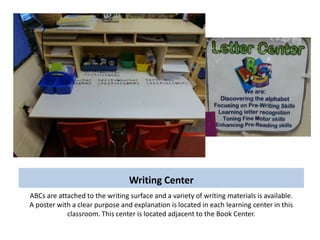
ABCs are attached to the writing surface and a variety of writing materials is available.
A poster with a clear purpose and explanation is located in each learning center in this
            classroom. This center is located adjacent to the Book Center.
Writing Center

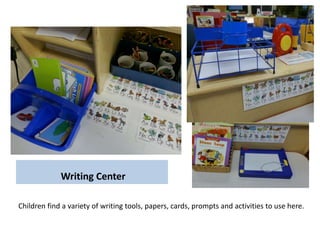
Children find a variety of writing tools, papers, cards, prompts and activities to use here.
Book Center

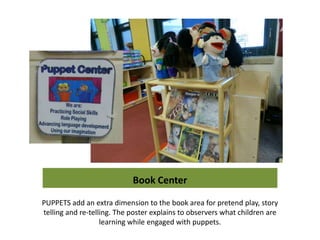
PUPPETS add an extra dimension to the book area for pretend play, story
telling and re-telling. The poster explains to observers what children are
                   learning while engaged with puppets.
Book Center
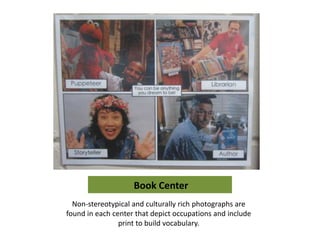
  Non-stereotypical and culturally rich photographs are
found in each center that depict occupations and include
                print to build vocabulary.
Book Center
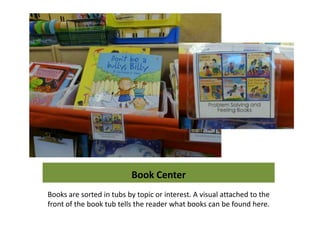
Books are sorted in tubs by topic or interest. A visual attached to the
front of the book tub tells the reader what books can be found here.
Book Center
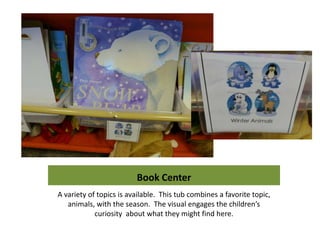
A variety of topics is available. This tub combines a favorite topic,
   animals, with the season. The visual engages the children’s
            curiosity about what they might find here.
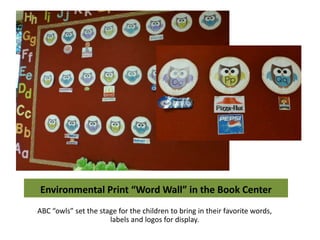
Environmental Print “Word Wall” in the Book Center
ABC “owls” set the stage for the children to bring in their favorite words,
                      labels and logos for display.
Discovery & Math Center
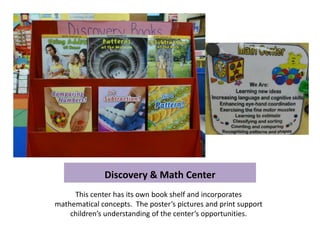
     This center has its own book shelf and incorporates
mathematical concepts. The poster’s pictures and print support
    children’s understanding of the center’s opportunities.
Discovery & Math Center
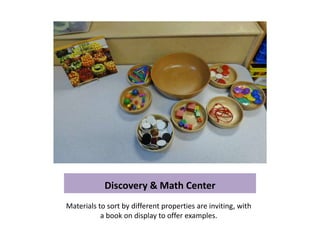
Materials to sort by different properties are inviting, with
           a book on display to offer examples.
Discovery & Math Center
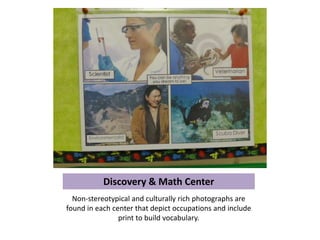
  Non-stereotypical and culturally rich photographs are
found in each center that depict occupations and include
                print to build vocabulary.
Discovery & Math Center
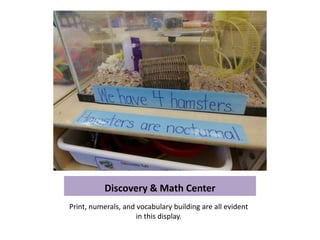
Print, numerals, and vocabulary building are all evident
                     in this display.
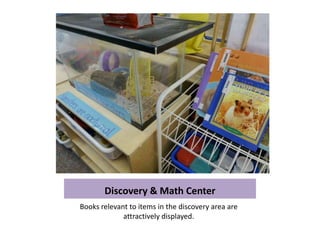
Discovery & Math Center
Books relevant to items in the discovery area are
             attractively displayed.
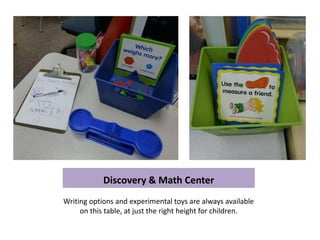
Discovery & Math Center
Writing options and experimental toys are always available
     on this table, at just the right height for children.
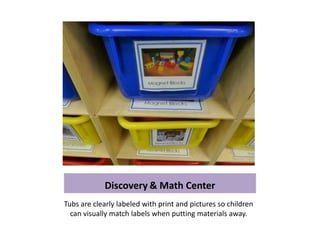
Discovery & Math Center
Tubs are clearly labeled with print and pictures so children
  can visually match labels when putting materials away.
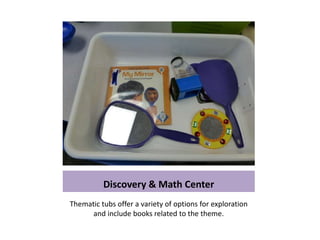
Discovery & Math Center
Thematic tubs offer a variety of options for exploration
      and include books related to the theme.
Discovery & Math Center
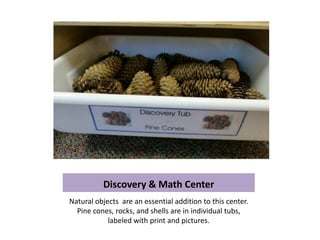
Natural objects are an essential addition to this center.
  Pine cones, rocks, and shells are in individual tubs,
            labeled with print and pictures.
Dramatic Play Center
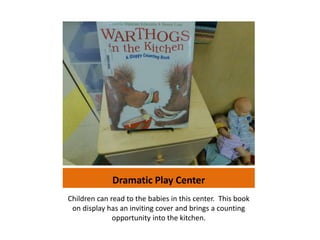
Children can read to the babies in this center. This book
 on display has an inviting cover and brings a counting
              opportunity into the kitchen.
Dramatic Play Center
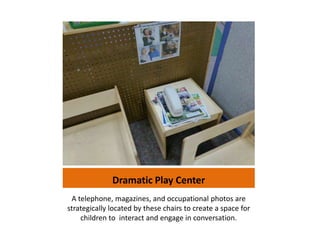
 A telephone, magazines, and occupational photos are
strategically located by these chairs to create a space for
    children to interact and engage in conversation.
Dramatic Play Center
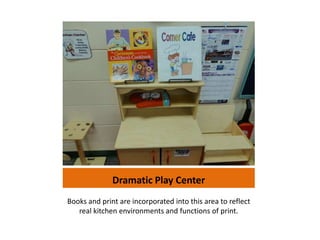
Books and print are incorporated into this area to reflect
   real kitchen environments and functions of print.
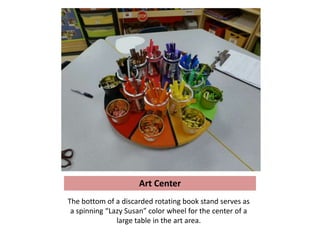
Art Center
The bottom of a discarded rotating book stand serves as
 a spinning “Lazy Susan” color wheel for the center of a
               large table in the art area.
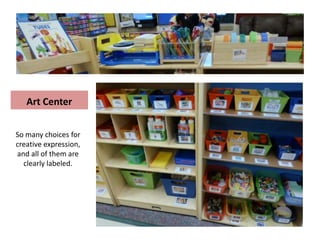
Art Center


So many choices for
creative expression,
and all of them are
  clearly labeled.
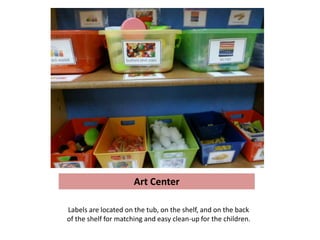
Art Center

Labels are located on the tub, on the shelf, and on the back
of the shelf for matching and easy clean-up for the children.
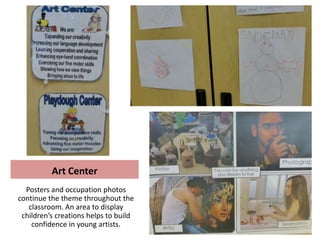
Art Center
  Posters and occupation photos
continue the theme throughout the
   classroom. An area to display
 children’s creations helps to build
    confidence in young artists.
Art Center
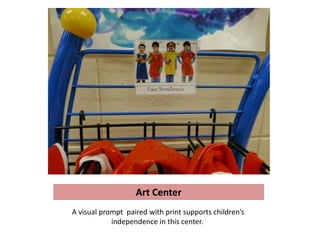
A visual prompt paired with print supports children’s
            independence in this center.
Art Center
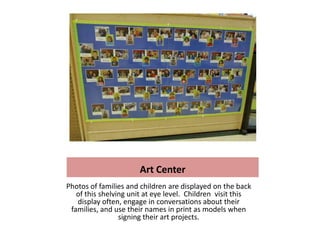
Photos of families and children are displayed on the back
   of this shelving unit at eye level. Children visit this
   display often, engage in conversations about their
 families, and use their names in print as models when
                 signing their art projects.
Snack Center
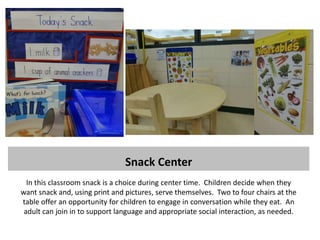
  In this classroom snack is a choice during center time. Children decide when they
want snack and, using print and pictures, serve themselves. Two to four chairs at the
table offer an opportunity for children to engage in conversation while they eat. An
 adult can join in to support language and appropriate social interaction, as needed.
Sand and Water Center
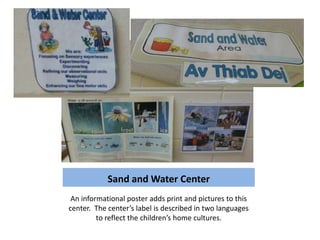
 An informational poster adds print and pictures to this
center. The center’s label is described in two languages
         to reflect the children’s home cultures.
Sand and Water Center
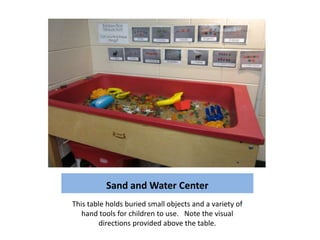
This table holds buried small objects and a variety of
   hand tools for children to use. Note the visual
         directions provided above the table.
Sand and Water Center
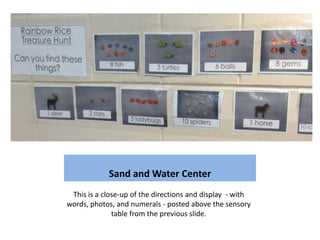
 This is a close-up of the directions and display - with
words, photos, and numerals - posted above the sensory
              table from the previous slide.
Check-in with Daily Question
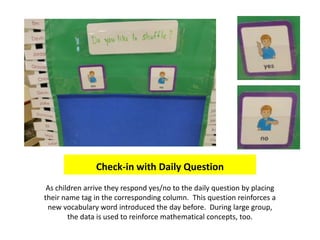
 As children arrive they respond yes/no to the daily question by placing
their name tag in the corresponding column. This question reinforces a
 new vocabulary word introduced the day before. During large group,
        the data is used to reinforce mathematical concepts, too.
Classroom Print / Prompts

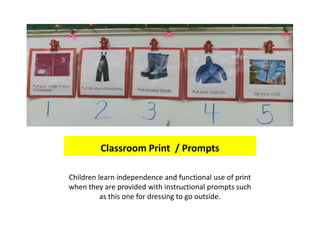
Children learn independence and functional use of print
when they are provided with instructional prompts such
          as this one for dressing to go outside.
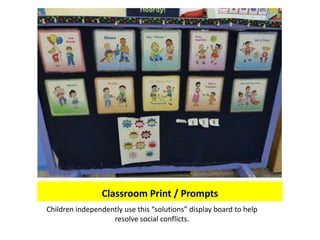
Classroom Print / Prompts
Children independently use this “solutions” display board to help
                   resolve social conflicts.
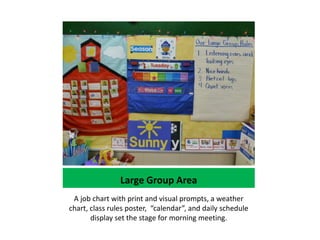
Large Group Area
 A job chart with print and visual prompts, a weather
chart, class rules poster, “calendar”, and daily schedule
       display set the stage for morning meeting.
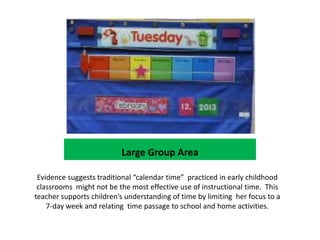
Large Group Area

 Evidence suggests traditional “calendar time” practiced in early childhood
 classrooms might not be the most effective use of instructional time. This
teacher supports children’s understanding of time by limiting her focus to a
    7-day week and relating time passage to school and home activities.
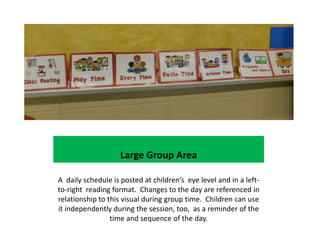
Large Group Area

A daily schedule is posted at children’s eye level and in a left-
to-right reading format. Changes to the day are referenced in
relationship to this visual during group time. Children can use
it independently during the session, too, as a reminder of the
                 time and sequence of the day.
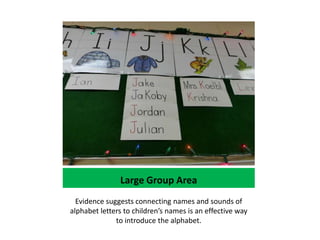
Large Group Area
  Evidence suggests connecting names and sounds of
alphabet letters to children’s names is an effective way
              to introduce the alphabet.
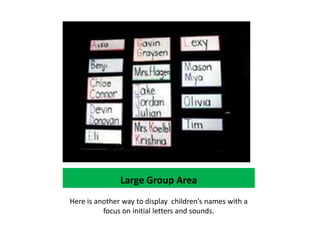
Large Group Area
Here is another way to display children’s names with a
          focus on initial letters and sounds.
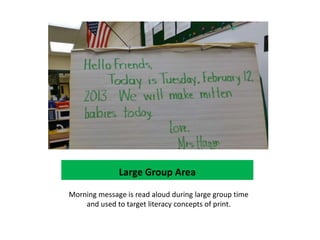
Large Group Area

Morning message is read aloud during large group time
    and used to target literacy concepts of print.
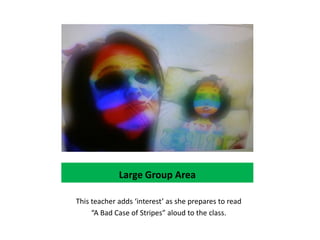
Large Group Area

This teacher adds ‘interest’ as she prepares to read
     “A Bad Case of Stripes” aloud to the class.
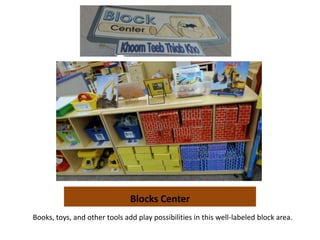
Blocks Center
Books, toys, and other tools add play possibilities in this well-labeled block area.
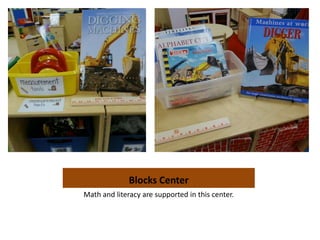
Blocks Center
Math and literacy are supported in this center.
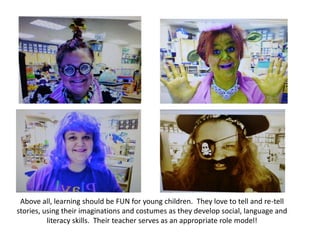
Above all, learning should be FUN for young children. They love to tell and re-tell
stories, using their imaginations and costumes as they develop social, language and
          literacy skills. Their teacher serves as an appropriate role model!
Special thanks and appreciation go to Tracy Hagen,
4K teacher, School District of Onalaska, for sharing
        her classroom for this presentation.

Literacy in Pre-school

  • 2.
    Writing Center ABCs areattached to the writing surface and a variety of writing materials is available. A poster with a clear purpose and explanation is located in each learning center in this classroom. This center is located adjacent to the Book Center.
  • 3.
    Writing Center Children finda variety of writing tools, papers, cards, prompts and activities to use here.
  • 4.
    Book Center PUPPETS addan extra dimension to the book area for pretend play, story telling and re-telling. The poster explains to observers what children are learning while engaged with puppets.
  • 5.
    Book Center Non-stereotypical and culturally rich photographs are found in each center that depict occupations and include print to build vocabulary.
  • 6.
    Book Center Books aresorted in tubs by topic or interest. A visual attached to the front of the book tub tells the reader what books can be found here.
  • 7.
    Book Center A varietyof topics is available. This tub combines a favorite topic, animals, with the season. The visual engages the children’s curiosity about what they might find here.
  • 8.
    Environmental Print “WordWall” in the Book Center ABC “owls” set the stage for the children to bring in their favorite words, labels and logos for display.
  • 9.
    Discovery & MathCenter This center has its own book shelf and incorporates mathematical concepts. The poster’s pictures and print support children’s understanding of the center’s opportunities.
  • 10.
    Discovery & MathCenter Materials to sort by different properties are inviting, with a book on display to offer examples.
  • 11.
    Discovery & MathCenter Non-stereotypical and culturally rich photographs are found in each center that depict occupations and include print to build vocabulary.
  • 12.
    Discovery & MathCenter Print, numerals, and vocabulary building are all evident in this display.
  • 13.
    Discovery & MathCenter Books relevant to items in the discovery area are attractively displayed.
  • 14.
    Discovery & MathCenter Writing options and experimental toys are always available on this table, at just the right height for children.
  • 15.
    Discovery & MathCenter Tubs are clearly labeled with print and pictures so children can visually match labels when putting materials away.
  • 16.
    Discovery & MathCenter Thematic tubs offer a variety of options for exploration and include books related to the theme.
  • 17.
    Discovery & MathCenter Natural objects are an essential addition to this center. Pine cones, rocks, and shells are in individual tubs, labeled with print and pictures.
  • 18.
    Dramatic Play Center Childrencan read to the babies in this center. This book on display has an inviting cover and brings a counting opportunity into the kitchen.
  • 19.
    Dramatic Play Center A telephone, magazines, and occupational photos are strategically located by these chairs to create a space for children to interact and engage in conversation.
  • 20.
    Dramatic Play Center Booksand print are incorporated into this area to reflect real kitchen environments and functions of print.
  • 21.
    Art Center The bottomof a discarded rotating book stand serves as a spinning “Lazy Susan” color wheel for the center of a large table in the art area.
  • 22.
    Art Center So manychoices for creative expression, and all of them are clearly labeled.
  • 23.
    Art Center Labels arelocated on the tub, on the shelf, and on the back of the shelf for matching and easy clean-up for the children.
  • 24.
    Art Center Posters and occupation photos continue the theme throughout the classroom. An area to display children’s creations helps to build confidence in young artists.
  • 25.
    Art Center A visualprompt paired with print supports children’s independence in this center.
  • 26.
    Art Center Photos offamilies and children are displayed on the back of this shelving unit at eye level. Children visit this display often, engage in conversations about their families, and use their names in print as models when signing their art projects.
  • 27.
    Snack Center In this classroom snack is a choice during center time. Children decide when they want snack and, using print and pictures, serve themselves. Two to four chairs at the table offer an opportunity for children to engage in conversation while they eat. An adult can join in to support language and appropriate social interaction, as needed.
  • 28.
    Sand and WaterCenter An informational poster adds print and pictures to this center. The center’s label is described in two languages to reflect the children’s home cultures.
  • 29.
    Sand and WaterCenter This table holds buried small objects and a variety of hand tools for children to use. Note the visual directions provided above the table.
  • 30.
    Sand and WaterCenter This is a close-up of the directions and display - with words, photos, and numerals - posted above the sensory table from the previous slide.
  • 31.
    Check-in with DailyQuestion As children arrive they respond yes/no to the daily question by placing their name tag in the corresponding column. This question reinforces a new vocabulary word introduced the day before. During large group, the data is used to reinforce mathematical concepts, too.
  • 32.
    Classroom Print /Prompts Children learn independence and functional use of print when they are provided with instructional prompts such as this one for dressing to go outside.
  • 33.
    Classroom Print /Prompts Children independently use this “solutions” display board to help resolve social conflicts.
  • 34.
    Large Group Area A job chart with print and visual prompts, a weather chart, class rules poster, “calendar”, and daily schedule display set the stage for morning meeting.
  • 35.
    Large Group Area Evidence suggests traditional “calendar time” practiced in early childhood classrooms might not be the most effective use of instructional time. This teacher supports children’s understanding of time by limiting her focus to a 7-day week and relating time passage to school and home activities.
  • 36.
    Large Group Area Adaily schedule is posted at children’s eye level and in a left- to-right reading format. Changes to the day are referenced in relationship to this visual during group time. Children can use it independently during the session, too, as a reminder of the time and sequence of the day.
  • 37.
    Large Group Area Evidence suggests connecting names and sounds of alphabet letters to children’s names is an effective way to introduce the alphabet.
  • 38.
    Large Group Area Hereis another way to display children’s names with a focus on initial letters and sounds.
  • 39.
    Large Group Area Morningmessage is read aloud during large group time and used to target literacy concepts of print.
  • 40.
    Large Group Area Thisteacher adds ‘interest’ as she prepares to read “A Bad Case of Stripes” aloud to the class.
  • 41.
    Blocks Center Books, toys,and other tools add play possibilities in this well-labeled block area.
  • 42.
    Blocks Center Math andliteracy are supported in this center.
  • 43.
    Above all, learningshould be FUN for young children. They love to tell and re-tell stories, using their imaginations and costumes as they develop social, language and literacy skills. Their teacher serves as an appropriate role model!
  • 44.
    Special thanks andappreciation go to Tracy Hagen, 4K teacher, School District of Onalaska, for sharing her classroom for this presentation.