







Teaching Children
to Write from the Start: Ability,
Culture, Meaning and Mechanics
March 2, 2013
Dr. Paul Rogers
Janina Lao Admana
An Overview
• An interactive conversation
– You are the experts on the children at your school
• Some background about writing and writing
development
• Talking about some practices or strategies
you’re using in your classroom around writing
Activity
Why focus on writing?
• Writing is a key element of
academic success.
• Writing is a powerful learning
too that supports both
understanding and
remembering.
• Writing is a key ability for full
participation in the 21st century.
2 out of 3 U.S. students fail
to meet grade level demands
in writing.
When does writing
begin?
• After children learn to read?
• When they begin to write words
conventionally?
A Different Perspective
• Literacy development begins long before
formal schooling
• Children learn about reading and writing
simultaneously in their everyday
experiences
Learning to write is about cognitive
development and social
participation
Children engage in writing to
explore the characteristics of
writing materials
the cognitive development
Children write to engage
in positive interactions
with adults and to form
relationships with peers
the social participation
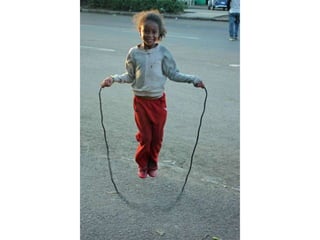
What motivates children to learn
to walk and talk? To learn
anything?
By what mechanisms
do children learn to
walk and talk? Do
children learn
anything?
Focus on Engagement
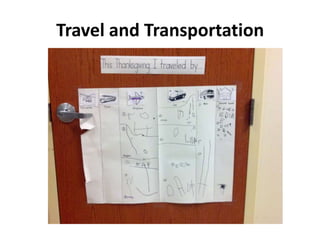
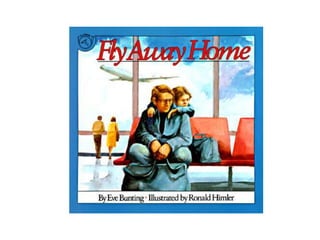
Travel and Transportation
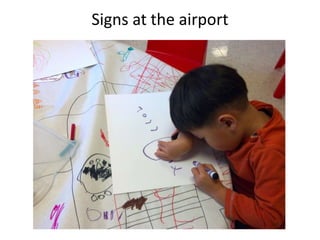
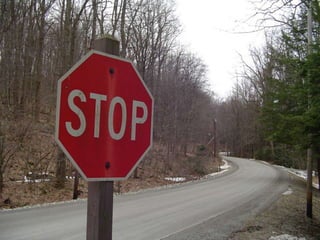
Signs at the airport
Traveling
• Postcard writing (picture)
The Basic Skills
• Spelling and punctuation
• Thinking, memory, and language
a(speaking), plus fine motor skills
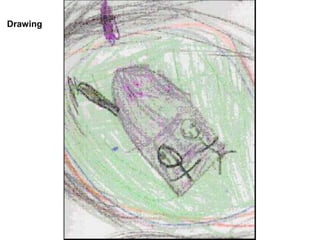
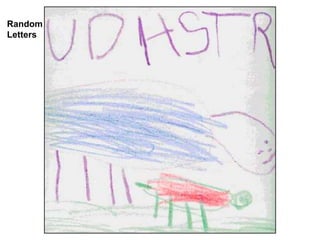
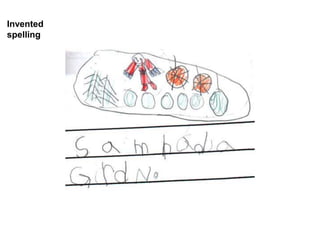
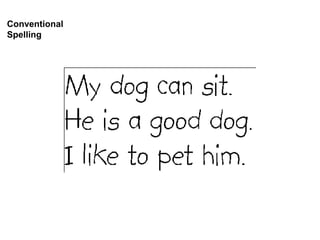
Children’s handwriting develops
sequentially “through stages of
drawing, scribbling, the making of
letterlike forms, moving to well-
learned units, invented spelling,
and conventional orthography”
(Boscolo, 2008)
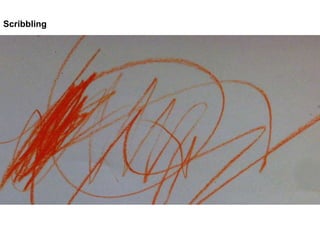
Scribbling
Drawing
Random
Letters
Invented
spelling
Conventional
Spelling
Writing before schooling can best be
described as exploration …
But … there’s more
• What hypotheses do children develop
about writing prior to entering school?
(bringing down to earth)
Identify the background knowledge
that all children possess … learning
revolves around the child’s mind
not the teachers.
Not convention but intention
In school
children learn what they are taught.
So focus on the multiple purposes for
writing like …
Authentic Purposes (Brainstrom)
Authentic Purposes
• Telling what I’ve learned (reports)
• Describing an experience (travel writing)
• Keeping notes (journaling)
• Comparing ideas (reviews)
• Conducting research (creating knowledge)
• Analyzing problems (making the world a better
place)
• Sharing happiness and wisdom (fictional
narratives)
• Introducing an important person (profiles)
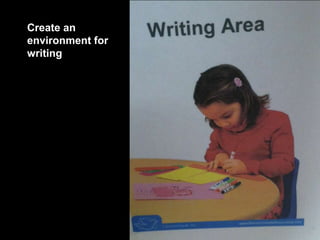
Create an
environment for
writing
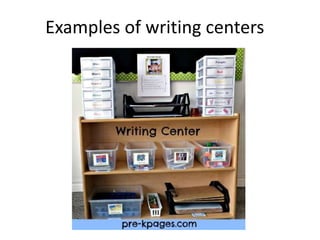
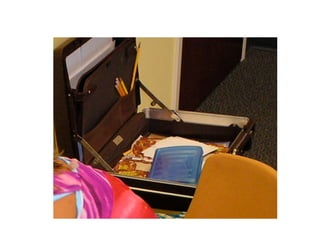
Examples of writing centers
Ideas for your writing center
• clipboards
• alphabet stamps
• sandpaper/felt letters
• stencils
• chalkboards
• dry erase cards
• name cards
• variety of writing utensils
(pencils, crayons, pens,
markers, chalk)
• paper
• tape, stapler, paper clips,
hole puncher (for
bookmaking)
• notebooks/journals
Portfolios
• Picture of Penguin binders and examples of
work inside
Portfolios
• Excellent way to document each individual
child’s progress
• Informal assessment tool
• Showcase child’s work giving value, creating
permanence
• Can be used together alongside progress
reports during parent-teacher conferences
• Home-school connection
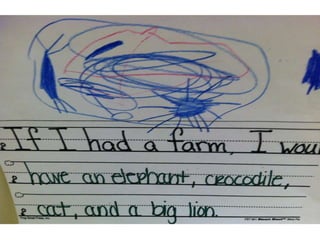
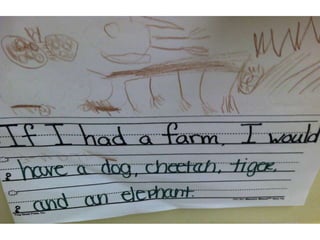
Integrating writing with art
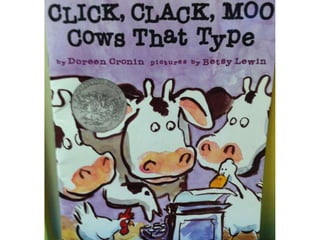
Linking reading and writing
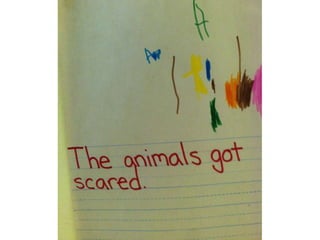
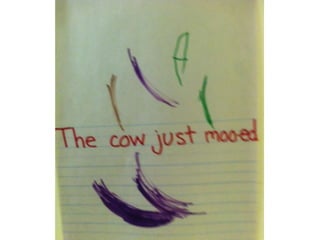
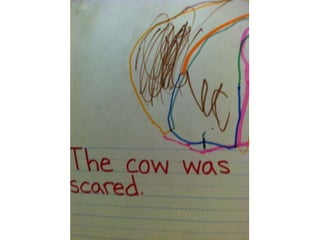
What happened in “Click Clack
Moo Cows That Type”?
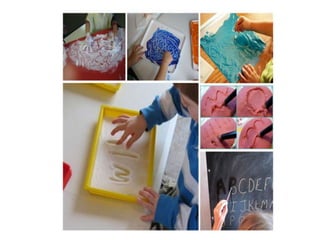
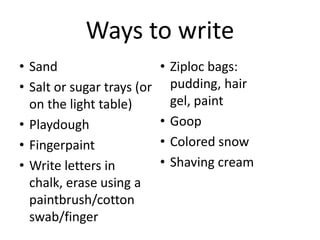
• Sand
• Salt or sugar trays (or
on the light table)
• Playdough
• Fingerpaint
• Write letters in
chalk, erase using a
paintbrush/cotton
swab/finger
• Ziploc bags:
pudding, hair
gel, paint
• Goop
• Colored snow
• Shaving cream
Ways to write
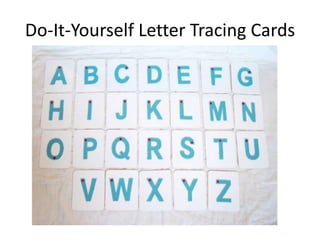
Do-It-Yourself Letter Tracing Cards
Strategies
• Write every day
• Revisit and reread
• Share the writing as a group
• Letter tracing
• Name writing
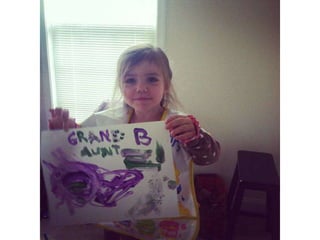
Name Writing
• A window into children’s emergent writing
• The child’s name is often the first word they
begin to write
• The child first learns to recognize letters in
their name, especially the first letter (own
name advantage)
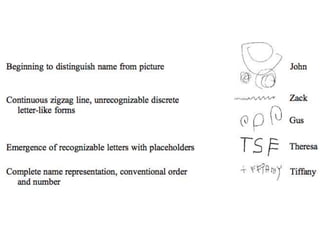
Name writing tends to progress in
the following manner:
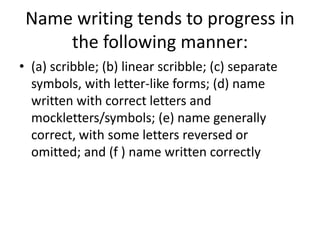
• (a) scribble; (b) linear scribble; (c) separate
symbols, with letter-like forms; (d) name
written with correct letters and
mockletters/symbols; (e) name generally
correct, with some letters reversed or
omitted; and (f ) name written correctly
Use Name Writing with Self-
Portraits
Look for lots of little transitions
Strategies
• Focus on what’s RIGHT!
• It is the act of writing that needs
encouragement
• Write with your students
Strategies
• Extrinsic rewards??
• Using mentor texts
– Supplied by both teacher and child
• Share what You write
• Celebrate writing
• Writing floats on a sea of talk
Evaluation
• Respond to completion
• Respond to pride of authorship
• Encourage students to try out ideas
Freedom of Choice
• Varying the amounts and types of input
– Experiment
– Let’s spend the next few minutes writing anything
we want
What are the most important
elements of of written language
that children need to learn?
Conventions or mechanics
Conventions and mechanics
Thank you for your attention

Teaching Children to Write from the Start

Editor's Notes

  • #2 I’m a professor at George Mason in English. My PhD is in education with a focus on writing development across the lifespan.
  • #3 I work with LOTS of teachers throughout Northern Virginia. I don’t like to give one-off talks as a form of professional development, but I’m really interested in expanding the nvwp to include preschool educators. I’m also interested in early childhood writing development; so, this is a fun conversation for me to have!
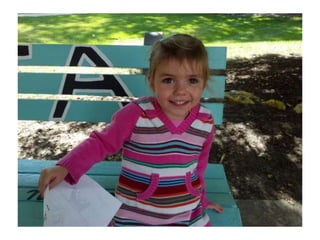
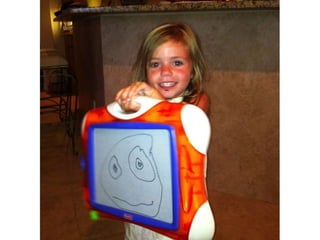
  • #4 This is my little girl, Estella. She’s 3 years old. So, there are three reasons I’m giving this talk: I’m an educational researchers, a teacher of teachers, and father of a preschooler.
  • #14 The cognitive
  • #15 and to engage in positive interactions with parents and teachers
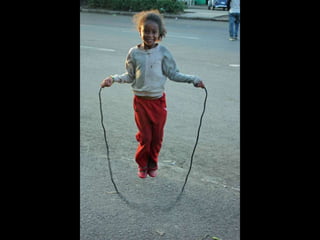
  • #17 Why does she jump rope? How does she learn?
  • #19 Why does she jump rope? How does she learn?
  • #20 Please don’t use writing as a punishment!
  • #32 Pt. 1 is the constructivePt. 2 is the multimodal
  • #33 Children draw on the world of print that surrounds them in forming their hypotheses about what writing is and what it does
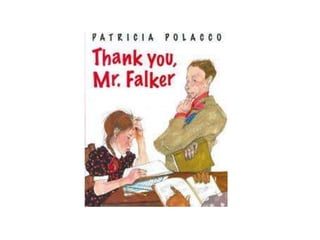
  • #50 The thank you card! Remember its intentionnot convention!
  • #52 One example of a writing center if the teacher has ample space. Take note of clipboards which children can carry around the room – “write around the room”: copy print they see in their environment.
  • #53 However! If one lacks the space to have a writing center, using a briefcase is a great “portable” type of writing center. All the necessary materials are included and stashed away inside the briefcase. Items inside can be changed frequently if necessary based on childrens’ interest.
  • #56 Also add onto home-school connection bullet: Families can use the book to take home at the end of each week and add to the portfolio (include paper for children to write about what they did during the weekend), and return to school to share with peers