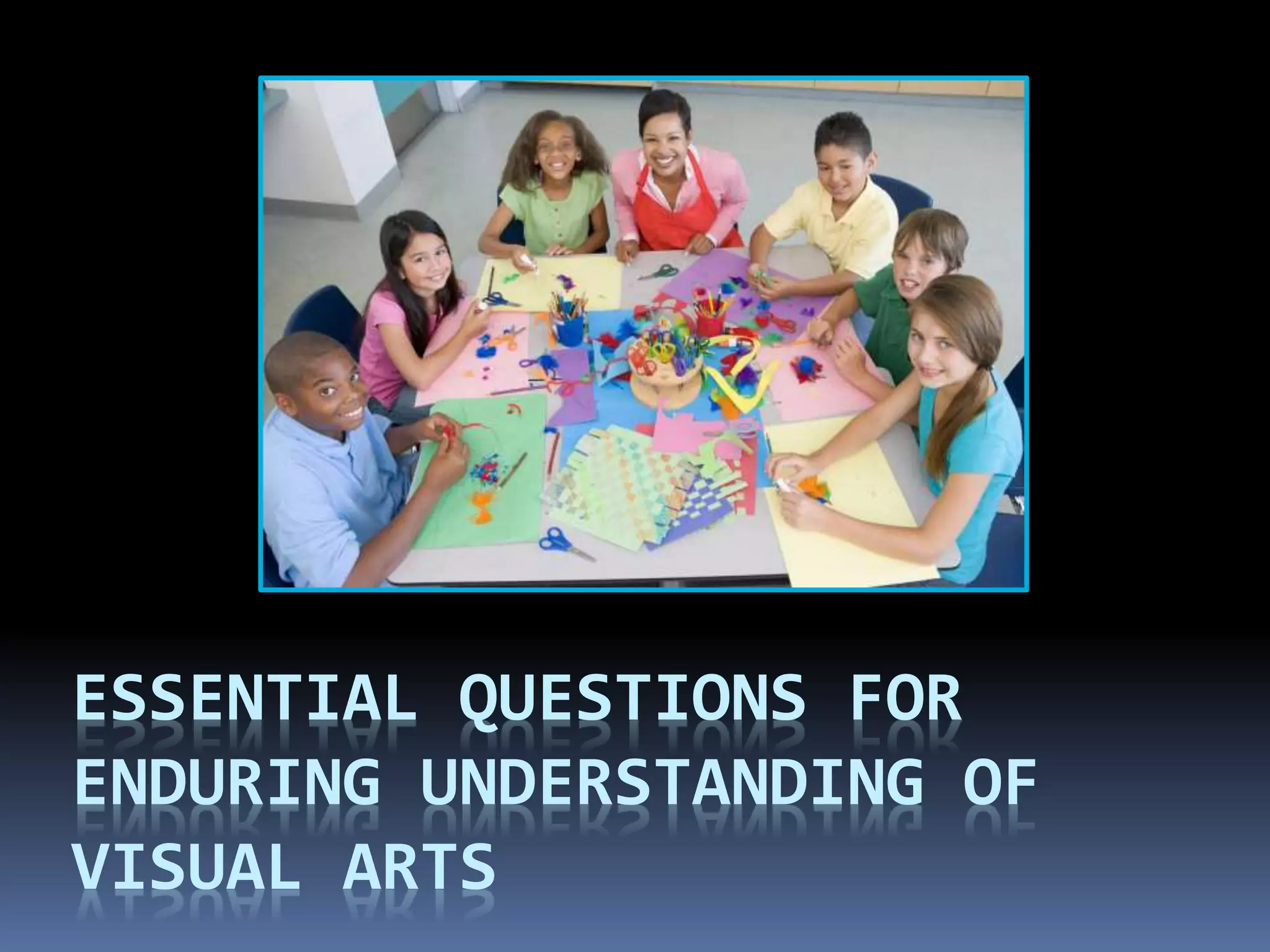
ESSENTIAL QUESTIONS FOR
ENDURING UNDERSTANDING OF
VISUAL ARTS
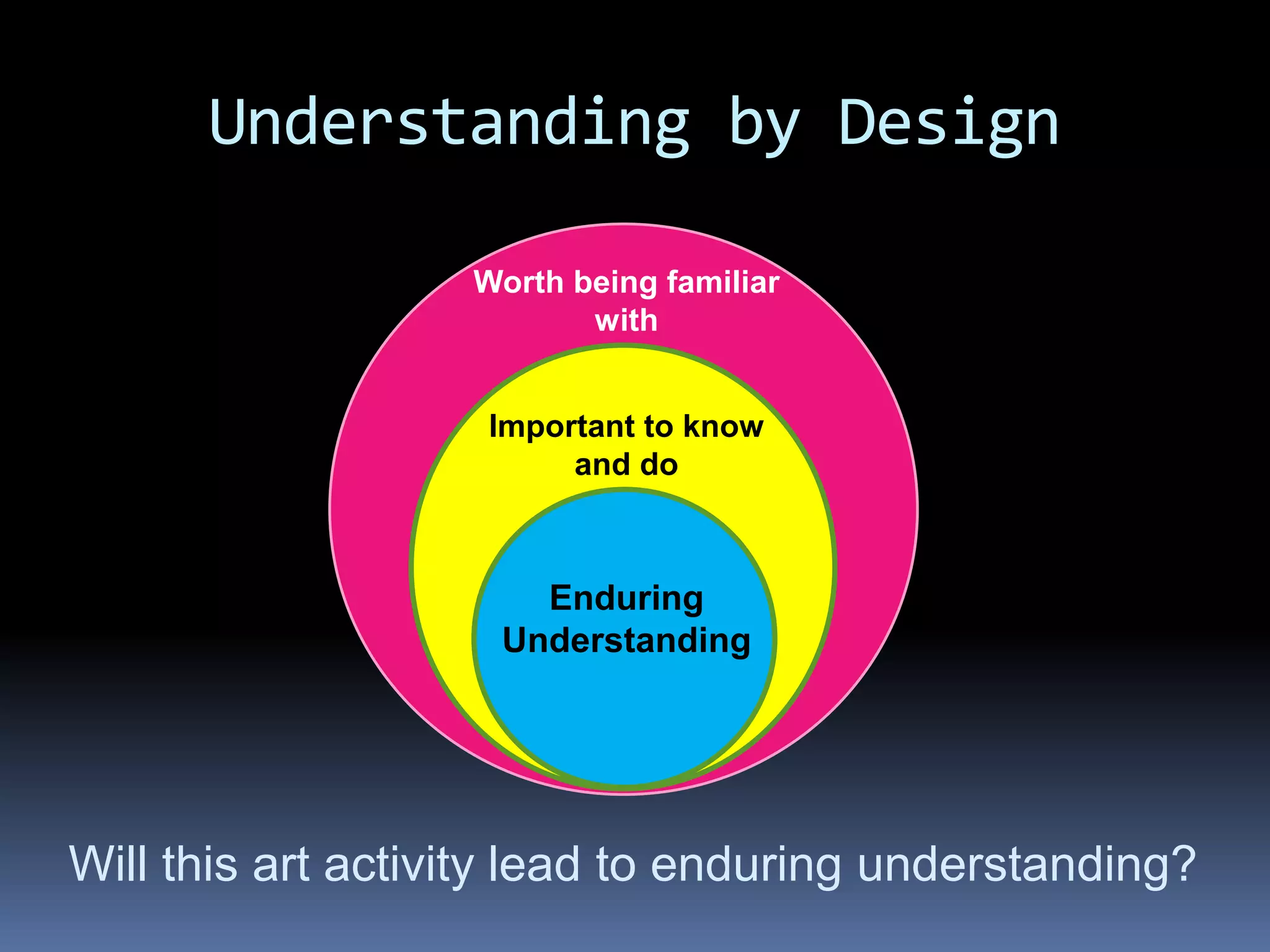
Understanding by Design
Will this art activity lead to enduring understanding?
Worth being familiar
with
Important to know
and do
Enduring
Understanding
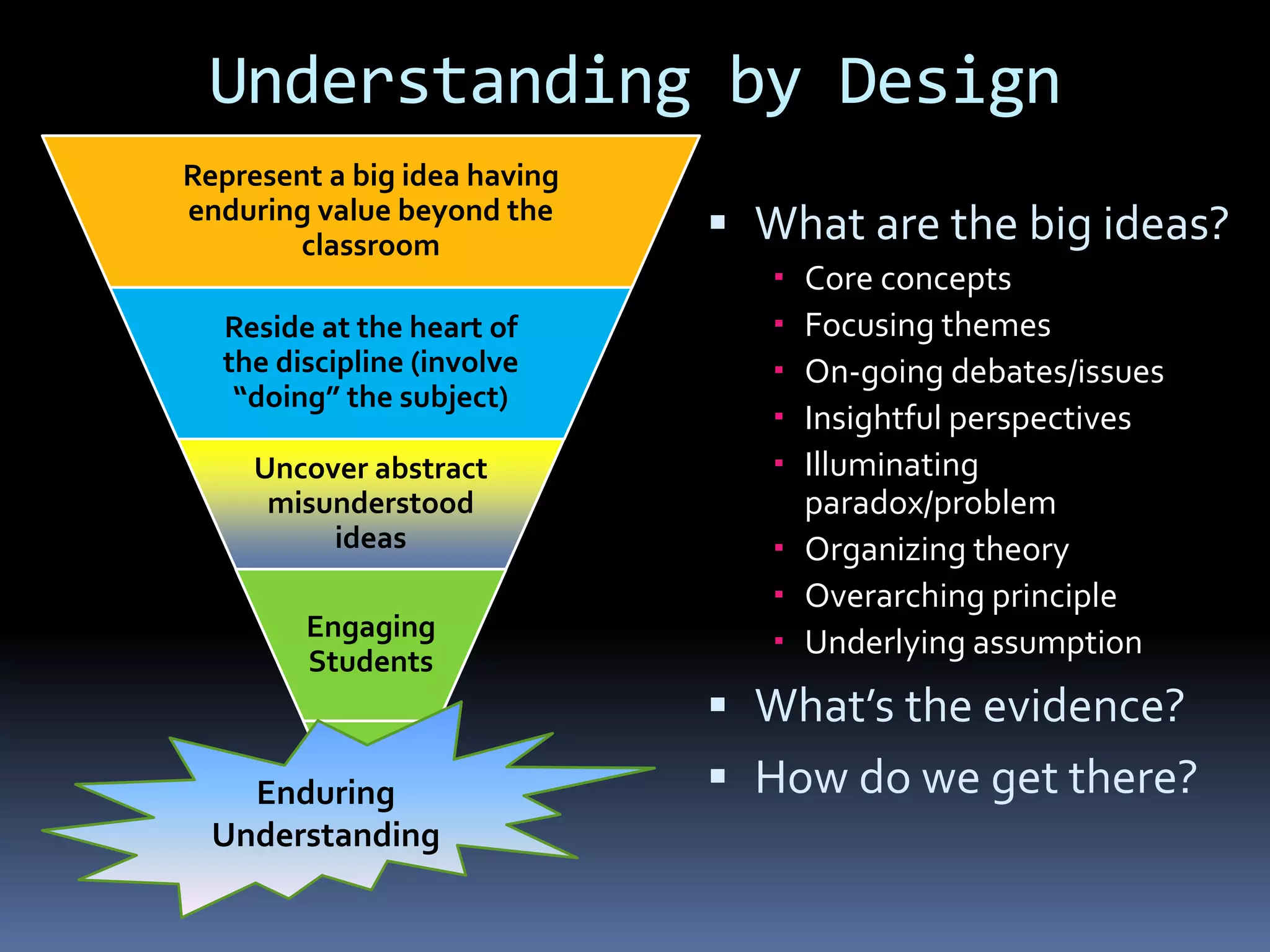
Understanding by Design
 What are the big ideas?
 Core concepts
 Focusing themes
 On-going debates/issues
 Insightful perspectives
 Illuminating
paradox/problem
 Organizing theory
 Overarching principle
 Underlying assumption
 What’s the evidence?
 How do we get there?
Represent a big idea having
enduring value beyond the
classroom
Reside at the heart of
the discipline (involve
“doing” the subject)
Uncover abstract
misunderstood
ideas
Engaging
Students
Enduring
Understanding
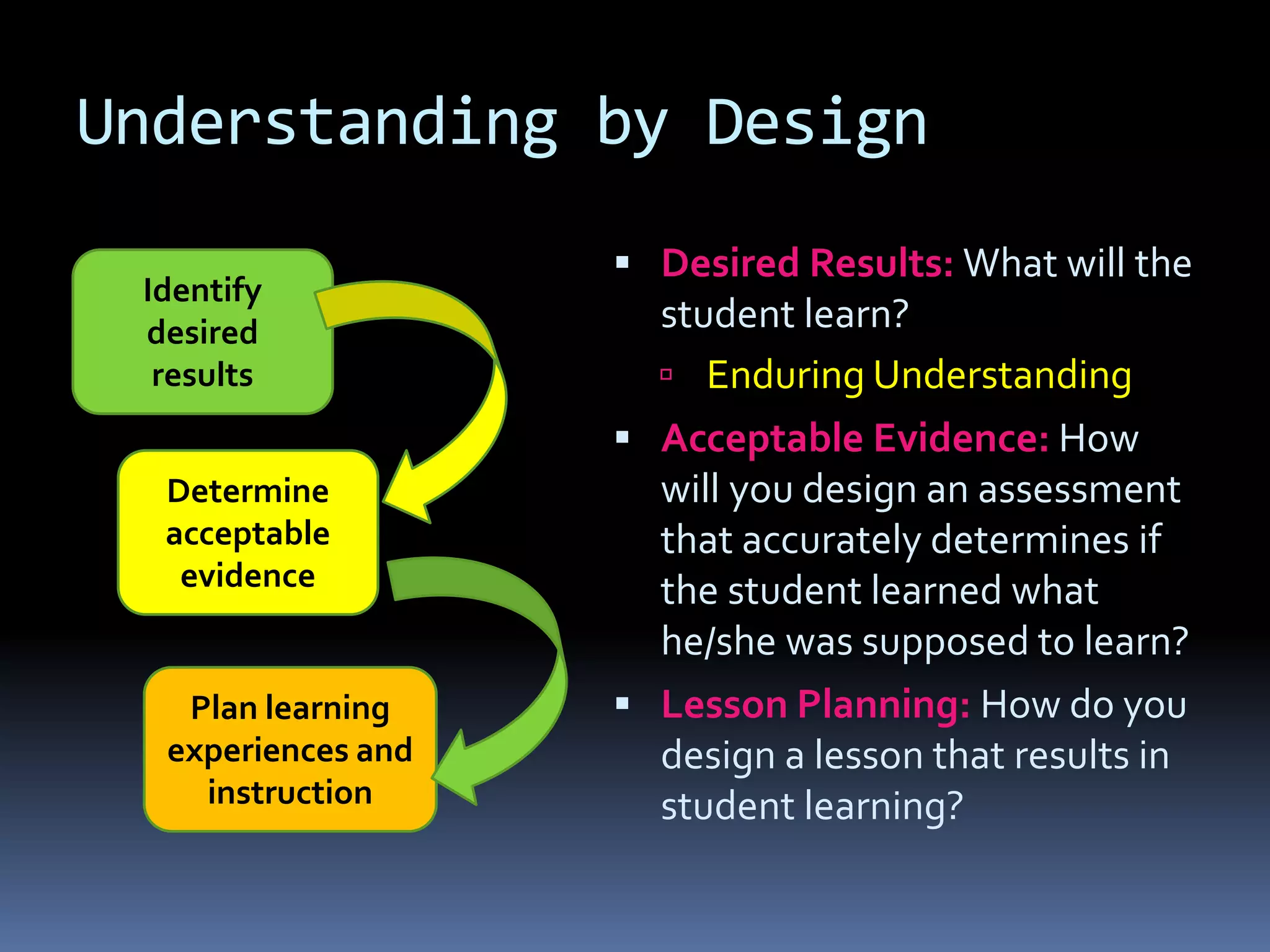
Understanding by Design
 Desired Results: What will the
student learn?
 Enduring Understanding
 Acceptable Evidence: How
will you design an assessment
that accurately determines if
the student learned what
he/she was supposed to learn?
 Lesson Planning: How do you
design a lesson that results in
student learning?
Identify
desired
results
Determine
acceptable
evidence
Plan learning
experiences and
instruction
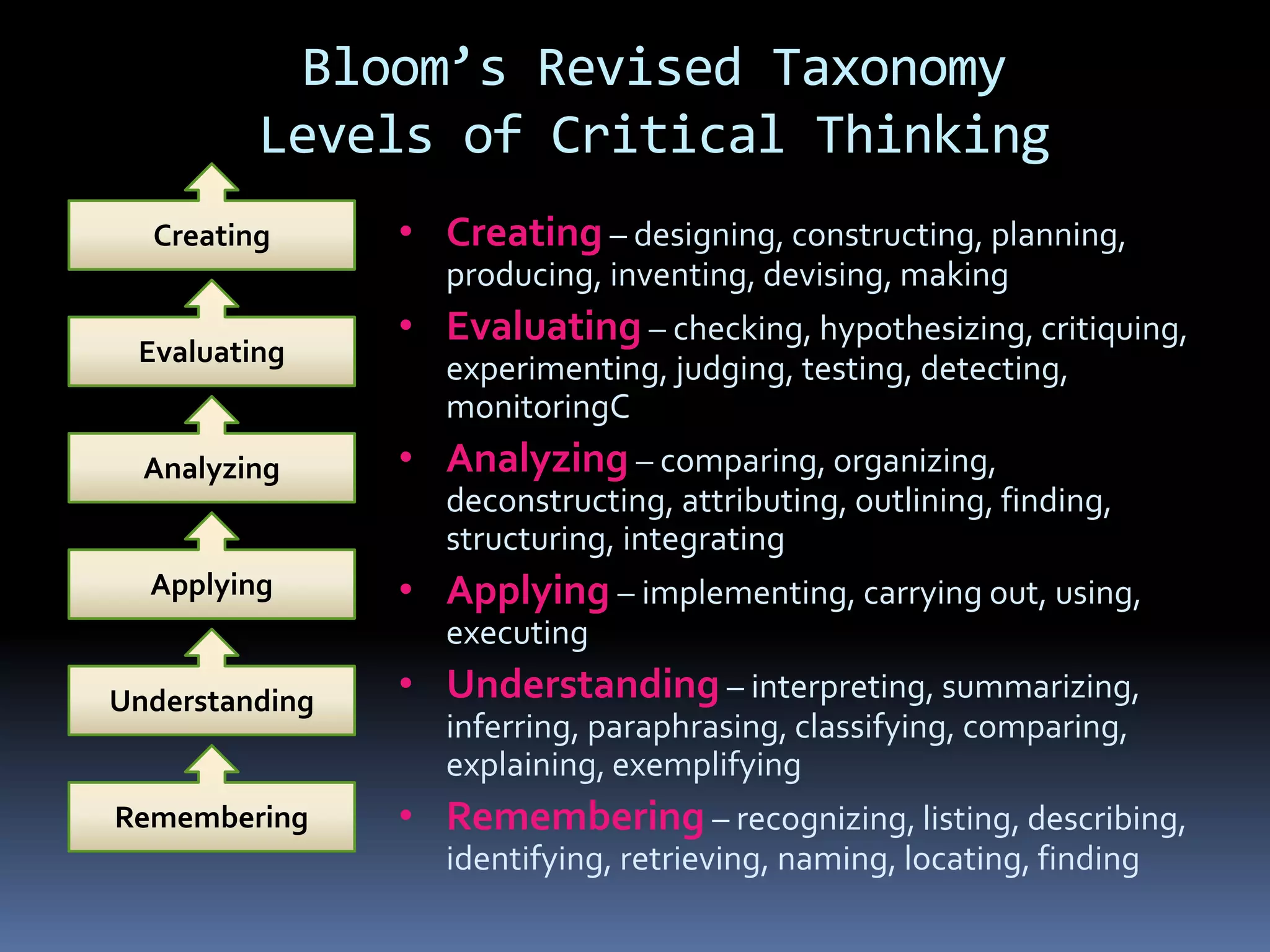
Remembering
Understanding
Applying
Analyzing
Evaluating
Creating • Creating – designing, constructing, planning,
producing, inventing, devising, making
• Evaluating – checking, hypothesizing, critiquing,
experimenting, judging, testing, detecting,
monitoringC
• Analyzing – comparing, organizing,
deconstructing, attributing, outlining, finding,
structuring, integrating
• Applying – implementing, carrying out, using,
executing
• Understanding – interpreting, summarizing,
inferring, paraphrasing, classifying, comparing,
explaining, exemplifying
• Remembering – recognizing, listing, describing,
identifying, retrieving, naming, locating, finding
Bloom’s Revised Taxonomy
Levels of Critical Thinking
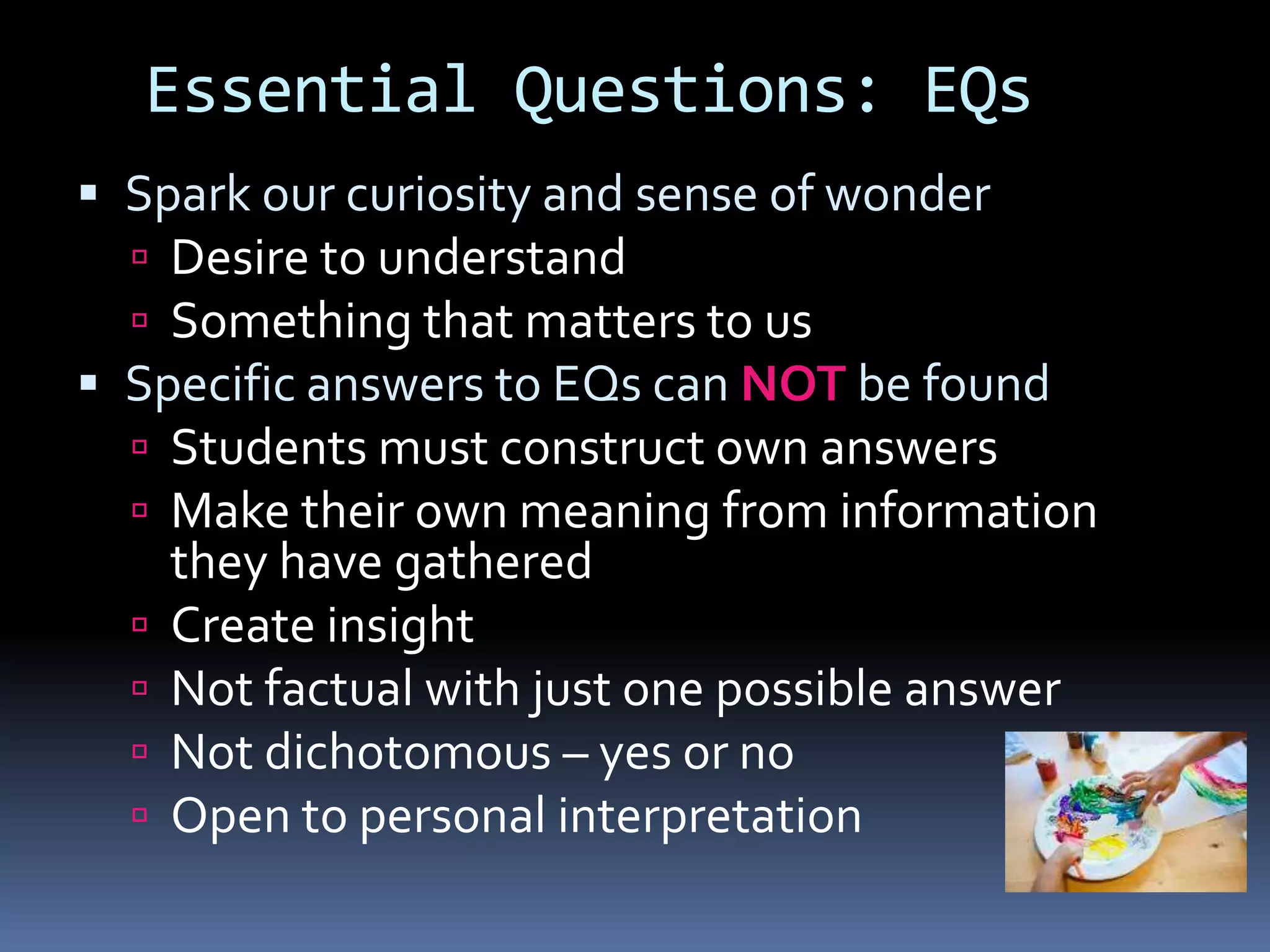
Essential Questions: EQs
 Spark our curiosity and sense of wonder
 Desire to understand
 Something that matters to us
 Specific answers to EQs can NOT be found
 Students must construct own answers
 Make their own meaning from information
they have gathered
 Create insight
 Not factual with just one possible answer
 Not dichotomous – yes or no
 Open to personal interpretation
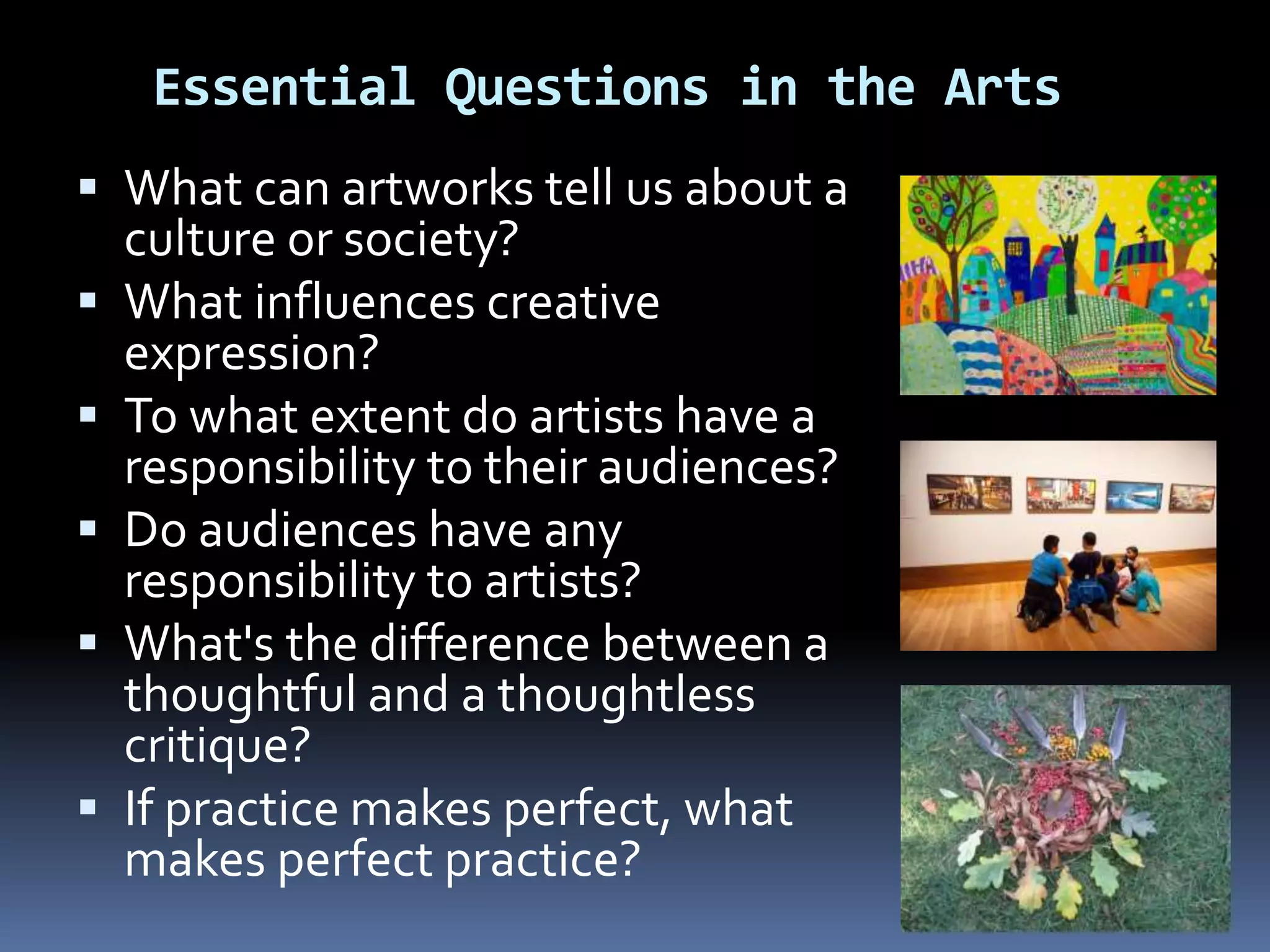
Essential Questions in the Arts
 What can artworks tell us about a
culture or society?
 What influences creative
expression?
 To what extent do artists have a
responsibility to their audiences?
 Do audiences have any
responsibility to artists?
 What's the difference between a
thoughtful and a thoughtless
critique?
 If practice makes perfect, what
makes perfect practice?
Visual Arts: Planning for
Enduring Understandings
 How will you engage your students in this topic?
 How do you hook them in with your “anticipatory
set”?
 How will you motivate students to think critically and
explore essential questions?
 How will you move beyond “recall” to problem
solving?
 How will your lessons result in “enduring
understanding” of key issues in society?
 What will students do, create, or present to express
their knowledge and understanding?
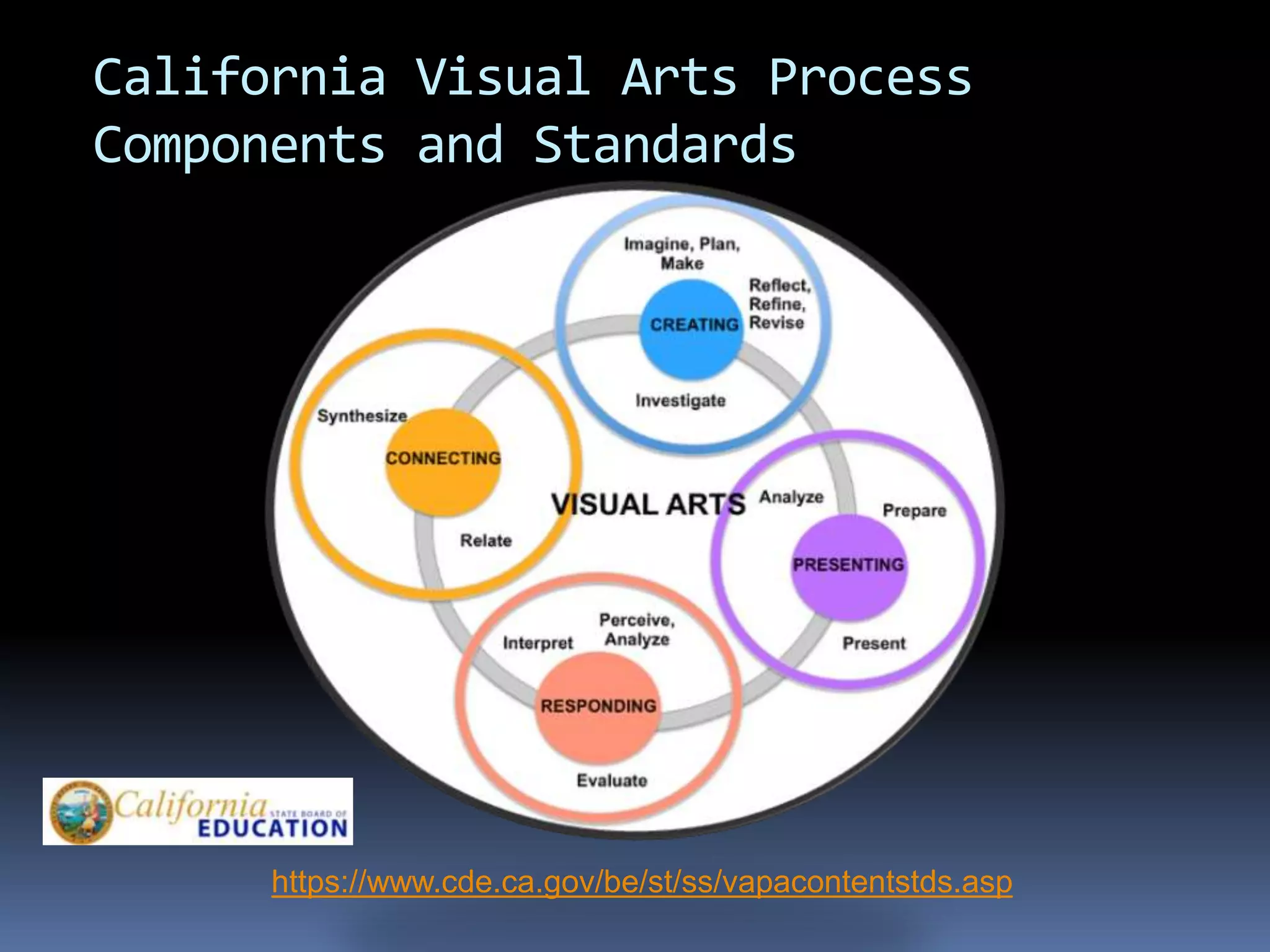
California Visual Arts Process
Components and Standards
https://www.cde.ca.gov/be/st/ss/vapacontentstds.asp
Creating—Anchor Standard 1: Generate and
Conceptualize Artistic Ideas and Work
Process Component
 Imagine, Plan, Make
 1.1 Enduring Understanding
 Creativity and innovative thinking are essential life
skills that can be developed.
 Essential Questions
 What conditions, attitudes, and behaviors support
creativity and innovative thinking?
 What factors prevent or encourage people to take
creative risks?
 How does collaboration expand the creative process?
Creating—Anchor Standard 1: Generate and
Conceptualize Artistic Ideas and Work
Process Component
 Imagine, Plan, Make
2.2 Enduring Understanding
 Artists and designers shape artistic investigations,
following or breaking with traditions in pursuit of creative
artmaking goals.
Essential Questions
 How does knowing the contexts, histories, and traditions of
art forms help us create works of art and design?
 Why do artists follow or break from established traditions?
 How do artists determine what resources and criteria are
needed to formulate artistic investigations?
Creating—Anchor Standard 2: Organize and
Develop Artistic Ideas and Work
Process Component
 Investigate
2.1 Enduring Understanding
 Artists and designers experiment with forms,
structures, materials, concepts, media, and art-
making approaches.
Essential Questions
 How do artists work?
 How do artists and designers determine whether a
particular direction in their work is effective?
 How do artists and designers learn from trial and error?
Creating—Anchor Standard 2: Organize and
Develop Artistic Ideas and Work
Process Component
 Investigate
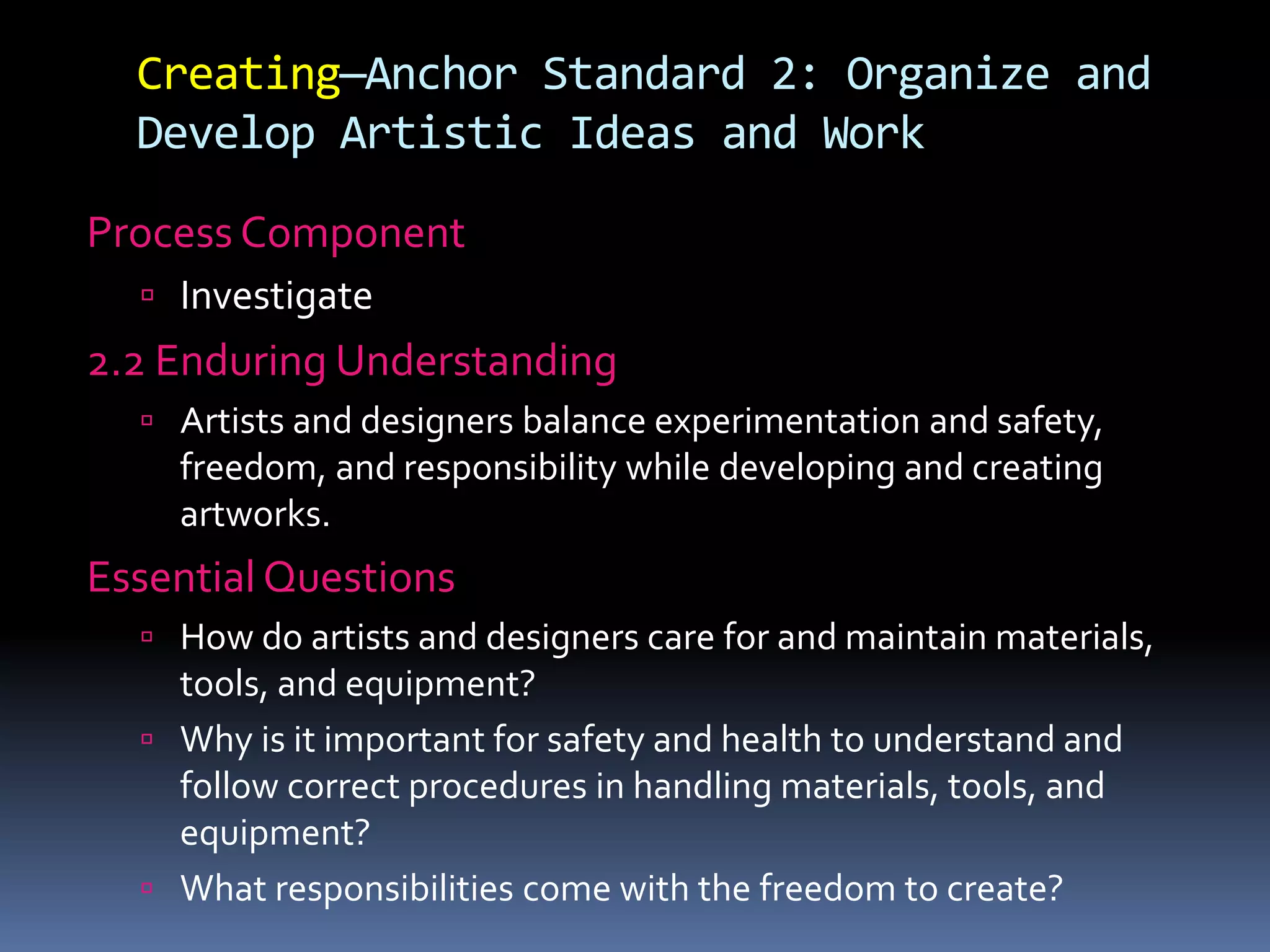
2.2 Enduring Understanding
 Artists and designers balance experimentation and safety,
freedom, and responsibility while developing and creating
artworks.
Essential Questions
 How do artists and designers care for and maintain materials,
tools, and equipment?
 Why is it important for safety and health to understand and
follow correct procedures in handling materials, tools, and
equipment?
 What responsibilities come with the freedom to create?
Creating—Anchor Standard 2: Organize and
Develop Artistic Ideas and Work
Process Component
 Investigate
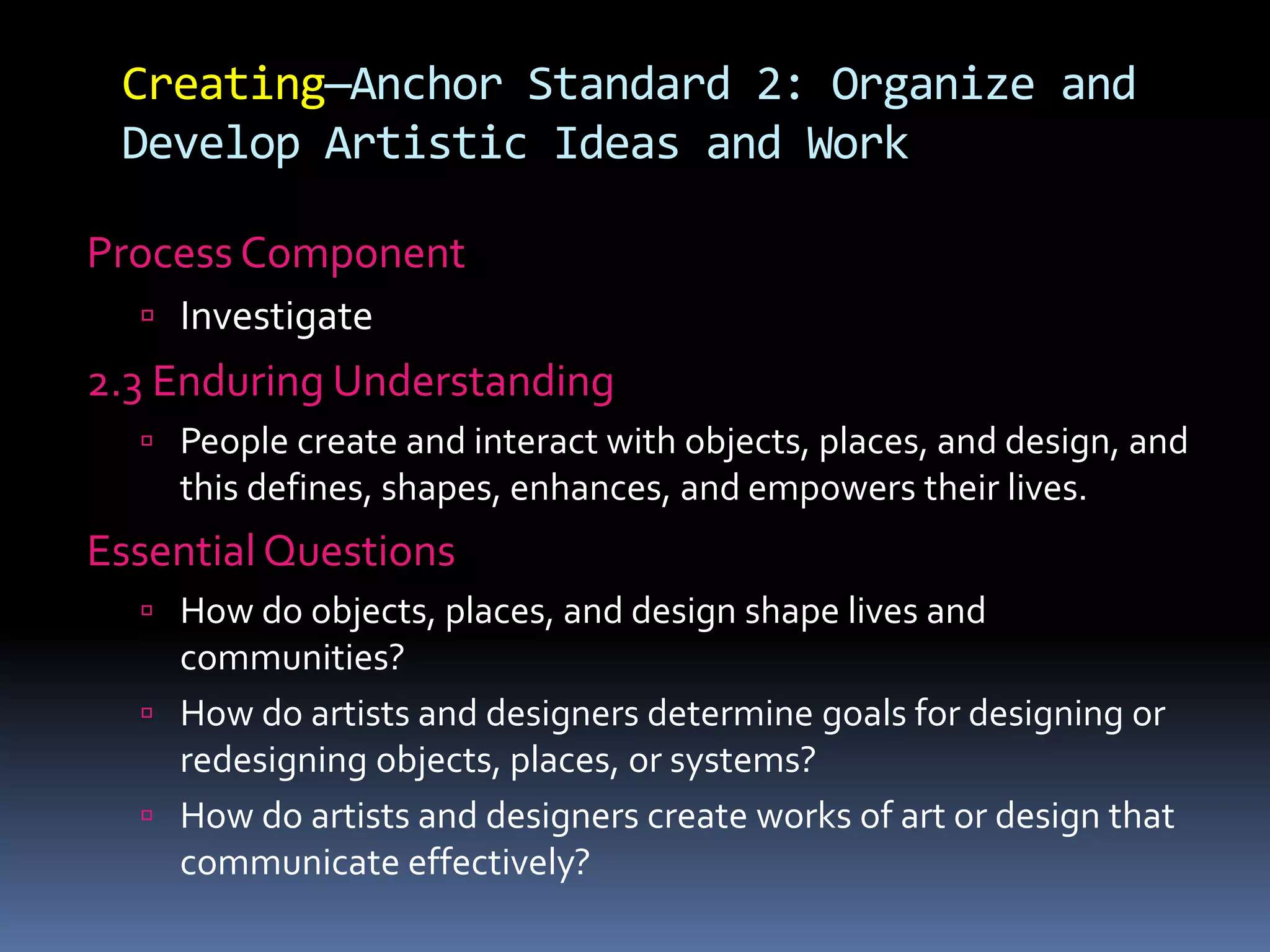
2.3 Enduring Understanding
 People create and interact with objects, places, and design, and
this defines, shapes, enhances, and empowers their lives.
Essential Questions
 How do objects, places, and design shape lives and
communities?
 How do artists and designers determine goals for designing or
redesigning objects, places, or systems?
 How do artists and designers create works of art or design that
communicate effectively?
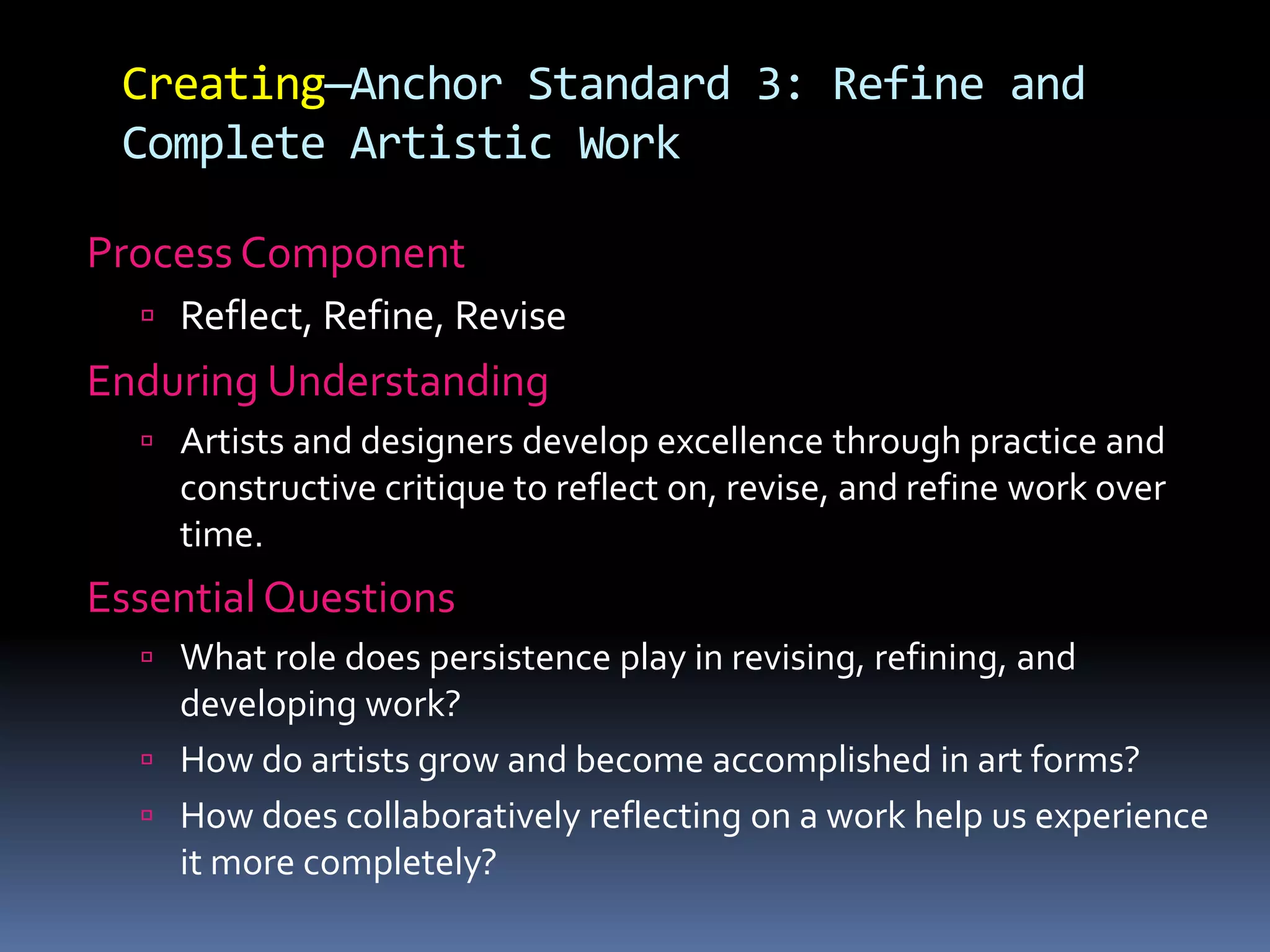
Creating—Anchor Standard 3: Refine and
Complete Artistic Work
Process Component
 Reflect, Refine, Revise
Enduring Understanding
 Artists and designers develop excellence through practice and
constructive critique to reflect on, revise, and refine work over
time.
Essential Questions
 What role does persistence play in revising, refining, and
developing work?
 How do artists grow and become accomplished in art forms?
 How does collaboratively reflecting on a work help us experience
it more completely?
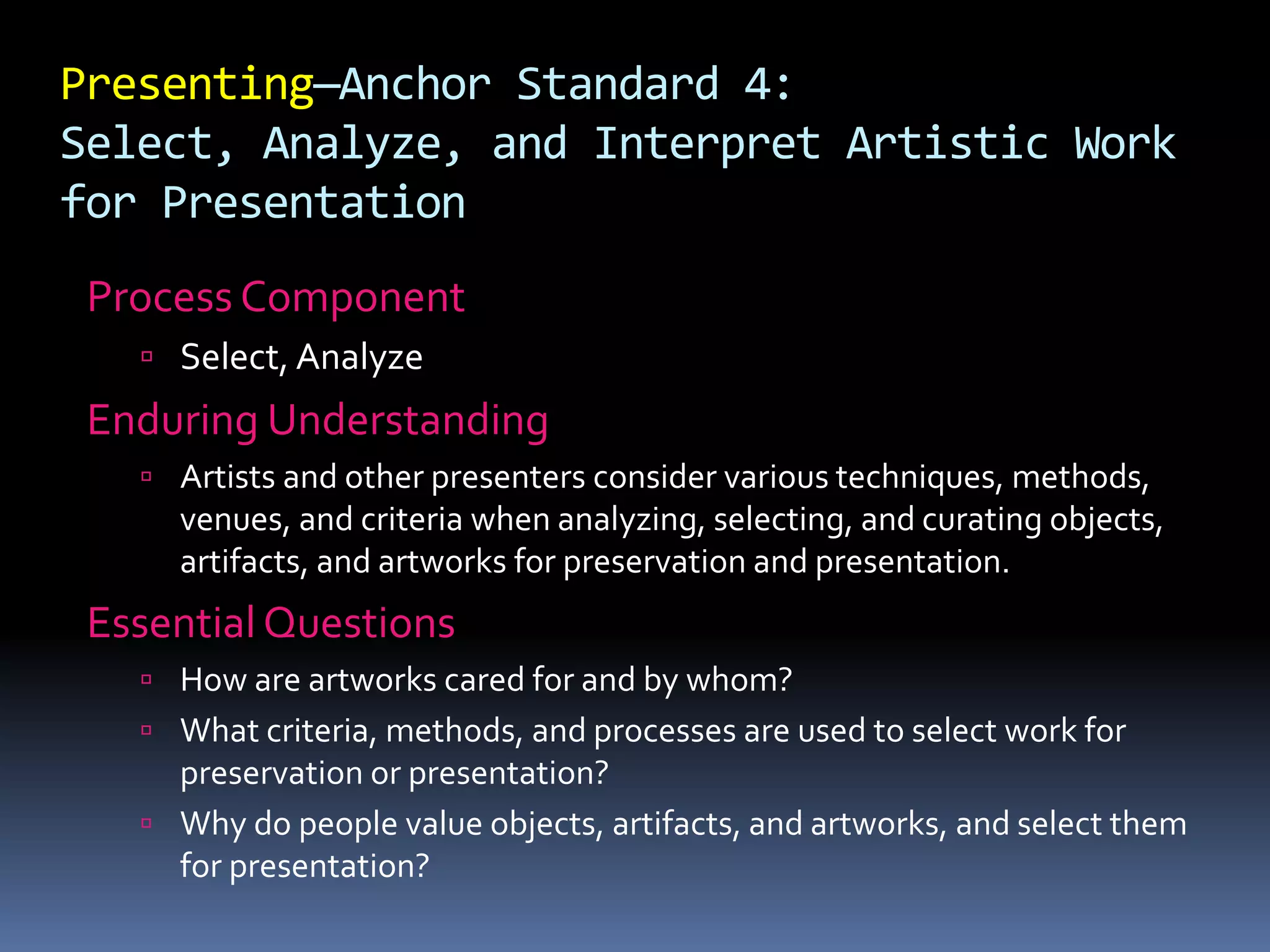
Presenting—Anchor Standard 4:
Select, Analyze, and Interpret Artistic Work
for Presentation
Process Component
 Select, Analyze
Enduring Understanding
 Artists and other presenters consider various techniques, methods,
venues, and criteria when analyzing, selecting, and curating objects,
artifacts, and artworks for preservation and presentation.
Essential Questions
 How are artworks cared for and by whom?
 What criteria, methods, and processes are used to select work for
preservation or presentation?
 Why do people value objects, artifacts, and artworks, and select them
for presentation?
Presenting—Anchor Standard 5:
Develop and Refine Artistic Techniques and
Work for Presentation
Process Component
 Prepare
Enduring Understanding
 Artists, curators, and others consider a variety of factors and
methods including evolving technologies when preparing and
refining artwork for display, and when deciding if and how to
preserve and protect it.
Essential Questions
 What methods, processes, and criteria are considered when
preparing artwork for presentation, preservation, portfolio, or
collection?
 How does assessing choices for presentation affect its meaning to
the viewer?
Presenting—Anchor Standard 5:
Develop and Refine Artistic Techniques and
Work for Presentation
Process Component
 Prepare
Enduring Understanding
 Artists, curators, and others consider a variety of factors and
methods including evolving technologies when preparing and
refining artwork for display, and when deciding if and how to
preserve and protect it.
Essential Questions
 What methods, processes, and criteria are considered when
preparing artwork for presentation, preservation, portfolio, or
collection?
 How does assessing choices for presentation affect its meaning to
the viewer?
Presenting—Anchor Standard 6: Convey Meaning
Through the Presentation of Artistic Work
Process Component
 Present
Enduring Understanding
 Objects, artifacts, and artworks collected, preserved, or presented
either by artists, museums, or other venues communicate meaning and
a record of social, cultural, and political experiences resulting in the
cultivating of appreciation and understanding.
Essential Questions
 What is an art museum?
 How does the presenting and sharing of objects, artifacts, and artworks
influence and shape ideas, beliefs, and experiences?
 How do objects, artifacts, and artworks that are collected, preserved, or
presented, cultivate appreciation and understanding?
Responding—Anchor Standard 7: Perceive and
Analyze Artistic Work
Process Component
 Perceive
7.1 Enduring Understanding
 Individual aesthetic and empathetic awareness developed
through engagement with art can lead to understanding and
appreciation of self, others, the natural world, and constructed
environments.
Essential Questions
 How do life experiences influence the way you relate to art?
 How does learning about art impact how we perceive the world?
 What can we learn from our responses to art?
Responding—Anchor Standard 7: Perceive and
Analyze Artistic Work
Process Component
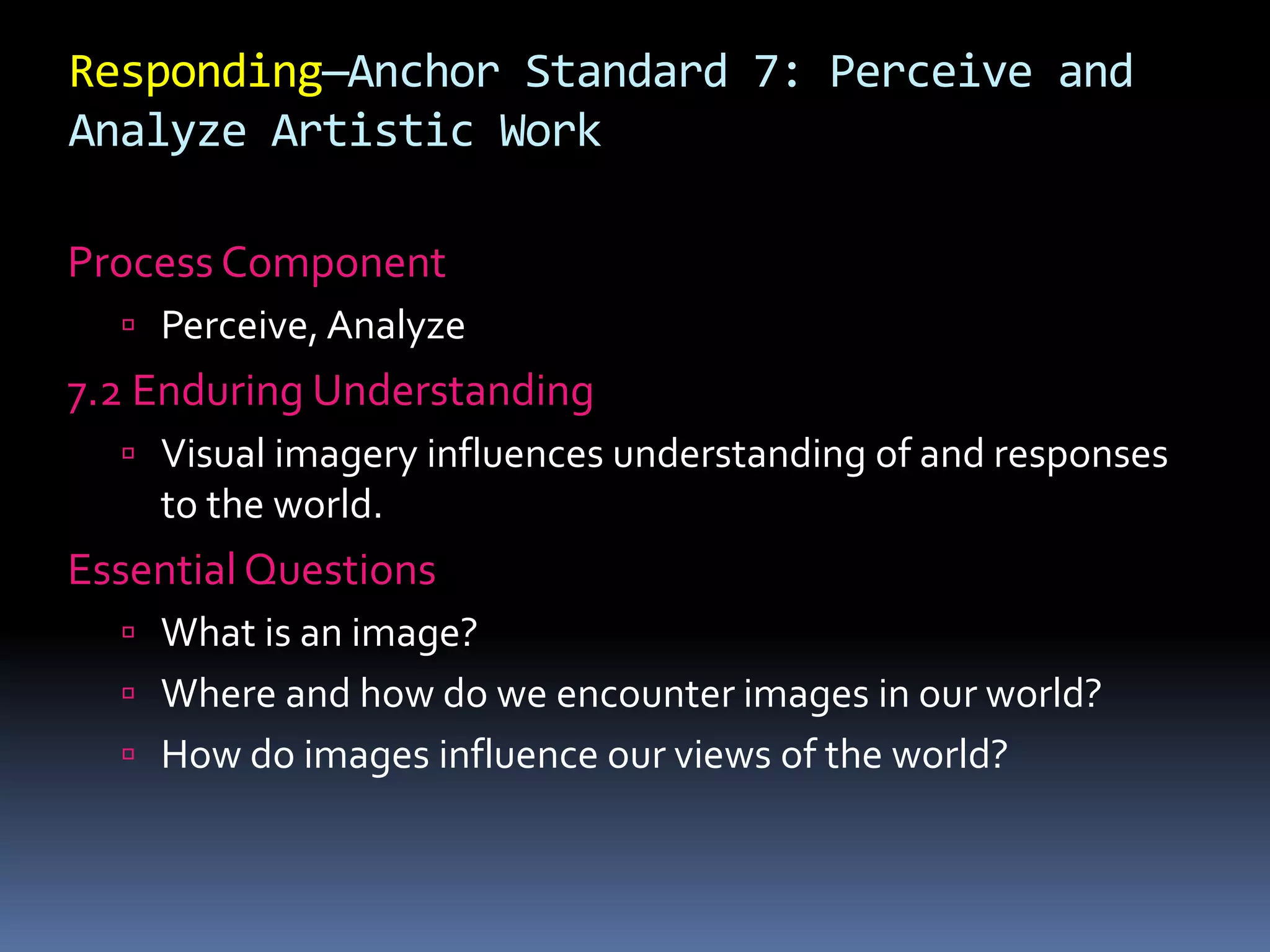
 Perceive, Analyze
7.2 Enduring Understanding
 Visual imagery influences understanding of and responses
to the world.
Essential Questions
 What is an image?
 Where and how do we encounter images in our world?
 How do images influence our views of the world?
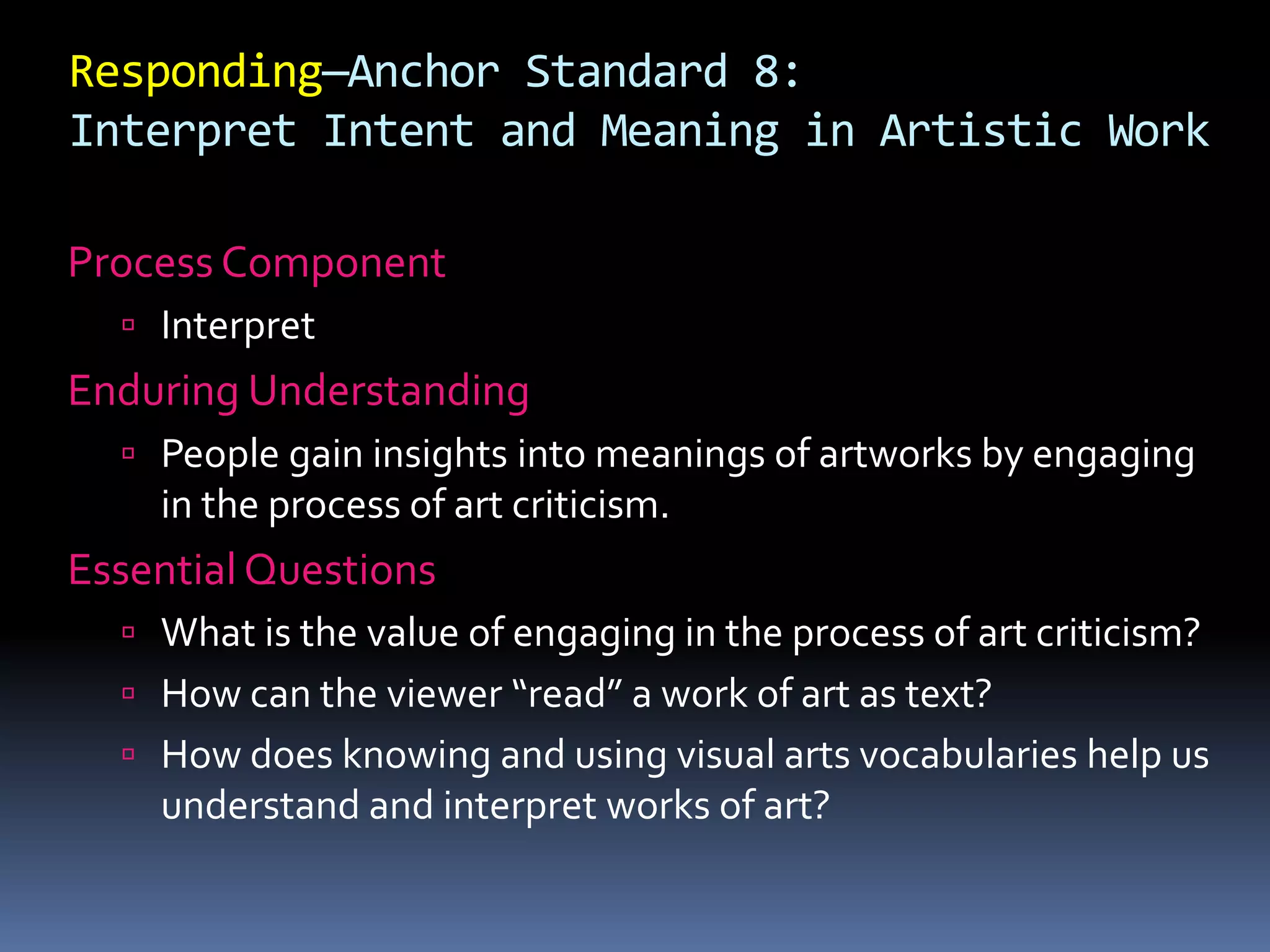
Responding—Anchor Standard 8:
Interpret Intent and Meaning in Artistic Work
Process Component
 Interpret
Enduring Understanding
 People gain insights into meanings of artworks by engaging
in the process of art criticism.
Essential Questions
 What is the value of engaging in the process of art criticism?
 How can the viewer “read” a work of art as text?
 How does knowing and using visual arts vocabularies help us
understand and interpret works of art?
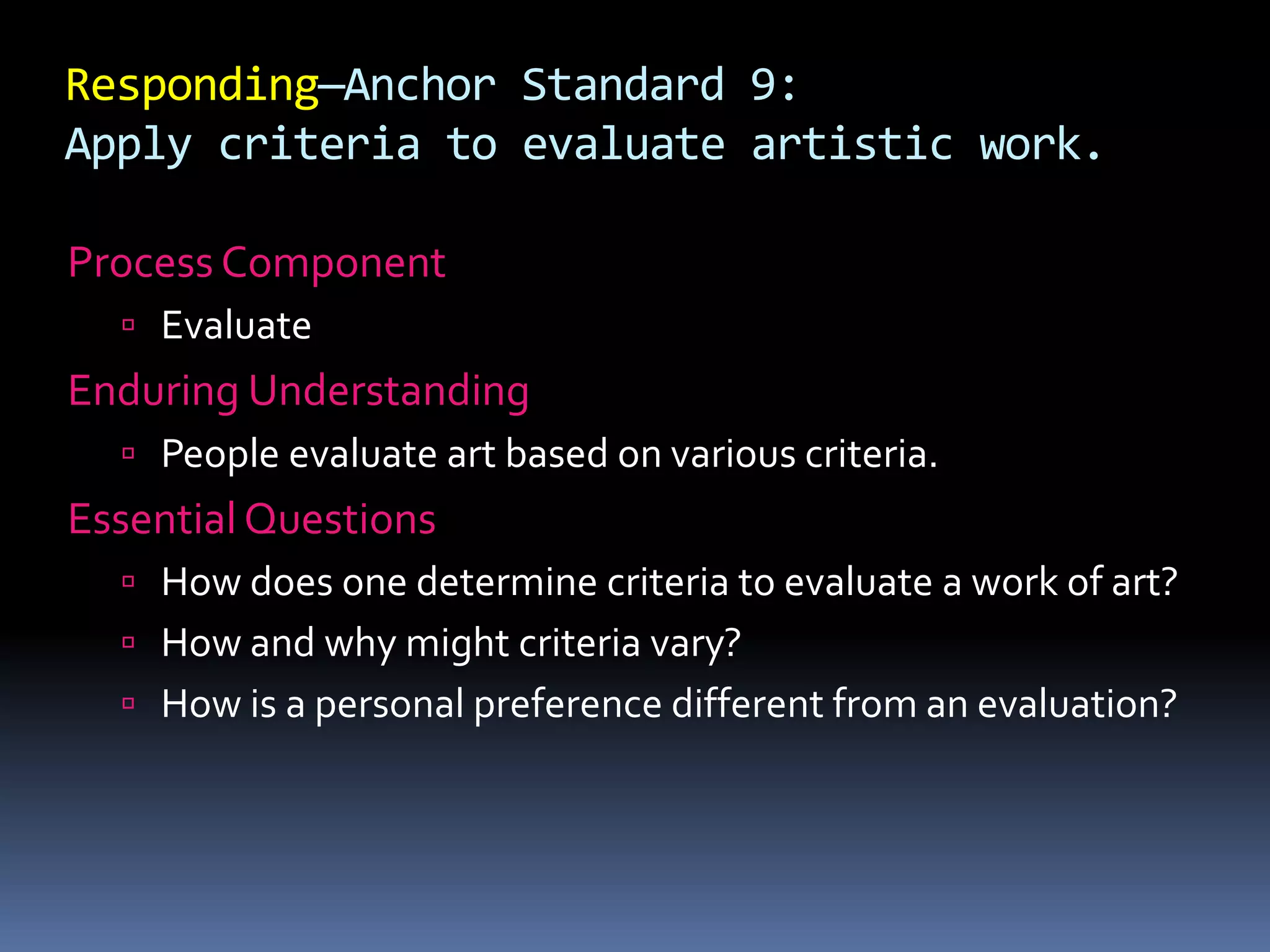
Responding—Anchor Standard 9:
Apply criteria to evaluate artistic work.
Process Component
 Evaluate
Enduring Understanding
 People evaluate art based on various criteria.
Essential Questions
 How does one determine criteria to evaluate a work of art?
 How and why might criteria vary?
 How is a personal preference different from an evaluation?
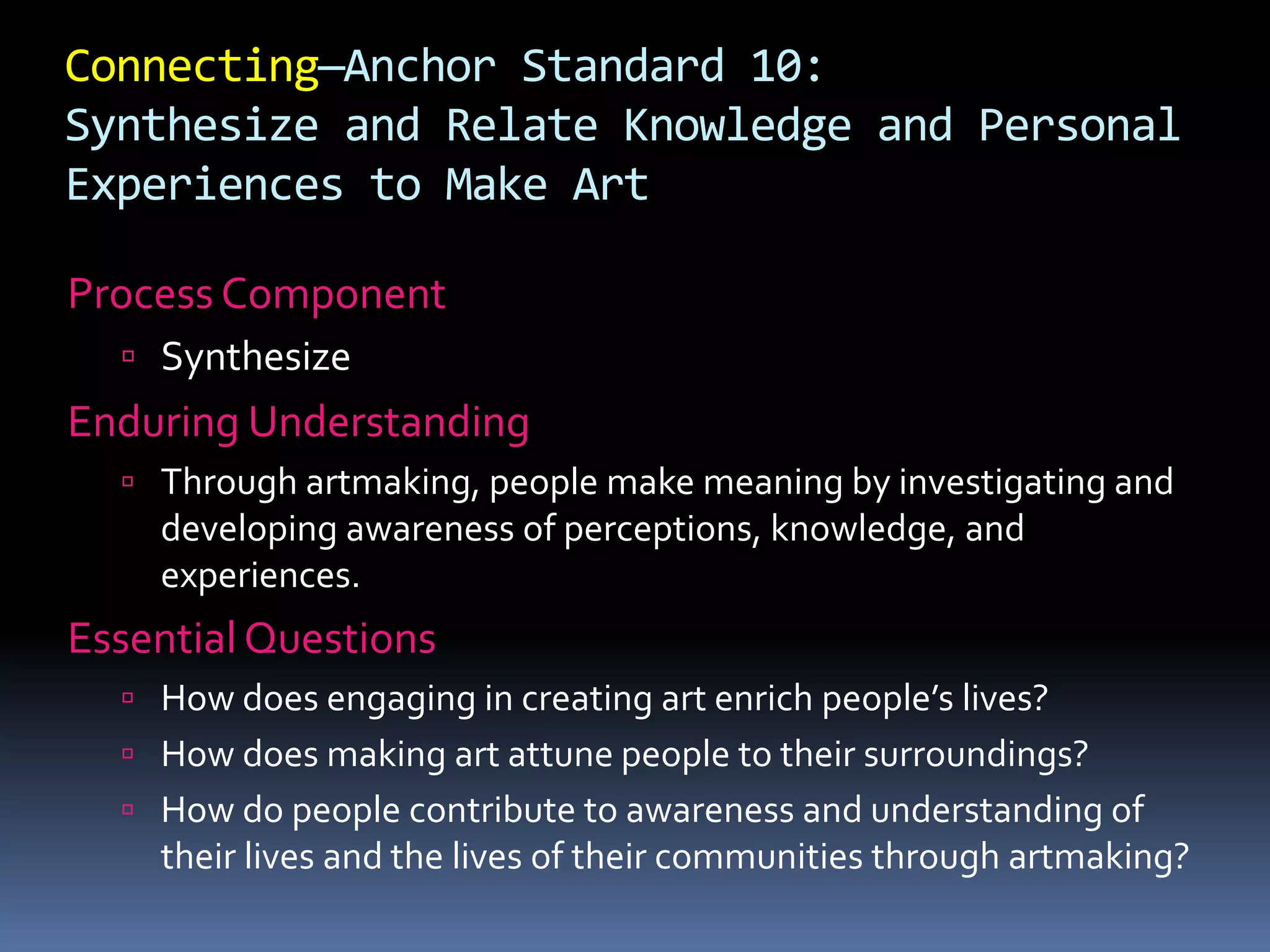
Connecting—Anchor Standard 10:
Synthesize and Relate Knowledge and Personal
Experiences to Make Art
Process Component
 Synthesize
Enduring Understanding
 Through artmaking, people make meaning by investigating and
developing awareness of perceptions, knowledge, and
experiences.
Essential Questions
 How does engaging in creating art enrich people’s lives?
 How does making art attune people to their surroundings?
 How do people contribute to awareness and understanding of
their lives and the lives of their communities through artmaking?
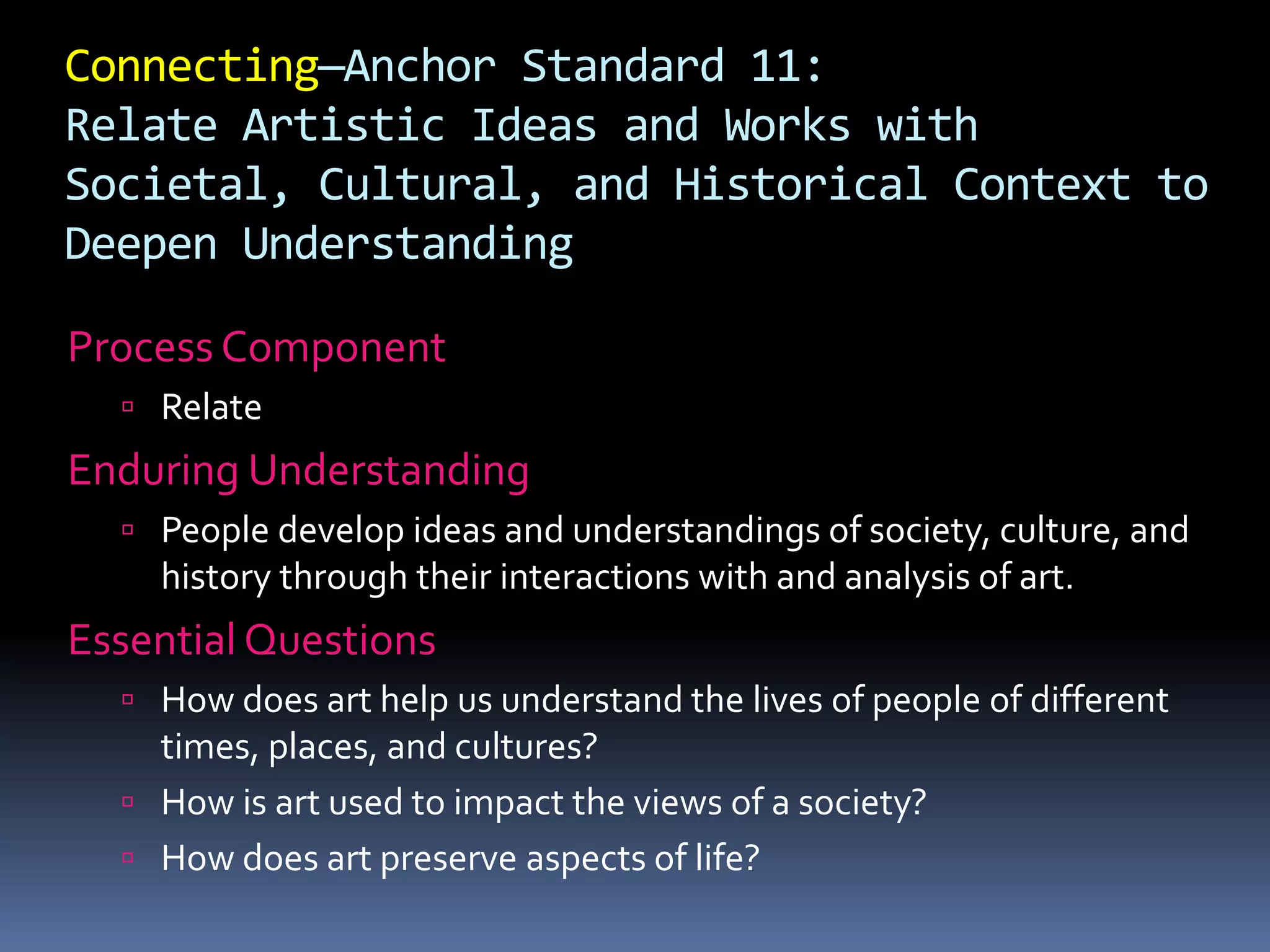
Connecting—Anchor Standard 11:
Relate Artistic Ideas and Works with
Societal, Cultural, and Historical Context to
Deepen Understanding
Process Component
 Relate
Enduring Understanding
 People develop ideas and understandings of society, culture, and
history through their interactions with and analysis of art.
Essential Questions
 How does art help us understand the lives of people of different
times, places, and cultures?
 How is art used to impact the views of a society?
 How does art preserve aspects of life?

Essential questions and enduring understandings of Visual Arts

  • 1.
    ESSENTIAL QUESTIONS FOR ENDURINGUNDERSTANDING OF VISUAL ARTS
  • 2.
    Understanding by Design Willthis art activity lead to enduring understanding? Worth being familiar with Important to know and do Enduring Understanding
  • 3.
    Understanding by Design What are the big ideas?  Core concepts  Focusing themes  On-going debates/issues  Insightful perspectives  Illuminating paradox/problem  Organizing theory  Overarching principle  Underlying assumption  What’s the evidence?  How do we get there? Represent a big idea having enduring value beyond the classroom Reside at the heart of the discipline (involve “doing” the subject) Uncover abstract misunderstood ideas Engaging Students Enduring Understanding
  • 4.
    Understanding by Design Desired Results: What will the student learn?  Enduring Understanding  Acceptable Evidence: How will you design an assessment that accurately determines if the student learned what he/she was supposed to learn?  Lesson Planning: How do you design a lesson that results in student learning? Identify desired results Determine acceptable evidence Plan learning experiences and instruction
  • 5.
    Remembering Understanding Applying Analyzing Evaluating Creating • Creating– designing, constructing, planning, producing, inventing, devising, making • Evaluating – checking, hypothesizing, critiquing, experimenting, judging, testing, detecting, monitoringC • Analyzing – comparing, organizing, deconstructing, attributing, outlining, finding, structuring, integrating • Applying – implementing, carrying out, using, executing • Understanding – interpreting, summarizing, inferring, paraphrasing, classifying, comparing, explaining, exemplifying • Remembering – recognizing, listing, describing, identifying, retrieving, naming, locating, finding Bloom’s Revised Taxonomy Levels of Critical Thinking
  • 6.
    Essential Questions: EQs Spark our curiosity and sense of wonder  Desire to understand  Something that matters to us  Specific answers to EQs can NOT be found  Students must construct own answers  Make their own meaning from information they have gathered  Create insight  Not factual with just one possible answer  Not dichotomous – yes or no  Open to personal interpretation
  • 7.
    Essential Questions inthe Arts  What can artworks tell us about a culture or society?  What influences creative expression?  To what extent do artists have a responsibility to their audiences?  Do audiences have any responsibility to artists?  What's the difference between a thoughtful and a thoughtless critique?  If practice makes perfect, what makes perfect practice?
  • 8.
    Visual Arts: Planningfor Enduring Understandings  How will you engage your students in this topic?  How do you hook them in with your “anticipatory set”?  How will you motivate students to think critically and explore essential questions?  How will you move beyond “recall” to problem solving?  How will your lessons result in “enduring understanding” of key issues in society?  What will students do, create, or present to express their knowledge and understanding?
  • 9.
    California Visual ArtsProcess Components and Standards https://www.cde.ca.gov/be/st/ss/vapacontentstds.asp
  • 10.
    Creating—Anchor Standard 1:Generate and Conceptualize Artistic Ideas and Work Process Component  Imagine, Plan, Make  1.1 Enduring Understanding  Creativity and innovative thinking are essential life skills that can be developed.  Essential Questions  What conditions, attitudes, and behaviors support creativity and innovative thinking?  What factors prevent or encourage people to take creative risks?  How does collaboration expand the creative process?
  • 11.
    Creating—Anchor Standard 1:Generate and Conceptualize Artistic Ideas and Work Process Component  Imagine, Plan, Make 2.2 Enduring Understanding  Artists and designers shape artistic investigations, following or breaking with traditions in pursuit of creative artmaking goals. Essential Questions  How does knowing the contexts, histories, and traditions of art forms help us create works of art and design?  Why do artists follow or break from established traditions?  How do artists determine what resources and criteria are needed to formulate artistic investigations?
  • 12.
    Creating—Anchor Standard 2:Organize and Develop Artistic Ideas and Work Process Component  Investigate 2.1 Enduring Understanding  Artists and designers experiment with forms, structures, materials, concepts, media, and art- making approaches. Essential Questions  How do artists work?  How do artists and designers determine whether a particular direction in their work is effective?  How do artists and designers learn from trial and error?
  • 13.
    Creating—Anchor Standard 2:Organize and Develop Artistic Ideas and Work Process Component  Investigate 2.2 Enduring Understanding  Artists and designers balance experimentation and safety, freedom, and responsibility while developing and creating artworks. Essential Questions  How do artists and designers care for and maintain materials, tools, and equipment?  Why is it important for safety and health to understand and follow correct procedures in handling materials, tools, and equipment?  What responsibilities come with the freedom to create?
  • 14.
    Creating—Anchor Standard 2:Organize and Develop Artistic Ideas and Work Process Component  Investigate 2.3 Enduring Understanding  People create and interact with objects, places, and design, and this defines, shapes, enhances, and empowers their lives. Essential Questions  How do objects, places, and design shape lives and communities?  How do artists and designers determine goals for designing or redesigning objects, places, or systems?  How do artists and designers create works of art or design that communicate effectively?
  • 15.
    Creating—Anchor Standard 3:Refine and Complete Artistic Work Process Component  Reflect, Refine, Revise Enduring Understanding  Artists and designers develop excellence through practice and constructive critique to reflect on, revise, and refine work over time. Essential Questions  What role does persistence play in revising, refining, and developing work?  How do artists grow and become accomplished in art forms?  How does collaboratively reflecting on a work help us experience it more completely?
  • 16.
    Presenting—Anchor Standard 4: Select,Analyze, and Interpret Artistic Work for Presentation Process Component  Select, Analyze Enduring Understanding  Artists and other presenters consider various techniques, methods, venues, and criteria when analyzing, selecting, and curating objects, artifacts, and artworks for preservation and presentation. Essential Questions  How are artworks cared for and by whom?  What criteria, methods, and processes are used to select work for preservation or presentation?  Why do people value objects, artifacts, and artworks, and select them for presentation?
  • 17.
    Presenting—Anchor Standard 5: Developand Refine Artistic Techniques and Work for Presentation Process Component  Prepare Enduring Understanding  Artists, curators, and others consider a variety of factors and methods including evolving technologies when preparing and refining artwork for display, and when deciding if and how to preserve and protect it. Essential Questions  What methods, processes, and criteria are considered when preparing artwork for presentation, preservation, portfolio, or collection?  How does assessing choices for presentation affect its meaning to the viewer?
  • 18.
    Presenting—Anchor Standard 5: Developand Refine Artistic Techniques and Work for Presentation Process Component  Prepare Enduring Understanding  Artists, curators, and others consider a variety of factors and methods including evolving technologies when preparing and refining artwork for display, and when deciding if and how to preserve and protect it. Essential Questions  What methods, processes, and criteria are considered when preparing artwork for presentation, preservation, portfolio, or collection?  How does assessing choices for presentation affect its meaning to the viewer?
  • 19.
    Presenting—Anchor Standard 6:Convey Meaning Through the Presentation of Artistic Work Process Component  Present Enduring Understanding  Objects, artifacts, and artworks collected, preserved, or presented either by artists, museums, or other venues communicate meaning and a record of social, cultural, and political experiences resulting in the cultivating of appreciation and understanding. Essential Questions  What is an art museum?  How does the presenting and sharing of objects, artifacts, and artworks influence and shape ideas, beliefs, and experiences?  How do objects, artifacts, and artworks that are collected, preserved, or presented, cultivate appreciation and understanding?
  • 20.
    Responding—Anchor Standard 7:Perceive and Analyze Artistic Work Process Component  Perceive 7.1 Enduring Understanding  Individual aesthetic and empathetic awareness developed through engagement with art can lead to understanding and appreciation of self, others, the natural world, and constructed environments. Essential Questions  How do life experiences influence the way you relate to art?  How does learning about art impact how we perceive the world?  What can we learn from our responses to art?
  • 21.
    Responding—Anchor Standard 7:Perceive and Analyze Artistic Work Process Component  Perceive, Analyze 7.2 Enduring Understanding  Visual imagery influences understanding of and responses to the world. Essential Questions  What is an image?  Where and how do we encounter images in our world?  How do images influence our views of the world?
  • 22.
    Responding—Anchor Standard 8: InterpretIntent and Meaning in Artistic Work Process Component  Interpret Enduring Understanding  People gain insights into meanings of artworks by engaging in the process of art criticism. Essential Questions  What is the value of engaging in the process of art criticism?  How can the viewer “read” a work of art as text?  How does knowing and using visual arts vocabularies help us understand and interpret works of art?
  • 23.
    Responding—Anchor Standard 9: Applycriteria to evaluate artistic work. Process Component  Evaluate Enduring Understanding  People evaluate art based on various criteria. Essential Questions  How does one determine criteria to evaluate a work of art?  How and why might criteria vary?  How is a personal preference different from an evaluation?
  • 24.
    Connecting—Anchor Standard 10: Synthesizeand Relate Knowledge and Personal Experiences to Make Art Process Component  Synthesize Enduring Understanding  Through artmaking, people make meaning by investigating and developing awareness of perceptions, knowledge, and experiences. Essential Questions  How does engaging in creating art enrich people’s lives?  How does making art attune people to their surroundings?  How do people contribute to awareness and understanding of their lives and the lives of their communities through artmaking?
  • 25.
    Connecting—Anchor Standard 11: RelateArtistic Ideas and Works with Societal, Cultural, and Historical Context to Deepen Understanding Process Component  Relate Enduring Understanding  People develop ideas and understandings of society, culture, and history through their interactions with and analysis of art. Essential Questions  How does art help us understand the lives of people of different times, places, and cultures?  How is art used to impact the views of a society?  How does art preserve aspects of life?