Date:02/06/2022 Educator: Amanjeet Kaur
Title of video from Videotapes: A Clear Purpose
Supports Persistence
Description of the play you’re observing: Constructive play
Noticing and Naming Practice part 1-Amanjeet Kaur Sandhu and Foram Gajjar
Red highlighted lines done by Amanjeet Kaur Sandhu and Yellow highlighted lines done by Foram after watching the video and shared and discuss
afterwards.
Dispositions to Learn
I/we are
playing
Inventing, creating, imagining
Telling and directing stories
Exploring, representing
Taking risks in/for learning
I/we are persisting Persevering with challenges and/or difficulties
Trying strategies
Asking for help
Reaching our own goals
I/we are
seeking
Questioning, wondering curious
Exploring with our senses
Solving problems
I/we are caring Helping
Caring about our families, others, and ourselves
Caring for the world and living things
I/we are
participatin
g
Engaging with others
Listening to, sharing ideas, thoughts and
feelings
Negotiating, taking turns, observing
Questions for
Families
Taken from: Makovichuk, L., Hewes, J., Lirette, P., & Thomas, N. (2014). Flight: Alberta’s early learning and care framework. Retrieved from
flightframework.ca
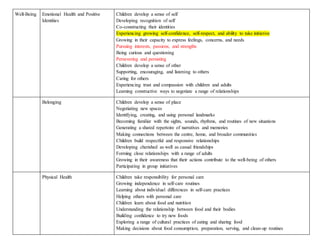
Holistic Play-Based Goals
Goal Facets Indicators
Well-Being Emotional Health and Positive
Identities
Children develop a sense of self
Developing recognition of self
Co-constructing their identities
Experiencing growing self-confidence, self-respect, and ability to take initiative
Growing in their capacity to express feelings, concerns, and needs
Pursuing interests, passions, and strengths
Being curious and questioning
Persevering and persisting
Children develop a sense of other
Supporting, encouraging, and listening to others
Caring for others
Experiencing trust and compassion with children and adults
Learning constructive ways to negotiate a range of relationships
Belonging Children develop a sense of place
Negotiating new spaces
Identifying, creating, and using personal landmarks
Becoming familiar with the sights, sounds, rhythms, and routines of new situations
Generating a shared repertoire of narratives and memories
Making connections between the centre, home, and broader communities
Children build respectful and responsive relationships
Developing cherished as well as casual friendships
Forming close relationships with a range of adults
Growing in their awareness that their actions contribute to the well-being of others
Participating in group initiatives
Physical Health Children take responsibility for personal care
Growing independence in self-care routines
Learning about individual differences in self-care practices
Helping others with personal care
Children learn about food and nutrition
Understanding the relationship between food and their bodies
Building confidence to try new foods
Exploring a range of cultural practices of eating and sharing food
Making decisions about food consumption, preparation, serving, and clean-up routines
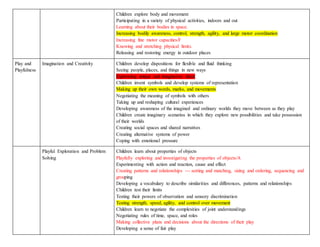
Children explore body and movement
Participating in a variety of physical activities, indoors and out
Learning about their bodies in space.
Increasing bodily awareness, control, strength, agility, and large motor coordination
Increasing fine motor capacities/F
Knowing and stretching physical limits.
Releasing and restoring energy in outdoor places
Play and
Playfulness
Imagination and Creativity Children develop dispositions for flexible and fluid thinking
Seeing people, places, and things in new ways
Expressing unique and imaginative ideas
Children invent symbols and develop systems of representation
Making up their own words, marks, and movements
Negotiating the meaning of symbols with others
Taking up and reshaping cultural experiences
Developing awareness of the imagined and ordinary worlds they move between as they play
Children create imaginary scenarios in which they explore new possibilities and take possession
of their worlds
Creating social spaces and shared narratives
Creating alternative systems of power
Coping with emotional pressure
Playful Exploration and Problem
Solving
Children learn about properties of objects
Playfully exploring and investigating the properties of objects/A
Experimenting with action and reaction, cause and effect
Creating patterns and relationships --- sorting and matching, sizing and ordering, sequencing and
grouping
Developing a vocabulary to describe similarities and differences, patterns and relationships
Children test their limits
Testing their powers of observation and sensory discrimination
Testing strength, speed, agility, and control over movement
Children learn to negotiate the complexities of joint understandings
Negotiating rules of time, space, and roles
Making collective plans and decisions about the directions of their play
Developing a sense of fair play
Children learn to employ creative approaches to identifying and working out practical problems
Developing sustained, shared thinking
Raising questions and making hypotheses about how and why things happen
Choosing from a range of materials, tools, and languages to investigate, experiment, and make
their thinking visible
Creating imagined worlds in which they can explore possibilities and test alternative
solutions/Combined approach
Dizzy Play Children take pleasure in being on the edge
Engaging in rough and tumble play
Experiencing exhilarating physical release
Playing at games of disrupting and restoring order
Children take pleasure in sharing the joy of laughter
Making nonsense
Clowning and physical humour
Communic
ation and
Literacies
Communicative Practices Children form relationships through communicative practices
Recognizing and responding to human presence and touch
Becoming attuned to rhyme, rhythm, pitch, tone, and vibrations
Practicing and playing with sounds
Initiating and responding to gestural and visual language
Children learn conventions of their languages
Growing in their implicit understanding of vocabulary
Developing confidence in using language(s)
Growing in their understanding of how others use language(s)
Experiencing and developing diverse linguistic repertoires
Children extend ideas and take action using language
Using language to express thoughts, feelings, and ideas
Using language to make friends, share materials, structure, negotiate, and create imaginary worlds
Using language to ask for help or information, argue, persuade, clarify, celebrate, or instruct
Multimodal Literacies Children explore a variety of sign systems
Becoming familiar with the sign systems of language, music, math, art, and drama
Engaging in multiple forms of representation
Transforming knowledge from one mode to another
Multimodal meaning making
Engaging with the symbols and practices of language, music, math, art, and/or drama
Literate Identities With/In
Communities
Children co-construct a range of literate identities
Creating texts reflective of family, local, and global literacies
Learning various local literacy practices within a range of communities
Learning the uniqueness and similarities of their family’s literacies and those of others
Children engage critically in the literacy practices of popular culture
Transporting and transforming the literacies of popular culture from home into the centre
Exploring various identities and characters embedded in popular culture
Growing in their capacity to ask critical questions
Children use literacy tools of digital technologies
Representing their experiences with technologies in everyday life
Accessing and using digital technologies
Diversity
and Social
Responsibil
ity
Inclusiveness and Equity Children appreciate their own distinctiveness and that of others
Learning about their cultural heritages and those of other families with the centre and the broader
society
Becoming knowledgeable and confident in their various identities, including cultural, racial,
physical, spiritual, linguistic, gender, and socioeconomic
Children engage in practices that respect diversity
Forming positive, inclusive relationships with all children
Learning about differences, including cultural, racial, physical, spiritual, linguistic, gender, social,
and economic
Learning about and participating in helping projects ---- locally and globally
Children raise questions and act to change inequitable practices that exclude or discriminate
Recognizing and challenging inequitable practices and situations
Negotiating equitable solutions to problems arising from differences
Standing up for themselves and others in a fair manner
Democratic Practices Children learn to be responsible and responsive members of the community
Showing sympathy and empathy for others
Giving help, comfort, and encouragement, and valuing others’ contributions
Respecting the materials, equipment, and spaces shared with others
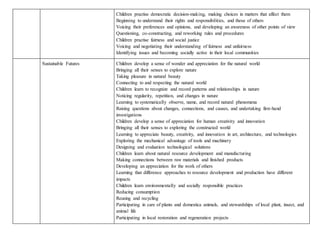
Children practise democratic decision-making, making choices in matters that affect them
Beginning to understand their rights and responsibilities, and those of others
Voicing their preferences and opinions, and developing an awareness of other points of view
Questioning, co-constructing, and reworking rules and procedures
Children practise fairness and social justice
Voicing and negotiating their understanding of fairness and unfairness
Identifying issues and becoming socially active in their local communities
Sustainable Futures Children develop a sense of wonder and appreciation for the natural world
Bringing all their senses to explore nature
Taking pleasure in natural beauty
Connecting to and respecting the natural world
Children learn to recognize and record patterns and relationships in nature
Noticing regularity, repetition, and changes in nature
Learning to systematically observe, name, and record natural phenomena
Raising questions about changes, connections, and causes, and undertaking first-hand
investigations
Children develop a sense of appreciation for human creativity and innovation
Bringing all their senses to exploring the constructed world
Learning to appreciate beauty, creativity, and innovation in art, architecture, and technologies
Exploring the mechanical advantage of tools and machinery
Designing and evaluation technological solutions
Children learn about natural resource development and manufacturing
Making connections between raw materials and finished products
Developing an appreciation for the work of others
Learning that difference approaches to resource development and production have different
impacts
Children learn environmentally and socially responsible practices
Reducing consumption
Reusing and recycling
Participating in care of plants and domestica animals, and stewardships of local plant, insect, and
animal life
Participating in local restoration and regeneration projects
Noticing and Naming Practice Reflection
In this assignment, I watch the video “A Clear Purpose Supports Persistence”, completed and noted the holistic-Play Based Goals and Dispositions to
Learn alone by myself. Once I completed my notes on holistic-play-based goals and dispositions to learn from video, discuss and share with my classmate
Foram Gajjar who watched the same video. After Discussion, I found some of my observations are the same as what Foram observed but some of the
observation notes are different. When I have shared my observation notes with Foram even though we concluded some additional points.
Moreover, I come up with more information after discussing with my classmate that I did not notice in my first attempt at watching the video. In First
observation noted holistic play-based goals and dispositions to learns of 20 months old boy who was playing with blocks and make those blocks stand but
he got knocked down with legs while getting up. Although my observation notes were refined after discussion with classmates.
References:
References: Makovichuk, L., Hewes, J., Lirette, P., & Thomas, N. (2014). Flight: Alberta’s early learning and care framework. Retrieved from
flightframework.ca

Noticing and naming assignment

  • 1.
    Date:02/06/2022 Educator: AmanjeetKaur Title of video from Videotapes: A Clear Purpose Supports Persistence Description of the play you’re observing: Constructive play Noticing and Naming Practice part 1-Amanjeet Kaur Sandhu and Foram Gajjar Red highlighted lines done by Amanjeet Kaur Sandhu and Yellow highlighted lines done by Foram after watching the video and shared and discuss afterwards. Dispositions to Learn I/we are playing Inventing, creating, imagining Telling and directing stories Exploring, representing Taking risks in/for learning I/we are persisting Persevering with challenges and/or difficulties Trying strategies Asking for help Reaching our own goals I/we are seeking Questioning, wondering curious Exploring with our senses Solving problems I/we are caring Helping Caring about our families, others, and ourselves Caring for the world and living things I/we are participatin g Engaging with others Listening to, sharing ideas, thoughts and feelings Negotiating, taking turns, observing Questions for Families Taken from: Makovichuk, L., Hewes, J., Lirette, P., & Thomas, N. (2014). Flight: Alberta’s early learning and care framework. Retrieved from flightframework.ca Holistic Play-Based Goals Goal Facets Indicators
  • 2.
    Well-Being Emotional Healthand Positive Identities Children develop a sense of self Developing recognition of self Co-constructing their identities Experiencing growing self-confidence, self-respect, and ability to take initiative Growing in their capacity to express feelings, concerns, and needs Pursuing interests, passions, and strengths Being curious and questioning Persevering and persisting Children develop a sense of other Supporting, encouraging, and listening to others Caring for others Experiencing trust and compassion with children and adults Learning constructive ways to negotiate a range of relationships Belonging Children develop a sense of place Negotiating new spaces Identifying, creating, and using personal landmarks Becoming familiar with the sights, sounds, rhythms, and routines of new situations Generating a shared repertoire of narratives and memories Making connections between the centre, home, and broader communities Children build respectful and responsive relationships Developing cherished as well as casual friendships Forming close relationships with a range of adults Growing in their awareness that their actions contribute to the well-being of others Participating in group initiatives Physical Health Children take responsibility for personal care Growing independence in self-care routines Learning about individual differences in self-care practices Helping others with personal care Children learn about food and nutrition Understanding the relationship between food and their bodies Building confidence to try new foods Exploring a range of cultural practices of eating and sharing food Making decisions about food consumption, preparation, serving, and clean-up routines
  • 3.
    Children explore bodyand movement Participating in a variety of physical activities, indoors and out Learning about their bodies in space. Increasing bodily awareness, control, strength, agility, and large motor coordination Increasing fine motor capacities/F Knowing and stretching physical limits. Releasing and restoring energy in outdoor places Play and Playfulness Imagination and Creativity Children develop dispositions for flexible and fluid thinking Seeing people, places, and things in new ways Expressing unique and imaginative ideas Children invent symbols and develop systems of representation Making up their own words, marks, and movements Negotiating the meaning of symbols with others Taking up and reshaping cultural experiences Developing awareness of the imagined and ordinary worlds they move between as they play Children create imaginary scenarios in which they explore new possibilities and take possession of their worlds Creating social spaces and shared narratives Creating alternative systems of power Coping with emotional pressure Playful Exploration and Problem Solving Children learn about properties of objects Playfully exploring and investigating the properties of objects/A Experimenting with action and reaction, cause and effect Creating patterns and relationships --- sorting and matching, sizing and ordering, sequencing and grouping Developing a vocabulary to describe similarities and differences, patterns and relationships Children test their limits Testing their powers of observation and sensory discrimination Testing strength, speed, agility, and control over movement Children learn to negotiate the complexities of joint understandings Negotiating rules of time, space, and roles Making collective plans and decisions about the directions of their play Developing a sense of fair play
  • 4.
    Children learn toemploy creative approaches to identifying and working out practical problems Developing sustained, shared thinking Raising questions and making hypotheses about how and why things happen Choosing from a range of materials, tools, and languages to investigate, experiment, and make their thinking visible Creating imagined worlds in which they can explore possibilities and test alternative solutions/Combined approach Dizzy Play Children take pleasure in being on the edge Engaging in rough and tumble play Experiencing exhilarating physical release Playing at games of disrupting and restoring order Children take pleasure in sharing the joy of laughter Making nonsense Clowning and physical humour Communic ation and Literacies Communicative Practices Children form relationships through communicative practices Recognizing and responding to human presence and touch Becoming attuned to rhyme, rhythm, pitch, tone, and vibrations Practicing and playing with sounds Initiating and responding to gestural and visual language Children learn conventions of their languages Growing in their implicit understanding of vocabulary Developing confidence in using language(s) Growing in their understanding of how others use language(s) Experiencing and developing diverse linguistic repertoires Children extend ideas and take action using language Using language to express thoughts, feelings, and ideas Using language to make friends, share materials, structure, negotiate, and create imaginary worlds Using language to ask for help or information, argue, persuade, clarify, celebrate, or instruct Multimodal Literacies Children explore a variety of sign systems Becoming familiar with the sign systems of language, music, math, art, and drama Engaging in multiple forms of representation
  • 5.
    Transforming knowledge fromone mode to another Multimodal meaning making Engaging with the symbols and practices of language, music, math, art, and/or drama Literate Identities With/In Communities Children co-construct a range of literate identities Creating texts reflective of family, local, and global literacies Learning various local literacy practices within a range of communities Learning the uniqueness and similarities of their family’s literacies and those of others Children engage critically in the literacy practices of popular culture Transporting and transforming the literacies of popular culture from home into the centre Exploring various identities and characters embedded in popular culture Growing in their capacity to ask critical questions Children use literacy tools of digital technologies Representing their experiences with technologies in everyday life Accessing and using digital technologies Diversity and Social Responsibil ity Inclusiveness and Equity Children appreciate their own distinctiveness and that of others Learning about their cultural heritages and those of other families with the centre and the broader society Becoming knowledgeable and confident in their various identities, including cultural, racial, physical, spiritual, linguistic, gender, and socioeconomic Children engage in practices that respect diversity Forming positive, inclusive relationships with all children Learning about differences, including cultural, racial, physical, spiritual, linguistic, gender, social, and economic Learning about and participating in helping projects ---- locally and globally Children raise questions and act to change inequitable practices that exclude or discriminate Recognizing and challenging inequitable practices and situations Negotiating equitable solutions to problems arising from differences Standing up for themselves and others in a fair manner Democratic Practices Children learn to be responsible and responsive members of the community Showing sympathy and empathy for others Giving help, comfort, and encouragement, and valuing others’ contributions Respecting the materials, equipment, and spaces shared with others
  • 6.
    Children practise democraticdecision-making, making choices in matters that affect them Beginning to understand their rights and responsibilities, and those of others Voicing their preferences and opinions, and developing an awareness of other points of view Questioning, co-constructing, and reworking rules and procedures Children practise fairness and social justice Voicing and negotiating their understanding of fairness and unfairness Identifying issues and becoming socially active in their local communities Sustainable Futures Children develop a sense of wonder and appreciation for the natural world Bringing all their senses to explore nature Taking pleasure in natural beauty Connecting to and respecting the natural world Children learn to recognize and record patterns and relationships in nature Noticing regularity, repetition, and changes in nature Learning to systematically observe, name, and record natural phenomena Raising questions about changes, connections, and causes, and undertaking first-hand investigations Children develop a sense of appreciation for human creativity and innovation Bringing all their senses to exploring the constructed world Learning to appreciate beauty, creativity, and innovation in art, architecture, and technologies Exploring the mechanical advantage of tools and machinery Designing and evaluation technological solutions Children learn about natural resource development and manufacturing Making connections between raw materials and finished products Developing an appreciation for the work of others Learning that difference approaches to resource development and production have different impacts Children learn environmentally and socially responsible practices Reducing consumption Reusing and recycling Participating in care of plants and domestica animals, and stewardships of local plant, insect, and animal life Participating in local restoration and regeneration projects
  • 7.
    Noticing and NamingPractice Reflection In this assignment, I watch the video “A Clear Purpose Supports Persistence”, completed and noted the holistic-Play Based Goals and Dispositions to Learn alone by myself. Once I completed my notes on holistic-play-based goals and dispositions to learn from video, discuss and share with my classmate Foram Gajjar who watched the same video. After Discussion, I found some of my observations are the same as what Foram observed but some of the observation notes are different. When I have shared my observation notes with Foram even though we concluded some additional points. Moreover, I come up with more information after discussing with my classmate that I did not notice in my first attempt at watching the video. In First observation noted holistic play-based goals and dispositions to learns of 20 months old boy who was playing with blocks and make those blocks stand but he got knocked down with legs while getting up. Although my observation notes were refined after discussion with classmates. References: References: Makovichuk, L., Hewes, J., Lirette, P., & Thomas, N. (2014). Flight: Alberta’s early learning and care framework. Retrieved from flightframework.ca