Thursday, April 19, 2018 1
LIFE-ORIENTED CURRICULUM
SELECTION OF CONTENT
BASED ON THE EXPERIENCES
OF CHILDREN
V.KAVIPRIYA B.A.
GCEW, CBE.
CURRICULUM CONTENT
“Body of facts, ideas, concepts and skills
that are presented, discussed and involved in course”.
SELECTION OF CONTENT REPRESENTS PRIORITIES
AND ASSUMPTIONS OF WHAT CONSTITUTES
“GOOD EDUCATION”.
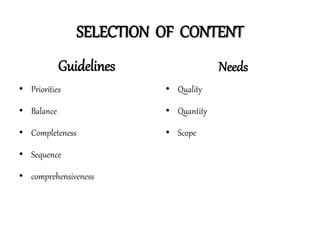
SELECTION OF CONTENT
Guidelines
• Priorities
• Balance
• Completeness
• Sequence
• comprehensiveness
Needs
• Quality
• Quantity
• Scope
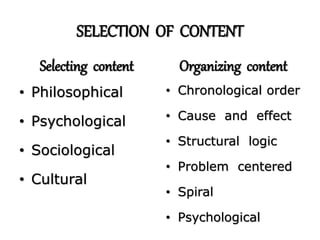
SELECTION OF CONTENT
Selecting content
• Philosophical
• Psychological
• Sociological
• Cultural
Organizing content
• Chronological order
• Cause and effect
• Structural logic
• Problem centered
• Spiral
• Psychological
INQUIRY–BASED LEARNING APPROACH
• inquiry-based learning = enquiry-based learning
• form of active learning
• includes problem-based learning
• related to the development and practice of thinking
skills
BASED ON THE EXPERIENCES OF CHILDREN
Current environmental crisis reminds about the
“PURPOSE OF EDUCATION”.
TEACHERS - makes shift to environmental inquiry.
Creates a classroom culture of learning ie.,
•PURPOSEFUL
•FUN
•PRODUCTIVE
•RESPONSIVE STUDENTS
AIMS TO NURTURE CHILD’S GROWTH
1. Providing children the opportunity to choose activities.
2. Providing group times that include music, stories and games.
3. Encouraging creativity.
4. Choosing materials and games that challenge children.
5. Encouraging children to think, reason, question, and experiment.
6. Encouraging social development and self-help skills.
needs of primary school children
 to communicate with other people
 to develop an awareness of self and an
understanding of the need for the care and protection
of the mind and body
 to be creative and to appreciate the creative
expression of others
 to understand the immediate environment
 to be helped to interpret experience and to
consider ultimate questions concerning meaning and
value in life.
Child-centredness
Kilpatrick suggests that the starting
point for education is
'the actual present life of the
boys and girls themselves, with all
their interests and desires, good
and bad'
A fundamental aspect of a curriculum based on
children's needs and interests is that it acknowledges that
children already have active minds.
A feature of child-centred curricula is their emphasis
on discovery. The child starts from his/her own
interest and extends his/her field of enquiry
outwards.

understanding disciplines and subjects

  • 1.
    Thursday, April 19,2018 1 LIFE-ORIENTED CURRICULUM SELECTION OF CONTENT BASED ON THE EXPERIENCES OF CHILDREN V.KAVIPRIYA B.A. GCEW, CBE.
  • 2.
    CURRICULUM CONTENT “Body offacts, ideas, concepts and skills that are presented, discussed and involved in course”. SELECTION OF CONTENT REPRESENTS PRIORITIES AND ASSUMPTIONS OF WHAT CONSTITUTES “GOOD EDUCATION”.
  • 3.
    SELECTION OF CONTENT Guidelines •Priorities • Balance • Completeness • Sequence • comprehensiveness Needs • Quality • Quantity • Scope
  • 4.
    SELECTION OF CONTENT Selectingcontent • Philosophical • Psychological • Sociological • Cultural Organizing content • Chronological order • Cause and effect • Structural logic • Problem centered • Spiral • Psychological
  • 5.
    INQUIRY–BASED LEARNING APPROACH •inquiry-based learning = enquiry-based learning • form of active learning • includes problem-based learning • related to the development and practice of thinking skills
  • 6.
    BASED ON THEEXPERIENCES OF CHILDREN Current environmental crisis reminds about the “PURPOSE OF EDUCATION”. TEACHERS - makes shift to environmental inquiry. Creates a classroom culture of learning ie., •PURPOSEFUL •FUN •PRODUCTIVE •RESPONSIVE STUDENTS
  • 7.
    AIMS TO NURTURECHILD’S GROWTH 1. Providing children the opportunity to choose activities. 2. Providing group times that include music, stories and games. 3. Encouraging creativity. 4. Choosing materials and games that challenge children. 5. Encouraging children to think, reason, question, and experiment. 6. Encouraging social development and self-help skills.
  • 8.
    needs of primaryschool children  to communicate with other people  to develop an awareness of self and an understanding of the need for the care and protection of the mind and body  to be creative and to appreciate the creative expression of others  to understand the immediate environment  to be helped to interpret experience and to consider ultimate questions concerning meaning and value in life.
  • 9.
    Child-centredness Kilpatrick suggests thatthe starting point for education is 'the actual present life of the boys and girls themselves, with all their interests and desires, good and bad'
  • 10.
    A fundamental aspectof a curriculum based on children's needs and interests is that it acknowledges that children already have active minds. A feature of child-centred curricula is their emphasis on discovery. The child starts from his/her own interest and extends his/her field of enquiry outwards.