CISP :Integrated
    Teaching


Dr Swanand S Pathak
drswanandp@yahoo.co.in
MY STORY
Anatomy physiology biochemistry


Pathology Pharmacology Microbiology Forensic medicine


Medicine


Medical Officer


MD Pharmacology


MET cell
Integration


NEED OR NOT ?
S – student centered
P – problem based
I - integrated
C – community based
E – elective
S – systemic approach
Foundation

Early clinical exposure

Integration

Skills
Objectives
• Define integrated teaching.
• Justify the need for integrated teaching.
• Enumerate the directions of integrated teaching.
• Define learning module.
• List types of learning modules.
• List steps of module development.
• State the drawbacks of integrated teaching.
Concept of Integration


• Integrate which means “make whole”


• Integration denotes “coordination of different activities
  to ensure harmonious functioning”
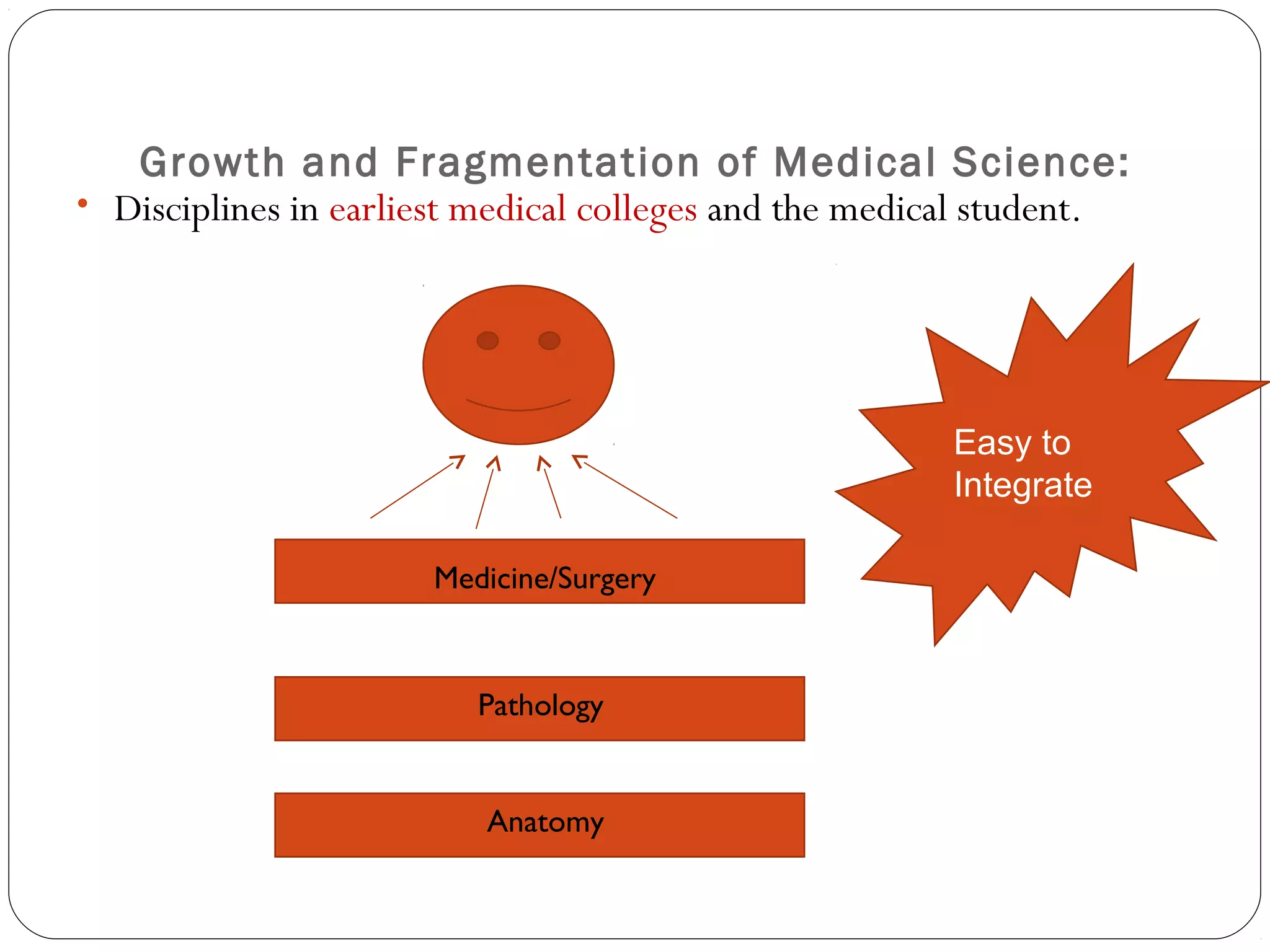
Growth and Fragmentation of Medical Science:
• Disciplines in earliest medical colleges and the medical student.


                                                       Easy to
                                                       Integrate

                      Medicine/Surgery


                         Pathology


                          Anatomy
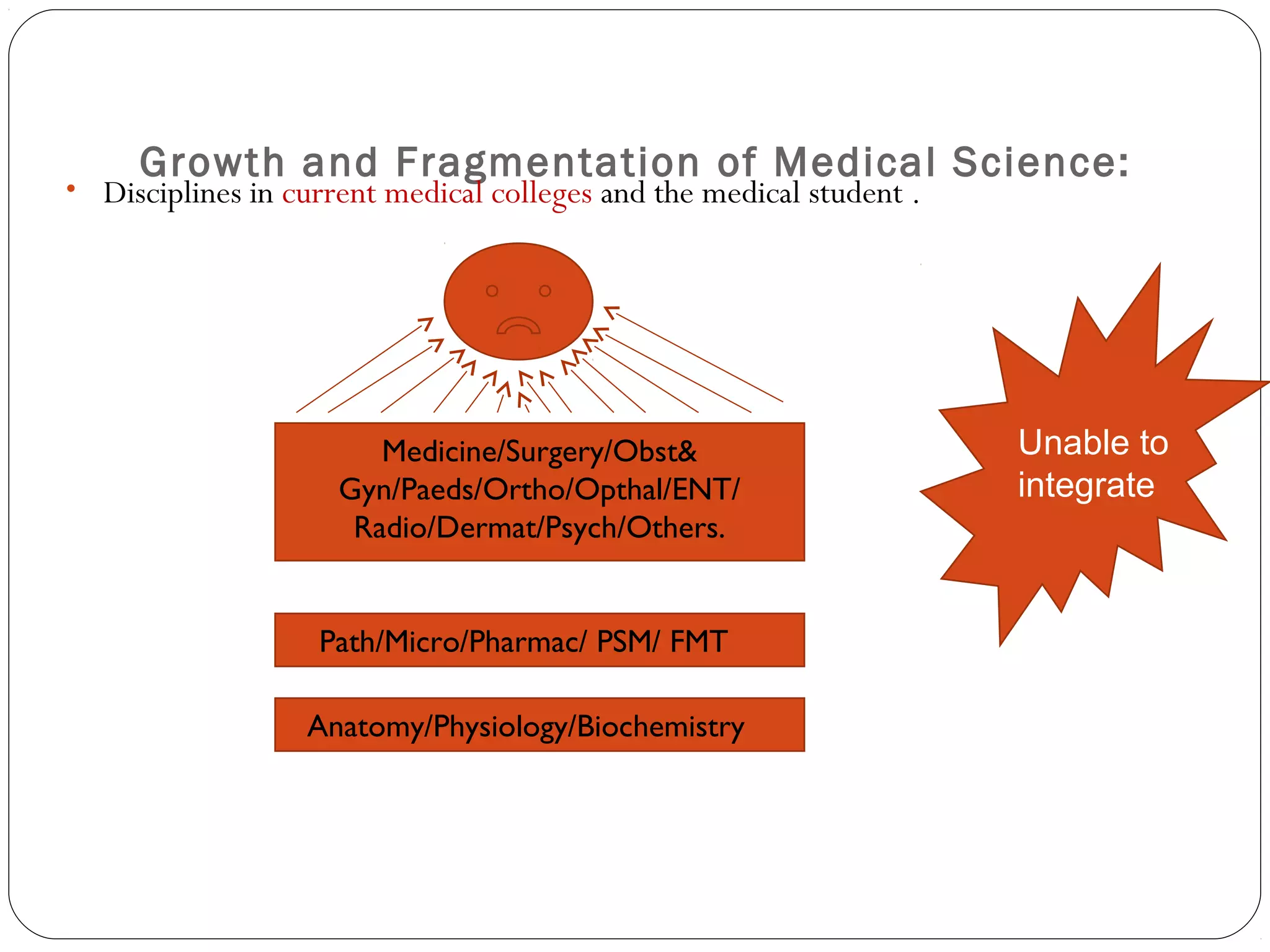
Growth and Fragmentation of Medical Science:
• Disciplines in current medical colleges and the medical student .


                        Medicine/Surgery/Obst&                        Unable to
                     Gyn/Paeds/Ortho/Opthal/ENT/                      integrate
                      Radio/Dermat/Psych/Others.


                   Path/Micro/Pharmac/ PSM/ FMT

                  Anatomy/Physiology/Biochemistry
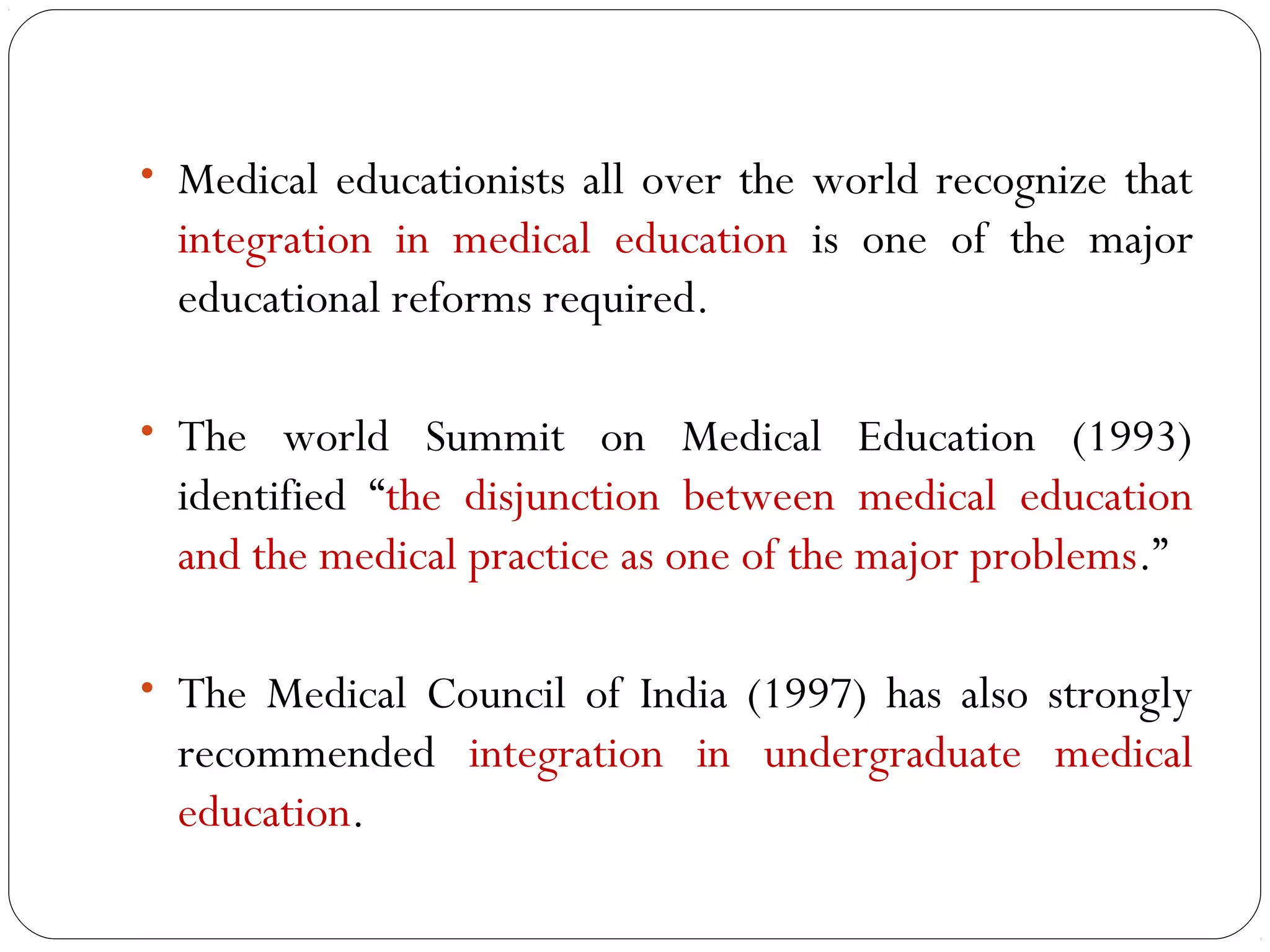
• Medical educationists all over the world recognize that
  integration in medical education is one of the major
  educational reforms required.

• The world Summit on Medical Education (1993)
  identified “the disjunction between medical education
  and the medical practice as one of the major problems.”

• The Medical Council of India (1997) has also strongly
  recommended integration in undergraduate medical
  education.
Integration of medical
          education


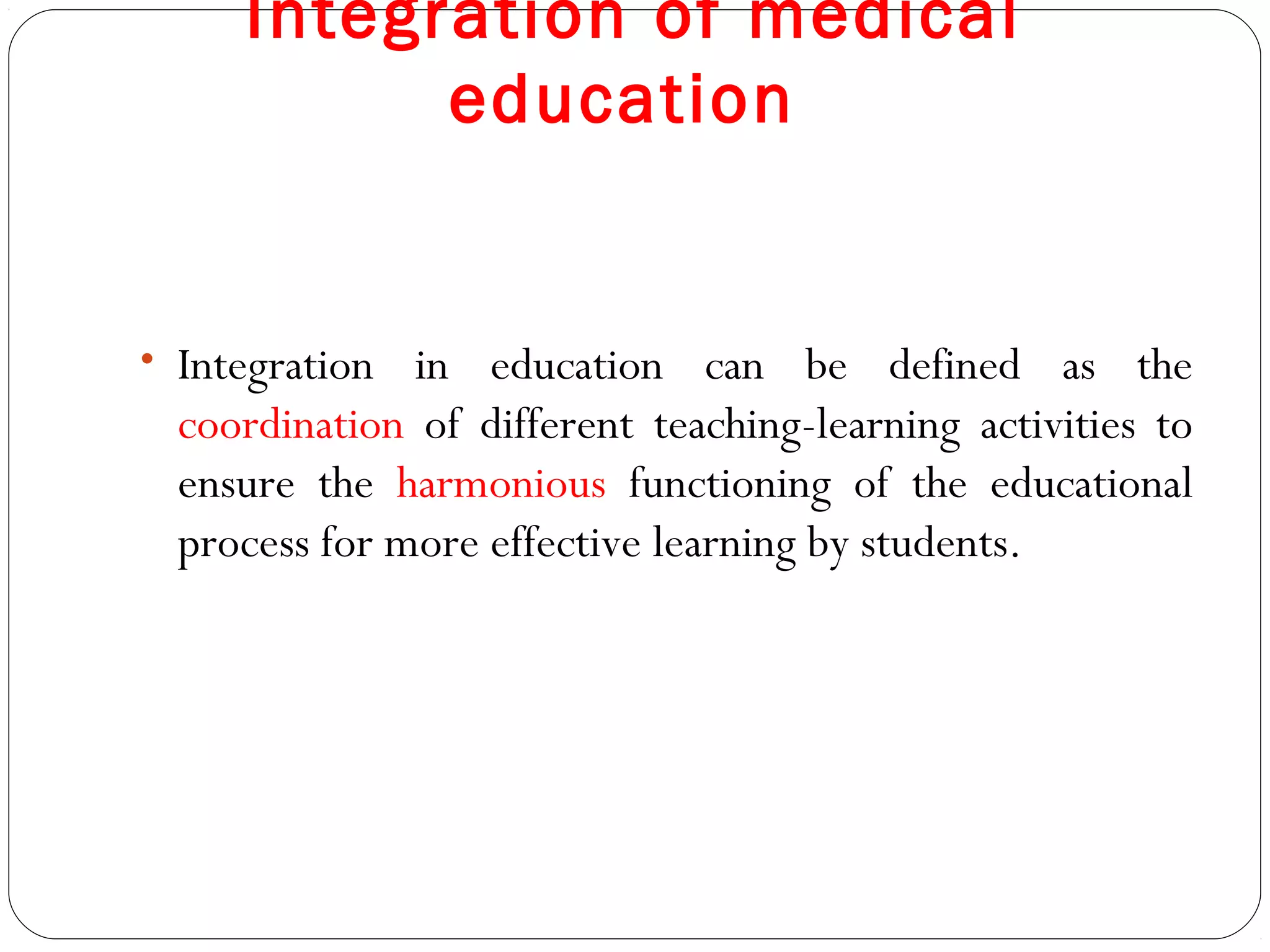
• Integration in education can be defined as the
 coordination of different teaching-learning activities to
 ensure the harmonious functioning of the educational
 process for more effective learning by students.
Purpose


• The purpose of integration is to increase the effectiveness of
  the teaching-learning process.
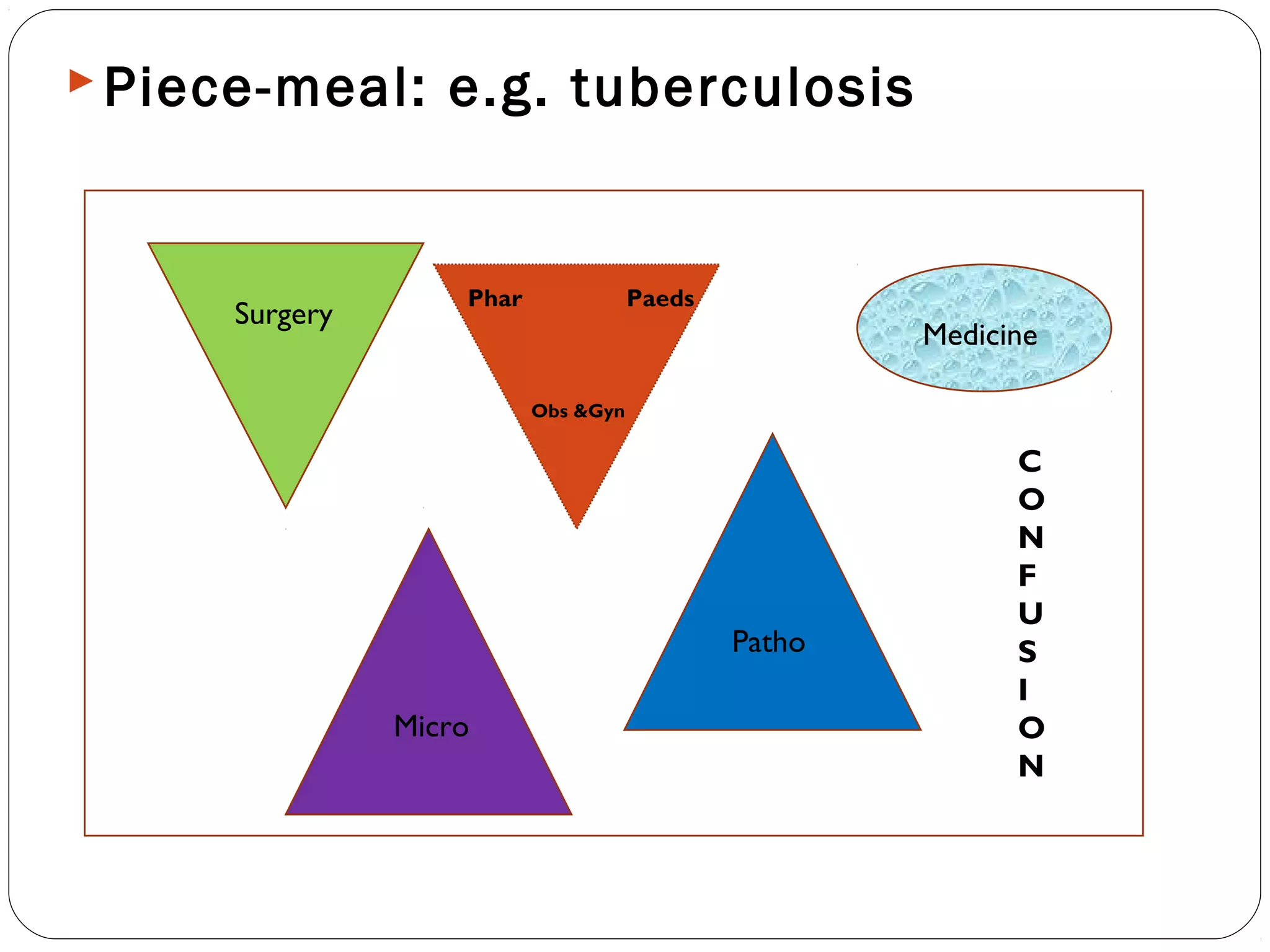
 Piece-meal: e.g. tuberculosis


                    Phar              Paeds
      Surgery
                                                      Medicine

                           Obs &Gyn

                                                            C
                                                            O
                                                            N
                                                            F
                                                            U
                                              Patho         S
                                                            I
                Micro                                       O
                                                            N
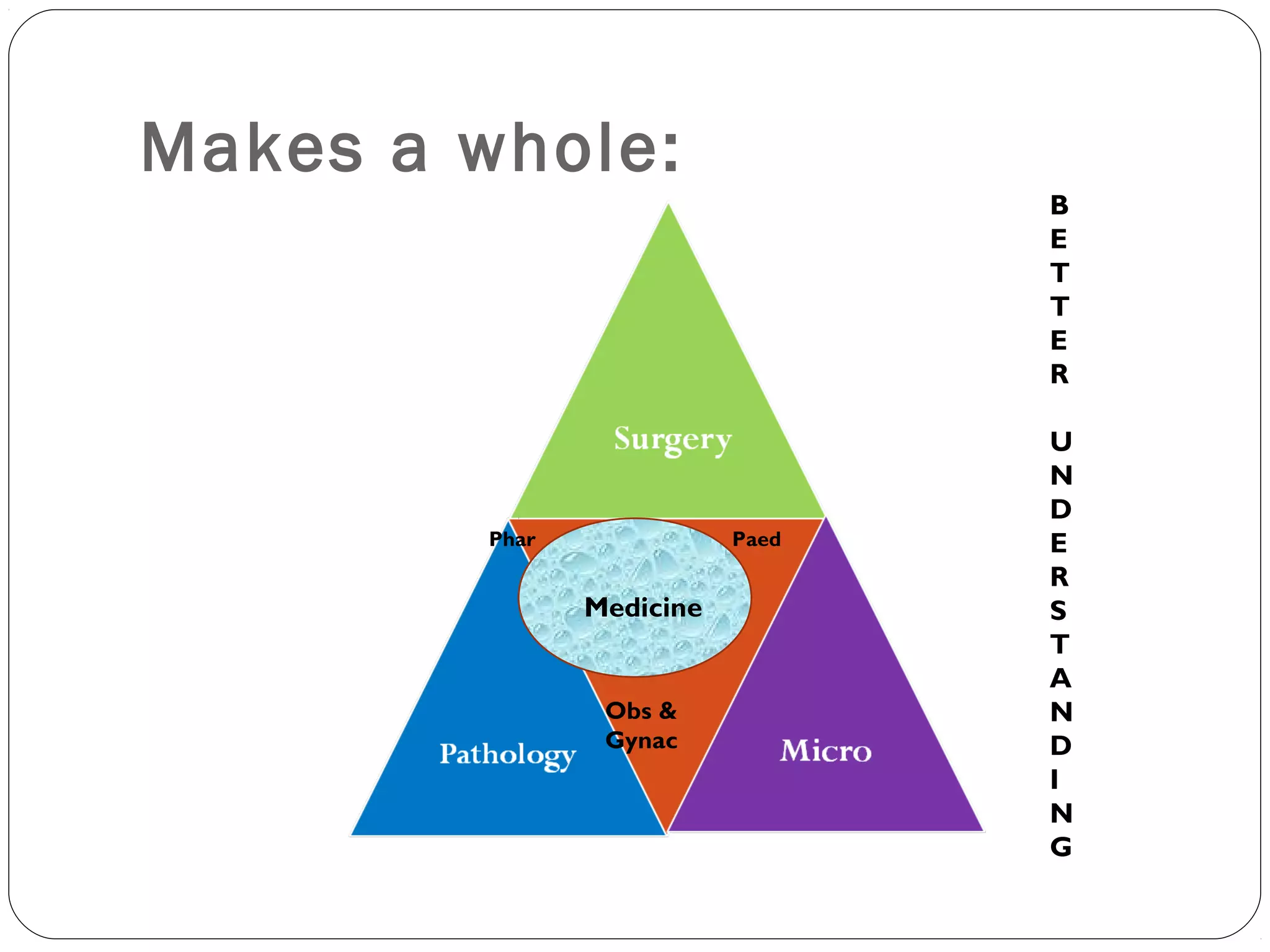
Makes a whole:
                                  B
                                  E
                                  T
                                  T
                                  E
                                  R

                                  U
                                  N
                                  D
         Phar              Paed   E
                                  R
                Medicine          S
                                  T
                                  A
                 Obs &            N
                 Gynac            D
                                  I
                                  N
                                  G
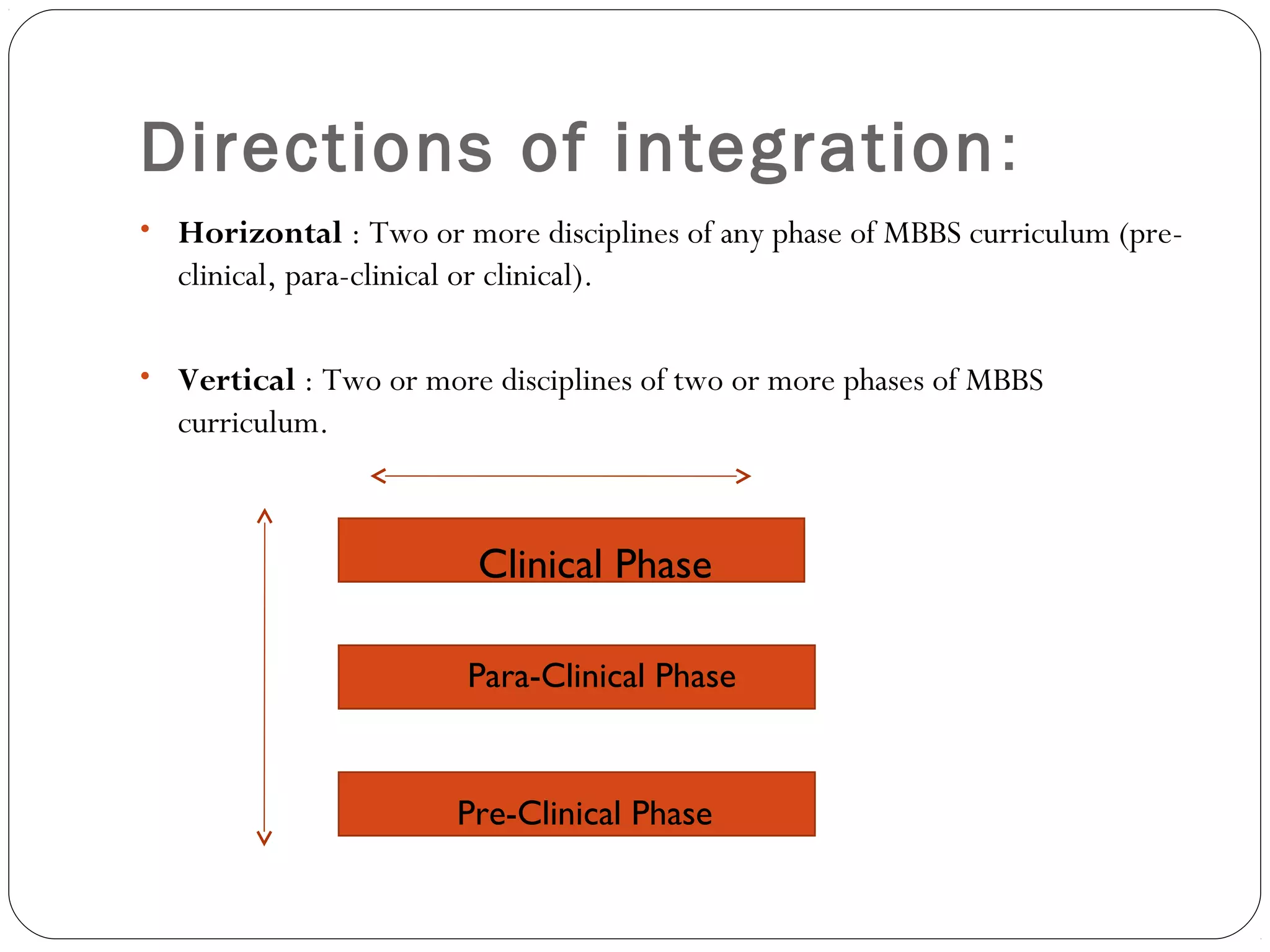
Directions of integration :
• Horizontal : Two or more disciplines of any phase of MBBS curriculum (pre-
  clinical, para-clinical or clinical).

• Vertical : Two or more disciplines of two or more phases of MBBS
  curriculum.


                            Clinical Phase

                           Para-Clinical Phase


                          Pre-Clinical Phase
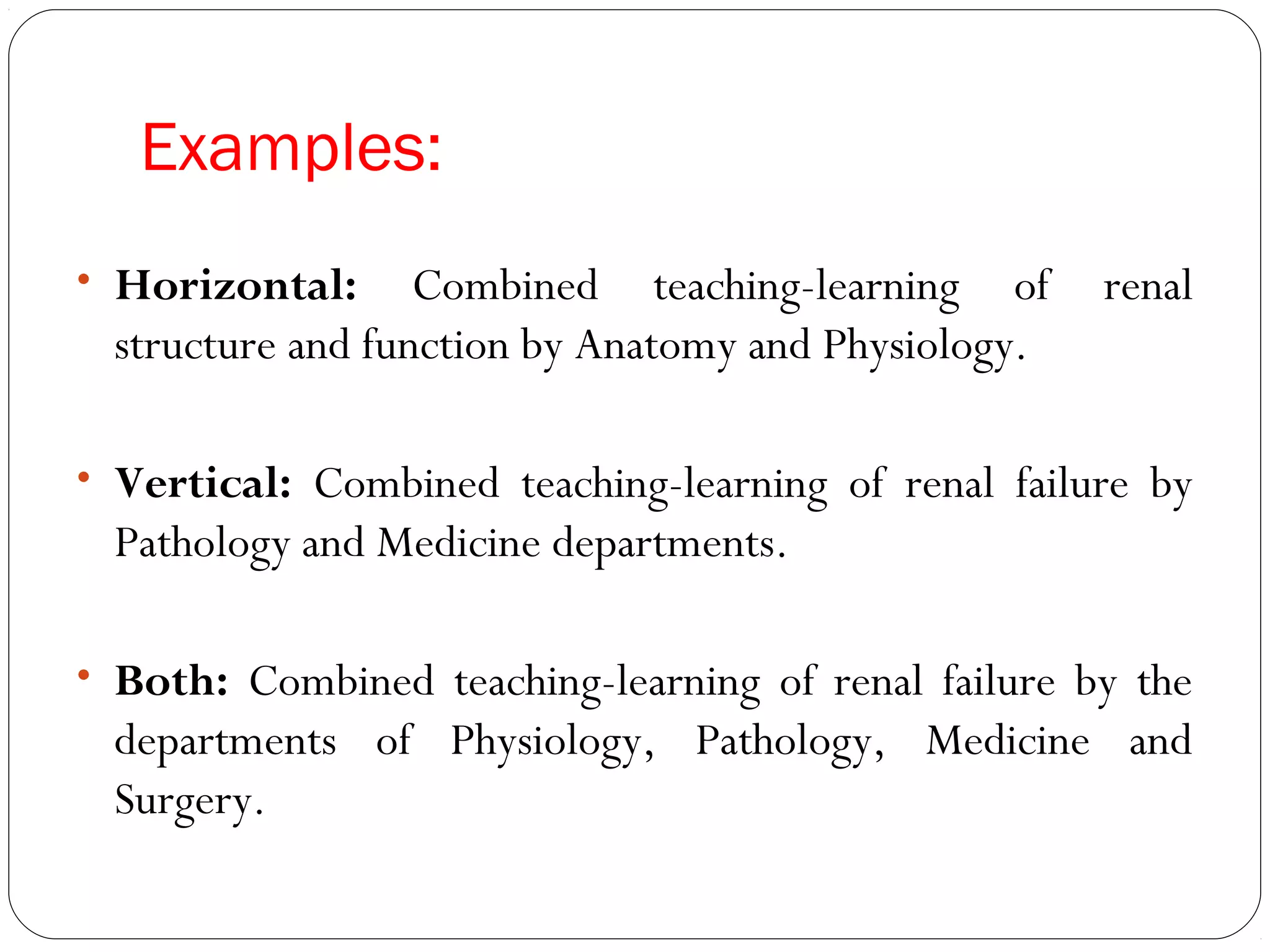
Examples:
• Horizontal:     Combined teaching-learning of      renal
 structure and function by Anatomy and Physiology.

• Vertical: Combined teaching-learning of renal failure by
 Pathology and Medicine departments.

• Both: Combined teaching-learning of renal failure by the
 departments of Physiology, Pathology, Medicine and
 Surgery.
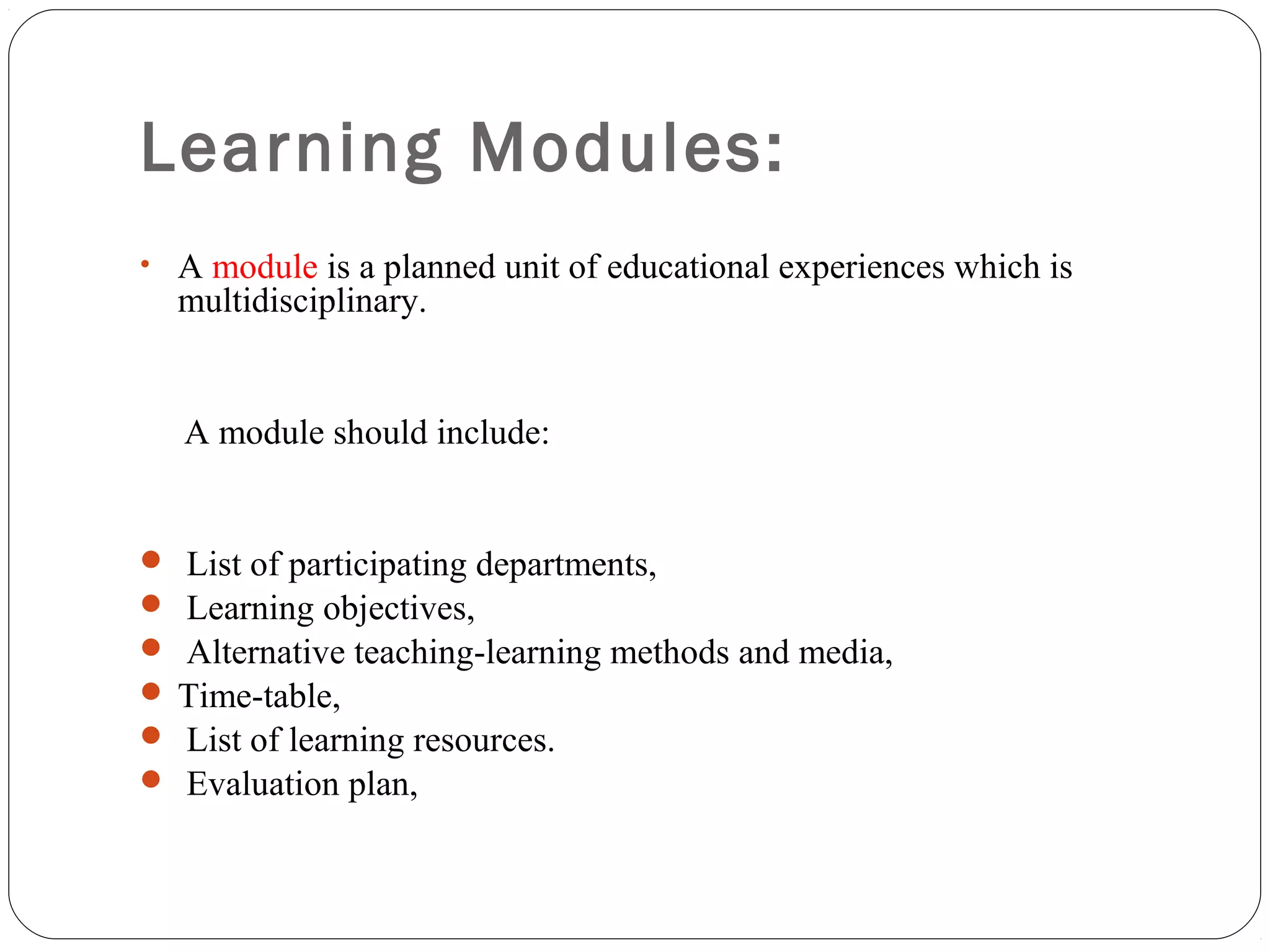
Learning Modules:
• A module is a planned unit of educational experiences which is
  multidisciplinary.


   A module should include:


 List of participating departments,
 Learning objectives,
 Alternative teaching-learning methods and media,
 Time-table,
 List of learning resources.
 Evaluation plan,
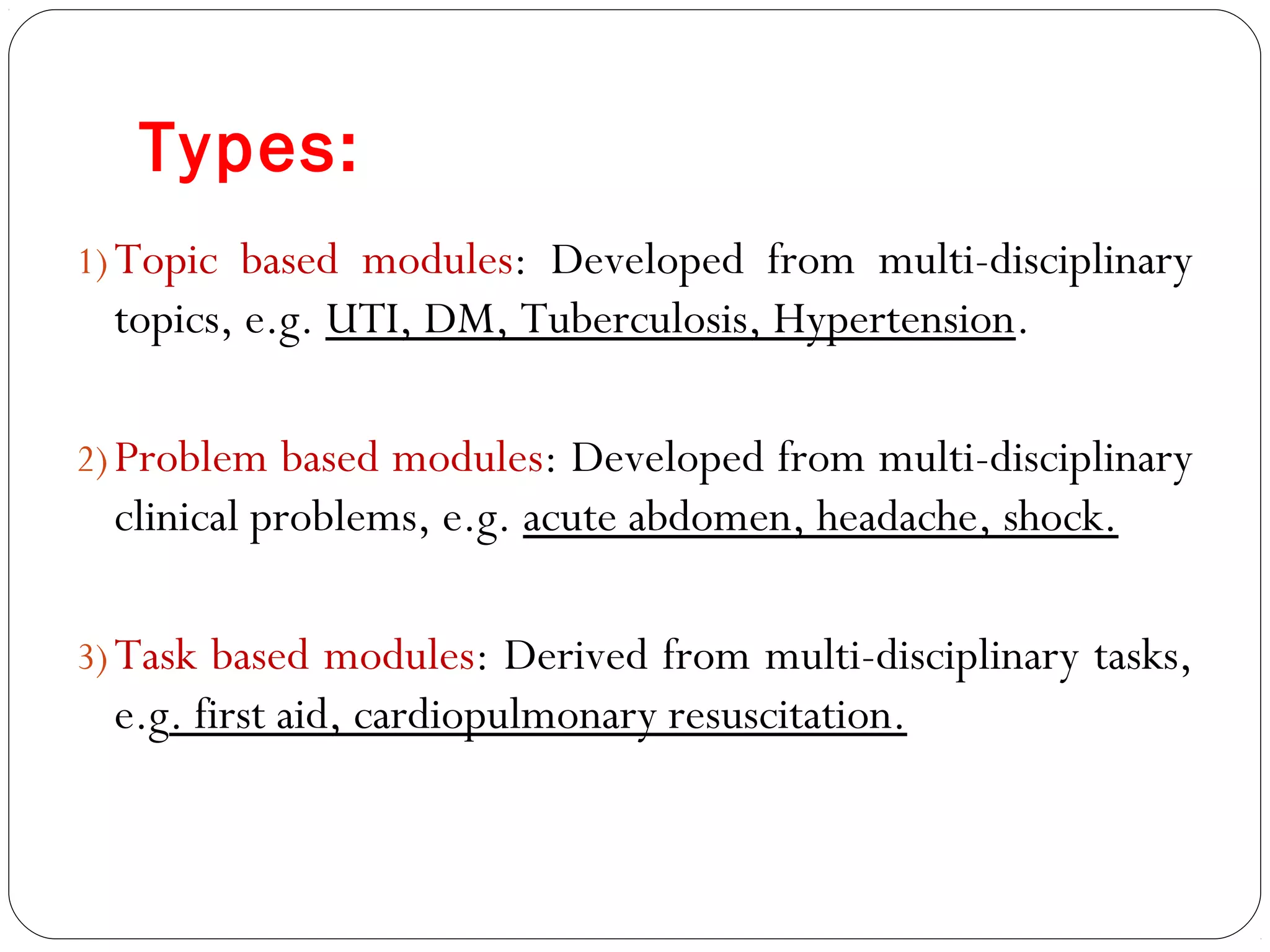
Types:
1) Topic based modules: Developed from multi-disciplinary
  topics, e.g. UTI, DM, Tuberculosis, Hypertension.

2) Problem based modules: Developed from multi-disciplinary
  clinical problems, e.g. acute abdomen, headache, shock.

3) Task based modules: Derived from multi-disciplinary tasks,
  e.g. first aid, cardiopulmonary resuscitation.
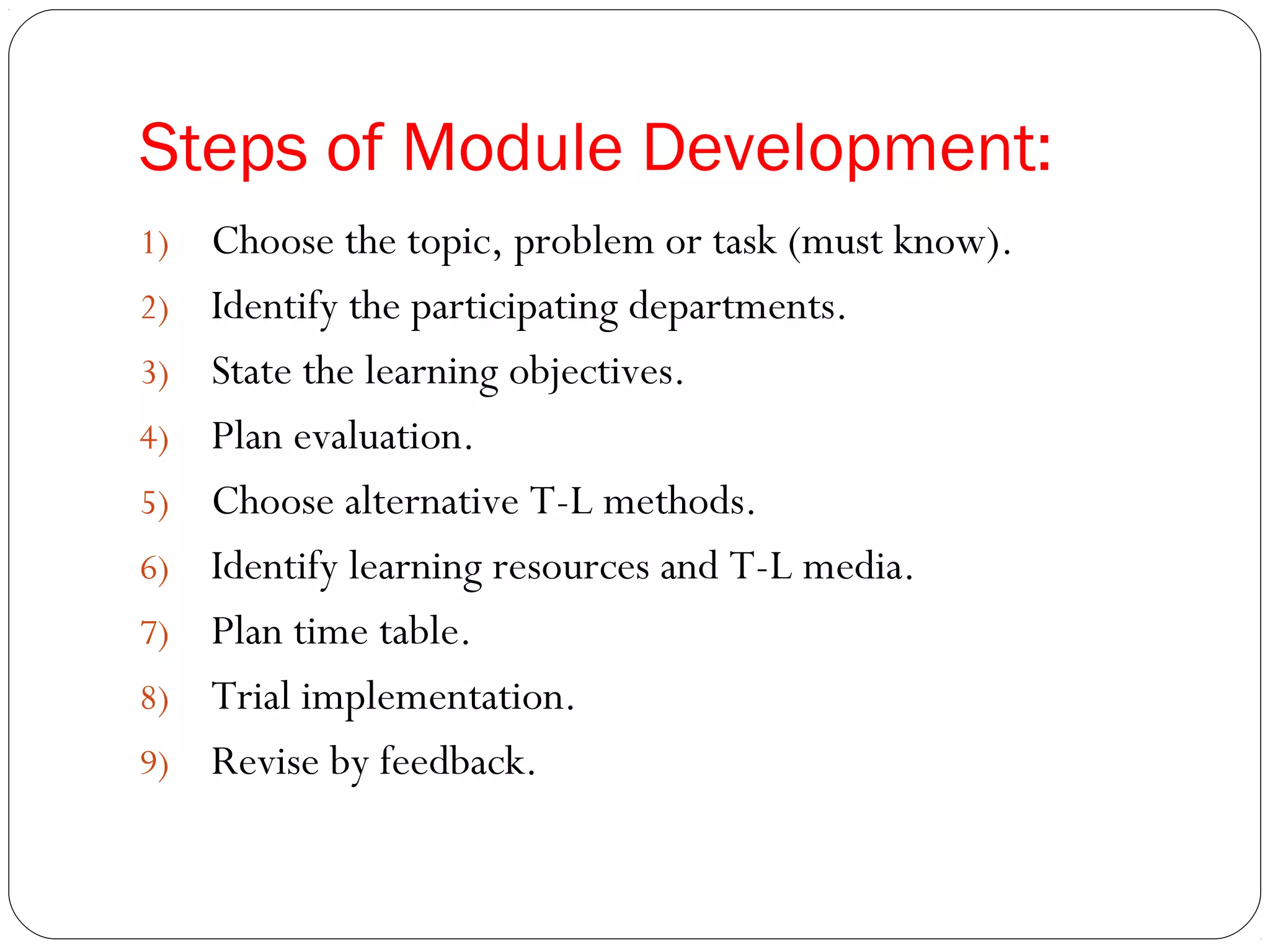
Steps of Module Development:
1)   Choose the topic, problem or task (must know).
2)   Identify the participating departments.
3)   State the learning objectives.
4)   Plan evaluation.
5)   Choose alternative T-L methods.
6)   Identify learning resources and T-L media.
7)   Plan time table.
8)   Trial implementation.
9)   Revise by feedback.
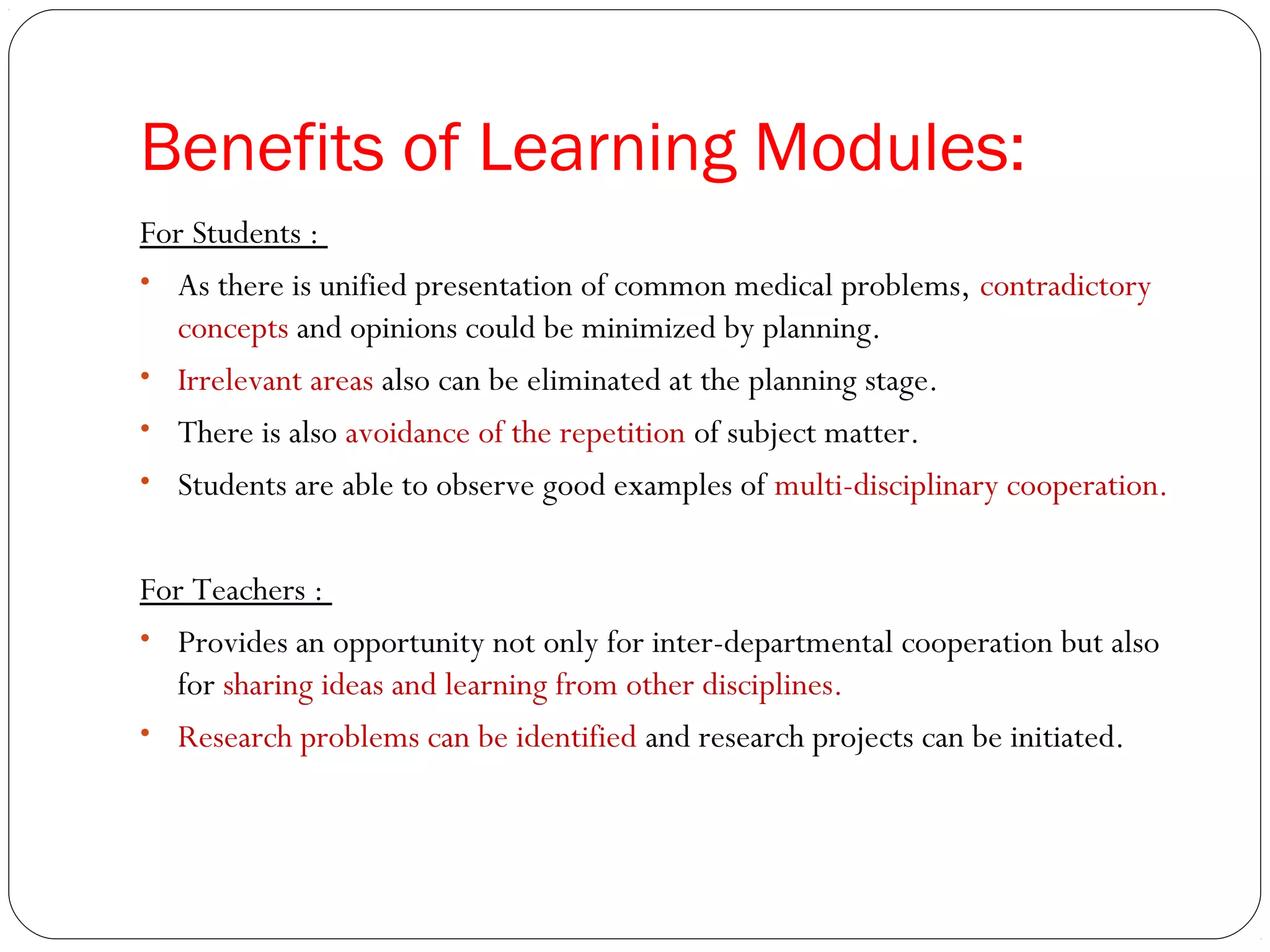
Benefits of Learning Modules:
For Students :
• As there is unified presentation of common medical problems, contradictory
  concepts and opinions could be minimized by planning.
• Irrelevant areas also can be eliminated at the planning stage.
• There is also avoidance of the repetition of subject matter.
• Students are able to observe good examples of multi-disciplinary cooperation.


For Teachers :
• Provides an opportunity not only for inter-departmental cooperation but also
  for sharing ideas and learning from other disciplines.
• Research problems can be identified and research projects can be initiated.
Problems of INTEGRATED TEACHING

1) Lack of adequate weightage in evaluation renders it irrelevant from
    achievement point of view.

2) Too many modules may result in complex schedules that few may
    able to keep up with.

3) Modular learning can also lead to fragmented learning of subjects and
    fragmentation of assessment.
Objectives
• Define integrated teaching.
• Justify the need for integrated teaching.
• Enumerate the directions of integrated teaching.
• Define learning module.
• List types of learning modules.
• List steps of module development.
• State the drawbacks of modular learning.
Any ?
thank you …

Integrated teaching

  • 1.
    CISP :Integrated Teaching Dr Swanand S Pathak drswanandp@yahoo.co.in
  • 2.
    MY STORY Anatomy physiologybiochemistry Pathology Pharmacology Microbiology Forensic medicine Medicine Medical Officer MD Pharmacology MET cell
  • 3.
  • 4.
    S – studentcentered P – problem based I - integrated C – community based E – elective S – systemic approach
  • 5.
  • 6.
    Objectives • Define integratedteaching. • Justify the need for integrated teaching. • Enumerate the directions of integrated teaching. • Define learning module. • List types of learning modules. • List steps of module development. • State the drawbacks of integrated teaching.
  • 7.
    Concept of Integration •Integrate which means “make whole” • Integration denotes “coordination of different activities to ensure harmonious functioning”
  • 8.
    Growth and Fragmentationof Medical Science: • Disciplines in earliest medical colleges and the medical student. Easy to Integrate Medicine/Surgery Pathology Anatomy
  • 9.
    Growth and Fragmentationof Medical Science: • Disciplines in current medical colleges and the medical student . Medicine/Surgery/Obst& Unable to Gyn/Paeds/Ortho/Opthal/ENT/ integrate Radio/Dermat/Psych/Others. Path/Micro/Pharmac/ PSM/ FMT Anatomy/Physiology/Biochemistry
  • 10.
    • Medical educationistsall over the world recognize that integration in medical education is one of the major educational reforms required. • The world Summit on Medical Education (1993) identified “the disjunction between medical education and the medical practice as one of the major problems.” • The Medical Council of India (1997) has also strongly recommended integration in undergraduate medical education.
  • 11.
    Integration of medical education • Integration in education can be defined as the coordination of different teaching-learning activities to ensure the harmonious functioning of the educational process for more effective learning by students.
  • 12.
    Purpose • The purposeof integration is to increase the effectiveness of the teaching-learning process.
  • 13.
     Piece-meal: e.g.tuberculosis Phar Paeds Surgery Medicine Obs &Gyn C O N F U Patho S I Micro O N
  • 14.
    Makes a whole: B E T T E R U N D Phar Paed E R Medicine S T A Obs & N Gynac D I N G
  • 15.
    Directions of integration: • Horizontal : Two or more disciplines of any phase of MBBS curriculum (pre- clinical, para-clinical or clinical). • Vertical : Two or more disciplines of two or more phases of MBBS curriculum. Clinical Phase Para-Clinical Phase Pre-Clinical Phase
  • 16.
    Examples: • Horizontal: Combined teaching-learning of renal structure and function by Anatomy and Physiology. • Vertical: Combined teaching-learning of renal failure by Pathology and Medicine departments. • Both: Combined teaching-learning of renal failure by the departments of Physiology, Pathology, Medicine and Surgery.
  • 17.
    Learning Modules: • Amodule is a planned unit of educational experiences which is multidisciplinary. A module should include:  List of participating departments,  Learning objectives,  Alternative teaching-learning methods and media,  Time-table,  List of learning resources.  Evaluation plan,
  • 18.
    Types: 1) Topic basedmodules: Developed from multi-disciplinary topics, e.g. UTI, DM, Tuberculosis, Hypertension. 2) Problem based modules: Developed from multi-disciplinary clinical problems, e.g. acute abdomen, headache, shock. 3) Task based modules: Derived from multi-disciplinary tasks, e.g. first aid, cardiopulmonary resuscitation.
  • 19.
    Steps of ModuleDevelopment: 1) Choose the topic, problem or task (must know). 2) Identify the participating departments. 3) State the learning objectives. 4) Plan evaluation. 5) Choose alternative T-L methods. 6) Identify learning resources and T-L media. 7) Plan time table. 8) Trial implementation. 9) Revise by feedback.
  • 20.
    Benefits of LearningModules: For Students : • As there is unified presentation of common medical problems, contradictory concepts and opinions could be minimized by planning. • Irrelevant areas also can be eliminated at the planning stage. • There is also avoidance of the repetition of subject matter. • Students are able to observe good examples of multi-disciplinary cooperation. For Teachers : • Provides an opportunity not only for inter-departmental cooperation but also for sharing ideas and learning from other disciplines. • Research problems can be identified and research projects can be initiated.
  • 21.
    Problems of INTEGRATEDTEACHING 1) Lack of adequate weightage in evaluation renders it irrelevant from achievement point of view. 2) Too many modules may result in complex schedules that few may able to keep up with. 3) Modular learning can also lead to fragmented learning of subjects and fragmentation of assessment.
  • 22.
    Objectives • Define integratedteaching. • Justify the need for integrated teaching. • Enumerate the directions of integrated teaching. • Define learning module. • List types of learning modules. • List steps of module development. • State the drawbacks of modular learning.
  • 23.
  • 24.