LANGUAGE
LITERACY
LEARNING
CA ELD Standards: EDMU 521
Adapted from Achieve the Core
CDE
LAUSD
Cue
Systems
for
English
Speaking
Children
BICS and CALP
California ELD Standards
CCSS for ELA
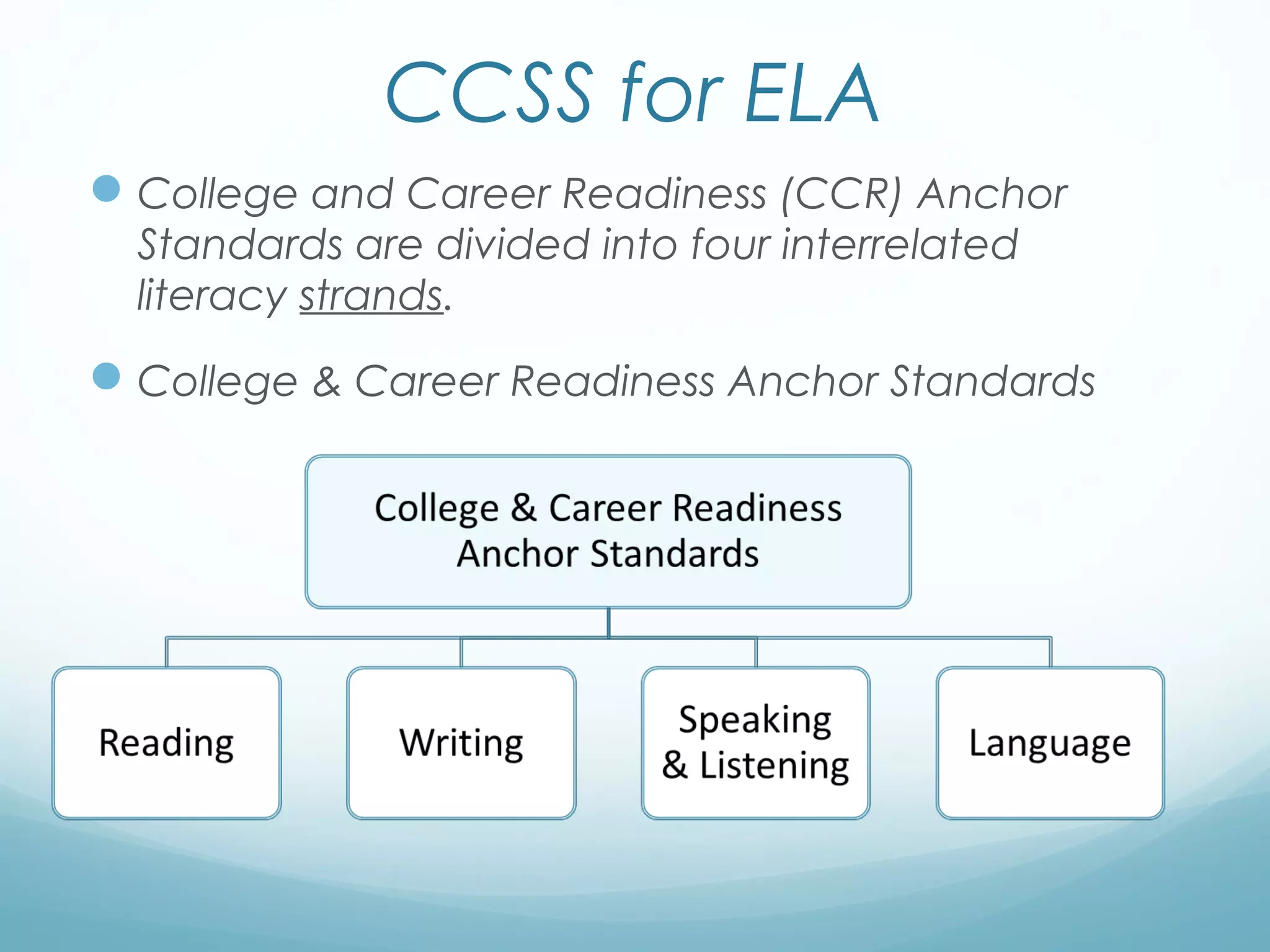
College and Career Readiness (CCR) Anchor
Standards are divided into four interrelated
literacy strands.
College & Career Readiness Anchor Standards
Students who are college and career ready…
… demonstrate independence
… build strong content knowledge
… comprehend as well as critique
… value evidence
… respond to the varying demands of audience,
task, purpose, and discipline
… use technology and media strategically and
capably
… come to understand other perspectives and
cultures
ELA / Literacy: Major Shifts
Balance of Literary and Informational Texts
Increased Complexity of Text
Writing Using Evidence
Text-based Questions and Answers
Academic Vocabulary
Literacy in the Content Areas
Balance of Writing Text Types
In grades K-5, the term opinion refers to persuasive
writing
Argumentative is a form of persuasion but brings in
evidence from both sides of the issue.
Narrative strategies are important component to
developing both argumentative and explanatory
writing
Grade
Level
To Persuade
(Argumentative)
To Explain
(Informative)
To Convey
Experience
(Narrative)
4 30% 35% 35%
8 35% 35% 30%
12 40% 40% 20%
ELA/Literacy CCSS
“Students can, without significant scaffolding:
comprehend and evaluate complex texts across a range of types
and disciplines
construct effective arguments and convey intricate or
multifaceted information
discern a speaker’s key points
request clarification and ask relevant questions
build on others’ ideas
articulate their own ideas, and confirm they have been
understood”
(CCSS for ELA Literacy in History/ Social Studies, Science and Technical Subjects, p.7)
What must students be able to do with language?
California English Learners 2013-14
CCSS for English Learners
What are the BENEFITS of CCSS
for English Learners?
What are the CHALLENGES of
CCSS for English Learners?
Purpose of The New ELD Standards
• Designed to be used in tandem with CCSS for ELA &
Literacy
• Highlight and amplify the critical knowledge about
language and skills using language in CCSS for
ELA/Literacy necessary for ELs to be successful in school
and life
• Provide fewer, clearer, higher standards so teachers can
focus on what’s most important
• Strengthen ELD opportunities in core content instruction
and in targeted ELD in light of new content standards
Goals of the CA ELD Standards
Fewer, Clearer, and Higher Standards
Promote EL abilities to interact in meaningful ways
during rich instruction so that they both develop
English and content knowledge
Develop proficiency in shifting register based on
content.
Be aware that different languages and variations
of English exist and recognize their home
languages and cultures as resources to value in
their own right and draw upon in building
proficiency in English
1. English Learners (ELs) are held to the same high expectations of
learning established for all students.
2. ELs develop full receptive and productive proficiencies in English in the
domains of listening, speaking, reading & writing.
3. ELs are taught challenging academic content that enables them to
meet performance standards in all content areas.
4. ELs receive instruction that builds on their previous education and
cognitive abilities and that reflects their language proficiency levels.
5. ELs are evaluated with appropriate and valid assessments that are
aligned to state and local standards and that take into account the
language development stages & cultural backgrounds of the students.
6. The academic success of ELs is a responsibility shared by all
educators, the family and the community.
English Learner Master Plan, 2012,
Pages 2-3
Guiding Principles
CCSS for English Learners
What are the BENEFITS of CCSS
for English Learners?
What are the CHALLENGES of
CCSS for English Learners?
Use of complex text and
text-dependent questioning which no
longer relegates English Learners to
the exclusive use of simplified text
Students make claim and use
supporting evidence to make an
argument
A focus on oral language
development for all students as
called for in EL Master Plan
Provide access to complex text to
students of varying English proficiency
levels as called for in the EL Master
Plan
Understand language and text of
argument, its structures and ways to
use supporting evidence
Students will need to discern and use
formal registers of language that are
designed for the audience, task and
purpose
Key Conceptual Shifts in
2012 CA ELD Standards
FROM A CONCEPTUALIZATION OF… TO UNDERSTANDING…
Key Conceptual Shifts in
2012 CA ELD Standards
Overview & Proficiency Level Descriptors (PLDs):
Alignment to CCSS for ELA & Literacy
CA’s EL Student
Proficiency Level Descriptors (PLDs)
Structure of the grade level standards
Grade Level Standards
Section 1: Goal, Critical Principles, At-a-glance Overview
Section 2: Elaboration on Critical Principles
• Part I: Interacting in Meaningful Ways
• Part II: Learning About How English Works
• Part III: Using Foundation Skills
Appendices:
Appendix A: Foundational Literacy Skills
Appendix B: Learning About How English Works
Appendix C: Theory and Research
Appendix D: Context, Development, Validation
Glossary of Key Terms
CA ELD Standards Overview
Layout of the CA ELD Standards
CCSS
ELD Standards Layout
Section I, Part I: Interacting in Meaningful Ways
CCSS
Proficiency levels
Emerging
Expanding
Bridging

ELD Standards and CCSS

  • 1.
    LANGUAGE LITERACY LEARNING CA ELD Standards:EDMU 521 Adapted from Achieve the Core CDE LAUSD
  • 2.
  • 3.
  • 4.
  • 5.
    CCSS for ELA Collegeand Career Readiness (CCR) Anchor Standards are divided into four interrelated literacy strands. College & Career Readiness Anchor Standards
  • 6.
    Students who arecollege and career ready… … demonstrate independence … build strong content knowledge … comprehend as well as critique … value evidence … respond to the varying demands of audience, task, purpose, and discipline … use technology and media strategically and capably … come to understand other perspectives and cultures
  • 7.
    ELA / Literacy:Major Shifts Balance of Literary and Informational Texts Increased Complexity of Text Writing Using Evidence Text-based Questions and Answers Academic Vocabulary Literacy in the Content Areas
  • 8.
    Balance of WritingText Types In grades K-5, the term opinion refers to persuasive writing Argumentative is a form of persuasion but brings in evidence from both sides of the issue. Narrative strategies are important component to developing both argumentative and explanatory writing Grade Level To Persuade (Argumentative) To Explain (Informative) To Convey Experience (Narrative) 4 30% 35% 35% 8 35% 35% 30% 12 40% 40% 20%
  • 9.
    ELA/Literacy CCSS “Students can,without significant scaffolding: comprehend and evaluate complex texts across a range of types and disciplines construct effective arguments and convey intricate or multifaceted information discern a speaker’s key points request clarification and ask relevant questions build on others’ ideas articulate their own ideas, and confirm they have been understood” (CCSS for ELA Literacy in History/ Social Studies, Science and Technical Subjects, p.7) What must students be able to do with language?
  • 10.
  • 11.
    CCSS for EnglishLearners What are the BENEFITS of CCSS for English Learners? What are the CHALLENGES of CCSS for English Learners?
  • 12.
    Purpose of TheNew ELD Standards • Designed to be used in tandem with CCSS for ELA & Literacy • Highlight and amplify the critical knowledge about language and skills using language in CCSS for ELA/Literacy necessary for ELs to be successful in school and life • Provide fewer, clearer, higher standards so teachers can focus on what’s most important • Strengthen ELD opportunities in core content instruction and in targeted ELD in light of new content standards
  • 13.
    Goals of theCA ELD Standards Fewer, Clearer, and Higher Standards Promote EL abilities to interact in meaningful ways during rich instruction so that they both develop English and content knowledge Develop proficiency in shifting register based on content. Be aware that different languages and variations of English exist and recognize their home languages and cultures as resources to value in their own right and draw upon in building proficiency in English
  • 14.
    1. English Learners(ELs) are held to the same high expectations of learning established for all students. 2. ELs develop full receptive and productive proficiencies in English in the domains of listening, speaking, reading & writing. 3. ELs are taught challenging academic content that enables them to meet performance standards in all content areas. 4. ELs receive instruction that builds on their previous education and cognitive abilities and that reflects their language proficiency levels. 5. ELs are evaluated with appropriate and valid assessments that are aligned to state and local standards and that take into account the language development stages & cultural backgrounds of the students. 6. The academic success of ELs is a responsibility shared by all educators, the family and the community. English Learner Master Plan, 2012, Pages 2-3 Guiding Principles
  • 15.
    CCSS for EnglishLearners What are the BENEFITS of CCSS for English Learners? What are the CHALLENGES of CCSS for English Learners? Use of complex text and text-dependent questioning which no longer relegates English Learners to the exclusive use of simplified text Students make claim and use supporting evidence to make an argument A focus on oral language development for all students as called for in EL Master Plan Provide access to complex text to students of varying English proficiency levels as called for in the EL Master Plan Understand language and text of argument, its structures and ways to use supporting evidence Students will need to discern and use formal registers of language that are designed for the audience, task and purpose
  • 17.
    Key Conceptual Shiftsin 2012 CA ELD Standards FROM A CONCEPTUALIZATION OF… TO UNDERSTANDING…
  • 18.
    FROM A CONCEPTUALIZATIONOF… TO UNDERSTANDING… Key Conceptual Shifts in 2012 CA ELD Standards
  • 19.
    Overview & ProficiencyLevel Descriptors (PLDs): Alignment to CCSS for ELA & Literacy CA’s EL Student Proficiency Level Descriptors (PLDs) Structure of the grade level standards Grade Level Standards Section 1: Goal, Critical Principles, At-a-glance Overview Section 2: Elaboration on Critical Principles • Part I: Interacting in Meaningful Ways • Part II: Learning About How English Works • Part III: Using Foundation Skills Appendices: Appendix A: Foundational Literacy Skills Appendix B: Learning About How English Works Appendix C: Theory and Research Appendix D: Context, Development, Validation Glossary of Key Terms CA ELD Standards Overview
  • 20.
    Layout of theCA ELD Standards CCSS
  • 21.
    ELD Standards Layout SectionI, Part I: Interacting in Meaningful Ways CCSS
  • 22.

Editor's Notes

  • #2 Slide 1: Session 1 was created for a minimum of 55 minutes. You can ask participants to read Appendix D before coming to the session Add your name to the presentation Why/Purpose: As a state and the district are transitioning into the 2012 New CA ELD standards, this is the first of 4 sessions that will assist us in this process. How: Say: We are going to be presenting 4 session that will deepen your understanding of the new ELD standards while also providing you with strategies that can be transferred into classroom practice.
  • #10 Slide 13: (2 minutes) Why: Highlight how language is embedded in CCSS Literacy without scaffolding. One of the benefits of the CCSS is that it brings language to the forefront. At the same time the language demands of the CCSS are complex and require language production from students. For example in ELA/ literacy all students including English Learners are expected to use academic language to construct effective arguments, request clarification, articulate their own ideas. The Standards insist that instruction in reading, writing, speaking, listening, and language be a shared responsibility within the school. How: Bring attention to Master plan Guiding principle #1: All students are held to the same high expectation for learning.
  • #11 Slide 5: ( 2 minutes) LAUSD classrooms are composed of diverse learners who require rigourous instruction that is designed to meet their linguistic and academic needs. When done successfully all youth achieve.
  • #12 Slides 11 –:15 (9 minutes)These slides are all connected, but should be chunked into slides 11-12 (5 minutes) and 13-15 (4 minutes). (After posing questions, allow 4 minutes for participants to turn and talk) Why/Purpose: Allowing participants to speak to their experiences in teaching the CCSS is beneficial and validating of their knowledge. The graphic organizer supports the organization of their thinking and talking to their partner supports their understanding. Calling out the instructional move will support their implementation of this strategy in their classroom. How: Ask participants what the benefits and challenges in teaching CCSS are for ELs. Use the T-chart to support participants in thinking about the BENEFITS and CHALLENGES of the CCSS. Give participants 30 seconds of think time and then ask them to turn and talk with a partner. After 4 minutes, have them share out to the whole group. Proceed to slide 11 after the whole group share out.
  • #13 Slide 17: (2 minutes) Why/Purpose: To ensure that participants understand the purpose of the new ELD Standards. How: Paraphrase the purpose of the new ELD CA standards: To be used in tandem with CCSS ELA Highlight and amplify critical knowledge about language and skills using CCSS ELA Provide fewer, clearer and higher standards Strengthen ELD opportunities in content instruction and in targeted ELD
  • #14 Slide 18: (2 minutes) Why/Purpose: To call attention to the Goals of the CA ELD Standards, as well as, misconceptions or “ What the CA ELD Standards Are Not.” Highlight the opportunities for students to interact to make CA ELD standards more interactive How: The facilitator will first explain the goals by saying: “English learners must simultaneously successfully engage in challenging academic activities, as set by the CCSS, while developing proficiency in advanced English. The CA ELD Standards are intended to support this dual endeavor by providing fewer, clearer, and higher standards: Fewer: Those standards that are necessary and essential for development and success; Clearer: A coherent body of standards that have clear links to curriculum and assessments; Higher: Alignment with the elevated standards of the Common Core State Standards for ELA.” The facilitator will continue reading the remainder of the goals, then continue with “What CA ELD Standards Are Not.” Additional Notes: This could be made into an activity where you cut the goals and ‘what the CA ELD are not’ into strips and then have participants sort them in to the two columns.
  • #15 Slide 6: (1 minute) Why/Purpose: The six guiding principles of the EL Master Plan are presented here to remind participants that they serve as a strong statement of values that guide all of our work in serving English Learners (ELs). How: The facilitator will remind participants of the Six Guiding Principles from the EL Master Plan (pages 2-3) Review guiding principles. Highlight number 1 and 6 as a focus for this session. Additional Notes: The guiding principles slide must be in every presentation.
  • #16 Slide 12 - This the share out slide for slide 10 (2 minutes) Why/Purpose: Specifically call out the 3 main benefits and challenges with the CCSS. This will ensure that the 3 main ideas are brought out to the group. How: Review the benefits and challenges. If people called out some of the items on the slides, you may want to begin with those. Ensure to speak to the fact that the benefits are also the challenges and vice versa.
  • #18 Slide 28: (1 minute) Purpose: To ensure that participants understand the purpose of the new ELD Standards. It addresses how instruction might need to change as we move forward. This is a review of some of the shift that we covered through this session How: Paraphrase and emphasize these shifts: English is a meaning making resource that students use based on audience, task and purpose We have moved from 5 proficiency level to 3. Each proficiency level has an early stage and an exit level. The grade levels/spans parallel CCSS The focus is on language development (modes of communication: collaborative, interpretive, productive) and having an understanding of how English works
  • #19 Slide 29: (2 minutes) Purpose: To ensure that participant How Say: The First Shift addresses how our concepts of language acquisition have evolved. It also addresses the spiraling nature of the ELD standards. For example, students don’t learn the present tense, then the past tense, then the future tense. Rather, we learn language based on the context in which it is used and the related skills. As a traveler, we learn basic communication phrases. In contrast, in K-12 settings, we learn language via the types of conversations and texts we use to learn (e.g., text book, magazines, videos on the plant cycle). In each of these cases the tense and grammar may vary, and ELs cannot be expected to “wait to learn that tense” or “form” prior to being exposed to it. The 2nd shift addresses how we have moved from focusing primarily on accuracy to a focus on how language is used. In the example above, a beginning EL who watched a video on the plant cycle may now need to work with another student to outline or draw the key concepts derived from this video, a teacher may provide a graphic organizer for the student to demonstrate the “steps”. While this is Science, it is also Language Arts in that the student must use this information to write a short description. EL teachers may draw from what the Science lesson is and how the science lesson uses language. In one setting, we are demonstrating an “understanding of content” and the other we provide “direction on writing a summary”. Students learn language by interacting in meaningful ways around intellectually challenging content (having collaborative discussions, interpreting texts, arguing for a position, etc.). In addition, teachers can make strategic choices about teaching their students how the language in these situations (e.g., an argument) is structured. This is how the ELD standards focus on both meaning and form. The 3rd shift addresses how cognitive challenge and content are conceptualized in the 2012 ELD Standards. For example, students at all levels of proficiency can participate in a collaborative discussion around the plant cycle. However, students at emerging levels will likely need more support, such as the graphic organizer mentioned or sentence frames, than bridging students in order to fully participate and demonstrate understanding along with use of language in context. This shift reflects the movement from ELD to teach “grammar ” in isolation from content and for the content teacher to teach content in isolation of language. Both teachers work from the “content” (e.g., Science/ EL) to meaning making.
  • #20 Slide 20: (2 Minutes) Why/Purpose: To allow time for participants to become familiar with the various sections for the CA ELD Standards Book. Materials needed: ELD Standards Book. How: Presenter takes time to help familiarize participants with the lay out of the CELDs book by having them tab the four sections above: Overview, Grade level standards, Appendices, Glossary. The facilitator will say, Here is the overview section (show the section and then explain the components briefly) Here is the grade level section (show the section and then explain the components briefly) Facilitator should point out that section 1 contains the goal, critical principle and At a Glance Overview of Section 2. The language of the standards is found on Section 2 Here are the appendices (show the section and then explain the components briefly). During this session, we will focus on the layout and structure of the Grade level Standards.
  • #21 Slide 21: (8 minutes) Purpose: To understand the various components of the CA ELD Standards Books (grade level standards) How: Say: “In this section you will have a chance to look at the first 3 pages of your grade level standards to familiarize yourself with the layout and various components” Let participants share out what they notice and what are some new findings. Let them do this using the Turn and Talk strategy
  • #22 Slides 22– 24: (11 minutes )These slides are all connected, but should be chunked into slides 22-23 (3 minutes) and 24-25 (8 minutes). Why/Purpose: to understand the layout of the new ELD Standards How: We’ve had an opportunity to look at our grade level standards. Now we are going to look at the structure, layout and the various components within each grade level. The grade-specific standards are divided into two sections. Section 1 has 3 parts: Part I: Interacting in meaningful ways, Part II How English works and Part III Foundational Skills This section highlights: Part 1 of the CA ELD Standards Interacting in Meaningful Ways. I
  • #23 Slide 25: (3 minutes) Purpose: Participants will understand that Section 2 is the actual grade level standards per each strands listed in section 1. It also has standards listed by the 3 levels of proficiency – Emerging, expanding, and bridging. How: The grade specific standards are divided into two sections. Section 2 has the same components and the language of the standards. This is where you will find what guides your instruction. There are 3 proficiency levels in the new CA ELD Standards. The proficiency levels are: Emerging, Expanding, and Bridging (Have participants label or highlight the document as you speak to each section) Say – The mode is listed here again. The first mode, collaborative and the strands are listed in Section 2. Under each strand are the actual standards for the corresponding grade level. (Have participants label or highlight the document as you speak to each section) Say – Section 2 also lists the teacher resources and CCSS aligned with the ELD Standards. (Have participants label or highlight the document as you speak to each section)