ESSENTIAL QUESTIONS:
THE BIG IDEAS
EDSU 533
ESSENTIAL QUESTIONS
BLOOM'S TAXONOMY
UNDERSTANDING BY DESIGN
BACKWARDS DESIGN
DEPTH OF KNOWLEDGE (DOK)
Thinking Levels
Ask students to demonstrate:
 Knowledge - recall information in original form
 Comprehension - show understanding
 Application - use learning in a new situation
 Analysis - show s/he can see relationships
 Synthesis - combine and integrate parts of prior
knowledge into a product, plan, or proposal that
is new
 Evaluation - assess and criticize on basis of
standards and criteria
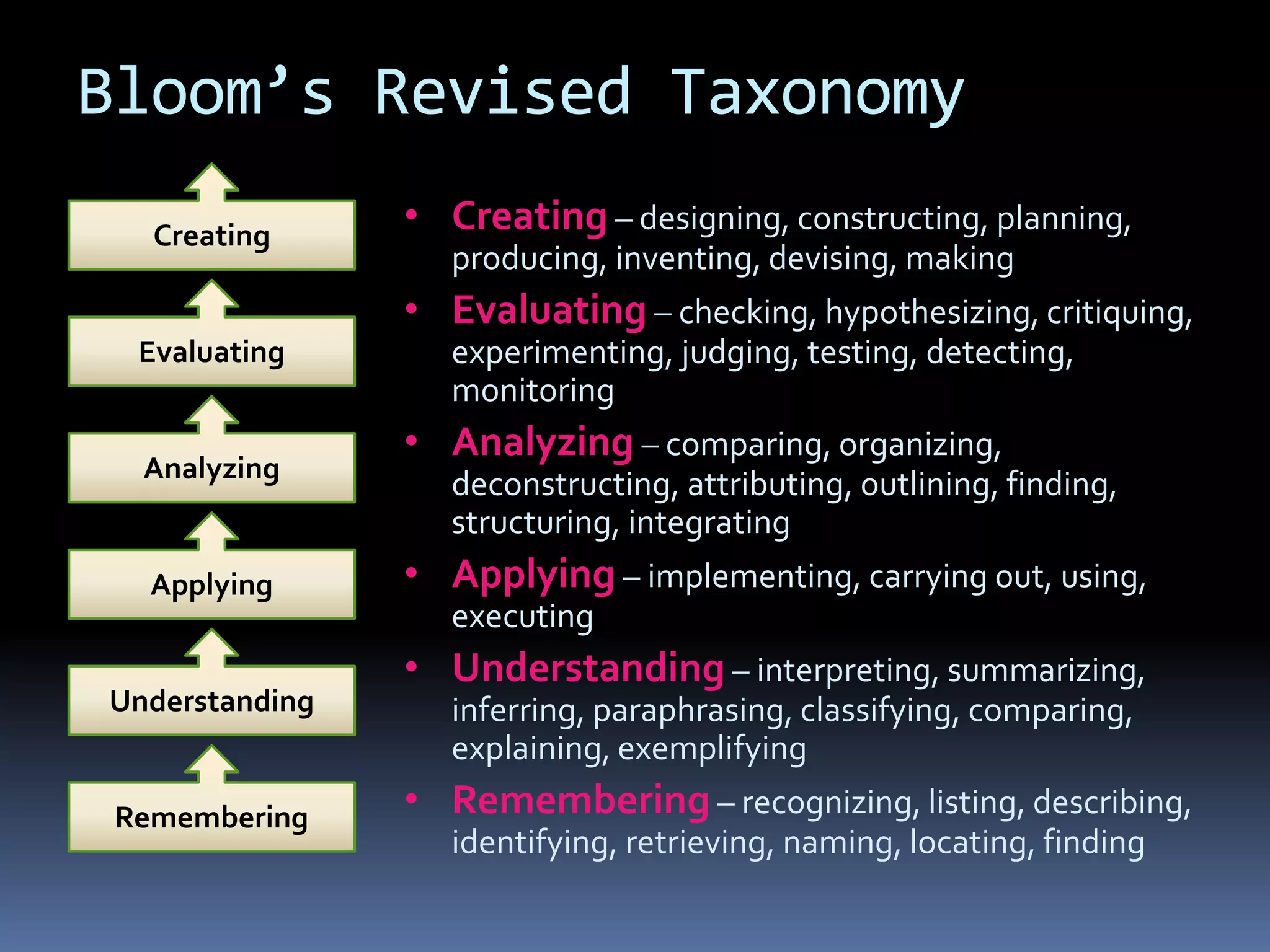
Remembering
Understanding
Applying
Analyzing
Evaluating
Creating
• Creating – designing, constructing, planning,
producing, inventing, devising, making
• Evaluating – checking, hypothesizing, critiquing,
experimenting, judging, testing, detecting,
monitoring
• Analyzing – comparing, organizing,
deconstructing, attributing, outlining, finding,
structuring, integrating
• Applying – implementing, carrying out, using,
executing
• Understanding – interpreting, summarizing,
inferring, paraphrasing, classifying, comparing,
explaining, exemplifying
• Remembering – recognizing, listing, describing,
identifying, retrieving, naming, locating, finding
Bloom’s Revised Taxonomy
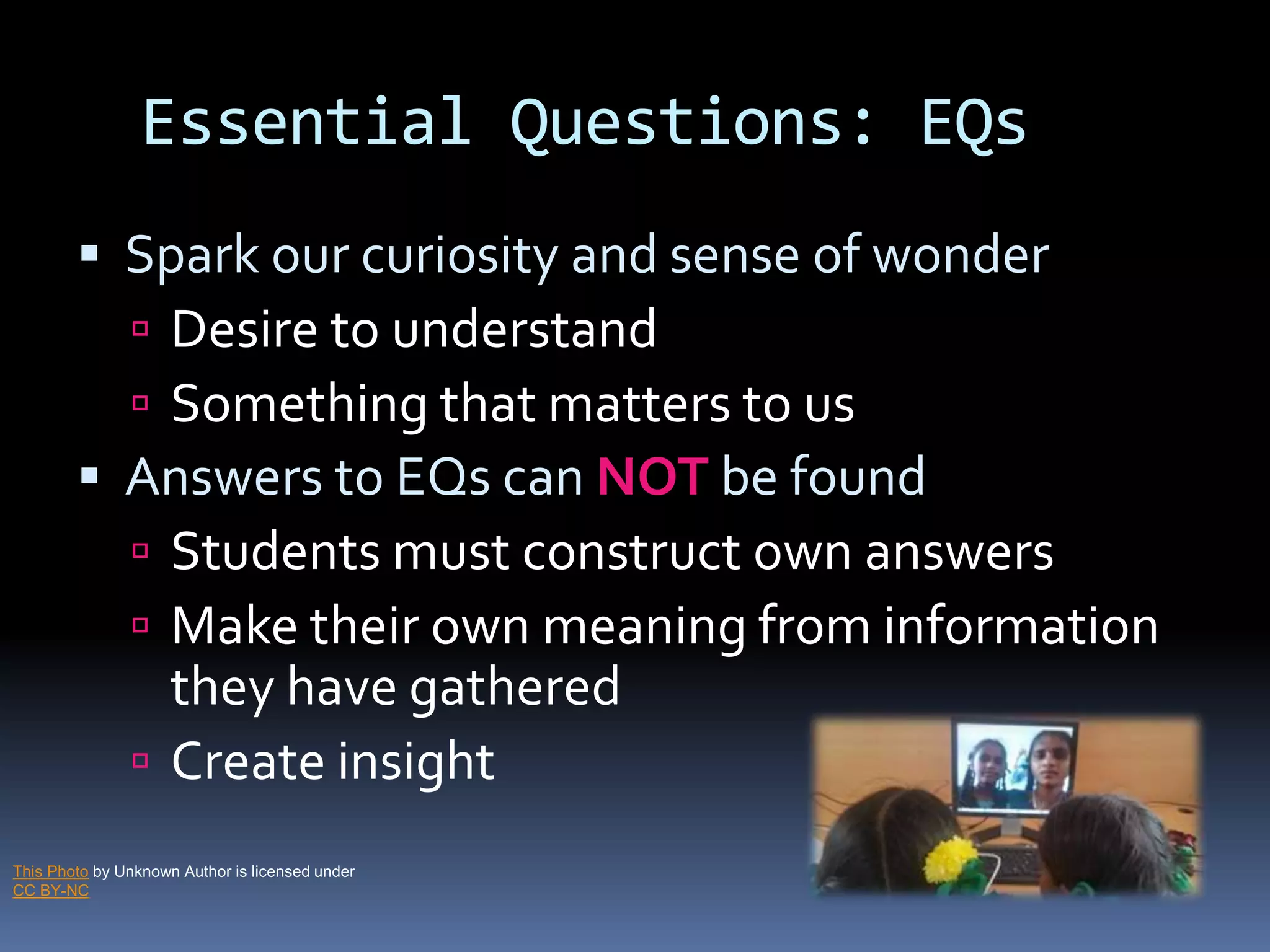
Essential Questions: EQs
 Spark our curiosity and sense of wonder
 Desire to understand
 Something that matters to us
 Answers to EQs can NOT be found
 Students must construct own answers
 Make their own meaning from information
they have gathered
 Create insight
This Photo by Unknown Author is licensed under
CC BY-NC
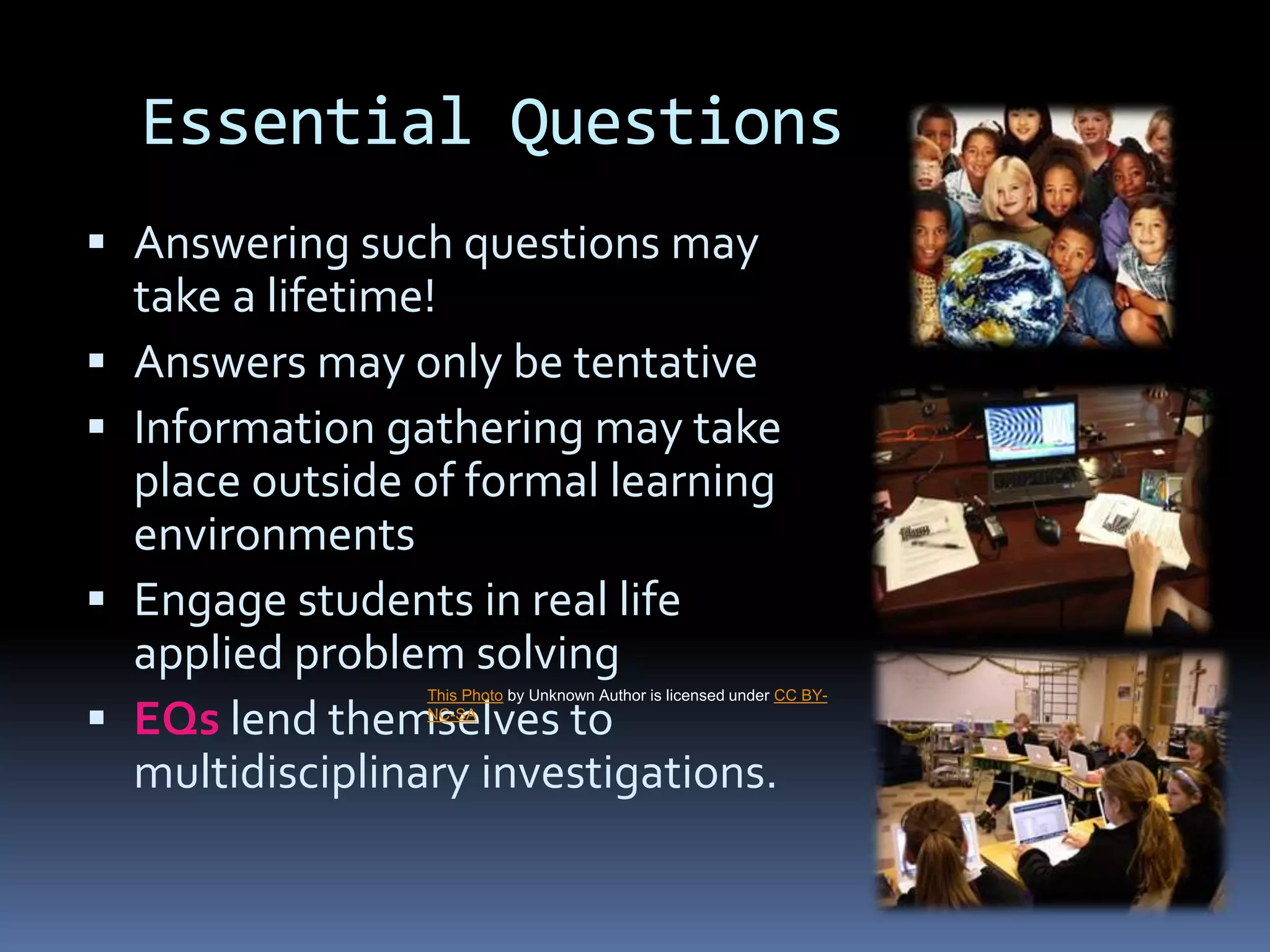
Essential Questions
 Answering such questions may
take a lifetime!
 Answers may only be tentative
 Information gathering may take
place outside of formal learning
environments
 Engage students in real life
applied problem solving
 EQs lend themselves to
multidisciplinary investigations.
This Photo by Unknown Author is licensed under CC BY-
NC-SA
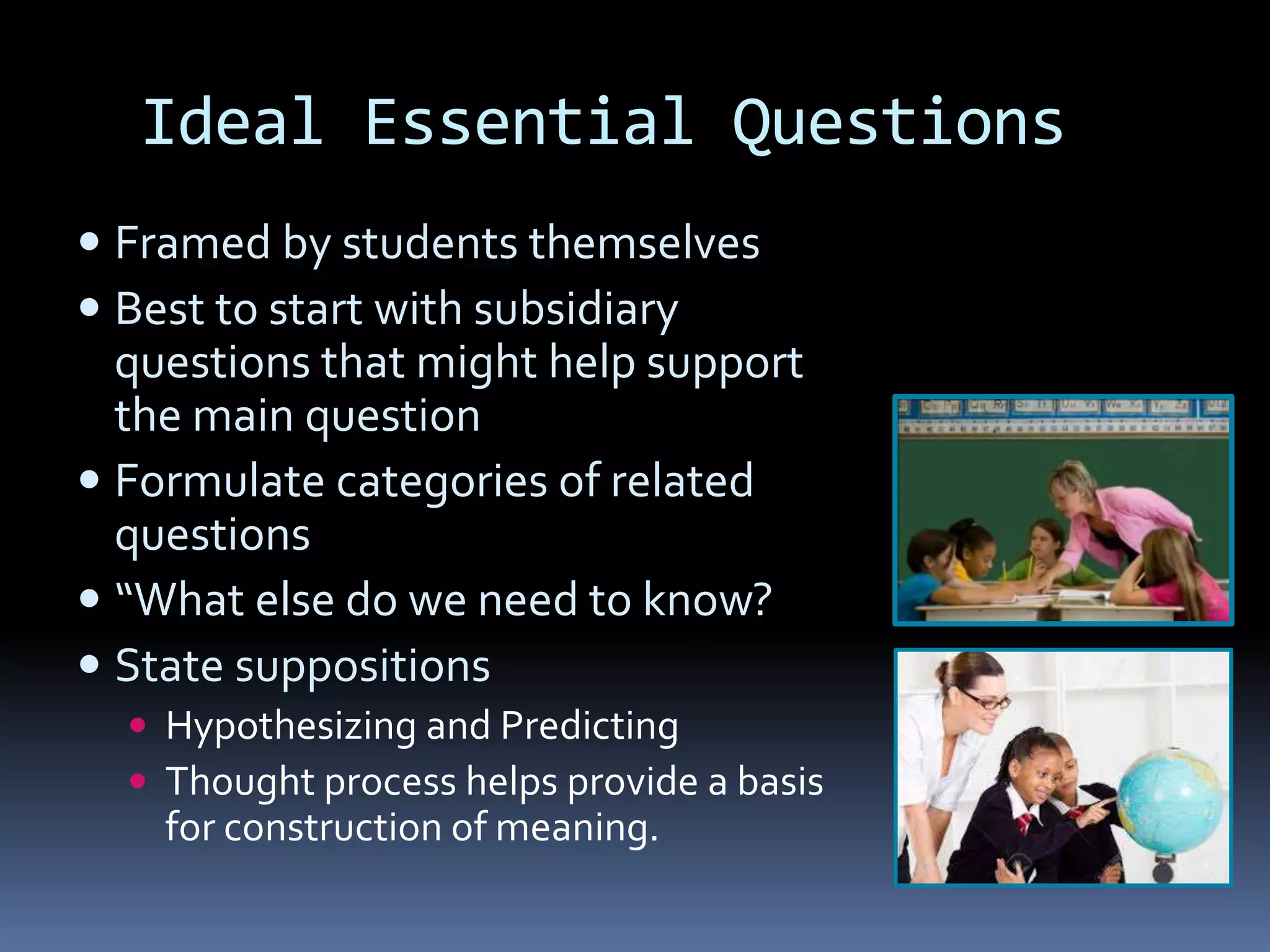
Ideal Essential Questions
 Framed by students themselves
 Best to start with subsidiary
questions that might help support
the main question
 Formulate categories of related
questions
 “What else do we need to know?
 State suppositions
 Hypothesizing and Predicting
 Thought process helps provide a basis
for construction of meaning.
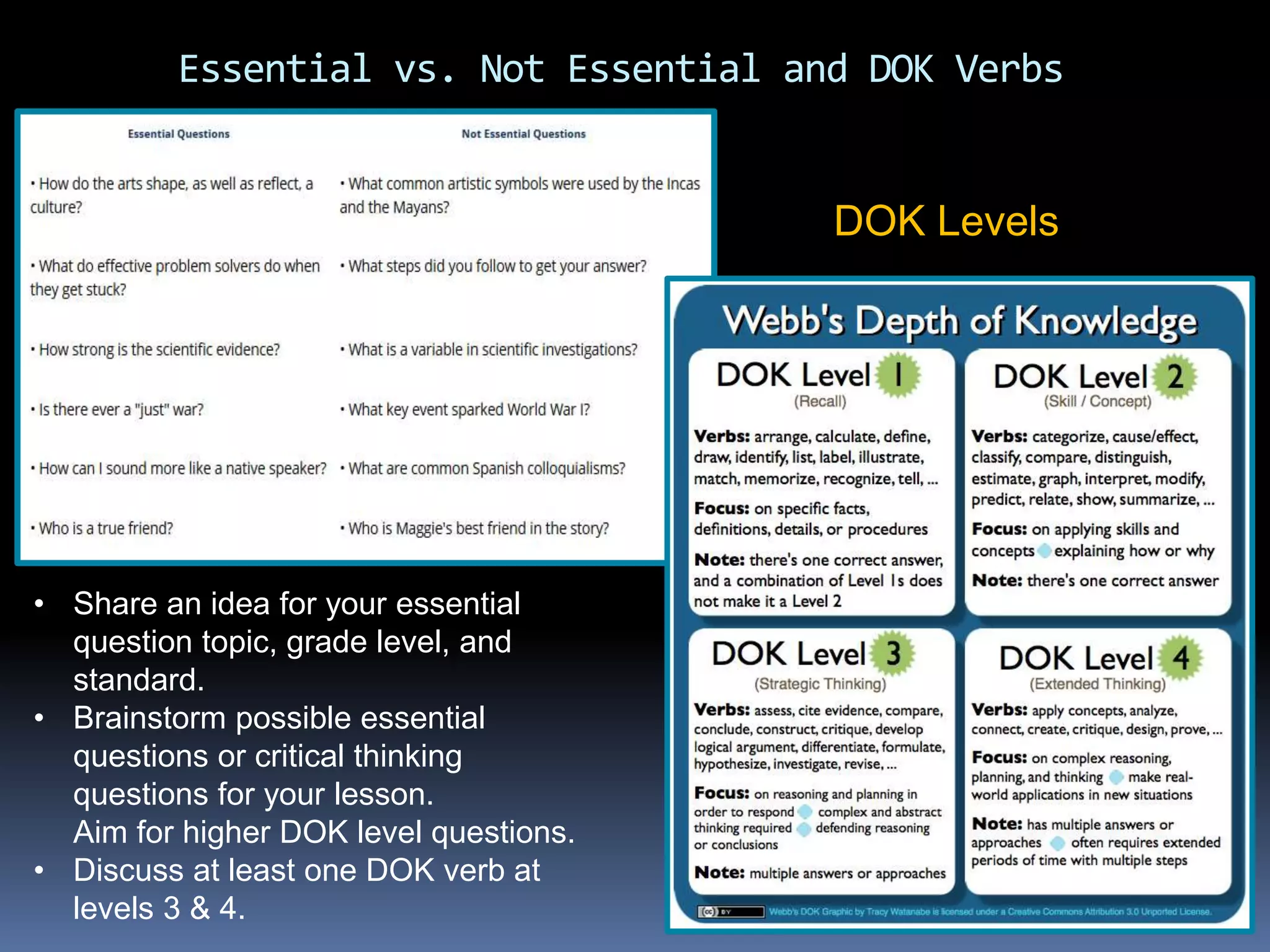
Essential vs. Not Essential and DOK Verbs
• Share an idea for your essential
question topic, grade level, and
standard.
• Brainstorm possible essential
questions or critical thinking
questions for your lesson.
Aim for higher DOK level questions.
• Discuss at least one DOK verb at
levels 3 & 4.
DOK Levels
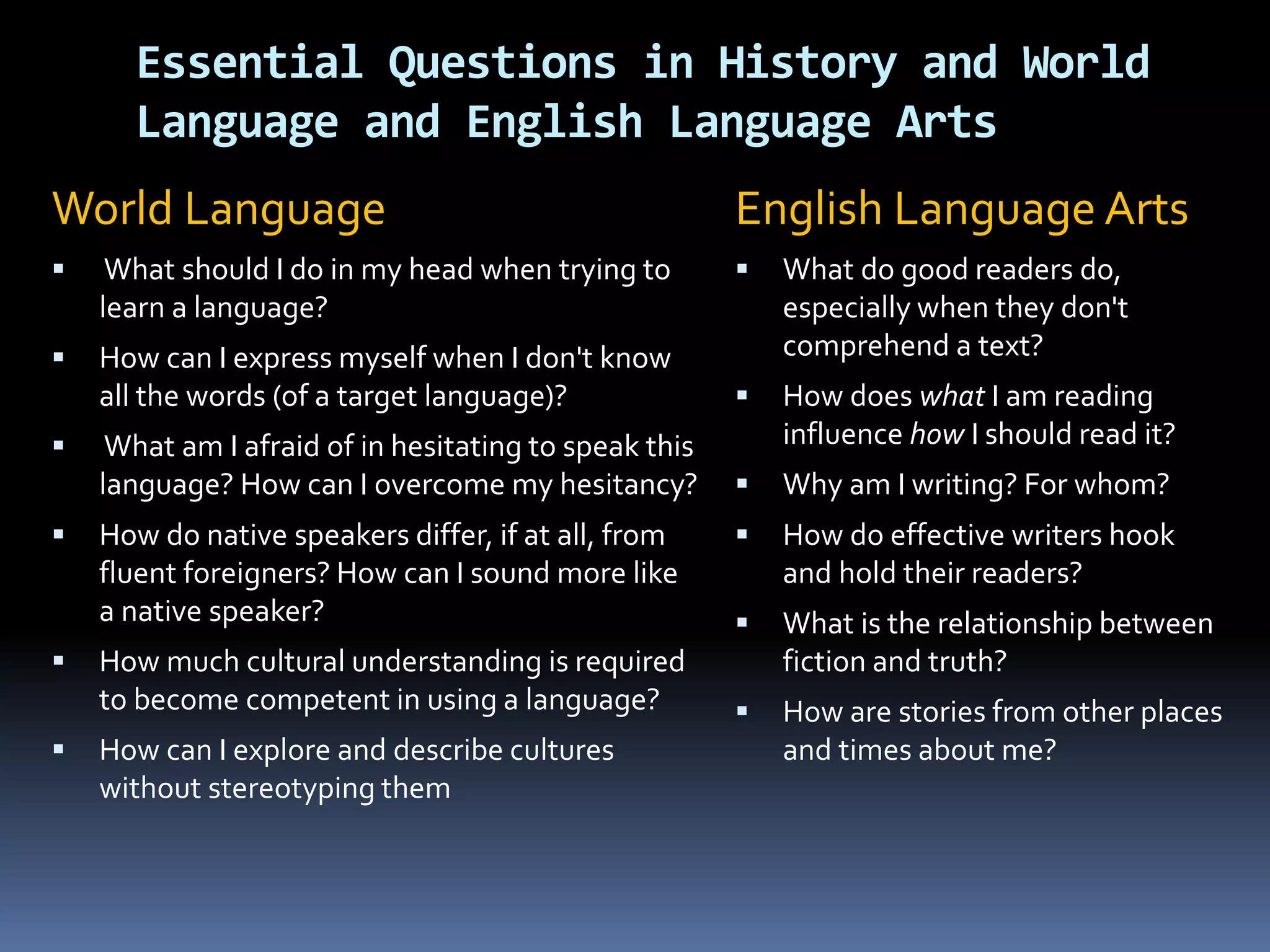
Essential Questions in History and World
Language and English Language Arts
World Language
 What should I do in my head when trying to
learn a language?
 How can I express myself when I don't know
all the words (of a target language)?
 What am I afraid of in hesitating to speak this
language? How can I overcome my hesitancy?
 How do native speakers differ, if at all, from
fluent foreigners? How can I sound more like
a native speaker?
 How much cultural understanding is required
to become competent in using a language?
 How can I explore and describe cultures
without stereotyping them
English Language Arts
 What do good readers do,
especially when they don't
comprehend a text?
 How does what I am reading
influence how I should read it?
 Why am I writing? For whom?
 How do effective writers hook
and hold their readers?
 What is the relationship between
fiction and truth?
 How are stories from other places
and times about me?
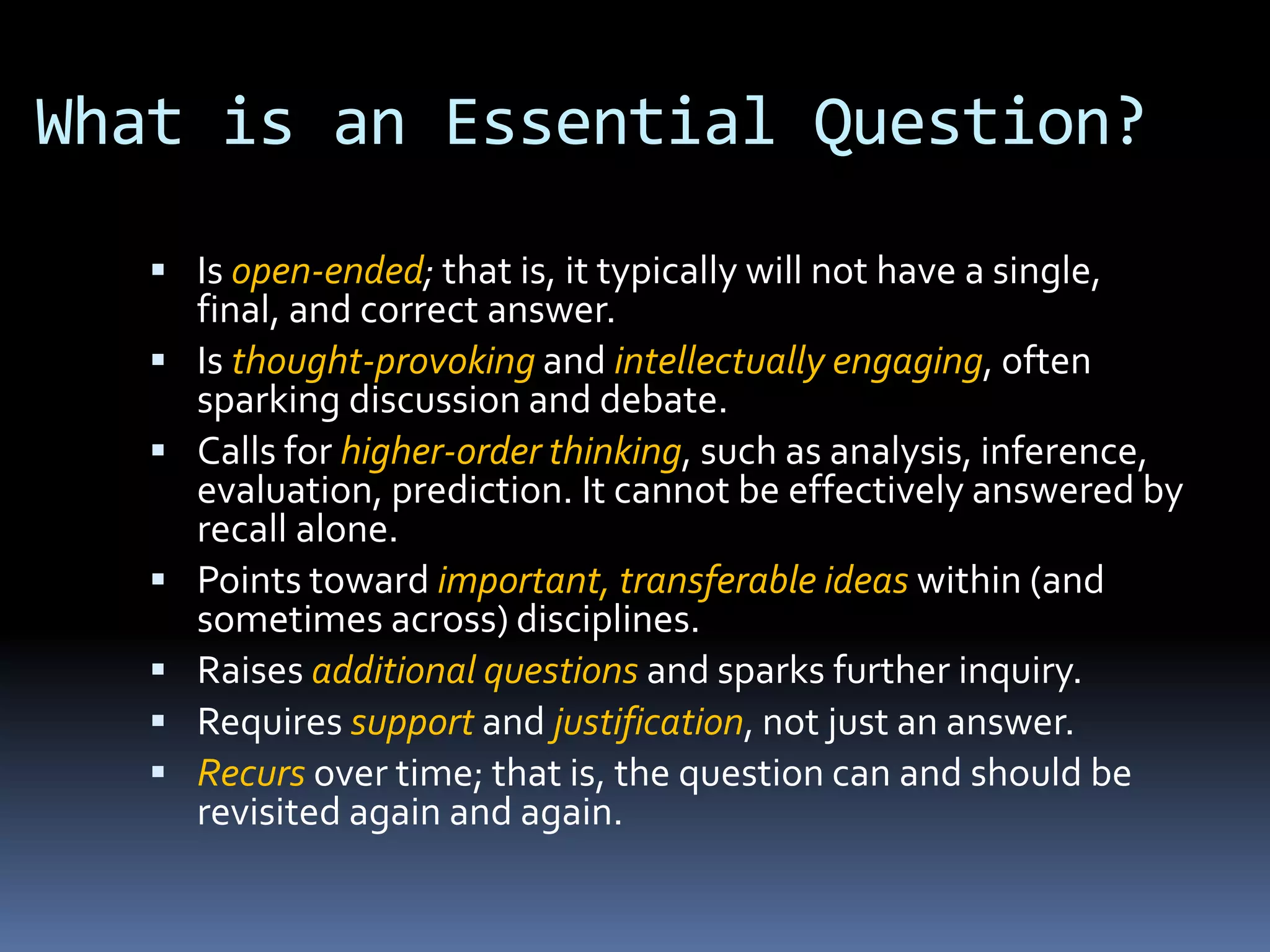
What is an Essential Question?
 Is open-ended; that is, it typically will not have a single,
final, and correct answer.
 Is thought-provoking and intellectually engaging, often
sparking discussion and debate.
 Calls for higher-order thinking, such as analysis, inference,
evaluation, prediction. It cannot be effectively answered by
recall alone.
 Points toward important, transferable ideas within (and
sometimes across) disciplines.
 Raises additional questions and sparks further inquiry.
 Requires support and justification, not just an answer.
 Recurs over time; that is, the question can and should be
revisited again and again.
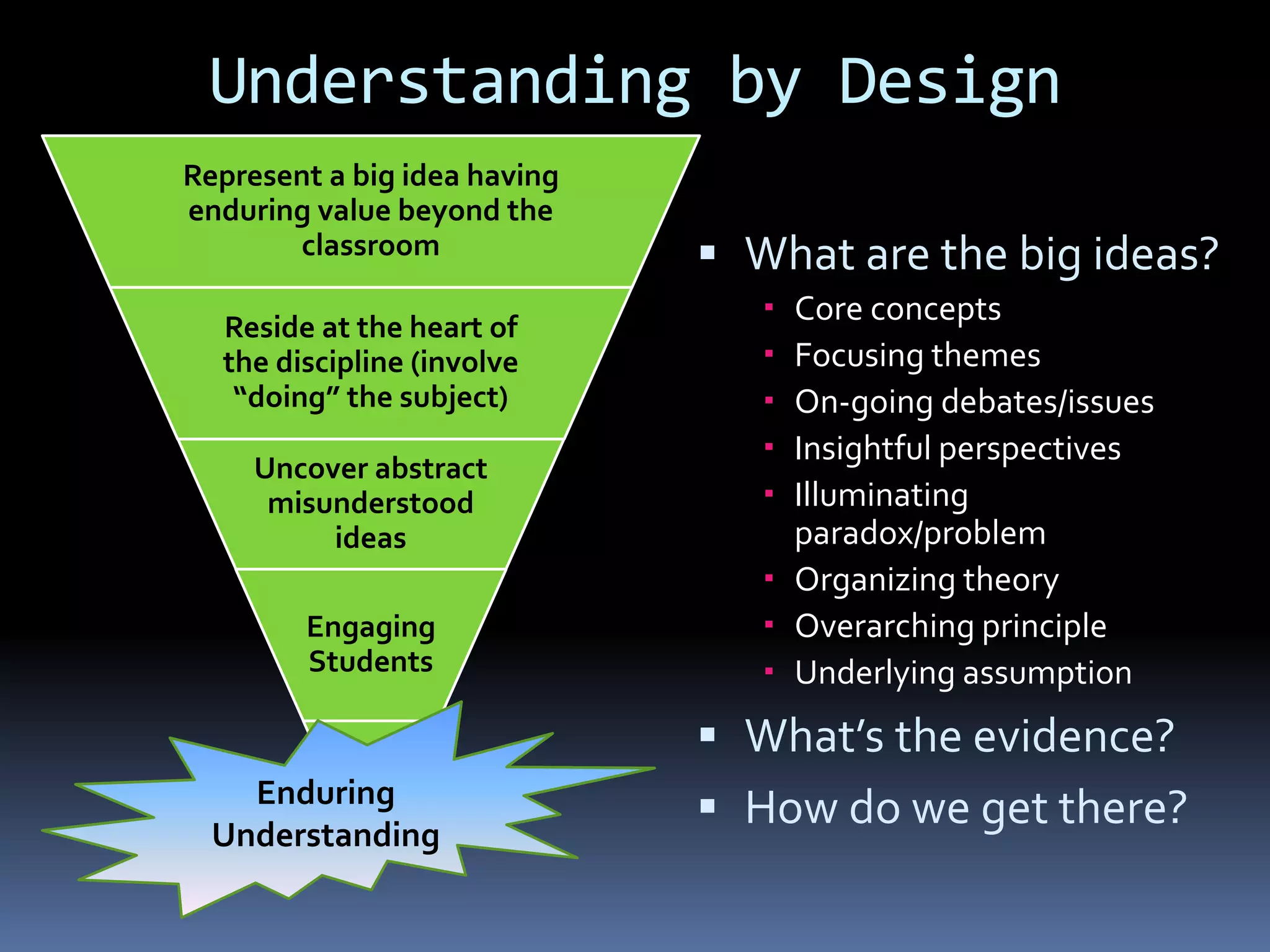
Understanding by Design
 What are the big ideas?
 Core concepts
 Focusing themes
 On-going debates/issues
 Insightful perspectives
 Illuminating
paradox/problem
 Organizing theory
 Overarching principle
 Underlying assumption
 What’s the evidence?
 How do we get there?
Represent a big idea having
enduring value beyond the
classroom
Reside at the heart of
the discipline (involve
“doing” the subject)
Uncover abstract
misunderstood
ideas
Engaging
Students
Enduring
Understanding
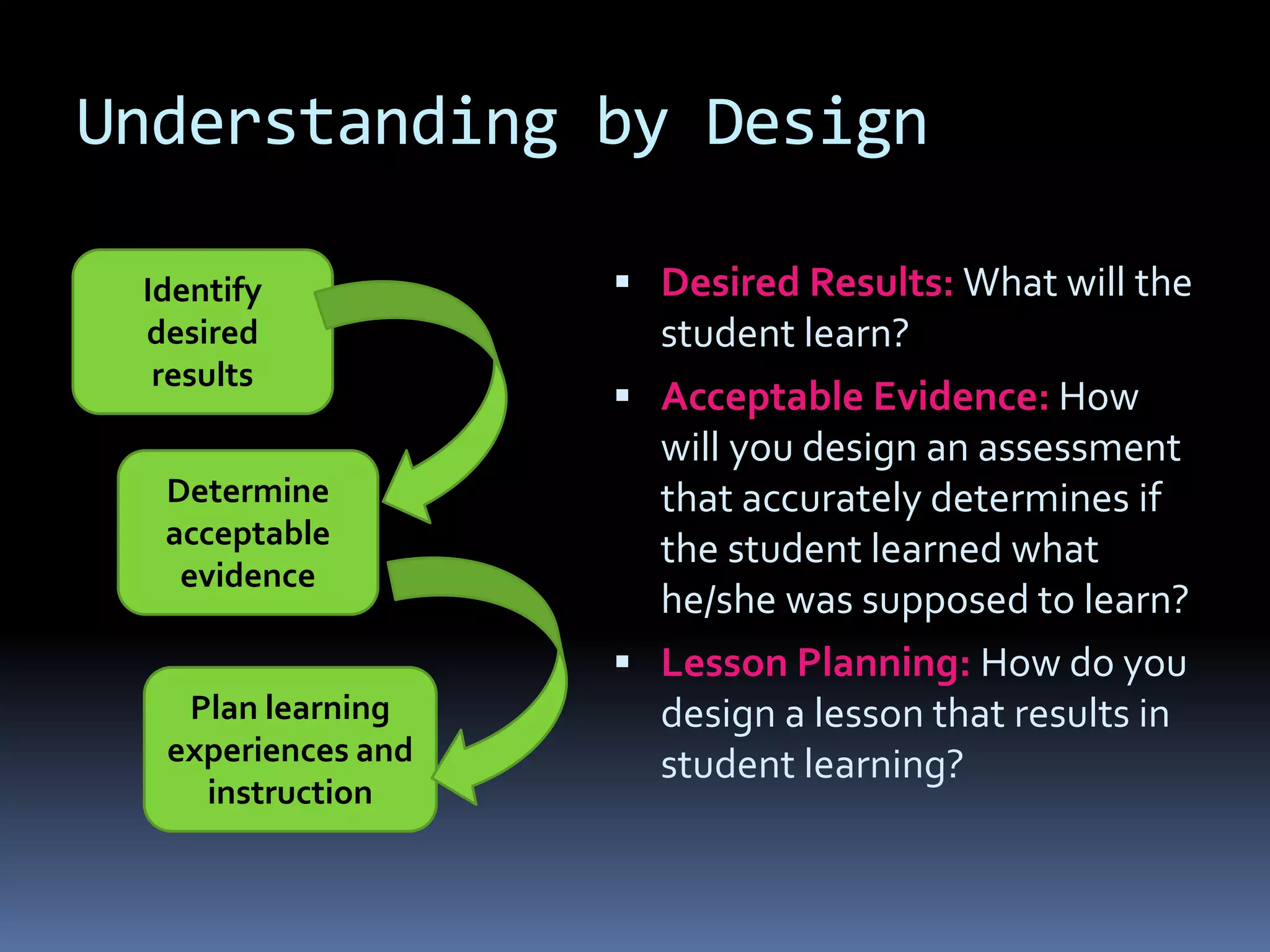
Understanding by Design
 Desired Results: What will the
student learn?
 Acceptable Evidence: How
will you design an assessment
that accurately determines if
the student learned what
he/she was supposed to learn?
 Lesson Planning: How do you
design a lesson that results in
student learning?
Identify
desired
results
Determine
acceptable
evidence
Plan learning
experiences and
instruction
Understanding by Design
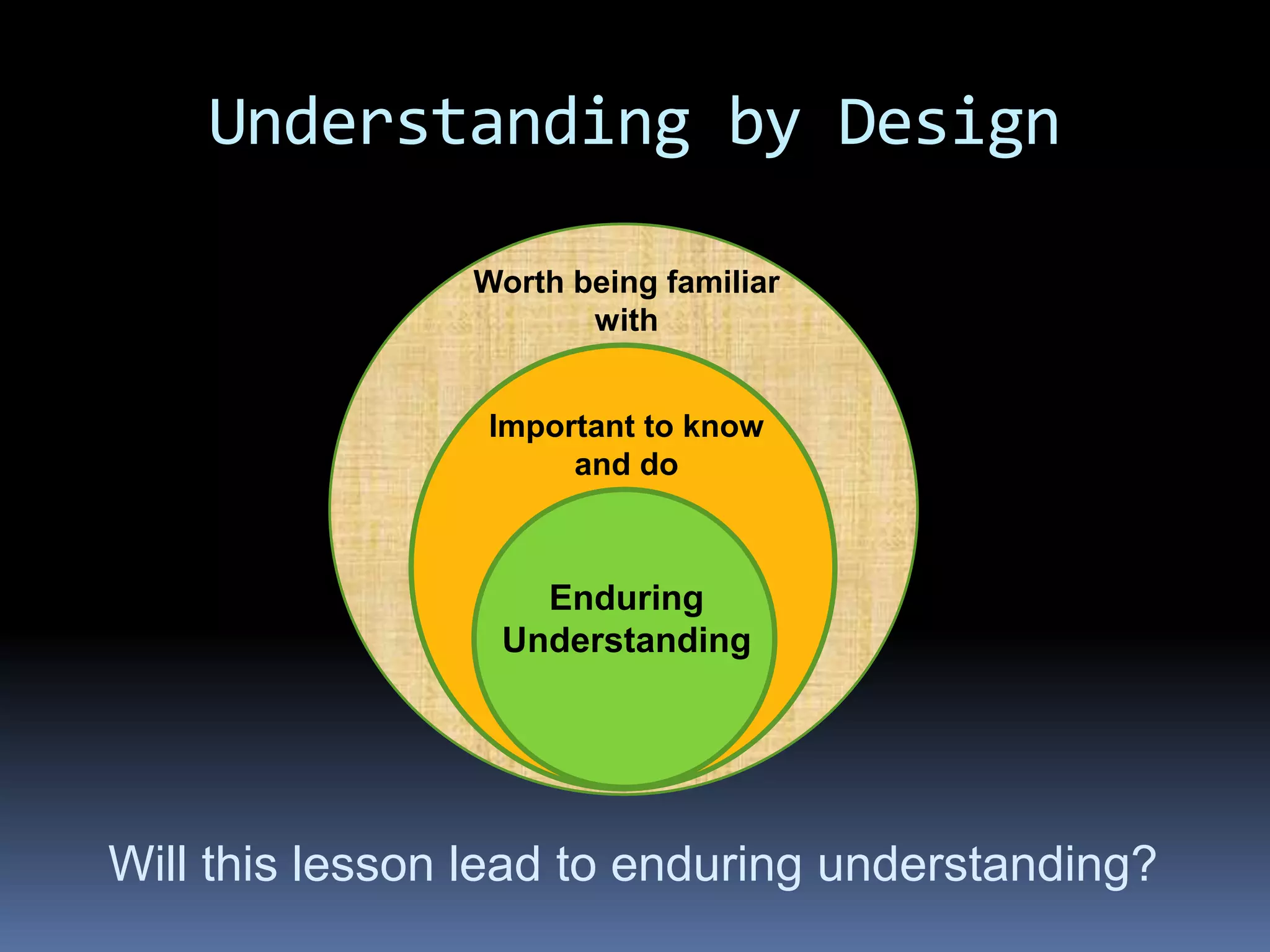
Will this lesson lead to enduring understanding?
Worth being familiar
with
Important to know
and do
Enduring
Understanding
Understanding by Design
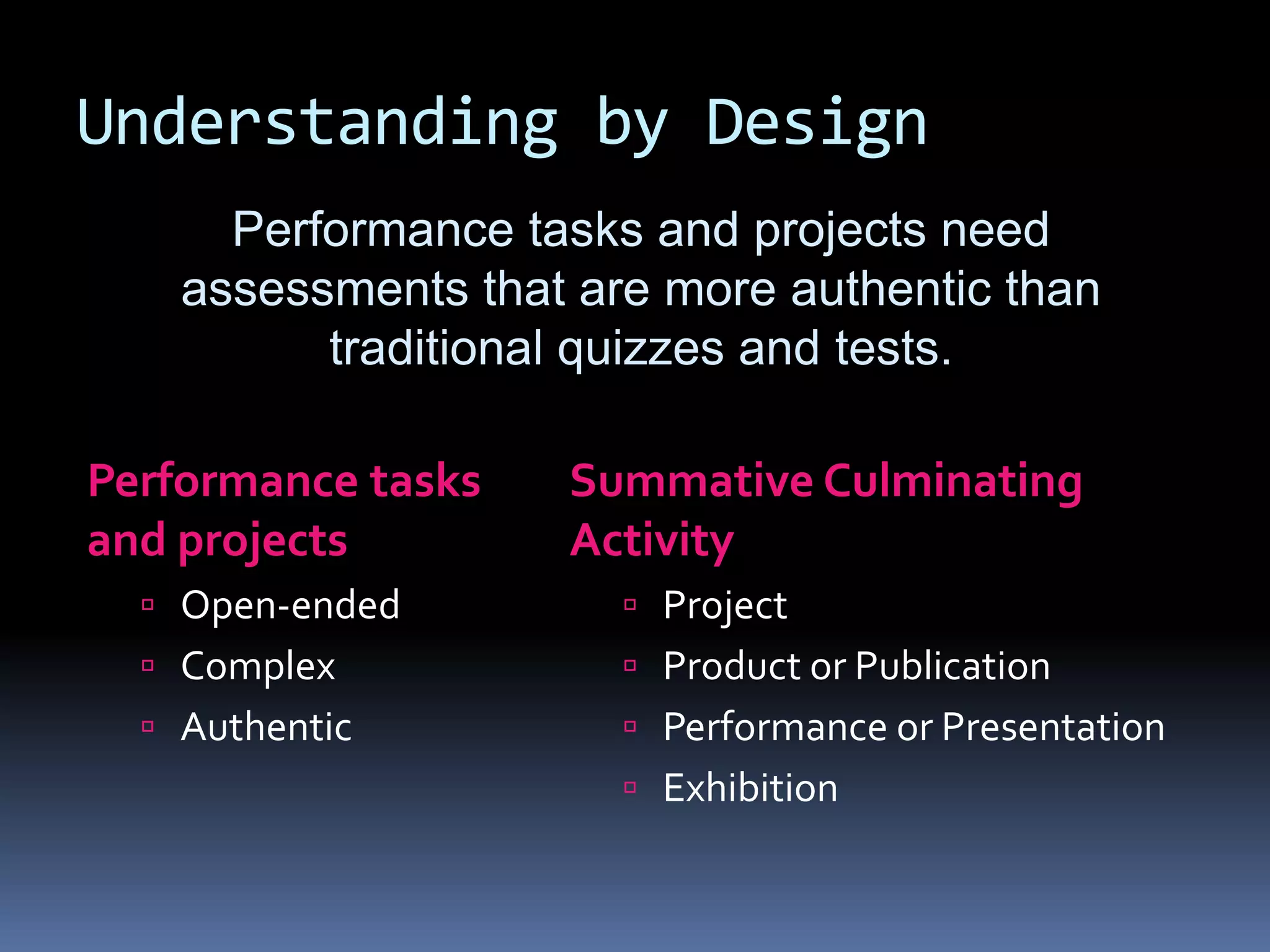
Performance tasks
and projects
 Open-ended
 Complex
 Authentic
Summative Culminating
Activity
 Project
 Product or Publication
 Performance or Presentation
 Exhibition
Performance tasks and projects need
assessments that are more authentic than
traditional quizzes and tests.
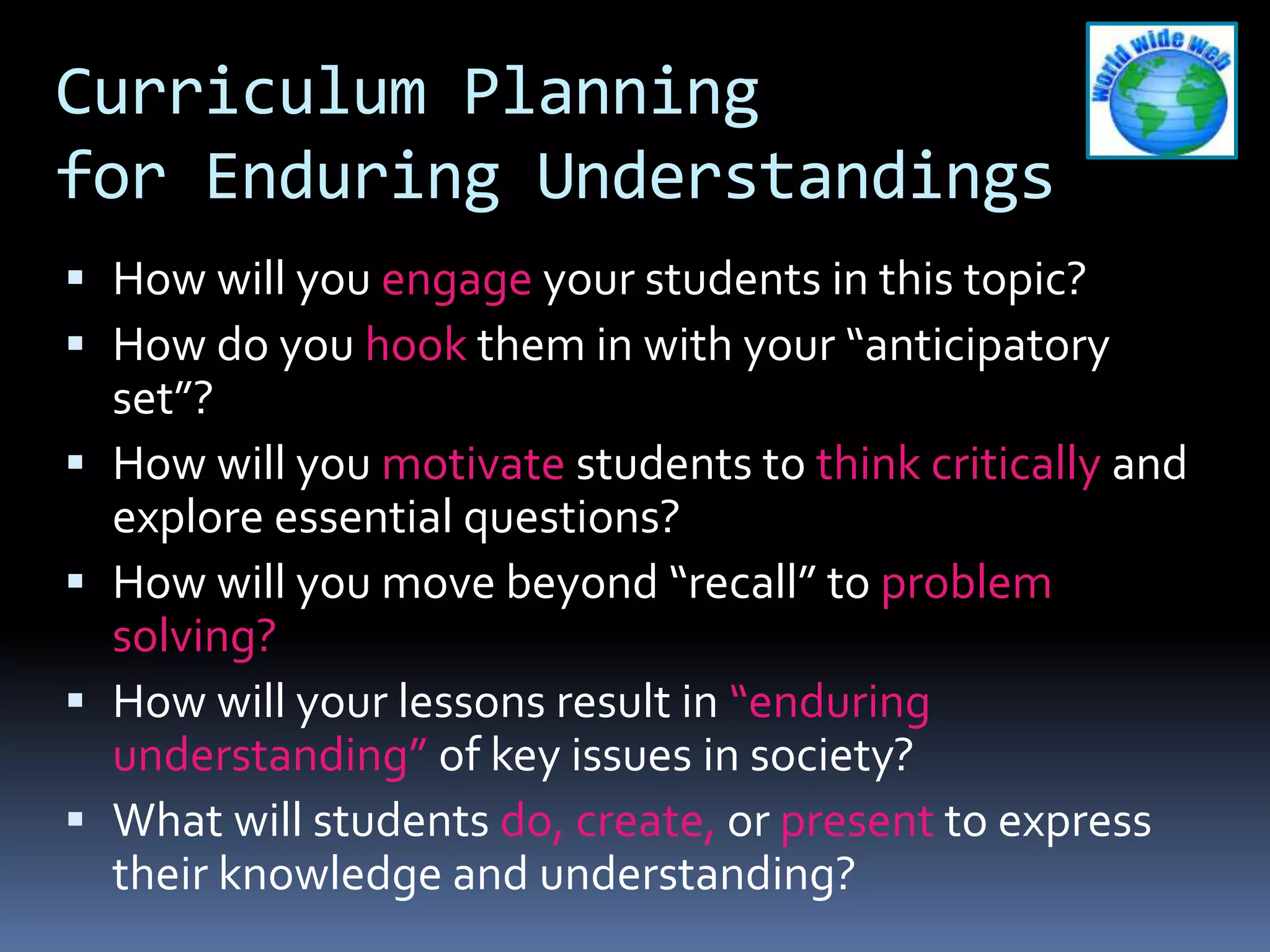
Curriculum Planning
for Enduring Understandings
 How will you engage your students in this topic?
 How do you hook them in with your “anticipatory
set”?
 How will you motivate students to think critically and
explore essential questions?
 How will you move beyond “recall” to problem
solving?
 How will your lessons result in “enduring
understanding” of key issues in society?
 What will students do, create, or present to express
their knowledge and understanding?
Common Core State Standards
English Language Arts, Math, History,
Visual/Performing Arts
Students need to be ready for college, workforce, and
life in a technological society. They need the ability to:
 Gather, comprehend, evaluate, synthesize, and
report on information and ideas.
 Conduct original research in order to answer
questions or solve problems.
 Analyze and create a high volume and extensive
range of print and nonprint texts in media forms
old and new.
Research to Build and Express
Knowledge
 Gather relevant information from multiple
authoritative print and digital sources, using
advanced searches effectively.
 Assess the strengths and limitations of each
source in terms of the task, purpose, and
audience.
 Integrate and evaluate content presented in
diverse formats and media, including visually
and quantitatively, as well as in words.
Visuals and Technology
 Interpret information presented visually, orally,
or quantitatively (e.g., in charts, graphs,
diagrams, time lines, animations, or interactive
elements on Web pages)
 Translate quantitative or technical information
expressed in words in a text into visual form (e.g.,
a table or chart) and translate information
expressed visually or mathematically (e.g., in an
equation) into words.
 Take advantage of technology’s capacity to link to
other information and to display information
flexibly and dynamically.
Digital Media Production
 Make strategic use of digital media (e.g.,
textual, graphical, audio, visual, and interactive
elements) in presentations to enhance
understanding of findings, reasoning, and
evidence and to add interest.
 Use technology, including the Internet, to
produce, publish, and update individual or
shared writing products
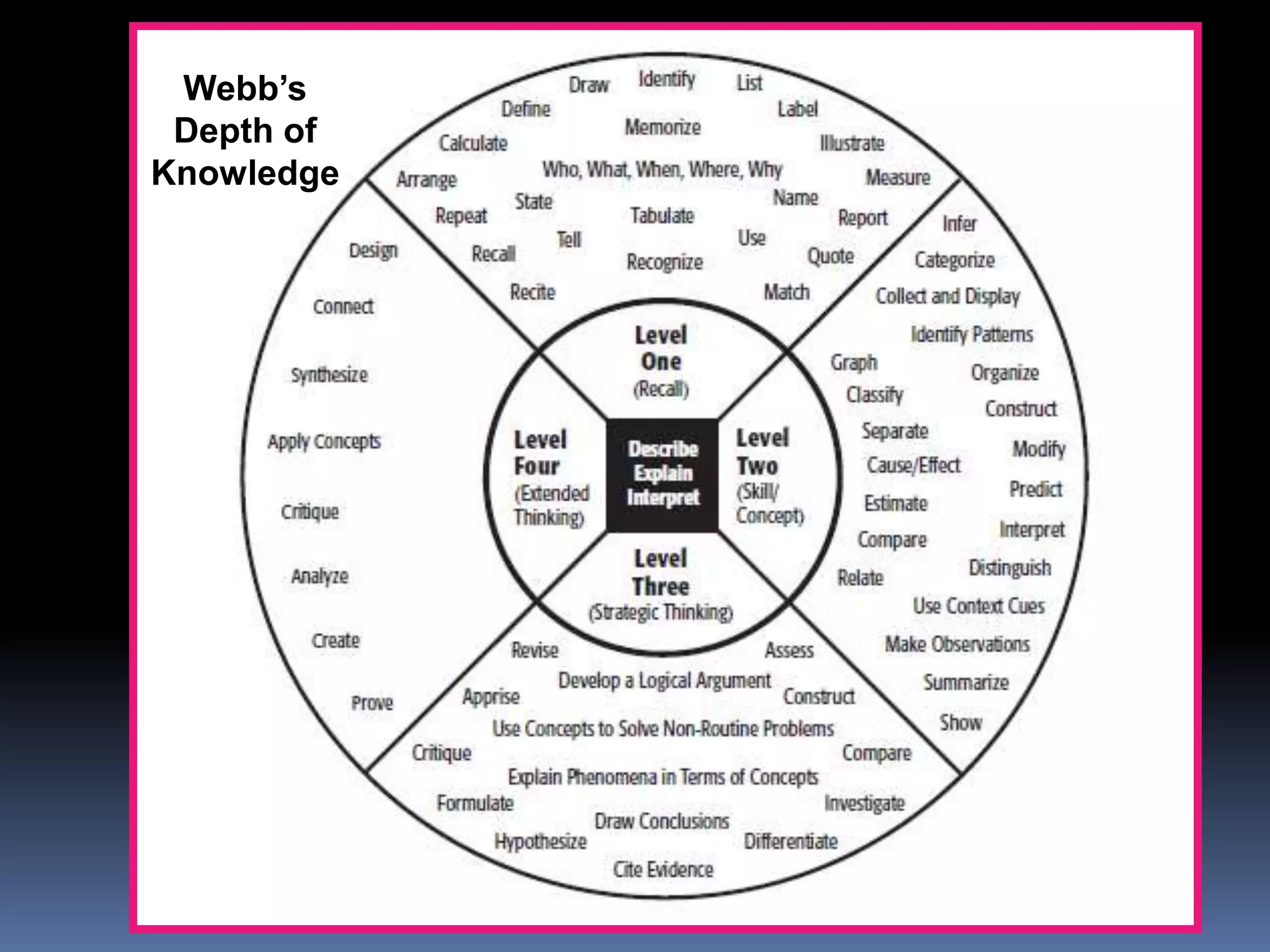
Webb’s
Depth of
Knowledge
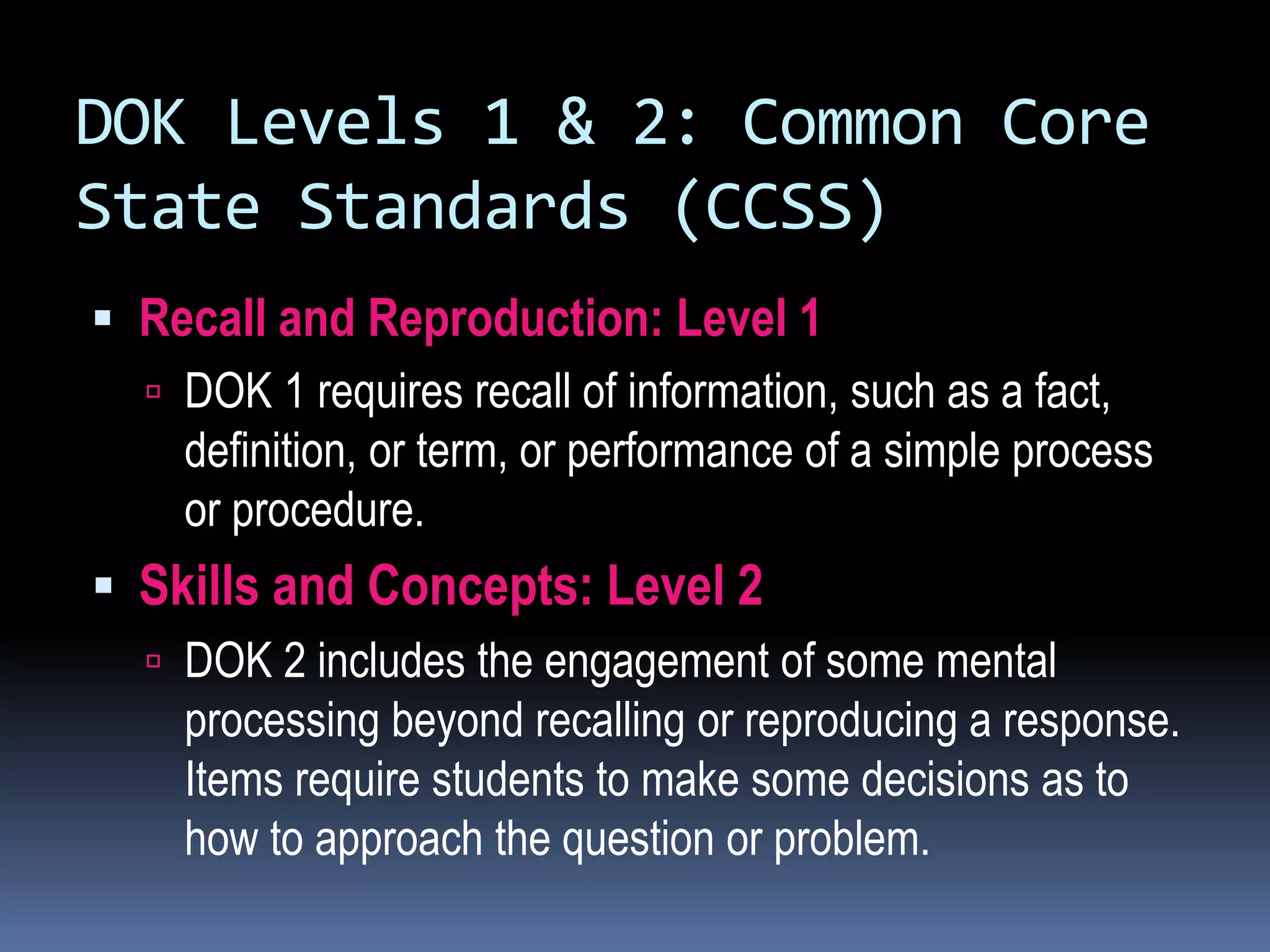
DOK Levels 1 & 2: Common Core
State Standards (CCSS)
 Recall and Reproduction: Level 1
 DOK 1 requires recall of information, such as a fact,
definition, or term, or performance of a simple process
or procedure.
 Skills and Concepts: Level 2
 DOK 2 includes the engagement of some mental
processing beyond recalling or reproducing a response.
Items require students to make some decisions as to
how to approach the question or problem.
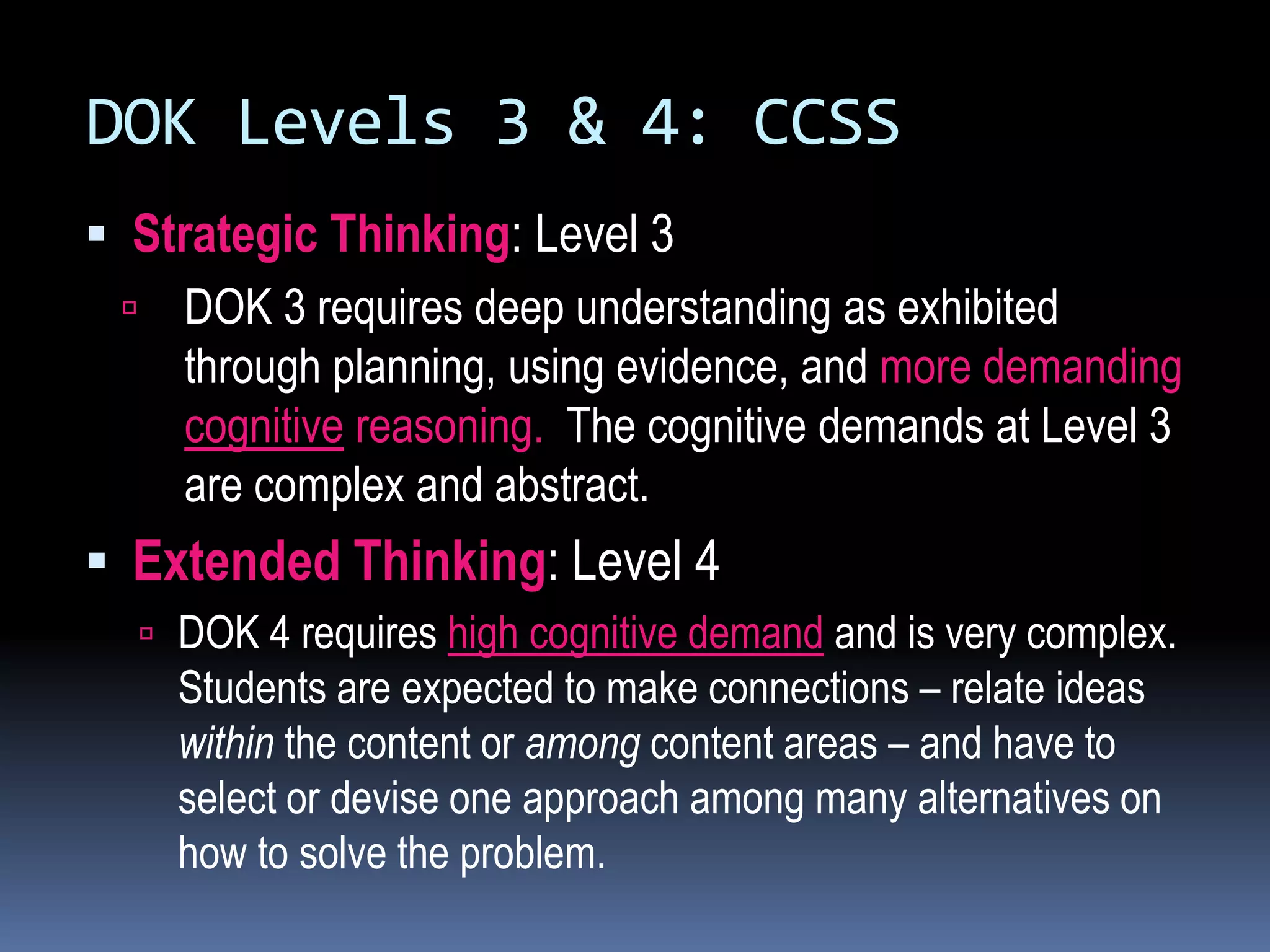
DOK Levels 3 & 4: CCSS
 Strategic Thinking: Level 3
 DOK 3 requires deep understanding as exhibited
through planning, using evidence, and more demanding
cognitive reasoning. The cognitive demands at Level 3
are complex and abstract.
 Extended Thinking: Level 4
 DOK 4 requires high cognitive demand and is very complex.
Students are expected to make connections – relate ideas
within the content or among content areas – and have to
select or devise one approach among many alternatives on
how to solve the problem.
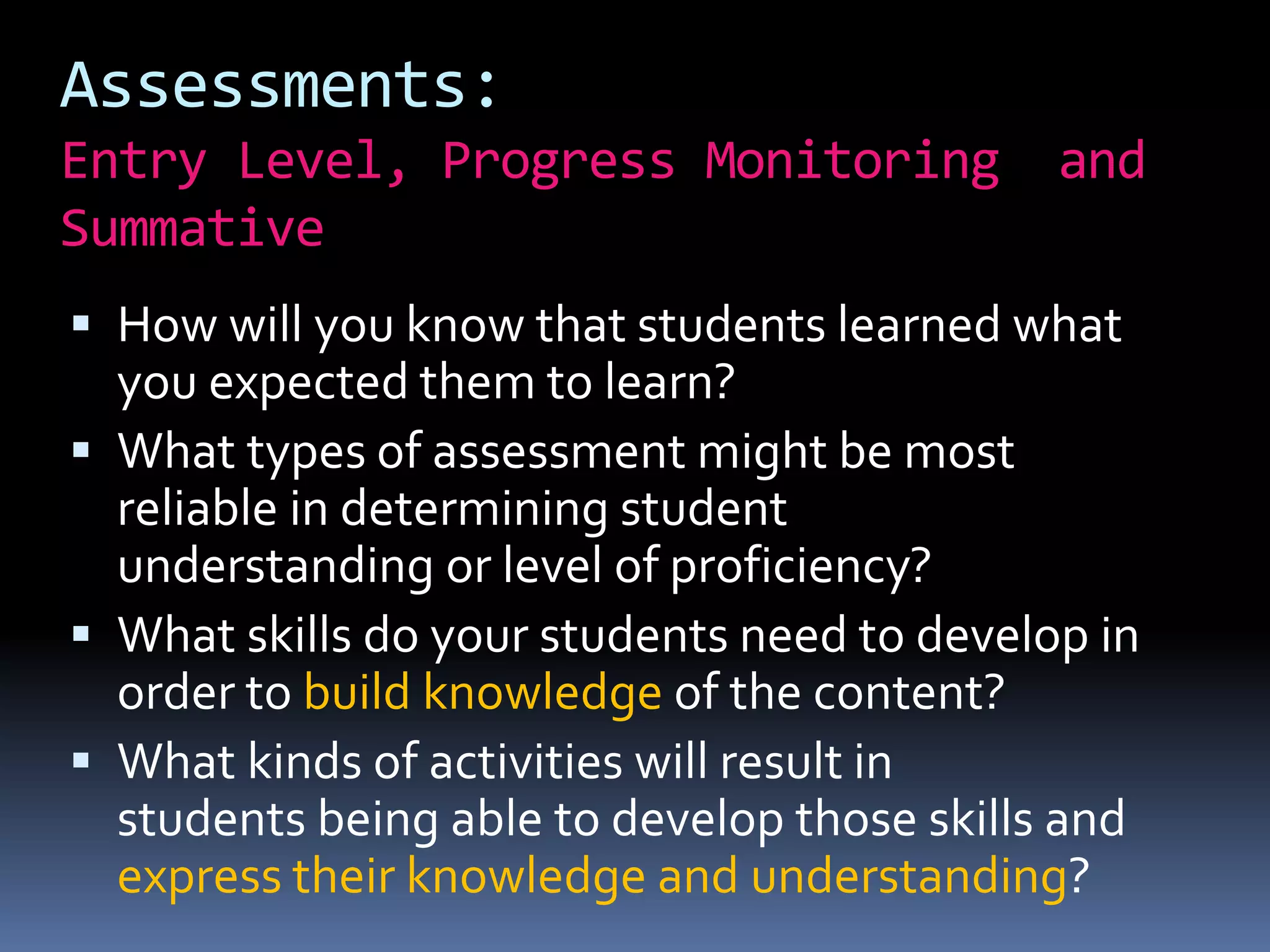
Assessments:
Entry Level, Progress Monitoring and
Summative
 How will you know that students learned what
you expected them to learn?
 What types of assessment might be most
reliable in determining student
understanding or level of proficiency?
 What skills do your students need to develop in
order to build knowledge of the content?
 What kinds of activities will result in
students being able to develop those skills and
express their knowledge and understanding?
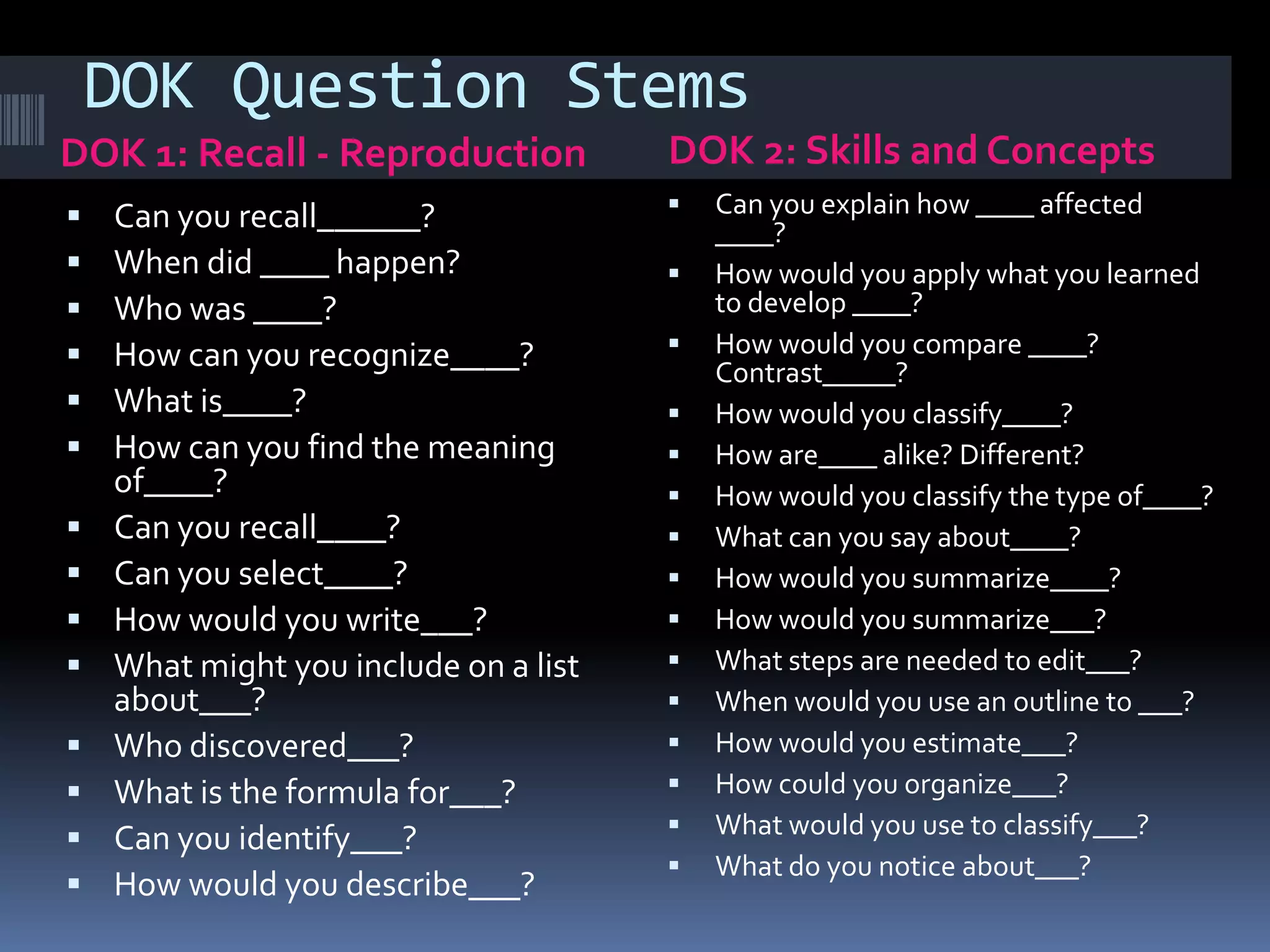
DOK Question Stems
DOK 1: Recall - Reproduction DOK 2: Skills and Concepts
 Can you recall______?
 When did ____ happen?
 Who was ____?
 How can you recognize____?
 What is____?
 How can you find the meaning
of____?
 Can you recall____?
 Can you select____?
 How would you write___?
 What might you include on a list
about___?
 Who discovered___?
 What is the formula for___?
 Can you identify___?
 How would you describe___?
 Can you explain how ____ affected
____?
 How would you apply what you learned
to develop ____?
 How would you compare ____?
Contrast_____?
 How would you classify____?
 How are____ alike? Different?
 How would you classify the type of____?
 What can you say about____?
 How would you summarize____?
 How would you summarize___?
 What steps are needed to edit___?
 When would you use an outline to ___?
 How would you estimate___?
 How could you organize___?
 What would you use to classify___?
 What do you notice about___?
DOK Question Stems
DOK 3: StrategicThinking DOK 4: ExtendedThinking
 How is ____ related to ____?
 What conclusions can you draw _____?
 How would you adapt____to create a
different____?
 How would you test____?
 Can you predict the outcome if____?
 What is the best answer? Why?
 What conclusion can be drawn from these
three texts?
 What is your interpretation of this text?
Support your rationale.
 How would you describe the sequence of____?
 What facts would you select to support____?
 Can you elaborate on the reason____?
 What would happen if___?
 Can you formulate a theory for___?
 How would you test___?
 Can you elaborate on the reason___?
 Write a thesis, drawing conclusions
from multiple sources.
 Design and conduct an experiment.
 Gather information to develop
alternative explanations for the
results of an experiment.
 Write a research paper on a topic.
 Apply information from one text to
another text to develop a persuasive
argument.
 What information can you gather to
support your idea about___?
 DOK 4 would most likely be the
writing of a research paper or
applying information from one text
to another text to develop a
persuasive argument.
 DOK 4 requires time for extended
thinking.

Essential Questions and DOK 533

  • 1.
  • 2.
    ESSENTIAL QUESTIONS BLOOM'S TAXONOMY UNDERSTANDINGBY DESIGN BACKWARDS DESIGN DEPTH OF KNOWLEDGE (DOK)
  • 3.
    Thinking Levels Ask studentsto demonstrate:  Knowledge - recall information in original form  Comprehension - show understanding  Application - use learning in a new situation  Analysis - show s/he can see relationships  Synthesis - combine and integrate parts of prior knowledge into a product, plan, or proposal that is new  Evaluation - assess and criticize on basis of standards and criteria
  • 4.
    Remembering Understanding Applying Analyzing Evaluating Creating • Creating –designing, constructing, planning, producing, inventing, devising, making • Evaluating – checking, hypothesizing, critiquing, experimenting, judging, testing, detecting, monitoring • Analyzing – comparing, organizing, deconstructing, attributing, outlining, finding, structuring, integrating • Applying – implementing, carrying out, using, executing • Understanding – interpreting, summarizing, inferring, paraphrasing, classifying, comparing, explaining, exemplifying • Remembering – recognizing, listing, describing, identifying, retrieving, naming, locating, finding Bloom’s Revised Taxonomy
  • 5.
    Essential Questions: EQs Spark our curiosity and sense of wonder  Desire to understand  Something that matters to us  Answers to EQs can NOT be found  Students must construct own answers  Make their own meaning from information they have gathered  Create insight This Photo by Unknown Author is licensed under CC BY-NC
  • 6.
    Essential Questions  Answeringsuch questions may take a lifetime!  Answers may only be tentative  Information gathering may take place outside of formal learning environments  Engage students in real life applied problem solving  EQs lend themselves to multidisciplinary investigations. This Photo by Unknown Author is licensed under CC BY- NC-SA
  • 7.
    Ideal Essential Questions Framed by students themselves  Best to start with subsidiary questions that might help support the main question  Formulate categories of related questions  “What else do we need to know?  State suppositions  Hypothesizing and Predicting  Thought process helps provide a basis for construction of meaning.
  • 8.
    Essential vs. NotEssential and DOK Verbs • Share an idea for your essential question topic, grade level, and standard. • Brainstorm possible essential questions or critical thinking questions for your lesson. Aim for higher DOK level questions. • Discuss at least one DOK verb at levels 3 & 4. DOK Levels
  • 9.
    Essential Questions inHistory and World Language and English Language Arts World Language  What should I do in my head when trying to learn a language?  How can I express myself when I don't know all the words (of a target language)?  What am I afraid of in hesitating to speak this language? How can I overcome my hesitancy?  How do native speakers differ, if at all, from fluent foreigners? How can I sound more like a native speaker?  How much cultural understanding is required to become competent in using a language?  How can I explore and describe cultures without stereotyping them English Language Arts  What do good readers do, especially when they don't comprehend a text?  How does what I am reading influence how I should read it?  Why am I writing? For whom?  How do effective writers hook and hold their readers?  What is the relationship between fiction and truth?  How are stories from other places and times about me?
  • 10.
    What is anEssential Question?  Is open-ended; that is, it typically will not have a single, final, and correct answer.  Is thought-provoking and intellectually engaging, often sparking discussion and debate.  Calls for higher-order thinking, such as analysis, inference, evaluation, prediction. It cannot be effectively answered by recall alone.  Points toward important, transferable ideas within (and sometimes across) disciplines.  Raises additional questions and sparks further inquiry.  Requires support and justification, not just an answer.  Recurs over time; that is, the question can and should be revisited again and again.
  • 11.
    Understanding by Design What are the big ideas?  Core concepts  Focusing themes  On-going debates/issues  Insightful perspectives  Illuminating paradox/problem  Organizing theory  Overarching principle  Underlying assumption  What’s the evidence?  How do we get there? Represent a big idea having enduring value beyond the classroom Reside at the heart of the discipline (involve “doing” the subject) Uncover abstract misunderstood ideas Engaging Students Enduring Understanding
  • 12.
    Understanding by Design Desired Results: What will the student learn?  Acceptable Evidence: How will you design an assessment that accurately determines if the student learned what he/she was supposed to learn?  Lesson Planning: How do you design a lesson that results in student learning? Identify desired results Determine acceptable evidence Plan learning experiences and instruction
  • 13.
    Understanding by Design Willthis lesson lead to enduring understanding? Worth being familiar with Important to know and do Enduring Understanding
  • 14.
    Understanding by Design Performancetasks and projects  Open-ended  Complex  Authentic Summative Culminating Activity  Project  Product or Publication  Performance or Presentation  Exhibition Performance tasks and projects need assessments that are more authentic than traditional quizzes and tests.
  • 15.
    Curriculum Planning for EnduringUnderstandings  How will you engage your students in this topic?  How do you hook them in with your “anticipatory set”?  How will you motivate students to think critically and explore essential questions?  How will you move beyond “recall” to problem solving?  How will your lessons result in “enduring understanding” of key issues in society?  What will students do, create, or present to express their knowledge and understanding?
  • 16.
    Common Core StateStandards English Language Arts, Math, History, Visual/Performing Arts Students need to be ready for college, workforce, and life in a technological society. They need the ability to:  Gather, comprehend, evaluate, synthesize, and report on information and ideas.  Conduct original research in order to answer questions or solve problems.  Analyze and create a high volume and extensive range of print and nonprint texts in media forms old and new.
  • 17.
    Research to Buildand Express Knowledge  Gather relevant information from multiple authoritative print and digital sources, using advanced searches effectively.  Assess the strengths and limitations of each source in terms of the task, purpose, and audience.  Integrate and evaluate content presented in diverse formats and media, including visually and quantitatively, as well as in words.
  • 18.
    Visuals and Technology Interpret information presented visually, orally, or quantitatively (e.g., in charts, graphs, diagrams, time lines, animations, or interactive elements on Web pages)  Translate quantitative or technical information expressed in words in a text into visual form (e.g., a table or chart) and translate information expressed visually or mathematically (e.g., in an equation) into words.  Take advantage of technology’s capacity to link to other information and to display information flexibly and dynamically.
  • 19.
    Digital Media Production Make strategic use of digital media (e.g., textual, graphical, audio, visual, and interactive elements) in presentations to enhance understanding of findings, reasoning, and evidence and to add interest.  Use technology, including the Internet, to produce, publish, and update individual or shared writing products
  • 20.
  • 21.
    DOK Levels 1& 2: Common Core State Standards (CCSS)  Recall and Reproduction: Level 1  DOK 1 requires recall of information, such as a fact, definition, or term, or performance of a simple process or procedure.  Skills and Concepts: Level 2  DOK 2 includes the engagement of some mental processing beyond recalling or reproducing a response. Items require students to make some decisions as to how to approach the question or problem.
  • 22.
    DOK Levels 3& 4: CCSS  Strategic Thinking: Level 3  DOK 3 requires deep understanding as exhibited through planning, using evidence, and more demanding cognitive reasoning. The cognitive demands at Level 3 are complex and abstract.  Extended Thinking: Level 4  DOK 4 requires high cognitive demand and is very complex. Students are expected to make connections – relate ideas within the content or among content areas – and have to select or devise one approach among many alternatives on how to solve the problem.
  • 23.
    Assessments: Entry Level, ProgressMonitoring and Summative  How will you know that students learned what you expected them to learn?  What types of assessment might be most reliable in determining student understanding or level of proficiency?  What skills do your students need to develop in order to build knowledge of the content?  What kinds of activities will result in students being able to develop those skills and express their knowledge and understanding?
  • 24.
    DOK Question Stems DOK1: Recall - Reproduction DOK 2: Skills and Concepts  Can you recall______?  When did ____ happen?  Who was ____?  How can you recognize____?  What is____?  How can you find the meaning of____?  Can you recall____?  Can you select____?  How would you write___?  What might you include on a list about___?  Who discovered___?  What is the formula for___?  Can you identify___?  How would you describe___?  Can you explain how ____ affected ____?  How would you apply what you learned to develop ____?  How would you compare ____? Contrast_____?  How would you classify____?  How are____ alike? Different?  How would you classify the type of____?  What can you say about____?  How would you summarize____?  How would you summarize___?  What steps are needed to edit___?  When would you use an outline to ___?  How would you estimate___?  How could you organize___?  What would you use to classify___?  What do you notice about___?
  • 25.
    DOK Question Stems DOK3: StrategicThinking DOK 4: ExtendedThinking  How is ____ related to ____?  What conclusions can you draw _____?  How would you adapt____to create a different____?  How would you test____?  Can you predict the outcome if____?  What is the best answer? Why?  What conclusion can be drawn from these three texts?  What is your interpretation of this text? Support your rationale.  How would you describe the sequence of____?  What facts would you select to support____?  Can you elaborate on the reason____?  What would happen if___?  Can you formulate a theory for___?  How would you test___?  Can you elaborate on the reason___?  Write a thesis, drawing conclusions from multiple sources.  Design and conduct an experiment.  Gather information to develop alternative explanations for the results of an experiment.  Write a research paper on a topic.  Apply information from one text to another text to develop a persuasive argument.  What information can you gather to support your idea about___?  DOK 4 would most likely be the writing of a research paper or applying information from one text to another text to develop a persuasive argument.  DOK 4 requires time for extended thinking.