


The Planning Importance
IMPORTANCE OF PLANNING: 
• BENEFITS TO YOU 
– Knowing what to expect reduces stress 
– Allows you to have the required materials 
– Following the day in an organized manner 
is easier and more fun 
– You feel confident about turning your 
program over to a substitute 
– Conveys professionalism to parents 
– Provides a sense of accomplishment & 
well-being
IMPORTANCE OF PLANNING: 
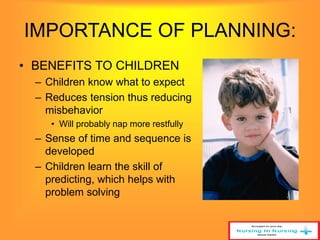
• BENEFITS TO CHILDREN 
– Children know what to expect 
– Reduces tension thus reducing 
misbehavior 
• Will probably nap more restfully 
– Sense of time and sequence is 
developed 
– Children learn the skill of 
predicting, which helps with 
problem solving
IMPORTANCE OF PLANNING: 
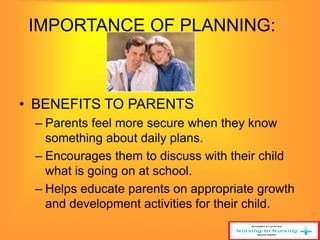
• BENEFITS TO PARENTS 
– Parents feel more secure when they know 
something about daily plans. 
– Encourages them to discuss with their child 
what is going on at school. 
– Helps educate parents on appropriate growth 
and development activities for their child.
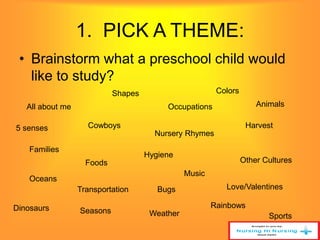
1. PICK A THEME: 
• Brainstorm what a preschool child would 
like to study? 
All about me 
Shapes Colors 
Occupations 
Cowboys Harvest 
Families 
Nursery Rhymes 
Hygiene 
Foods Other Cultures 
Oceans 
Music 
Transportation Bugs Love/Valentines 
Dinosaurs Seasons Weather 
Rainbows 
Sports 
5 senses 
Animals
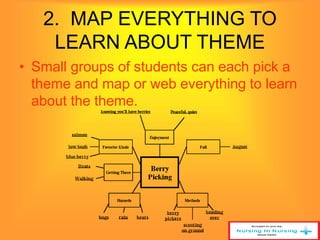
2. MAP EVERYTHING TO 
LEARN ABOUT THEME 
• Small groups of students can each pick a 
theme and map or web everything to learn 
about the theme.
3. DEFINE IMPORTANT 
TOPICS TO TEACH 
• Topics should be based on children’s 
interests and needs. 
• Decide on creative activities that will teach 
children about the topic. 
– Small group 
– Whole group 
– Learning centers 
– Field trips 
– Cooking experience
4. DECIDE ON OBJECTIVES 
• Overall goals 
• Ask, “What type of learning is to occur?” 
• Should be based on observing and 
recording children’s needs. 
• Have knowledge of developmental stages 
• Help each child develop to their fullest 
– Age appropriate but challenging
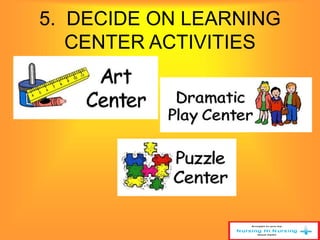
5. DECIDE ON LEARNING 
CENTER ACTIVITIES
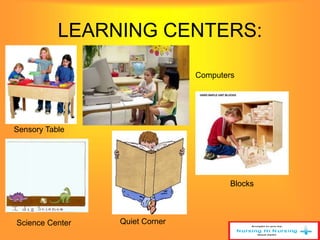
LEARNING CENTERS: 
Sensory Table 
Science Center Quiet Corner 
Computers 
Blocks
GROUP ACTIVITY: 
• Each group needs a paper for each 
learning center and each student needs a 
colored marker. 
• Pass the papers around the group several 
times. Each student will write something 
that they think would belong in that center. 
• Share with the class. 
• Grade student participation by number of 
times they wrote in their color of marker.
DAILY SCHEDULE 
• Schedule needs to be flexible so children 
can finish projects and activities. 
• Activities are designed to develop self 
esteem and positive feelings about 
learning. 
• Planning as a team is best. Why? 
• Teaching files can be very helpful in 
planning.
FREE PLAY: 
• Inviting start of the preschool day. 
• Daily greet each child warmly. 
– It is essential to their self esteem. 
• Large motor activities of their choosing. 
– Acts on own imagination. 
• Best when restrictions are few. 
– Computers, blocks, balance beam, climbing 
tube, basket ball hoop, dress ups, puzzles, 
play dough, doll house or barn.
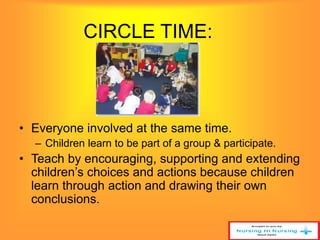
CIRCLE TIME: 
• Everyone involved at the same time. 
– Children learn to be part of a group & participate. 
• Teach by encouraging, supporting and extending 
children’s choices and actions because children 
learn through action and drawing their own 
conclusions.
CIRCLE TIME Cont’d: 
• Let children help decide what is to be done 
during circle time. 
– Choices: Calendar, pledge, count kids, 
songs, introduce theme, letter of week 
activity, birthdays, guest speakers.
IT IS IMPORTANCE TO 
PLAN EACH DAY WITH 
EACH CHILD 
what they will be 
doing for work time.
PLANNING TIME with children: 
• THE IMPORANCE OF PLANNING: 
– Encourages verbal skills about choices and 
decisions 
– Promotes self esteem 
– Creates an environment of less self control 
– Leads to involvement and concentration on 
play
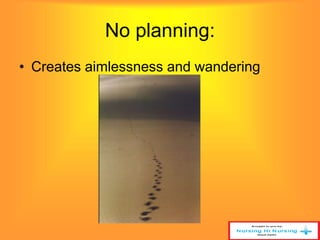
No planning: 
• Creates aimlessness and wandering
PLANNING IS: 
• A promise to do something acceptable 
• An exciting opportunity to form a mental 
model to guide future activities.
TRUE or FALSE? 
• Planning helps preschool children develop 
a multi step sequence of actions. 
T 
• Children often modify their plans as they 
play. 
T 
• Planning is a non-flexible process only 
done before work time. 
F 
• Most young children are in the habit of 
planning. 
F
Planning Helps the Children: 
1. Articulate ideas, choices and decisions. 
2. Promotes children self confidence. 
3. Promotes children’s sense of self control. 
4. Leads to involvement & concentrated 
play. 
5. Supports development of complex play.
RESPONSES TO: “What would 
you like to do?” 
• “I don’t know.” 
Give ideas and show centers 
• No answer. 
See where they are looking, notice 
gestures 
• Same every day. 
Encourage variety, show what others are 
doing
CHILDREN CAN LEARN TO PLAN 
• First plans are vague 
• Then plans are routine 
• Then plans become detailed
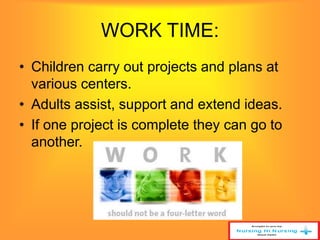
WORK TIME: 
• Children carry out projects and plans at 
various centers. 
• Adults assist, support and extend ideas. 
• If one project is complete they can go to 
another.
CLEAN UP TIME: 
• Encourage clean up as they go. 
• Give a 5 minute warning so it doesn’t end abruptly. 
• Define specifically how to clean up. 
• Help them & work along with them. 
• Have clean up games. What are some? 
• Have them help others until everyone is done. 
• Move to a central gathering place and survey the room 
with children. 
• Motivate with a new activity as soon as cleanup is 
finished. 
• On messy days begin cleanup with a group meeting.
RECALL TIME: (SNACK) 
• Recall and show what they did to small group. 
• Can see relation between plans and activities 
and develop awareness of their own actions. 
• Helps them evaluate and learn from their own 
experiences. 
• Recall in small groups helps them get ideas from 
others and hear others describe their work.
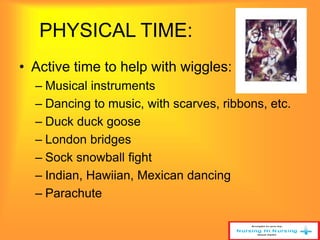
PHYSICAL TIME: 
• Active time to help with wiggles: 
– Musical instruments 
– Dancing to music, with scarves, ribbons, etc. 
– Duck duck goose 
– London bridges 
– Sock snowball fight 
– Indian, Hawiian, Mexican dancing 
– Parachute
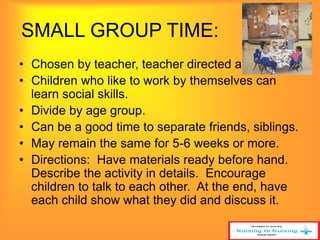
SMALL GROUP TIME: 
• Chosen by teacher, teacher directed activity. 
• Children who like to work by themselves can 
learn social skills. 
• Divide by age group. 
• Can be a good time to separate friends, siblings. 
• May remain the same for 5-6 weeks or more. 
• Directions: Have materials ready before hand. 
Describe the activity in details. Encourage 
children to talk to each other. At the end, have 
each child show what they did and discuss it.
SMALL GROUP cont’d: 
• IDEAS: 
– Art 
– Create a story 
– Read stories about the theme 
– Act out stories 
– Cooking experience 
– Math, science experiences 
– Letter of the week activity
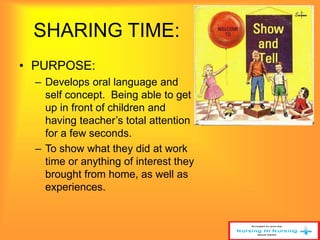
SHARING TIME: 
• PURPOSE: 
– Develops oral language and 
self concept. Being able to get 
up in front of children and 
having teacher’s total attention 
for a few seconds. 
– To show what they did at work 
time or anything of interest they 
brought from home, as well as 
experiences.
SHARING TIME GUIDELINES: 
• They don’t have to always have something. 
Or you could help them find something of interest or think of 
something to tell. 
• Have children guess what it is, give hints. 
• Focus on feelings 
– Get excited about what they brought. 
– Be sincere and remember how important this is to 
child. 
– Closeness and touching. 
– Have other children ask questions, clap & cheer for 
each other. 
– Can share good new and bad news.
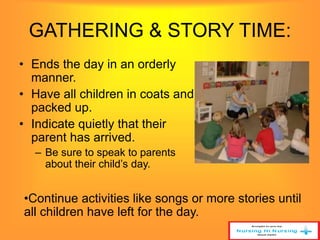
GATHERING & STORY TIME: 
• Ends the day in an orderly 
manner. 
• Have all children in coats and 
packed up. 
• Indicate quietly that their 
parent has arrived. 
– Be sure to speak to parents 
about their child’s day. 
•Continue activities like songs or more stories until 
all children have left for the day.
TRANSITIONS: 
• Help children move easily from one time period 
or activity to another. 
• Reduces confusion and disruptive behavior 
between activities. 
– Plan active times next to quiet or passive times. 
(Define active & passive activities) 
– Follow routines consistently. Why? 
– Clearly signal end of times. Give a 5 minute warning 
though. 
– Help children decide how to move from one area to 
the next. Ideas?
TRANSITIONS cont’d: 
• Should be well planned and smooth. 
• Don’t wait for all to assemble. 
• Keep things moving. 
• More gets done because we don’t waste time. 
• Those not finished can hear and see what is 
going on and will come soon. 
• “We’ll start after you are all quiet, sit still and 
listen” could be replaced with catching children 
attention. 
– Capture it within 30-40 seconds or they will be lost.
TOILETING ROUTINE: 
• Plan as a group before and after snack or 
meal time. 
• Be sure to have all children wash hands 
before snack and meal time and after 
toileting. 
• Make sure children understand they are 
free to use the bathroom at any time 
during the day.
EVALUATE THE DAY: 
• How did things go? 
• What went well and what didn’t? 
• How would I do things different next time?
FIELD TRIPS: 
• PURPOSE: To learn about the community 
and different occupations. 
• PREPARATION: Stories and activities 
about the field trip.
FIELD TRIPS cont’d: 
1. Need parent permission slips 
2. Need student permission slips 
3. Call the facility 
4. Arrange transportation 
5. Time (usually takes entire class time) 
6. Supervision (Assign each child to a teacher) 
7. Nametags not used in public places. Only have name of school and 
phone number. 
8. Food & drink (have extras for those who forgot) 
9. Sign (Post sign on door to remind parents ahead of time and inform late 
parent) 
10. Camera and drawing pads for children to record trip 
11. First Aid Kit 
12. List of questions to ask and discuss after 
13. Thank you letter or treat if appropriate
GUEST SPEAKERS: 
• PREPARATION: 
– Call and make all arrangements 
– Park in visitor parking 
– Age appropriate 
• Go over what they will say 
• Length of time 
– Thank you note within a week
ASSIGNMENT: 
• Create a daily schedule 
– Alternate active & passive 
– Snack mid morning with time to 
prepare 
• Outdoor play (20 minutes) 
• Small group (10 minutes) 
• Snack time, recall (10 minutes) 
• Story time (10 minutes) 
• Free play (20 minutes) 
• Circle time (20 minutes) 
• Work time (30 minutes) 
• Planning time (5 minutes) 
• Sharing time (10 minutes) 
• Song time (10 minutes) 
TOTAL TIME: 150 MINUTES 
(2 ½ HOURS) 
9:30 – 12:00 AM
This platform has been started by 
Parveen Kumar Chadha with the 
vision that nobody should suffer the 
way he has suffered because of lack 
and improper healthcare facilities in 
India. We need lots of funds 
manpower etc. to make this vision a 
reality please contact us. Join us as 
a member for a noble cause.
Our views have increased the 
mark of the 25,000 
 Thank you viewers 
 Looking forward for franchise, 
collaboration, partners.
Contact us:- 011-25464531, 9818569476 
E-mail:- nursingnursing@yahoo.in 
43 
Saxbee Consultants Details :-www.parveenchadha.com

Planning importance

  • 1.
  • 2.
    IMPORTANCE OF PLANNING: • BENEFITS TO YOU – Knowing what to expect reduces stress – Allows you to have the required materials – Following the day in an organized manner is easier and more fun – You feel confident about turning your program over to a substitute – Conveys professionalism to parents – Provides a sense of accomplishment & well-being
  • 3.
    IMPORTANCE OF PLANNING: • BENEFITS TO CHILDREN – Children know what to expect – Reduces tension thus reducing misbehavior • Will probably nap more restfully – Sense of time and sequence is developed – Children learn the skill of predicting, which helps with problem solving
  • 4.
    IMPORTANCE OF PLANNING: • BENEFITS TO PARENTS – Parents feel more secure when they know something about daily plans. – Encourages them to discuss with their child what is going on at school. – Helps educate parents on appropriate growth and development activities for their child.
  • 5.
    1. PICK ATHEME: • Brainstorm what a preschool child would like to study? All about me Shapes Colors Occupations Cowboys Harvest Families Nursery Rhymes Hygiene Foods Other Cultures Oceans Music Transportation Bugs Love/Valentines Dinosaurs Seasons Weather Rainbows Sports 5 senses Animals
  • 6.
    2. MAP EVERYTHINGTO LEARN ABOUT THEME • Small groups of students can each pick a theme and map or web everything to learn about the theme.
  • 7.
    3. DEFINE IMPORTANT TOPICS TO TEACH • Topics should be based on children’s interests and needs. • Decide on creative activities that will teach children about the topic. – Small group – Whole group – Learning centers – Field trips – Cooking experience
  • 8.
    4. DECIDE ONOBJECTIVES • Overall goals • Ask, “What type of learning is to occur?” • Should be based on observing and recording children’s needs. • Have knowledge of developmental stages • Help each child develop to their fullest – Age appropriate but challenging
  • 9.
    5. DECIDE ONLEARNING CENTER ACTIVITIES
  • 10.
    LEARNING CENTERS: SensoryTable Science Center Quiet Corner Computers Blocks
  • 11.
    GROUP ACTIVITY: •Each group needs a paper for each learning center and each student needs a colored marker. • Pass the papers around the group several times. Each student will write something that they think would belong in that center. • Share with the class. • Grade student participation by number of times they wrote in their color of marker.
  • 12.
    DAILY SCHEDULE •Schedule needs to be flexible so children can finish projects and activities. • Activities are designed to develop self esteem and positive feelings about learning. • Planning as a team is best. Why? • Teaching files can be very helpful in planning.
  • 13.
    FREE PLAY: •Inviting start of the preschool day. • Daily greet each child warmly. – It is essential to their self esteem. • Large motor activities of their choosing. – Acts on own imagination. • Best when restrictions are few. – Computers, blocks, balance beam, climbing tube, basket ball hoop, dress ups, puzzles, play dough, doll house or barn.
  • 14.
    CIRCLE TIME: •Everyone involved at the same time. – Children learn to be part of a group & participate. • Teach by encouraging, supporting and extending children’s choices and actions because children learn through action and drawing their own conclusions.
  • 15.
    CIRCLE TIME Cont’d: • Let children help decide what is to be done during circle time. – Choices: Calendar, pledge, count kids, songs, introduce theme, letter of week activity, birthdays, guest speakers.
  • 16.
    IT IS IMPORTANCETO PLAN EACH DAY WITH EACH CHILD what they will be doing for work time.
  • 17.
    PLANNING TIME withchildren: • THE IMPORANCE OF PLANNING: – Encourages verbal skills about choices and decisions – Promotes self esteem – Creates an environment of less self control – Leads to involvement and concentration on play
  • 18.
    No planning: •Creates aimlessness and wandering
  • 19.
    PLANNING IS: •A promise to do something acceptable • An exciting opportunity to form a mental model to guide future activities.
  • 20.
    TRUE or FALSE? • Planning helps preschool children develop a multi step sequence of actions. T • Children often modify their plans as they play. T • Planning is a non-flexible process only done before work time. F • Most young children are in the habit of planning. F
  • 21.
    Planning Helps theChildren: 1. Articulate ideas, choices and decisions. 2. Promotes children self confidence. 3. Promotes children’s sense of self control. 4. Leads to involvement & concentrated play. 5. Supports development of complex play.
  • 22.
    RESPONSES TO: “Whatwould you like to do?” • “I don’t know.” Give ideas and show centers • No answer. See where they are looking, notice gestures • Same every day. Encourage variety, show what others are doing
  • 23.
    CHILDREN CAN LEARNTO PLAN • First plans are vague • Then plans are routine • Then plans become detailed
  • 24.
    WORK TIME: •Children carry out projects and plans at various centers. • Adults assist, support and extend ideas. • If one project is complete they can go to another.
  • 25.
    CLEAN UP TIME: • Encourage clean up as they go. • Give a 5 minute warning so it doesn’t end abruptly. • Define specifically how to clean up. • Help them & work along with them. • Have clean up games. What are some? • Have them help others until everyone is done. • Move to a central gathering place and survey the room with children. • Motivate with a new activity as soon as cleanup is finished. • On messy days begin cleanup with a group meeting.
  • 26.
    RECALL TIME: (SNACK) • Recall and show what they did to small group. • Can see relation between plans and activities and develop awareness of their own actions. • Helps them evaluate and learn from their own experiences. • Recall in small groups helps them get ideas from others and hear others describe their work.
  • 27.
    PHYSICAL TIME: •Active time to help with wiggles: – Musical instruments – Dancing to music, with scarves, ribbons, etc. – Duck duck goose – London bridges – Sock snowball fight – Indian, Hawiian, Mexican dancing – Parachute
  • 28.
    SMALL GROUP TIME: • Chosen by teacher, teacher directed activity. • Children who like to work by themselves can learn social skills. • Divide by age group. • Can be a good time to separate friends, siblings. • May remain the same for 5-6 weeks or more. • Directions: Have materials ready before hand. Describe the activity in details. Encourage children to talk to each other. At the end, have each child show what they did and discuss it.
  • 29.
    SMALL GROUP cont’d: • IDEAS: – Art – Create a story – Read stories about the theme – Act out stories – Cooking experience – Math, science experiences – Letter of the week activity
  • 30.
    SHARING TIME: •PURPOSE: – Develops oral language and self concept. Being able to get up in front of children and having teacher’s total attention for a few seconds. – To show what they did at work time or anything of interest they brought from home, as well as experiences.
  • 31.
    SHARING TIME GUIDELINES: • They don’t have to always have something. Or you could help them find something of interest or think of something to tell. • Have children guess what it is, give hints. • Focus on feelings – Get excited about what they brought. – Be sincere and remember how important this is to child. – Closeness and touching. – Have other children ask questions, clap & cheer for each other. – Can share good new and bad news.
  • 32.
    GATHERING & STORYTIME: • Ends the day in an orderly manner. • Have all children in coats and packed up. • Indicate quietly that their parent has arrived. – Be sure to speak to parents about their child’s day. •Continue activities like songs or more stories until all children have left for the day.
  • 33.
    TRANSITIONS: • Helpchildren move easily from one time period or activity to another. • Reduces confusion and disruptive behavior between activities. – Plan active times next to quiet or passive times. (Define active & passive activities) – Follow routines consistently. Why? – Clearly signal end of times. Give a 5 minute warning though. – Help children decide how to move from one area to the next. Ideas?
  • 34.
    TRANSITIONS cont’d: •Should be well planned and smooth. • Don’t wait for all to assemble. • Keep things moving. • More gets done because we don’t waste time. • Those not finished can hear and see what is going on and will come soon. • “We’ll start after you are all quiet, sit still and listen” could be replaced with catching children attention. – Capture it within 30-40 seconds or they will be lost.
  • 35.
    TOILETING ROUTINE: •Plan as a group before and after snack or meal time. • Be sure to have all children wash hands before snack and meal time and after toileting. • Make sure children understand they are free to use the bathroom at any time during the day.
  • 36.
    EVALUATE THE DAY: • How did things go? • What went well and what didn’t? • How would I do things different next time?
  • 37.
    FIELD TRIPS: •PURPOSE: To learn about the community and different occupations. • PREPARATION: Stories and activities about the field trip.
  • 38.
    FIELD TRIPS cont’d: 1. Need parent permission slips 2. Need student permission slips 3. Call the facility 4. Arrange transportation 5. Time (usually takes entire class time) 6. Supervision (Assign each child to a teacher) 7. Nametags not used in public places. Only have name of school and phone number. 8. Food & drink (have extras for those who forgot) 9. Sign (Post sign on door to remind parents ahead of time and inform late parent) 10. Camera and drawing pads for children to record trip 11. First Aid Kit 12. List of questions to ask and discuss after 13. Thank you letter or treat if appropriate
  • 39.
    GUEST SPEAKERS: •PREPARATION: – Call and make all arrangements – Park in visitor parking – Age appropriate • Go over what they will say • Length of time – Thank you note within a week
  • 40.
    ASSIGNMENT: • Createa daily schedule – Alternate active & passive – Snack mid morning with time to prepare • Outdoor play (20 minutes) • Small group (10 minutes) • Snack time, recall (10 minutes) • Story time (10 minutes) • Free play (20 minutes) • Circle time (20 minutes) • Work time (30 minutes) • Planning time (5 minutes) • Sharing time (10 minutes) • Song time (10 minutes) TOTAL TIME: 150 MINUTES (2 ½ HOURS) 9:30 – 12:00 AM
  • 41.
    This platform hasbeen started by Parveen Kumar Chadha with the vision that nobody should suffer the way he has suffered because of lack and improper healthcare facilities in India. We need lots of funds manpower etc. to make this vision a reality please contact us. Join us as a member for a noble cause.
  • 42.
    Our views haveincreased the mark of the 25,000  Thank you viewers  Looking forward for franchise, collaboration, partners.
  • 43.
    Contact us:- 011-25464531,9818569476 E-mail:- nursingnursing@yahoo.in 43 Saxbee Consultants Details :-www.parveenchadha.com