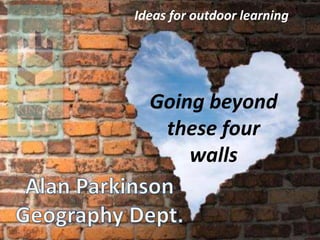
Going beyond
these four
walls
Ideas for outdoor learning
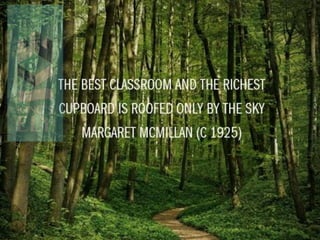
“Man is most nearly
himself when he
achieves the
seriousness of a
child at play.”
Herodotus, Greek
historian
Field Studies Council Research
• Substantial evidence exists to indicate that
fieldwork, properly conceived, adequately planned,
well taught and effectively followed up, offers
learners opportunities to develop their knowledge
and skills in ways that add value to their everyday
experiences in the classroom.
• Specifically, fieldwork can have a positive impact on
long-term memory due to the memorable nature of the
fieldwork setting. Effective fieldwork, and residential
experience in particular, can lead to individual growth
and improvements in social skills. More importantly,
there can be reinforcement between the affective and
the cognitive, with each influencing the other and
providing a bridge to higher order learning.
#kebeyond4walls
• 78% of parents are concerned that children
don’t spend enough time interacting with
nature
• 57% of parents say their children spend a
little or a lot less time outdoors than they did
Wildlife Trust Research
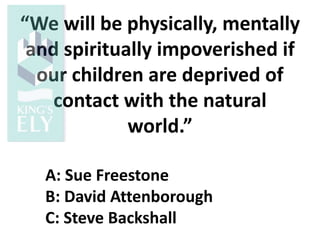
“We will be physically, mentally
and spiritually impoverished if
our children are deprived of
contact with the natural
world.”
A: Sue Freestone
B: David Attenborough
C: Steve Backshall
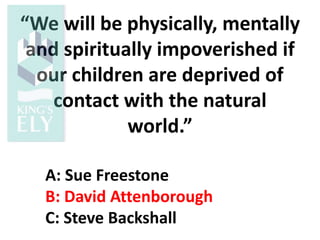
“We will be physically, mentally
and spiritually impoverished if
our children are deprived of
contact with the natural
world.”
A: Sue Freestone
B: David Attenborough
C: Steve Backshall
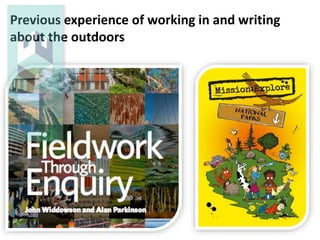
Previous experience of working in and writing
about the outdoors
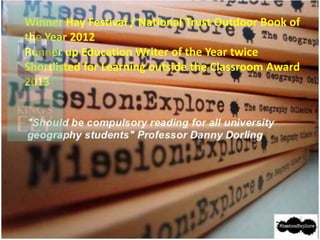
Winner Hay Festival / National Trust Outdoor Book of
the Year 2012
Runner up Education Writer of the Year twice
Shortlisted for Learning outside the Classroom Award
2013
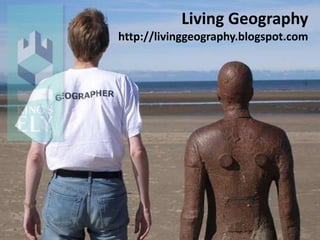
Living Geography
http://livinggeography.blogspot.com
Risk
Minimised in the classroom…
Check out the work of West Rise
Primary School
https://www.channel4.com/news/buff
alo-shotguns-and-quad-bikes-at-school
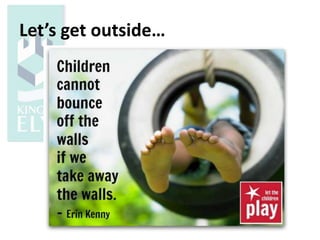
Let’s get outside…
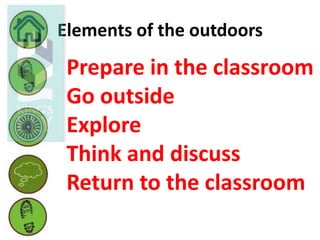
Elements of the outdoors
Prepare in the classroom
Go outside
Explore
Think and discuss
Return to the classroom
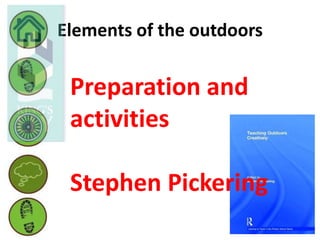
Elements of the outdoors
Preparation and
activities
Stephen Pickering
“In an English school,
teachers can teach their
children anything at all as
long as it is legal and safe..”
Mick Waters
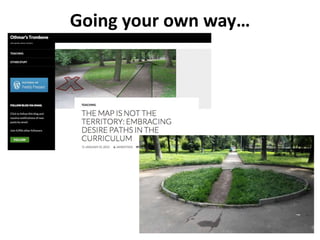
Going your own way…
15 + 45 + 15
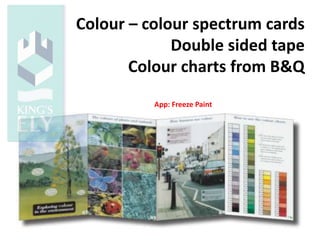
Colour – colour spectrum cards
Double sided tape
Colour charts from B&Q
App: Freeze Paint
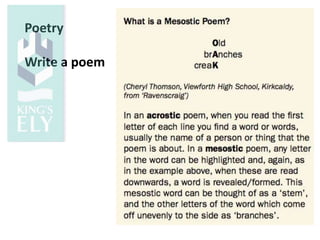
Poetry
Write a poem
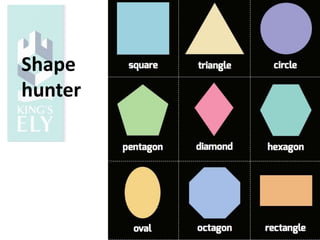
Shape
hunter
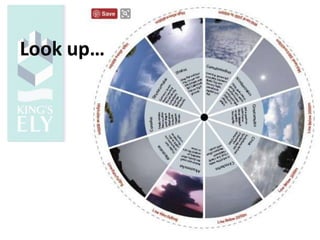
Look up…
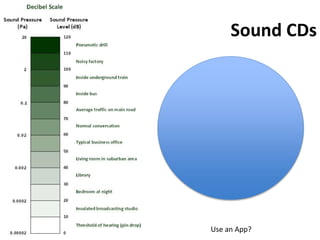
Sound CDs
Use an App?
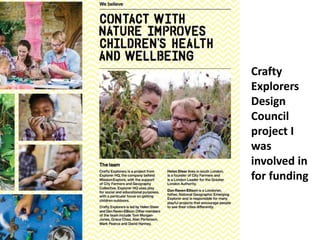
Crafty
Explorers
Design
Council
project I
was
involved in
for funding
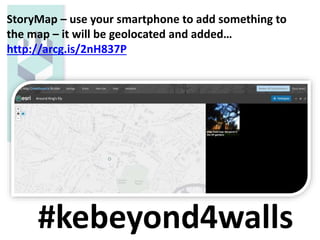
StoryMap – use your smartphone to add something to
the map – it will be geolocated and added…
http://arcg.is/2nH837P
#kebeyond4walls
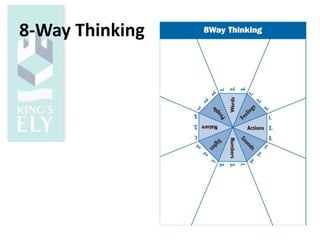
8-Way Thinking
Dérive…
Sharon Witt, University of
Winchester
Ways of Walking
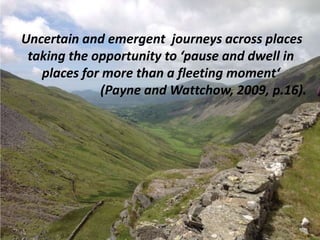
Uncertain and emergent journeys across places
taking the opportunity to ‘pause and dwell in
places for more than a fleeting moment‘
(Payne and Wattchow, 2009, p.16).
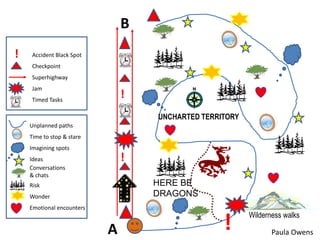
A
B
HERE BE
DRAGONS
!
!
Wilderness walks
UNCHARTED TERRITORY
Unplanned paths
Time to stop & stare
Imagining spots
Ideas
Conversations
& chats
Risk
Wonder
Emotional encounters
! Accident Black Spot
Checkpoint
Superhighway
Jam
Timed Tasks
! Paula Owens
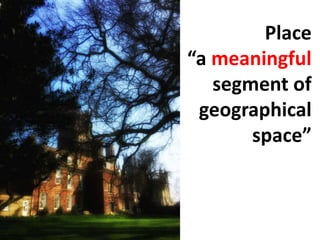
Place
“a meaningful
segment of
geographical
space”
Comfort
Zone
Pedagogy:
“leading students to a
place where they can
learn”
Your challenge
•Select an activity
•Add a subject context
•Create a curriculum
artefact
curriculum artefacts
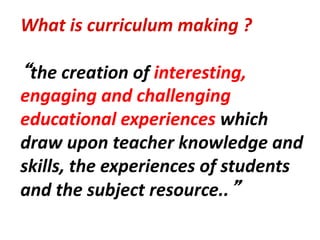
What is curriculum making ?
“the creation of interesting,
engaging and challenging
educational experiences which
draw upon teacher knowledge and
skills, the experiences of students
and the subject resource..”
The use of curriculum artefacts is important when
planning lessons. You may have returned from the
Easter break with a range of new items which could be
used in a lesson. These could include:
Clothing
Stones or sand from a beach
Maps
Leaflets and other ephemera including tickets
Images
Sound clips
Video material
Souvenirs that you have bought
Memories
By themselves these remain simply ‘things’ but in the hands of a
teacher they come to life.
This happens for three reasons, which are to do with the skill of
the teacher, as described by Professor David Lambert.
“First, using this resource requires specialist subject
knowledge to realise the educational benefits of using
it.
Secondly, it requires the teacher to decide on a sound
way to use the resource.
Thirdly, it requires the teacher to able to 'place' the
resource really effectively - thinking about what prior
knowledge would be helpful and how to follow it
through and build on the understanding gained
through its use.”
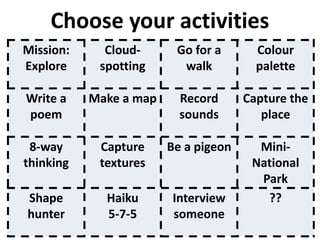
Choose your activities
Mission:
Explore
Cloud-
spotting
Go for a
walk
Colour
palette
Write a
poem
Make a map Record
sounds
Capture the
place
8-way
thinking
Capture
textures
Be a pigeon Mini-
National
Park
Shape
hunter
Haiku
5-7-5
Interview
someone
??
Your challenge
•Select an activity
•Add a subject context
•Create a curriculum
artefact
Be back here in 45 minutes
please… and be ready to share…
#kebeyond4walls
Feedback / forward
• What did you learn about the place(s)
that you visited?
• How could you use the outdoors in your
own subject area?
• What ONE thing are you going to try
during the summer term?
#kebeyond4walls
References
FSC Research Report (2004)
https://www.field-studies-
council.org/media/268859/2004_a_review_of_r
esearch_on_outdoor_learning.pdf
Stephen Pickering: “Teaching Outdoors
Creatively: Learning to teach in the Primary
School” – Routledge (April 2017) – next week
Sharon Witt
Dr. Paula Owens
References
Sound mapping:
http://www.rgs.org/OurWork/Schools/Fieldwork+a
nd+local+learning/Fieldwork+techniques/Fieldwork
+technology/Soundscapes.htm
Keri Smith: “How to be an Explorer of the World”

Beyond These 4 Walls Final

  • 1.
  • 2.
    “Man is mostnearly himself when he achieves the seriousness of a child at play.” Herodotus, Greek historian
  • 3.
    Field Studies CouncilResearch • Substantial evidence exists to indicate that fieldwork, properly conceived, adequately planned, well taught and effectively followed up, offers learners opportunities to develop their knowledge and skills in ways that add value to their everyday experiences in the classroom. • Specifically, fieldwork can have a positive impact on long-term memory due to the memorable nature of the fieldwork setting. Effective fieldwork, and residential experience in particular, can lead to individual growth and improvements in social skills. More importantly, there can be reinforcement between the affective and the cognitive, with each influencing the other and providing a bridge to higher order learning.
  • 4.
    #kebeyond4walls • 78% ofparents are concerned that children don’t spend enough time interacting with nature • 57% of parents say their children spend a little or a lot less time outdoors than they did Wildlife Trust Research
  • 7.
    “We will bephysically, mentally and spiritually impoverished if our children are deprived of contact with the natural world.” A: Sue Freestone B: David Attenborough C: Steve Backshall
  • 8.
    “We will bephysically, mentally and spiritually impoverished if our children are deprived of contact with the natural world.” A: Sue Freestone B: David Attenborough C: Steve Backshall
  • 9.
    Previous experience ofworking in and writing about the outdoors
  • 10.
    Winner Hay Festival/ National Trust Outdoor Book of the Year 2012 Runner up Education Writer of the Year twice Shortlisted for Learning outside the Classroom Award 2013
  • 11.
  • 12.
    Risk Minimised in theclassroom… Check out the work of West Rise Primary School https://www.channel4.com/news/buff alo-shotguns-and-quad-bikes-at-school
  • 13.
  • 14.
    Elements of theoutdoors Prepare in the classroom Go outside Explore Think and discuss Return to the classroom
  • 15.
    Elements of theoutdoors Preparation and activities Stephen Pickering
  • 17.
    “In an Englishschool, teachers can teach their children anything at all as long as it is legal and safe..” Mick Waters
  • 18.
  • 19.
    15 + 45+ 15
  • 20.
    Colour – colourspectrum cards Double sided tape Colour charts from B&Q App: Freeze Paint
  • 21.
  • 23.
  • 24.
  • 25.
  • 26.
  • 27.
    StoryMap – useyour smartphone to add something to the map – it will be geolocated and added… http://arcg.is/2nH837P #kebeyond4walls
  • 28.
  • 29.
    Dérive… Sharon Witt, Universityof Winchester Ways of Walking
  • 30.
    Uncertain and emergentjourneys across places taking the opportunity to ‘pause and dwell in places for more than a fleeting moment‘ (Payne and Wattchow, 2009, p.16).
  • 31.
    A B HERE BE DRAGONS ! ! Wilderness walks UNCHARTEDTERRITORY Unplanned paths Time to stop & stare Imagining spots Ideas Conversations & chats Risk Wonder Emotional encounters ! Accident Black Spot Checkpoint Superhighway Jam Timed Tasks ! Paula Owens
  • 32.
  • 33.
  • 34.
    Pedagogy: “leading students toa place where they can learn”
  • 35.
    Your challenge •Select anactivity •Add a subject context •Create a curriculum artefact
  • 36.
  • 37.
    What is curriculummaking ? “the creation of interesting, engaging and challenging educational experiences which draw upon teacher knowledge and skills, the experiences of students and the subject resource..”
  • 38.
    The use ofcurriculum artefacts is important when planning lessons. You may have returned from the Easter break with a range of new items which could be used in a lesson. These could include: Clothing Stones or sand from a beach Maps Leaflets and other ephemera including tickets Images Sound clips Video material Souvenirs that you have bought Memories
  • 39.
    By themselves theseremain simply ‘things’ but in the hands of a teacher they come to life. This happens for three reasons, which are to do with the skill of the teacher, as described by Professor David Lambert. “First, using this resource requires specialist subject knowledge to realise the educational benefits of using it. Secondly, it requires the teacher to decide on a sound way to use the resource. Thirdly, it requires the teacher to able to 'place' the resource really effectively - thinking about what prior knowledge would be helpful and how to follow it through and build on the understanding gained through its use.”
  • 40.
    Choose your activities Mission: Explore Cloud- spotting Gofor a walk Colour palette Write a poem Make a map Record sounds Capture the place 8-way thinking Capture textures Be a pigeon Mini- National Park Shape hunter Haiku 5-7-5 Interview someone ??
  • 41.
    Your challenge •Select anactivity •Add a subject context •Create a curriculum artefact
  • 42.
    Be back herein 45 minutes please… and be ready to share… #kebeyond4walls
  • 43.
    Feedback / forward •What did you learn about the place(s) that you visited? • How could you use the outdoors in your own subject area? • What ONE thing are you going to try during the summer term? #kebeyond4walls
  • 44.
    References FSC Research Report(2004) https://www.field-studies- council.org/media/268859/2004_a_review_of_r esearch_on_outdoor_learning.pdf Stephen Pickering: “Teaching Outdoors Creatively: Learning to teach in the Primary School” – Routledge (April 2017) – next week Sharon Witt Dr. Paula Owens
  • 45.