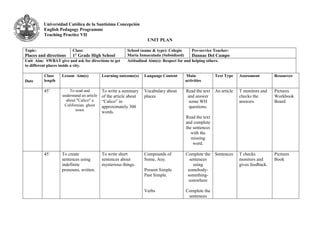
Universidad Católica de la Santísima Concepción 
English Pedagogy Programme 
Teaching Practice VII 
UNIT PLAN 
Topic: 
Places and directions 
Class: 
1° Grade High School 
School (name & type): Colegio 
María Inmaculada (Subsidized) 
Pre-service Teacher: 
Dannae Del Campo 
Unit Aim: SWBAT give and ask for directions to get 
to different places inside a city. 
Attitudinal Aim(s): Respect for and helping others. 
Date 
Class 
length 
Lesson Aim(s) 
Learning outcome(s) Language Content Main 
activities 
Text Type Assessment Resources 
45’ To read and 
understand an article 
about "Calico" a 
Californian. ghost 
town 
To write a summary 
of the article about 
“Calico” in 
approximately 300 
words. 
Vocabulary about 
places 
Read the text 
and answer 
some WH 
questions. 
Read the text 
and complete 
the sentences 
with the 
missing 
word. 
An article T monitors and 
checks the 
answers. 
Pictures 
Workbook 
Board 
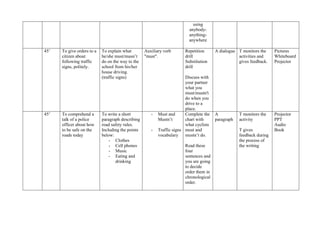
45´ To create 
sentences using 
indefinite 
pronouns, written. 
To write short 
sentences about 
mysterious things. 
Compounds of 
Some, Any. 
Present Simple 
Past Simple. 
Verbs 
Complete the 
sentences 
using 
somebody-something-somwhere 
Complete the 
sentences 
Sentences T checks 
monitors and 
gives feedback. 
Pictures 
Book
using 
anybody-anything-anywhere 
45’ To give orders to a 
citizen about 
following traffic 
signs, politely. 
To explain what 
he/she must/musn’t 
do on the way to the 
school from his/her 
house driving. 
(traffic signs) 
Auxiliary verb 
"must". 
Repetition 
drill 
Substitution 
drill 
Discuss with 
your partner 
what you 
must/mustn't 
do when you 
drive to a 
place. 
A dialogue T monitors the 
activities and 
gives feedback. 
Pictures 
Whiteboard 
Projector 
45’ To comprehend a 
talk of a police 
officer about how 
to be safe on the 
roads today 
To write a short 
paragraph describing 
road safety rules. 
Including the points 
below: 
- Clothes 
- Cell phones 
- Music 
- Eating and 
drinking 
- Must and 
Mustn’t 
- Traffic signs 
vocabulary 
Complete the 
chart with 
what cyclists 
must and 
mustn’t do. 
Read these 
four 
sentences and 
you are going 
to decide 
order them in 
chronological 
order. 
A 
paragraph 
T monitors the 
activity 
T gives 
feedback during 
the process of 
the writing 
Projector 
PPT 
Audio 
Book
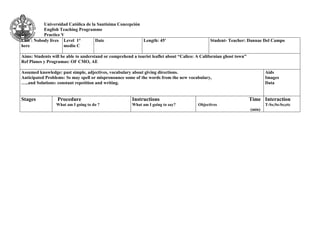
Universidad Católica de la Santísima Concepción 
English Teaching Programme 
Practice V 
Unit : Nobody lives 
here 
Level 1° 
medio C 
Date 
Length: 45' 
Student- Teacher: Dannae Del Campo 
Aims: Students will be able to understand or comprehend a tourist leaflet about “Calico: A Californian ghost town” 
Ref Planes y Programas: OF CMO, AE 
Assumed knowledge: past simple, adjectives, vocabulary about giving directions. 
Anticipated Problems: Ss may spell or mispronounce some of the words from the new vocabulary, 
…..and Solutions: constant repetition and writing. 
Aids 
Images 
Data 
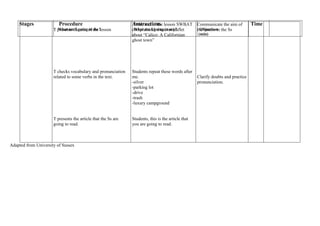
Stages 
Procedure 
What am I going to do ? 
Instructions 
What am I going to say? 
Time 
Objectives 
(min) 
Interaction 
T-Ss;Ss-Ss;etc
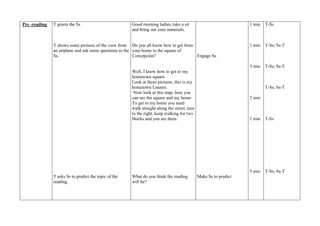
Pre -reading T greets the Ss 
T shows some pictures of the view from 
an airplane and ask some questions to the 
Ss. 
T asks Ss to predict the topic of the 
reading. 
Good morning ladies, take a sit 
and bring out your materials. 
Do you all know how to get from 
your home to the square of 
Concepción? 
Well, I know how to get to my 
hometown square. 
Look at these pictures, this is my 
hometown Linares. 
Now look at this map, here you 
can see the square and my home. 
To get to my home you need 
walk straight along the street, turn 
to the right, keep walking for two 
blocks and you are there. 
What do you think the reading 
will be? 
Engage Ss 
Make Ss to predict 
1 min 
1 min 
3 min 
2 min 
1 min 
5 min 
T-Ss 
T-Ss; Ss-T 
T-Ss; Ss-T 
T-Ss; Ss-T 
T-Ss 
T-Ss; Ss-T
T presents the aim of the lesson 
T checks vocabulary and pronunciation 
related to some verbs in the text. 
T presents the article that the Ss are 
going to read. 
Adapted from University of Sussex 
At the end of the lesson SWBAT 
comprehend a tourist leaflet 
about “Calico: A Californian 
ghost town” 
Students repeat these words after 
me. 
-silver 
-parking lot 
-drive 
-trash 
-luxury campground 
Students, this is the article that 
you are going to read. 
Communicate the aim of 
the lesson to the Ss 
Clarify doubts and practice 
pronunciation. 
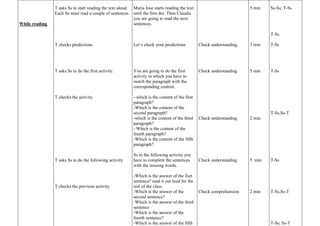
Stages 
Procedure 
What am I going to do ? 
Instructions 
What am I going to say? 
Objectives 
(min) 
Time
While reading 
T asks Ss to start reading the text aloud. 
Each Ss must read a couple of sentences. 
T checks predictions 
T asks Ss to do the first activity. 
T checks the activity 
T asks Ss to do the following activity. 
T checks the previous activity. 
Maria Jose starts reading the text 
until the first dot. Then Claudia 
you are going to read the next 
sentences. 
Let’s check your predictions 
You are going to do the first 
activity in which you have to 
match the paragraph with the 
corresponding content. 
- which is the content of the first 
paragraph? 
-Which is the content of the 
second paragraph? 
-which is the content of the third 
paragraph? 
- Which is the content of the 
fourth paragraph? 
-Which is the content of the fifth 
paragraph? 
Ss in the following activity you 
have to complete the sentences 
with the missing words. 
-Which is the answer of the fisrt 
sentence? read it out loud for the 
rest of the class. 
-Which is the answer of the 
second sentence? 
-Which is the answer of the third 
sentence 
-Which is the answer of the 
fourth sentence? 
-Which is the answer of the fifth 
Check understanding. 
Check understanding 
Check understanding 
Check understanding 
Check comprehension 
5 min 
3 min 
5 min 
2 min 
5 min 
2 min 
Ss-Ss; T-Ss 
T-Ss 
T-Ss 
T-Ss 
T-Ss;Ss-T 
T-Ss 
T-Ss;Ss-T 
T-Ss; Ss-T
POST LESSON COMMENTS: 
How did the lesson come out in relation to what you have planned? Refer to: aims, anticipated problems, time, students’ motivation, 
organization, setting up tasks. 
What would be the aspects you need to improve in the planning and development of future lessons? 
Adapted from University of Sussex
Universidad Católica de la Santísima Concepción 
English Pedagogy 
Teaching Practice 
LESSON PLAN 
Class: I medio C 
School: Colegio María Inmaculada 
Date of lesson: 
Time of lesson: 
08:00-08:45 
Length of 
lesson: 
45’ 
Student-Teacher’s 
name: 
Dannae Del Campo
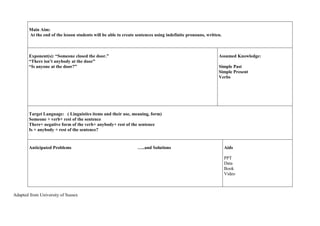
Main Aim: 
At the end of the lesson students will be able to create sentences using indefinite pronouns, written. 
Exponent(s): “Someone closed the door.” 
“There isn’t anybody at the door” 
“Is anyone at the door?” 
Adapted from University of Sussex 
Assumed Knowledge: 
Simple Past 
Simple Present 
Verbs 
Target Language: ( Linguistics items and their use, meaning, form) 
Someone + verb+ rest of the sentence 
There+ negative form of the verb+ anybody+ rest of the sentence 
Is + anybody + rest of the sentence? 
Anticipated Problems …..and Solutions 
Aids 
PPT 
Data 
Book 
Video
Stages 
Procedure 
What I am going to do 
What I am going to say 
Instructions, CCQs, Feedback,etc 
Skill 
Time 
(min) 
Interactio 
n 
T-Ss;Ss- 
Ss;etc 
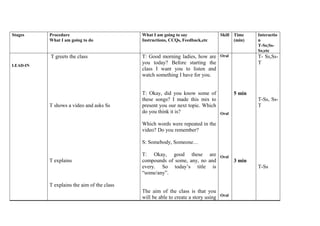
LEAD-IN 
T greets the class 
T shows a video and asks Ss 
T explains 
T explains the aim of the class 
T: Good morning ladies, how are 
you today? Before starting the 
class I want you to listen and 
watch something I have for you. 
T: Okay, did you know some of 
these songs? I made this mix to 
present you our next topic. Which 
do you think it is? 
Which words were repeated in the 
video? Do you remember? 
S: Somebody, Someone… 
T: Okay, good these are 
compounds of some, any, no and 
every. So today’s title is 
“some/any”. 
The aim of the class is that you 
will be able to create a story using 
Oral 
Oral 
Oral 
Oral 
5 min 
3 min 
T- Ss,Ss- 
T 
T-Ss, Ss- 
T 
T-Ss
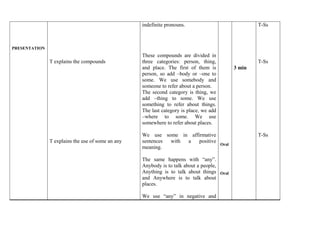
PRESENTATION 
T explains the compounds 
T explains the use of some an any 
indefinite pronouns. 
These compounds are divided in 
three categories: person, thing, 
and place. The first of them is 
person, so add –body or –one to 
some. We use somebody and 
someone to refer about a person. 
The second category is thing, we 
add –thing to some. We use 
something to refer about things. 
The last category is place, we add 
–where to some. We use 
somewhere to refer about places. 
We use some in affirmative 
sentences with a positive 
meaning. 
The same happens with “any”. 
Anybody is to talk about a people, 
Anything is to talk about things 
and Anywhere is to talk about 
places. 
We use “any” in negative and 
Oral 
Oral 
3 min 
T-Ss 
T-Ss 
T-Ss
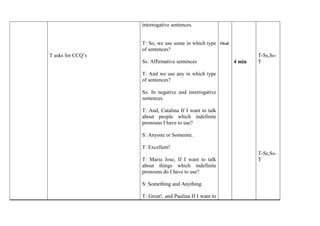
T asks for CCQ’s 
interrogative sentences. 
T: So, we use some in which type 
of sentences? 
Ss: Affirmative sentences 
T: And we use any in which type 
of sentences? 
Ss: In negative and interrogative 
sentences. 
T: And, Catalina If I want to talk 
about people which indefinite 
pronouns I have to use? 
S: Anyone or Someone. 
T: Excellent! 
T: Maria Jose, If I want to talk 
about things which indefinite 
pronouns do I have to use? 
S: Something and Anything. 
T: Great!, and Paulina If I want to 
Oral 
4 min 
T-Ss,Ss- 
T 
T-Ss,Ss- 
T
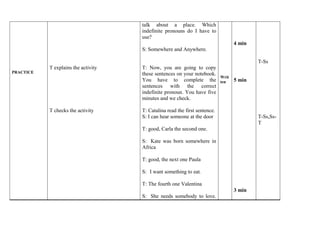
PRACTICE 
T explains the activity 
T checks the activity 
talk about a place. Which 
indefinite pronouns do I have to 
use? 
S: Somewhere and Anywhere. 
T: Now, you are going to copy 
these sentences on your notebook. 
You have to complete the 
sentences with the correct 
indefinite pronoun. You have five 
minutes and we check. 
T: Catalina read the first sentence. 
S: I can hear someone at the door 
T: good, Carla the second one. 
S: Kate was born somewhere in 
Africa 
T: good, the next one Paula 
S: I want something to eat. 
T: The fourth one Valentina 
S: She needs somebody to love. 
Writ 
ten 
4 min 
5 min 
3 min 
T-Ss 
T-Ss,Ss- 
T
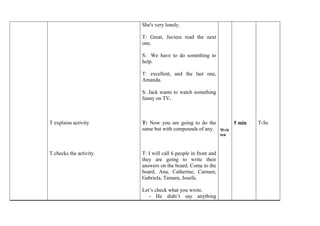
T explains activity 
T checks the activity. 
She's very lonely. 
T: Great, Javiera read the next 
one. 
S: We have to do something to 
help. 
T: excellent, and the last one, 
Amanda. 
S: Jack wants to watch something 
funny on TV. 
T: Now you are going to do the 
same but with compounds of any. 
T: I will call 6 people in front and 
they are going to write their 
answers on the board. Come to the 
board, Ana, Catherine, Carmen, 
Gabriela, Tamara, Josefa. 
Let’s check what you wrote. 
- He didn’t say anything 
Writ 
ten 
5 min 
T-Ss
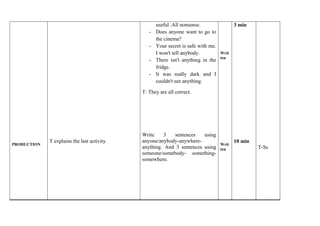
PRODUCTION 
T explains the last activity. 
useful .All nonsense. 
- Does anyone want to go to 
the cinema? 
- Your secret is safe with me. 
I won't tell anybody. 
- There isn't anything in the 
fridge. 
- It was really dark and I 
couldn't see anything. 
T: They are all correct. 
Write 3 sentences using 
anyone/anybody-anywhere-anything. 
And 3 sentences using 
someone/somebody- something-somewhere. 
Writ 
ten 
Writ 
ten 
3 min 
10 min 
T-Ss
POST LESSON COMMENTS: 
__________________________________________________________________________________________________________________________ 
__________________________________________________________________________________________________________________________ 
__________________________________________________________________________________________________________________________ 
__________________________________________________________________________________________________ 
___________________________________________________________________________________________________________________
Universidad Católica de la Santísima Concepción 
English Pedagogy 
Teaching Practice 
LESSON PLAN
Adapted from University of Sussex 
Class: 1 medio C 
School: Colegio María Inmaculada 
Date of lesson: 
Time of lesson: 
08:00-08:45 
Length of 
lesson: 
45’ 
Student-Teacher’s 
name: 
Dannae Del Campo 
Main Aim: 
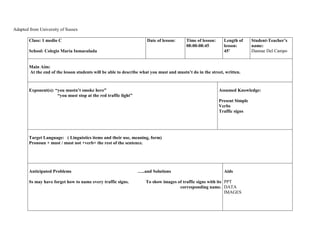
At the end of the lesson students will be able to describe what you must and mustn’t do in the street, written. 
Exponent(s): “you mustn’t smoke here” 
“you must stop at the red traffic light” 
Assumed Knowledge: 
Present Simple 
Verbs 
Traffic signs 
Target Language: ( Linguistics items and their use, meaning, form) 
Pronoun + must / must not +verb+ the rest of the sentence. 
Anticipated Problems …..and Solutions 
Ss may have forget how to name every traffic signs. To show images of traffic signs with its 
corresponding name. 
Aids 
PPT 
DATA 
IMAGES
Stages 
Procedure 
What I am going to do 
What I am going to say 
Instructions, CCQs, Feedback,etc 
Skill 
Time 
(min) 
Interaction 
T-Ss;Ss-Ss;etc 
LEAD-IN 
PRESENTATION 
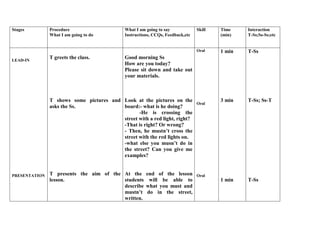
T greets the class. 
T shows some pictures and 
asks the Ss. 
T presents the aim of the 
lesson. 
Good morning Ss 
How are you today? 
Please sit down and take out 
your materials. 
Look at the pictures on the 
board:- what is he doing? 
-He is crossing the 
street with a red light, right? 
-That is right? Or wrong? 
- Then, he mustn’t cross the 
street with the red lights on. 
-what else you musn’t do in 
the street? Can you give me 
examples? 
At the end of the lesson 
students will be able to 
describe what you must and 
mustn’t do in the street, 
written. 
Oral 
Oral 
Oral 
1 min 
3 min 
1 min 
T-Ss 
T-Ss; Ss-T 
T-Ss
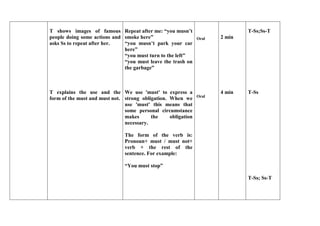
T shows images of famous 
people doing some actions and 
asks Ss to repeat after her. 
T explains the use and the 
form of the must and must not. 
Repeat after me: “you musn’t 
smoke here” 
“you musn’t park your car 
here” 
“you must turn to the left” 
“you must leave the trash on 
the garbage” 
We use 'must' to express a 
strong obligation. When we 
use 'must' this means that 
some personal circumstance 
makes the obligation 
necessary. 
The form of the verb is: 
Pronoun+ must / must not+ 
verb + the rest of the 
sentence. For example: 
“You must stop” 
Oral 
Oral 
2 min 
4 min 
T-Ss;Ss-T 
T-Ss 
T-Ss; Ss-T
PRACTICE 
T asks for CCQ’s 
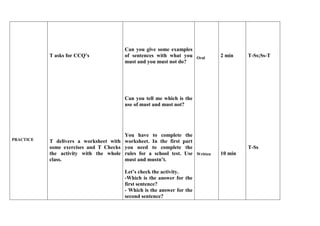
T delivers a worksheet with 
some exercises and T Checks 
the activity with the whole 
class. 
Can you give some examples 
of sentences with what you 
must and you must not do? 
Can you tell me which is the 
use of must and must not? 
You have to complete the 
worksheet. In the first part 
you need to complete the 
rules for a school test. Use 
must and mustn’t. 
Let’s check the activity. 
-Which is the answer for the 
first sentence? 
- Which is the answer for the 
second sentence? 
Oral 
Written 
2 min 
10 min 
T-Ss;Ss-T 
T-Ss
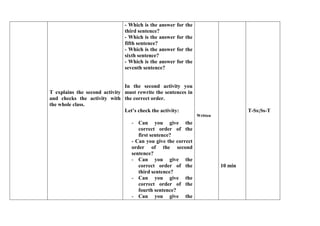
T explains the second activity 
and checks the activity with 
the whole class. 
- Which is the answer for the 
third sentence? 
- Which is the answer for the 
fifth sentence? 
- Which is the answer for the 
sixth sentence? 
- Which is the answer for the 
seventh sentence? 
In the second activity you 
must rewrite the sentences in 
the correct order. 
Let’s check the activity: 
- Can you give the 
correct order of the 
first sentence? 
- Can you give the correct 
order of the second 
sentence? 
- Can you give the 
correct order of the 
third sentence? 
- Can you give the 
correct order of the 
fourth sentence? 
- Can you give the 
Written 
10 min 
T-Ss;Ss-T
PRODUCTION 
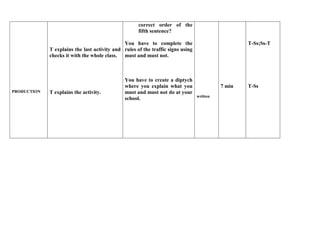
T explains the last activity and 
checks it with the whole class. 
T explains the activity. 
correct order of the 
fifth sentence? 
You have to complete the 
rules of the traffic signs using 
must and must not. 
You have to create a diptych 
where you explain what you 
must and must not do at your 
school. 
written 
7 min 
T-Ss;Ss-T 
T-Ss
POST LESSON COMMENTS: 
__________________________________________________________________________________________________________________________ 
__________________________________________________________________________________________________________________________ 
__________________________________________________________________________________________________________________________ 
__________________________________________________________________________________________________ 
___________________________________________________________________________________________________________________
Universidad Católica de la Santísima Concepción 
Unit : 
Nobody lives here 
Level 
I medio C 
Date 
Length 
English Teaching Programme 
Practice V 
45’ 
Student- Teacher 
Dannae Del Campo Méndez 
Aims: Students will be able to comprehend a talk of a police officer about how to be safe on the roads today. 
Planes y Programas: OF CMO, AE 
Assumed knowledge ( Content, vocabulary, strategies) 
- Must and Mustn’t 
- Traffic signs vocabulary 
Aids 
Power Point 
Images
Anticipated Problems: They won’t be able to understand all the vocabulary during the talk. 
…..and Solutions: To show images with new vocabulary before the listening. 
Data 
Whiteboard 
Stages 
Procedure 
What am I going to do ? 
What are students going to do? 
Instructions 
What am I going to say? 
Time 
Objectives 
(min) 
Interaction 
T-Ss;Ss-Ss;etc 
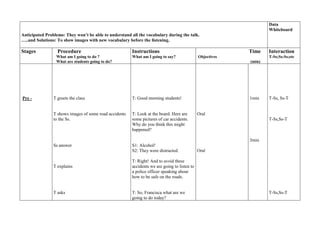
Pre - 
T greets the class 
T shows images of some road accidents 
to the Ss. 
Ss answer 
T explains 
T asks 
T: Good morning students! 
T: Look at the board. Here are 
some pictures of car accidents. 
Why do you think this might 
happened? 
S1: Alcohol! 
S2: They were distracted. 
T: Right! And to avoid these 
accidents we are going to listen to 
a police officer speaking about 
how to be safe on the roads. 
T: So, Francisca what are we 
going to do today? 
Oral 
Oral 
1min 
3min 
T-Ss, Ss-T 
T-Ss,Ss-T 
T-Ss,Ss-T
S answer 
T explains the aim of the lesson 
Adapted from University of Sussex 
S: we are going to listen to a 
police officer. 
T: exactly! So, the aim of the 
lesson is that you will be able to 
understand a talk of a police 
officer about how to be safe on 
the roads today. 
Oral 
3min 
T-Ss 
Stages 
Procedure 
What am I going to do ? 
What are the students going to do? 
Instructions 
What am I going to say? 
Skills 
(min) 
Time
While 
T explains 
T explains 
T asks 
Ss answer 
T checks the answers 
T: So, now you are going to listen 
to Denzel Wilcox, a police 
officer, speaking about how to be 
safe on roads. Pay attention. 
T: So, the first activity says 
complete the chart with what 
cyclists must and mustn’t do. For 
that we are going to listen again 
but this time pay attention to the 
answers you need. 
T: What cyclist must do? 
S1: They must wear a helmet 
S2: They must ride the correct 
side of the road. 
T: what else? 
Ss: They must use hand signals 
T: right! 
T: So, now you have to put your 
answers in the chart and we are 
going to check together. You 
have 5 minutes. 
T: Josefa, read the first sentence 
on what cyclist must do. 
S1: They must wear a helmet 
T: correct! Maria Jose read the 
second one. 
Oral 
Written 
Oral 
10min 
10 min 
7 min 
T-Ss 
T-Ss 
T-Ss,Ss-T 
T-Ss 
T-Ss,Ss-T
POST LESSON COMMENTS : 
How did the lesson come out in relation to what you have planned? Refer to: aims, anticipated problems, time, students’ motivation, 
organization, setting up tasks. 
What would be the aspects you need to improve in the planning and development of future lessons?

Dannae unit plan and individual lessons

  • 1.
    Universidad Católica dela Santísima Concepción English Pedagogy Programme Teaching Practice VII UNIT PLAN Topic: Places and directions Class: 1° Grade High School School (name & type): Colegio María Inmaculada (Subsidized) Pre-service Teacher: Dannae Del Campo Unit Aim: SWBAT give and ask for directions to get to different places inside a city. Attitudinal Aim(s): Respect for and helping others. Date Class length Lesson Aim(s) Learning outcome(s) Language Content Main activities Text Type Assessment Resources 45’ To read and understand an article about "Calico" a Californian. ghost town To write a summary of the article about “Calico” in approximately 300 words. Vocabulary about places Read the text and answer some WH questions. Read the text and complete the sentences with the missing word. An article T monitors and checks the answers. Pictures Workbook Board 45´ To create sentences using indefinite pronouns, written. To write short sentences about mysterious things. Compounds of Some, Any. Present Simple Past Simple. Verbs Complete the sentences using somebody-something-somwhere Complete the sentences Sentences T checks monitors and gives feedback. Pictures Book
  • 2.
    using anybody-anything-anywhere 45’To give orders to a citizen about following traffic signs, politely. To explain what he/she must/musn’t do on the way to the school from his/her house driving. (traffic signs) Auxiliary verb "must". Repetition drill Substitution drill Discuss with your partner what you must/mustn't do when you drive to a place. A dialogue T monitors the activities and gives feedback. Pictures Whiteboard Projector 45’ To comprehend a talk of a police officer about how to be safe on the roads today To write a short paragraph describing road safety rules. Including the points below: - Clothes - Cell phones - Music - Eating and drinking - Must and Mustn’t - Traffic signs vocabulary Complete the chart with what cyclists must and mustn’t do. Read these four sentences and you are going to decide order them in chronological order. A paragraph T monitors the activity T gives feedback during the process of the writing Projector PPT Audio Book
  • 3.
    Universidad Católica dela Santísima Concepción English Teaching Programme Practice V Unit : Nobody lives here Level 1° medio C Date Length: 45' Student- Teacher: Dannae Del Campo Aims: Students will be able to understand or comprehend a tourist leaflet about “Calico: A Californian ghost town” Ref Planes y Programas: OF CMO, AE Assumed knowledge: past simple, adjectives, vocabulary about giving directions. Anticipated Problems: Ss may spell or mispronounce some of the words from the new vocabulary, …..and Solutions: constant repetition and writing. Aids Images Data Stages Procedure What am I going to do ? Instructions What am I going to say? Time Objectives (min) Interaction T-Ss;Ss-Ss;etc
  • 4.
    Pre -reading Tgreets the Ss T shows some pictures of the view from an airplane and ask some questions to the Ss. T asks Ss to predict the topic of the reading. Good morning ladies, take a sit and bring out your materials. Do you all know how to get from your home to the square of Concepción? Well, I know how to get to my hometown square. Look at these pictures, this is my hometown Linares. Now look at this map, here you can see the square and my home. To get to my home you need walk straight along the street, turn to the right, keep walking for two blocks and you are there. What do you think the reading will be? Engage Ss Make Ss to predict 1 min 1 min 3 min 2 min 1 min 5 min T-Ss T-Ss; Ss-T T-Ss; Ss-T T-Ss; Ss-T T-Ss T-Ss; Ss-T
  • 5.
    T presents theaim of the lesson T checks vocabulary and pronunciation related to some verbs in the text. T presents the article that the Ss are going to read. Adapted from University of Sussex At the end of the lesson SWBAT comprehend a tourist leaflet about “Calico: A Californian ghost town” Students repeat these words after me. -silver -parking lot -drive -trash -luxury campground Students, this is the article that you are going to read. Communicate the aim of the lesson to the Ss Clarify doubts and practice pronunciation. Stages Procedure What am I going to do ? Instructions What am I going to say? Objectives (min) Time
  • 6.
    While reading Tasks Ss to start reading the text aloud. Each Ss must read a couple of sentences. T checks predictions T asks Ss to do the first activity. T checks the activity T asks Ss to do the following activity. T checks the previous activity. Maria Jose starts reading the text until the first dot. Then Claudia you are going to read the next sentences. Let’s check your predictions You are going to do the first activity in which you have to match the paragraph with the corresponding content. - which is the content of the first paragraph? -Which is the content of the second paragraph? -which is the content of the third paragraph? - Which is the content of the fourth paragraph? -Which is the content of the fifth paragraph? Ss in the following activity you have to complete the sentences with the missing words. -Which is the answer of the fisrt sentence? read it out loud for the rest of the class. -Which is the answer of the second sentence? -Which is the answer of the third sentence -Which is the answer of the fourth sentence? -Which is the answer of the fifth Check understanding. Check understanding Check understanding Check understanding Check comprehension 5 min 3 min 5 min 2 min 5 min 2 min Ss-Ss; T-Ss T-Ss T-Ss T-Ss T-Ss;Ss-T T-Ss T-Ss;Ss-T T-Ss; Ss-T
  • 7.
    POST LESSON COMMENTS: How did the lesson come out in relation to what you have planned? Refer to: aims, anticipated problems, time, students’ motivation, organization, setting up tasks. What would be the aspects you need to improve in the planning and development of future lessons? Adapted from University of Sussex
  • 8.
    Universidad Católica dela Santísima Concepción English Pedagogy Teaching Practice LESSON PLAN Class: I medio C School: Colegio María Inmaculada Date of lesson: Time of lesson: 08:00-08:45 Length of lesson: 45’ Student-Teacher’s name: Dannae Del Campo
  • 9.
    Main Aim: Atthe end of the lesson students will be able to create sentences using indefinite pronouns, written. Exponent(s): “Someone closed the door.” “There isn’t anybody at the door” “Is anyone at the door?” Adapted from University of Sussex Assumed Knowledge: Simple Past Simple Present Verbs Target Language: ( Linguistics items and their use, meaning, form) Someone + verb+ rest of the sentence There+ negative form of the verb+ anybody+ rest of the sentence Is + anybody + rest of the sentence? Anticipated Problems …..and Solutions Aids PPT Data Book Video
  • 10.
    Stages Procedure WhatI am going to do What I am going to say Instructions, CCQs, Feedback,etc Skill Time (min) Interactio n T-Ss;Ss- Ss;etc LEAD-IN T greets the class T shows a video and asks Ss T explains T explains the aim of the class T: Good morning ladies, how are you today? Before starting the class I want you to listen and watch something I have for you. T: Okay, did you know some of these songs? I made this mix to present you our next topic. Which do you think it is? Which words were repeated in the video? Do you remember? S: Somebody, Someone… T: Okay, good these are compounds of some, any, no and every. So today’s title is “some/any”. The aim of the class is that you will be able to create a story using Oral Oral Oral Oral 5 min 3 min T- Ss,Ss- T T-Ss, Ss- T T-Ss
  • 11.
    PRESENTATION T explainsthe compounds T explains the use of some an any indefinite pronouns. These compounds are divided in three categories: person, thing, and place. The first of them is person, so add –body or –one to some. We use somebody and someone to refer about a person. The second category is thing, we add –thing to some. We use something to refer about things. The last category is place, we add –where to some. We use somewhere to refer about places. We use some in affirmative sentences with a positive meaning. The same happens with “any”. Anybody is to talk about a people, Anything is to talk about things and Anywhere is to talk about places. We use “any” in negative and Oral Oral 3 min T-Ss T-Ss T-Ss
  • 12.
    T asks forCCQ’s interrogative sentences. T: So, we use some in which type of sentences? Ss: Affirmative sentences T: And we use any in which type of sentences? Ss: In negative and interrogative sentences. T: And, Catalina If I want to talk about people which indefinite pronouns I have to use? S: Anyone or Someone. T: Excellent! T: Maria Jose, If I want to talk about things which indefinite pronouns do I have to use? S: Something and Anything. T: Great!, and Paulina If I want to Oral 4 min T-Ss,Ss- T T-Ss,Ss- T
  • 13.
    PRACTICE T explainsthe activity T checks the activity talk about a place. Which indefinite pronouns do I have to use? S: Somewhere and Anywhere. T: Now, you are going to copy these sentences on your notebook. You have to complete the sentences with the correct indefinite pronoun. You have five minutes and we check. T: Catalina read the first sentence. S: I can hear someone at the door T: good, Carla the second one. S: Kate was born somewhere in Africa T: good, the next one Paula S: I want something to eat. T: The fourth one Valentina S: She needs somebody to love. Writ ten 4 min 5 min 3 min T-Ss T-Ss,Ss- T
  • 14.
    T explains activity T checks the activity. She's very lonely. T: Great, Javiera read the next one. S: We have to do something to help. T: excellent, and the last one, Amanda. S: Jack wants to watch something funny on TV. T: Now you are going to do the same but with compounds of any. T: I will call 6 people in front and they are going to write their answers on the board. Come to the board, Ana, Catherine, Carmen, Gabriela, Tamara, Josefa. Let’s check what you wrote. - He didn’t say anything Writ ten 5 min T-Ss
  • 15.
    PRODUCTION T explainsthe last activity. useful .All nonsense. - Does anyone want to go to the cinema? - Your secret is safe with me. I won't tell anybody. - There isn't anything in the fridge. - It was really dark and I couldn't see anything. T: They are all correct. Write 3 sentences using anyone/anybody-anywhere-anything. And 3 sentences using someone/somebody- something-somewhere. Writ ten Writ ten 3 min 10 min T-Ss
  • 16.
    POST LESSON COMMENTS: __________________________________________________________________________________________________________________________ __________________________________________________________________________________________________________________________ __________________________________________________________________________________________________________________________ __________________________________________________________________________________________________ ___________________________________________________________________________________________________________________
  • 17.
    Universidad Católica dela Santísima Concepción English Pedagogy Teaching Practice LESSON PLAN
  • 18.
    Adapted from Universityof Sussex Class: 1 medio C School: Colegio María Inmaculada Date of lesson: Time of lesson: 08:00-08:45 Length of lesson: 45’ Student-Teacher’s name: Dannae Del Campo Main Aim: At the end of the lesson students will be able to describe what you must and mustn’t do in the street, written. Exponent(s): “you mustn’t smoke here” “you must stop at the red traffic light” Assumed Knowledge: Present Simple Verbs Traffic signs Target Language: ( Linguistics items and their use, meaning, form) Pronoun + must / must not +verb+ the rest of the sentence. Anticipated Problems …..and Solutions Ss may have forget how to name every traffic signs. To show images of traffic signs with its corresponding name. Aids PPT DATA IMAGES
  • 19.
    Stages Procedure WhatI am going to do What I am going to say Instructions, CCQs, Feedback,etc Skill Time (min) Interaction T-Ss;Ss-Ss;etc LEAD-IN PRESENTATION T greets the class. T shows some pictures and asks the Ss. T presents the aim of the lesson. Good morning Ss How are you today? Please sit down and take out your materials. Look at the pictures on the board:- what is he doing? -He is crossing the street with a red light, right? -That is right? Or wrong? - Then, he mustn’t cross the street with the red lights on. -what else you musn’t do in the street? Can you give me examples? At the end of the lesson students will be able to describe what you must and mustn’t do in the street, written. Oral Oral Oral 1 min 3 min 1 min T-Ss T-Ss; Ss-T T-Ss
  • 20.
    T shows imagesof famous people doing some actions and asks Ss to repeat after her. T explains the use and the form of the must and must not. Repeat after me: “you musn’t smoke here” “you musn’t park your car here” “you must turn to the left” “you must leave the trash on the garbage” We use 'must' to express a strong obligation. When we use 'must' this means that some personal circumstance makes the obligation necessary. The form of the verb is: Pronoun+ must / must not+ verb + the rest of the sentence. For example: “You must stop” Oral Oral 2 min 4 min T-Ss;Ss-T T-Ss T-Ss; Ss-T
  • 21.
    PRACTICE T asksfor CCQ’s T delivers a worksheet with some exercises and T Checks the activity with the whole class. Can you give some examples of sentences with what you must and you must not do? Can you tell me which is the use of must and must not? You have to complete the worksheet. In the first part you need to complete the rules for a school test. Use must and mustn’t. Let’s check the activity. -Which is the answer for the first sentence? - Which is the answer for the second sentence? Oral Written 2 min 10 min T-Ss;Ss-T T-Ss
  • 22.
    T explains thesecond activity and checks the activity with the whole class. - Which is the answer for the third sentence? - Which is the answer for the fifth sentence? - Which is the answer for the sixth sentence? - Which is the answer for the seventh sentence? In the second activity you must rewrite the sentences in the correct order. Let’s check the activity: - Can you give the correct order of the first sentence? - Can you give the correct order of the second sentence? - Can you give the correct order of the third sentence? - Can you give the correct order of the fourth sentence? - Can you give the Written 10 min T-Ss;Ss-T
  • 23.
    PRODUCTION T explainsthe last activity and checks it with the whole class. T explains the activity. correct order of the fifth sentence? You have to complete the rules of the traffic signs using must and must not. You have to create a diptych where you explain what you must and must not do at your school. written 7 min T-Ss;Ss-T T-Ss
  • 24.
    POST LESSON COMMENTS: __________________________________________________________________________________________________________________________ __________________________________________________________________________________________________________________________ __________________________________________________________________________________________________________________________ __________________________________________________________________________________________________ ___________________________________________________________________________________________________________________
  • 25.
    Universidad Católica dela Santísima Concepción Unit : Nobody lives here Level I medio C Date Length English Teaching Programme Practice V 45’ Student- Teacher Dannae Del Campo Méndez Aims: Students will be able to comprehend a talk of a police officer about how to be safe on the roads today. Planes y Programas: OF CMO, AE Assumed knowledge ( Content, vocabulary, strategies) - Must and Mustn’t - Traffic signs vocabulary Aids Power Point Images
  • 26.
    Anticipated Problems: Theywon’t be able to understand all the vocabulary during the talk. …..and Solutions: To show images with new vocabulary before the listening. Data Whiteboard Stages Procedure What am I going to do ? What are students going to do? Instructions What am I going to say? Time Objectives (min) Interaction T-Ss;Ss-Ss;etc Pre - T greets the class T shows images of some road accidents to the Ss. Ss answer T explains T asks T: Good morning students! T: Look at the board. Here are some pictures of car accidents. Why do you think this might happened? S1: Alcohol! S2: They were distracted. T: Right! And to avoid these accidents we are going to listen to a police officer speaking about how to be safe on the roads. T: So, Francisca what are we going to do today? Oral Oral 1min 3min T-Ss, Ss-T T-Ss,Ss-T T-Ss,Ss-T
  • 27.
    S answer Texplains the aim of the lesson Adapted from University of Sussex S: we are going to listen to a police officer. T: exactly! So, the aim of the lesson is that you will be able to understand a talk of a police officer about how to be safe on the roads today. Oral 3min T-Ss Stages Procedure What am I going to do ? What are the students going to do? Instructions What am I going to say? Skills (min) Time
  • 28.
    While T explains T explains T asks Ss answer T checks the answers T: So, now you are going to listen to Denzel Wilcox, a police officer, speaking about how to be safe on roads. Pay attention. T: So, the first activity says complete the chart with what cyclists must and mustn’t do. For that we are going to listen again but this time pay attention to the answers you need. T: What cyclist must do? S1: They must wear a helmet S2: They must ride the correct side of the road. T: what else? Ss: They must use hand signals T: right! T: So, now you have to put your answers in the chart and we are going to check together. You have 5 minutes. T: Josefa, read the first sentence on what cyclist must do. S1: They must wear a helmet T: correct! Maria Jose read the second one. Oral Written Oral 10min 10 min 7 min T-Ss T-Ss T-Ss,Ss-T T-Ss T-Ss,Ss-T
  • 29.
    POST LESSON COMMENTS: How did the lesson come out in relation to what you have planned? Refer to: aims, anticipated problems, time, students’ motivation, organization, setting up tasks. What would be the aspects you need to improve in the planning and development of future lessons?