Formative & Summative
Assessment
Link to Image Source
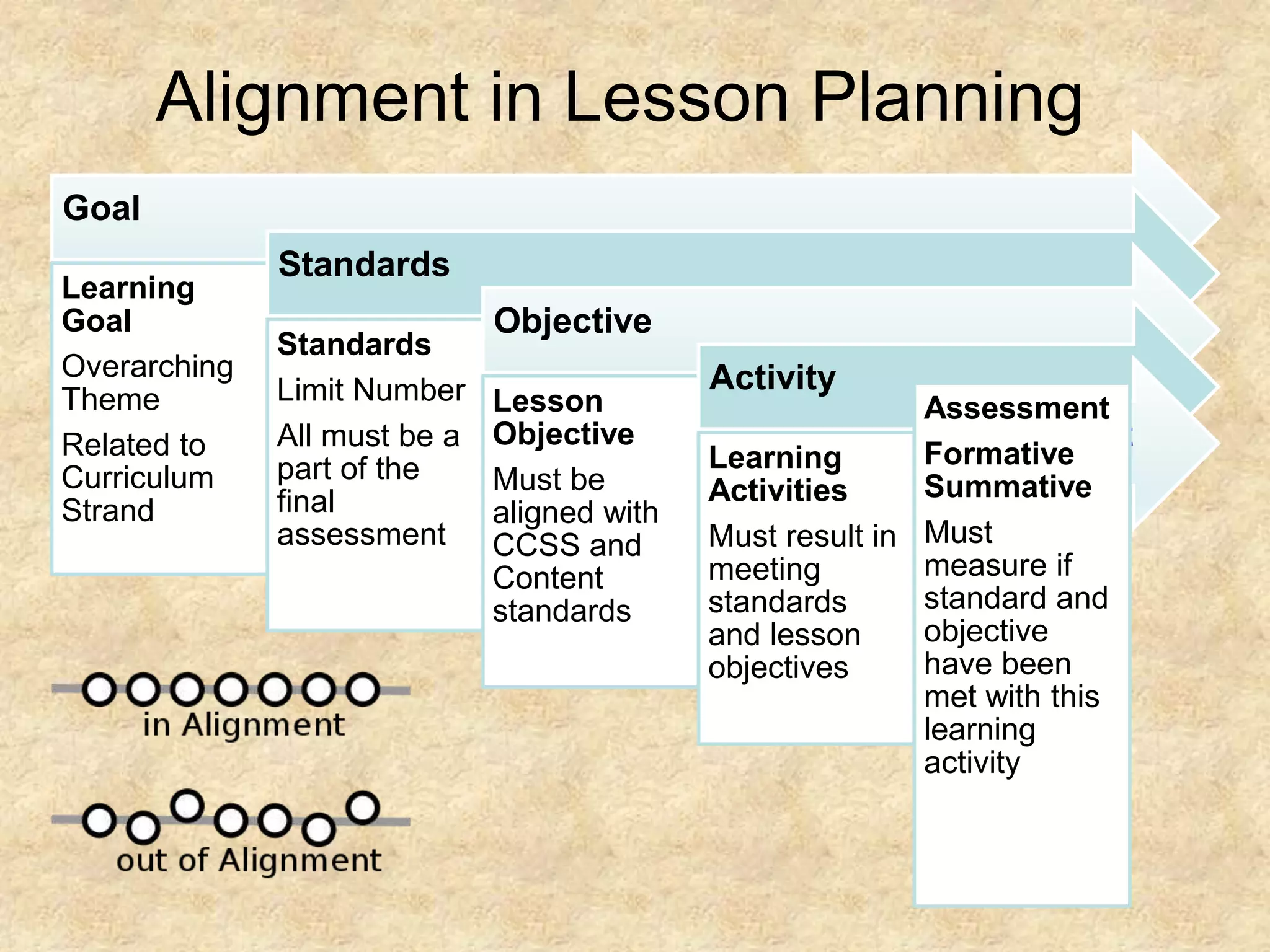
Alignment in Lesson Planning
Goal
Learning
Goal
Overarching
Theme
Related to
Curriculum
Strand
Standards
Standards
Limit Number
All must be a
part of the
final
assessment
Objective
Lesson
Objective
Must be
aligned with
CCSS and
Content
standards
Activity
Learning
Activities
Must result in
meeting
standards
and lesson
objectives
Assessment
Assessment
Formative
Summative
Must
measure if
standard and
objective
have been
met with this
learning
activity
Assessment
How will you measure learning outcomes?
• What will students say or do to show that lesson
objectives were met?
• What will you collect to show student’s learning
(portfolios, observations, work samples,
photographs, journals, etc.)
• How will you evaluate student work?
• How will you grade the student?
Assessment: How do you measure
what students have learned?
• Traditional quizzes and tests
– Paper/pencil
• Selected response
• Constructed response
• Performance tasks and projects
– Open-ended
– Complex
– Authentic
• 3 Kinds of Assessment
– Entry Level
– Progress-Monitoring (Formative)
– Summative
Types of Formative Assessments
• Summaries and Reflections
– Students stop and reflect, make sense of what they have
heard or read, derive personal meaning from their learning
experiences, and/or increase their metacognitive skills.
– These require that students use content-specific language.
• Lists, Charts, and Graphic Organizers
– Students will organize information, make connections, and
note relationships through the use of various graphic
organizers.
Dodge, J. Scholastic Article
Types of Formative Assessments
• Visual Representations of Information
– Students will use both words and pictures to make
connections and increase memory, facilitating retrieval
of information later on.
– This "dual coding" helps teachers address classroom
diversity, preferences in learning style, and different
ways of "knowing."
• Collaborative Activities
– Students have the opportunity to move and/or
communicate with others as they develop and
demonstrate their understanding of concepts.
Dodge, J. Scholastic Article
Progress-Monitoring Formative
Assessments Suggestions
• Postcard or Poster
• Mobile Devices
(Socrative, text answer,
digital corkboard, Google
Forms, etc.)
• Venn Diagram
• Visualize: Be the
Illustrator
• Mini whiteboards
• Create or build something
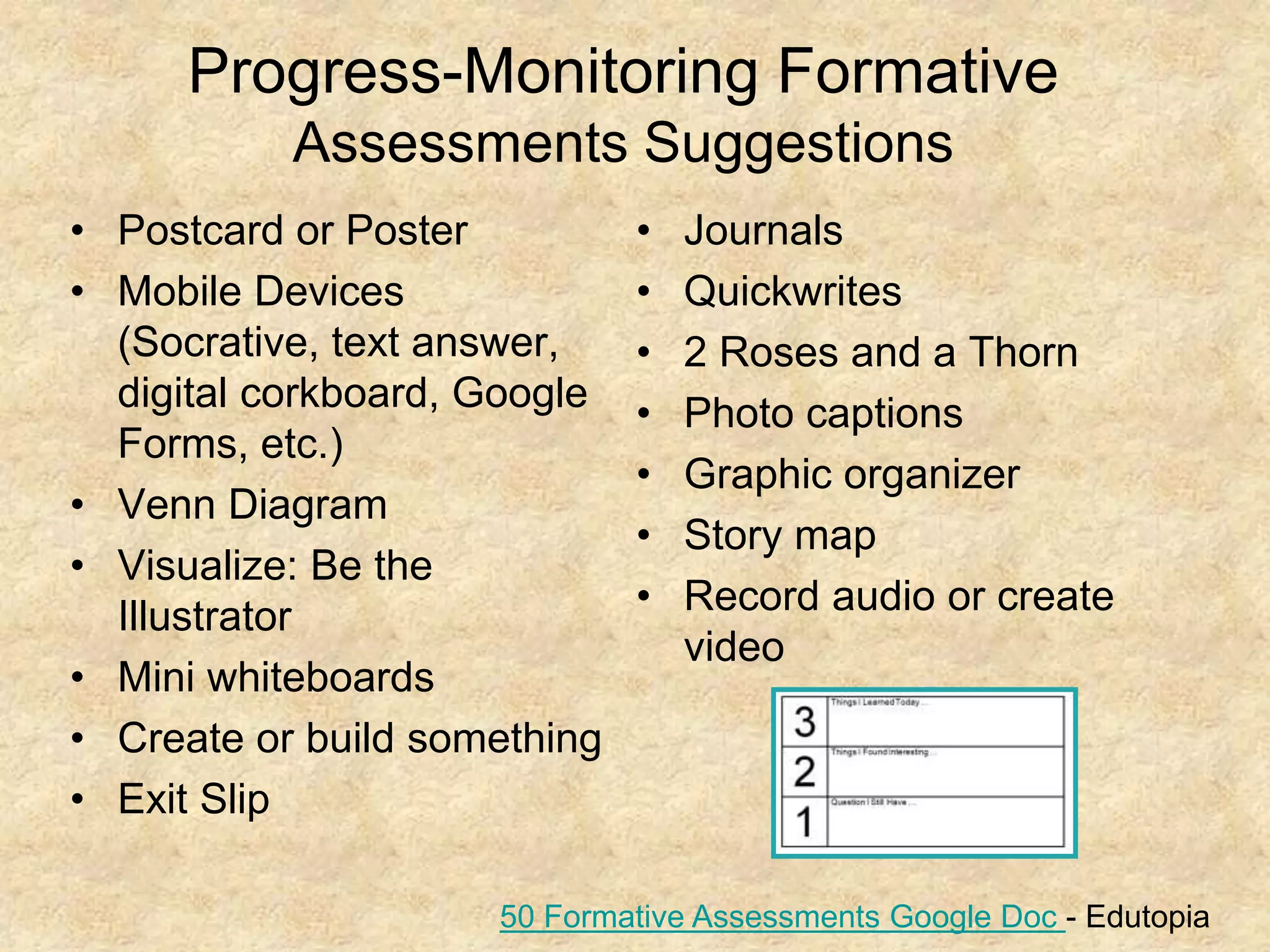
• Exit Slip
• Journals
• Quickwrites
• 2 Roses and a Thorn
• Photo captions
• Graphic organizer
• Story map
• Record audio or create
video
50 Formative Assessments Google Doc - Edutopia
Try Google Docs and Forms
Rubrics and Formative Assessments
Bloom’s Taxonomy Google Tools
Interactives -
https://www.schrockg
uide.net/bloomin-
apps.html
Rubrics for Summative Assessment
• Rubric - a scoring guide for evaluating student performance
• Allows for a variety of criteria or categories to be evaluated
on a sliding rating scale (not subject to one final percentage
score as in testing)
• A way to measure real-life, authentic learning experiences
in the classroom
• Provides a guide for students in determining expectations
of assignments
• Shows students and parents how the teacher is judging
student performance
Rubric Criteria
Performance Assessment
Writing Process Rubric
https://my.pblworks.org/system/files/documents/PBLworks-Rubric-for-Rubrics.pdf
https://my.pblworks.org/resource/document/6_12_critical_thinking_rubric_ccss_aligned
https://my.pblworks.org/system/files/documents/PBLWorks-9-12-Presentation-Rubric-CCSS.pdf
https://my.pblworks.org/system/files/documents/PBLWorks-6-12-Creativity-Innovation-Rubric-CCSS.pdf
On-Going Assessment to Improve
Teaching and Learning
The Assessment Cycle
PBL iPad Learning Tools
Bloomin’Apps
Interactives - https://www.schrockguide.net/bloomin-apps.html
Bloomin’
Apps Online
Interactives -
https://www.schrockguide.net/bloomin-
apps.html

Assessment