PREPARED BY
RAHUL SINHA-130280109107
 INTRODUCTION
 MAGNITUDE OF ELECTRIC FIELD INTENSITY
 ELECTRIC FIELD DUE TO POINT CHARGE
 PRINCIPLE OF SUPERPOSITION
 ELECTRIC FIELD DUE TO N CHARGES
 ELECTRIC FIELD LINES RULES & PATTERNS
 GAUSS’S LAW
 ELECTRIC FIELD DUE TO INFINITE LINE CHARGE
 ELECTRIC FIELD DUE TO INFINITE SURFACE
CHARGE
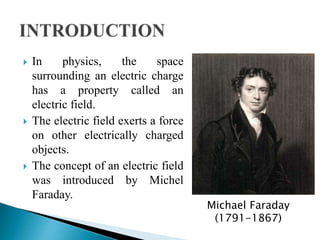
 In physics, the space
surrounding an electric charge
has a property called an
electric field.
 The electric field exerts a force
on other electrically charged
objects.
 The concept of an electric field
was introduced by Michel
Faraday.
Michael Faraday
(1791-1867)
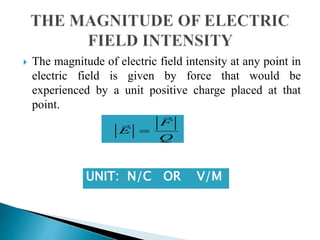
 The magnitude of electric field intensity at any point in
electric field is given by force that would be
experienced by a unit positive charge placed at that
point.
UNIT: N/C OR V/M
F
E
Q

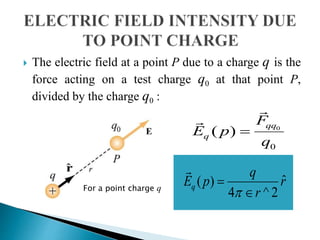
 The electric field at a point P due to a charge q is the
force acting on a test charge q0 at that point P,
divided by the charge q0 :
For a point charge q
0
0
( )
qq
q
F
E p
q

ˆ( )
4 ^ 2
q
q
E p r
r


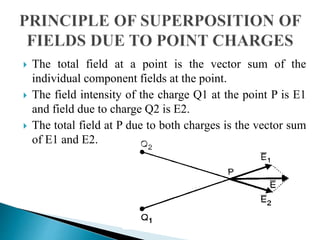
 The total field at a point is the vector sum of the
individual component fields at the point.
 The field intensity of the charge Q1 at the point P is E1
and field due to charge Q2 is E2.
 The total field at P due to both charges is the vector sum
of E1 and E2.
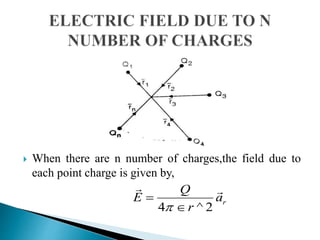
 When there are n number of charges,the field due to
each point charge is given by,
4 ^ 2
r
Q
E a
r


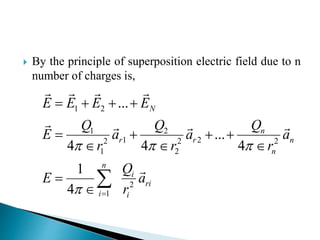
 By the principle of superposition electric field due to n
number of charges is,
1 2
1 2
1 22 2 2
1 2
2
1
...
...
4 4 4
1
4
N
n
r r n
n
n
i
ri
i i
E E E E
QQ Q
E a a a
r r r
Q
E a
r
  
 
   
   
  



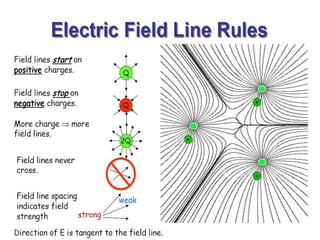
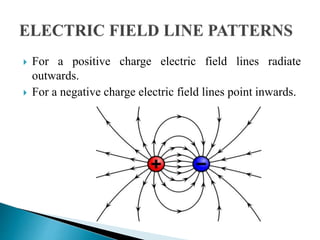
 For a positive charge electric field lines radiate
outwards.
 For a negative charge electric field lines point inwards.
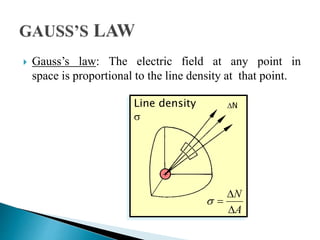
 Gauss’s law: The electric field at any point in
space is proportional to the line density at that point.
Line density
s
DN
N
A
s
D

D
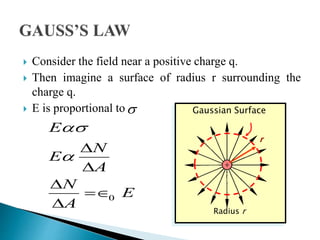
 Consider the field near a positive charge q.
 Then imagine a surface of radius r surrounding the
charge q.
 E is proportional tos
0
E
N
E
A
N
E
A
s

D
D
D

D
Gaussian Surface
Radius r
r
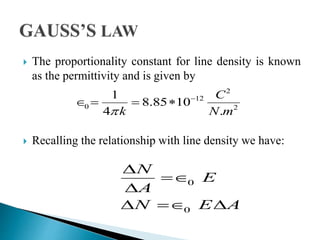
 The proportionality constant for line density is known
as the permittivity and is given by
 Recalling the relationship with line density we have:
2
12
0 2
1
8.85 10
4 .
C
k N m

   
0
0
N
E
A
N E A
D

D
D  D
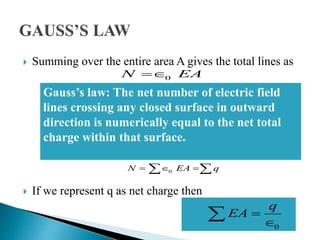
 Summing over the entire area A gives the total lines as
 If we represent q as net charge then
0N EA
Gauss’s law: The net number of electric field
lines crossing any closed surface in outward
direction is numerically equal to the net total
charge within that surface.
0
q
EA 


0N EA q   
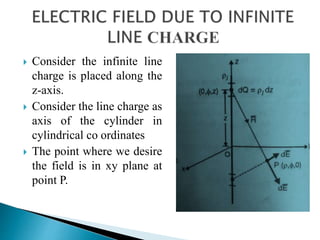
 Consider the infinite line
charge is placed along the
z-axis.
 Consider the line charge as
axis of the cylinder in
cylindrical co ordinates
 The point where we desire
the field is in xy plane at
point P.
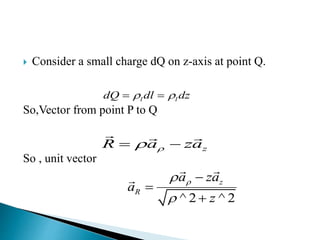
 Consider a small charge dQ on z-axis at point Q.
So,Vector from point P to Q
So , unit vector
l ldQ dl dz  
zR a za 
^ 2 ^ 2
z
R
a za
a
z





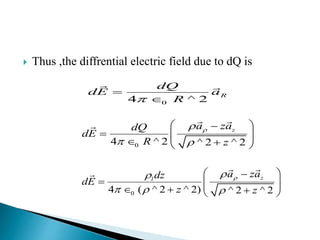
 Thus ,the diffrential electric field due to dQ is
04 ^ 2
R
dQ
dE a
R


04 ^ 2 ^ 2 ^ 2
za zadQ
dE
R z

 
 
     
04 ( ^ 2 ^ 2) ^ 2 ^ 2
zl
a zadz
dE
z z

  
 
      
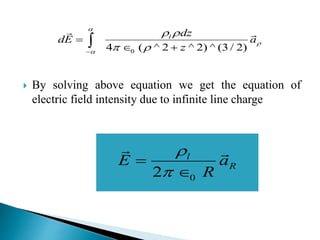
 By solving above equation we get the equation of
electric field intensity due to infinite line charge
04 ( ^ 2 ^ 2) ^ (3 / 2)
l dz
dE a
z



 
 

 
02
l
RE a
R




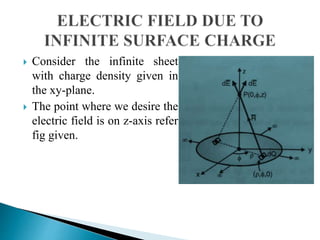
 Consider the infinite sheet
with charge density given in
the xy-plane.
 The point where we desire the
electric field is on z-axis refer
fig given.
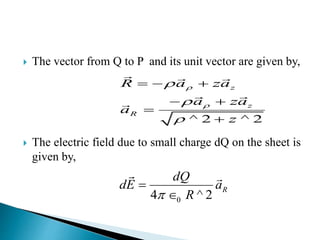
 The vector from Q to P and its unit vector are given by,
 The electric field due to small charge dQ on the sheet is
given by,
^ 2 ^ 2
z
z
R
R a za
a za
a
z





  
 


04 ^ 2
R
dQ
dE a
R


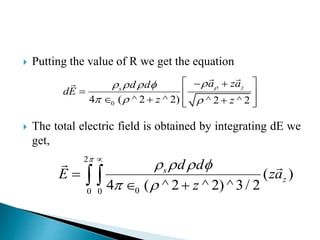
 Putting the value of R we get the equation
 The total electric field is obtained by integrating dE we
get,
04 ( ^ 2 ^ 2) ^ 2 ^ 2
zs
a zad d
dE
z z
   
  
  
  
    
2
00 0
( )
4 ( ^ 2 ^ 2) ^ 3/ 2
s
z
d d
E za
z

   
 


  
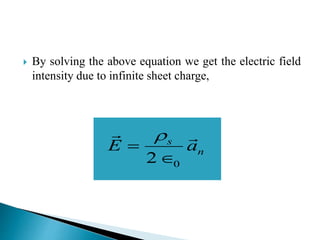
 By solving the above equation we get the electric field
intensity due to infinite sheet charge,
02
s
nE a



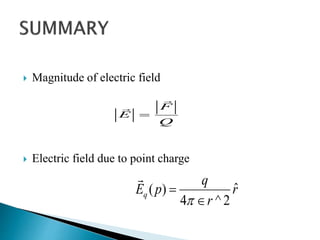
 Magnitude of electric field
 Electric field due to point charge
ˆ( )
4 ^ 2
q
q
E p r
r


F
E
Q

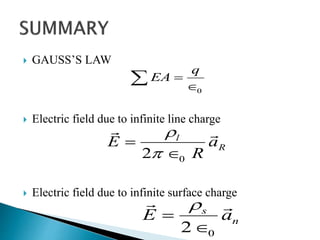
 GAUSS’S LAW
 Electric field due to infinite line charge
 Electric field due to infinite surface charge
02
s
nE a



02
l
RE a
R




0
q
EA 


 http://en.wikipedia.org/wiki/Electric_field
 http://en.wikipedia.org/wiki/Gauss%27s_law
 http://en.wikipedia.org/wiki/Field_line
THANK YOU

Electric field intensity

  • 1.
  • 2.
     INTRODUCTION  MAGNITUDEOF ELECTRIC FIELD INTENSITY  ELECTRIC FIELD DUE TO POINT CHARGE  PRINCIPLE OF SUPERPOSITION  ELECTRIC FIELD DUE TO N CHARGES  ELECTRIC FIELD LINES RULES & PATTERNS  GAUSS’S LAW  ELECTRIC FIELD DUE TO INFINITE LINE CHARGE  ELECTRIC FIELD DUE TO INFINITE SURFACE CHARGE
  • 3.
     In physics,the space surrounding an electric charge has a property called an electric field.  The electric field exerts a force on other electrically charged objects.  The concept of an electric field was introduced by Michel Faraday. Michael Faraday (1791-1867)
  • 4.
     The magnitudeof electric field intensity at any point in electric field is given by force that would be experienced by a unit positive charge placed at that point. UNIT: N/C OR V/M F E Q 
  • 5.
     The electricfield at a point P due to a charge q is the force acting on a test charge q0 at that point P, divided by the charge q0 : For a point charge q 0 0 ( ) qq q F E p q  ˆ( ) 4 ^ 2 q q E p r r  
  • 6.
     The totalfield at a point is the vector sum of the individual component fields at the point.  The field intensity of the charge Q1 at the point P is E1 and field due to charge Q2 is E2.  The total field at P due to both charges is the vector sum of E1 and E2.
  • 7.
     When thereare n number of charges,the field due to each point charge is given by, 4 ^ 2 r Q E a r  
  • 8.
     By theprinciple of superposition electric field due to n number of charges is, 1 2 1 2 1 22 2 2 1 2 2 1 ... ... 4 4 4 1 4 N n r r n n n i ri i i E E E E QQ Q E a a a r r r Q E a r                   
  • 10.
     For apositive charge electric field lines radiate outwards.  For a negative charge electric field lines point inwards.
  • 11.
     Gauss’s law:The electric field at any point in space is proportional to the line density at that point. Line density s DN N A s D  D
  • 12.
     Consider thefield near a positive charge q.  Then imagine a surface of radius r surrounding the charge q.  E is proportional tos 0 E N E A N E A s  D D D  D Gaussian Surface Radius r r
  • 13.
     The proportionalityconstant for line density is known as the permittivity and is given by  Recalling the relationship with line density we have: 2 12 0 2 1 8.85 10 4 . C k N m      0 0 N E A N E A D  D D  D
  • 14.
     Summing overthe entire area A gives the total lines as  If we represent q as net charge then 0N EA Gauss’s law: The net number of electric field lines crossing any closed surface in outward direction is numerically equal to the net total charge within that surface. 0 q EA    0N EA q   
  • 15.
     Consider theinfinite line charge is placed along the z-axis.  Consider the line charge as axis of the cylinder in cylindrical co ordinates  The point where we desire the field is in xy plane at point P.
  • 16.
     Consider asmall charge dQ on z-axis at point Q. So,Vector from point P to Q So , unit vector l ldQ dl dz   zR a za  ^ 2 ^ 2 z R a za a z     
  • 17.
     Thus ,thediffrential electric field due to dQ is 04 ^ 2 R dQ dE a R   04 ^ 2 ^ 2 ^ 2 za zadQ dE R z            04 ( ^ 2 ^ 2) ^ 2 ^ 2 zl a zadz dE z z             
  • 18.
     By solvingabove equation we get the equation of electric field intensity due to infinite line charge 04 ( ^ 2 ^ 2) ^ (3 / 2) l dz dE a z           02 l RE a R    
  • 19.
     Consider theinfinite sheet with charge density given in the xy-plane.  The point where we desire the electric field is on z-axis refer fig given.
  • 20.
     The vectorfrom Q to P and its unit vector are given by,  The electric field due to small charge dQ on the sheet is given by, ^ 2 ^ 2 z z R R a za a za a z             04 ^ 2 R dQ dE a R  
  • 21.
     Putting thevalue of R we get the equation  The total electric field is obtained by integrating dE we get, 04 ( ^ 2 ^ 2) ^ 2 ^ 2 zs a zad d dE z z                   2 00 0 ( ) 4 ( ^ 2 ^ 2) ^ 3/ 2 s z d d E za z            
  • 22.
     By solvingthe above equation we get the electric field intensity due to infinite sheet charge, 02 s nE a   
  • 23.
     Magnitude ofelectric field  Electric field due to point charge ˆ( ) 4 ^ 2 q q E p r r   F E Q 
  • 24.
     GAUSS’S LAW Electric field due to infinite line charge  Electric field due to infinite surface charge 02 s nE a    02 l RE a R     0 q EA   
  • 25.
  • 26.