One-Dimensional Travelling Wave
The amplitude/value of a travelling wave is a
function of both distance and time.
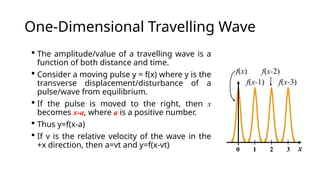
Consider a moving pulse y = f(x) where y is the
transverse displacement/disturbance of a
pulse/wave from equilibrium.
If the pulse is moved to the right, then x
becomes x-a, where a is a positive number.
Thus y=f(x-a)
If v is the relative velocity of the wave in the
+x direction, then a=vt and y=f(x-vt)
f(x)
f(x-3)
f(x-2)
f(x-1)
x
0 1 2 3
2.
One-dimensional Travelling Wave
Sof(x-vt) represents a rightward, or forward,
propagating/ travelling wave.
Similarly, f(x+vt) represents a leftward or backward,
propagating wave.
The function f depends on the nature/shape of the
signal.
For example, f can be:
oy= A sin(k[x-vt]) i.e travelling periodic function in +x direction
oy= ek(x+vt)
i.e travelling -x direction
3.
Harmonic Wave Function
Harmonic waves are smooth patterns that repeat endlessly.
They involve the sine and cosine functions:
• y= A sin(k[x±vt]) or y= A cos(k[x±vt])
If we consider spatial variations of a wave at a fixed time t then
the repetitive spatial unit of the wave is the wavelength, .
Thus,y= A sin(k[(x+ )+vt]) = A sin[k(x+ vt)+ 2]
• Recall that sin x = sin (x + 2), thus k = 2
• k =
k is called the propagation constant.
4.
Harmonic Wave Function
Alternatively, if we consider time variations of a wave at a
fixed point x along the wave, then the repetitive temporal
unit of the wave is the period, T.
Thus,y= A sin(k[x + v(t+T)]) = A sin[k(x+ vt)+ 2]
y= A sin(kx + kvt + kvT) = A sin[kx+ kvt+ 2]
Therefore, k = and
•
5.
One Dimensional WaveEquation
A wave equation is a real partial differential equation in which the
second derivative with respect to position x is proportional to the
second derivative with respect to time t.
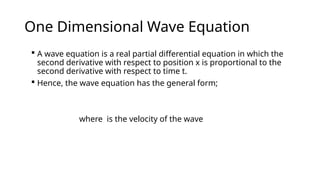
Hence, the wave equation has the general form;
where is the velocity of the wave
6.
General Solution tothe Wave Equation
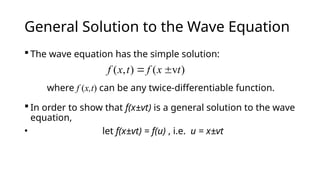
The wave equation has the simple solution:
In order to show that f(x±vt) is a general solution to the wave
equation,
• let f(x±vt) = f(u) , i.e. u = x±vt
( , ) ( v )
f x t f x t
where f (x,t) can be any twice-differentiable function.
7.
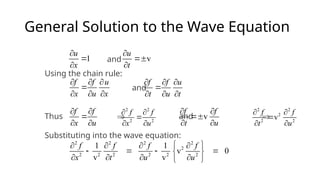
General Solution tothe Wave Equation
and
Using the chain rule:
and
Thus Þ and Þ
Substituting into the wave equation:
1
u
x
v
u
t
f f u
x u x
f f u
t u t
f f
x u
v
f f
t u
2 2
2
2 2
v
f f
t u
2 2
2 2
f f
x u
2 2 2 2
2
2 2 2 2 2 2
1 1
v 0
v v
f f f f
x t u u
8.
Maxwell’s Equations
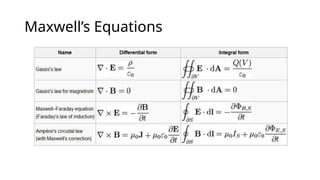
Maxwell's Equationsare a set of 4 equations that
describe the world of electromagnetics.
The equations explain how electric and magnetic
fields are generated by charges, currents, and
changes of the fields.
Maxwell’s Equations
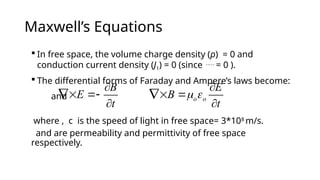
Infree space, the volume charge density (ρ) = 0 and
conduction current density (J1) = 0 (since = 0 ).
The differential forms of Faraday and Ampere’s laws become:
and
where , c is the speed of light in free space= 3*108
m/s.
and are permeability and permittivity of free space
respectively.
o o
E
B
t
B
E
t
11.
The Curl Operator
If × F is, for F composed of [Fx, Fy, Fz]:
∇
where i, j, and k are the unit vectors
for
the x-, y-, and z-axes,
respectively.
then
12.
Moving Fields
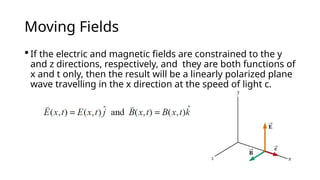
Ifthe electric and magnetic fields are constrained to the y
and z directions, respectively, and they are both functions of
x and t only, then the result will be a linearly polarized plane
wave travelling in the x direction at the speed of light c.
13.
Moving Fields
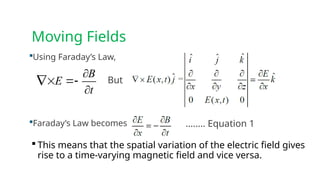
Thismeans that the spatial variation of the electric field gives
rise to a time-varying magnetic field and vice versa.
Using Faraday’s Law,
B
E
t
But
Faraday’s Law becomes …….. Equation 1
14.
Moving Fields
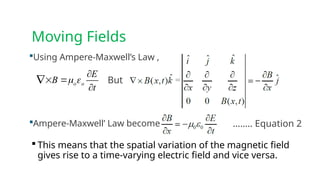
Thismeans that the spatial variation of the magnetic field
gives rise to a time-varying electric field and vice versa.
Using Ampere-Maxwell’s Law ,
But
Ampere-Maxwell’ Law becomes
o o
E
B
t
…….. Equation 2
15.
Electromagnetic Wave Equation
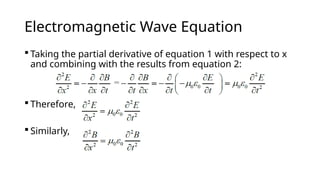
Taking the partial derivative of equation 1 with respect to x
and combining with the results from equation 2:
Therefore,
Similarly,
16.
Electromagnetic Wave Equation
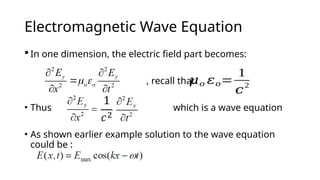
In one dimension, the electric field part becomes:
, recall that
• Thus which is a wave equation
• As shown earlier example solution to the wave equation
could be :
2 2
2 2
y y
o o
E E
x t
𝜇𝑜 𝜀𝑜=
1
𝑐
2
17.
Exercise
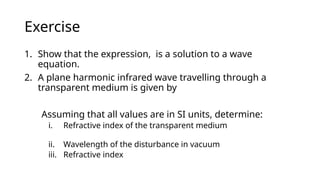
1. Show thatthe expression, is a solution to a wave
equation.
2. A plane harmonic infrared wave travelling through a
transparent medium is given by
Assuming that all values are in SI units, determine:
i. Refractive index of the transparent medium
ii. Wavelength of the disturbance in vacuum
iii. Refractive index
![One-dimensional Travelling Wave
So f(x-vt) represents a rightward, or forward,
propagating/ travelling wave.
Similarly, f(x+vt) represents a leftward or backward,
propagating wave.
The function f depends on the nature/shape of the
signal.
For example, f can be:
oy= A sin(k[x-vt]) i.e travelling periodic function in +x direction
oy= ek(x+vt)
i.e travelling -x direction](https://image.slidesharecdn.com/one-dimensionaltravellingwave-250909045731-df181b59/85/One-Dimensional-Travelling-Wave-equa-pptx-2-320.jpg)
![Harmonic Wave Function
Harmonic waves are smooth patterns that repeat endlessly.
They involve the sine and cosine functions:
• y= A sin(k[x±vt]) or y= A cos(k[x±vt])
If we consider spatial variations of a wave at a fixed time t then
the repetitive spatial unit of the wave is the wavelength, .
Thus,y= A sin(k[(x+ )+vt]) = A sin[k(x+ vt)+ 2]
• Recall that sin x = sin (x + 2), thus k = 2
• k =
k is called the propagation constant.](https://image.slidesharecdn.com/one-dimensionaltravellingwave-250909045731-df181b59/85/One-Dimensional-Travelling-Wave-equa-pptx-3-320.jpg)
![Harmonic Wave Function
Alternatively, if we consider time variations of a wave at a
fixed point x along the wave, then the repetitive temporal
unit of the wave is the period, T.
Thus,y= A sin(k[x + v(t+T)]) = A sin[k(x+ vt)+ 2]
y= A sin(kx + kvt + kvT) = A sin[kx+ kvt+ 2]
Therefore, k = and
•](https://image.slidesharecdn.com/one-dimensionaltravellingwave-250909045731-df181b59/85/One-Dimensional-Travelling-Wave-equa-pptx-4-320.jpg)
![The Curl Operator
If × F is, for F composed of [Fx, Fy, Fz]:
∇
where i, j, and k are the unit vectors
for
the x-, y-, and z-axes,
respectively.
then](https://image.slidesharecdn.com/one-dimensionaltravellingwave-250909045731-df181b59/85/One-Dimensional-Travelling-Wave-equa-pptx-11-320.jpg)