Harmonic Waves
LEARNING OBJECT
LG2- ALISON WU
What is a Harmonic Wave?
 If a wave is undergoing harmonic motion it is considered a
harmonic wave. Simple harmonic motion is the type of periodic
motion in which the restoring force is directly proportional to the
displacement
 It is also known as a sinusoidal wave (a sin graph)
 It has a smooth repetitive oscillation
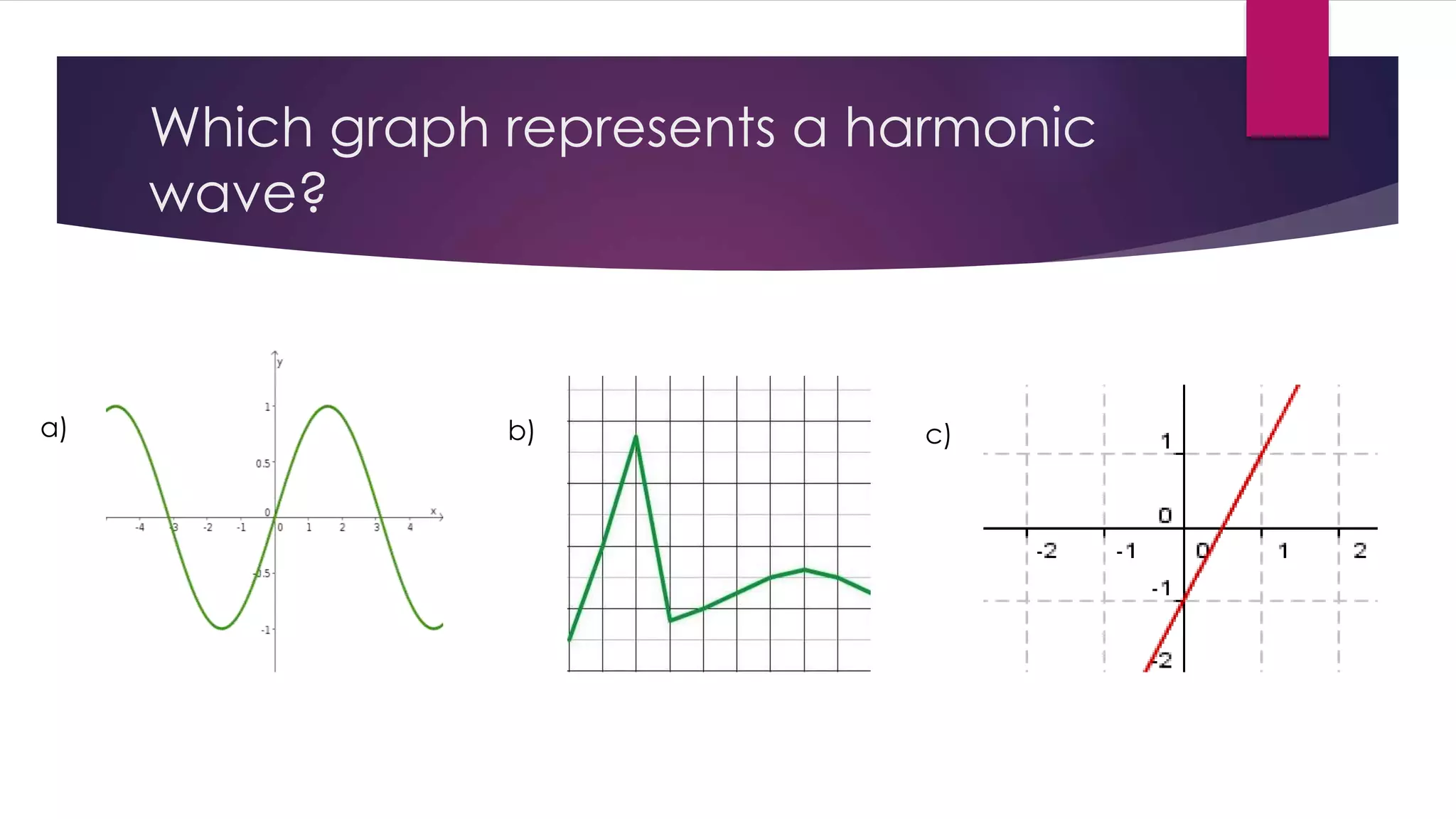
Which graph represents a harmonic
wave?
a) b) c)
Solution
 A)
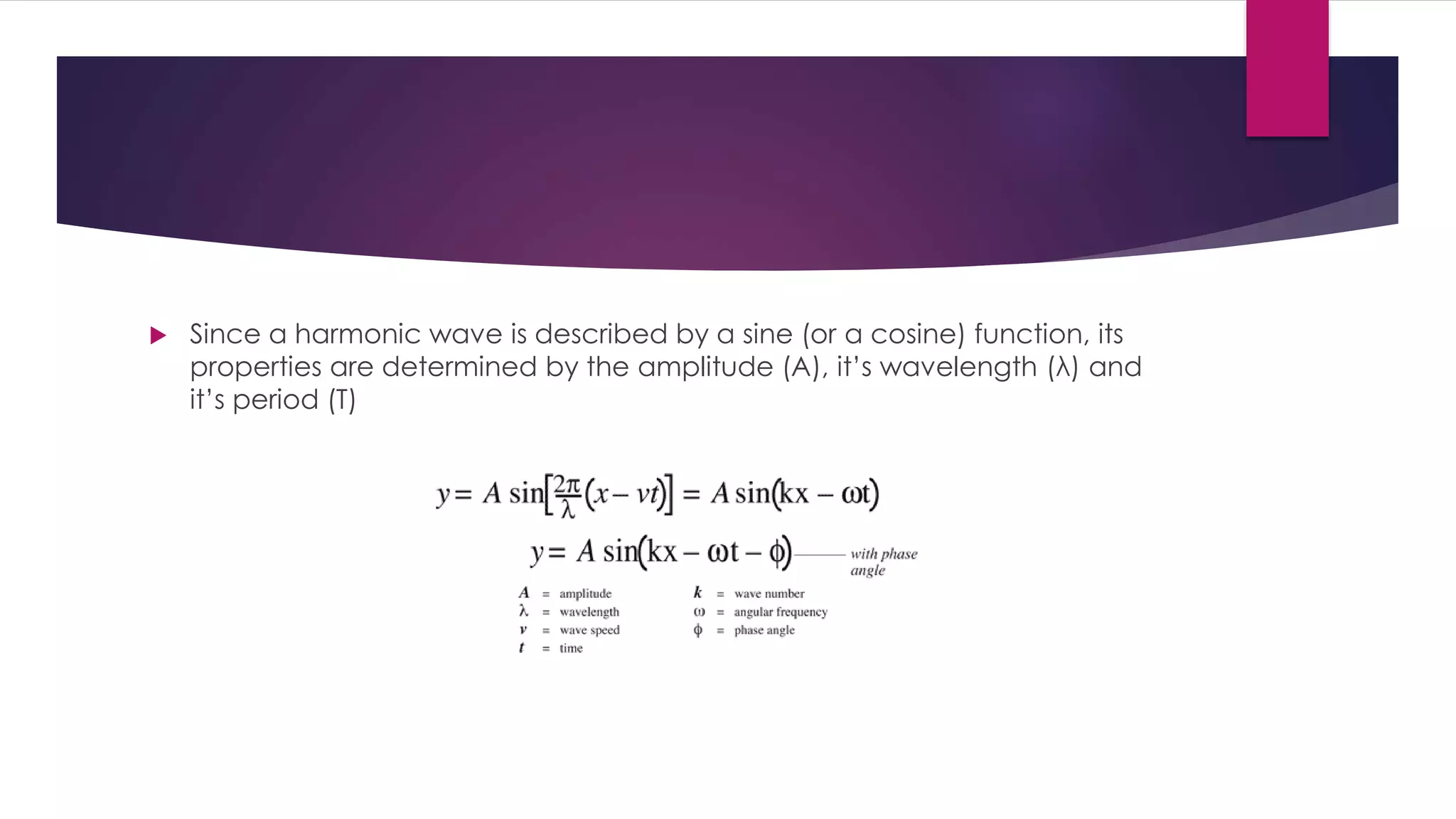
 Since a harmonic wave is described by a sine (or a cosine) function, its
properties are determined by the amplitude (A), it’s wavelength (λ) and
it’s period (T)
Characteristics of a Harmonic wave
 Amplitude: Corresponds to the maximum displacement from the equilibrium
position of any element. Amplitude is always a positive quantity.
 Wavelength: The shortest distance over which a wave shape repeats is called
the wavelength. Represented by the symbol lambda (λ)
 Wave number: the reciprocal of the wavelength
 Period: the time for a particle make one complete cycle T=1/f
 Frequency: the number of wave cycles passing a fixed point of the medium in
one section
 Phase shift (φ) : a horizontal shift by how many units the "starting point" (0,0) of
a standard sine curve, y = sin(x), has moved to the right or left.
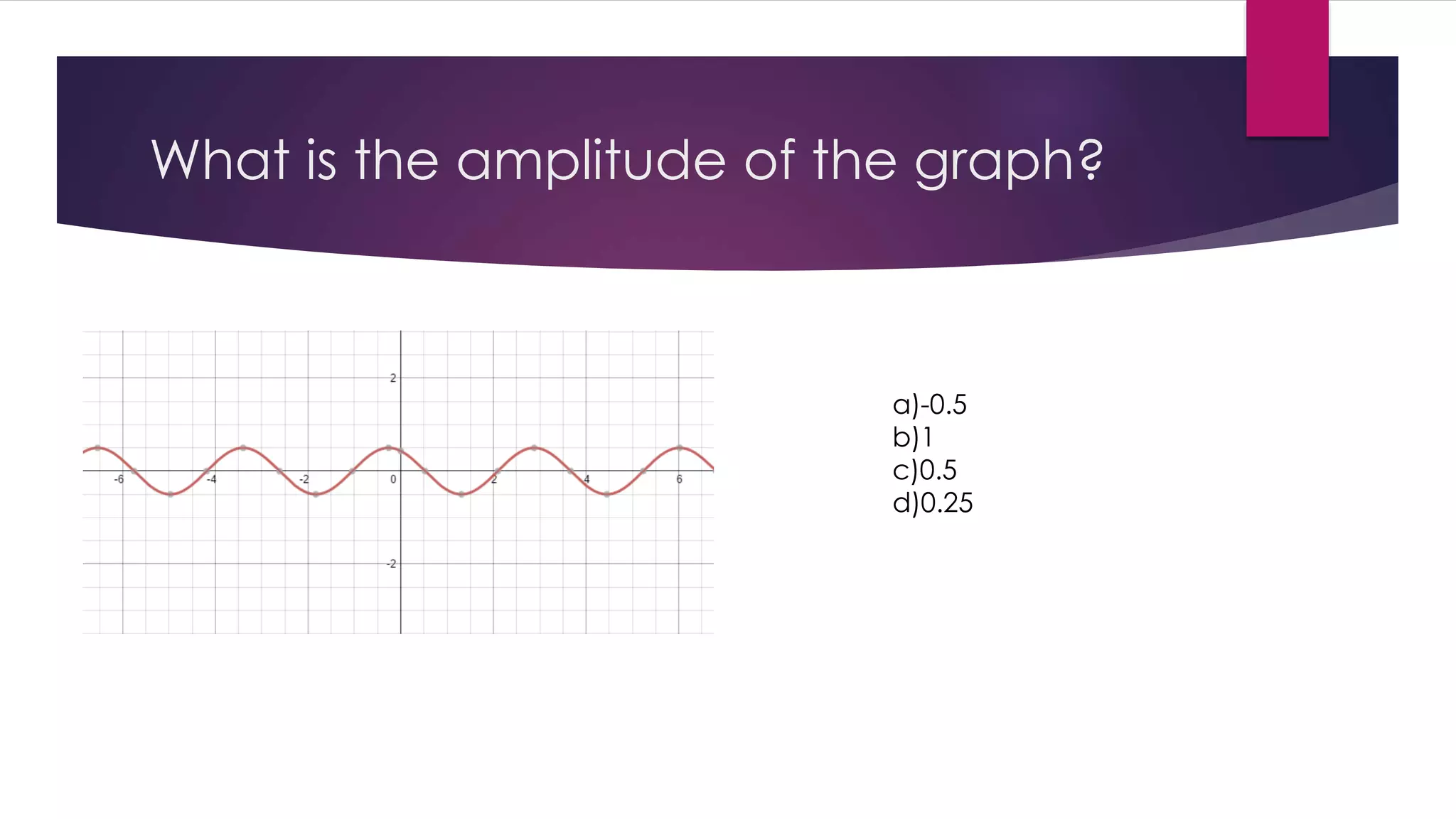
What is the amplitude of the graph?
a)-0.5
b)1
c)0.5
d)0.25
What is the wave number of the
graph?
a)pi
b)pi/2
c)1/2
d)2
What is the phase shift?
a)2pi
b)2pi/3
c)pi/3
d)pi
Solutions
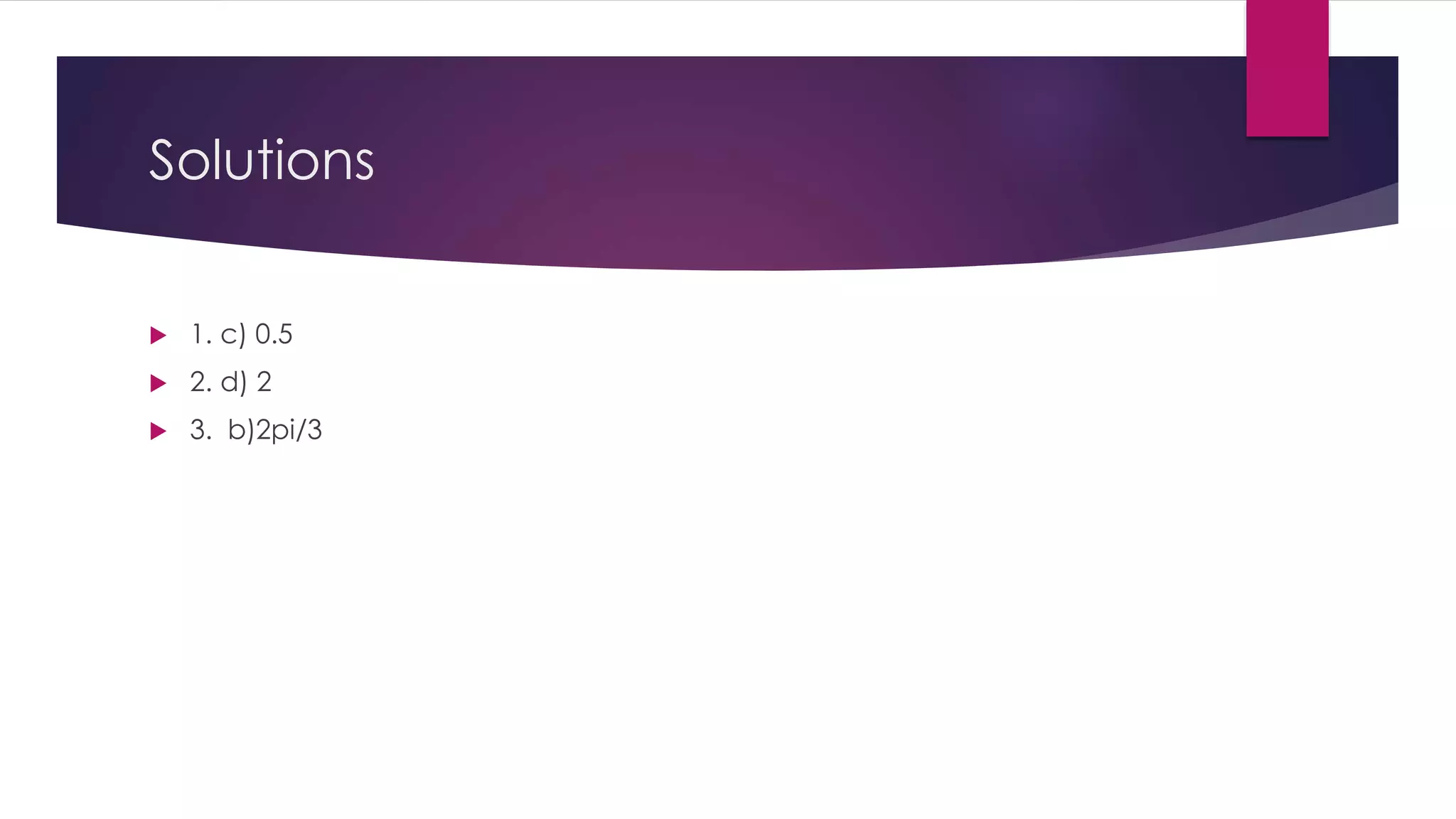
 1. c) 0.5
 2. d) 2
 3. b)2pi/3
Speed of the Wave
 To calculate the speed of the wave you multiply the wavelength of the
graph to the frequency.
Find the angular frequency when the
wave has a velocity of 100m/s, a
wave number of 2.
 a) 50
 b) 0
 c) 200
 d) 30
Solutions
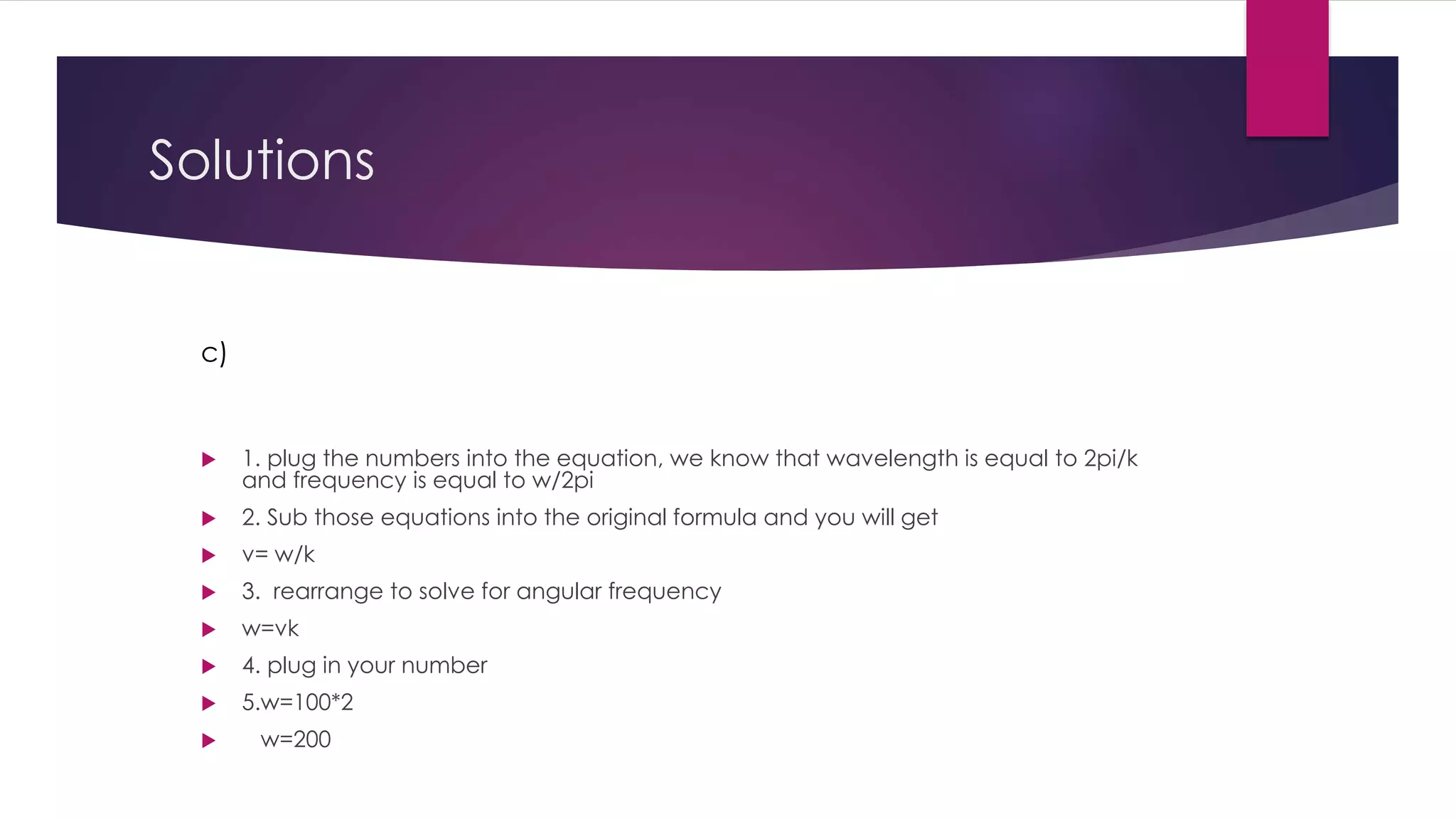
 1. plug the numbers into the equation, we know that wavelength is equal to 2pi/k
and frequency is equal to w/2pi
 2. Sub those equations into the original formula and you will get
 v= w/k
 3. rearrange to solve for angular frequency
 w=vk
 4. plug in your number
 5.w=100*2
 w=200
c)
If the frequency increased what
would happen to the velocity?
 a) it remains constant
 b) it would decrease
 c) it would increase
Solution
 C) it would increase
 All three factors are in direct correlation so if the frequency increased the
velocity would increase to.

Harmonic waves

  • 1.
  • 2.
    What is aHarmonic Wave?  If a wave is undergoing harmonic motion it is considered a harmonic wave. Simple harmonic motion is the type of periodic motion in which the restoring force is directly proportional to the displacement  It is also known as a sinusoidal wave (a sin graph)  It has a smooth repetitive oscillation
  • 3.
    Which graph representsa harmonic wave? a) b) c)
  • 4.
  • 5.
     Since aharmonic wave is described by a sine (or a cosine) function, its properties are determined by the amplitude (A), it’s wavelength (λ) and it’s period (T)
  • 6.
    Characteristics of aHarmonic wave  Amplitude: Corresponds to the maximum displacement from the equilibrium position of any element. Amplitude is always a positive quantity.  Wavelength: The shortest distance over which a wave shape repeats is called the wavelength. Represented by the symbol lambda (λ)  Wave number: the reciprocal of the wavelength  Period: the time for a particle make one complete cycle T=1/f  Frequency: the number of wave cycles passing a fixed point of the medium in one section  Phase shift (φ) : a horizontal shift by how many units the "starting point" (0,0) of a standard sine curve, y = sin(x), has moved to the right or left.
  • 7.
    What is theamplitude of the graph? a)-0.5 b)1 c)0.5 d)0.25
  • 8.
    What is thewave number of the graph? a)pi b)pi/2 c)1/2 d)2
  • 9.
    What is thephase shift? a)2pi b)2pi/3 c)pi/3 d)pi
  • 10.
    Solutions  1. c)0.5  2. d) 2  3. b)2pi/3
  • 11.
    Speed of theWave  To calculate the speed of the wave you multiply the wavelength of the graph to the frequency.
  • 12.
    Find the angularfrequency when the wave has a velocity of 100m/s, a wave number of 2.  a) 50  b) 0  c) 200  d) 30
  • 13.
    Solutions  1. plugthe numbers into the equation, we know that wavelength is equal to 2pi/k and frequency is equal to w/2pi  2. Sub those equations into the original formula and you will get  v= w/k  3. rearrange to solve for angular frequency  w=vk  4. plug in your number  5.w=100*2  w=200 c)
  • 14.
    If the frequencyincreased what would happen to the velocity?  a) it remains constant  b) it would decrease  c) it would increase
  • 15.
    Solution  C) itwould increase  All three factors are in direct correlation so if the frequency increased the velocity would increase to.