Renaissance
Renascere (ree-na-sheer)
Latin word meaning act of being reborn.
When did Renaissance begin?
Renaissance began AFTER the middle ages also known as
“The Dark Ages” – the period which was marked by
frequent warfare and a virtual disappearance of urban life
between 11th and 13th century. During this time, classical
antiquity became lost in Europe. Thus the revival of
antiquity or revival of learning began – hence Renaissance
started to exist during the early part of 13th century.
What is Classical Antiquity?
~ Referred to the culture of Ancient Greece
and Rome.
How long did Renaissance last?
It lasted from the 13th century and came to
an end during the 16th century.
Humanism
~ It is the study of Classical Antiquity
~ Described as combination of Wisdom
and Virtue
Humanists
~ Scholars and artists who studied classical
antiquity and believed that these would help
better understand the problems of humanity
Italian Humanism:
The Home of Renaissance
Renaissance started in the country of Italy
specifically in the City of Florence and Siena
then spread to England, Germany, Netherlands,
Spain and other countries.
Why in Italy?
• They are in the center of trade and industry.
• They have acquired wealth and prestige.
• They freed themselves earlier from the
domination of the Holy Roman Emperor.
• It is the home of Greco-Roman culture
Aims of Italian Humanism
~Academic Freedom
~ Abundant Living
~ Liberal Education
Agencies of Education and
Contents Studied
~Lower or Elementary Schools
~Secondary or Court Schools
~Universities
What did they study?
~ Greek and Roman Classics related to creativity in poetry,
drama and romance.
~ Human interests that makes life beautiful:
arts and designs
~ Manners, moral precepts, physical exercises, music,
dancing and chivalric elements.
Leonardo di ser Piero da Vinci
Leonardo Da Vinci
15 April 1452 – 2 May 1519
Mona Lisa
“Birth of Venus” by:
Sandro Botticelli
“Statue of David” by:
Michelangelo
~ Lectures: were minimized due to more
books provided
Methods of Instruction
~ Writing themes: develops writing skills
~ Oral Recitations: develops self expression
~ Critical Thinking: develops interest and
power or thinking
Methods of Instruction
~ Mental and Physical Activities:
balance for each subject was essential
~ Varied Curriculum
~ Discipline: was mild and motivation
was emphasized, punishment and
threats for punishment were not used
as motives for learning
Agencies of Education
~ Court Schools: for Boys until 20 years old
~ Home and Tutors: for Girls
Outstanding Contributions to Education
~ Secondary Schools
~ Modern Academic Freedom
~ Interest in Roman and Greek Classics
~ More use of books, Less in Lectures
~ Focus on written themes
~ Application of individual differences: advocated by Vittorino De Feltre
Vittorino Rambaldoni
~ He is well known as Vittorino De
Feltre for he was he was born in Feltre,
Belluno, Republic of Venice and died in
Mantua.
~ The first modern and professional
teacher who owned a school at Mantua
in Northern Italy.
Northern Humanism:
also known as Christian Humanism
~ Shared artistic values of High Renaissance: Idealism,
rationalism, deep love of Classical literature
~ Preoccupied with condition of the church and the
Christian world
~ Approached faith in simple terms: Any Christian with
pure & humble heart could pray directly to God
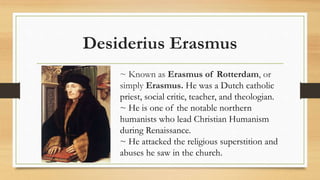
Desiderius Erasmus
~ Known as Erasmus of Rotterdam, or
simply Erasmus. He was a Dutch catholic
priest, social critic, teacher, and theologian.
~ He is one of the notable northern
humanists who lead Christian Humanism
during Renaissance.
~ He attacked the religious superstition and
abuses he saw in the church.
François Rabelais
~ He has historically been regarded as a writer of
fantasy, satire, the grotesque, bawdy jokes and
songs. Also known for his famous written work:
Gargantua and Pantagruel
~ Attacked church’s abuses, ridiculed clergy &
theologians
~ Affirmed goodness of human nature and ability
of men & women to lead useful lives based in
reason and common sense
Marguerite de Navarre
~ As an author and a patron of humanists
and reformers, she was an outstanding figure
of the French Renaissance.
~ She was called, "The First Modern Woman"
for she was outspoken in sexual matters.
~ She protected many artists and writers who
were considered as protestant reformers and
among them was François Rabelais.
Aims of Norther Humanism
~ Social
~ Religious and Moral
~ Literacy
~ Literary
~ Democratic
Agencies of Education and
Contents Studied
~ Elementary Schools
~ Secondary Schools: Male only
~ Universities
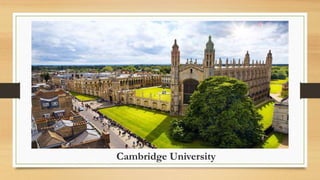
Cambridge University
Oxford University
Contents Studies:
~ Biblical ad Classical Literature
~ Church Catechism
~ Hebrew Language
~ History, Geography and Science
Methods of Instruction
~ Ciceronianism & Memorization
~ Excessive Formalism
~ Harsh punishment
~ Gloomy classroom work
~ Religious Indoctrination
~ Humanistic Elements
Outstanding Contributions to Education
~ The Class-a-year practice
~ Emphasis on social education
Reformation
A religious movement of the
1500’s that led to Protestanism.
Who Initiated Reformation?
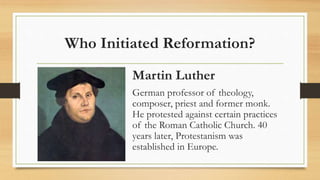
Martin Luther
German professor of theology,
composer, priest and former monk.
He protested against certain practices
of the Roman Catholic Church. 40
years later, Protestanism was
established in Europe.
Martin Luther’s Famous Speech
in front of Emperor Charles V and members of the imperial diet when
asked to renounce his writings and teachings about reformation.
“Unless I am convinced by the testimony of the Scriptures or
by clear reason (for I do not trust either in the pope or in
councils alone, since it is well known that they have often
erred and contradicted themselves), I am bound by the
Scriptures I have quoted and my conscience is captive to the
Word of God. I cannot and I will not retract anything, since
it is neither safe nor right to go against conscience. I cannot
do otherwise.”
Other Notable Protestants
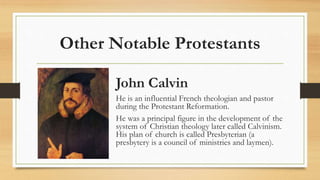
John Calvin
He is an influential French theologian and pastor
during the Protestant Reformation.
He was a principal figure in the development of the
system of Christian theology later called Calvinism.
His plan of church is called Presbyterian (a
presbytery is a council of ministries and laymen).
Other Notable Protestants
Philip Melanchthon
German reformer, collaborator with Martin Luther, the first
systematic theologian of the Protestant Reformation,
intellectual leader of the Lutheran Reformation, and an
influential designer of educational systems which became
the basis of the Saxony Plan.
Saxony Plan is the establishment of the secondary schools
in every town under the support and control of the state.
~ Religious Causes
~ Cultural Causes
~ Political Causes
~ Economic Causes
What are the causes of reformation?
~ Corrupt financial practices by the catholic church
officials
~ Popes and higher clergy lived like secular princes
~ Sacraments were often celebrated meaninglessly
~ Disputes with regards to giving money to church for
salvation from sins.
Religious Cause
Cultural Causes
~ People outside the clergy gained education
~ Study of Hebrew and Greek, language used for the
original scriptures without translations
~ Belief that returning from classics will be a doorstep to
begin a new age
Political Cause
~ Kings are increasing their power over the people against the
catholic church
~ Some people regarded the pope as a political leader of a foreign
state and opposed his control and influence
~ Monarchs boke away from the Pope when reformation began
Economic Cause
~ Local Lords and Prince-Bishops were threw off their
control as cities progressed and people became wealthy.
Aims of Education
~ Religious Moralism
~ Protestant Ethic
~ Literacy Promotion
Types of Protestant School System
~ Vernacular
~ Secondary
~ University
Methods of Instruction
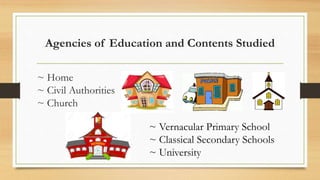
Agencies of Education and Contents Studied
~ Home
~ Civil Authorities
~ Church
~ Vernacular Primary School
~ Classical Secondary Schools
~ University
Outstanding Contributions to Education
~ Saxony Plan
~ Class-a-Year Plan
~ Vernacular Elementary School
Catholic Counter Reformation
The period of Catholic resurgence beginning with
the Council of Trent (1545–1563) and ending at the
close of the Thirty Years' War (1648), and was
initiated in response to the Protestant Reformation.
Counter Reformation Two Main Forms
~ Rebirth of faith among the people
~ Reassessment of principles by church leaders
Aims of the Catholic Counter Reformation
~ Religious Moralism and
Complete Obedience to the Church
~ Leadership Training
~ Education of the Poor
~ Spiritual Salvation
Agencies of Education and Contents Studied
~ Elementary School
~ Secondary School: 5 Classes
1-3 Grammar Class: Infirma, Media, Suprema
4th Class: Humanitas
5th Class: Rhetorica
Agencies of Education and Contents Studied
For Prospective Jesuits, spiritual preparation for 2 years:
~ Higher Schools (Higher College)
~ Teacher Training Schools:
Practice teaching
Theological course
Educational Methods
~ Jesuits
~ Christian Brother
~ Jansenists
Jesuits:
Designated to Train Leaders
~ Two Steps in the Teaching Method:
1. Prelection
2. Repetition
~ “Little by little and slowly but surely”
Doing a small amount of work at a time, doing it well, making
sure it is retained
Jesuits
~ Adapting the lesson to the abilities and interests of children;
~ Participation of the pupils by question and answer
~ A lot of repetition for mastery
~ Review
~ Motivation by rivalry emulation
Christian Brothers:
Designated to teach the poor
~ Grade pupils according to the ability
~ Adopt the method in which the pupil will recite to the class
From the Jansenists:
Designated for spiritual salvation
~ Teaching of the vernacular by phonetic method
~ Nothing is to be memorized unless understood
~ Use of textbooks
Outstanding Contributions to Education
~ Conception of the Role of the Teacher
~ Discovery of the New World
~ Industrial Revolution
Outstanding Contributions to Education
From Jesuits:
~ Well-knit hierarchal structural organization of a school system
~ Professional training in teacher education
From Christian Brothers:
~ Grouping of pupils according to ability
~ Use of phonetic method of teaching and reading
Recap Quiz
Question no. 1
What is Renaissance?
A. It came from the Latin root word “Renascere”, meaning act of being
reborn.
B. It is a cultural movement that began during the early 1300’s.
C. Renaissance started in Italy and spread through Europe.
D. All of the above.
ANSWER
Question no. 2
Who is Erasmus?
A. Erasmus is also known as Erasmus of Rotterdam and he lead Christian
Humanism during Renaissance.
B. He was a German catholic priest.
C. A and B
D. B only
ANSWER
Question no. 3
During the Renaissance period, school education was
available to:
A. Female
B. Male
C. A and B
D. None of the above.
ANSWER
Question no. 4
Saxony Plan was one of the outstanding contributions
of Reformation to education, it was designed for:
A. Development of the state school system
B. The Class-a-Year Plan
C. The Vernacular Elementary School
D. All of the above.
ANSWER
Question no. 5
What is the main agency of education for the Catholic
Counter Reformation?
A. Homes
B. School
C. Church
D. B and C
ANSWER
Question no. 6
Question no. 7
Question no. 8
Question no. 9
Question no. 10
Question no. 1
What is Renaissance?
A. It came from the Latin root word “Renascere”, meaning act of being
reborn.
B. It is a cultural movement that began during the early 1300’s.
C. Renaissance started in Italy and spread through Europe.
D.All of the above.
BACK
Question no. 2
Who is Erasmus?
A. Erasmus is also known as Erasmus of Rotterdam and
he lead Christian Humanism during Renaissance.
B. He was a German catholic priest.
C. A and B
D. B only
BACK
Question no. 3
During the Renaissance period, school education was
available to:
A. Female
B. Male
C. A and B
D. None of the above.
BACK
Question no. 4
Saxony Plan was one of the outstanding contributions
of Reformation to education, it was designed for:
A. Development of the state school system
B. The Class-a-Year Plan
C. The Vernacular Elementary School
D. All of the above.
BACK
Question no. 5
What is the main agency of education for the Catholic
Counter Reformation?
A. Homes
B. School
C. Church
D.B and C

Renaissance

  • 2.
  • 4.
    When did Renaissancebegin? Renaissance began AFTER the middle ages also known as “The Dark Ages” – the period which was marked by frequent warfare and a virtual disappearance of urban life between 11th and 13th century. During this time, classical antiquity became lost in Europe. Thus the revival of antiquity or revival of learning began – hence Renaissance started to exist during the early part of 13th century.
  • 5.
    What is ClassicalAntiquity? ~ Referred to the culture of Ancient Greece and Rome.
  • 6.
    How long didRenaissance last? It lasted from the 13th century and came to an end during the 16th century.
  • 7.
    Humanism ~ It isthe study of Classical Antiquity ~ Described as combination of Wisdom and Virtue
  • 8.
    Humanists ~ Scholars andartists who studied classical antiquity and believed that these would help better understand the problems of humanity
  • 9.
    Italian Humanism: The Homeof Renaissance Renaissance started in the country of Italy specifically in the City of Florence and Siena then spread to England, Germany, Netherlands, Spain and other countries.
  • 10.
    Why in Italy? •They are in the center of trade and industry. • They have acquired wealth and prestige. • They freed themselves earlier from the domination of the Holy Roman Emperor. • It is the home of Greco-Roman culture
  • 11.
    Aims of ItalianHumanism ~Academic Freedom ~ Abundant Living ~ Liberal Education
  • 12.
    Agencies of Educationand Contents Studied ~Lower or Elementary Schools ~Secondary or Court Schools ~Universities
  • 13.
    What did theystudy? ~ Greek and Roman Classics related to creativity in poetry, drama and romance. ~ Human interests that makes life beautiful: arts and designs ~ Manners, moral precepts, physical exercises, music, dancing and chivalric elements.
  • 14.
    Leonardo di serPiero da Vinci Leonardo Da Vinci 15 April 1452 – 2 May 1519 Mona Lisa
  • 15.
    “Birth of Venus”by: Sandro Botticelli “Statue of David” by: Michelangelo
  • 16.
    ~ Lectures: wereminimized due to more books provided Methods of Instruction ~ Writing themes: develops writing skills ~ Oral Recitations: develops self expression ~ Critical Thinking: develops interest and power or thinking
  • 17.
    Methods of Instruction ~Mental and Physical Activities: balance for each subject was essential ~ Varied Curriculum ~ Discipline: was mild and motivation was emphasized, punishment and threats for punishment were not used as motives for learning
  • 18.
    Agencies of Education ~Court Schools: for Boys until 20 years old ~ Home and Tutors: for Girls
  • 19.
    Outstanding Contributions toEducation ~ Secondary Schools ~ Modern Academic Freedom ~ Interest in Roman and Greek Classics ~ More use of books, Less in Lectures ~ Focus on written themes ~ Application of individual differences: advocated by Vittorino De Feltre
  • 20.
    Vittorino Rambaldoni ~ Heis well known as Vittorino De Feltre for he was he was born in Feltre, Belluno, Republic of Venice and died in Mantua. ~ The first modern and professional teacher who owned a school at Mantua in Northern Italy.
  • 21.
    Northern Humanism: also knownas Christian Humanism ~ Shared artistic values of High Renaissance: Idealism, rationalism, deep love of Classical literature ~ Preoccupied with condition of the church and the Christian world ~ Approached faith in simple terms: Any Christian with pure & humble heart could pray directly to God
  • 22.
    Desiderius Erasmus ~ Knownas Erasmus of Rotterdam, or simply Erasmus. He was a Dutch catholic priest, social critic, teacher, and theologian. ~ He is one of the notable northern humanists who lead Christian Humanism during Renaissance. ~ He attacked the religious superstition and abuses he saw in the church.
  • 23.
    François Rabelais ~ Hehas historically been regarded as a writer of fantasy, satire, the grotesque, bawdy jokes and songs. Also known for his famous written work: Gargantua and Pantagruel ~ Attacked church’s abuses, ridiculed clergy & theologians ~ Affirmed goodness of human nature and ability of men & women to lead useful lives based in reason and common sense
  • 24.
    Marguerite de Navarre ~As an author and a patron of humanists and reformers, she was an outstanding figure of the French Renaissance. ~ She was called, "The First Modern Woman" for she was outspoken in sexual matters. ~ She protected many artists and writers who were considered as protestant reformers and among them was François Rabelais.
  • 25.
    Aims of NortherHumanism ~ Social ~ Religious and Moral ~ Literacy ~ Literary ~ Democratic
  • 26.
    Agencies of Educationand Contents Studied ~ Elementary Schools ~ Secondary Schools: Male only ~ Universities
  • 27.
  • 28.
  • 29.
    Contents Studies: ~ Biblicalad Classical Literature ~ Church Catechism ~ Hebrew Language ~ History, Geography and Science
  • 30.
    Methods of Instruction ~Ciceronianism & Memorization ~ Excessive Formalism ~ Harsh punishment ~ Gloomy classroom work ~ Religious Indoctrination ~ Humanistic Elements
  • 31.
    Outstanding Contributions toEducation ~ The Class-a-year practice ~ Emphasis on social education
  • 32.
    Reformation A religious movementof the 1500’s that led to Protestanism.
  • 33.
    Who Initiated Reformation? MartinLuther German professor of theology, composer, priest and former monk. He protested against certain practices of the Roman Catholic Church. 40 years later, Protestanism was established in Europe.
  • 34.
    Martin Luther’s FamousSpeech in front of Emperor Charles V and members of the imperial diet when asked to renounce his writings and teachings about reformation. “Unless I am convinced by the testimony of the Scriptures or by clear reason (for I do not trust either in the pope or in councils alone, since it is well known that they have often erred and contradicted themselves), I am bound by the Scriptures I have quoted and my conscience is captive to the Word of God. I cannot and I will not retract anything, since it is neither safe nor right to go against conscience. I cannot do otherwise.”
  • 35.
    Other Notable Protestants JohnCalvin He is an influential French theologian and pastor during the Protestant Reformation. He was a principal figure in the development of the system of Christian theology later called Calvinism. His plan of church is called Presbyterian (a presbytery is a council of ministries and laymen).
  • 36.
    Other Notable Protestants PhilipMelanchthon German reformer, collaborator with Martin Luther, the first systematic theologian of the Protestant Reformation, intellectual leader of the Lutheran Reformation, and an influential designer of educational systems which became the basis of the Saxony Plan. Saxony Plan is the establishment of the secondary schools in every town under the support and control of the state.
  • 37.
    ~ Religious Causes ~Cultural Causes ~ Political Causes ~ Economic Causes What are the causes of reformation?
  • 38.
    ~ Corrupt financialpractices by the catholic church officials ~ Popes and higher clergy lived like secular princes ~ Sacraments were often celebrated meaninglessly ~ Disputes with regards to giving money to church for salvation from sins. Religious Cause
  • 39.
    Cultural Causes ~ Peopleoutside the clergy gained education ~ Study of Hebrew and Greek, language used for the original scriptures without translations ~ Belief that returning from classics will be a doorstep to begin a new age
  • 40.
    Political Cause ~ Kingsare increasing their power over the people against the catholic church ~ Some people regarded the pope as a political leader of a foreign state and opposed his control and influence ~ Monarchs boke away from the Pope when reformation began
  • 41.
    Economic Cause ~ LocalLords and Prince-Bishops were threw off their control as cities progressed and people became wealthy.
  • 42.
    Aims of Education ~Religious Moralism ~ Protestant Ethic ~ Literacy Promotion
  • 43.
    Types of ProtestantSchool System ~ Vernacular ~ Secondary ~ University
  • 44.
  • 45.
    Agencies of Educationand Contents Studied ~ Home ~ Civil Authorities ~ Church ~ Vernacular Primary School ~ Classical Secondary Schools ~ University
  • 46.
    Outstanding Contributions toEducation ~ Saxony Plan ~ Class-a-Year Plan ~ Vernacular Elementary School
  • 47.
    Catholic Counter Reformation Theperiod of Catholic resurgence beginning with the Council of Trent (1545–1563) and ending at the close of the Thirty Years' War (1648), and was initiated in response to the Protestant Reformation.
  • 48.
    Counter Reformation TwoMain Forms ~ Rebirth of faith among the people ~ Reassessment of principles by church leaders
  • 49.
    Aims of theCatholic Counter Reformation ~ Religious Moralism and Complete Obedience to the Church ~ Leadership Training ~ Education of the Poor ~ Spiritual Salvation
  • 50.
    Agencies of Educationand Contents Studied ~ Elementary School ~ Secondary School: 5 Classes 1-3 Grammar Class: Infirma, Media, Suprema 4th Class: Humanitas 5th Class: Rhetorica
  • 51.
    Agencies of Educationand Contents Studied For Prospective Jesuits, spiritual preparation for 2 years: ~ Higher Schools (Higher College) ~ Teacher Training Schools: Practice teaching Theological course
  • 52.
    Educational Methods ~ Jesuits ~Christian Brother ~ Jansenists
  • 53.
    Jesuits: Designated to TrainLeaders ~ Two Steps in the Teaching Method: 1. Prelection 2. Repetition ~ “Little by little and slowly but surely” Doing a small amount of work at a time, doing it well, making sure it is retained
  • 54.
    Jesuits ~ Adapting thelesson to the abilities and interests of children; ~ Participation of the pupils by question and answer ~ A lot of repetition for mastery ~ Review ~ Motivation by rivalry emulation
  • 55.
    Christian Brothers: Designated toteach the poor ~ Grade pupils according to the ability ~ Adopt the method in which the pupil will recite to the class
  • 56.
    From the Jansenists: Designatedfor spiritual salvation ~ Teaching of the vernacular by phonetic method ~ Nothing is to be memorized unless understood ~ Use of textbooks
  • 57.
    Outstanding Contributions toEducation ~ Conception of the Role of the Teacher ~ Discovery of the New World ~ Industrial Revolution
  • 58.
    Outstanding Contributions toEducation From Jesuits: ~ Well-knit hierarchal structural organization of a school system ~ Professional training in teacher education From Christian Brothers: ~ Grouping of pupils according to ability ~ Use of phonetic method of teaching and reading
  • 59.
  • 60.
    Question no. 1 Whatis Renaissance? A. It came from the Latin root word “Renascere”, meaning act of being reborn. B. It is a cultural movement that began during the early 1300’s. C. Renaissance started in Italy and spread through Europe. D. All of the above. ANSWER
  • 61.
    Question no. 2 Whois Erasmus? A. Erasmus is also known as Erasmus of Rotterdam and he lead Christian Humanism during Renaissance. B. He was a German catholic priest. C. A and B D. B only ANSWER
  • 62.
    Question no. 3 Duringthe Renaissance period, school education was available to: A. Female B. Male C. A and B D. None of the above. ANSWER
  • 63.
    Question no. 4 SaxonyPlan was one of the outstanding contributions of Reformation to education, it was designed for: A. Development of the state school system B. The Class-a-Year Plan C. The Vernacular Elementary School D. All of the above. ANSWER
  • 64.
    Question no. 5 Whatis the main agency of education for the Catholic Counter Reformation? A. Homes B. School C. Church D. B and C ANSWER
  • 65.
  • 66.
  • 67.
  • 68.
  • 69.
  • 70.
    Question no. 1 Whatis Renaissance? A. It came from the Latin root word “Renascere”, meaning act of being reborn. B. It is a cultural movement that began during the early 1300’s. C. Renaissance started in Italy and spread through Europe. D.All of the above. BACK
  • 71.
    Question no. 2 Whois Erasmus? A. Erasmus is also known as Erasmus of Rotterdam and he lead Christian Humanism during Renaissance. B. He was a German catholic priest. C. A and B D. B only BACK
  • 72.
    Question no. 3 Duringthe Renaissance period, school education was available to: A. Female B. Male C. A and B D. None of the above. BACK
  • 73.
    Question no. 4 SaxonyPlan was one of the outstanding contributions of Reformation to education, it was designed for: A. Development of the state school system B. The Class-a-Year Plan C. The Vernacular Elementary School D. All of the above. BACK
  • 74.
    Question no. 5 Whatis the main agency of education for the Catholic Counter Reformation? A. Homes B. School C. Church D.B and C

Editor's Notes

  • #3 Foundations of Education
  • #5 European renaissance became prevalent on the 1400’s
  • #8 They believed that the study of humanism would make people more civilized and humane. Reference: As asserted by Gianozzo Manetti in On the Dignity and Excellence of Man, cited in Clare, J., Italian Renaissance. http://www.historydoctor.net/Advanced%20Placement%20European%20History/Notes/italian_renaissance.htm
  • #9 They believed that the study of humanism would make people more civilized and humane. Reference: As asserted by Gianozzo Manetti in On the Dignity and Excellence of Man, cited in Clare, J., Italian Renaissance. http://www.historydoctor.net/Advanced%20Placement%20European%20History/Notes/italian_renaissance.htm
  • #11 Renaissance may be considered as a form of activism in our present generation. Additional Notes: Bankers ad rulers of many city states in Italy were ardent patrons of humanism, supporting literary studies in he universities, the establishment of libraries and the maintenance of courts schools Reasons for starting Renaissance in Italy: it was the center for trade and commerce, the first port of call for both goods and new ideas. From: www.methacton.org retrieved January 27, 2016
  • #12 Academic Freedom – free from the demands imposed by institutions like: Church, guilds, and monasteries Abundant Living – develop a versatile individual capable of getting the most of life. Disregards social status and instead focuses on learning Liberal Education – to be open minded, to study without limitations, to go beyond the boundaries
  • #13 Lower or Elementary Schools – for beginners Secondary or Court Schools – were equivalent to colleges but later became preparatory schools when the universities adopted humanism. It was one of the outstanding contribution of humanism to education. Universities – higher education, evolved later as the value of humanistic education was recognized.
  • #14 Additional Notes: Rich children paid fees Poor children did not Bright but poor children received aid Funds came from princes and dukes from Italian cities
  • #19 Noted from: Foundation of Education II, (Historical, Philosophical and Legal Foundations of Education) Rosalinda A. San Mateo Maura G. Tangco Page 34, 35
  • #22 http://www.opsu.edu/Academics/LiberalArts/Speech/files/GenHumanities/CHAPTER13.pdf The influence of Italy was not initially that powerful, but eventually it reached France, where Northern Humanism began.
  • #24  Mihail Mihajlovič Bakhtin (1984). Rabelais and His World. Indiana University Press. pp. 1–2. ISBN 978-0-253-20341-0. Retrieved 6 January 2013.
  • #25  Marie Dentiére, Epistle to Marguerite de Navarre and Preface to a Sermon by John Calvin (Chicago: University of Chicago Press, 2004), 51.
  • #26 Social – they wanted to reform society by improving social relationships, eliminating greed, selfishness, hypocrisy and exploitation by Church and Political leaders Religious and Moral – 2 characteristics of Northern Humanism: piety ahead of learning & morality ahead of manners Literacy – to wipe out the ignorance of people Literary – to study literature to enhance religious training. Democratic – democratize education, accessible to all classes in society Democracy meaning-  power is vested in the people, who rule either directly or through freely elected representatives.  Literary – to study literature to enhance religious training Democratic – democratize education and make education accessible to all classes of society
  • #27 Elementary Schools – a pre-requisite to higher education; secondary school Secondary Schools – important in carrying out humanistic education Universities – higher education, evolved later as the value of humanistic education was recognized.
  • #31 Ciceronianism: imitation of or resemblance to the oratorical or literary style of Cicero especially as practiced or produced by the Ciceronians of the early Renaissance; Memorization: from bible and hymns Excessive Formalism: a critical emphasis upon style, arrangement and artistic means with limited attention to content, harsh punishment, gloomy classroom work and terror among children Religious Indoctrination: thought of WHAT to think, NOT HOW to think – some sort of brain washing?
  • #33 Foundations of Education
  • #43 ~ Religious Moralism: to live a worthy life o earth will guarantee a glorious here after ~ Protestant Ethic: encourage industriousness, thrifty living, careful management of material things ~ Literacy Promotion: to promote literacy, to enable everyone to read the bible
  • #44 ~ Vernacular School: primary school for popular education, compulsory for boys and girls but were thought separately according to gender ~ Secondary School: reformation gained its greatest stride ~ University School: training for masses for the future leaders
  • #54 Prelect – to lecture or discourse publicly