Recent Updates In
Corneal Collagen
Crosslinking.
Dr. Amr Mounir.MD
Lecturer of Ophthalmology
Sohag University Hospital
Introduction:
 Corneal collagen cross-linking is a technique
which uses UV light and a photosensitizer to
strengthen chemical bonds in the cornea.
 The goal of the treatment is to halt progressive
and irregular changes in corneal shape known as
ectasia.
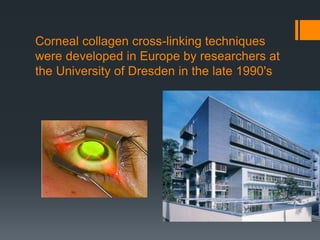
Corneal collagen cross-linking techniques
were developed in Europe by researchers at
the University of Dresden in the late 1990's
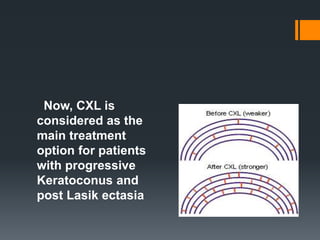
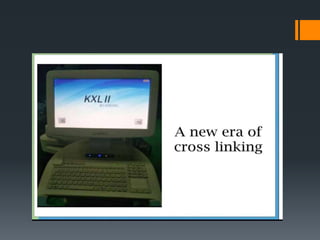
Now, CXL is
considered as the
main treatment
option for patients
with progressive
Keratoconus and
post Lasik ectasia
After practicing CXL for several
years. Refinement becomes a
must.
Recent advances and debates
about CXL are needed to
discussed
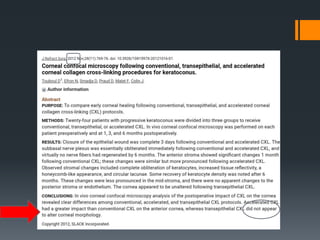
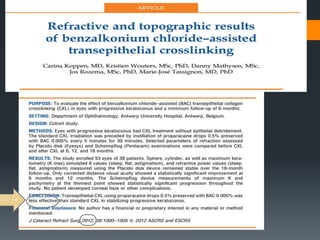
Epi-On Versus Epi-Off
Epithelium-Off vs. Epithelium-
On CXL
One of the big questions is whether epithelium-on
CXL can provide similar results to crosslinking
procedures where the epithelium has been
removed (Epi-off CXL)
Advantages of epithelium-on CXL include reduced
risk of infection, less corneal haze and fewer
delays in epithelial healing.
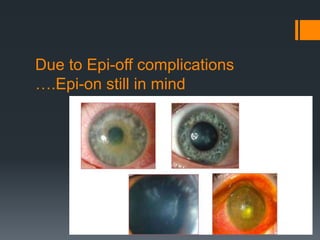
Due to Epi-off complications
….Epi-on still in mind
How to increase efficacy of Epi-on
??
Iontophoresis
Enhanced Riboflavin solutions
Iontophoresis
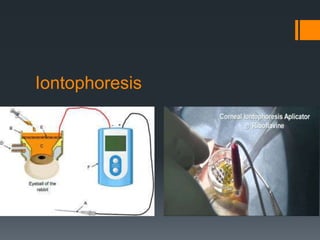
 Iontophoresis consists of the transfer of molecules, with an
ionic charge, inside the tissues to treat, thanks to a low
intensity electric field.
 Iontophoresis increases the penetration power of special type
of riboflavin into the underlying epithelium with increase
efficacy of Epi-on CXL
 The mid-term results (12-18 months) available in scientific
literature (Bikbova et al., Acta Oftalmologica; Vinciguerra et
al., JRS; Mastropasqua et al., EUCORNEA and ESCRS
Congress 2014) show how iontophoresis is an efficacious
technique in stabilizing progressive keratoconus (reduction
of Kmax, no variation in corneal thickness in the follow-up
period) with a moderate inflammatory activation and no
cases of haze in the treated patients.
Enhanced Riboflavin solutions
Enhanced Riboflavin
solutions
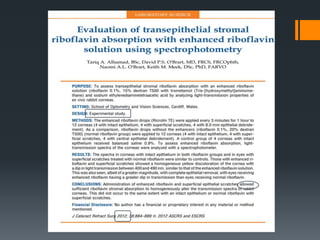
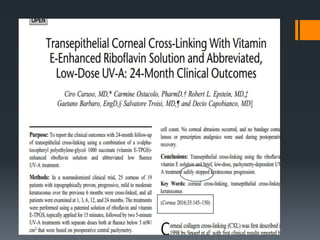
To increase Riboflavin penetration to
the corneal epithelium
Done by increase in riboflavin
concentration or using substances
increase epithelial disintegration
Customized Crosslinking
Customized Crosslinking to
Reshape the Cornea
Conventional CXL achieves this effect by
uniformly stiffening the central 9mm of the
anterior stroma.
Customized UVA illumination patterns will
allow surgeons to focally stiffen the
weakest region of the cornea rather than
the conventional approach of uniformly
stiffening the entire central cornea.
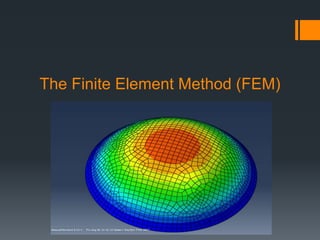
The Finite Element Method (FEM)
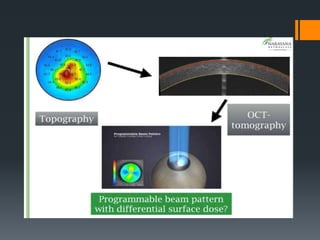
Photorefractive intrastromal cross-
linking (PiXL)
The device delivers specific light
patterns to the cornea based on a
patient’s topographic data.
 Used for refractive purposes.
CXL at Slit lamp
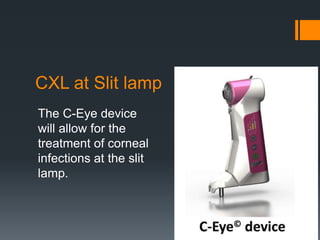
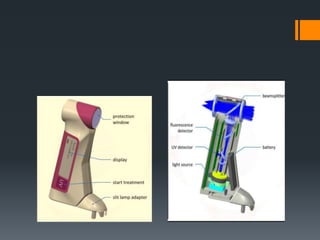
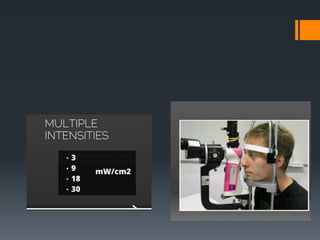
The C-Eye device
will allow for the
treatment of corneal
infections at the slit
lamp.
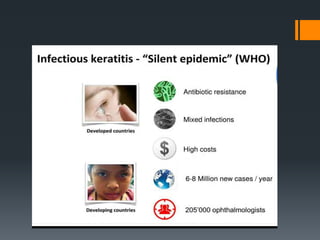
Antimicrobial resistance
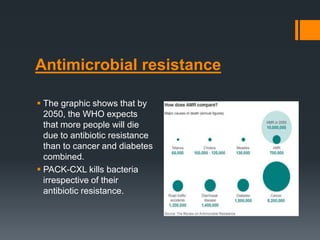
 The graphic shows that by
2050, the WHO expects
that more people will die
due to antibiotic resistance
than to cancer and diabetes
combined.
 PACK-CXL kills bacteria
irrespective of their
antibiotic resistance.
Corneal collagen cross-linking
(CXL) in thin corneas
In the conventional CXL protocol,
A minimum de-epithelialized corneal
thickness of 400 μm is recommended to
avoid potential irradiation damage to the
corneal endothelium
The modified CXL protocols
In advanced keratoconus, stromal
thickness is often lower than 400 μm, which
limits the application of CXL in that
category So, modified CXL is needed.
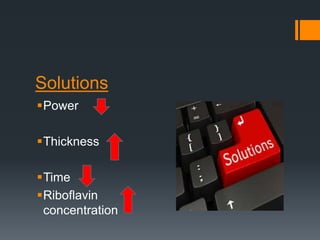
Solutions
Power
Thickness
Time
Riboflavin
concentration
The modified CXL protocols for
thin cornea
Hypoosmolar riboflavin solution:
- The deepithelialized cornea can swell to double its normal
thickness when irrigated with a Hypoosmolar solution.
- The 0.1 % dextran-free Hypoosmolar riboflavin was then
administered until the corneal thickness at the thinnest point
reached 400 μm, before the initiation of UVA irradiation.
The modified CXL protocols for
thin cornea
Transepithelial collagen cross-linking
- By adding the enhancers to help riboflavin penetrate to the
corneal stroma through the intact epithelium, CXL can be
performed without epithelial debridement (Transepithelial
CXL)
- Thinner corneas can be treated safer by Transepithelial
compared to the conventional CXL, since the endothelium is
better protected by UVA-filtering effect of the intact
epithelium.
The modified CXL protocols for
thin cornea
Custom epithelial debridement
technique
- In this modified CXL approach, 8.0 mm diameter of corneal
epithelium was removed; leaving a small, localized area of
corneal epithelium corresponding to the thinnest area over
the apex of the cone.
- The ability of the epithelium to absorb the UVA radiation may
lead to reduced CXL effect in the cone area and affect the
efficacy of the whole procedure. Long-term efficacy of this
modified CXL procedure with a larger number of patients
needs to be assessed.
The modified CXL protocols for
thin cornea
Contact lens-assisted collagen cross-
linking
A Soflens daily disposable soft contact lens of 90 μm thickness
immersed in isoosmolar riboflavin 0.1 % in dextran for
30 minutes, before it was applied onto the deepithelialized,
riboflavin-saturated cornea.
The riboflavin solution was instilled every 3 minutes. The pre-
corneal riboflavin film with contact lens created an absorption
medium in the pre-corneal space by artificially increasing the
thickness of the “riboflavin-filter
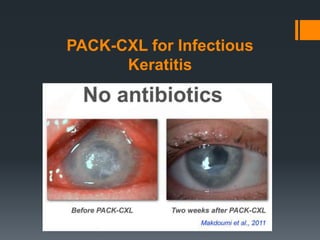
PACK-CXL for Infectious
Keratitis
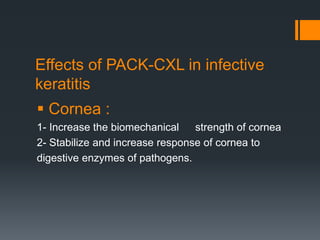
Effects of PACK-CXL in infective
keratitis
 Cornea :
1- Increase the biomechanical strength of cornea
2- Stabilize and increase response of cornea to
digestive enzymes of pathogens.
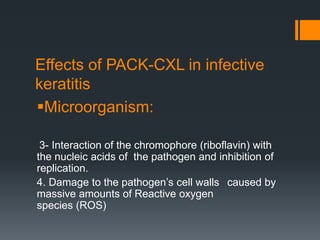
Effects of PACK-CXL in infective
keratitis
Microorganism:
3- Interaction of the chromophore (riboflavin) with
the nucleic acids of the pathogen and inhibition of
replication.
4. Damage to the pathogen’s cell walls caused by
massive amounts of Reactive oxygen
species (ROS)
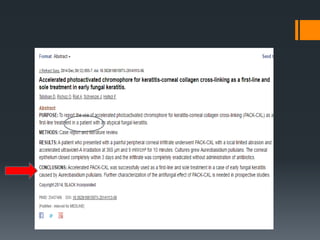
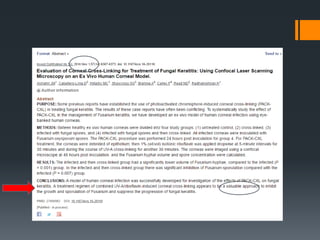
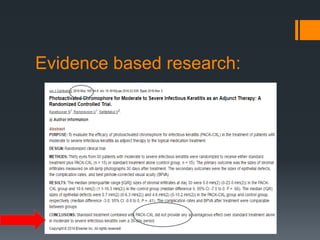
Evidence based research:
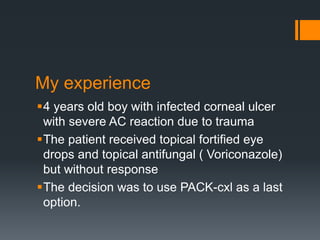
My experience
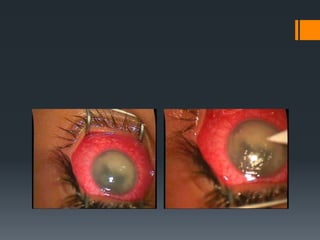
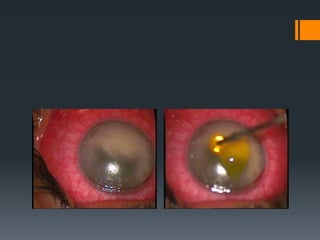
4 years old boy with infected corneal ulcer
with severe AC reaction due to trauma
The patient received topical fortified eye
drops and topical antifungal ( Voriconazole)
but without response
The decision was to use PACK-cxl as a last
option.
Result: No improvement
Conclusion
Theoretically, PACK-CXL is
effective in infective keratitis but
need further evidence based
research
Pediatric CXL
KERATOCONUS PROGRESSION
Most frequent in younger patients (< 18
years)
Risk of acute KC development (< 16 years)
 More significant and faster refractive and
pachymetric worsening in young patients
25 % progression with CXL
Pediatric Comorbidities
Vernal keratoconjunctivitis (VKC):
- Continued surface inflammation and the tendency
toward eye rubbing further accelerates keratoconus
progression and may lead to advanced disease in
young age.
- Many eyes with VKC demonstrate partial limbal
cell deficiency which may result in delayed epithelial
healing after standard CXL treatment.
Advices in pediatric CXL
1- Don't wait for progression
Once diagnosed
must be
crosslinked
2- Hit Hard
 TE CXL may be of limited
value especially in the
pediatric age
 Standard epithelium off
CXL is recommended in
pediatric eyes
 TE CXL is needed in thin
corneas
 Epi-off ???? Take care
endothelium and infection
3- Frequent screening
25 %
progression with
CXL
4- In ocular allergy
No eye rubbing
Don't do CXL
in active VKC
Home Message
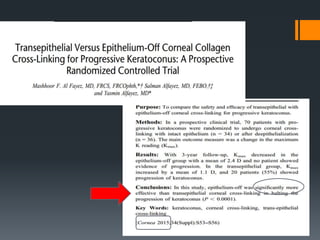
 Epi-On CXL is less effective than Epi-Off CXL But the Latter
has more complications.
 Trials has been mad to increase efficacy of Epi-On CXL by
Enhanced Riboflavin solutions and iontophoresis.
 Customized UVA illumination patterns will allow surgeons to
focally stiffen the weakest region of the cornea not all the
cornea.
 Theoretically, PACK-CXL is effective in infective keratitis but
need further evidence based research.
 Pediatric CXL should be aggressive , don't wait for
progression and frequent screening is mandatory.
Thank you

The recent updates about corneal collagen crosslinking

  • 1.
    Recent Updates In CornealCollagen Crosslinking. Dr. Amr Mounir.MD Lecturer of Ophthalmology Sohag University Hospital
  • 2.
    Introduction:  Corneal collagencross-linking is a technique which uses UV light and a photosensitizer to strengthen chemical bonds in the cornea.  The goal of the treatment is to halt progressive and irregular changes in corneal shape known as ectasia.
  • 3.
    Corneal collagen cross-linkingtechniques were developed in Europe by researchers at the University of Dresden in the late 1990's
  • 4.
    Now, CXL is consideredas the main treatment option for patients with progressive Keratoconus and post Lasik ectasia
  • 5.
    After practicing CXLfor several years. Refinement becomes a must.
  • 6.
    Recent advances anddebates about CXL are needed to discussed
  • 8.
  • 9.
    Epithelium-Off vs. Epithelium- OnCXL One of the big questions is whether epithelium-on CXL can provide similar results to crosslinking procedures where the epithelium has been removed (Epi-off CXL) Advantages of epithelium-on CXL include reduced risk of infection, less corneal haze and fewer delays in epithelial healing.
  • 13.
    Due to Epi-offcomplications ….Epi-on still in mind
  • 14.
    How to increaseefficacy of Epi-on ?? Iontophoresis Enhanced Riboflavin solutions
  • 15.
  • 16.
     Iontophoresis consistsof the transfer of molecules, with an ionic charge, inside the tissues to treat, thanks to a low intensity electric field.  Iontophoresis increases the penetration power of special type of riboflavin into the underlying epithelium with increase efficacy of Epi-on CXL
  • 17.
     The mid-termresults (12-18 months) available in scientific literature (Bikbova et al., Acta Oftalmologica; Vinciguerra et al., JRS; Mastropasqua et al., EUCORNEA and ESCRS Congress 2014) show how iontophoresis is an efficacious technique in stabilizing progressive keratoconus (reduction of Kmax, no variation in corneal thickness in the follow-up period) with a moderate inflammatory activation and no cases of haze in the treated patients.
  • 18.
  • 19.
    Enhanced Riboflavin solutions To increaseRiboflavin penetration to the corneal epithelium Done by increase in riboflavin concentration or using substances increase epithelial disintegration
  • 22.
  • 23.
    Customized Crosslinking to Reshapethe Cornea Conventional CXL achieves this effect by uniformly stiffening the central 9mm of the anterior stroma. Customized UVA illumination patterns will allow surgeons to focally stiffen the weakest region of the cornea rather than the conventional approach of uniformly stiffening the entire central cornea.
  • 24.
    The Finite ElementMethod (FEM)
  • 27.
    Photorefractive intrastromal cross- linking(PiXL) The device delivers specific light patterns to the cornea based on a patient’s topographic data.  Used for refractive purposes.
  • 29.
    CXL at Slitlamp The C-Eye device will allow for the treatment of corneal infections at the slit lamp.
  • 33.
    Antimicrobial resistance  Thegraphic shows that by 2050, the WHO expects that more people will die due to antibiotic resistance than to cancer and diabetes combined.  PACK-CXL kills bacteria irrespective of their antibiotic resistance.
  • 34.
  • 35.
    In the conventionalCXL protocol, A minimum de-epithelialized corneal thickness of 400 μm is recommended to avoid potential irradiation damage to the corneal endothelium
  • 36.
    The modified CXLprotocols In advanced keratoconus, stromal thickness is often lower than 400 μm, which limits the application of CXL in that category So, modified CXL is needed.
  • 37.
  • 38.
    The modified CXLprotocols for thin cornea Hypoosmolar riboflavin solution: - The deepithelialized cornea can swell to double its normal thickness when irrigated with a Hypoosmolar solution. - The 0.1 % dextran-free Hypoosmolar riboflavin was then administered until the corneal thickness at the thinnest point reached 400 μm, before the initiation of UVA irradiation.
  • 39.
    The modified CXLprotocols for thin cornea Transepithelial collagen cross-linking - By adding the enhancers to help riboflavin penetrate to the corneal stroma through the intact epithelium, CXL can be performed without epithelial debridement (Transepithelial CXL) - Thinner corneas can be treated safer by Transepithelial compared to the conventional CXL, since the endothelium is better protected by UVA-filtering effect of the intact epithelium.
  • 40.
    The modified CXLprotocols for thin cornea Custom epithelial debridement technique - In this modified CXL approach, 8.0 mm diameter of corneal epithelium was removed; leaving a small, localized area of corneal epithelium corresponding to the thinnest area over the apex of the cone. - The ability of the epithelium to absorb the UVA radiation may lead to reduced CXL effect in the cone area and affect the efficacy of the whole procedure. Long-term efficacy of this modified CXL procedure with a larger number of patients needs to be assessed.
  • 41.
    The modified CXLprotocols for thin cornea Contact lens-assisted collagen cross- linking A Soflens daily disposable soft contact lens of 90 μm thickness immersed in isoosmolar riboflavin 0.1 % in dextran for 30 minutes, before it was applied onto the deepithelialized, riboflavin-saturated cornea. The riboflavin solution was instilled every 3 minutes. The pre- corneal riboflavin film with contact lens created an absorption medium in the pre-corneal space by artificially increasing the thickness of the “riboflavin-filter
  • 42.
  • 45.
    Effects of PACK-CXLin infective keratitis  Cornea : 1- Increase the biomechanical strength of cornea 2- Stabilize and increase response of cornea to digestive enzymes of pathogens.
  • 46.
    Effects of PACK-CXLin infective keratitis Microorganism: 3- Interaction of the chromophore (riboflavin) with the nucleic acids of the pathogen and inhibition of replication. 4. Damage to the pathogen’s cell walls caused by massive amounts of Reactive oxygen species (ROS)
  • 50.
  • 51.
    My experience 4 yearsold boy with infected corneal ulcer with severe AC reaction due to trauma The patient received topical fortified eye drops and topical antifungal ( Voriconazole) but without response The decision was to use PACK-cxl as a last option.
  • 54.
  • 55.
    Conclusion Theoretically, PACK-CXL is effectivein infective keratitis but need further evidence based research
  • 56.
  • 57.
    KERATOCONUS PROGRESSION Most frequentin younger patients (< 18 years) Risk of acute KC development (< 16 years)  More significant and faster refractive and pachymetric worsening in young patients 25 % progression with CXL
  • 58.
    Pediatric Comorbidities Vernal keratoconjunctivitis(VKC): - Continued surface inflammation and the tendency toward eye rubbing further accelerates keratoconus progression and may lead to advanced disease in young age. - Many eyes with VKC demonstrate partial limbal cell deficiency which may result in delayed epithelial healing after standard CXL treatment.
  • 59.
  • 60.
    1- Don't waitfor progression Once diagnosed must be crosslinked
  • 61.
    2- Hit Hard TE CXL may be of limited value especially in the pediatric age  Standard epithelium off CXL is recommended in pediatric eyes  TE CXL is needed in thin corneas  Epi-off ???? Take care endothelium and infection
  • 62.
    3- Frequent screening 25% progression with CXL
  • 63.
    4- In ocularallergy No eye rubbing Don't do CXL in active VKC
  • 65.
    Home Message  Epi-OnCXL is less effective than Epi-Off CXL But the Latter has more complications.  Trials has been mad to increase efficacy of Epi-On CXL by Enhanced Riboflavin solutions and iontophoresis.  Customized UVA illumination patterns will allow surgeons to focally stiffen the weakest region of the cornea not all the cornea.  Theoretically, PACK-CXL is effective in infective keratitis but need further evidence based research.  Pediatric CXL should be aggressive , don't wait for progression and frequent screening is mandatory.
  • 66.