Dr. Ragu Krishnan
Gomathi Eye and Cornea Centre
Mulund
 Acknowledgements:
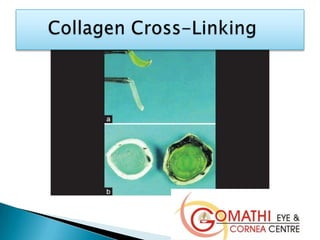
-Wollensak et al-Effect of cross linking on
porcine cornea
-A J Kanellopoulos et al-Lasik Extra.
-Tobias Koller-UV-X-1000 and UV-X-2000.
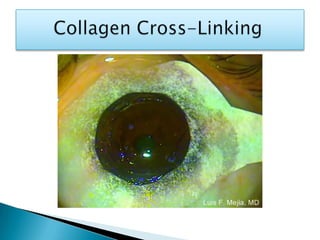
-Luis F. Mejia.
 History:
Theo Seiler, Spoerl and Wollensak.
Since 1998.
 Mechanism:
Riboflavin:
Photosensitization.
Photo-protection.
 Beneficial effects:
Photo-oxidation and chemical bonding.
Collagen fibrils- size.
bonding.
resists digestion.
Increases resistance and induces
stabilization.
Indications:
Keratoconus.
Post-lasik/post RK ectasia.
Pellucid, Terrien’s.
Innovative:
Post PK.
Refractory microbial keratitis.
Temporary for PBK.
 Standard Cross-linking:
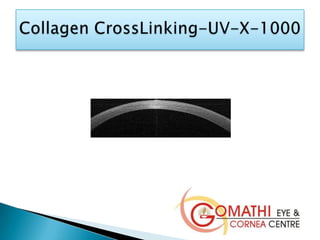
Dresden protocol, UV-A X1000.
 Uses the ‘top hat’ UV beam profile
 Accelerated Cross linking:
Reduces time and corneal dehydration.
Coupled with SimLC and Lasik extra.
 Accelerated Cross-Linking:
 A J Kanellopoulos- Athens, Greece-2005.
 Wellington Eye Clinic, New Zealand-2007.
 Paolo Vinciguerra, Italy-2007-2008.
 Switzerland and Bangalore, India.
 Accelerated Cross linking:
 Principle-Bunsen Roscoe law of reciprocity
 Experiments:
Wernli et al-40-45 mW/cm2
Hafezi et al-30 mW/cm2
 Accelerated Cross linking:
 IROC device- 9mW/cm2 for 10 mts.
 Avedro- various combinations
40mW/cm2 for 2 mts.
30mW/cm2 for 3 mts.
6mW/cm2 for 15 mts.
 Time and power vary, irradiation constant-
5.4J/cm2
 Accelerated Cross linking-Applications:
 SimLC- TPG PRK with Cross linking.
 The Athens protocol.
-Avedro used at 6mW/cm2 for 15 mts.
 Toponeutralization- TNT-NN group,
Bangalore -Avedro used
30mW/cm2 for 4 mts.
 Accelerated Cross linking:
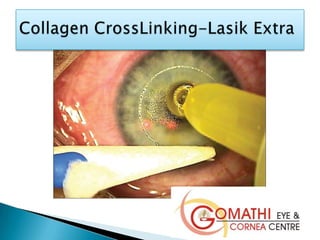
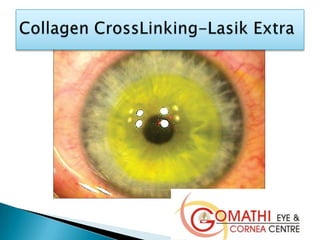
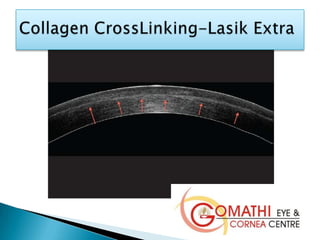
Lasik extra-A J Kanellopoulos et al
Myopes, special indications.
All hyperopes.
 Avedro used 30mW/cm2 for 80 seconds.
 Other applications:
- AJ Kanellopoulos-Avedro-45mW/cm2 for 3
mts, after astigmatic keratotomy with
femtolaser.
-5-6 hours post Keraflex-Avedro-30mW/cm2
for 3 mts.
-Also being used after Conductive
Keratoplasty.
 Tobias Koller-8th International Crosslinking
meet-Geneva, Switzerland.
 Prospective comparision between:
-Standard and Accelerated Cross linking
-One year results
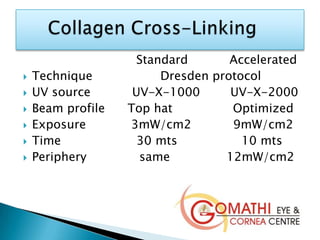
Standard Accelerated
 Technique Dresden protocol
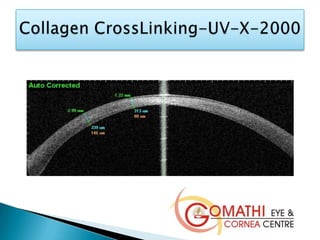
 UV source UV-X-1000 UV-X-2000
 Beam profile Top hat Optimized
 Exposure 3mW/cm2 9mW/cm2
 Time 30 mts 10 mts
 Periphery same 12mW/cm2
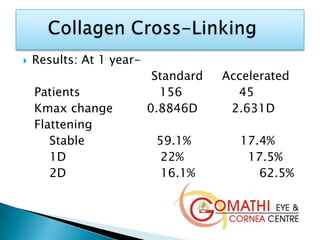
 Results: At 1 year-
Standard Accelerated
Patients 156 45
Kmax change 0.8846D 2.631D
Flattening
Stable 59.1% 17.4%
1D 22% 17.5%
2D 16.1% 62.5%
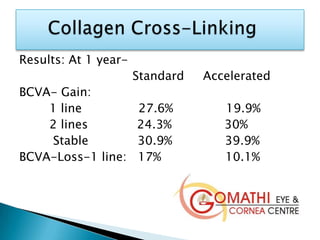
Results: At 1 year-
Standard Accelerated
BCVA- Gain:
1 line 27.6% 19.9%
2 lines 24.3% 30%
Stable 30.9% 39.9%
BCVA-Loss-1 line: 17% 10.1%
 Results: At 1 year-
Standard Accelerated
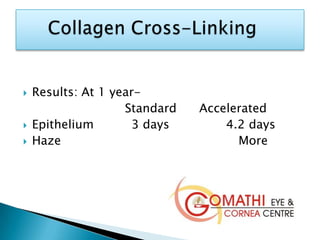
 Epithelium 3 days 4.2 days
 Haze More
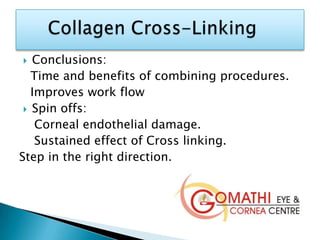
 Conclusions:
Time and benefits of combining procedures.
Improves work flow
 Spin offs:
Corneal endothelial damage.
Sustained effect of Cross linking.
Step in the right direction.

Collagen Cross Linking

  • 1.
    Dr. Ragu Krishnan GomathiEye and Cornea Centre Mulund
  • 2.
     Acknowledgements: -Wollensak etal-Effect of cross linking on porcine cornea -A J Kanellopoulos et al-Lasik Extra. -Tobias Koller-UV-X-1000 and UV-X-2000. -Luis F. Mejia.
  • 3.
     History: Theo Seiler,Spoerl and Wollensak. Since 1998.  Mechanism: Riboflavin: Photosensitization. Photo-protection.
  • 4.
     Beneficial effects: Photo-oxidationand chemical bonding. Collagen fibrils- size. bonding. resists digestion. Increases resistance and induces stabilization.
  • 6.
    Indications: Keratoconus. Post-lasik/post RK ectasia. Pellucid,Terrien’s. Innovative: Post PK. Refractory microbial keratitis. Temporary for PBK.
  • 7.
     Standard Cross-linking: Dresdenprotocol, UV-A X1000.  Uses the ‘top hat’ UV beam profile
  • 9.
     Accelerated Crosslinking: Reduces time and corneal dehydration. Coupled with SimLC and Lasik extra.
  • 10.
     Accelerated Cross-Linking: A J Kanellopoulos- Athens, Greece-2005.  Wellington Eye Clinic, New Zealand-2007.  Paolo Vinciguerra, Italy-2007-2008.  Switzerland and Bangalore, India.
  • 11.
     Accelerated Crosslinking:  Principle-Bunsen Roscoe law of reciprocity  Experiments: Wernli et al-40-45 mW/cm2 Hafezi et al-30 mW/cm2
  • 12.
     Accelerated Crosslinking:  IROC device- 9mW/cm2 for 10 mts.  Avedro- various combinations 40mW/cm2 for 2 mts. 30mW/cm2 for 3 mts. 6mW/cm2 for 15 mts.  Time and power vary, irradiation constant- 5.4J/cm2
  • 13.
     Accelerated Crosslinking-Applications:  SimLC- TPG PRK with Cross linking.  The Athens protocol. -Avedro used at 6mW/cm2 for 15 mts.  Toponeutralization- TNT-NN group, Bangalore -Avedro used 30mW/cm2 for 4 mts.
  • 14.
     Accelerated Crosslinking: Lasik extra-A J Kanellopoulos et al Myopes, special indications. All hyperopes.  Avedro used 30mW/cm2 for 80 seconds.
  • 18.
     Other applications: -AJ Kanellopoulos-Avedro-45mW/cm2 for 3 mts, after astigmatic keratotomy with femtolaser. -5-6 hours post Keraflex-Avedro-30mW/cm2 for 3 mts. -Also being used after Conductive Keratoplasty.
  • 19.
     Tobias Koller-8thInternational Crosslinking meet-Geneva, Switzerland.  Prospective comparision between: -Standard and Accelerated Cross linking -One year results
  • 20.
    Standard Accelerated  TechniqueDresden protocol  UV source UV-X-1000 UV-X-2000  Beam profile Top hat Optimized  Exposure 3mW/cm2 9mW/cm2  Time 30 mts 10 mts  Periphery same 12mW/cm2
  • 23.
     Results: At1 year- Standard Accelerated Patients 156 45 Kmax change 0.8846D 2.631D Flattening Stable 59.1% 17.4% 1D 22% 17.5% 2D 16.1% 62.5%
  • 24.
    Results: At 1year- Standard Accelerated BCVA- Gain: 1 line 27.6% 19.9% 2 lines 24.3% 30% Stable 30.9% 39.9% BCVA-Loss-1 line: 17% 10.1%
  • 25.
     Results: At1 year- Standard Accelerated  Epithelium 3 days 4.2 days  Haze More
  • 26.
     Conclusions: Time andbenefits of combining procedures. Improves work flow  Spin offs: Corneal endothelial damage. Sustained effect of Cross linking. Step in the right direction.