The Present Simple
The simple present tense is one of several forms of present
tense in English. It is used to describe habits, unchanging
situations, general truths, and routines.
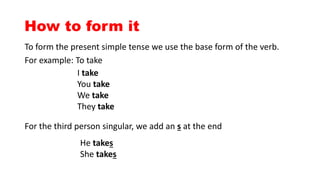
How to form it
To form the present simple tense we use the base form of the verb.
For example: To take
I take
You take
We take
They take
For the third person singular, we add an s at the end
He takes
She takes
Negatives
Subject + don’t/doesn’t + verb
I
You
We
They
He
She
It
Don’t
Doesn’t
Drink water
Rules for third person singular
• Negative forms and questions use the word ‘DOES’ when referring to
the third person singular.
Does she want an apple? She does not (or doesn’t)
Does he need help? No, he does not (or doesn’t)
• Verbs that end in –y change to –ies in the third person singular form
(unless there is a vowel before the –y e.g playplays)
To carry  He carries
To fly He flies
To cry  he cries
• Add -es to the third person singular form of the verbs ending in –ss, -
x, -ch, -sh, -o
To pass- he passes
To catch - she catches
To fix – she fixes
To push – he pushes
To go – she goes
Permission and Requests
When the subject is before the verb, it expresses ability. For example:
We say ‘I can play football’ when we have the ability to play football.
However, when the subject is after the verb, it is a request. For example: We
say, ‘Can I play football?’ to ask for permission to play football.
The subject always comes after Can/Do/Does when asking
questions
The verb ‘To Be’
To Be is different from the other verbs in this tense
Positive Positive Short form
I am I’m
You are You’re
He is He’s
She is She’s
It is It’s
We are We’re
They are They’re
Negative Negative Short form
I am not I’m not
You are not You aren’t
He is not He isn’t
She is not She isn’t
It is not It isn’t
We are not We aren’t
They are not They aren’t
The present simple

The present simple

  • 2.
    The Present Simple Thesimple present tense is one of several forms of present tense in English. It is used to describe habits, unchanging situations, general truths, and routines.
  • 3.
    How to formit To form the present simple tense we use the base form of the verb. For example: To take I take You take We take They take For the third person singular, we add an s at the end He takes She takes
  • 4.
    Negatives Subject + don’t/doesn’t+ verb I You We They He She It Don’t Doesn’t Drink water
  • 5.
    Rules for thirdperson singular • Negative forms and questions use the word ‘DOES’ when referring to the third person singular. Does she want an apple? She does not (or doesn’t) Does he need help? No, he does not (or doesn’t) • Verbs that end in –y change to –ies in the third person singular form (unless there is a vowel before the –y e.g playplays) To carry  He carries To fly He flies To cry  he cries
  • 6.
    • Add -esto the third person singular form of the verbs ending in –ss, - x, -ch, -sh, -o To pass- he passes To catch - she catches To fix – she fixes To push – he pushes To go – she goes
  • 7.
    Permission and Requests Whenthe subject is before the verb, it expresses ability. For example: We say ‘I can play football’ when we have the ability to play football. However, when the subject is after the verb, it is a request. For example: We say, ‘Can I play football?’ to ask for permission to play football. The subject always comes after Can/Do/Does when asking questions
  • 8.
    The verb ‘ToBe’ To Be is different from the other verbs in this tense Positive Positive Short form I am I’m You are You’re He is He’s She is She’s It is It’s We are We’re They are They’re Negative Negative Short form I am not I’m not You are not You aren’t He is not He isn’t She is not She isn’t It is not It isn’t We are not We aren’t They are not They aren’t