To describe
 Habits
 unchanging situations
 general truth
 fixed arrangements
 The simple present tense is simple to form.
 Just use the base form of the verb
I take. He take+s=
He takes.
You take. She take+s=
She takes.
We take. It take+s=
It takes.
They Take.
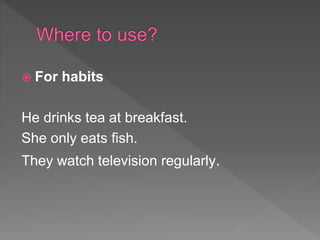
 For habits
He drinks tea at breakfast.
She only eats fish.
They watch television regularly.
 For repeated actions or events
We catch the bus every morning.
It rains every afternoon in the hot season.
They drive to Monaco every summer.
 For general truths
Water freezes at zero degrees.
The Earth revolves around the Sun.
Her mother is Spanish.
 For instructions or directions
Open the packet and pour the contents into
hot water.
You take the No.6 bus to Watney and then
the No.10 to Bedford.
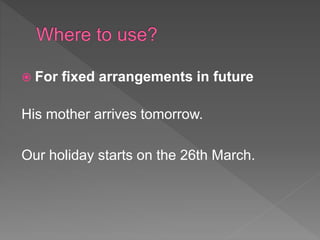
 For fixed arrangements in future
His mother arrives tomorrow.
Our holiday starts on the 26th March.
 With future constructions
She'll see you before she leaves.
We'll give it to her when she arrives.
Affirmative Interrogative Negative Negative
Interrogative
I think Do I think?
Yes, I do.
I do not think Don’t I think?
No, I don’t.
You think. Do you think?
Yes, you do.
You don’t think. Don’t you think?
We think. Do we think?
Yes, we do.
We don’t think. Don’t we think?
They think. Do they think?
Yes, they do.
They don’t think. Don’t they think.
He thinks Does he think?
Yes, he does.
He does not think. Doesn’t he think?
No, he doesn’t.
She thinks. Does she think?
Yes, she does.
She doesn’t think. Doesn’t she think?
It thinks. Does it think?
Yes, it does.
IT doesn’t think. Doesn’t it think?
 In the third person singular the
verb always ends in -s:
he wants.
she needs.
he gives.
she thinks.
 Negative and question forms use DOES
(= the third person of the auxiliary 'DO') +
the infinitive of the verb.
He wants ice cream.
Does he want strawberry?
He does not want vanilla.
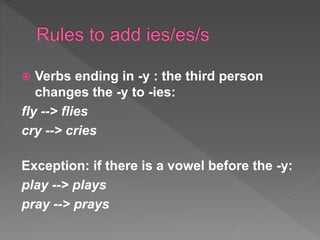
 Verbs ending in -y : the third person
changes the -y to -ies:
fly --> flies
cry --> cries
Exception: if there is a vowel before the -y:
play --> plays
pray --> prays
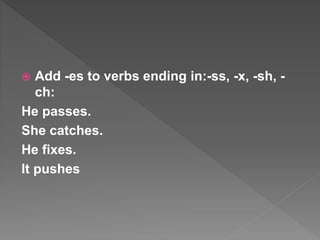
 Add -es to verbs ending in:-ss, -x, -sh, -
ch:
He passes.
She catches.
He fixes.
It pushes
Thank you!

Simple present tense

  • 2.
    To describe  Habits unchanging situations  general truth  fixed arrangements
  • 3.
     The simplepresent tense is simple to form.  Just use the base form of the verb I take. He take+s= He takes. You take. She take+s= She takes. We take. It take+s= It takes. They Take.
  • 4.
     For habits Hedrinks tea at breakfast. She only eats fish. They watch television regularly.
  • 5.
     For repeatedactions or events We catch the bus every morning. It rains every afternoon in the hot season. They drive to Monaco every summer.
  • 6.
     For generaltruths Water freezes at zero degrees. The Earth revolves around the Sun. Her mother is Spanish.
  • 7.
     For instructionsor directions Open the packet and pour the contents into hot water. You take the No.6 bus to Watney and then the No.10 to Bedford.
  • 8.
     For fixedarrangements in future His mother arrives tomorrow. Our holiday starts on the 26th March.
  • 9.
     With futureconstructions She'll see you before she leaves. We'll give it to her when she arrives.
  • 10.
    Affirmative Interrogative NegativeNegative Interrogative I think Do I think? Yes, I do. I do not think Don’t I think? No, I don’t. You think. Do you think? Yes, you do. You don’t think. Don’t you think? We think. Do we think? Yes, we do. We don’t think. Don’t we think? They think. Do they think? Yes, they do. They don’t think. Don’t they think. He thinks Does he think? Yes, he does. He does not think. Doesn’t he think? No, he doesn’t. She thinks. Does she think? Yes, she does. She doesn’t think. Doesn’t she think? It thinks. Does it think? Yes, it does. IT doesn’t think. Doesn’t it think?
  • 11.
     In thethird person singular the verb always ends in -s: he wants. she needs. he gives. she thinks.
  • 12.
     Negative andquestion forms use DOES (= the third person of the auxiliary 'DO') + the infinitive of the verb. He wants ice cream. Does he want strawberry? He does not want vanilla.
  • 13.
     Verbs endingin -y : the third person changes the -y to -ies: fly --> flies cry --> cries Exception: if there is a vowel before the -y: play --> plays pray --> prays
  • 14.
     Add -esto verbs ending in:-ss, -x, -sh, - ch: He passes. She catches. He fixes. It pushes
  • 15.