Simple PresentSimple Present
(Present Simple)(Present Simple)
IntroductionIntroduction
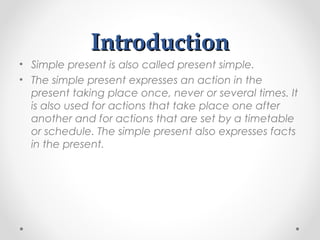
• Simple present is also called present simple.
• The simple present expresses an action in the
present taking place once, never or several times. It
is also used for actions that take place one after
another and for actions that are set by a timetable
or schedule. The simple present also expresses facts
in the present.
BeBe
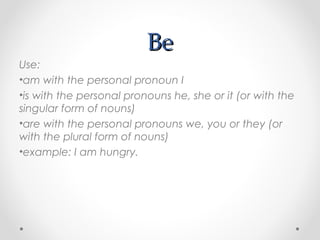
Use:
•am with the personal pronoun I
•is with the personal pronouns he, she or it (or with the
singular form of nouns)
•are with the personal pronouns we, you or they (or
with the plural form of nouns)
•example: I am hungry.
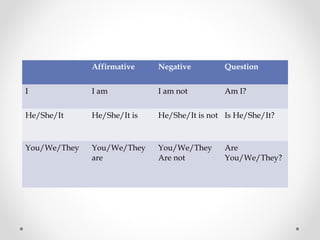
Affirmative Negative Question
I I am I am not Am I?
He/She/It He/She/It is He/She/It is not Is He/She/It?
You/We/They You/We/They
are
You/We/They
Are not
Are
You/We/They?
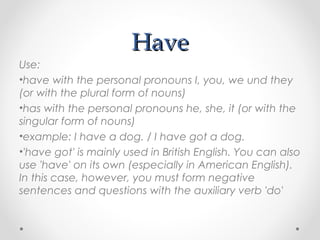
HaveHave
Use:
•have with the personal pronouns I, you, we und they
(or with the plural form of nouns)
•has with the personal pronouns he, she, it (or with the
singular form of nouns)
•example: I have a dog. / I have got a dog.
•'have got' is mainly used in British English. You can also
use 'have' on its own (especially in American English).
In this case, however, you must form negative
sentences and questions with the auxiliary verb 'do'
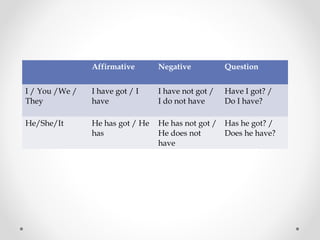
Affirmative Negative Question
I / You /We /
They
I have got / I
have
I have not got /
I do not have
Have I got? /
Do I have?
He/She/It He has got / He
has
He has not got /
He does not
have
Has he got? /
Does he have?
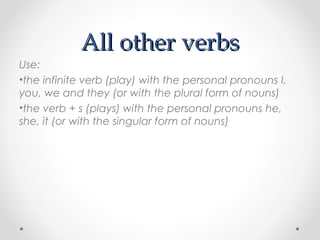
All other verbsAll other verbs
Use:
•the infinite verb (play) with the personal pronouns I,
you, we and they (or with the plural form of nouns)
•the verb + s (plays) with the personal pronouns he,
she, it (or with the singular form of nouns)
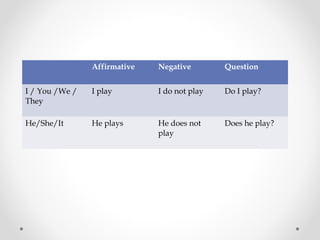
Affirmative Negative Question
I / You /We /
They
I play I do not play Do I play?
He/She/It He plays He does not
play
Does he play?
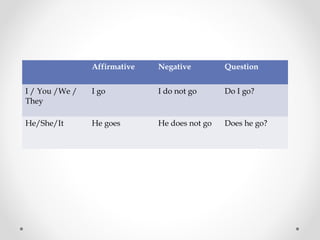
Affirmative Negative Question
I / You /We /
They
I go I do not go Do I go?
He/She/It He goes He does not go Does he go?
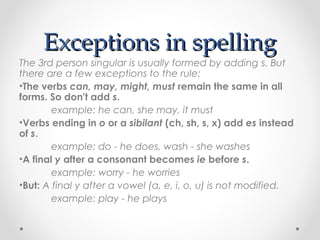
Exceptions in spellingExceptions in spelling
The 3rd person singular is usually formed by adding s. But
there are a few exceptions to the rule:
•The verbs can, may, might, must remain the same in all
forms. So don't add s.
example: he can, she may, it must
•Verbs ending in o or a sibilant (ch, sh, s, x) add es instead
of s.
example: do - he does, wash - she washes
•A final y after a consonant becomes ie before s.
example: worry - he worries
•But: A final y after a vowel (a, e, i, o, u) is not modified.
example: play - he plays
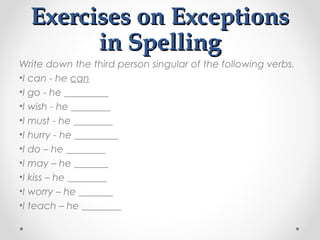
Exercises on ExceptionsExercises on Exceptions
in Spellingin Spelling
Write down the third person singular of the following verbs.
•I can - he can
•I go - he _________
•I wish - he ________
•I must - he ________
•I hurry - he _________
•I do – he ________
•I may – he _______
•I kiss – he ________
•I worry – he _______
•I teach – he ________
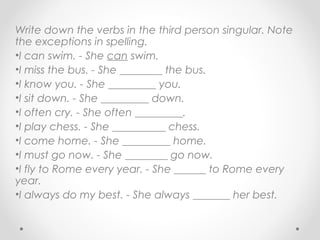
Write down the verbs in the third person singular. Note
the exceptions in spelling.
•I can swim. - She can swim.
•I miss the bus. - She ________ the bus.
•I know you. - She _________ you.
•I sit down. - She _________ down.
•I often cry. - She often _________.
•I play chess. - She __________ chess.
•I come home. - She _________ home.
•I must go now. - She ________ go now.
•I fly to Rome every year. - She ______ to Rome every
year.
•I always do my best. - She always _______ her best.
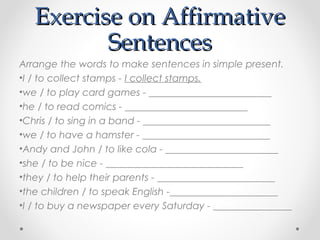
Exercise on AffirmativeExercise on Affirmative
SentencesSentences
Arrange the words to make sentences in simple present.
•I / to collect stamps - I collect stamps.
•we / to play card games - _________________________
•he / to read comics - _________________________
•Chris / to sing in a band - __________________________
•we / to have a hamster - __________________________
•Andy and John / to like cola - _______________________
•she / to be nice - ____________________________
•they / to help their parents - ________________________
•the children / to speak English -______________________
•I / to buy a newspaper every Saturday - ________________
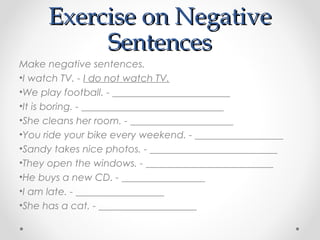
Exercise on NegativeExercise on Negative
SentencesSentences
Make negative sentences.
•I watch TV. - I do not watch TV.
•We play football. - ________________________
•It is boring. - _____________________________
•She cleans her room. - _____________________
•You ride your bike every weekend. - __________________
•Sandy takes nice photos. - __________________________
•They open the windows. - __________________________
•He buys a new CD. - _________________
•I am late. - __________________
•She has a cat. - ____________________
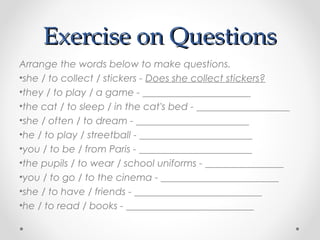
Exercise on QuestionsExercise on Questions
Arrange the words below to make questions.
•she / to collect / stickers - Does she collect stickers?
•they / to play / a game - ______________________
•the cat / to sleep / in the cat's bed - ___________________
•she / often / to dream - _______________________
•he / to play / streetball - _______________________
•you / to be / from Paris - _______________________
•the pupils / to wear / school uniforms - ________________
•you / to go / to the cinema - ________________________
•she / to have / friends - __________________________
•he / to read / books - __________________________

Presentació simple present_eva

  • 1.
  • 2.
    IntroductionIntroduction • Simple presentis also called present simple. • The simple present expresses an action in the present taking place once, never or several times. It is also used for actions that take place one after another and for actions that are set by a timetable or schedule. The simple present also expresses facts in the present.
  • 3.
    BeBe Use: •am with thepersonal pronoun I •is with the personal pronouns he, she or it (or with the singular form of nouns) •are with the personal pronouns we, you or they (or with the plural form of nouns) •example: I am hungry.
  • 4.
    Affirmative Negative Question II am I am not Am I? He/She/It He/She/It is He/She/It is not Is He/She/It? You/We/They You/We/They are You/We/They Are not Are You/We/They?
  • 5.
    HaveHave Use: •have with thepersonal pronouns I, you, we und they (or with the plural form of nouns) •has with the personal pronouns he, she, it (or with the singular form of nouns) •example: I have a dog. / I have got a dog. •'have got' is mainly used in British English. You can also use 'have' on its own (especially in American English). In this case, however, you must form negative sentences and questions with the auxiliary verb 'do'
  • 6.
    Affirmative Negative Question I/ You /We / They I have got / I have I have not got / I do not have Have I got? / Do I have? He/She/It He has got / He has He has not got / He does not have Has he got? / Does he have?
  • 7.
    All other verbsAllother verbs Use: •the infinite verb (play) with the personal pronouns I, you, we and they (or with the plural form of nouns) •the verb + s (plays) with the personal pronouns he, she, it (or with the singular form of nouns)
  • 8.
    Affirmative Negative Question I/ You /We / They I play I do not play Do I play? He/She/It He plays He does not play Does he play?
  • 9.
    Affirmative Negative Question I/ You /We / They I go I do not go Do I go? He/She/It He goes He does not go Does he go?
  • 10.
    Exceptions in spellingExceptionsin spelling The 3rd person singular is usually formed by adding s. But there are a few exceptions to the rule: •The verbs can, may, might, must remain the same in all forms. So don't add s. example: he can, she may, it must •Verbs ending in o or a sibilant (ch, sh, s, x) add es instead of s. example: do - he does, wash - she washes •A final y after a consonant becomes ie before s. example: worry - he worries •But: A final y after a vowel (a, e, i, o, u) is not modified. example: play - he plays
  • 11.
    Exercises on ExceptionsExerciseson Exceptions in Spellingin Spelling Write down the third person singular of the following verbs. •I can - he can •I go - he _________ •I wish - he ________ •I must - he ________ •I hurry - he _________ •I do – he ________ •I may – he _______ •I kiss – he ________ •I worry – he _______ •I teach – he ________
  • 12.
    Write down theverbs in the third person singular. Note the exceptions in spelling. •I can swim. - She can swim. •I miss the bus. - She ________ the bus. •I know you. - She _________ you. •I sit down. - She _________ down. •I often cry. - She often _________. •I play chess. - She __________ chess. •I come home. - She _________ home. •I must go now. - She ________ go now. •I fly to Rome every year. - She ______ to Rome every year. •I always do my best. - She always _______ her best.
  • 13.
    Exercise on AffirmativeExerciseon Affirmative SentencesSentences Arrange the words to make sentences in simple present. •I / to collect stamps - I collect stamps. •we / to play card games - _________________________ •he / to read comics - _________________________ •Chris / to sing in a band - __________________________ •we / to have a hamster - __________________________ •Andy and John / to like cola - _______________________ •she / to be nice - ____________________________ •they / to help their parents - ________________________ •the children / to speak English -______________________ •I / to buy a newspaper every Saturday - ________________
  • 14.
    Exercise on NegativeExerciseon Negative SentencesSentences Make negative sentences. •I watch TV. - I do not watch TV. •We play football. - ________________________ •It is boring. - _____________________________ •She cleans her room. - _____________________ •You ride your bike every weekend. - __________________ •Sandy takes nice photos. - __________________________ •They open the windows. - __________________________ •He buys a new CD. - _________________ •I am late. - __________________ •She has a cat. - ____________________
  • 15.
    Exercise on QuestionsExerciseon Questions Arrange the words below to make questions. •she / to collect / stickers - Does she collect stickers? •they / to play / a game - ______________________ •the cat / to sleep / in the cat's bed - ___________________ •she / often / to dream - _______________________ •he / to play / streetball - _______________________ •you / to be / from Paris - _______________________ •the pupils / to wear / school uniforms - ________________ •you / to go / to the cinema - ________________________ •she / to have / friends - __________________________ •he / to read / books - __________________________