Engr.Tehseen Ahsan 
Lecturer, Electrical Engineering Department 
EE-307 Electronic Systems Design 
HITEC University Taxila Cantt, Pakistan 
The Operational Amplifier (Part 1)
12-1 Introduction to Operational Amplifiers 
Thedevices,suchasdiodeandthetransistor,areseparatedevicesthatareindividuallypackagedandinterconnectedinacircuitwithotherdevicestoformacomplete,functionalunit-DiscreteComponents. 
Linearintegratedcircuits(ICs),wheremanytransistors,diodes, resistorsandcapacitorsarefabricatedonasingletinychipofsemiconductormaterial. 
Thismeansthatwewillbeconcernedwithwhatthecircuitdoesfromanexternalviewpointthanfromaninternal, component-levelviewpoint. 
2
12-1 Introduction to Operational Amplifiers Continue… 
EarlyoperationalAmplifiers(i.e,usedfor+,-,∫andd/dx). 
Earlyop-ampwereconstructedwithvaccumtubesandworkedwithhighvoltages. 
Today’sop-amparelinearICsthatuserelativelylowdcsupplyvoltagesandarereliableandinexpensive. 
3
12-1 Introduction to Operational Amplifiers Continue… 
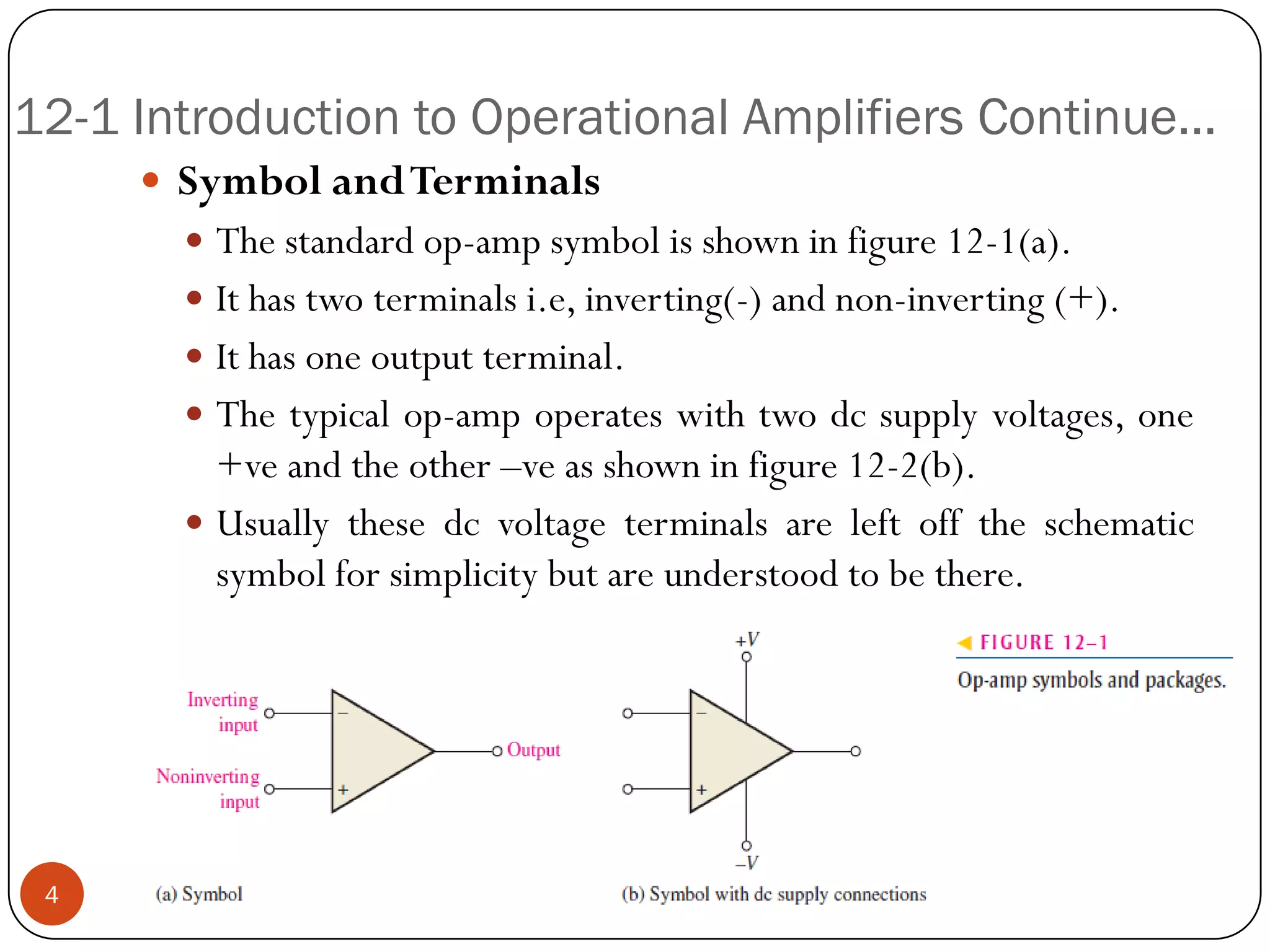
SymbolandTerminals 
Thestandardop-ampsymbolisshowninfigure12-1(a). 
Ithastwoterminalsi.e,inverting(-)andnon-inverting(+). 
Ithasoneoutputterminal. 
Thetypicalop-ampoperateswithtwodcsupplyvoltages,one+veandtheother–veasshowninfigure12-2(b). 
Usuallythesedcvoltageterminalsareleftofftheschematicsymbolforsimplicitybutareunderstoodtobethere. 4
12-1 Introduction to Operational Amplifiers Continue… 
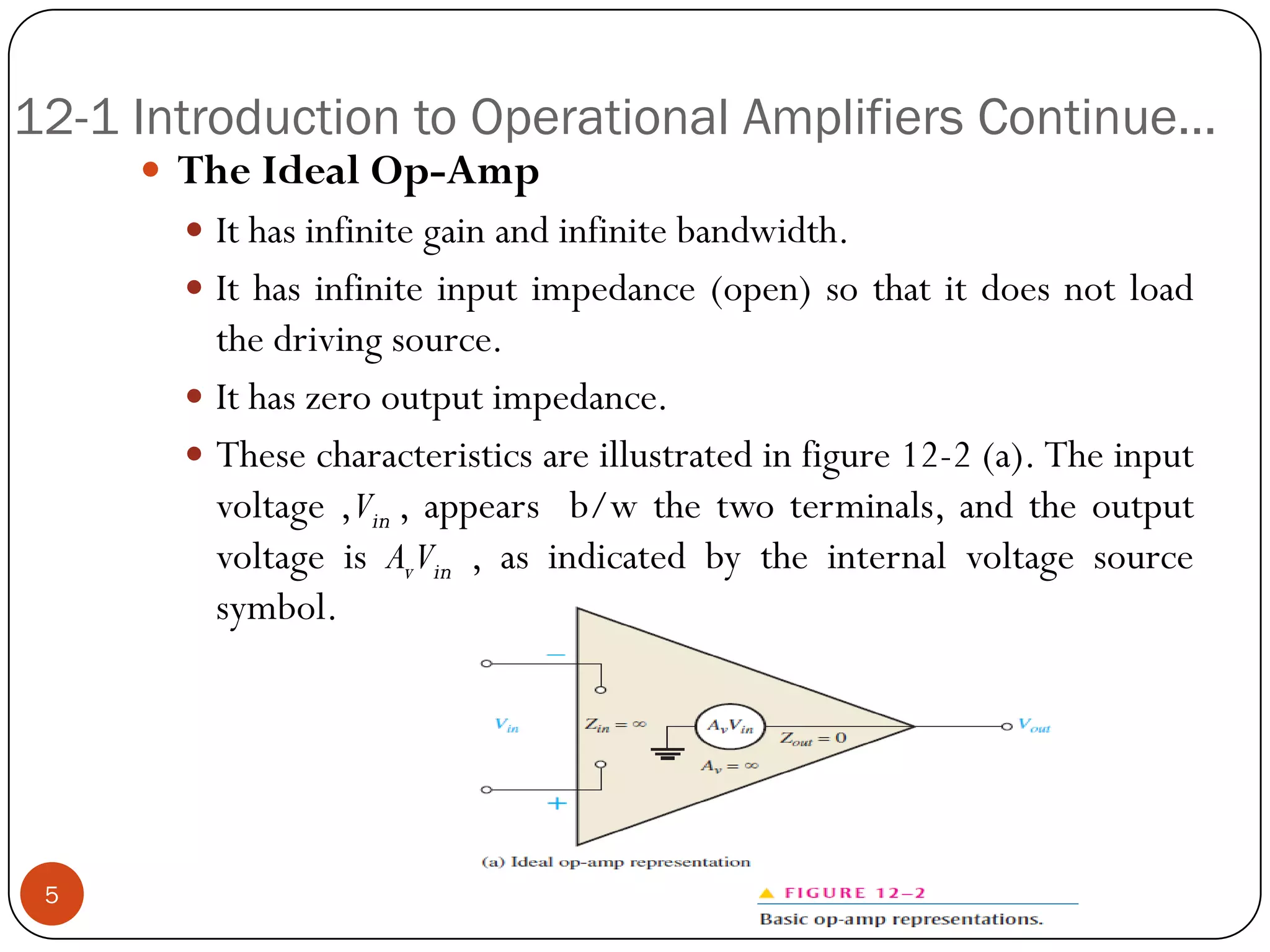
TheIdealOp-Amp 
Ithasinfinitegainandinfinitebandwidth. 
Ithasinfiniteinputimpedance(open)sothatitdoesnotloadthedrivingsource. 
Ithaszerooutputimpedance. 
Thesecharacteristicsareillustratedinfigure12-2(a).Theinputvoltage,Vin,appearsb/wthetwoterminals,andtheoutputvoltageisAvVin,asindicatedbytheinternalvoltagesourcesymbol. 
5
12-1 Introduction to Operational Amplifiers Continue… 
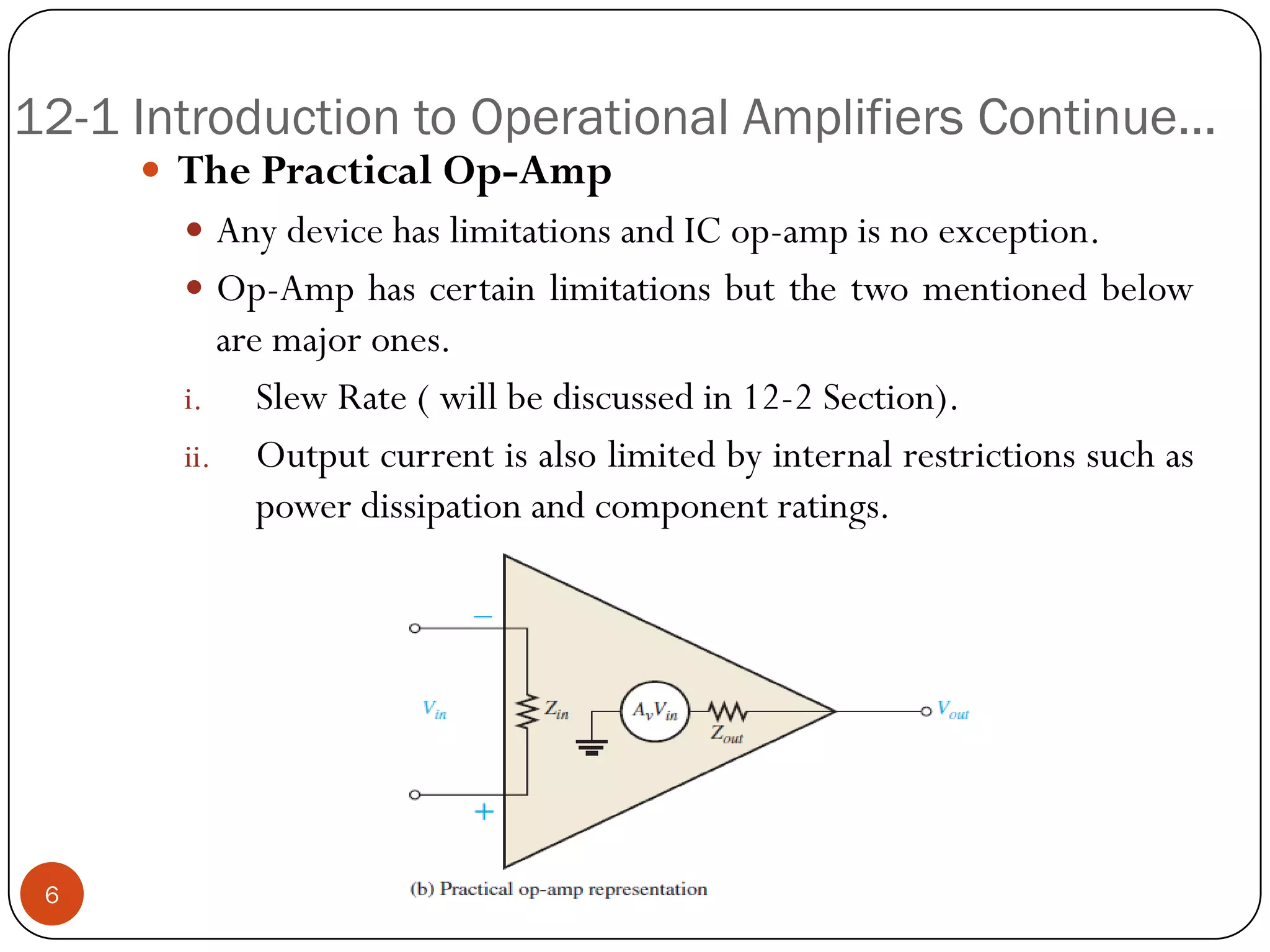
ThePracticalOp-Amp 
AnydevicehaslimitationsandICop-ampisnoexception. 
Op-Amphascertainlimitationsbutthetwomentionedbelowaremajorones. 
i.SlewRate(willbediscussedin12-2Section). 
ii.Outputcurrentisalsolimitedbyinternalrestrictionssuchaspowerdissipationandcomponentratings. 
6
12-1 Introduction to Operational Amplifiers Continue… 
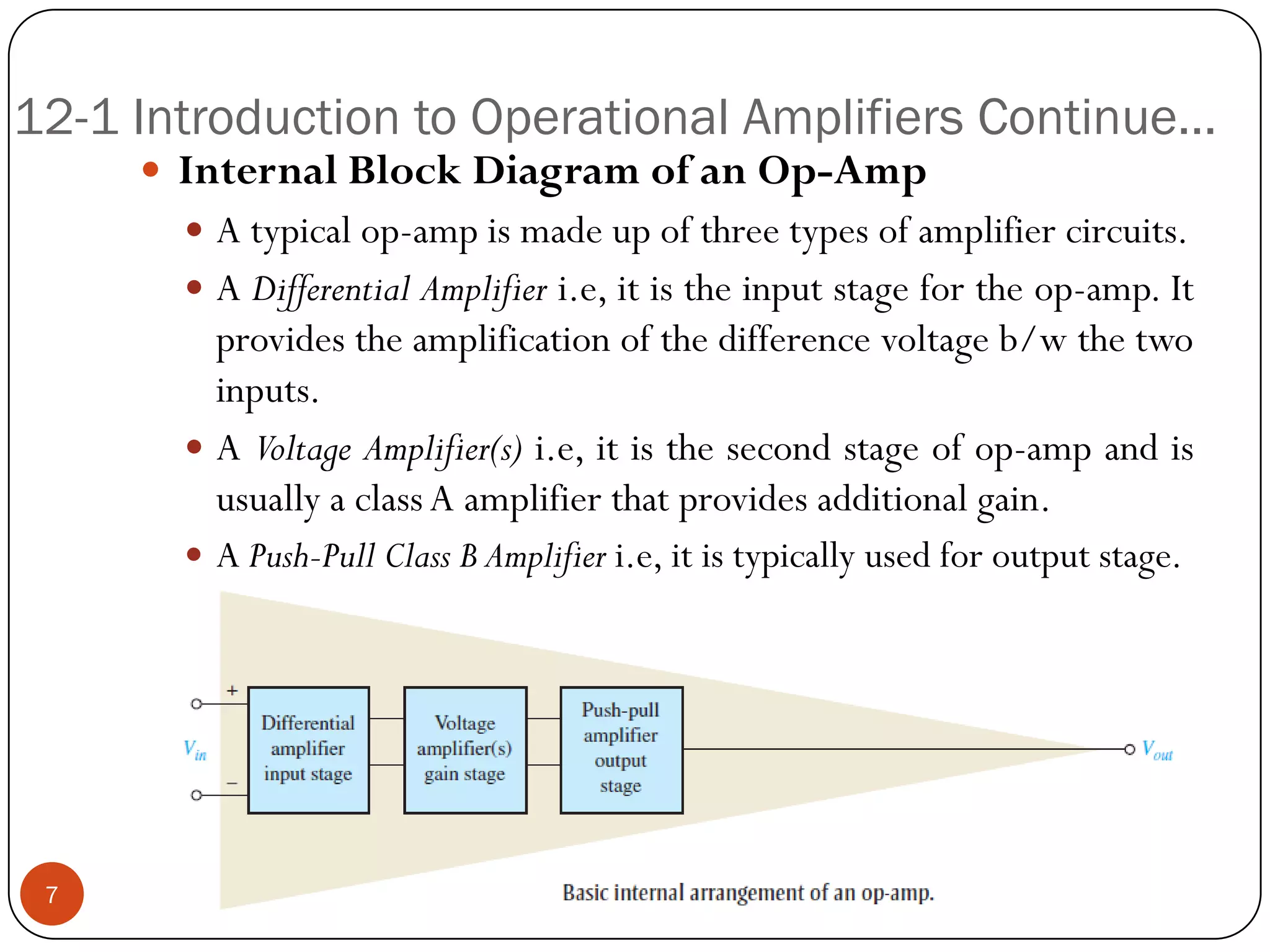
InternalBlockDiagramofanOp-Amp 
Atypicalop-ampismadeupofthreetypesofamplifiercircuits. 
ADifferentialAmplifieri.e,itistheinputstagefortheop-amp.Itprovidestheamplificationofthedifferencevoltageb/wthetwoinputs. 
AVoltageAmplifier(s)i.e,itisthesecondstageofop-ampandisusuallyaclassAamplifierthatprovidesadditionalgain. 
APush-PullClassBAmplifieri.e,itistypicallyusedforoutputstage. 
7
12-1 Introduction to Operational Amplifiers Continue… 
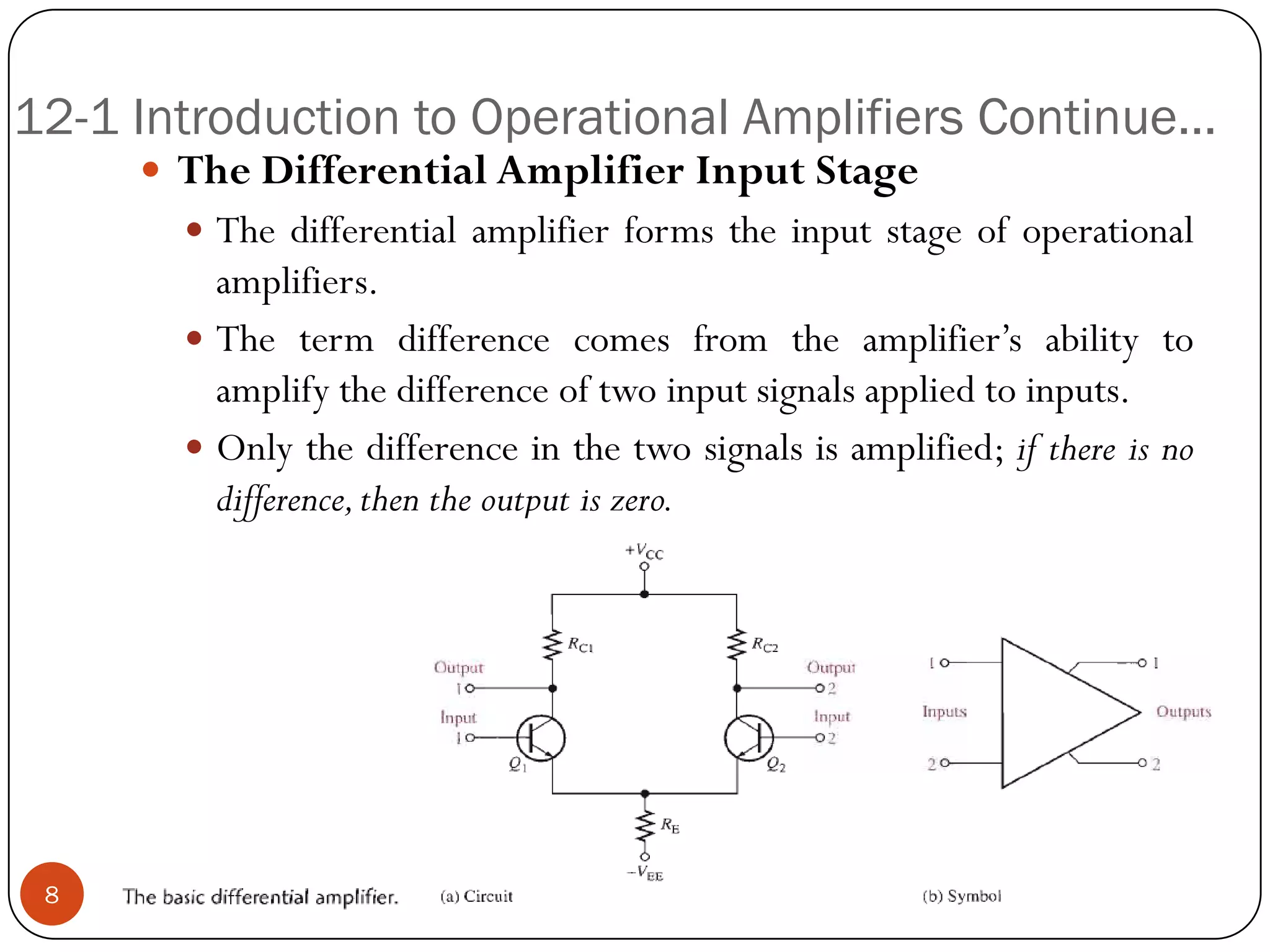
TheDifferentialAmplifierInputStage 
Thedifferentialamplifierformstheinputstageofoperationalamplifiers. 
Thetermdifferencecomesfromtheamplifier’sabilitytoamplifythedifferenceoftwoinputsignalsappliedtoinputs. 
Onlythedifferenceinthetwosignalsisamplified;ifthereisnodifference,thentheoutputiszero. 
8
12-1 Introduction to Operational Amplifiers Continue… 
TheDifferentialAmplifierInputStageContinue… 
Thetransistors(Q1andQ2)andthecollectorresistors(RC1andRC2)arecarefullymatchedtohaveidenticalcharacteristics(Refertofigureinpreviousslide). 
NoticethatthetwotransistorsshareasingleRE. 
Letussupposebothbasesareconnectedtoground.Theemittervoltagewillbe-0.7V. 
Theemittercurrentsareequal(IE1=IE2). 
Thecollectorcurrentsarebothequalandareapproximatelyequaltotheemittercurrents. 
Sincecollectorcurrentsarethesame,thecollectorvoltagesarealsothesame. 
Thereisazerodifferenceintheinputvoltages(bothbasesareat0V).9
12-1 Introduction to Operational Amplifiers Continue… 
TheDifferentialAmplifierInputStageContinue… 
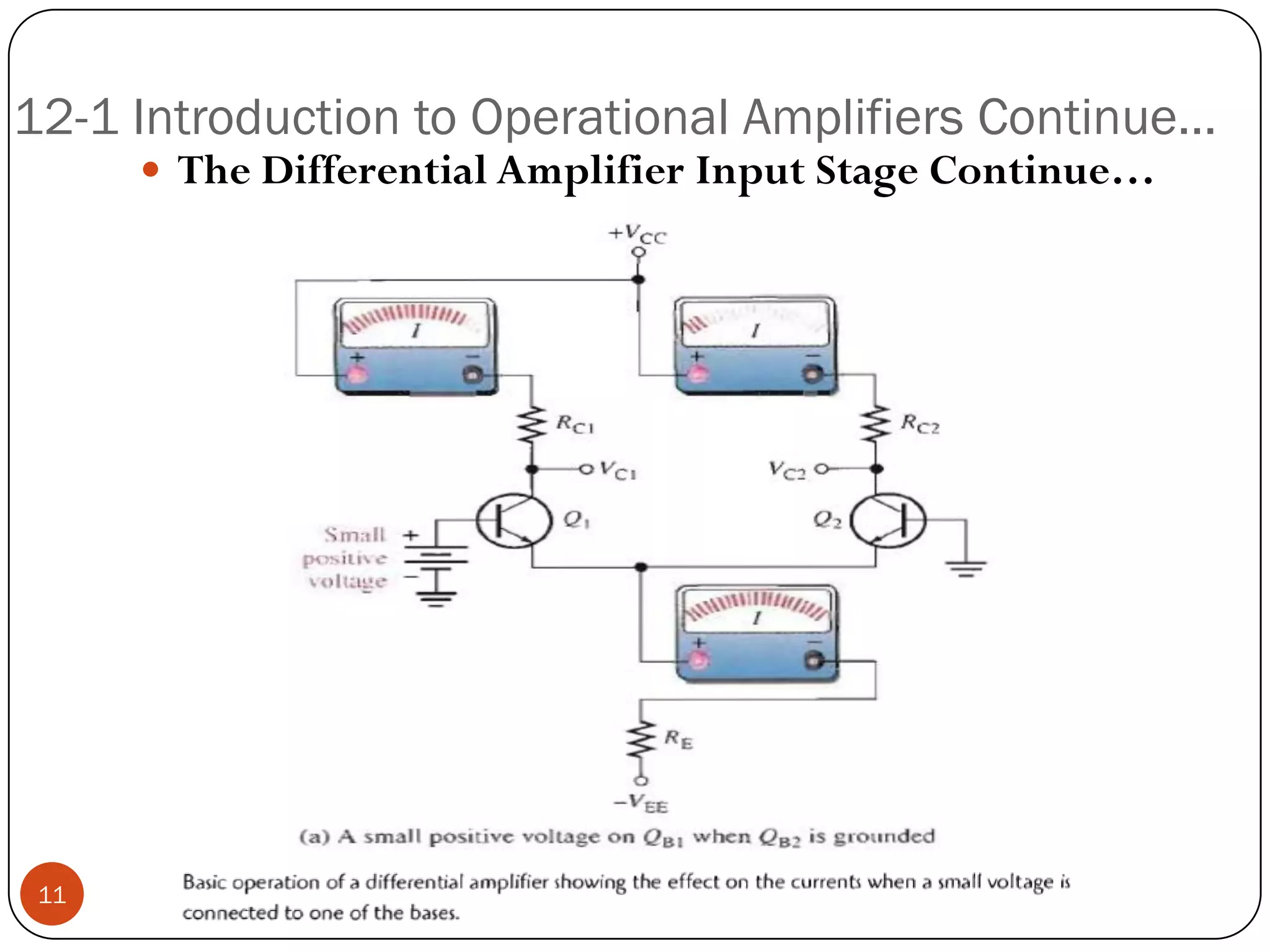
IfthebaseofQ1isdisconnectedfromgroundandconnectedtoasmallpositivevoltage,Q1willconductmorecurrentbecausethepositivevoltageonitsbasecausestheemittervoltagetoincreaseslightly. 
TheemittercurrentisnowdividedsothatmoreofitisinQ1andlessinQ2. 
AsaresultthecollectorvoltageofQ1willdecreaseandthecollectorvoltageofQ2willincrease,reflectingthedifferenceintheinputvoltages(oneis0Vandtheotheratasmallpositivevalue). 
Thisconditionisillustratedinfigurenextslide. 
10
12-1 Introduction to Operational Amplifiers Continue… 
TheDifferentialAmplifierInputStageContinue… 11
12-2 OP-AMP Input Modes and Parameters 
Thedifferentialamplifierexhibitsthreemodesofoperationbasedonthetypeofinputsignals.Thesemodesaresingle-ended,differentialandcommon.Sincethedifferentialamplifieristheinputstageoftheop- amp,theop-ampexhibitsthesamemodes. 12
12-2 OP-AMP Input Modes and Parameters Continue… 
Single-EndedMode 
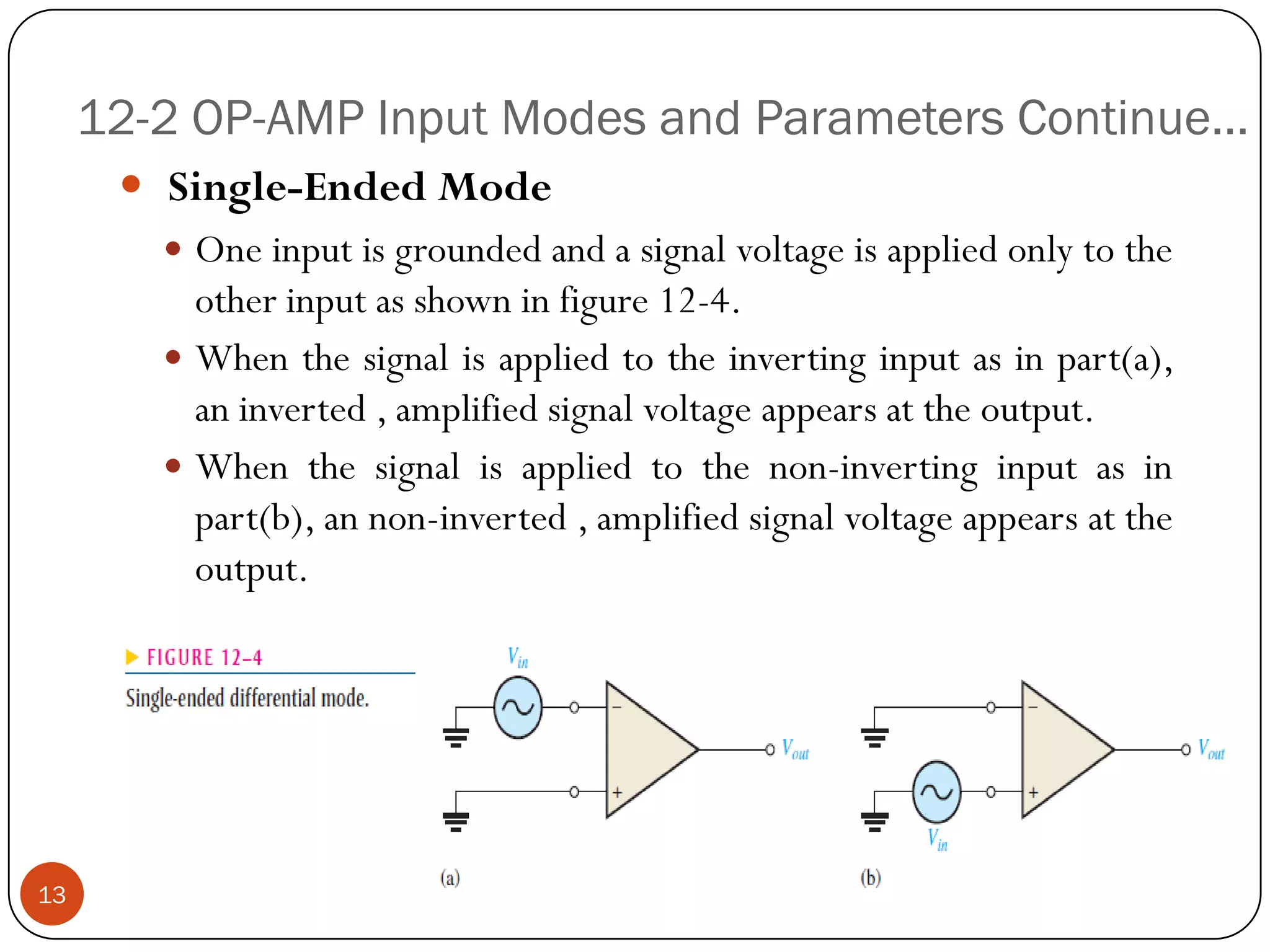
Oneinputisgroundedandasignalvoltageisappliedonlytotheotherinputasshowninfigure12-4. 
Whenthesignalisappliedtotheinvertinginputasinpart(a), aninverted,amplifiedsignalvoltageappearsattheoutput. 
Whenthesignalisappliedtothenon-invertinginputasinpart(b),annon-inverted,amplifiedsignalvoltageappearsattheoutput. 13
12-2 OP-AMP Input Modes and Parameters Continue… 
DifferentialMode 
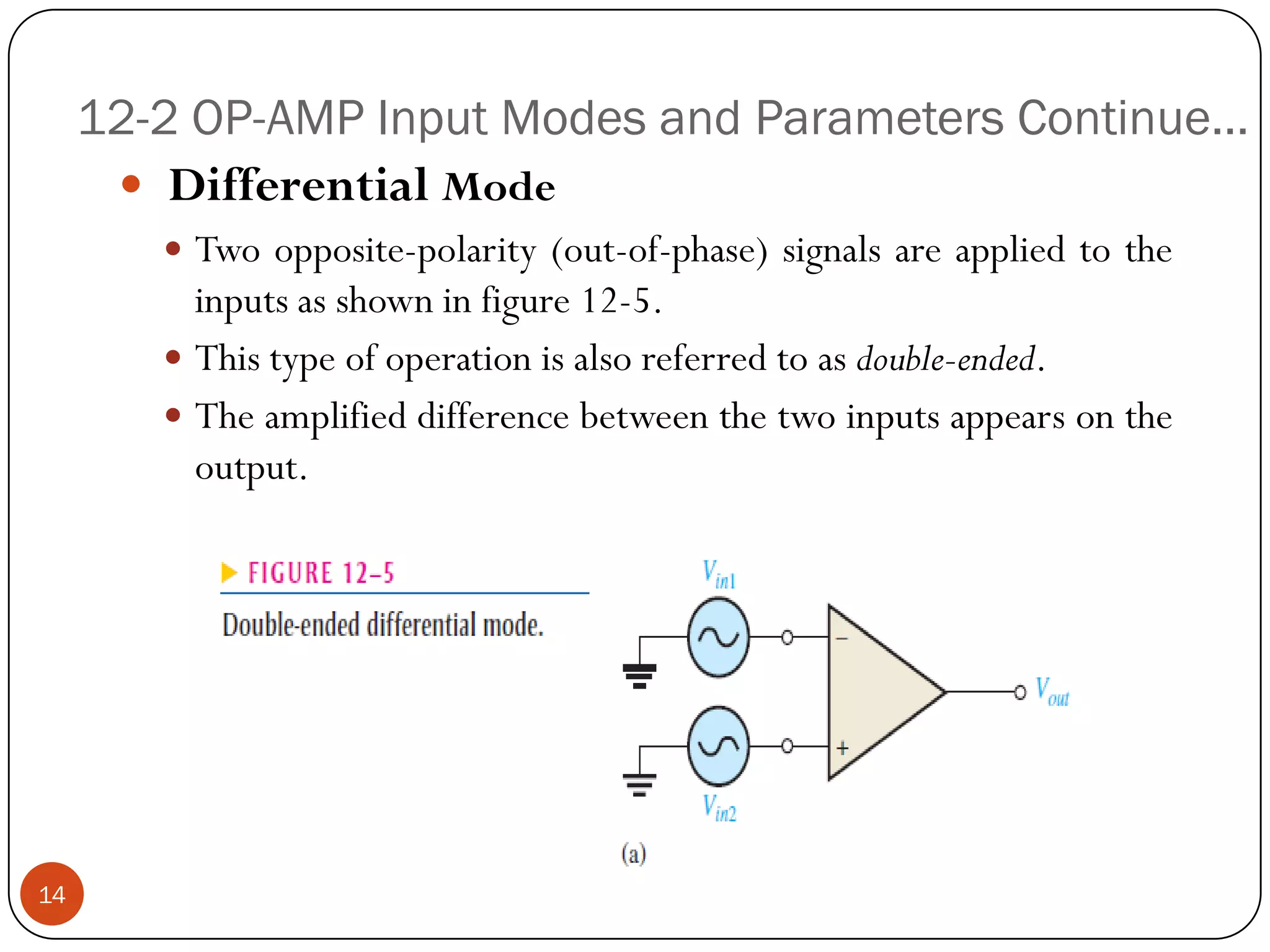
Twoopposite-polarity(out-of-phase)signalsareappliedtotheinputsasshowninfigure12-5. 
Thistypeofoperationisalsoreferredtoasdouble-ended. 
Theamplifieddifferencebetweenthetwoinputsappearsontheoutput. 14
12-2 OP-AMP Input Modes and Parameters Continue… 
CommonMode 
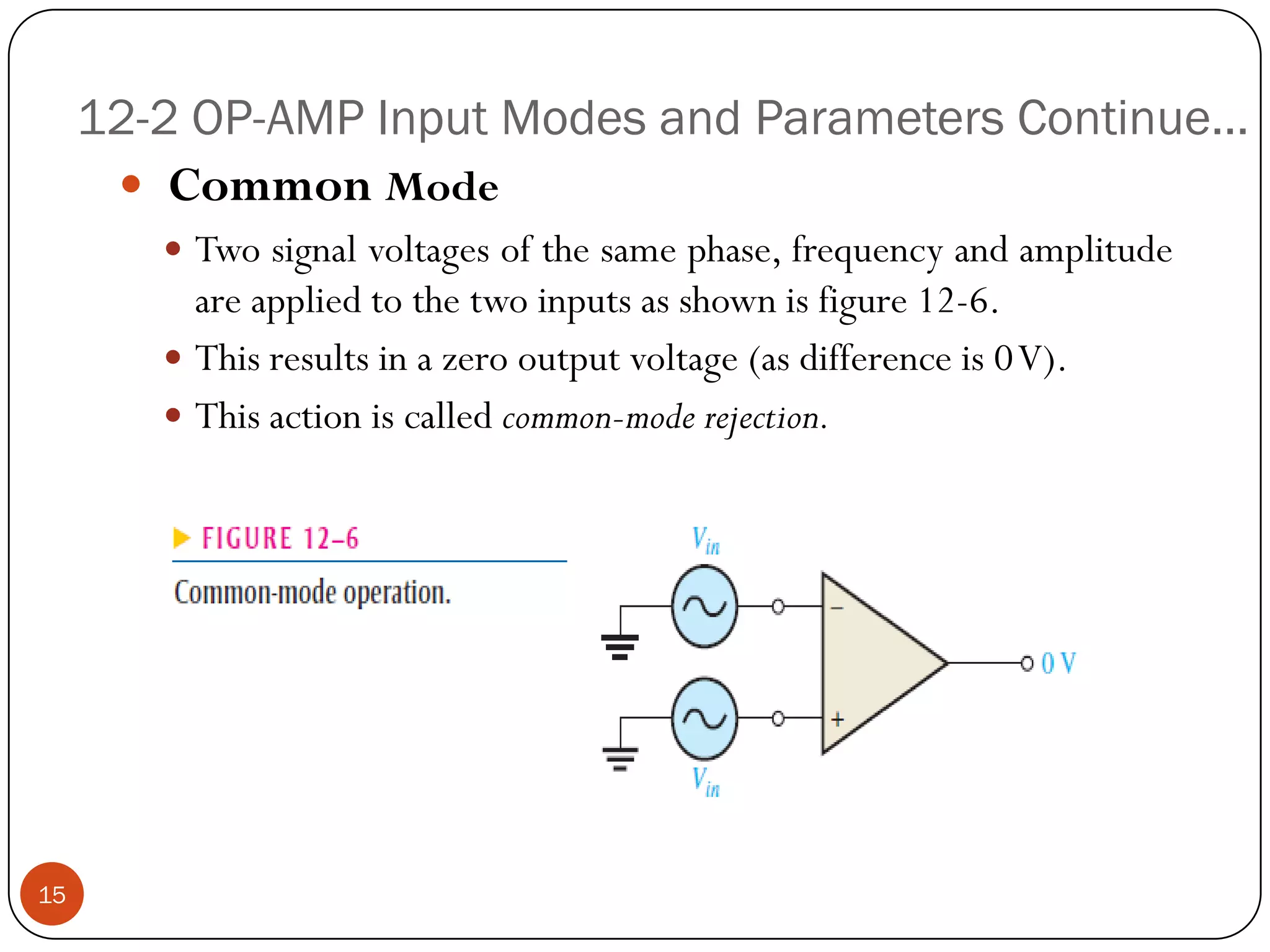
Twosignalvoltagesofthesamephase,frequencyandamplitudeareappliedtothetwoinputsasshownisfigure12-6. 
Thisresultsinazerooutputvoltage(asdifferenceis0V). 
Thisactioniscalledcommon-moderejection. 15
12-2 OP-AMP Input Modes and Parameters Continue… 
CommonModeContinue… 
It’simportanceliesinthesituationwhereanunwantedsignalappearscommonlyonbothop-ampinputs. 
Common-moderejectionmeansthatthisunwantedsignalwillnotappearontheoutputanddistortthedesiredsignal. 
CommonModeRejectionRatio 
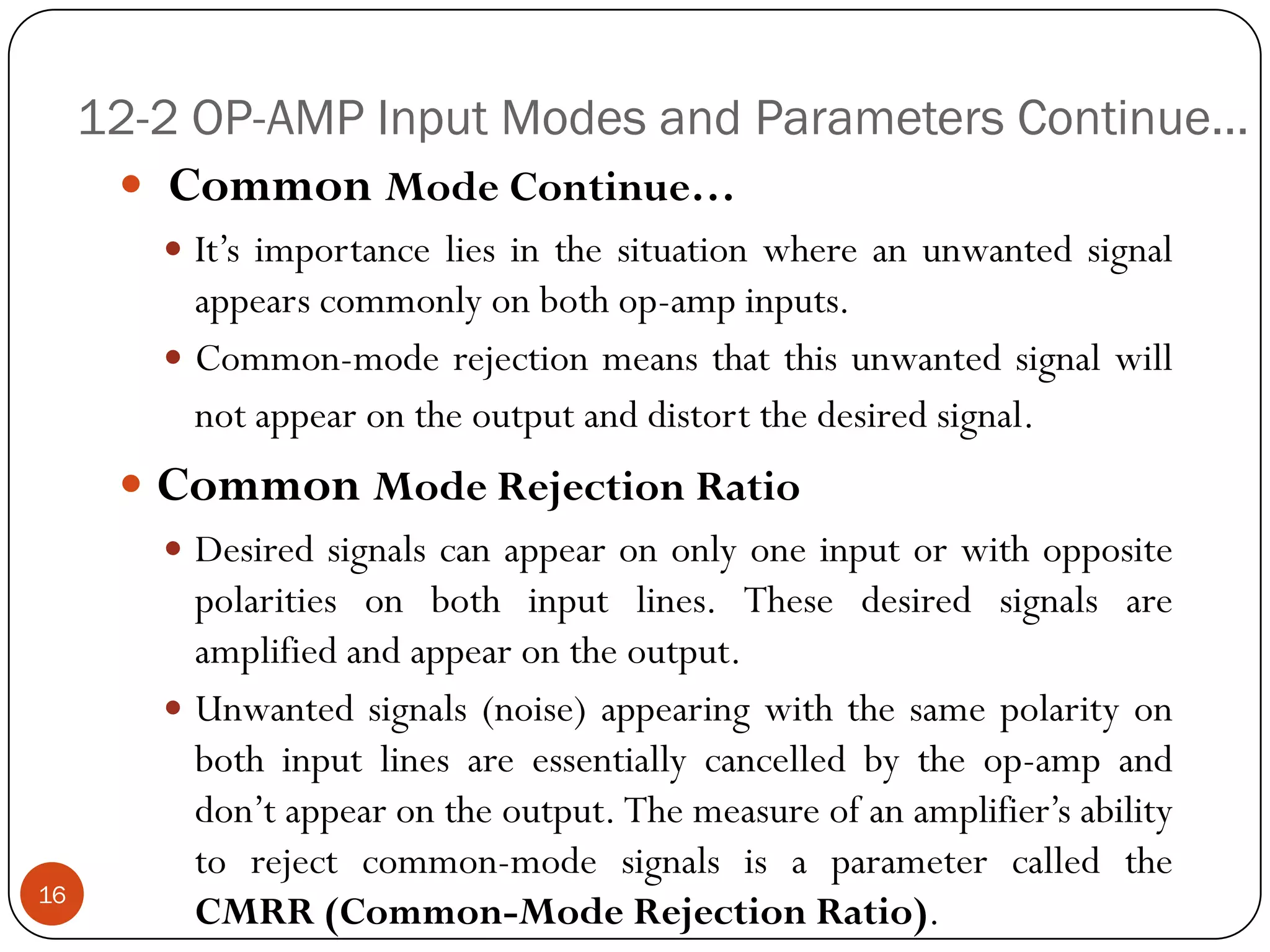
Desiredsignalscanappearononlyoneinputorwithoppositepolaritiesonbothinputlines.Thesedesiredsignalsareamplifiedandappearontheoutput. 
Unwantedsignals(noise)appearingwiththesamepolarityonbothinputlinesareessentiallycancelledbytheop-ampanddon’tappearontheoutput.Themeasureofanamplifier’sabilitytorejectcommon-modesignalsisaparametercalledtheCMRR(Common-ModeRejectionRatio). 16
12-2 OP-AMP Input Modes and Parameters Continue… 
CommonModeRejectionRatioContinue... 
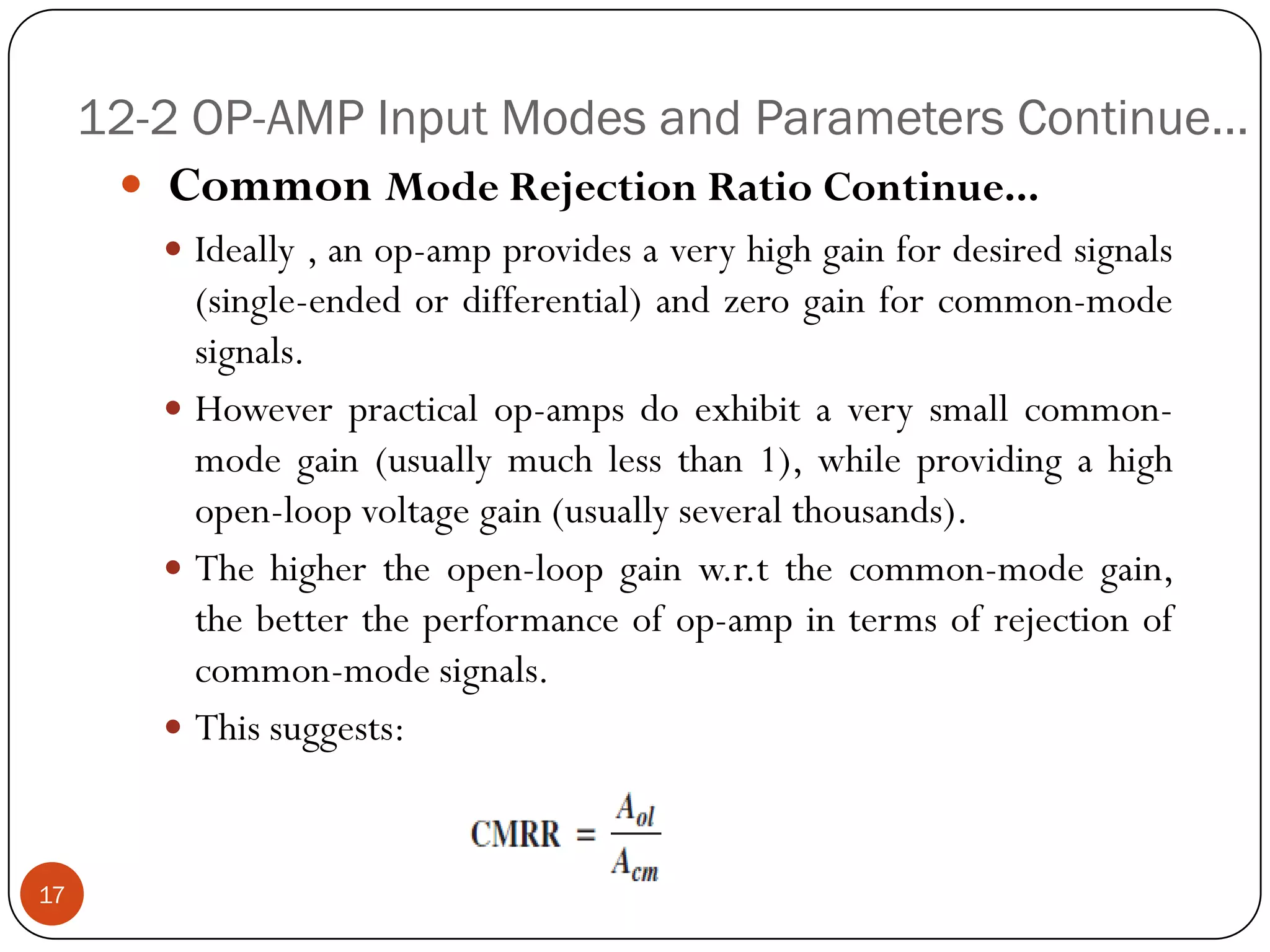
Ideally,anop-ampprovidesaveryhighgainfordesiredsignals(single-endedordifferential)andzerogainforcommon-modesignals. 
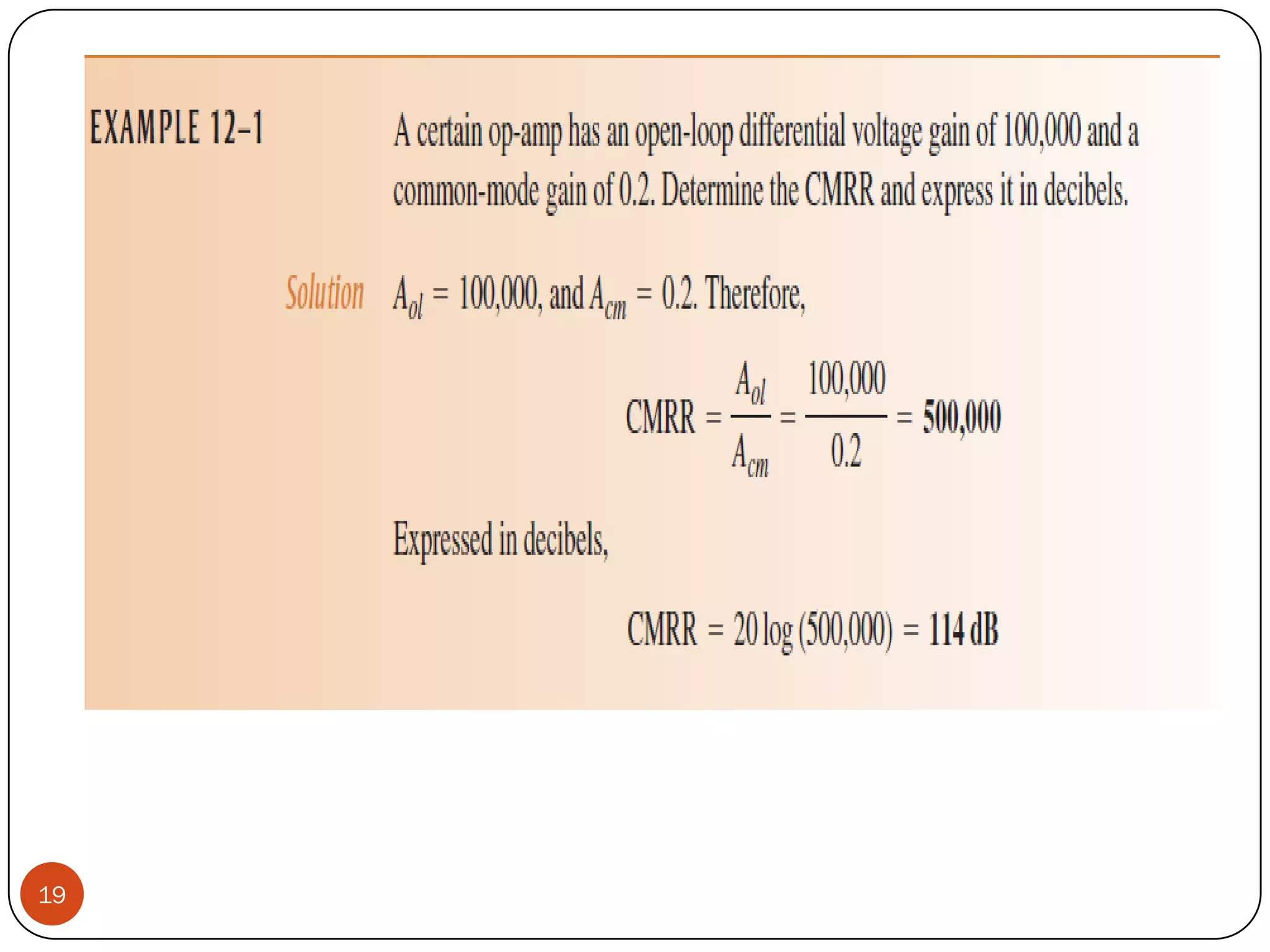
Howeverpracticalop-ampsdoexhibitaverysmallcommon- modegain(usuallymuchlessthan1),whileprovidingahighopen-loopvoltagegain(usuallyseveralthousands). 
Thehighertheopen-loopgainw.r.tthecommon-modegain, thebettertheperformanceofop-ampintermsofrejectionofcommon-modesignals. 
Thissuggests: 
17
12-2 OP-AMP Input Modes and Parameters Continue… 
CommonModeRejectionRatioContinue... 
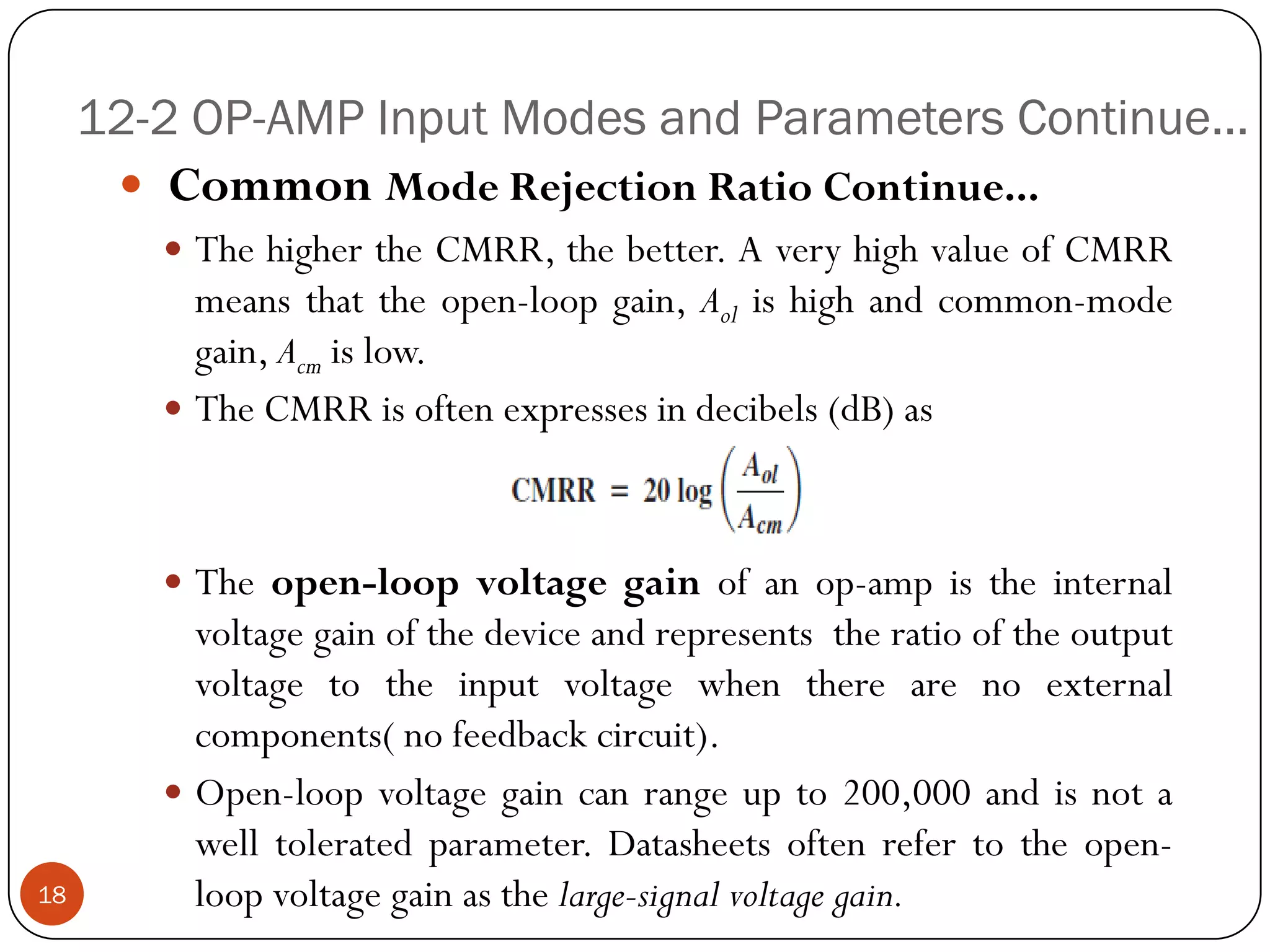
ThehighertheCMRR,thebetter.AveryhighvalueofCMRRmeansthattheopen-loopgain,Aolishighandcommon-modegain,Acmislow. 
TheCMRRisoftenexpressesindecibels(dB)as 
Theopen-loopvoltagegainofanop-ampistheinternalvoltagegainofthedeviceandrepresentstheratiooftheoutputvoltagetotheinputvoltagewhentherearenoexternalcomponents(nofeedbackcircuit). 
Open-loopvoltagegaincanrangeupto200,000andisnotawelltoleratedparameter.Datasheetsoftenrefertotheopen- loopvoltagegainasthelarge-signalvoltagegain. 
18
19
12-2 OP-AMP Input Modes and Parameters Continue… 
InputOffsetVoltage 
Idealop-ampproduceszerovoltsoutforzerovoltsin. 
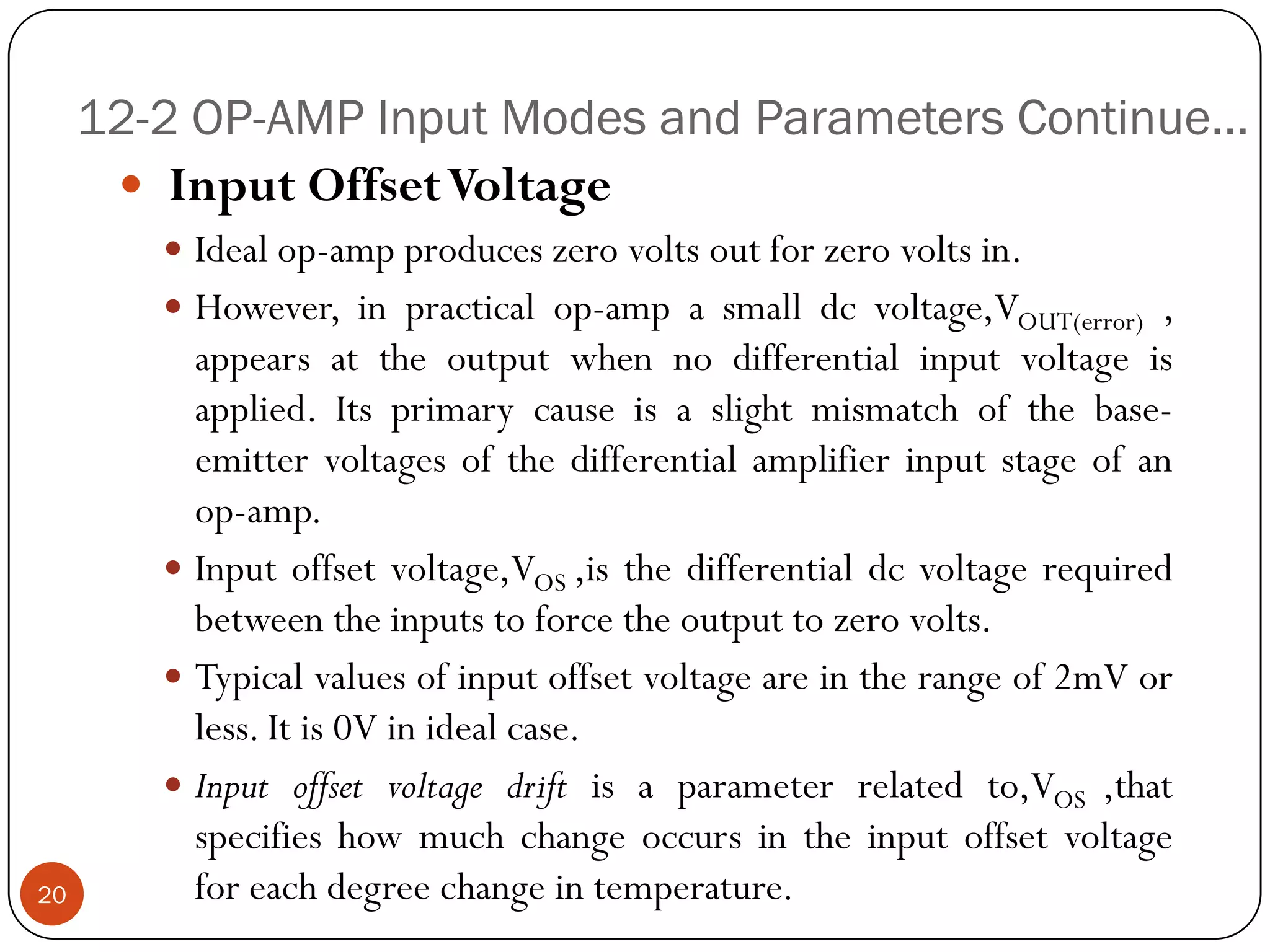
However,inpracticalop-ampasmalldcvoltage,VOUT(error), appearsattheoutputwhennodifferentialinputvoltageisapplied.Itsprimarycauseisaslightmismatchofthebase- emittervoltagesofthedifferentialamplifierinputstageofanop-amp. 
Inputoffsetvoltage,VOS,isthedifferentialdcvoltagerequiredbetweentheinputstoforcetheoutputtozerovolts. 
Typicalvaluesofinputoffsetvoltageareintherangeof2mVorless.Itis0Vinidealcase. 
Inputoffsetvoltagedriftisaparameterrelatedto,VOS,thatspecifieshowmuchchangeoccursintheinputoffsetvoltageforeachdegreechangeintemperature.20
12-2 OP-AMP Input Modes and Parameters Continue… 
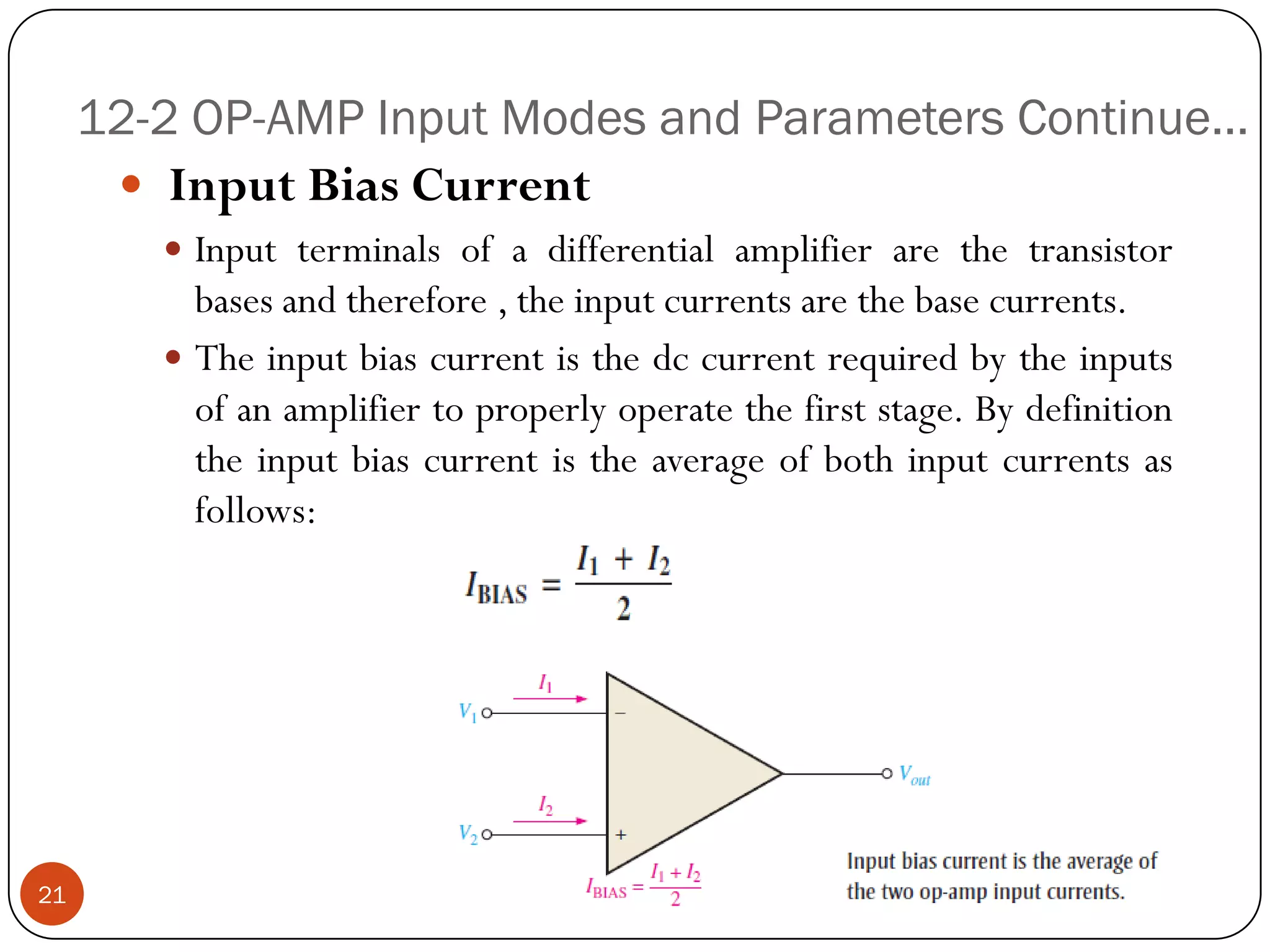
InputBiasCurrent 
Inputterminalsofadifferentialamplifierarethetransistorbasesandtherefore,theinputcurrentsarethebasecurrents. 
Theinputbiascurrentisthedccurrentrequiredbytheinputsofanamplifiertoproperlyoperatethefirststage.Bydefinitiontheinputbiascurrentistheaverageofbothinputcurrentsasfollows: 21
12-2 OP-AMP Input Modes and Parameters Continue… 
InputImpedance 
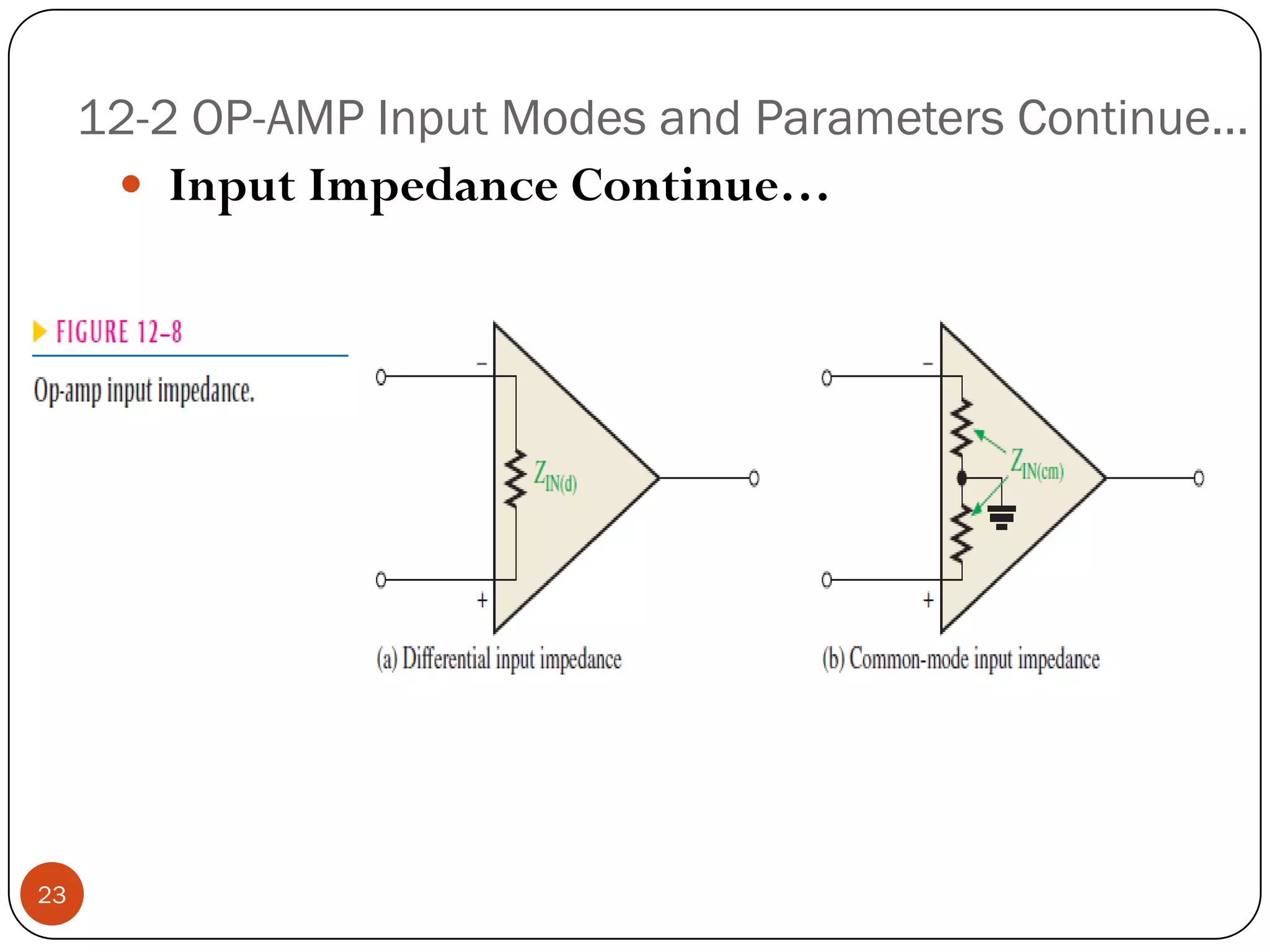
Twobasicwaysofspecifyingtheinputimpedance 
1.TheDifferentialinputimpedanceisthetotalresistancebetweentheinvertingandnon-invertingterminalsasillustrated12-8(a)nextslide.Differentialimpedanceismeasuredbydeterminingthechangeinbiascurrentforagivenchangeindifferentialinputvoltage. 
2.Thecommon-modeinputimpedanceistheresistancebetweeneachinputandgroundandismeasuredbydeterminingthechangeinbiascurrentforagivenchangeincommon-modeinputvoltageshowninfigure12-8(b)nextslide. 
22
12-2 OP-AMP Input Modes and Parameters Continue… 
InputImpedanceContinue… 
23
12-2 OP-AMP Input Modes and Parameters Continue… 
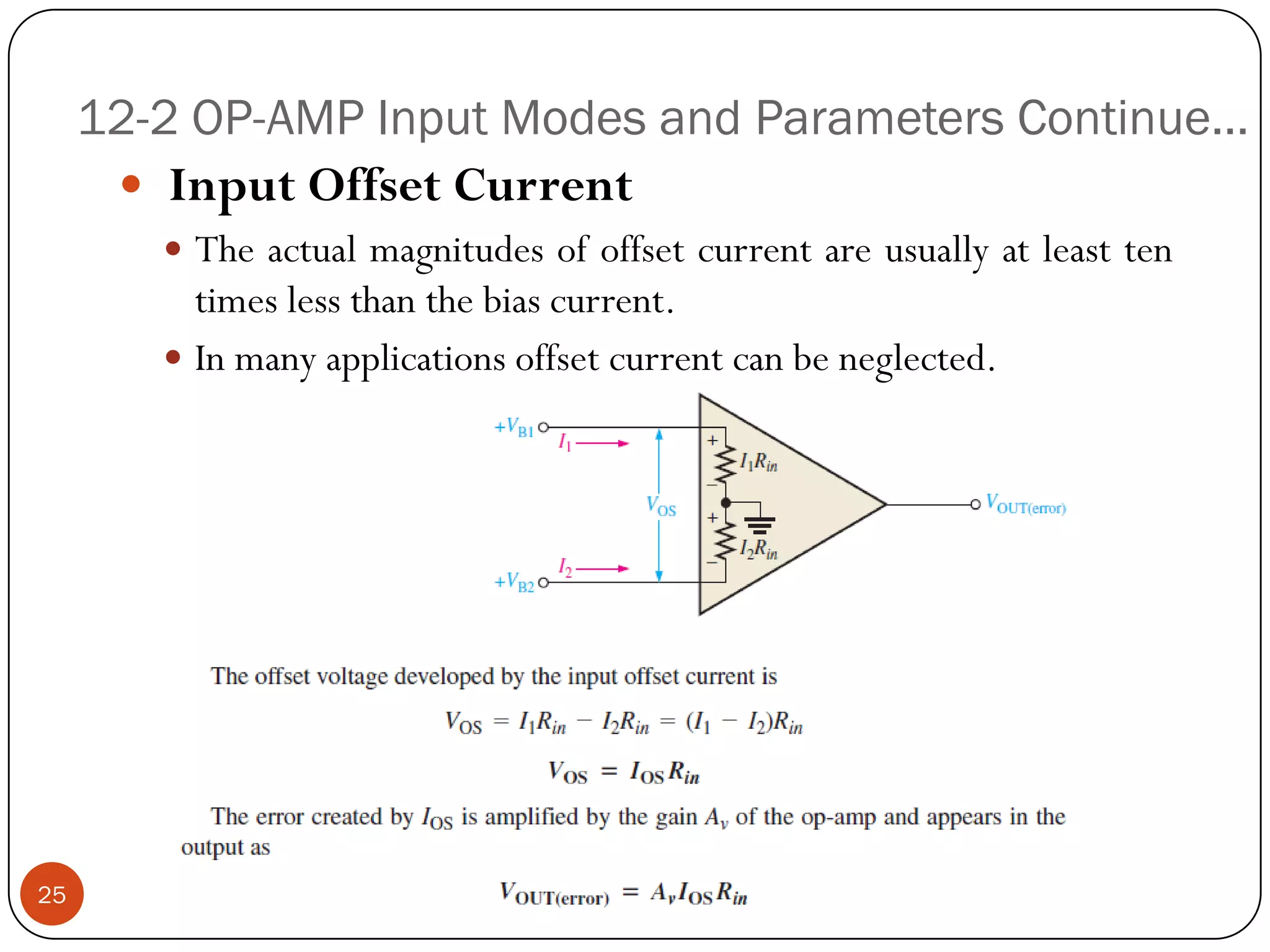
InputOffsetCurrent 
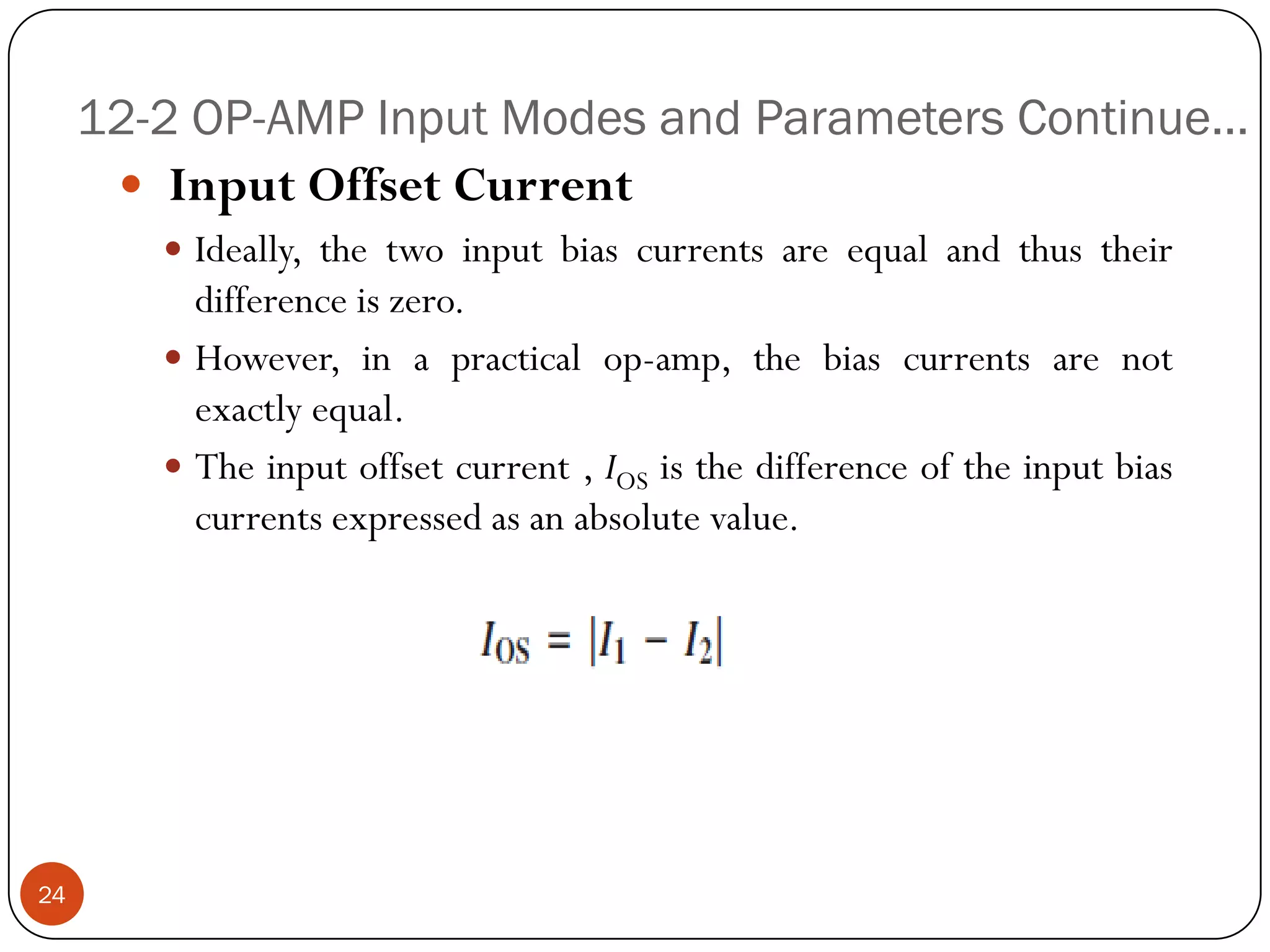
Ideally,thetwoinputbiascurrentsareequalandthustheirdifferenceiszero. 
However,inapracticalop-amp,thebiascurrentsarenotexactlyequal. 
Theinputoffsetcurrent,IOSisthedifferenceoftheinputbiascurrentsexpressedasanabsolutevalue. 24
12-2 OP-AMP Input Modes and Parameters Continue… 
InputOffsetCurrent 
Theactualmagnitudesofoffsetcurrentareusuallyatleasttentimeslessthanthebiascurrent. 
Inmanyapplicationsoffsetcurrentcanbeneglected. 
25
12-2 OP-AMP Input Modes and Parameters Continue… 
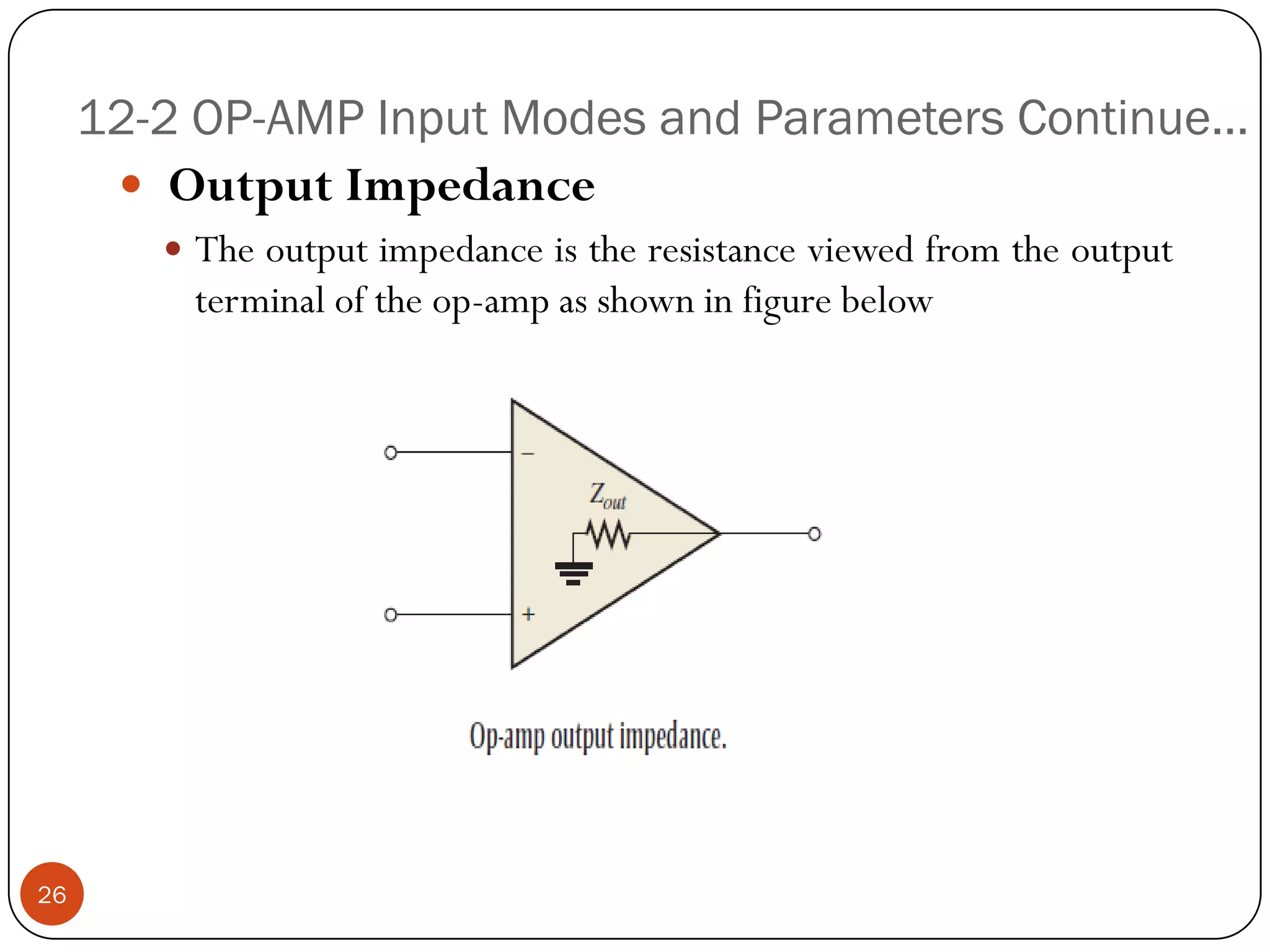
OutputImpedance 
Theoutputimpedanceistheresistanceviewedfromtheoutputterminaloftheop-ampasshowninfigurebelow 
26
12-2 OP-AMP Input Modes and Parameters Continue… 
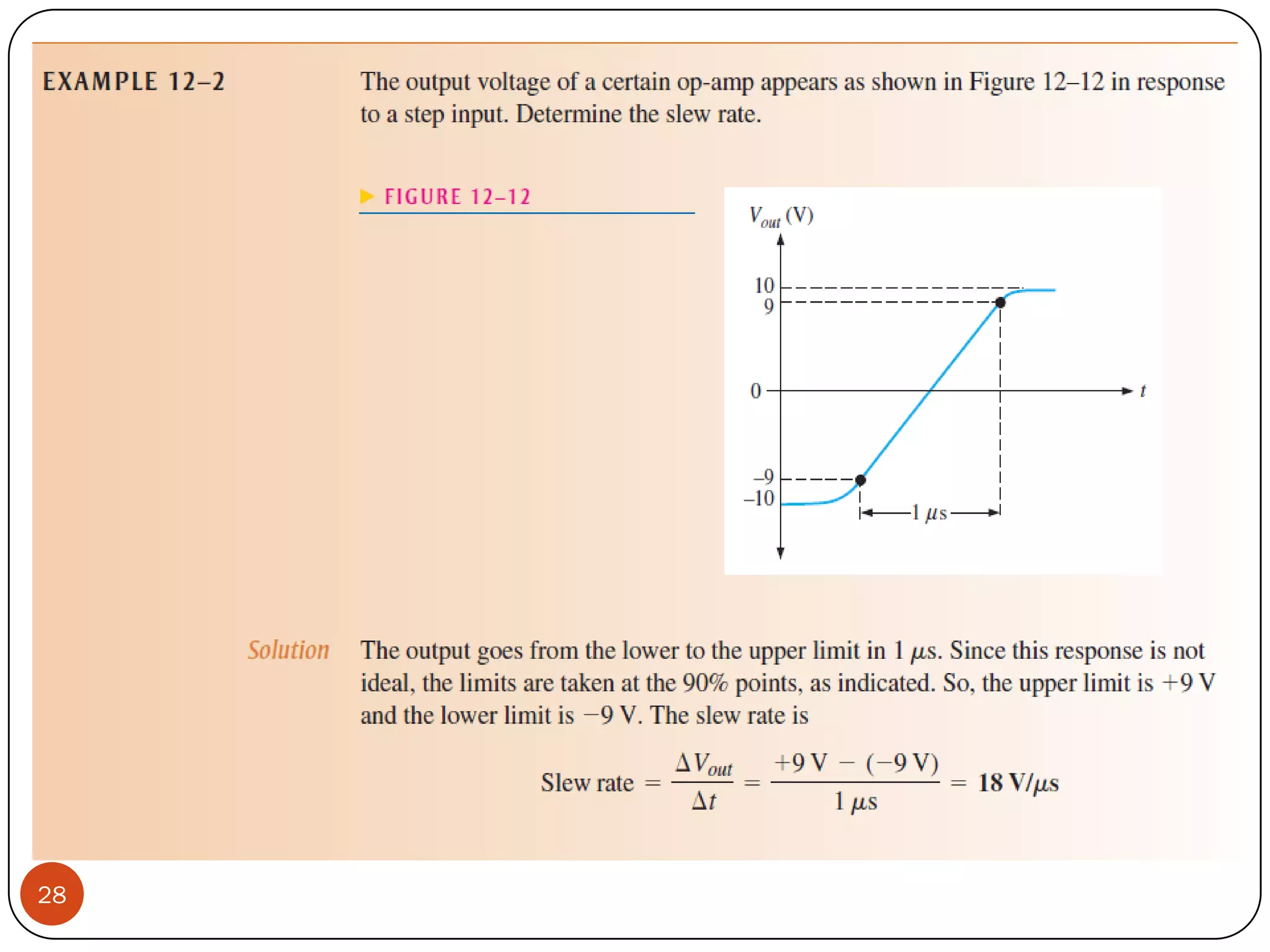
SlewRate 
Theslewrate(SR)ofanop-ampisthemaximumrateatwhichtheoutputvoltagecanchangeinresponsetoinputvoltage. 
WhentheSRistooslowfortheinput,distortionresults. 
Whenainputsinewaveisappliedtoavoltagefolloweritproducesatriangularoutputwaveform. 
Thetriangularwaveformresultsbecausetheop-ampsimplycannotmovefastenoughtofollowthesinewaveinput. 
Thishappensbecausevoltagechangeinthesecondstage( VoltageAmplifier(s))islimitedbythecharginganddischargingofcapacitor. 
Theslewrateisexpressedas:SR=ΔVO/Δt 
TheunitofSRisvoltspermicroseconds. 
27
28
12-3 Negative Feedback 
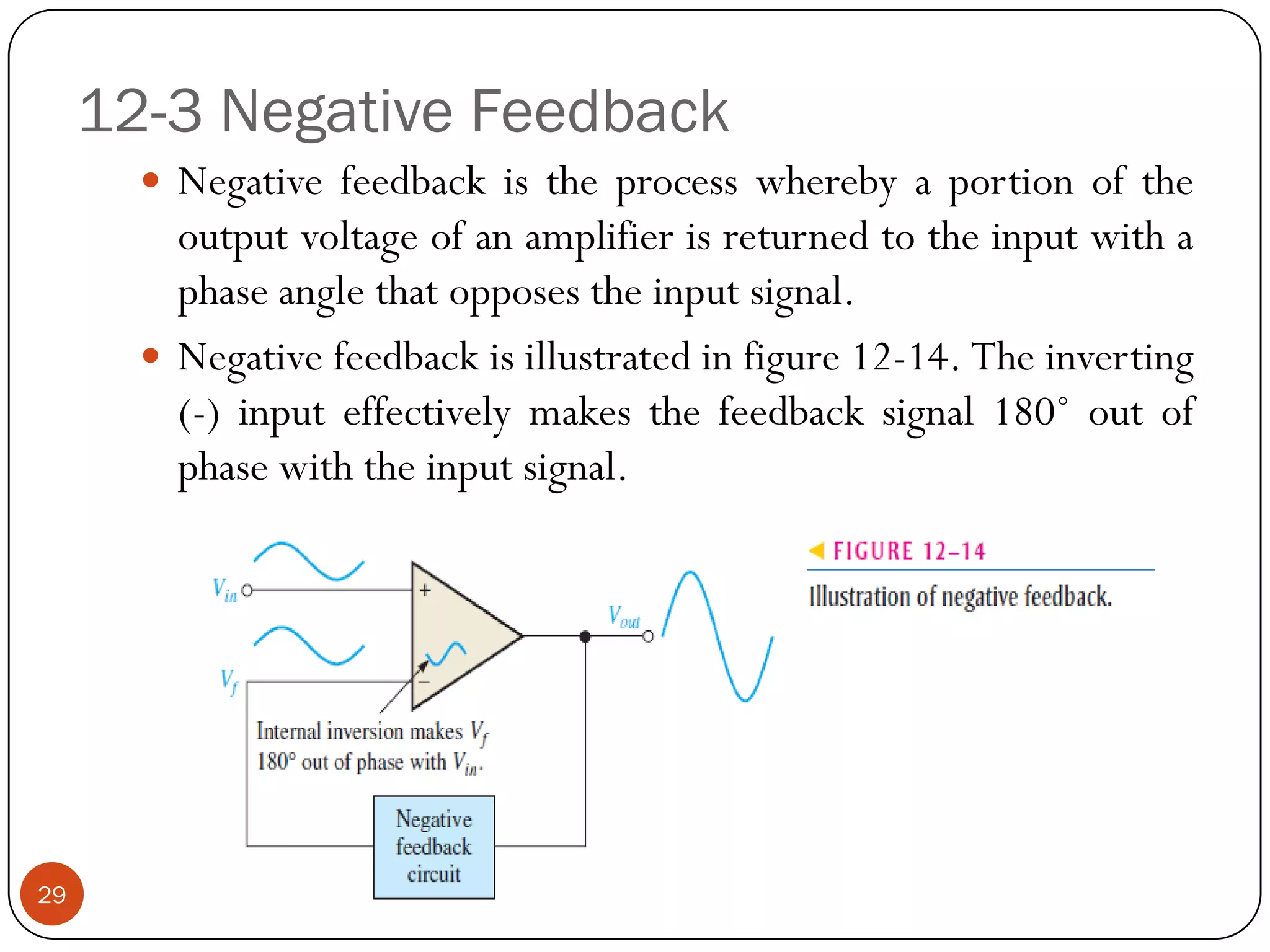
Negativefeedbackistheprocesswherebyaportionoftheoutputvoltageofanamplifierisreturnedtotheinputwithaphaseanglethatopposestheinputsignal. 
Negativefeedbackisillustratedinfigure12-14.Theinverting(-)inputeffectivelymakesthefeedbacksignal180˚outofphasewiththeinputsignal. 29
12-3 Negative Feedback 
WhyUseNegativeFeedback? 
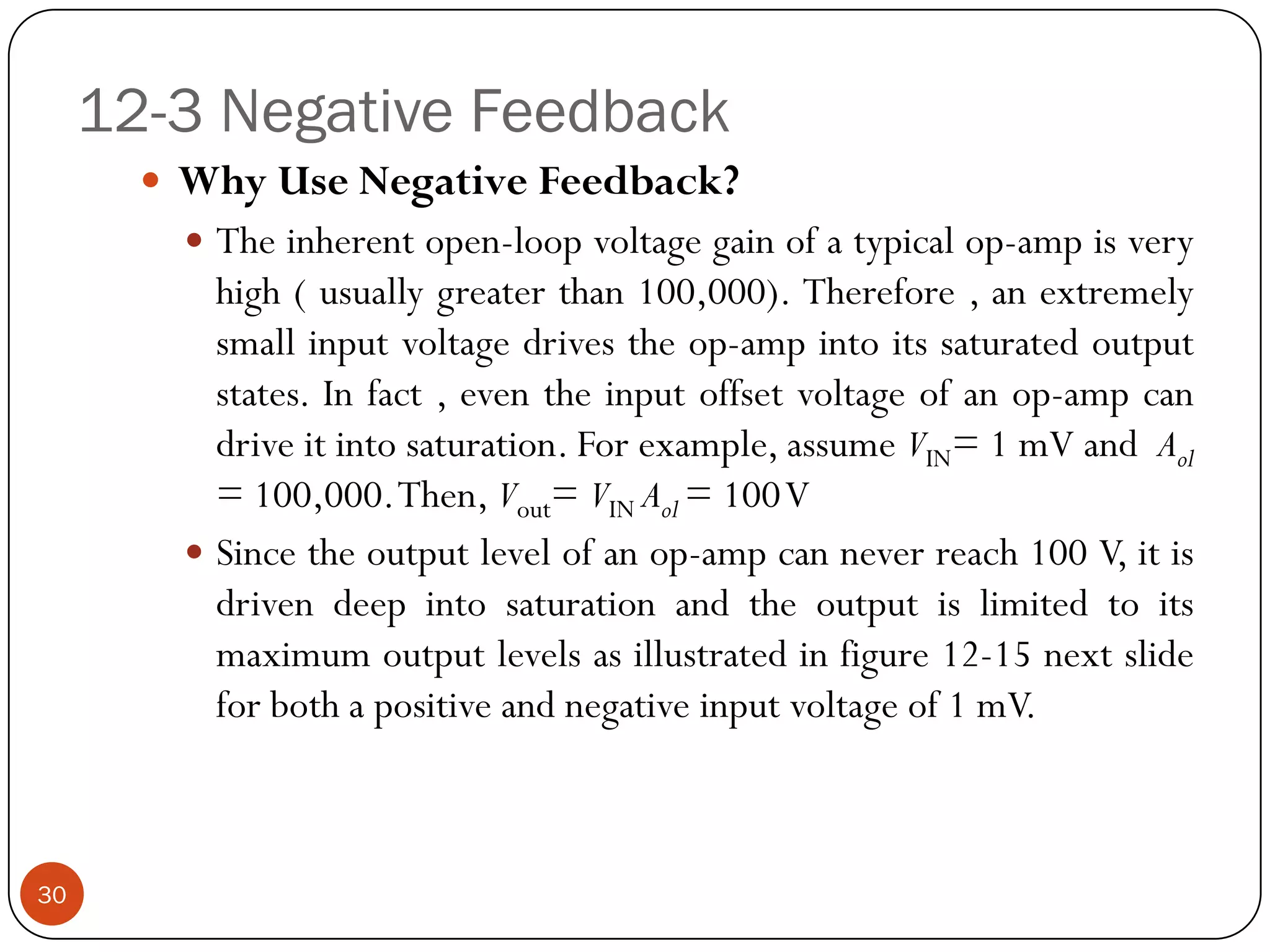
Theinherentopen-loopvoltagegainofatypicalop-ampisveryhigh(usuallygreaterthan100,000).Therefore,anextremelysmallinputvoltagedrivestheop-ampintoitssaturatedoutputstates.Infact,eventheinputoffsetvoltageofanop-ampcandriveitintosaturation.Forexample,assumeVIN=1mVandAol=100,000.Then,Vout=VINAol=100V 
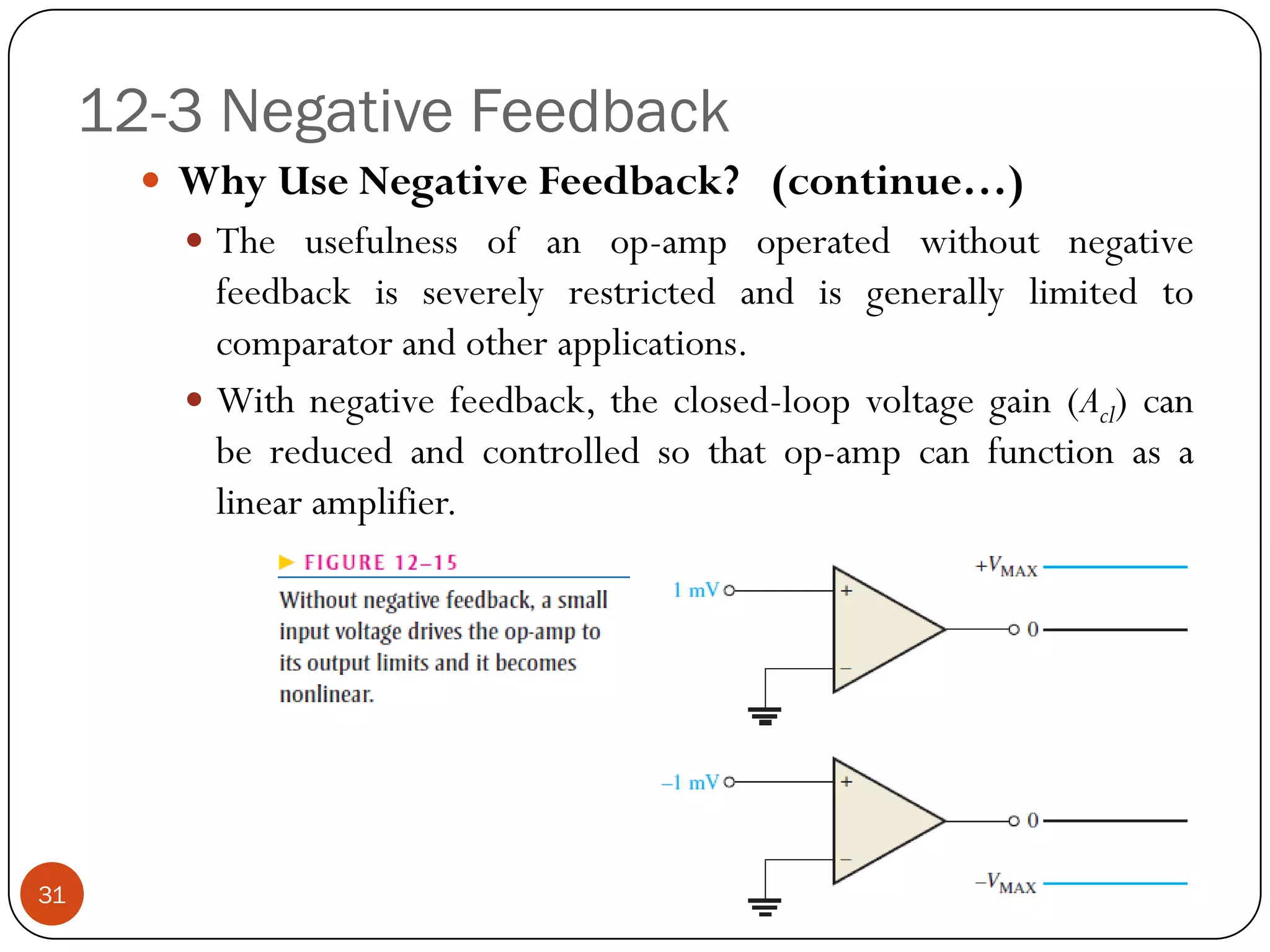
Sincetheoutputlevelofanop-ampcanneverreach100V,itisdrivendeepintosaturationandtheoutputislimitedtoitsmaximumoutputlevelsasillustratedinfigure12-15nextslideforbothapositiveandnegativeinputvoltageof1mV. 
30
12-3 Negative Feedback 
WhyUseNegativeFeedback?(continue…) 
Theusefulnessofanop-ampoperatedwithoutnegativefeedbackisseverelyrestrictedandisgenerallylimitedtocomparatorandotherapplications. 
Withnegativefeedback,theclosed-loopvoltagegain(Acl)canbereducedandcontrolledsothatop-ampcanfunctionasalinearamplifier. 
31
12-4 OP-AMPS With Negative Feedback 
Theextremelyhighopen-loopgainofanop-ampcreatesanunstablesituationbecauseasmallnoisevoltageontheinputcanbeamplifiedtoapointwheretheamplifierisdrivenoutofitslinearregion. 
Negativefeedbacktakesaportionoftheoutputandappliesitbackoutofphasewiththeinput,creatinganeffectivereductioningain. 
Thisclosed-loopgainisusuallymuchlessthantheopen-loopgain. 
32
12-4 OP-AMPS With Negative Feedback Continue… 
Closed-LoopVoltageGain,Acl 
Theclosed-loopgainisthevoltagegainofanop-ampwithexternalfeedback.Theamplifierconfigurationconsistsoftheop-ampandanexternalfeedbackcircuitthatconnectstheoutputtoinvertinginput. 
Theclosed-loopvoltagegainisdeterminedbytheexternalcomponentvaluesandcanbepreciselycontrolledbythem. 33
12-4 OP-AMPS With Negative Feedback Continue… 
Non-invertingAmplifier 
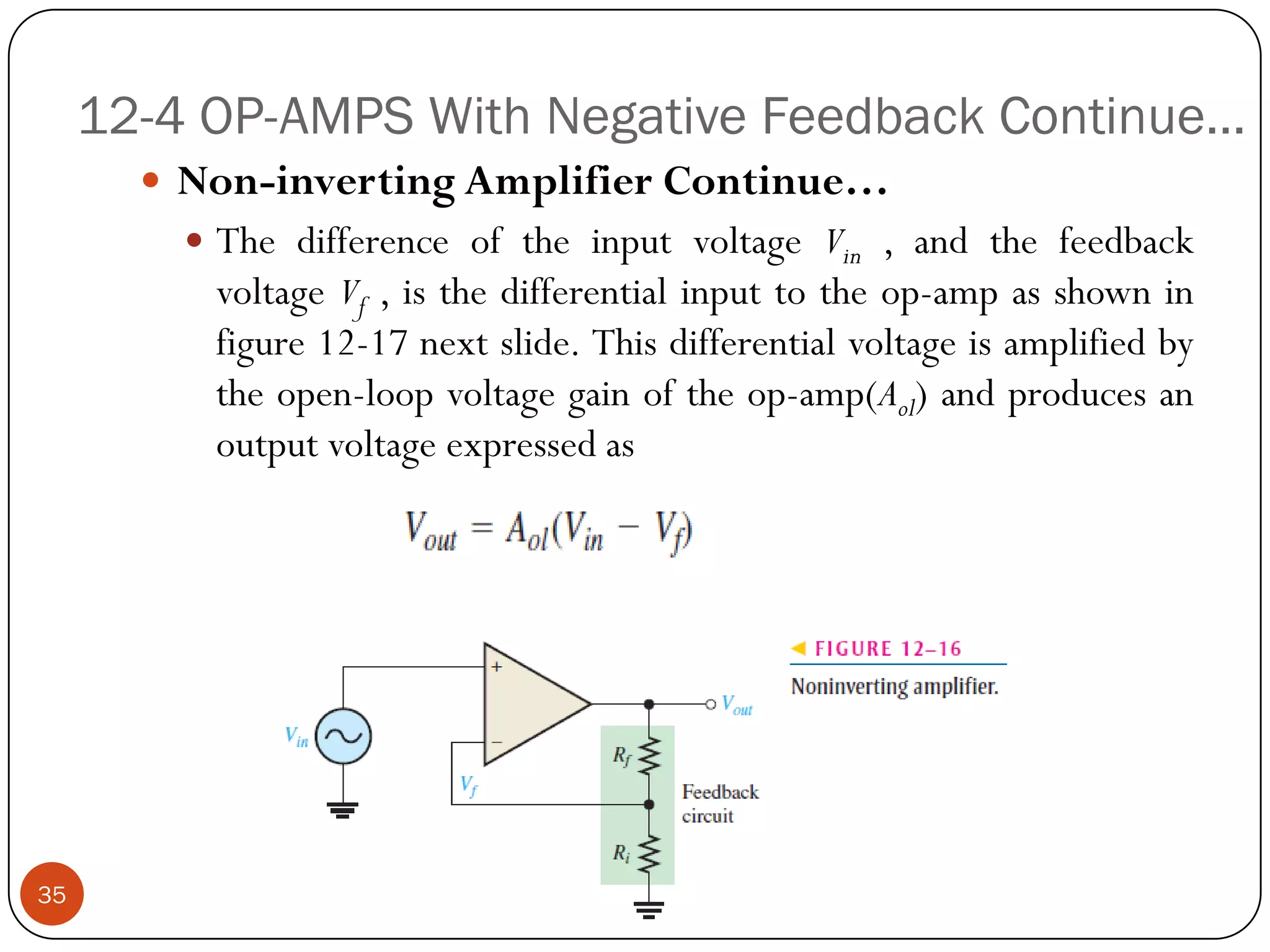
Anop-ampinaclosed-loopconfigurationasanon-invertingamplifierwithacontrolledamountofvoltagegainisshowninfigure12-16nextslide. 
Theinputsignalisappliedtothenon-inverting(+)input. 
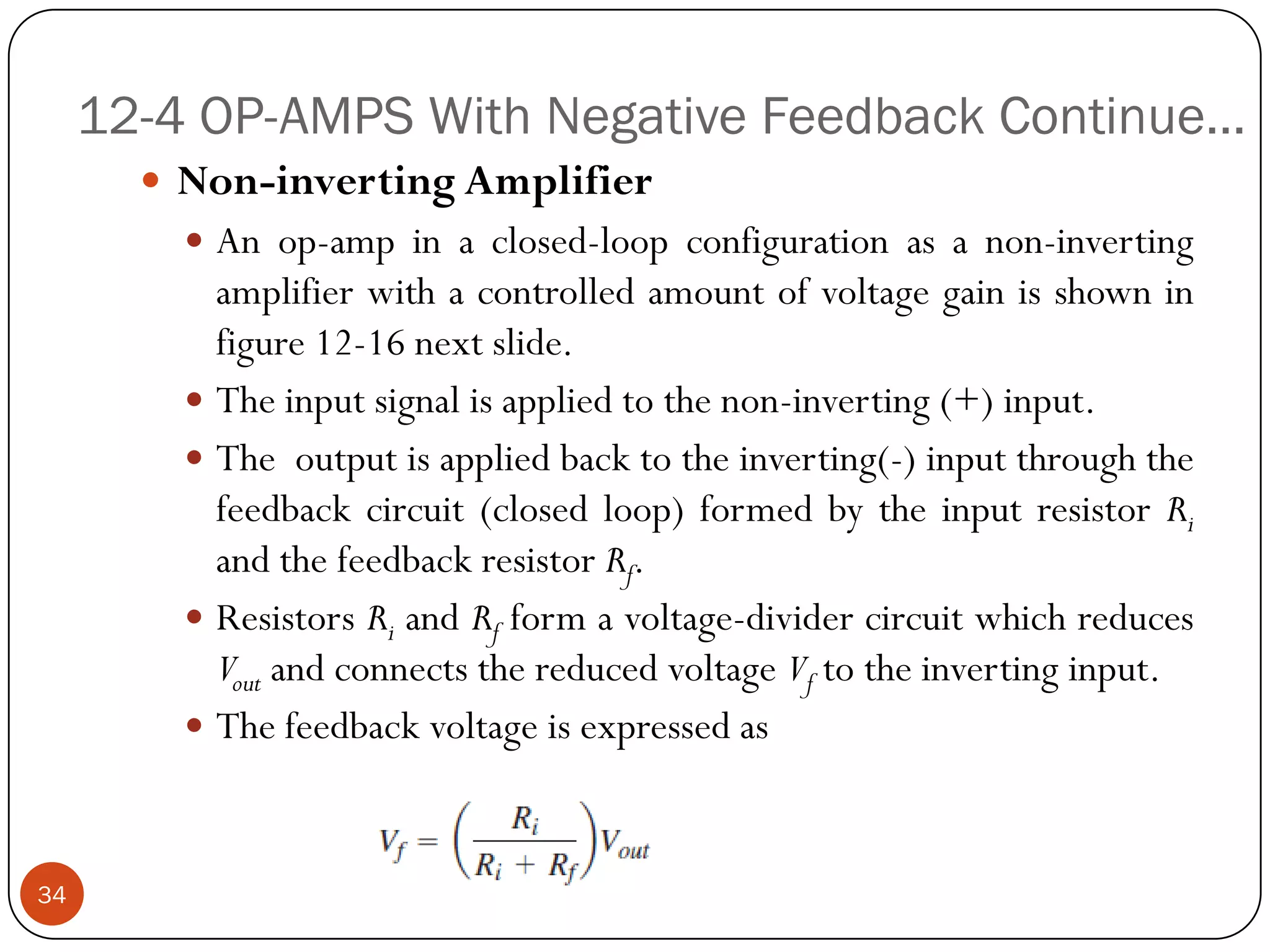
Theoutputisappliedbacktotheinverting(-)inputthroughthefeedbackcircuit(closedloop)formedbytheinputresistorRiandthefeedbackresistorRf. 
ResistorsRiandRfformavoltage-dividercircuitwhichreducesVoutandconnectsthereducedvoltageVftotheinvertinginput. 
Thefeedbackvoltageisexpressedas34
12-4 OP-AMPS With Negative Feedback Continue… 
Non-invertingAmplifierContinue… 
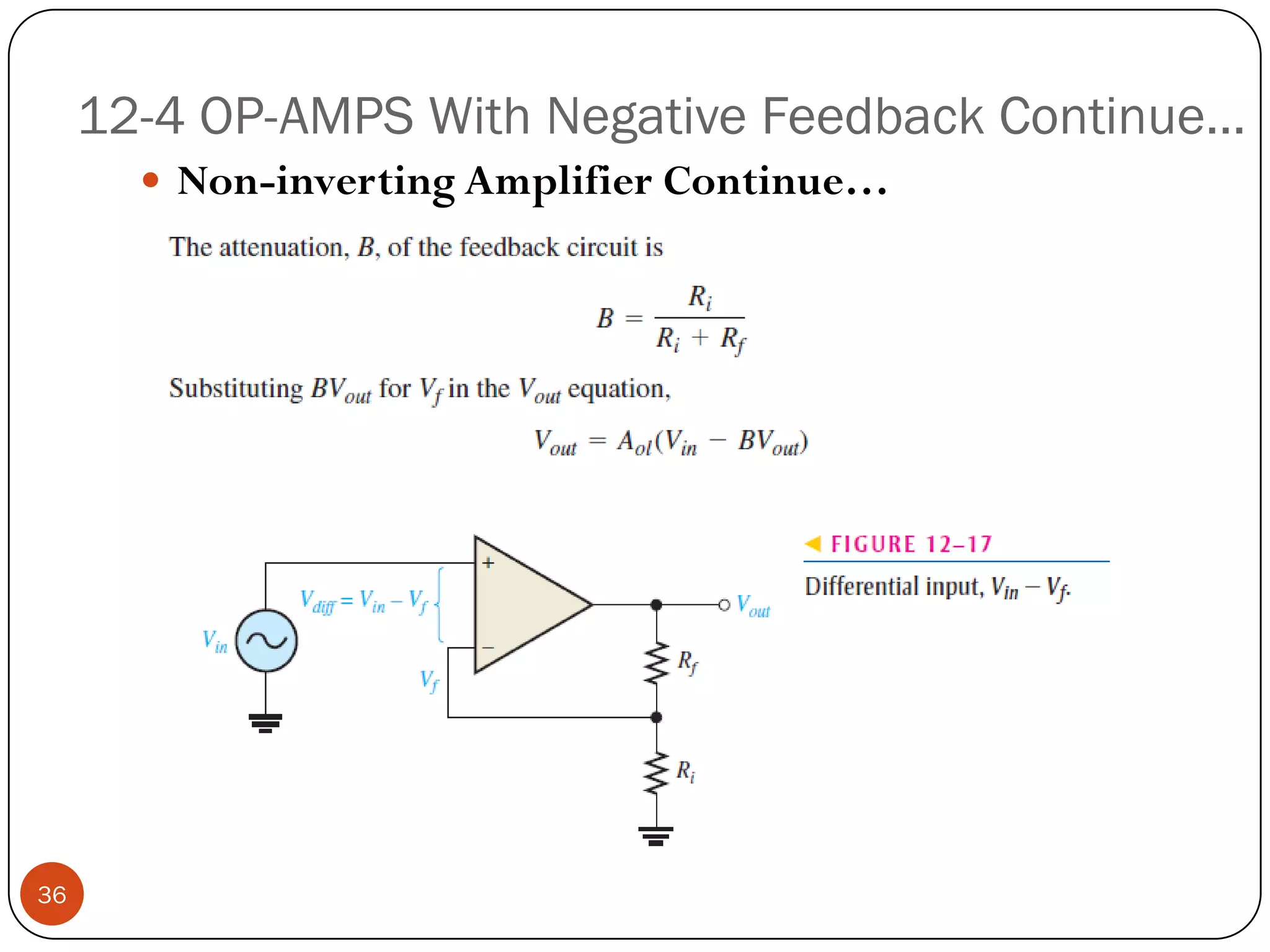
ThedifferenceoftheinputvoltageVin,andthefeedbackvoltageVf,isthedifferentialinputtotheop-ampasshowninfigure12-17nextslide.Thisdifferentialvoltageisamplifiedbytheopen-loopvoltagegainoftheop-amp(Aol)andproducesanoutputvoltageexpressedas 
35
12-4 OP-AMPS With Negative Feedback Continue… 
Non-invertingAmplifierContinue… 
36
12-4 OP-AMPS With Negative Feedback Continue… 
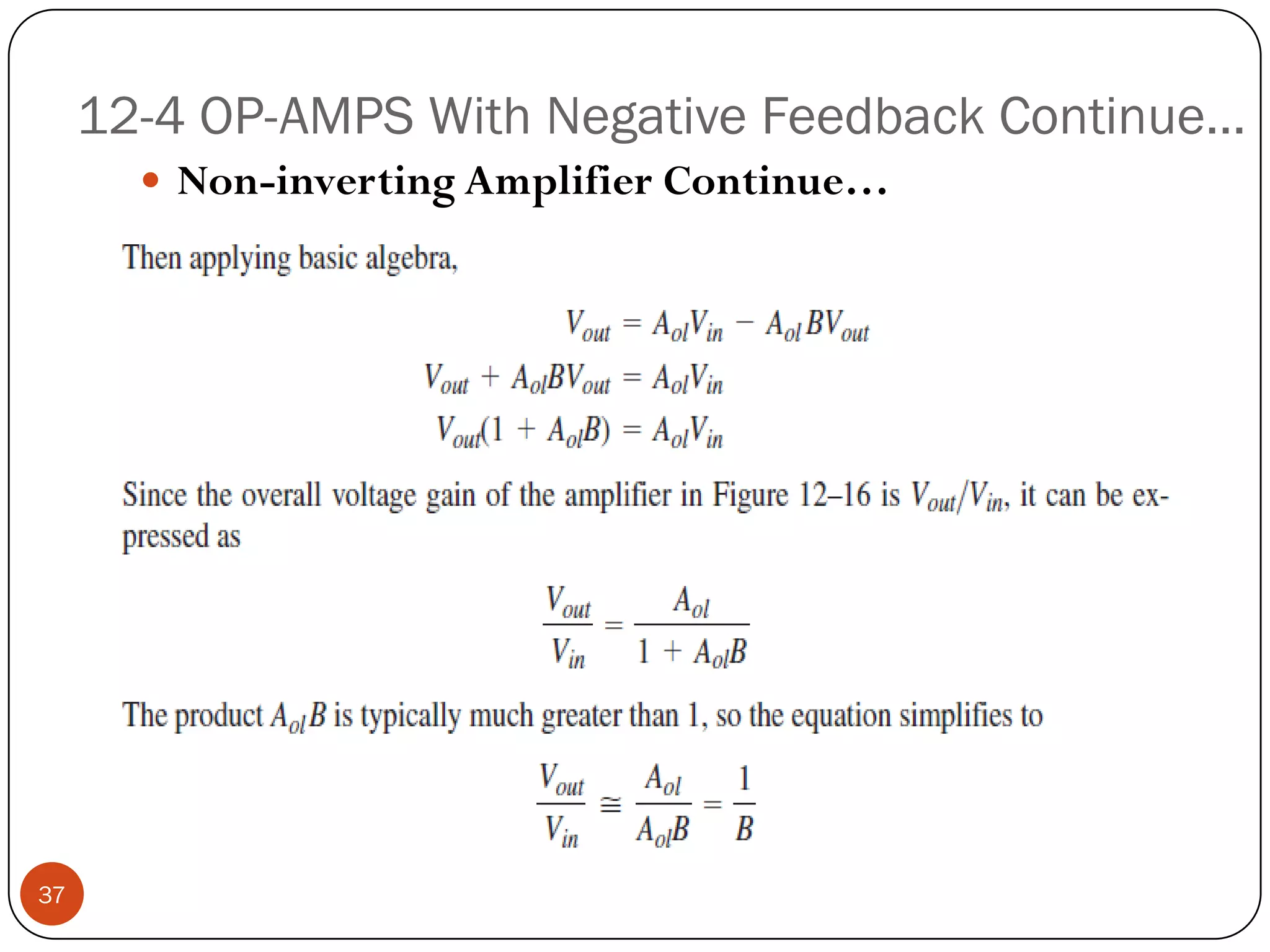
Non-invertingAmplifierContinue… 37
12-4 OP-AMPS With Negative Feedback Continue… 
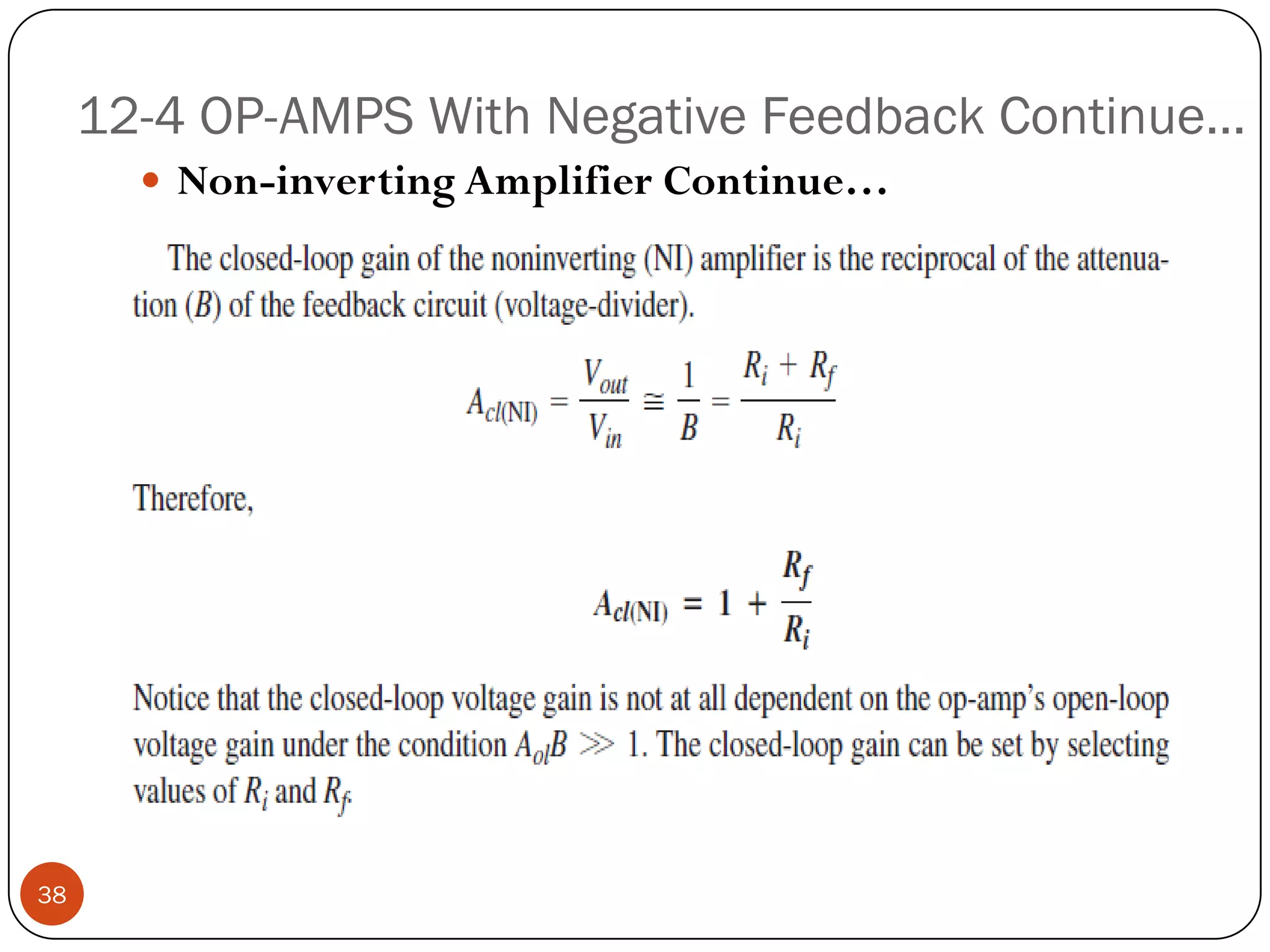
Non-invertingAmplifierContinue… 38
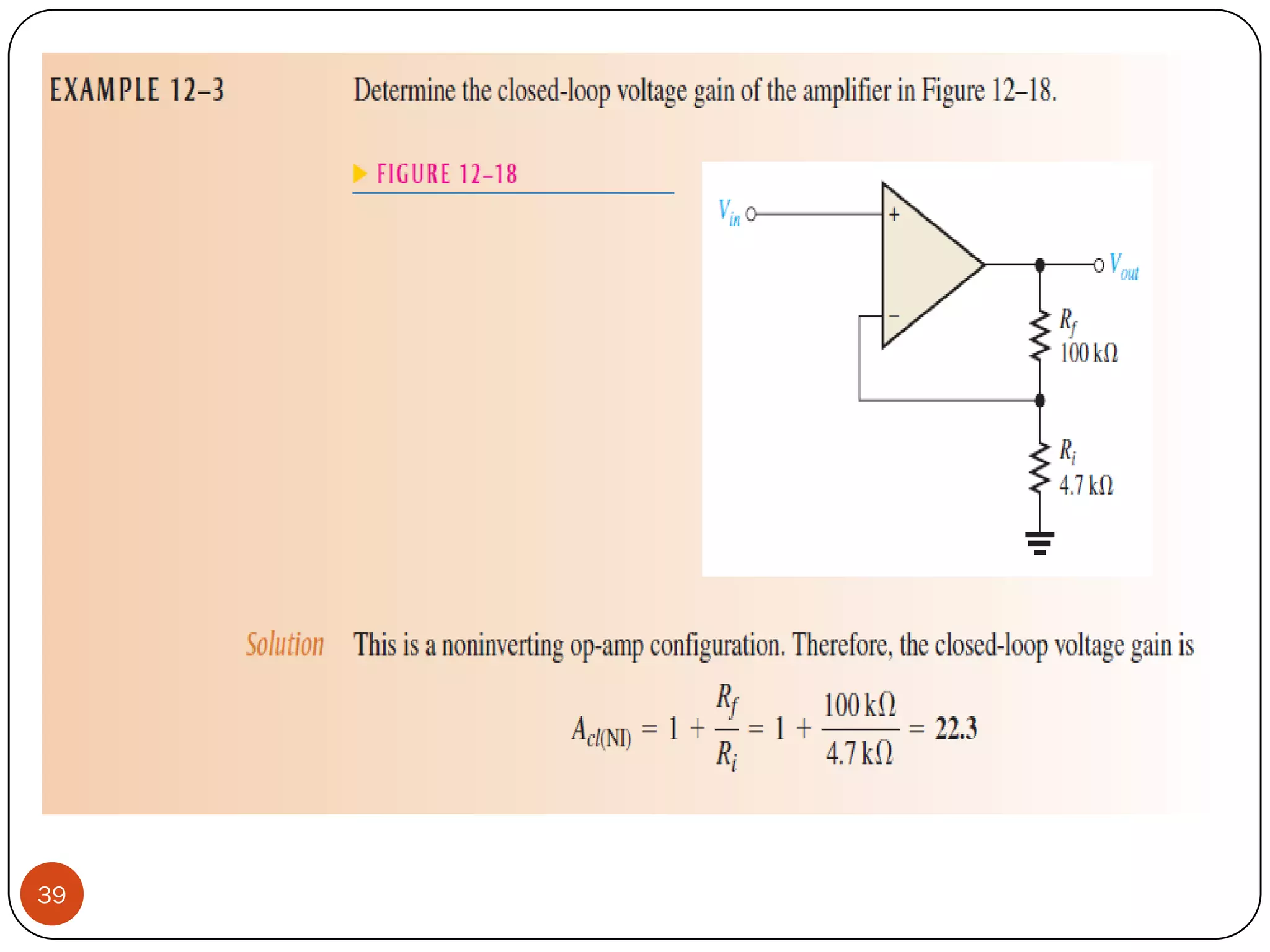
39
12-4 OP-AMPS With Negative Feedback Continue… 
VoltageFollower 
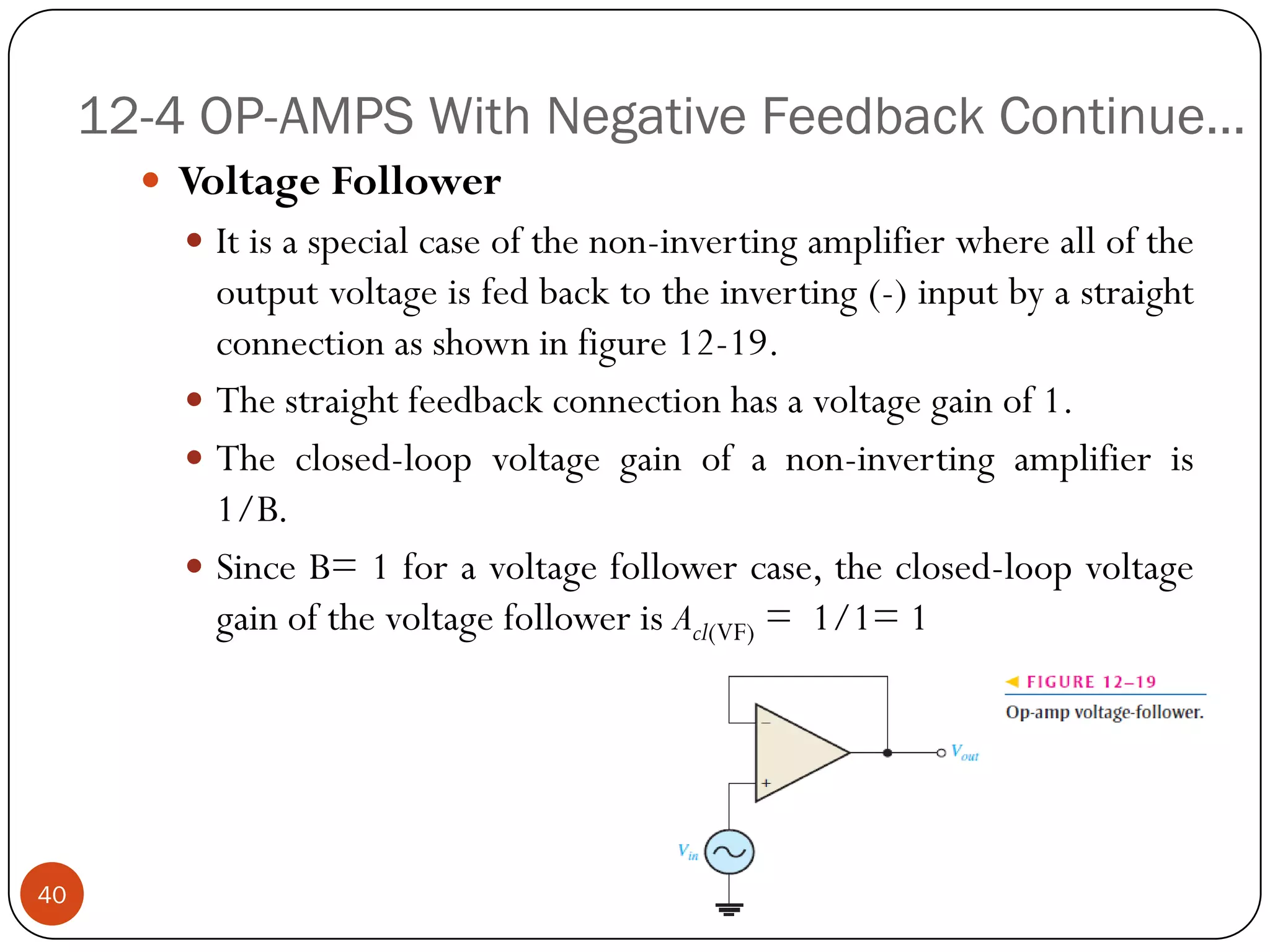
Itisaspecialcaseofthenon-invertingamplifierwherealloftheoutputvoltageisfedbacktotheinverting(-)inputbyastraightconnectionasshowninfigure12-19. 
Thestraightfeedbackconnectionhasavoltagegainof1. 
Theclosed-loopvoltagegainofanon-invertingamplifieris1/B. 
SinceB=1foravoltagefollowercase,theclosed-loopvoltagegainofthevoltagefollowerisAcl(VF)=1/1=1 
40
12-4 OP-AMPS With Negative Feedback Continue… 
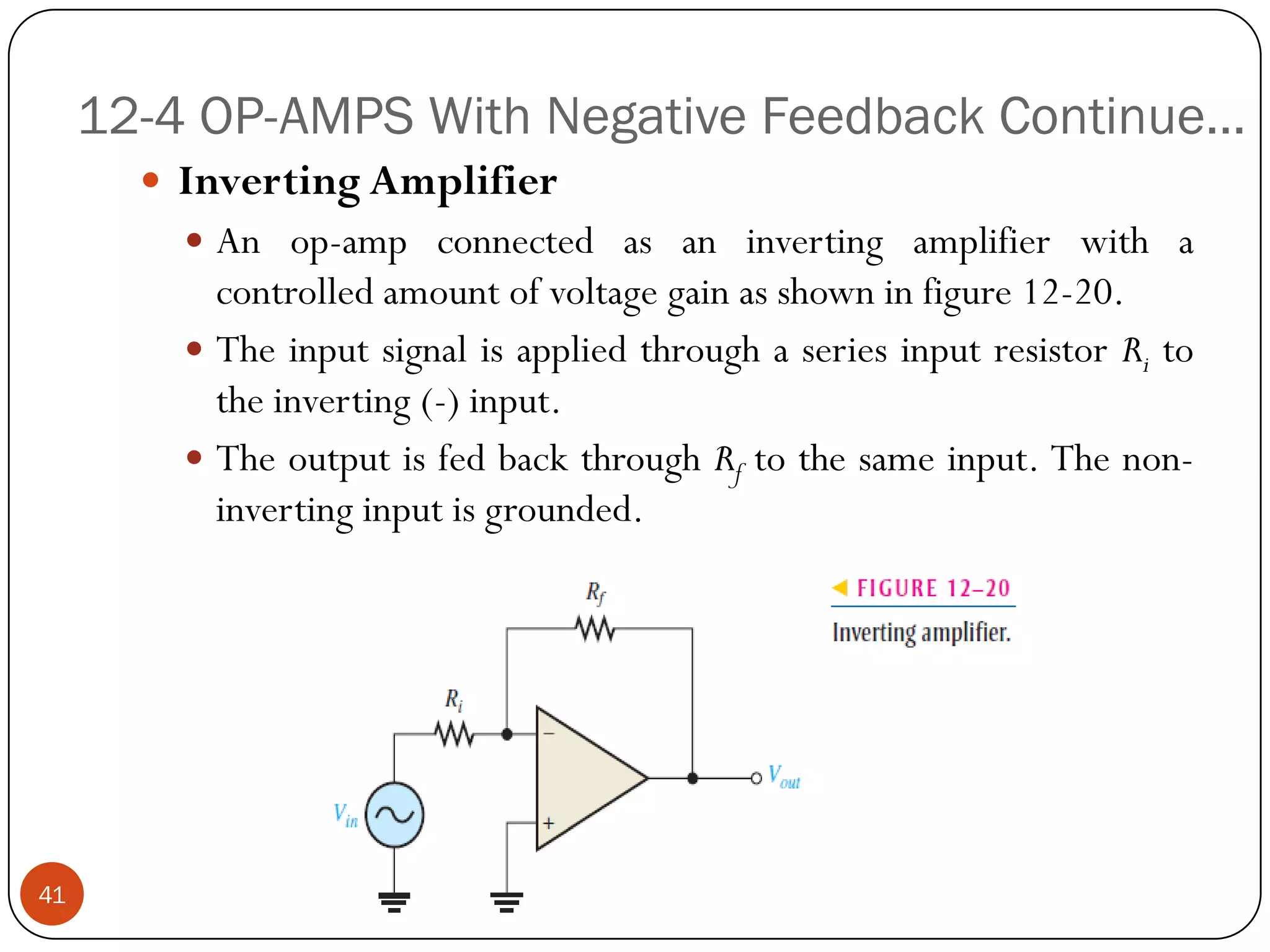
InvertingAmplifier 
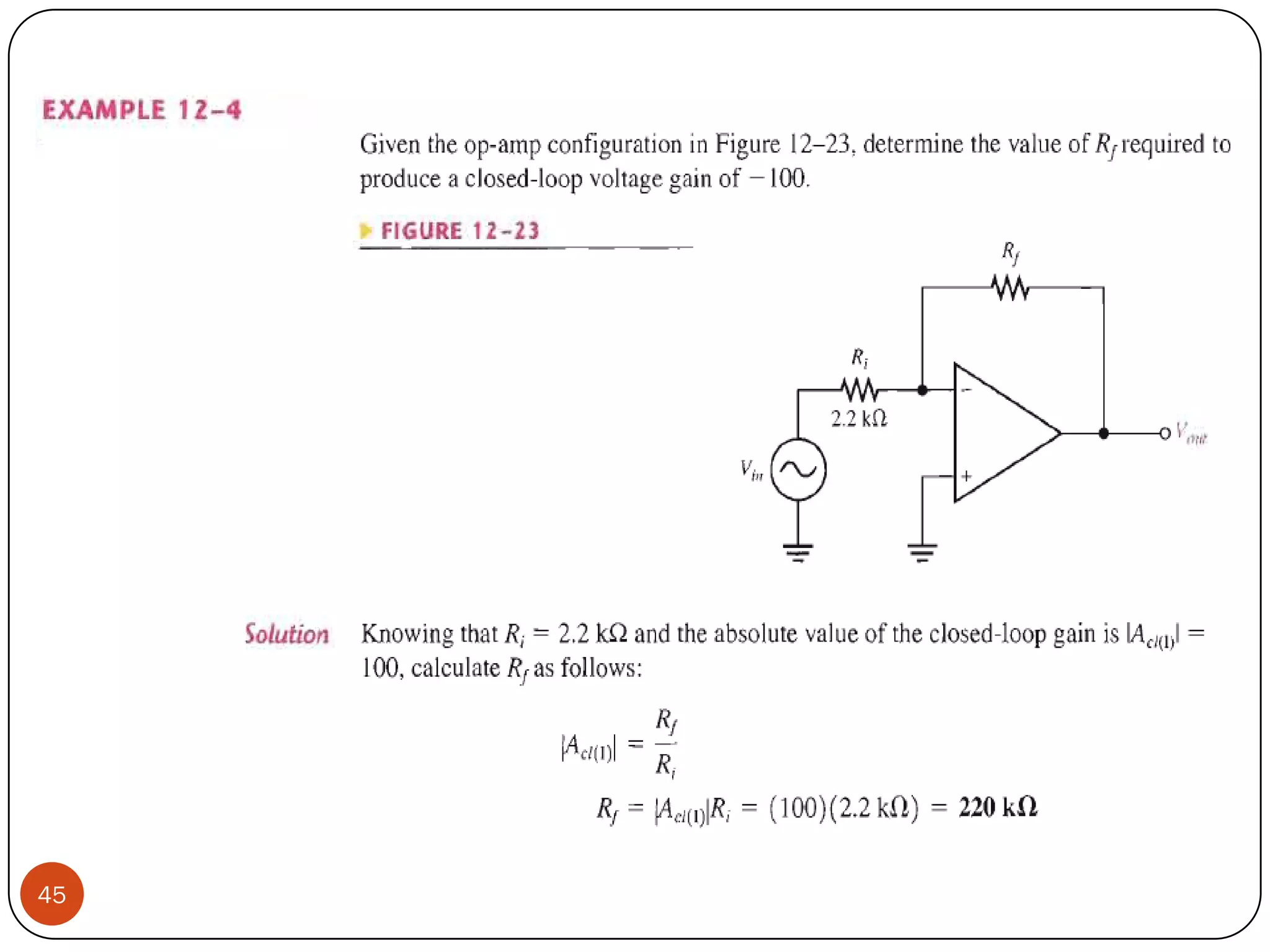
Anop-ampconnectedasaninvertingamplifierwithacontrolledamountofvoltagegainasshowninfigure12-20. 
TheinputsignalisappliedthroughaseriesinputresistorRitotheinverting(-)input. 
TheoutputisfedbackthroughRftothesameinput.Thenon- invertinginputisgrounded. 
41
12-4 OP-AMPS With Negative Feedback Continue… 
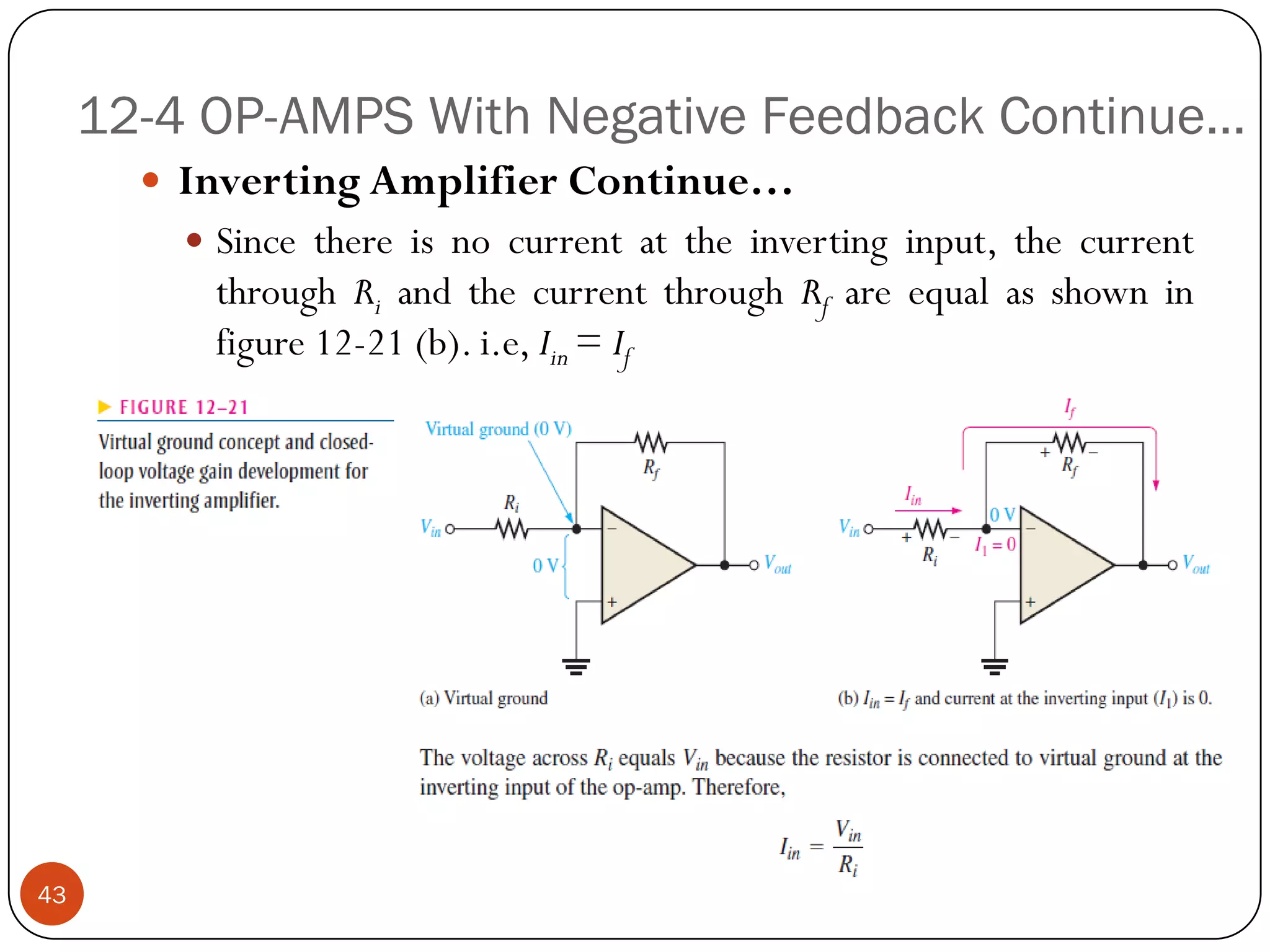
InvertingAmplifierContinue… 
Atthispoint,theidealop-ampparametersmentionedearlierareusefulinsimplifyingtheanalysisofthiscircuit. 
Particularlytheconceptofinfiniteinputimpedanceisofgreatvalue. 
Aninfiniteinputimpedanceimplieszerocurrentattheinvertinginput. 
Ifthereiszerocurrentthroughtheinputimpedance,thentheremustbenovoltagedropbetweentheinvertingandnon- invertingterminals. 
Thismeansthatthevoltageattheinverting(-)inputiszero. Thiszerovoltageattheinvertinginputterminalisreferredtoasvirtualground.Thisconditionisillustratedinfigure12-21(a) nextslide.42
12-4 OP-AMPS With Negative Feedback Continue… 
InvertingAmplifierContinue… 
Sincethereisnocurrentattheinvertinginput,thecurrentthroughRiandthecurrentthroughRfareequalasshowninfigure12-21(b).i.e,Iin=If43
12-4 OP-AMPS With Negative Feedback Continue… 
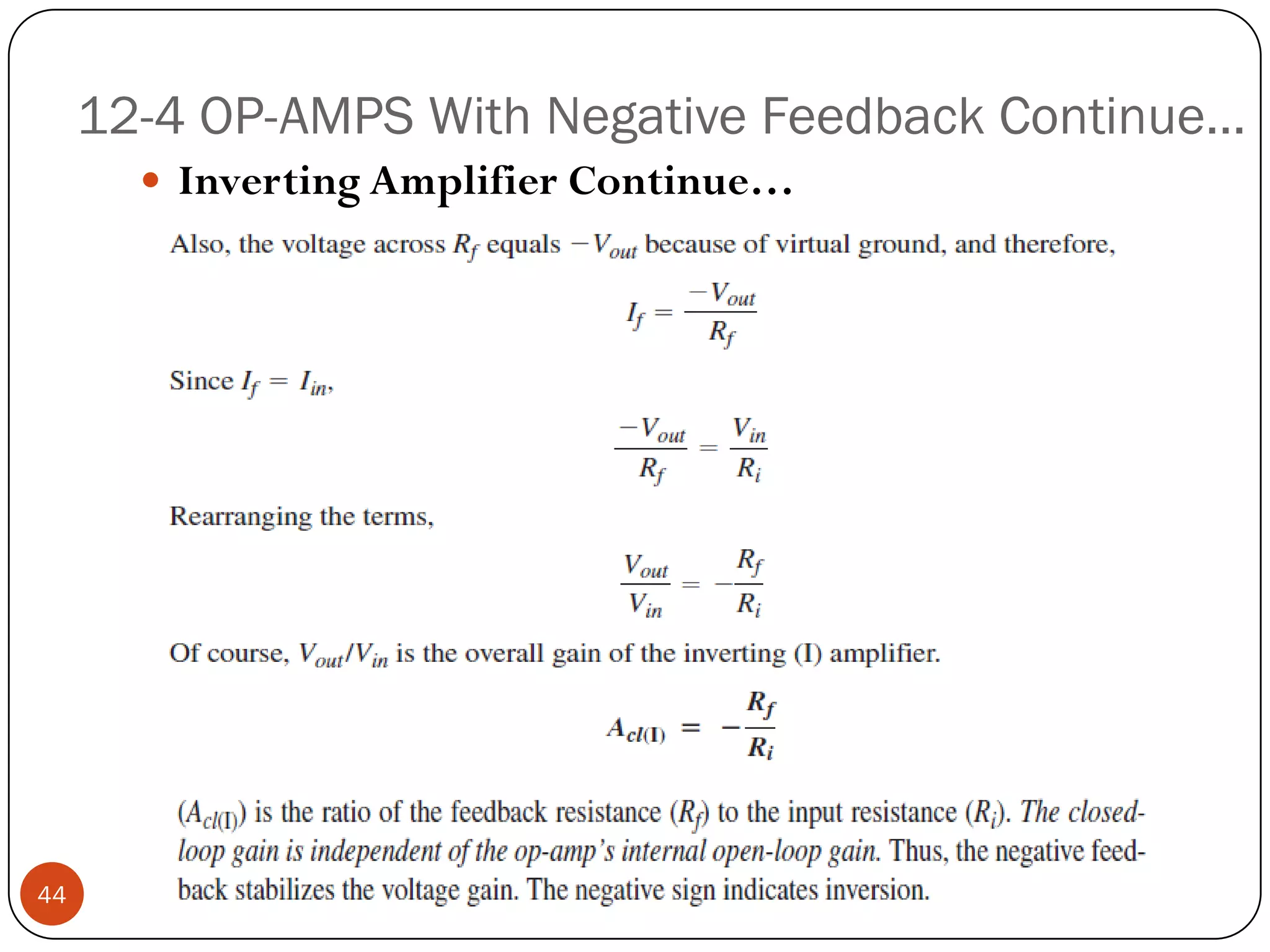
InvertingAmplifierContinue… 44
45

The operational amplifier (part 1)

  • 1.
    Engr.Tehseen Ahsan Lecturer,Electrical Engineering Department EE-307 Electronic Systems Design HITEC University Taxila Cantt, Pakistan The Operational Amplifier (Part 1)
  • 2.
    12-1 Introduction toOperational Amplifiers Thedevices,suchasdiodeandthetransistor,areseparatedevicesthatareindividuallypackagedandinterconnectedinacircuitwithotherdevicestoformacomplete,functionalunit-DiscreteComponents. Linearintegratedcircuits(ICs),wheremanytransistors,diodes, resistorsandcapacitorsarefabricatedonasingletinychipofsemiconductormaterial. Thismeansthatwewillbeconcernedwithwhatthecircuitdoesfromanexternalviewpointthanfromaninternal, component-levelviewpoint. 2
  • 3.
    12-1 Introduction toOperational Amplifiers Continue… EarlyoperationalAmplifiers(i.e,usedfor+,-,∫andd/dx). Earlyop-ampwereconstructedwithvaccumtubesandworkedwithhighvoltages. Today’sop-amparelinearICsthatuserelativelylowdcsupplyvoltagesandarereliableandinexpensive. 3
  • 4.
    12-1 Introduction toOperational Amplifiers Continue… SymbolandTerminals Thestandardop-ampsymbolisshowninfigure12-1(a). Ithastwoterminalsi.e,inverting(-)andnon-inverting(+). Ithasoneoutputterminal. Thetypicalop-ampoperateswithtwodcsupplyvoltages,one+veandtheother–veasshowninfigure12-2(b). Usuallythesedcvoltageterminalsareleftofftheschematicsymbolforsimplicitybutareunderstoodtobethere. 4
  • 5.
    12-1 Introduction toOperational Amplifiers Continue… TheIdealOp-Amp Ithasinfinitegainandinfinitebandwidth. Ithasinfiniteinputimpedance(open)sothatitdoesnotloadthedrivingsource. Ithaszerooutputimpedance. Thesecharacteristicsareillustratedinfigure12-2(a).Theinputvoltage,Vin,appearsb/wthetwoterminals,andtheoutputvoltageisAvVin,asindicatedbytheinternalvoltagesourcesymbol. 5
  • 6.
    12-1 Introduction toOperational Amplifiers Continue… ThePracticalOp-Amp AnydevicehaslimitationsandICop-ampisnoexception. Op-Amphascertainlimitationsbutthetwomentionedbelowaremajorones. i.SlewRate(willbediscussedin12-2Section). ii.Outputcurrentisalsolimitedbyinternalrestrictionssuchaspowerdissipationandcomponentratings. 6
  • 7.
    12-1 Introduction toOperational Amplifiers Continue… InternalBlockDiagramofanOp-Amp Atypicalop-ampismadeupofthreetypesofamplifiercircuits. ADifferentialAmplifieri.e,itistheinputstagefortheop-amp.Itprovidestheamplificationofthedifferencevoltageb/wthetwoinputs. AVoltageAmplifier(s)i.e,itisthesecondstageofop-ampandisusuallyaclassAamplifierthatprovidesadditionalgain. APush-PullClassBAmplifieri.e,itistypicallyusedforoutputstage. 7
  • 8.
    12-1 Introduction toOperational Amplifiers Continue… TheDifferentialAmplifierInputStage Thedifferentialamplifierformstheinputstageofoperationalamplifiers. Thetermdifferencecomesfromtheamplifier’sabilitytoamplifythedifferenceoftwoinputsignalsappliedtoinputs. Onlythedifferenceinthetwosignalsisamplified;ifthereisnodifference,thentheoutputiszero. 8
  • 9.
    12-1 Introduction toOperational Amplifiers Continue… TheDifferentialAmplifierInputStageContinue… Thetransistors(Q1andQ2)andthecollectorresistors(RC1andRC2)arecarefullymatchedtohaveidenticalcharacteristics(Refertofigureinpreviousslide). NoticethatthetwotransistorsshareasingleRE. Letussupposebothbasesareconnectedtoground.Theemittervoltagewillbe-0.7V. Theemittercurrentsareequal(IE1=IE2). Thecollectorcurrentsarebothequalandareapproximatelyequaltotheemittercurrents. Sincecollectorcurrentsarethesame,thecollectorvoltagesarealsothesame. Thereisazerodifferenceintheinputvoltages(bothbasesareat0V).9
  • 10.
    12-1 Introduction toOperational Amplifiers Continue… TheDifferentialAmplifierInputStageContinue… IfthebaseofQ1isdisconnectedfromgroundandconnectedtoasmallpositivevoltage,Q1willconductmorecurrentbecausethepositivevoltageonitsbasecausestheemittervoltagetoincreaseslightly. TheemittercurrentisnowdividedsothatmoreofitisinQ1andlessinQ2. AsaresultthecollectorvoltageofQ1willdecreaseandthecollectorvoltageofQ2willincrease,reflectingthedifferenceintheinputvoltages(oneis0Vandtheotheratasmallpositivevalue). Thisconditionisillustratedinfigurenextslide. 10
  • 11.
    12-1 Introduction toOperational Amplifiers Continue… TheDifferentialAmplifierInputStageContinue… 11
  • 12.
    12-2 OP-AMP InputModes and Parameters Thedifferentialamplifierexhibitsthreemodesofoperationbasedonthetypeofinputsignals.Thesemodesaresingle-ended,differentialandcommon.Sincethedifferentialamplifieristheinputstageoftheop- amp,theop-ampexhibitsthesamemodes. 12
  • 13.
    12-2 OP-AMP InputModes and Parameters Continue… Single-EndedMode Oneinputisgroundedandasignalvoltageisappliedonlytotheotherinputasshowninfigure12-4. Whenthesignalisappliedtotheinvertinginputasinpart(a), aninverted,amplifiedsignalvoltageappearsattheoutput. Whenthesignalisappliedtothenon-invertinginputasinpart(b),annon-inverted,amplifiedsignalvoltageappearsattheoutput. 13
  • 14.
    12-2 OP-AMP InputModes and Parameters Continue… DifferentialMode Twoopposite-polarity(out-of-phase)signalsareappliedtotheinputsasshowninfigure12-5. Thistypeofoperationisalsoreferredtoasdouble-ended. Theamplifieddifferencebetweenthetwoinputsappearsontheoutput. 14
  • 15.
    12-2 OP-AMP InputModes and Parameters Continue… CommonMode Twosignalvoltagesofthesamephase,frequencyandamplitudeareappliedtothetwoinputsasshownisfigure12-6. Thisresultsinazerooutputvoltage(asdifferenceis0V). Thisactioniscalledcommon-moderejection. 15
  • 16.
    12-2 OP-AMP InputModes and Parameters Continue… CommonModeContinue… It’simportanceliesinthesituationwhereanunwantedsignalappearscommonlyonbothop-ampinputs. Common-moderejectionmeansthatthisunwantedsignalwillnotappearontheoutputanddistortthedesiredsignal. CommonModeRejectionRatio Desiredsignalscanappearononlyoneinputorwithoppositepolaritiesonbothinputlines.Thesedesiredsignalsareamplifiedandappearontheoutput. Unwantedsignals(noise)appearingwiththesamepolarityonbothinputlinesareessentiallycancelledbytheop-ampanddon’tappearontheoutput.Themeasureofanamplifier’sabilitytorejectcommon-modesignalsisaparametercalledtheCMRR(Common-ModeRejectionRatio). 16
  • 17.
    12-2 OP-AMP InputModes and Parameters Continue… CommonModeRejectionRatioContinue... Ideally,anop-ampprovidesaveryhighgainfordesiredsignals(single-endedordifferential)andzerogainforcommon-modesignals. Howeverpracticalop-ampsdoexhibitaverysmallcommon- modegain(usuallymuchlessthan1),whileprovidingahighopen-loopvoltagegain(usuallyseveralthousands). Thehighertheopen-loopgainw.r.tthecommon-modegain, thebettertheperformanceofop-ampintermsofrejectionofcommon-modesignals. Thissuggests: 17
  • 18.
    12-2 OP-AMP InputModes and Parameters Continue… CommonModeRejectionRatioContinue... ThehighertheCMRR,thebetter.AveryhighvalueofCMRRmeansthattheopen-loopgain,Aolishighandcommon-modegain,Acmislow. TheCMRRisoftenexpressesindecibels(dB)as Theopen-loopvoltagegainofanop-ampistheinternalvoltagegainofthedeviceandrepresentstheratiooftheoutputvoltagetotheinputvoltagewhentherearenoexternalcomponents(nofeedbackcircuit). Open-loopvoltagegaincanrangeupto200,000andisnotawelltoleratedparameter.Datasheetsoftenrefertotheopen- loopvoltagegainasthelarge-signalvoltagegain. 18
  • 19.
  • 20.
    12-2 OP-AMP InputModes and Parameters Continue… InputOffsetVoltage Idealop-ampproduceszerovoltsoutforzerovoltsin. However,inpracticalop-ampasmalldcvoltage,VOUT(error), appearsattheoutputwhennodifferentialinputvoltageisapplied.Itsprimarycauseisaslightmismatchofthebase- emittervoltagesofthedifferentialamplifierinputstageofanop-amp. Inputoffsetvoltage,VOS,isthedifferentialdcvoltagerequiredbetweentheinputstoforcetheoutputtozerovolts. Typicalvaluesofinputoffsetvoltageareintherangeof2mVorless.Itis0Vinidealcase. Inputoffsetvoltagedriftisaparameterrelatedto,VOS,thatspecifieshowmuchchangeoccursintheinputoffsetvoltageforeachdegreechangeintemperature.20
  • 21.
    12-2 OP-AMP InputModes and Parameters Continue… InputBiasCurrent Inputterminalsofadifferentialamplifierarethetransistorbasesandtherefore,theinputcurrentsarethebasecurrents. Theinputbiascurrentisthedccurrentrequiredbytheinputsofanamplifiertoproperlyoperatethefirststage.Bydefinitiontheinputbiascurrentistheaverageofbothinputcurrentsasfollows: 21
  • 22.
    12-2 OP-AMP InputModes and Parameters Continue… InputImpedance Twobasicwaysofspecifyingtheinputimpedance 1.TheDifferentialinputimpedanceisthetotalresistancebetweentheinvertingandnon-invertingterminalsasillustrated12-8(a)nextslide.Differentialimpedanceismeasuredbydeterminingthechangeinbiascurrentforagivenchangeindifferentialinputvoltage. 2.Thecommon-modeinputimpedanceistheresistancebetweeneachinputandgroundandismeasuredbydeterminingthechangeinbiascurrentforagivenchangeincommon-modeinputvoltageshowninfigure12-8(b)nextslide. 22
  • 23.
    12-2 OP-AMP InputModes and Parameters Continue… InputImpedanceContinue… 23
  • 24.
    12-2 OP-AMP InputModes and Parameters Continue… InputOffsetCurrent Ideally,thetwoinputbiascurrentsareequalandthustheirdifferenceiszero. However,inapracticalop-amp,thebiascurrentsarenotexactlyequal. Theinputoffsetcurrent,IOSisthedifferenceoftheinputbiascurrentsexpressedasanabsolutevalue. 24
  • 25.
    12-2 OP-AMP InputModes and Parameters Continue… InputOffsetCurrent Theactualmagnitudesofoffsetcurrentareusuallyatleasttentimeslessthanthebiascurrent. Inmanyapplicationsoffsetcurrentcanbeneglected. 25
  • 26.
    12-2 OP-AMP InputModes and Parameters Continue… OutputImpedance Theoutputimpedanceistheresistanceviewedfromtheoutputterminaloftheop-ampasshowninfigurebelow 26
  • 27.
    12-2 OP-AMP InputModes and Parameters Continue… SlewRate Theslewrate(SR)ofanop-ampisthemaximumrateatwhichtheoutputvoltagecanchangeinresponsetoinputvoltage. WhentheSRistooslowfortheinput,distortionresults. Whenainputsinewaveisappliedtoavoltagefolloweritproducesatriangularoutputwaveform. Thetriangularwaveformresultsbecausetheop-ampsimplycannotmovefastenoughtofollowthesinewaveinput. Thishappensbecausevoltagechangeinthesecondstage( VoltageAmplifier(s))islimitedbythecharginganddischargingofcapacitor. Theslewrateisexpressedas:SR=ΔVO/Δt TheunitofSRisvoltspermicroseconds. 27
  • 28.
  • 29.
    12-3 Negative Feedback Negativefeedbackistheprocesswherebyaportionoftheoutputvoltageofanamplifierisreturnedtotheinputwithaphaseanglethatopposestheinputsignal. Negativefeedbackisillustratedinfigure12-14.Theinverting(-)inputeffectivelymakesthefeedbacksignal180˚outofphasewiththeinputsignal. 29
  • 30.
    12-3 Negative Feedback WhyUseNegativeFeedback? Theinherentopen-loopvoltagegainofatypicalop-ampisveryhigh(usuallygreaterthan100,000).Therefore,anextremelysmallinputvoltagedrivestheop-ampintoitssaturatedoutputstates.Infact,eventheinputoffsetvoltageofanop-ampcandriveitintosaturation.Forexample,assumeVIN=1mVandAol=100,000.Then,Vout=VINAol=100V Sincetheoutputlevelofanop-ampcanneverreach100V,itisdrivendeepintosaturationandtheoutputislimitedtoitsmaximumoutputlevelsasillustratedinfigure12-15nextslideforbothapositiveandnegativeinputvoltageof1mV. 30
  • 31.
    12-3 Negative Feedback WhyUseNegativeFeedback?(continue…) Theusefulnessofanop-ampoperatedwithoutnegativefeedbackisseverelyrestrictedandisgenerallylimitedtocomparatorandotherapplications. Withnegativefeedback,theclosed-loopvoltagegain(Acl)canbereducedandcontrolledsothatop-ampcanfunctionasalinearamplifier. 31
  • 32.
    12-4 OP-AMPS WithNegative Feedback Theextremelyhighopen-loopgainofanop-ampcreatesanunstablesituationbecauseasmallnoisevoltageontheinputcanbeamplifiedtoapointwheretheamplifierisdrivenoutofitslinearregion. Negativefeedbacktakesaportionoftheoutputandappliesitbackoutofphasewiththeinput,creatinganeffectivereductioningain. Thisclosed-loopgainisusuallymuchlessthantheopen-loopgain. 32
  • 33.
    12-4 OP-AMPS WithNegative Feedback Continue… Closed-LoopVoltageGain,Acl Theclosed-loopgainisthevoltagegainofanop-ampwithexternalfeedback.Theamplifierconfigurationconsistsoftheop-ampandanexternalfeedbackcircuitthatconnectstheoutputtoinvertinginput. Theclosed-loopvoltagegainisdeterminedbytheexternalcomponentvaluesandcanbepreciselycontrolledbythem. 33
  • 34.
    12-4 OP-AMPS WithNegative Feedback Continue… Non-invertingAmplifier Anop-ampinaclosed-loopconfigurationasanon-invertingamplifierwithacontrolledamountofvoltagegainisshowninfigure12-16nextslide. Theinputsignalisappliedtothenon-inverting(+)input. Theoutputisappliedbacktotheinverting(-)inputthroughthefeedbackcircuit(closedloop)formedbytheinputresistorRiandthefeedbackresistorRf. ResistorsRiandRfformavoltage-dividercircuitwhichreducesVoutandconnectsthereducedvoltageVftotheinvertinginput. Thefeedbackvoltageisexpressedas34
  • 35.
    12-4 OP-AMPS WithNegative Feedback Continue… Non-invertingAmplifierContinue… ThedifferenceoftheinputvoltageVin,andthefeedbackvoltageVf,isthedifferentialinputtotheop-ampasshowninfigure12-17nextslide.Thisdifferentialvoltageisamplifiedbytheopen-loopvoltagegainoftheop-amp(Aol)andproducesanoutputvoltageexpressedas 35
  • 36.
    12-4 OP-AMPS WithNegative Feedback Continue… Non-invertingAmplifierContinue… 36
  • 37.
    12-4 OP-AMPS WithNegative Feedback Continue… Non-invertingAmplifierContinue… 37
  • 38.
    12-4 OP-AMPS WithNegative Feedback Continue… Non-invertingAmplifierContinue… 38
  • 39.
  • 40.
    12-4 OP-AMPS WithNegative Feedback Continue… VoltageFollower Itisaspecialcaseofthenon-invertingamplifierwherealloftheoutputvoltageisfedbacktotheinverting(-)inputbyastraightconnectionasshowninfigure12-19. Thestraightfeedbackconnectionhasavoltagegainof1. Theclosed-loopvoltagegainofanon-invertingamplifieris1/B. SinceB=1foravoltagefollowercase,theclosed-loopvoltagegainofthevoltagefollowerisAcl(VF)=1/1=1 40
  • 41.
    12-4 OP-AMPS WithNegative Feedback Continue… InvertingAmplifier Anop-ampconnectedasaninvertingamplifierwithacontrolledamountofvoltagegainasshowninfigure12-20. TheinputsignalisappliedthroughaseriesinputresistorRitotheinverting(-)input. TheoutputisfedbackthroughRftothesameinput.Thenon- invertinginputisgrounded. 41
  • 42.
    12-4 OP-AMPS WithNegative Feedback Continue… InvertingAmplifierContinue… Atthispoint,theidealop-ampparametersmentionedearlierareusefulinsimplifyingtheanalysisofthiscircuit. Particularlytheconceptofinfiniteinputimpedanceisofgreatvalue. Aninfiniteinputimpedanceimplieszerocurrentattheinvertinginput. Ifthereiszerocurrentthroughtheinputimpedance,thentheremustbenovoltagedropbetweentheinvertingandnon- invertingterminals. Thismeansthatthevoltageattheinverting(-)inputiszero. Thiszerovoltageattheinvertinginputterminalisreferredtoasvirtualground.Thisconditionisillustratedinfigure12-21(a) nextslide.42
  • 43.
    12-4 OP-AMPS WithNegative Feedback Continue… InvertingAmplifierContinue… Sincethereisnocurrentattheinvertinginput,thecurrentthroughRiandthecurrentthroughRfareequalasshowninfigure12-21(b).i.e,Iin=If43
  • 44.
    12-4 OP-AMPS WithNegative Feedback Continue… InvertingAmplifierContinue… 44
  • 45.