Welcome to our Presentation 
12/05/14
Presentation on 
Silicon Control Rectifier 
(SCR) 
Prepared by 
1. Emran Hossain ID# 10105020 
2. MD. Rimon Miha ID# 10105074 
3. MD. Monimul Haque ID# 10305036 
4. MD. Salauddin Babu ID# 12105057 
5. Ruhul Amin ID# 12105114 
IUBAT-International University of Business Agriculture 
and Technology 
12/05/14
Contents 
Introduction 
What is a SCR? 
 Basic SCR 
How does SCR work? 
Characteristics curve of SCR 
Importance of SCR 
Conclusion 
12/05/14
Introduction 
The silicon-controlled rectifier(SCR) which is a power 
electronic device is unquestionable of the greatest 
interest today. It was first introduced in 1956 by Bell 
Telephone Laboratories. It can convert alternating 
current into direct current and at the same time can 
control the amount of power fed to the load. Thus it 
combines the features of a rectifier and a transistor. 
12/05/14
What is a silicon control rectifier? 
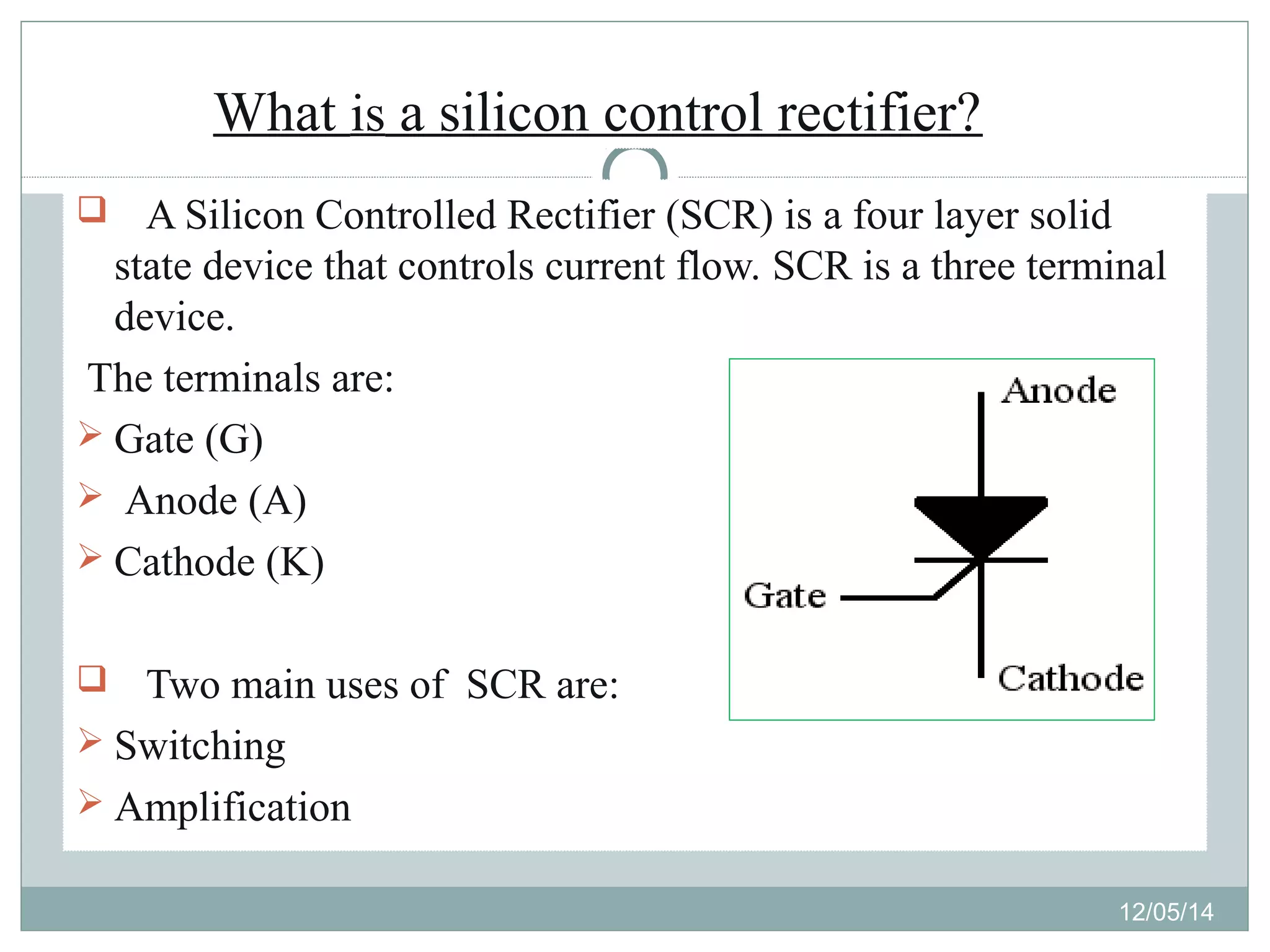
 A Silicon Controlled Rectifier (SCR) is a four layer solid 
state device that controls current flow. SCR is a three terminal 
device. 
The terminals are: 
 Gate (G) 
 Anode (A) 
 Cathode (K) 
 Two main uses of SCR are: 
 Switching 
 Amplification 
12/05/14
Basic SCR structure 
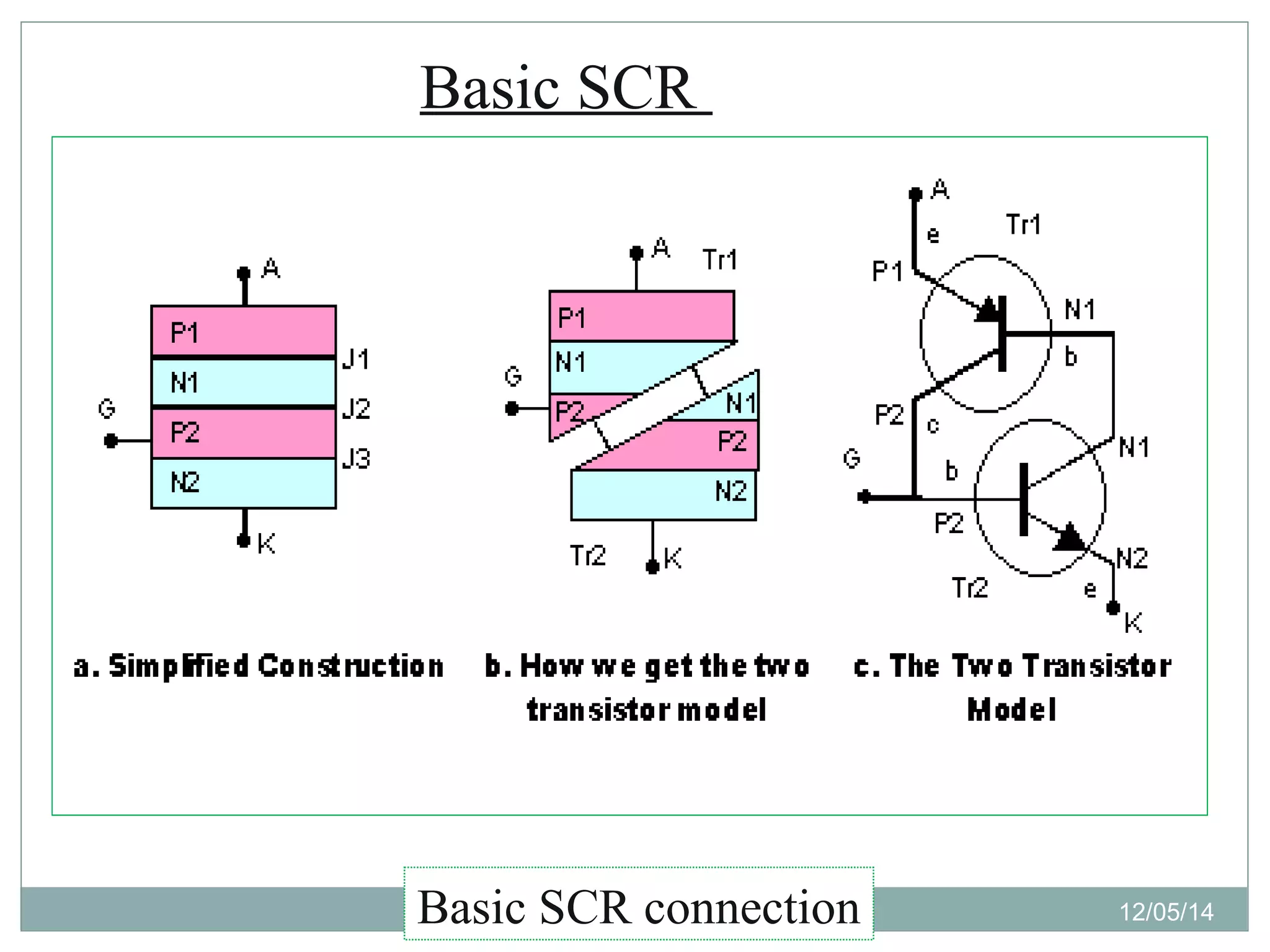
The SCR consists of a four layer p-n-p-n structure 
with the outer layers are referred to as the anode (p-type) 
and cathode (n-type). The control terminal of 
the SCR is named the gate and it is connected to the 
p-type layer located next to the cathode. 
The three junctions are normally denoted as J1, J2, 
and J3. They are numbered serially with J1 being 
nearest to the anode. 
12/05/14
Basic SCR 
Basic SCR connection 12/05/14
How does SCR work? 
 Load is connected in series with anode. 
 The anode is always kept at a higher potential than 
the cathode. 
The working of SCR is to be studied under two different 
conditions: 
1.When Gate (G) is open 
2.When Gate (G) is positive with respect to Cathode (K) 
12/05/14
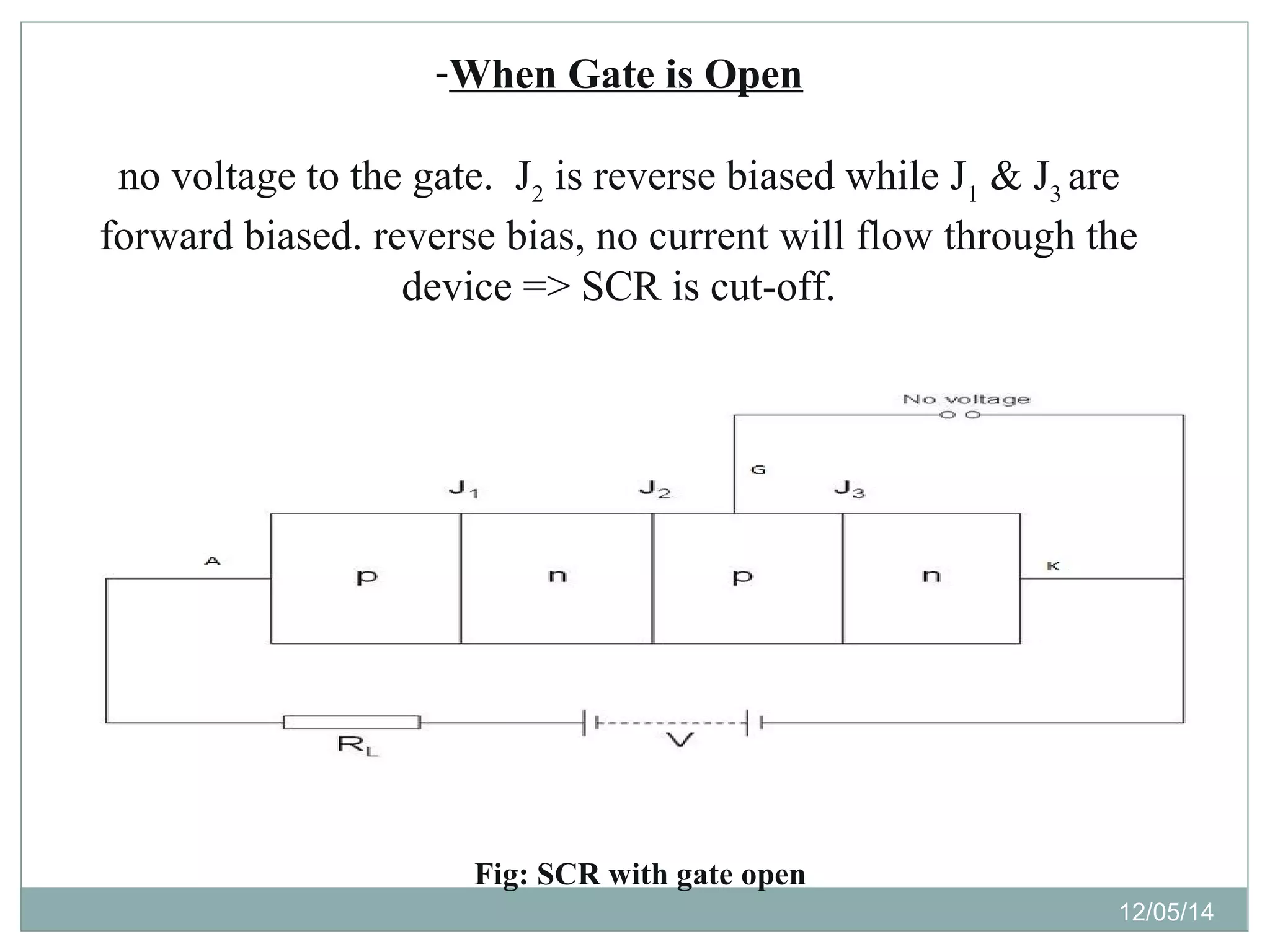
-When Gate is Open 
no voltage to the gate. J2 is reverse biased while J1 & J3 are 
forward biased. reverse bias, no current will flow through the 
device => SCR is cut-off. 
Fig: SCR with gate open 
12/05/14
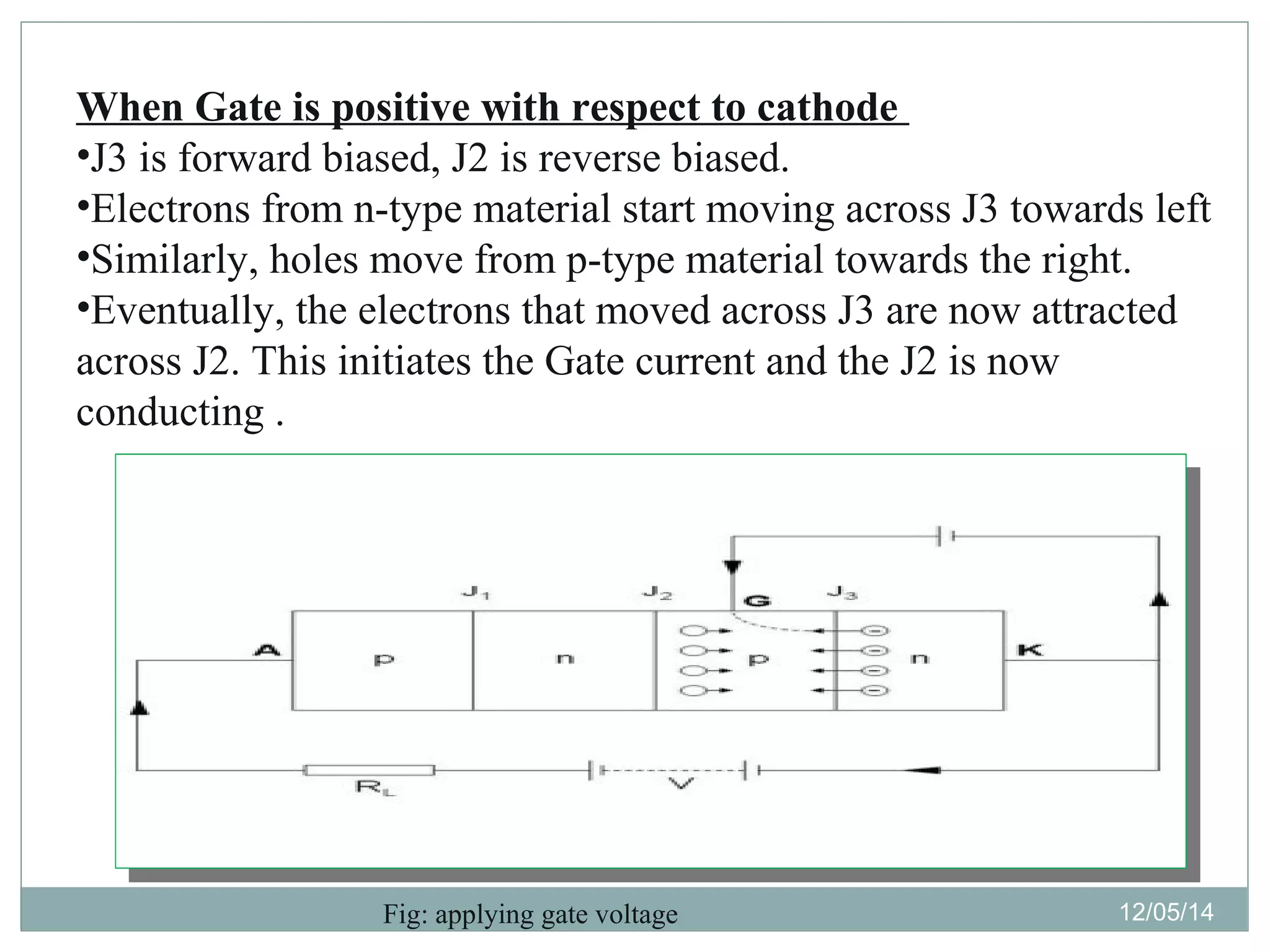
When Gate is positive with respect to cathode 
•J3 is forward biased, J2 is reverse biased. 
•Electrons from n-type material start moving across J3 towards left 
•Similarly, holes move from p-type material towards the right. 
•Eventually, the electrons that moved across J3 are now attracted 
across J2. This initiates the Gate current and the J2 is now 
conducting . 
Fig: applying gate voltage 12/05/14
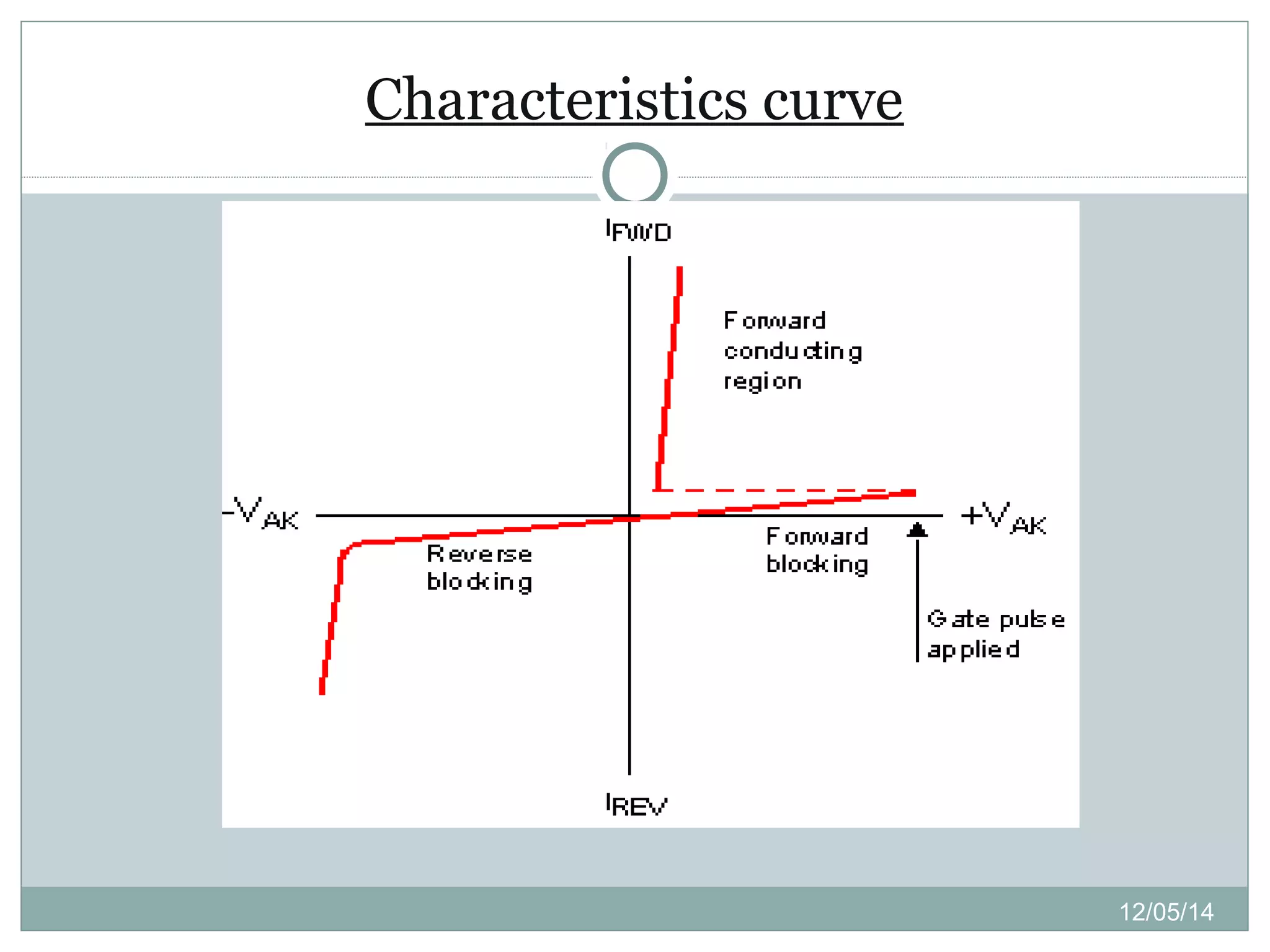
Characteristics curve 
12/05/14
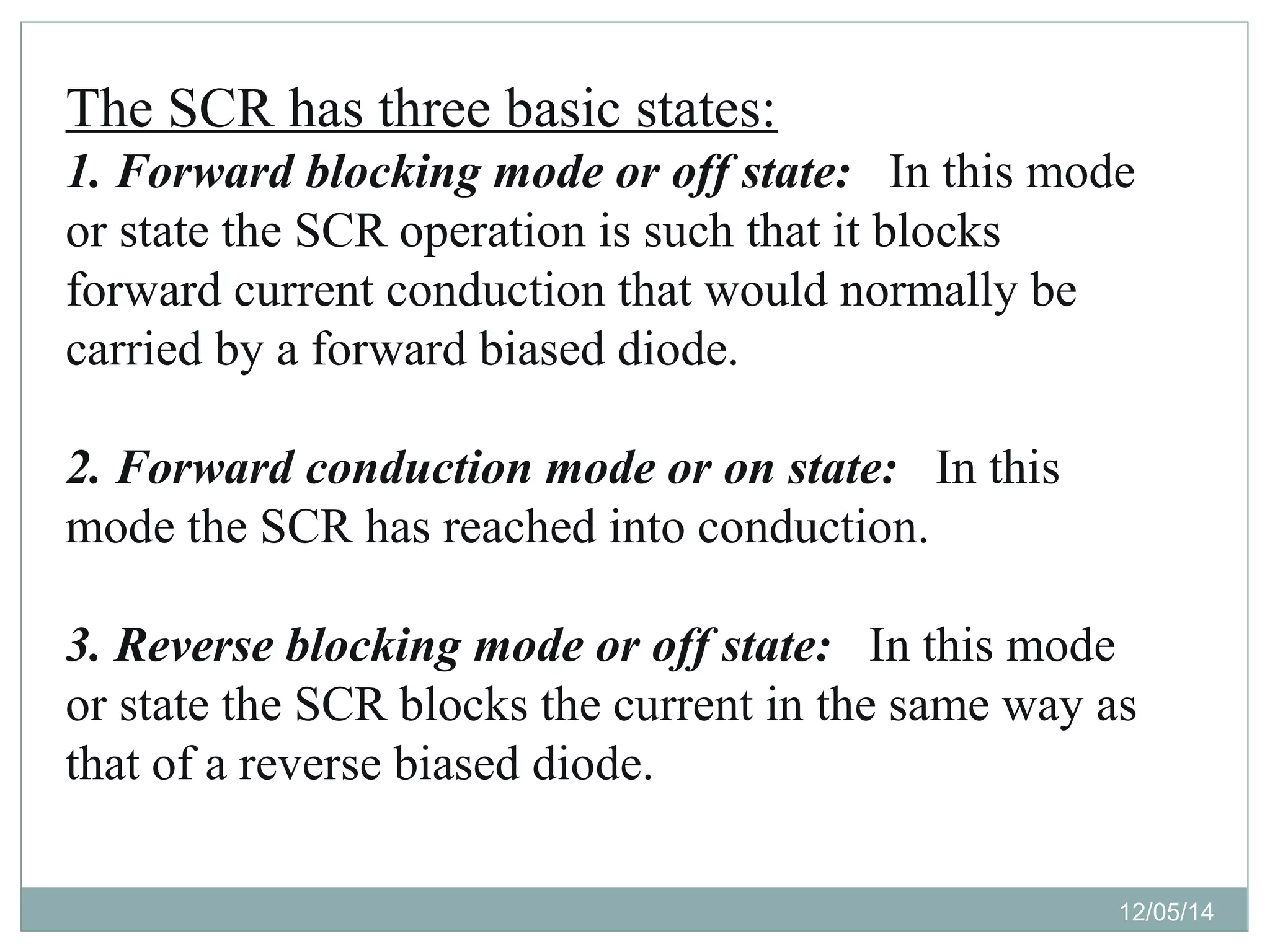
The SCR has three basic states: 
1. Forward blocking mode or off state: In this mode 
or state the SCR operation is such that it blocks 
forward current conduction that would normally be 
carried by a forward biased diode. 
2. Forward conduction mode or on state: In this 
mode the SCR has reached into conduction. 
3. Reverse blocking mode or off state: In this mode 
or state the SCR blocks the current in the same way as 
that of a reverse biased diode. 
12/05/14
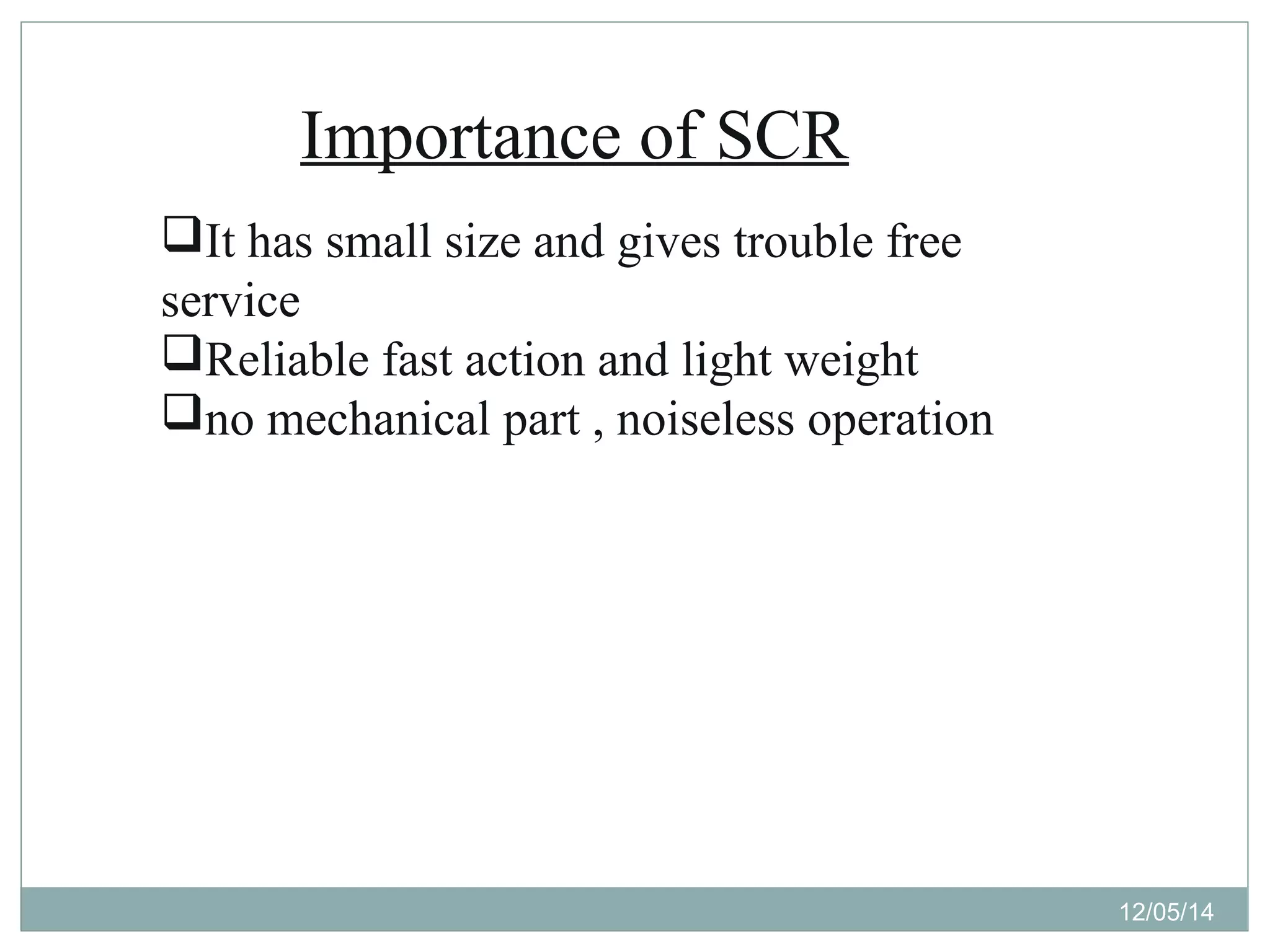
Importance of SCR 
It has small size and gives trouble free 
service 
Reliable fast action and light weight 
no mechanical part , noiseless operation 
12/05/14
12/05/14 
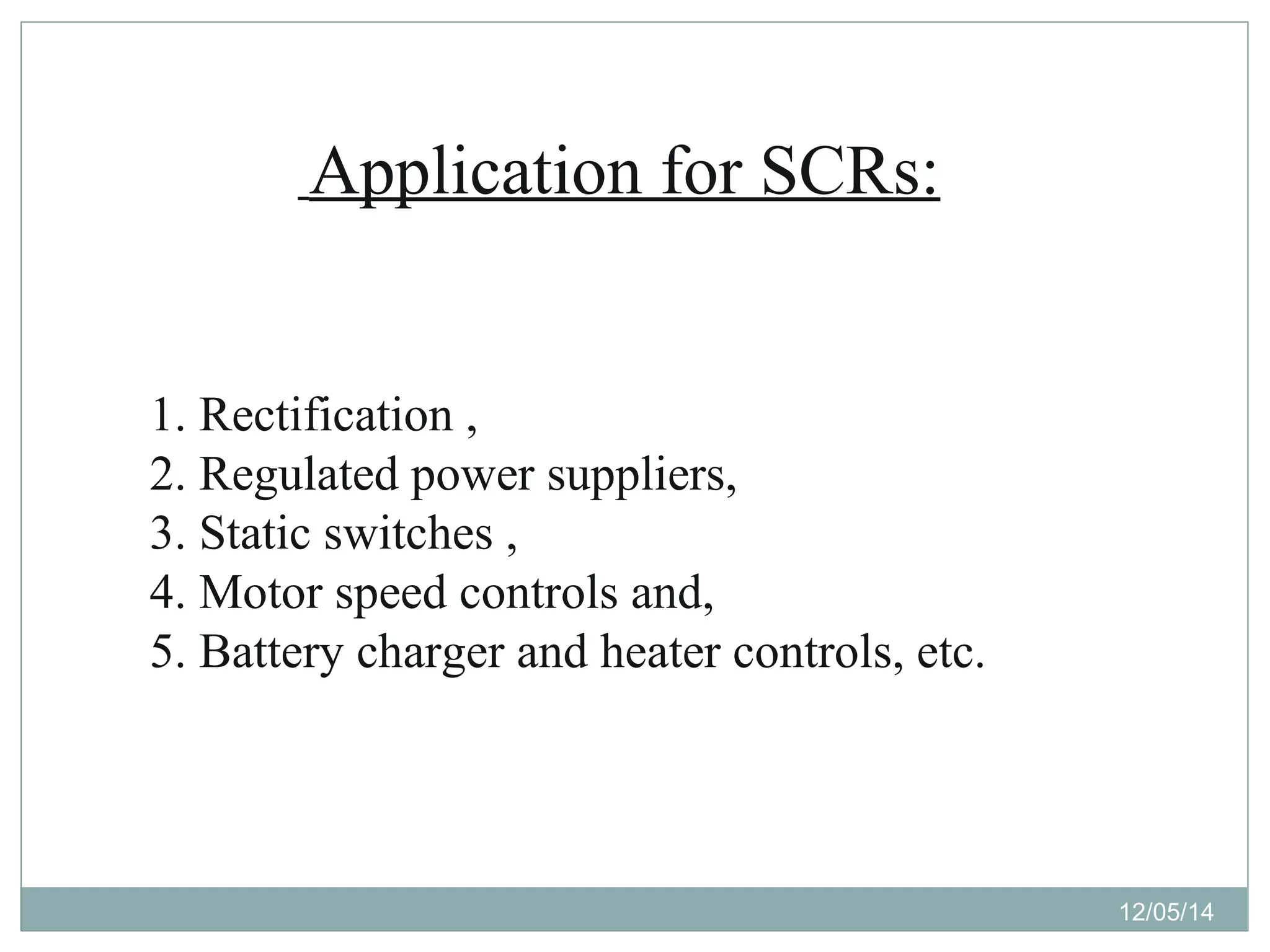
Application for SCRs: 
1. Rectification , 
2. Regulated power suppliers, 
3. Static switches , 
4. Motor speed controls and, 
5. Battery charger and heater controls, etc.
Conclusion 
Finally , Silicon control rectifier (SCR) are widely used in 
many areas of electronics. SCR circuits can be used for 
many power applications as these electronics 
components are able to switch high currents very easily. 
In addition, these electronics components are very 
cheap and they are widely available. 
12/05/14
Thank You 
Query ? 
12/05/14

Silicon control rectifier

  • 1.
    Welcome to ourPresentation 12/05/14
  • 2.
    Presentation on SiliconControl Rectifier (SCR) Prepared by 1. Emran Hossain ID# 10105020 2. MD. Rimon Miha ID# 10105074 3. MD. Monimul Haque ID# 10305036 4. MD. Salauddin Babu ID# 12105057 5. Ruhul Amin ID# 12105114 IUBAT-International University of Business Agriculture and Technology 12/05/14
  • 3.
    Contents Introduction Whatis a SCR?  Basic SCR How does SCR work? Characteristics curve of SCR Importance of SCR Conclusion 12/05/14
  • 4.
    Introduction The silicon-controlledrectifier(SCR) which is a power electronic device is unquestionable of the greatest interest today. It was first introduced in 1956 by Bell Telephone Laboratories. It can convert alternating current into direct current and at the same time can control the amount of power fed to the load. Thus it combines the features of a rectifier and a transistor. 12/05/14
  • 5.
    What is asilicon control rectifier?  A Silicon Controlled Rectifier (SCR) is a four layer solid state device that controls current flow. SCR is a three terminal device. The terminals are:  Gate (G)  Anode (A)  Cathode (K)  Two main uses of SCR are:  Switching  Amplification 12/05/14
  • 6.
    Basic SCR structure The SCR consists of a four layer p-n-p-n structure with the outer layers are referred to as the anode (p-type) and cathode (n-type). The control terminal of the SCR is named the gate and it is connected to the p-type layer located next to the cathode. The three junctions are normally denoted as J1, J2, and J3. They are numbered serially with J1 being nearest to the anode. 12/05/14
  • 7.
    Basic SCR BasicSCR connection 12/05/14
  • 8.
    How does SCRwork?  Load is connected in series with anode.  The anode is always kept at a higher potential than the cathode. The working of SCR is to be studied under two different conditions: 1.When Gate (G) is open 2.When Gate (G) is positive with respect to Cathode (K) 12/05/14
  • 9.
    -When Gate isOpen no voltage to the gate. J2 is reverse biased while J1 & J3 are forward biased. reverse bias, no current will flow through the device => SCR is cut-off. Fig: SCR with gate open 12/05/14
  • 10.
    When Gate ispositive with respect to cathode •J3 is forward biased, J2 is reverse biased. •Electrons from n-type material start moving across J3 towards left •Similarly, holes move from p-type material towards the right. •Eventually, the electrons that moved across J3 are now attracted across J2. This initiates the Gate current and the J2 is now conducting . Fig: applying gate voltage 12/05/14
  • 11.
  • 12.
    The SCR hasthree basic states: 1. Forward blocking mode or off state: In this mode or state the SCR operation is such that it blocks forward current conduction that would normally be carried by a forward biased diode. 2. Forward conduction mode or on state: In this mode the SCR has reached into conduction. 3. Reverse blocking mode or off state: In this mode or state the SCR blocks the current in the same way as that of a reverse biased diode. 12/05/14
  • 13.
    Importance of SCR It has small size and gives trouble free service Reliable fast action and light weight no mechanical part , noiseless operation 12/05/14
  • 14.
    12/05/14 Application forSCRs: 1. Rectification , 2. Regulated power suppliers, 3. Static switches , 4. Motor speed controls and, 5. Battery charger and heater controls, etc.
  • 15.
    Conclusion Finally ,Silicon control rectifier (SCR) are widely used in many areas of electronics. SCR circuits can be used for many power applications as these electronics components are able to switch high currents very easily. In addition, these electronics components are very cheap and they are widely available. 12/05/14
  • 16.
    Thank You Query? 12/05/14