Engr.Tehseen Ahsan 
Lecturer, Electrical Engineering Department 
EE-307 Electronic Systems Design 
HITEC University Taxila Cantt, Pakistan 
The Operational Amplifier (Part 2)
12-5 Effect of Negative FeedBack On OP-AMP Impedances 
ImpedancesofaNon-invertingAmplifier 
InputImpedance 
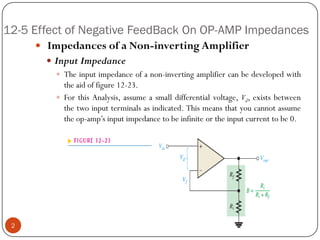
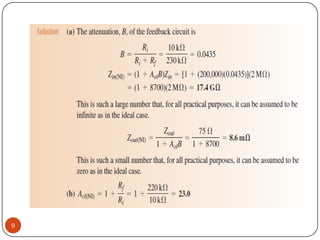
Theinputimpedanceofanon-invertingamplifiercanbedevelopedwiththeaidoffigure12-23. 
ForthisAnalysis,assumeasmalldifferentialvoltage,Vd,existsbetweenthetwoinputterminalsasindicated.Thismeansthatyoucannotassumetheop-amp’sinputimpedancetobeinfiniteortheinputcurrenttobe0. 
2
12-5 Effect of Negative FeedBack On OP-AMP Impedances Continue… 
ImpedancesofaNon-invertingAmplifier 
InputImpedancecontinue… 
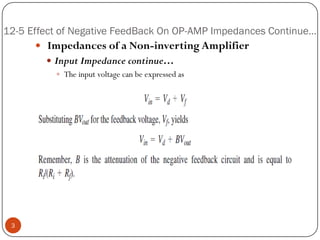
Theinputvoltagecanbeexpressedas3
12-5 Effect of Negative FeedBack On OP-AMP Impedances Continue… 
ImpedancesofaNon-invertingAmplifier 
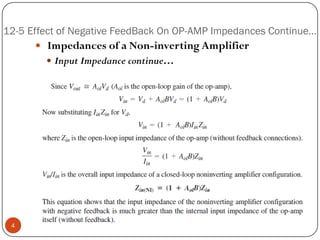
InputImpedancecontinue… 4
12-5 Effect of Negative FeedBack On OP-AMP Impedances Continue… 
ImpedancesofaNon-invertingAmplifier 
OutputImpedance 
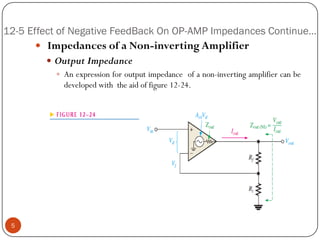
Anexpressionforoutputimpedanceofanon-invertingamplifiercanbedevelopedwiththeaidoffigure12-24. 
5
12-5 Effect of Negative FeedBack On OP-AMP Impedances Continue… 
ImpedancesofaNon-invertingAmplifier 
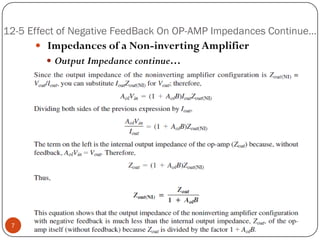
OutputImpedancecontinue… 
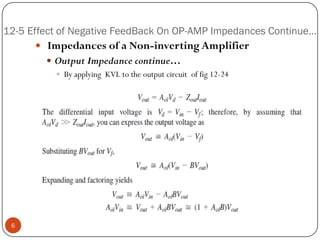
ByapplyingKVLtotheoutputcircuitoffig12-24 
6
12-5 Effect of Negative FeedBack On OP-AMP Impedances Continue… 
ImpedancesofaNon-invertingAmplifier 
OutputImpedancecontinue… 
7
8
9
12-5 Effect of Negative FeedBack On OP-AMP Impedances Continue… 
Voltage-FollowerImpedances 
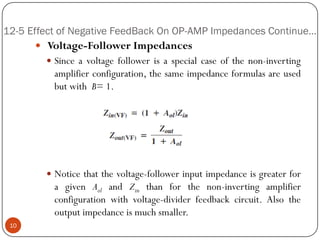
Sinceavoltagefollowerisaspecialcaseofthenon-invertingamplifierconfiguration,thesameimpedanceformulasareusedbutwithB=1. 
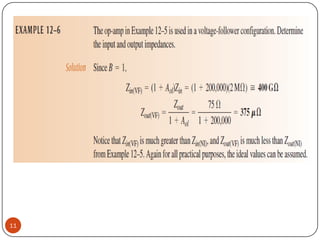
Noticethatthevoltage-followerinputimpedanceisgreaterforagivenAolandZinthanforthenon-invertingamplifierconfigurationwithvoltage-dividerfeedbackcircuit.Alsotheoutputimpedanceismuchsmaller. 10
11
12-5 Effect of Negative FeedBack On OP-AMP Impedances Continue… 
ImpedancesofanInvertingAmplifier 
InputImpedance 
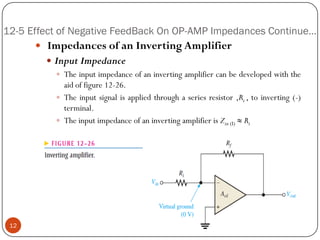
Theinputimpedanceofaninvertingamplifiercanbedevelopedwiththeaidoffigure12-26. 
Theinputsignalisappliedthroughaseriesresistor,Ri,toinverting(-) terminal. 
TheinputimpedanceofaninvertingamplifierisZin(I)≈Ri12
12-5 Effect of Negative FeedBack On OP-AMP Impedances Continue… 
ImpedancesofanInvertingAmplifier 
OutputImpedance 
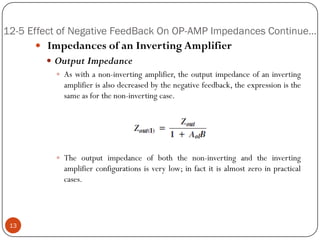
Aswithanon-invertingamplifier,theoutputimpedanceofaninvertingamplifierisalsodecreasedbythenegativefeedback,theexpressionisthesameasforthenon-invertingcase. 
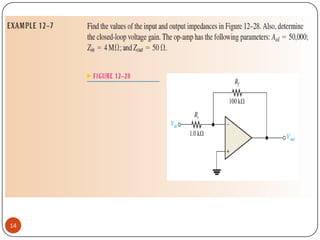
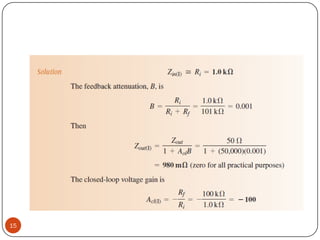
Theoutputimpedanceofboththenon-invertingandtheinvertingamplifierconfigurationsisverylow;infactitisalmostzeroinpracticalcases. 13
14
15
12-6 Bias Current and Offset Voltage 
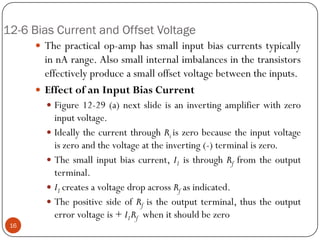
Thepracticalop-amphassmallinputbiascurrentstypicallyinnArange.Alsosmallinternalimbalancesinthetransistorseffectivelyproduceasmalloffsetvoltagebetweentheinputs. 
EffectofanInputBiasCurrent 
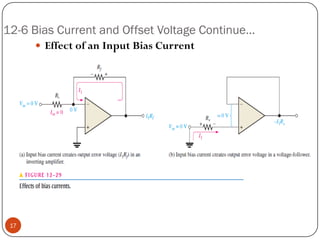
Figure12-29(a)nextslideisaninvertingamplifierwithzeroinputvoltage. 
IdeallythecurrentthroughRiiszerobecausetheinputvoltageiszeroandthevoltageattheinverting(-)terminaliszero. 
Thesmallinputbiascurrent,I1isthroughRffromtheoutputterminal. 
I1createsavoltagedropacrossRfasindicated. 
ThepositivesideofRfistheoutputterminal,thustheoutputerrorvoltageis+I1Rfwhenitshouldbezero16
12-6 Bias Current and Offset Voltage Continue… 
EffectofanInputBiasCurrent17
12-6 Bias Current and Offset Voltage Continue… 
EffectofanInputBiasCurrent 
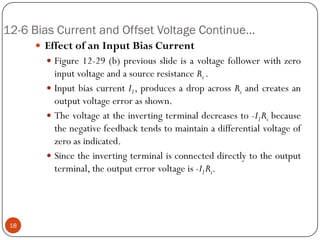
Figure12-29(b)previousslideisavoltagefollowerwithzeroinputvoltageandasourceresistanceRs. 
InputbiascurrentI1,producesadropacrossRsandcreatesanoutputvoltageerrorasshown. 
Thevoltageattheinvertingterminaldecreasesto-I1Rsbecausethenegativefeedbacktendstomaintainadifferentialvoltageofzeroasindicated. 
Sincetheinvertingterminalisconnecteddirectlytotheoutputterminal,theoutputerrorvoltageis-I1Rs. 18
12-6 Bias Current and Offset Voltage Continue… 
EffectofanInputBiasCurrent 
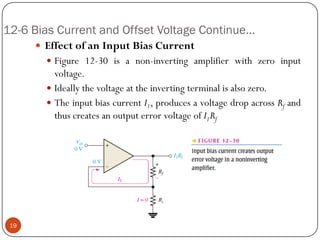
Figure12-30isanon-invertingamplifierwithzeroinputvoltage. 
Ideallythevoltageattheinvertingterminalisalsozero. 
TheinputbiascurrentI1,producesavoltagedropacrossRfandthuscreatesanoutputerrorvoltageofI1Rf19
12-6 Bias Current and Offset Voltage Continue… 
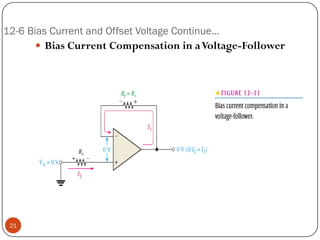
BiasCurrentCompensationinaVoltage-Follower 
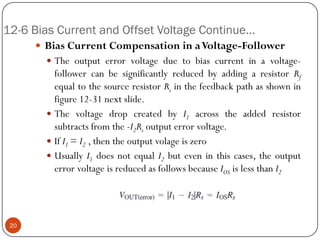
Theoutputerrorvoltageduetobiascurrentinavoltage- followercanbesignificantlyreducedbyaddingaresistorRfequaltothesourceresistorRsinthefeedbackpathasshowninfigure12-31nextslide. 
ThevoltagedropcreatedbyI1acrosstheaddedresistorsubtractsfromthe-I2Rsoutputerrorvoltage. 
IfI1=I2,thentheoutputvolageiszero 
UsuallyI1doesnotequalI2buteveninthiscases,theoutputerrorvoltageisreducedasfollowsbecauseIOSislessthanI220
12-6 Bias Current and Offset Voltage Continue… 
BiasCurrentCompensationinaVoltage-Follower 
21
12-6 Bias Current and Offset Voltage Continue… 
BiasCurrentCompensationinOtherOp-AmpConfigurations 
Practicalop-amphasverysmallfiniteinputbiascurrentsonbothofitsinputs. 
Thesetwobiascurrents(I1andI2)canproduceasmalldcoutputvoltage(VOUT(error))evenwhentheinputvoltageiszero. 
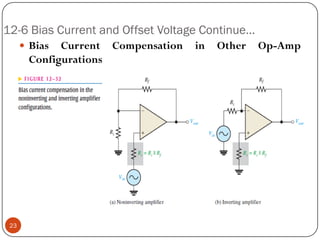
TheeasiestwaytominimizethisproblemisbyincludingacompensatingresistorRcinserieswiththenon-invertinginputofanon-invertingamplifierasshowninfigure12-32(a)nextslide. 
ThecompensatingresistorRcvalueequalstheparallelcombinationofRiandRf. 
RcProvideshighinputimpedancewhichwillsignificantlyreducethemagnitudesofbiascurrents. 
Theinvertingamplifierissimilarlycompensatedshownin12-32(b)22
12-6 Bias Current and Offset Voltage Continue… 
BiasCurrentCompensationinOtherOp-AmpConfigurations23
12-6 Bias Current and Offset Voltage Continue… 
EffectofInputOffsetVoltage 
InputOffsetVoltageCompensation 
HOMEREADINGASSIGNMENT24
12-7 Open-Loop Response 
Inthissection,wewilllearnabouttheopen-loopfrequencyresponseandtheopen-loopphaseresponseofanop-amp. 
Open-loopresponsesrelatetoanop-ampwithnoexternalfeedback. 
Thefrequencyresponseindicateshowthevoltagegainchangeswithfrequency. 
Thephaseresponseindicateshowthephaseshiftbetweentheinputandoutputsignalchangeswithfrequency. 
Theopen-loopgain,liketheβofatransistor,variesgreatlyfromonedevicetothenextofthesametypeandcannotbedependentupontohaveaconstantvalue. 
25
12-7 Open-Loop Response Continue… 
VoltageGainisFrequencyDependent 
Previously,allofthevoltagegainexpressionswerebasedonthemidrangegainandwereconsideredindependentofthefrequency. 
Themidrangeopen-loopgainofanop-ampextendsfromzerofrequencyuptoacriticalfrequencyatwhichthegainis3dBlessthanthemidrangevalue. 
Op-Amparedcamplifiers(nocouplingcapacitorsbetweenstages), andthereforenolowercriticalfrequency. 
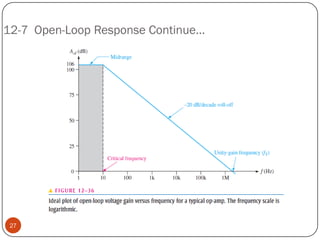
Anopen-loopresponsecurve(BodePlot)foracertainamplifierisshowninfigure12-36nextslide. 
Noticethatthecurverollsoff(decrease)at-20dBperdecade(-6dBperoctave). 
Themidrangegainis200,000,whichis106dBandthecritical(cutoff)frequencyisapproximately10Hz. 
26
12-7 Open-Loop Response Continue… 
27
12-7 Open-Loop Response Continue… 
3dBOpen-LoopBandwidth 
GenerallytheB.Wequalstheuppercriticalfrequencyminusthelowercriticalfrequency. 
BW=fcu-fcl 
Sincefclforanop-ampiszero,theB.Wissimplyequaltotheuppercriticalfrequency. 
BW=fcu 
Fromnowon,wewillrefertofcuassimplyfc;andwewilluseopen- loop(ol)orclosed-loop(cl)subscriptdesignators,forexample,fc(ol). 28
12-7 Open-Loop Response Continue… 
Unity-GainBandwidth 
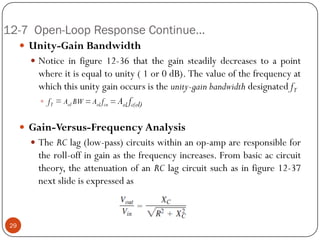
Noticeinfigure12-36thatthegainsteadilydecreasestoapointwhereitisequaltounity(1or0dB).Thevalueofthefrequencyatwhichthisunitygainoccursistheunity-gainbandwidthdesignatedfT 
fT=AolBW=Aolfcu=Aolfc(ol) 
Gain-Versus-FrequencyAnalysis 
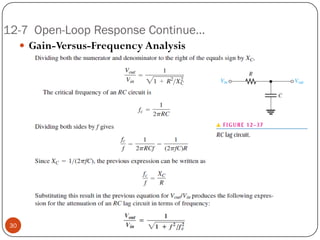
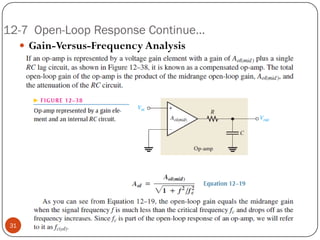
TheRClag(low-pass)circuitswithinanop-ampareresponsiblefortheroll-offingainasthefrequencyincreases.Frombasicaccircuittheory,theattenuationofanRClagcircuitsuchasinfigure12-37nextslideisexpressedas29
12-7 Open-Loop Response Continue… 
Gain-Versus-FrequencyAnalysis 
30
12-7 Open-Loop Response Continue… 
Gain-Versus-FrequencyAnalysis31
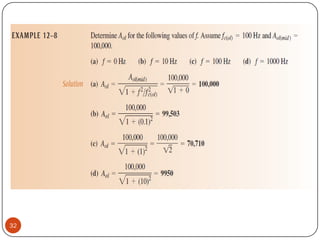
32
12-7 Open-Loop Response Continue… 
PhaseShift 
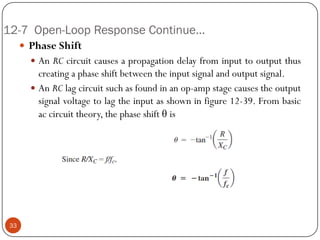
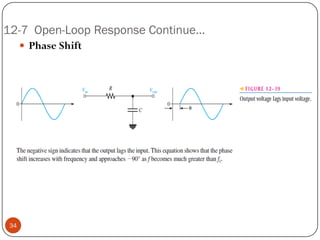
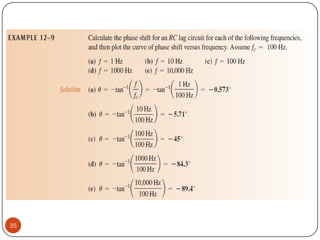
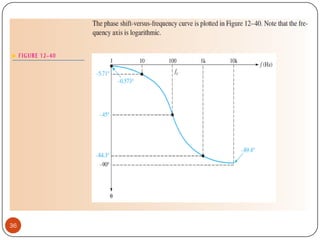
AnRCcircuitcausesapropagationdelayfrominputtooutputthuscreatingaphaseshiftbetweentheinputsignalandoutputsignal. 
AnRClagcircuitsuchasfoundinanop-ampstagecausestheoutputsignalvoltagetolagtheinputasshowninfigure12-39.Frombasicaccircuittheory,thephaseshiftθis33
12-7 Open-Loop Response Continue… 
PhaseShift34
35
36
12-7 Open-Loop Response Continue… 
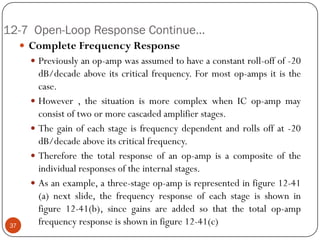
CompleteFrequencyResponse 
Previouslyanop-ampwasassumedtohaveaconstantroll-offof-20dB/decadeaboveitscriticalfrequency.Formostop-ampsitisthecase. 
However,thesituationismorecomplexwhenICop-ampmayconsistoftwoormorecascadedamplifierstages. 
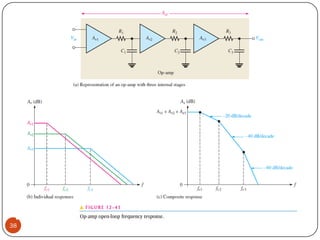
Thegainofeachstageisfrequencydependentandrollsoffat-20dB/decadeaboveitscriticalfrequency. 
Thereforethetotalresponseofanop-ampisacompositeoftheindividualresponsesoftheinternalstages. 
Asanexample,athree-stageop-ampisrepresentedinfigure12-41(a)nextslide,thefrequencyresponseofeachstageisshowninfigure12-41(b),sincegainsareaddedsothatthetotalop-ampfrequencyresponseisshowninfigure12-41(c)37
38
12-7 Open-Loop Response Continue… 
CompletePhaseResponse 
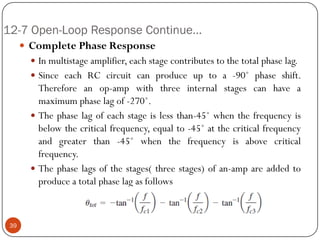
Inmultistageamplifier,eachstagecontributestothetotalphaselag. 
SinceeachRCcircuitcanproduceuptoa-90˚phaseshift. Thereforeanop-ampwiththreeinternalstagescanhaveamaximumphaselagof-270˚. 
Thephaselagofeachstageislessthan-45˚whenthefrequencyisbelowthecriticalfrequency,equalto-45˚atthecriticalfrequencyandgreaterthan-45˚whenthefrequencyisabovecriticalfrequency. 
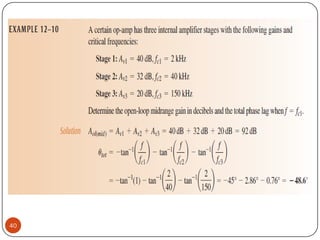
Thephaselagsofthestages(threestages)ofan-ampareaddedtoproduceatotalphaselagasfollows39
40
12-8 Closed-Loop Response 
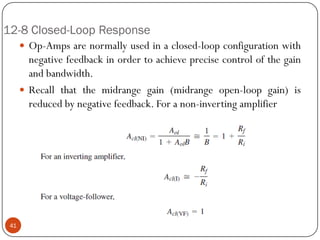
Op-Ampsarenormallyusedinaclosed-loopconfigurationwithnegativefeedbackinordertoachieveprecisecontrolofthegainandbandwidth. 
Recallthatthemidrangegain(midrangeopen-loopgain)isreducedbynegativefeedback.Foranon-invertingamplifier41
12-8 Closed-Loop Response Continue… 
EffectofNegativeFeedbackonBandwidth 
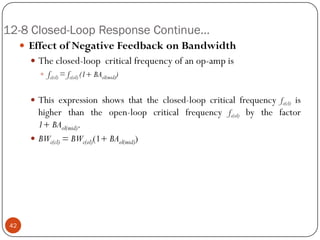
Theclosed-loopcriticalfrequencyofanop-ampis 
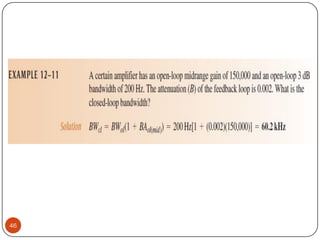
fc(cl)=fc(ol)(1+BAol(mid)) 
Thisexpressionshowsthattheclosed-loopcriticalfrequencyfc(cl)ishigherthantheopen-loopcriticalfrequencyfc(ol)bythefactor1+BAol(mid). 
BWc(cl)=BWc(ol)(1+BAol(mid)) 42
12-8 Closed-Loop Response Continue… 
EffectofNegativeFeedbackonBandwidth 
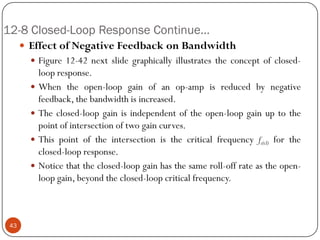
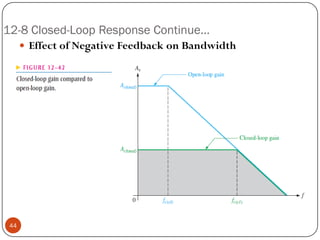
Figure12-42nextslidegraphicallyillustratestheconceptofclosed- loopresponse. 
Whentheopen-loopgainofanop-ampisreducedbynegativefeedback,thebandwidthisincreased. 
Theclosed-loopgainisindependentoftheopen-loopgainuptothepointofintersectionoftwogaincurves. 
Thispointoftheintersectionisthecriticalfrequencyfc(cl)fortheclosed-loopresponse. 
Noticethattheclosed-loopgainhasthesameroll-offrateastheopen- loopgain,beyondtheclosed-loopcriticalfrequency. 43
12-8 Closed-Loop Response Continue… 
EffectofNegativeFeedbackonBandwidth44
12-8 Closed-Loop Response Continue… 
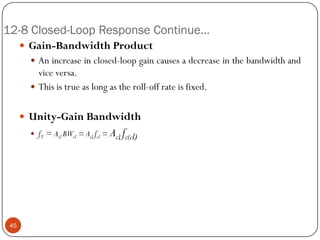
Gain-BandwidthProduct 
Anincreaseinclosed-loopgaincausesadecreaseinthebandwidthandviceversa. 
Thisistrueaslongastheroll-offrateisfixed. 
Unity-GainBandwidth 
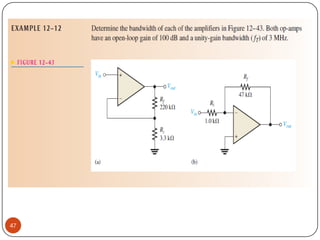
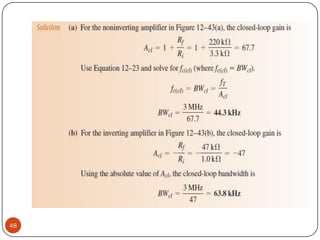
fT=AclBWcl=Aclfcl=Aclfc(cl) 45
46
47
48

The operational amplifier (part 2)

  • 1.
    Engr.Tehseen Ahsan Lecturer,Electrical Engineering Department EE-307 Electronic Systems Design HITEC University Taxila Cantt, Pakistan The Operational Amplifier (Part 2)
  • 2.
    12-5 Effect ofNegative FeedBack On OP-AMP Impedances ImpedancesofaNon-invertingAmplifier InputImpedance Theinputimpedanceofanon-invertingamplifiercanbedevelopedwiththeaidoffigure12-23. ForthisAnalysis,assumeasmalldifferentialvoltage,Vd,existsbetweenthetwoinputterminalsasindicated.Thismeansthatyoucannotassumetheop-amp’sinputimpedancetobeinfiniteortheinputcurrenttobe0. 2
  • 3.
    12-5 Effect ofNegative FeedBack On OP-AMP Impedances Continue… ImpedancesofaNon-invertingAmplifier InputImpedancecontinue… Theinputvoltagecanbeexpressedas3
  • 4.
    12-5 Effect ofNegative FeedBack On OP-AMP Impedances Continue… ImpedancesofaNon-invertingAmplifier InputImpedancecontinue… 4
  • 5.
    12-5 Effect ofNegative FeedBack On OP-AMP Impedances Continue… ImpedancesofaNon-invertingAmplifier OutputImpedance Anexpressionforoutputimpedanceofanon-invertingamplifiercanbedevelopedwiththeaidoffigure12-24. 5
  • 6.
    12-5 Effect ofNegative FeedBack On OP-AMP Impedances Continue… ImpedancesofaNon-invertingAmplifier OutputImpedancecontinue… ByapplyingKVLtotheoutputcircuitoffig12-24 6
  • 7.
    12-5 Effect ofNegative FeedBack On OP-AMP Impedances Continue… ImpedancesofaNon-invertingAmplifier OutputImpedancecontinue… 7
  • 8.
  • 9.
  • 10.
    12-5 Effect ofNegative FeedBack On OP-AMP Impedances Continue… Voltage-FollowerImpedances Sinceavoltagefollowerisaspecialcaseofthenon-invertingamplifierconfiguration,thesameimpedanceformulasareusedbutwithB=1. Noticethatthevoltage-followerinputimpedanceisgreaterforagivenAolandZinthanforthenon-invertingamplifierconfigurationwithvoltage-dividerfeedbackcircuit.Alsotheoutputimpedanceismuchsmaller. 10
  • 11.
  • 12.
    12-5 Effect ofNegative FeedBack On OP-AMP Impedances Continue… ImpedancesofanInvertingAmplifier InputImpedance Theinputimpedanceofaninvertingamplifiercanbedevelopedwiththeaidoffigure12-26. Theinputsignalisappliedthroughaseriesresistor,Ri,toinverting(-) terminal. TheinputimpedanceofaninvertingamplifierisZin(I)≈Ri12
  • 13.
    12-5 Effect ofNegative FeedBack On OP-AMP Impedances Continue… ImpedancesofanInvertingAmplifier OutputImpedance Aswithanon-invertingamplifier,theoutputimpedanceofaninvertingamplifierisalsodecreasedbythenegativefeedback,theexpressionisthesameasforthenon-invertingcase. Theoutputimpedanceofboththenon-invertingandtheinvertingamplifierconfigurationsisverylow;infactitisalmostzeroinpracticalcases. 13
  • 14.
  • 15.
  • 16.
    12-6 Bias Currentand Offset Voltage Thepracticalop-amphassmallinputbiascurrentstypicallyinnArange.Alsosmallinternalimbalancesinthetransistorseffectivelyproduceasmalloffsetvoltagebetweentheinputs. EffectofanInputBiasCurrent Figure12-29(a)nextslideisaninvertingamplifierwithzeroinputvoltage. IdeallythecurrentthroughRiiszerobecausetheinputvoltageiszeroandthevoltageattheinverting(-)terminaliszero. Thesmallinputbiascurrent,I1isthroughRffromtheoutputterminal. I1createsavoltagedropacrossRfasindicated. ThepositivesideofRfistheoutputterminal,thustheoutputerrorvoltageis+I1Rfwhenitshouldbezero16
  • 17.
    12-6 Bias Currentand Offset Voltage Continue… EffectofanInputBiasCurrent17
  • 18.
    12-6 Bias Currentand Offset Voltage Continue… EffectofanInputBiasCurrent Figure12-29(b)previousslideisavoltagefollowerwithzeroinputvoltageandasourceresistanceRs. InputbiascurrentI1,producesadropacrossRsandcreatesanoutputvoltageerrorasshown. Thevoltageattheinvertingterminaldecreasesto-I1Rsbecausethenegativefeedbacktendstomaintainadifferentialvoltageofzeroasindicated. Sincetheinvertingterminalisconnecteddirectlytotheoutputterminal,theoutputerrorvoltageis-I1Rs. 18
  • 19.
    12-6 Bias Currentand Offset Voltage Continue… EffectofanInputBiasCurrent Figure12-30isanon-invertingamplifierwithzeroinputvoltage. Ideallythevoltageattheinvertingterminalisalsozero. TheinputbiascurrentI1,producesavoltagedropacrossRfandthuscreatesanoutputerrorvoltageofI1Rf19
  • 20.
    12-6 Bias Currentand Offset Voltage Continue… BiasCurrentCompensationinaVoltage-Follower Theoutputerrorvoltageduetobiascurrentinavoltage- followercanbesignificantlyreducedbyaddingaresistorRfequaltothesourceresistorRsinthefeedbackpathasshowninfigure12-31nextslide. ThevoltagedropcreatedbyI1acrosstheaddedresistorsubtractsfromthe-I2Rsoutputerrorvoltage. IfI1=I2,thentheoutputvolageiszero UsuallyI1doesnotequalI2buteveninthiscases,theoutputerrorvoltageisreducedasfollowsbecauseIOSislessthanI220
  • 21.
    12-6 Bias Currentand Offset Voltage Continue… BiasCurrentCompensationinaVoltage-Follower 21
  • 22.
    12-6 Bias Currentand Offset Voltage Continue… BiasCurrentCompensationinOtherOp-AmpConfigurations Practicalop-amphasverysmallfiniteinputbiascurrentsonbothofitsinputs. Thesetwobiascurrents(I1andI2)canproduceasmalldcoutputvoltage(VOUT(error))evenwhentheinputvoltageiszero. TheeasiestwaytominimizethisproblemisbyincludingacompensatingresistorRcinserieswiththenon-invertinginputofanon-invertingamplifierasshowninfigure12-32(a)nextslide. ThecompensatingresistorRcvalueequalstheparallelcombinationofRiandRf. RcProvideshighinputimpedancewhichwillsignificantlyreducethemagnitudesofbiascurrents. Theinvertingamplifierissimilarlycompensatedshownin12-32(b)22
  • 23.
    12-6 Bias Currentand Offset Voltage Continue… BiasCurrentCompensationinOtherOp-AmpConfigurations23
  • 24.
    12-6 Bias Currentand Offset Voltage Continue… EffectofInputOffsetVoltage InputOffsetVoltageCompensation HOMEREADINGASSIGNMENT24
  • 25.
    12-7 Open-Loop Response Inthissection,wewilllearnabouttheopen-loopfrequencyresponseandtheopen-loopphaseresponseofanop-amp. Open-loopresponsesrelatetoanop-ampwithnoexternalfeedback. Thefrequencyresponseindicateshowthevoltagegainchangeswithfrequency. Thephaseresponseindicateshowthephaseshiftbetweentheinputandoutputsignalchangeswithfrequency. Theopen-loopgain,liketheβofatransistor,variesgreatlyfromonedevicetothenextofthesametypeandcannotbedependentupontohaveaconstantvalue. 25
  • 26.
    12-7 Open-Loop ResponseContinue… VoltageGainisFrequencyDependent Previously,allofthevoltagegainexpressionswerebasedonthemidrangegainandwereconsideredindependentofthefrequency. Themidrangeopen-loopgainofanop-ampextendsfromzerofrequencyuptoacriticalfrequencyatwhichthegainis3dBlessthanthemidrangevalue. Op-Amparedcamplifiers(nocouplingcapacitorsbetweenstages), andthereforenolowercriticalfrequency. Anopen-loopresponsecurve(BodePlot)foracertainamplifierisshowninfigure12-36nextslide. Noticethatthecurverollsoff(decrease)at-20dBperdecade(-6dBperoctave). Themidrangegainis200,000,whichis106dBandthecritical(cutoff)frequencyisapproximately10Hz. 26
  • 27.
  • 28.
    12-7 Open-Loop ResponseContinue… 3dBOpen-LoopBandwidth GenerallytheB.Wequalstheuppercriticalfrequencyminusthelowercriticalfrequency. BW=fcu-fcl Sincefclforanop-ampiszero,theB.Wissimplyequaltotheuppercriticalfrequency. BW=fcu Fromnowon,wewillrefertofcuassimplyfc;andwewilluseopen- loop(ol)orclosed-loop(cl)subscriptdesignators,forexample,fc(ol). 28
  • 29.
    12-7 Open-Loop ResponseContinue… Unity-GainBandwidth Noticeinfigure12-36thatthegainsteadilydecreasestoapointwhereitisequaltounity(1or0dB).Thevalueofthefrequencyatwhichthisunitygainoccursistheunity-gainbandwidthdesignatedfT fT=AolBW=Aolfcu=Aolfc(ol) Gain-Versus-FrequencyAnalysis TheRClag(low-pass)circuitswithinanop-ampareresponsiblefortheroll-offingainasthefrequencyincreases.Frombasicaccircuittheory,theattenuationofanRClagcircuitsuchasinfigure12-37nextslideisexpressedas29
  • 30.
    12-7 Open-Loop ResponseContinue… Gain-Versus-FrequencyAnalysis 30
  • 31.
    12-7 Open-Loop ResponseContinue… Gain-Versus-FrequencyAnalysis31
  • 32.
  • 33.
    12-7 Open-Loop ResponseContinue… PhaseShift AnRCcircuitcausesapropagationdelayfrominputtooutputthuscreatingaphaseshiftbetweentheinputsignalandoutputsignal. AnRClagcircuitsuchasfoundinanop-ampstagecausestheoutputsignalvoltagetolagtheinputasshowninfigure12-39.Frombasicaccircuittheory,thephaseshiftθis33
  • 34.
    12-7 Open-Loop ResponseContinue… PhaseShift34
  • 35.
  • 36.
  • 37.
    12-7 Open-Loop ResponseContinue… CompleteFrequencyResponse Previouslyanop-ampwasassumedtohaveaconstantroll-offof-20dB/decadeaboveitscriticalfrequency.Formostop-ampsitisthecase. However,thesituationismorecomplexwhenICop-ampmayconsistoftwoormorecascadedamplifierstages. Thegainofeachstageisfrequencydependentandrollsoffat-20dB/decadeaboveitscriticalfrequency. Thereforethetotalresponseofanop-ampisacompositeoftheindividualresponsesoftheinternalstages. Asanexample,athree-stageop-ampisrepresentedinfigure12-41(a)nextslide,thefrequencyresponseofeachstageisshowninfigure12-41(b),sincegainsareaddedsothatthetotalop-ampfrequencyresponseisshowninfigure12-41(c)37
  • 38.
  • 39.
    12-7 Open-Loop ResponseContinue… CompletePhaseResponse Inmultistageamplifier,eachstagecontributestothetotalphaselag. SinceeachRCcircuitcanproduceuptoa-90˚phaseshift. Thereforeanop-ampwiththreeinternalstagescanhaveamaximumphaselagof-270˚. Thephaselagofeachstageislessthan-45˚whenthefrequencyisbelowthecriticalfrequency,equalto-45˚atthecriticalfrequencyandgreaterthan-45˚whenthefrequencyisabovecriticalfrequency. Thephaselagsofthestages(threestages)ofan-ampareaddedtoproduceatotalphaselagasfollows39
  • 40.
  • 41.
    12-8 Closed-Loop Response Op-Ampsarenormallyusedinaclosed-loopconfigurationwithnegativefeedbackinordertoachieveprecisecontrolofthegainandbandwidth. Recallthatthemidrangegain(midrangeopen-loopgain)isreducedbynegativefeedback.Foranon-invertingamplifier41
  • 42.
    12-8 Closed-Loop ResponseContinue… EffectofNegativeFeedbackonBandwidth Theclosed-loopcriticalfrequencyofanop-ampis fc(cl)=fc(ol)(1+BAol(mid)) Thisexpressionshowsthattheclosed-loopcriticalfrequencyfc(cl)ishigherthantheopen-loopcriticalfrequencyfc(ol)bythefactor1+BAol(mid). BWc(cl)=BWc(ol)(1+BAol(mid)) 42
  • 43.
    12-8 Closed-Loop ResponseContinue… EffectofNegativeFeedbackonBandwidth Figure12-42nextslidegraphicallyillustratestheconceptofclosed- loopresponse. Whentheopen-loopgainofanop-ampisreducedbynegativefeedback,thebandwidthisincreased. Theclosed-loopgainisindependentoftheopen-loopgainuptothepointofintersectionoftwogaincurves. Thispointoftheintersectionisthecriticalfrequencyfc(cl)fortheclosed-loopresponse. Noticethattheclosed-loopgainhasthesameroll-offrateastheopen- loopgain,beyondtheclosed-loopcriticalfrequency. 43
  • 44.
    12-8 Closed-Loop ResponseContinue… EffectofNegativeFeedbackonBandwidth44
  • 45.
    12-8 Closed-Loop ResponseContinue… Gain-BandwidthProduct Anincreaseinclosed-loopgaincausesadecreaseinthebandwidthandviceversa. Thisistrueaslongastheroll-offrateisfixed. Unity-GainBandwidth fT=AclBWcl=Aclfcl=Aclfc(cl) 45
  • 46.
  • 47.
  • 48.