introduction
Operational Amplifiers
introduction
Introduction
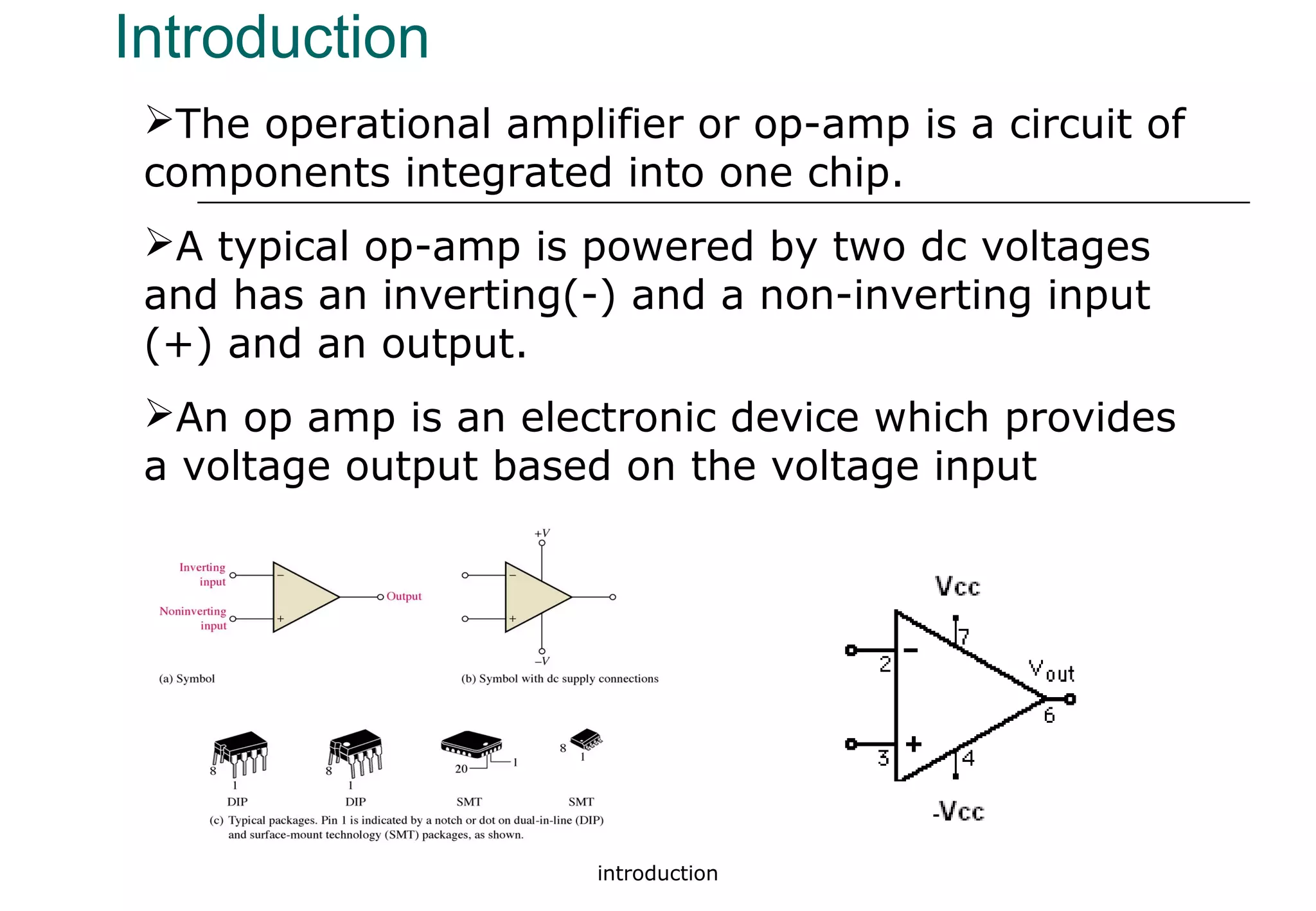
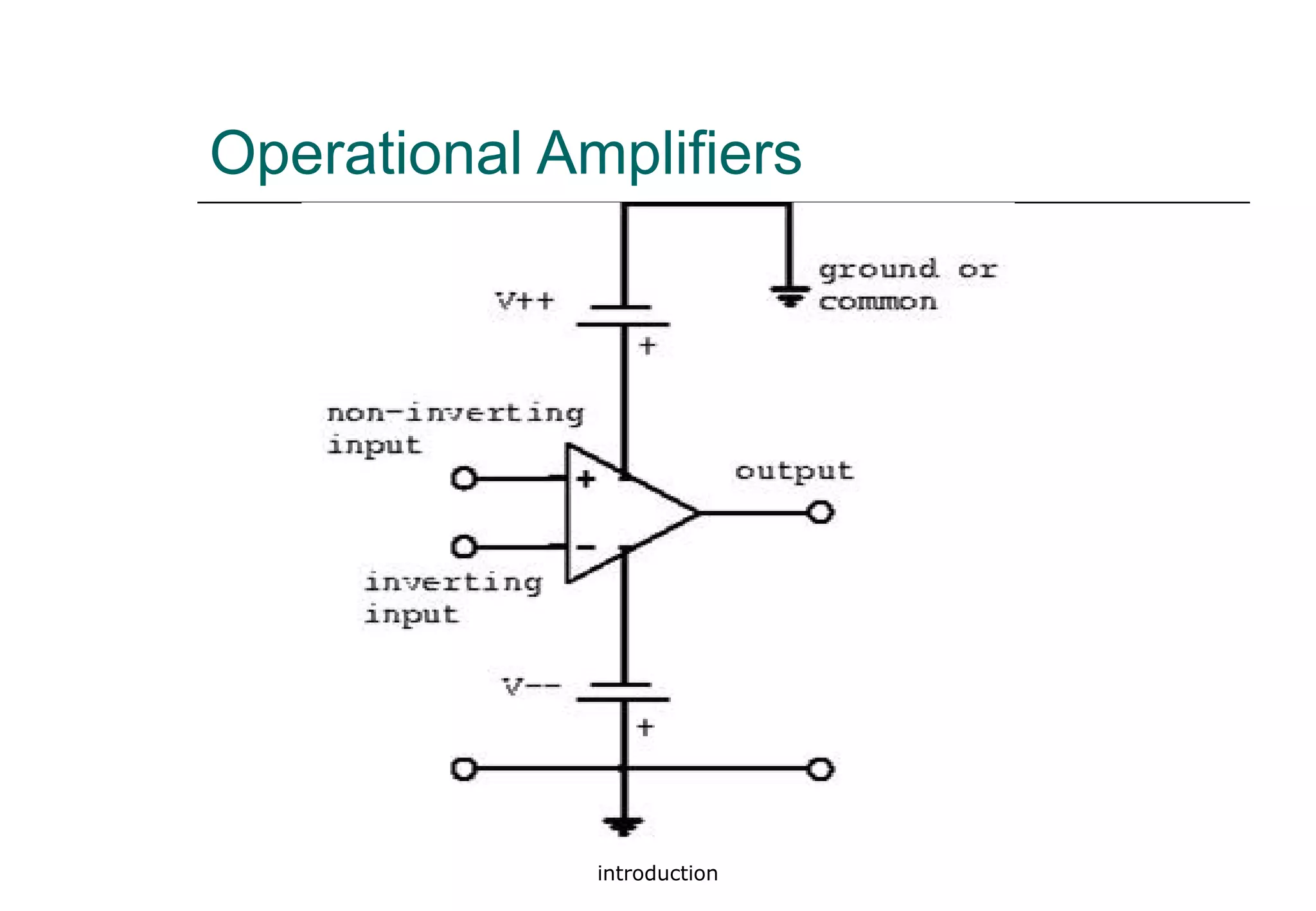
The operational amplifier or op-amp is a circuit of
components integrated into one chip.
A typical op-amp is powered by two dc voltages
and has an inverting(-) and a non-inverting input
(+) and an output.
An op amp is an electronic device which provides
a voltage output based on the voltage input
introduction
Basic op-amp
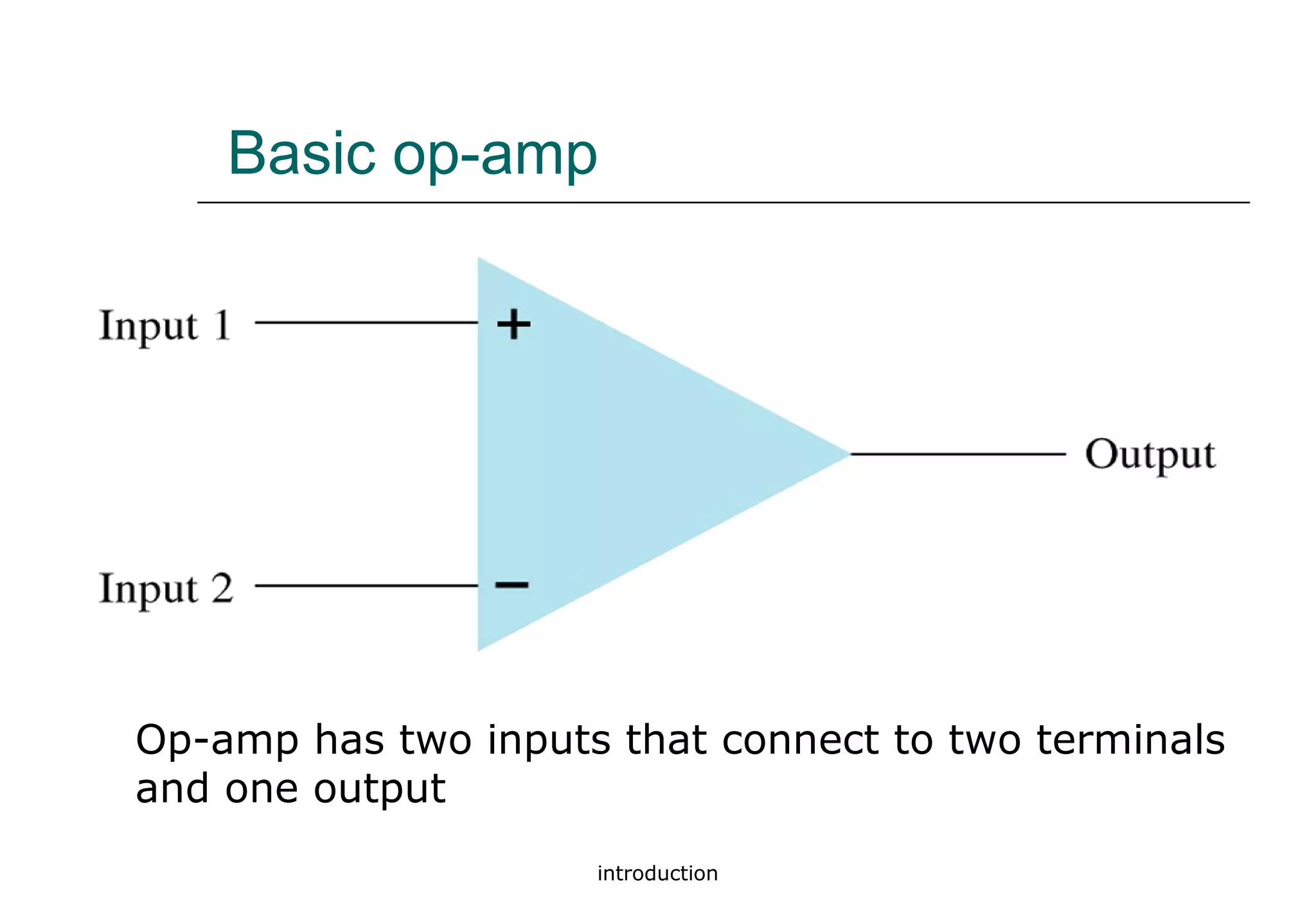
Op-amp has two inputs that connect to two terminals
and one output
introduction
Operational Amplifiers
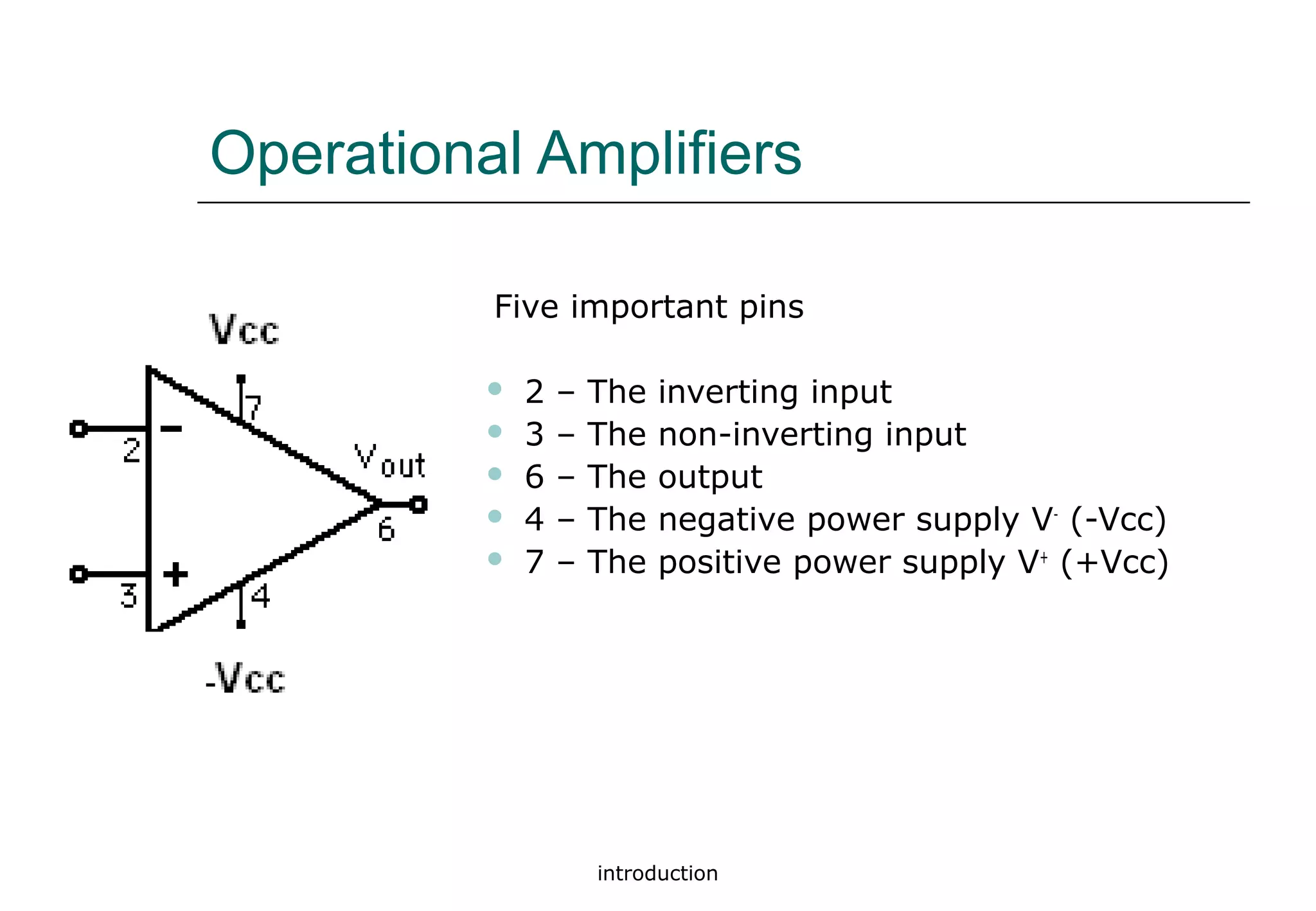
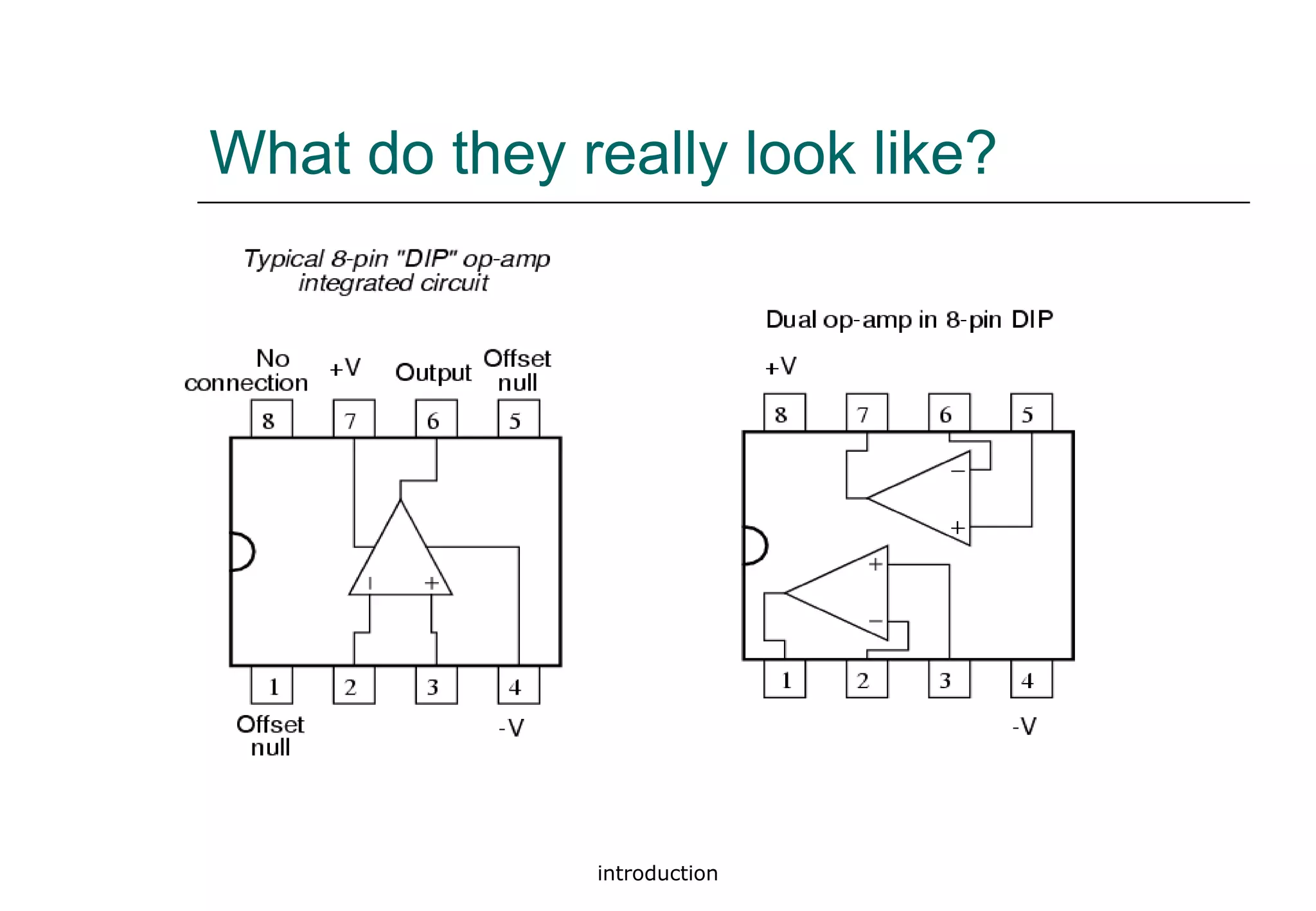
Five important pins
 2 – The inverting input
 3 – The non-inverting input
 6 – The output
 4 – The negative power supply V-
(-Vcc)
 7 – The positive power supply V+
(+Vcc)
introduction
Operational Amplifiers
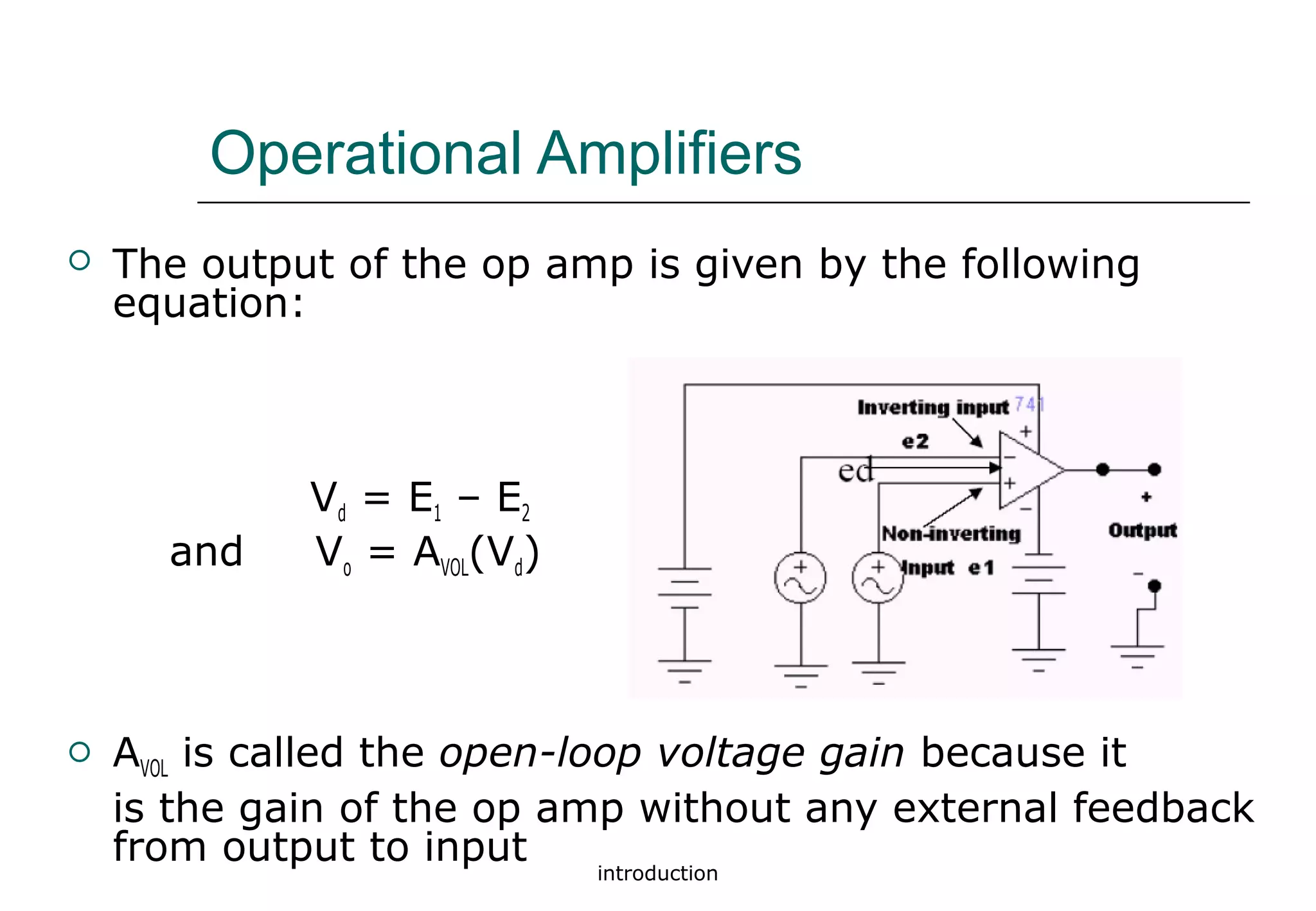
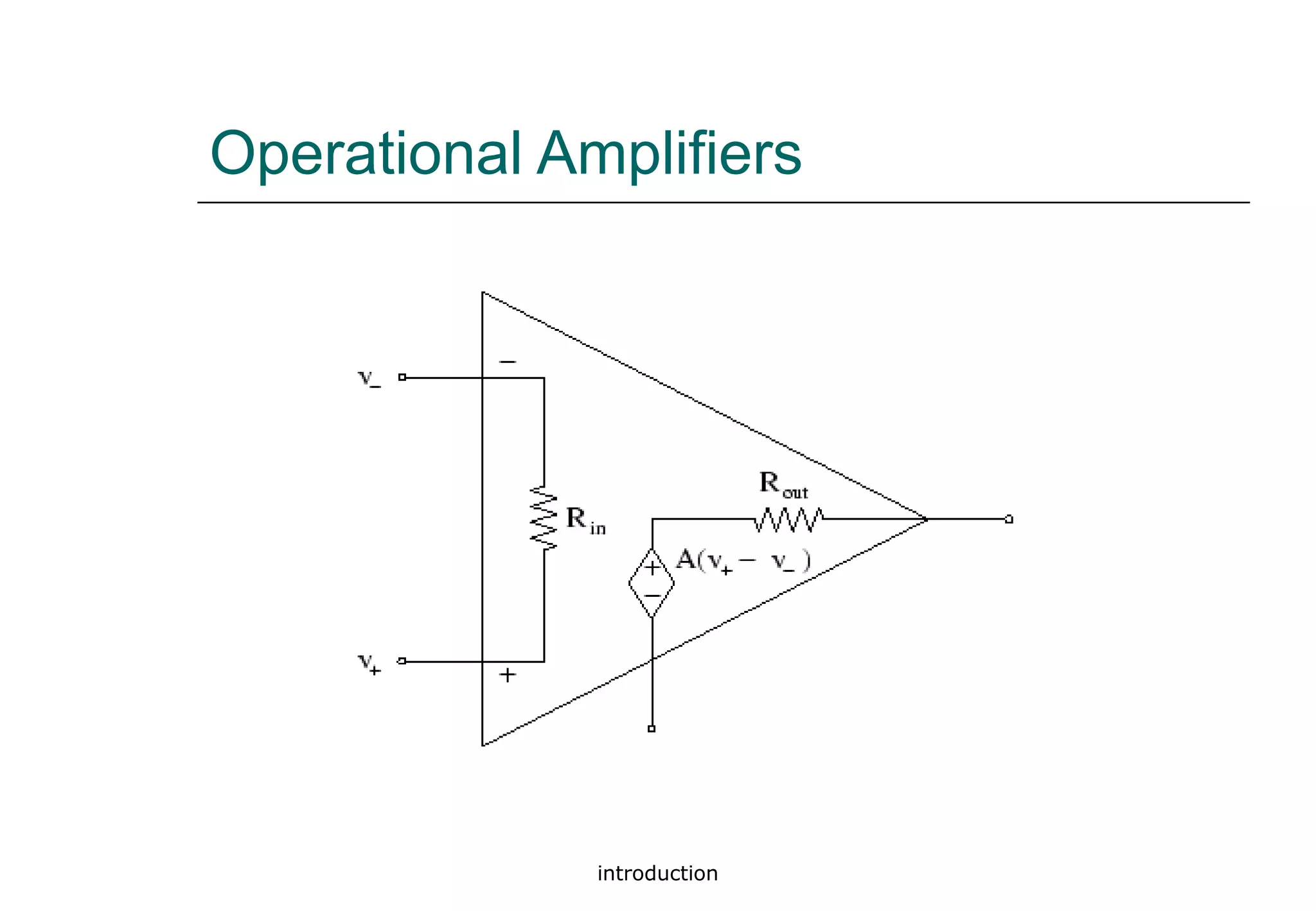
 The output of the op amp is given by the following
equation:
Vd = E1 – E2
and Vo = AVOL(Vd)
 AVOL is called the open-loop voltage gain because it
is the gain of the op amp without any external feedback
from output to input
introduction
Operational Amplifiers
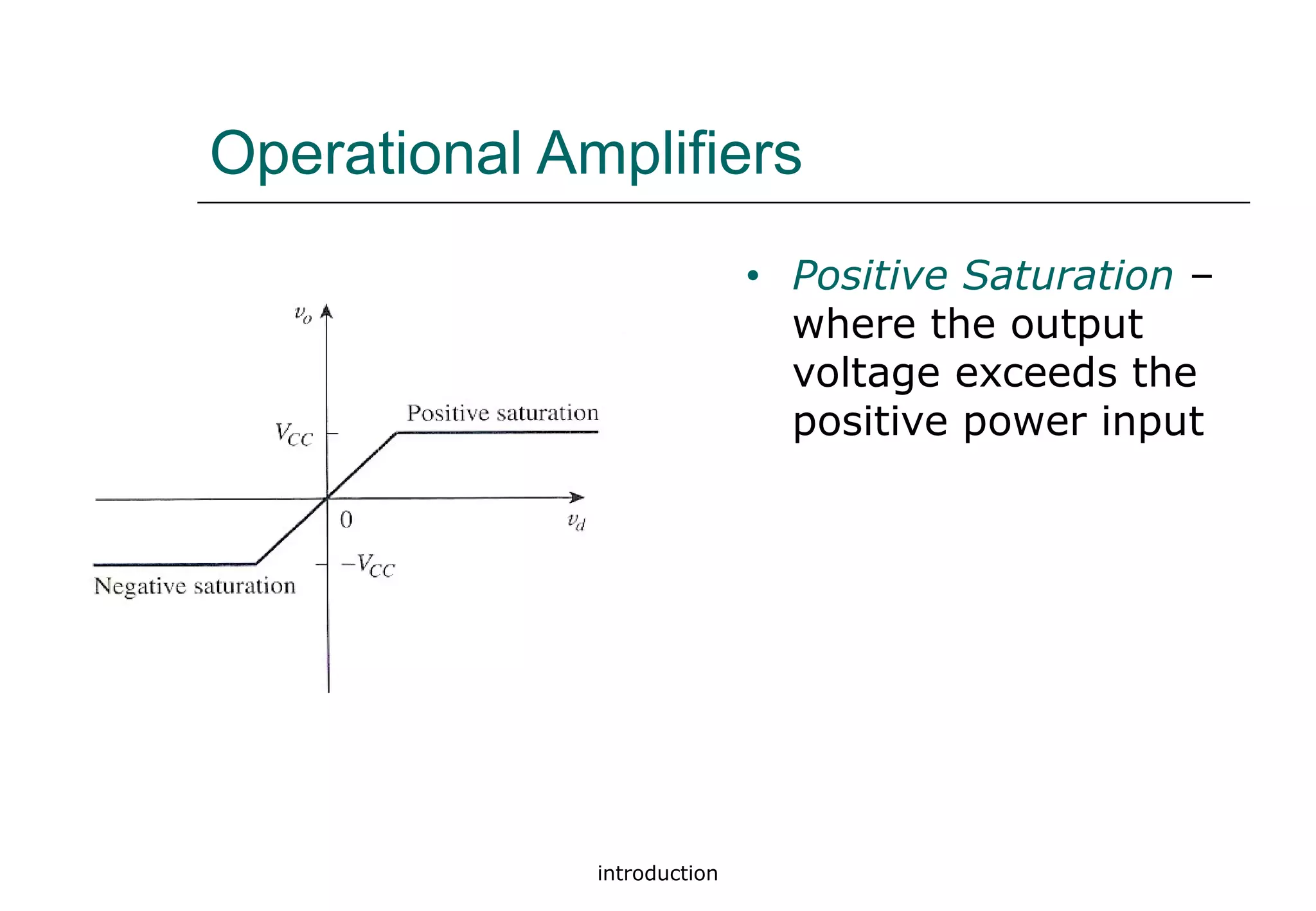
• Positive Saturation –
where the output
voltage exceeds the
positive power input
introduction
Operational Amplifiers
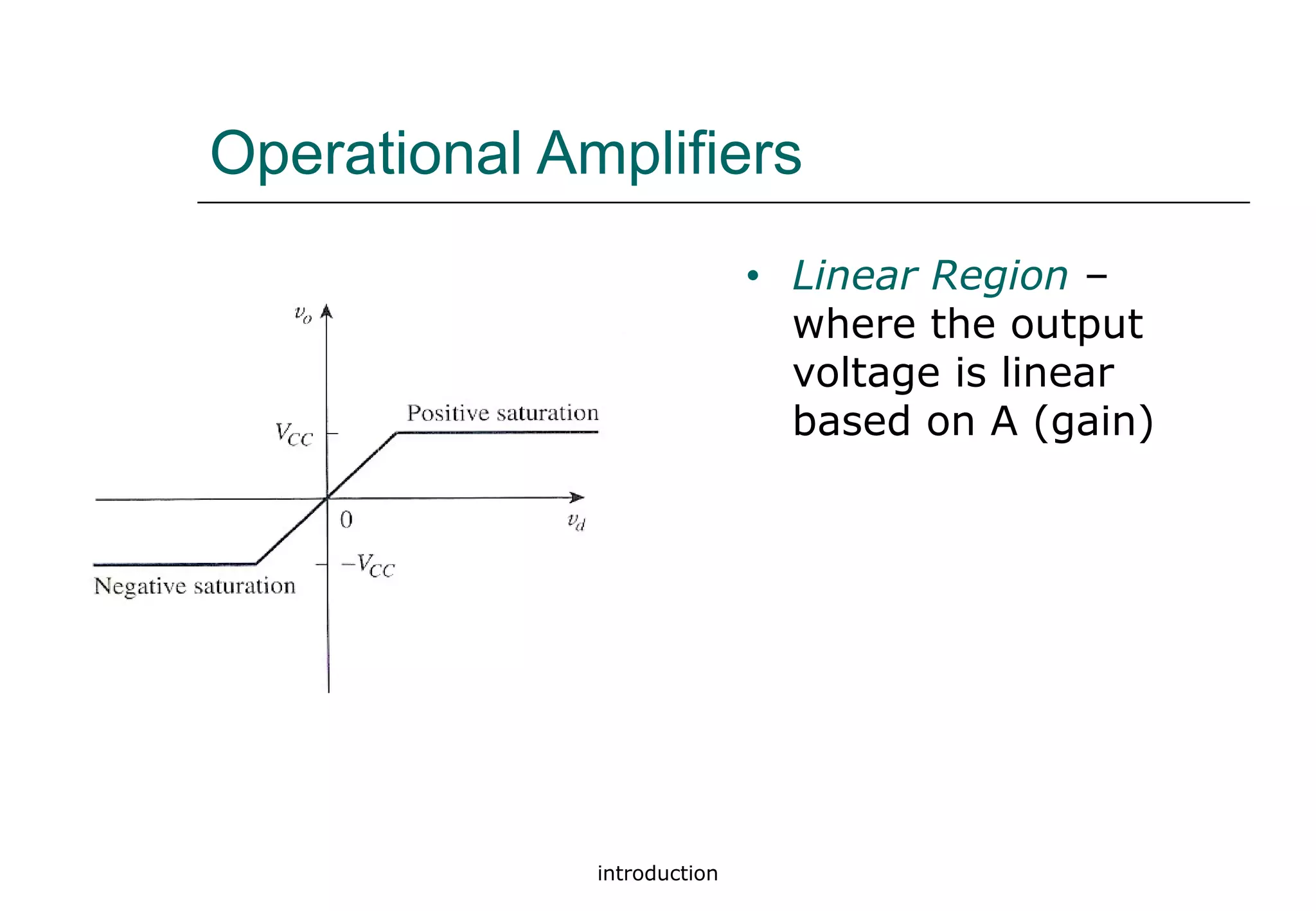
• Linear Region –
where the output
voltage is linear
based on A (gain)
introduction
Operational Amplifiers
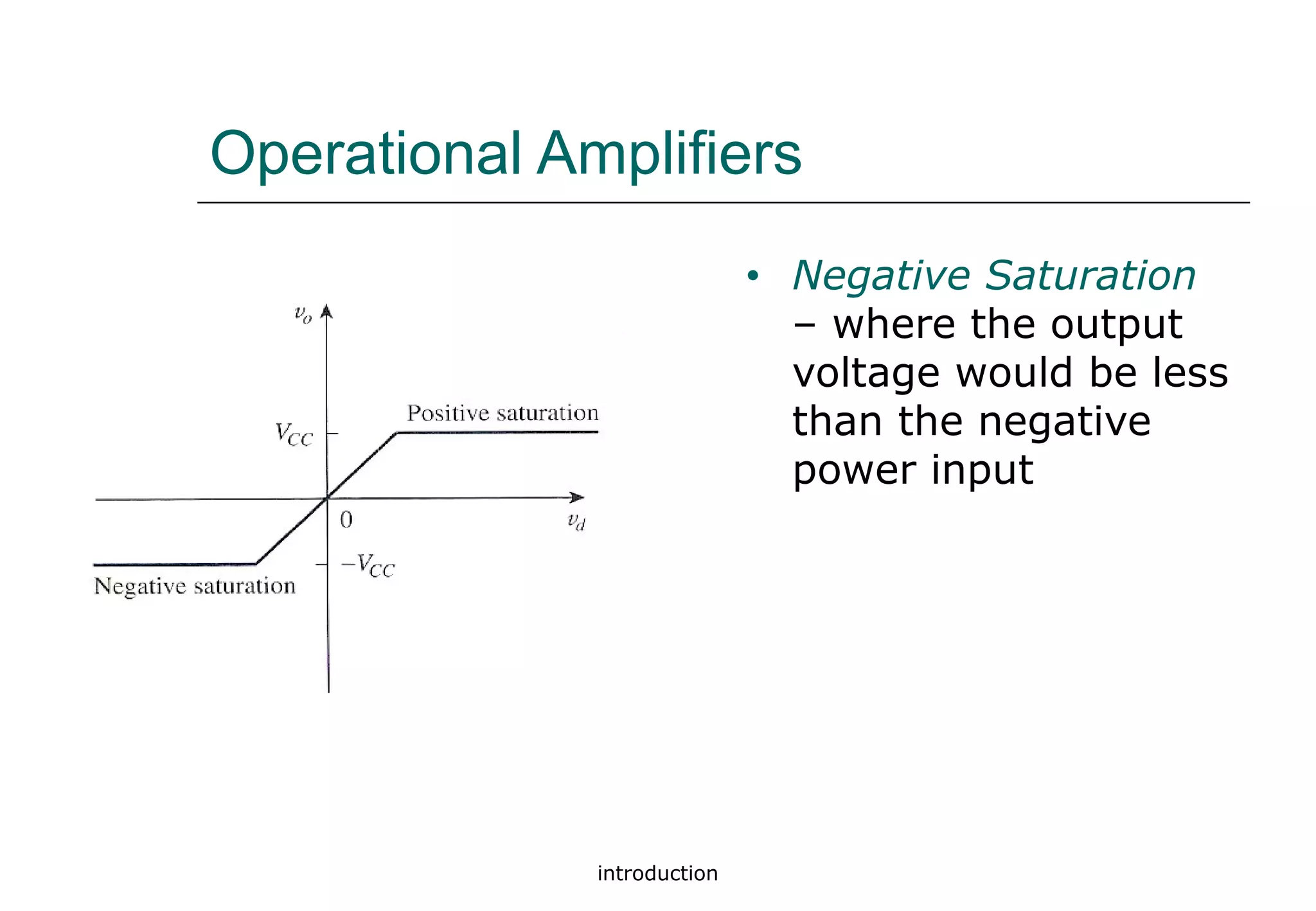
• Negative Saturation
– where the output
voltage would be less
than the negative
power input
introduction
Operational Amplifiers
introduction
What do they really look like?
introduction
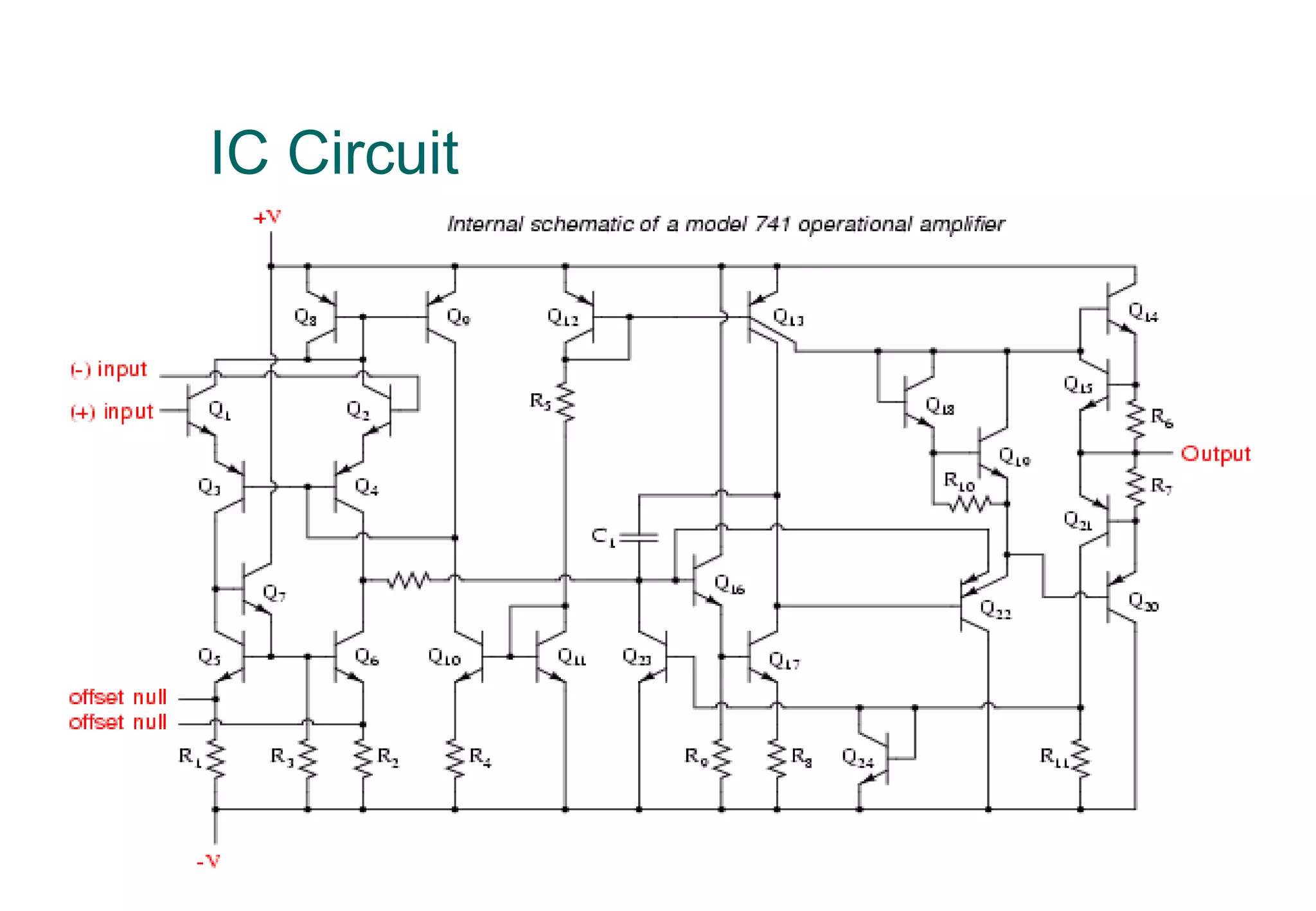
IC Circuit
introduction
Operational Amplifiers
introduction
Operational Amplifiers
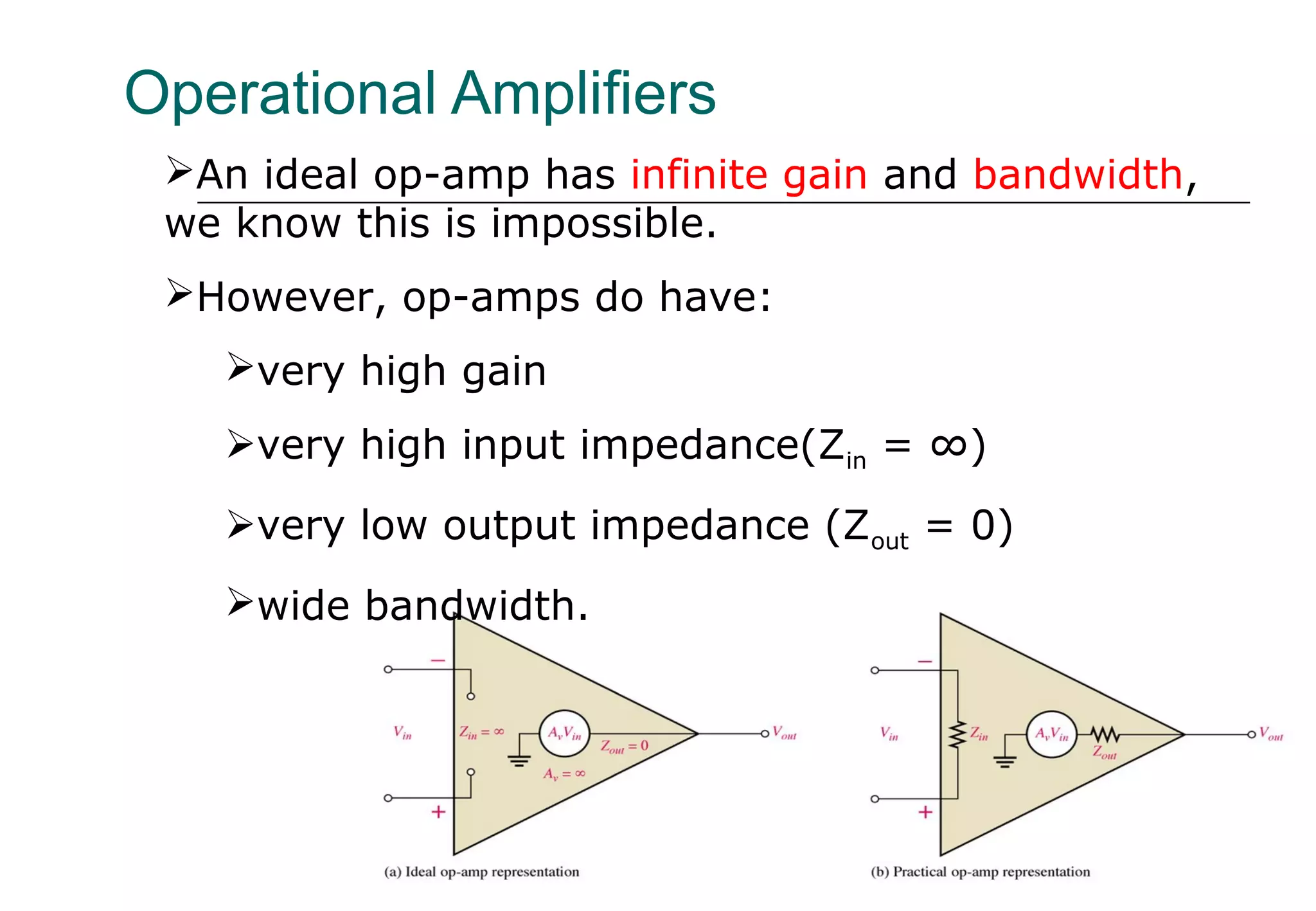
An ideal op-amp has infinite gain and bandwidth,
we know this is impossible.
However, op-amps do have:
very high gain
very high input impedance(Zin = ∞)
very low output impedance (Zout = 0)
wide bandwidth.
application
Application in op-amp
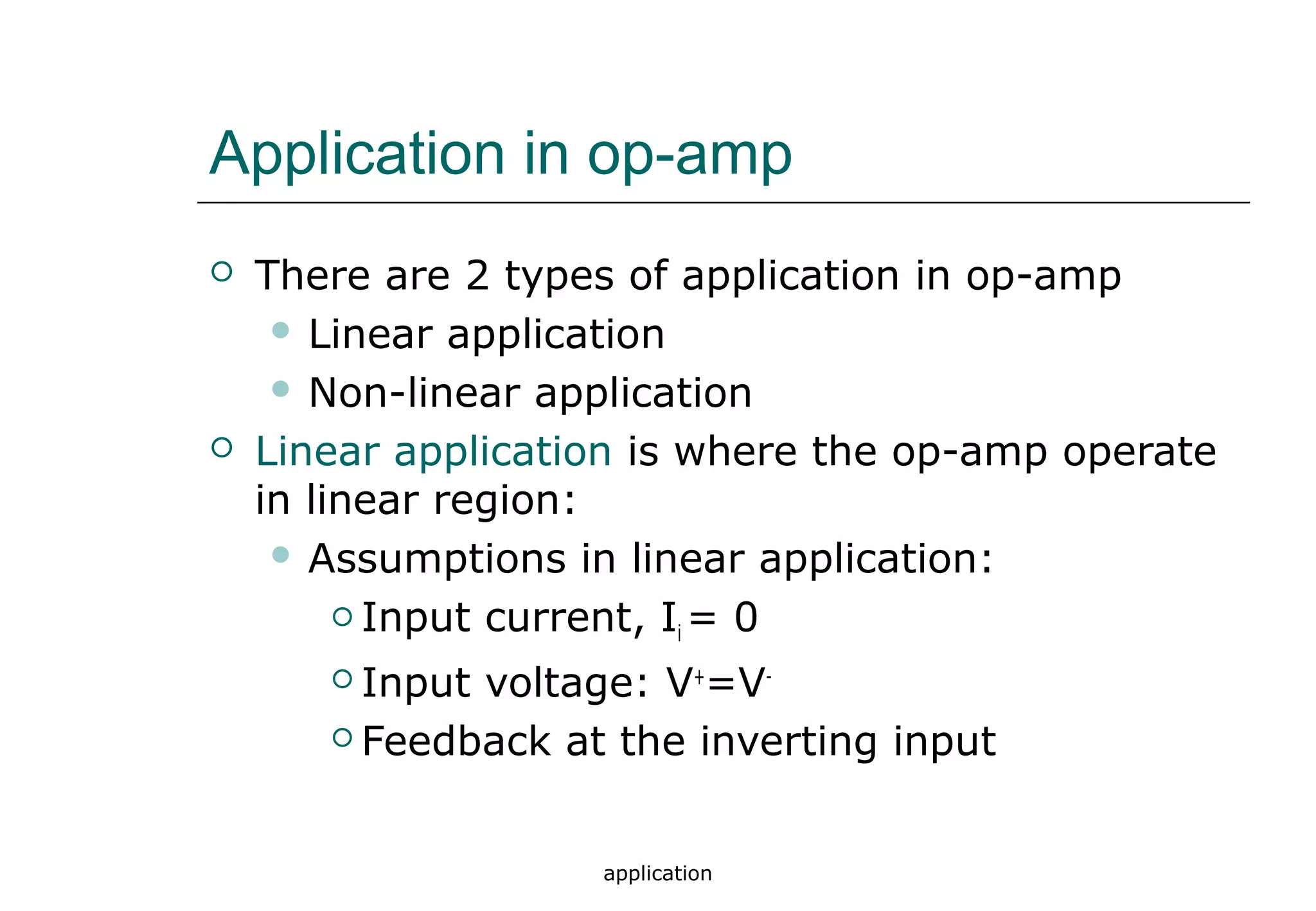
 There are 2 types of application in op-amp
 Linear application
 Non-linear application
 Linear application is where the op-amp operate
in linear region:
 Assumptions in linear application:
 Input current, Ii = 0
 Input voltage: V+
=V-
 Feedback at the inverting input
application
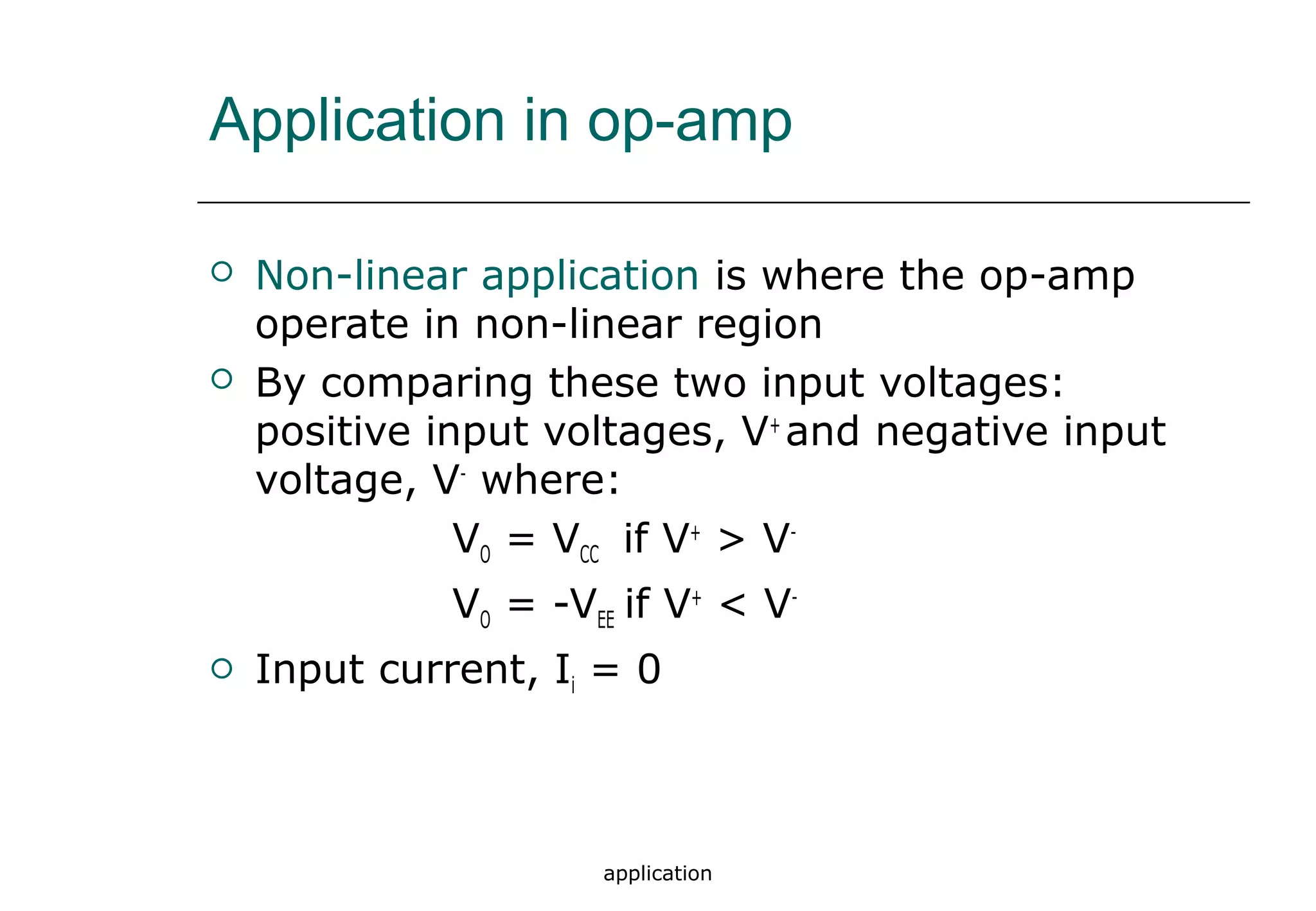
 Non-linear application is where the op-amp
operate in non-linear region
 By comparing these two input voltages:
positive input voltages, V+
and negative input
voltage, V-
where:
VO = VCC if V+
> V-
VO = -VEE if V+
< V-
 Input current, Ii = 0
Application in op-amp
application
Applications of op-amp
 Comparator
 Inverter
 Audio amplifier
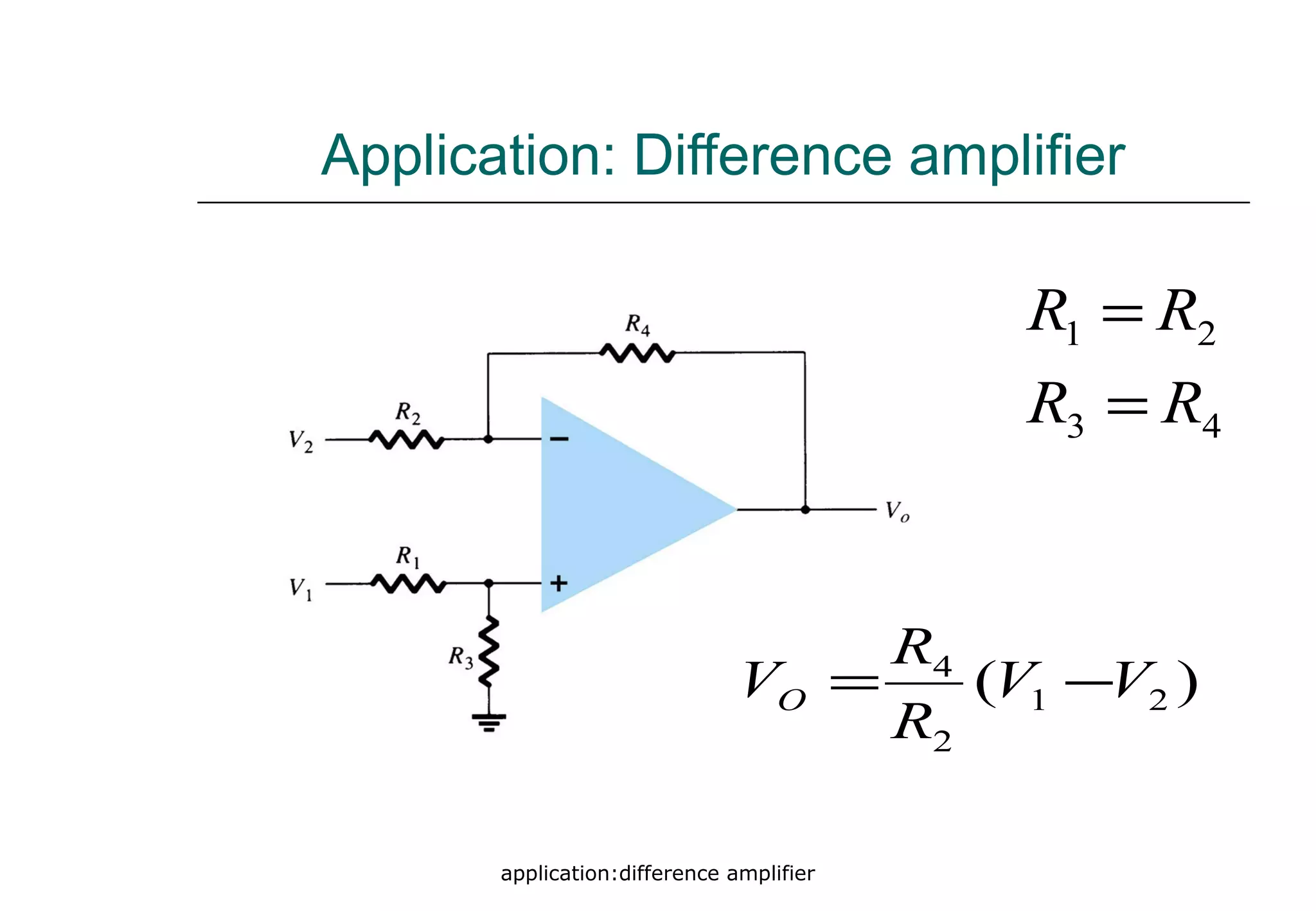
 Difference Amplifier
 Filter
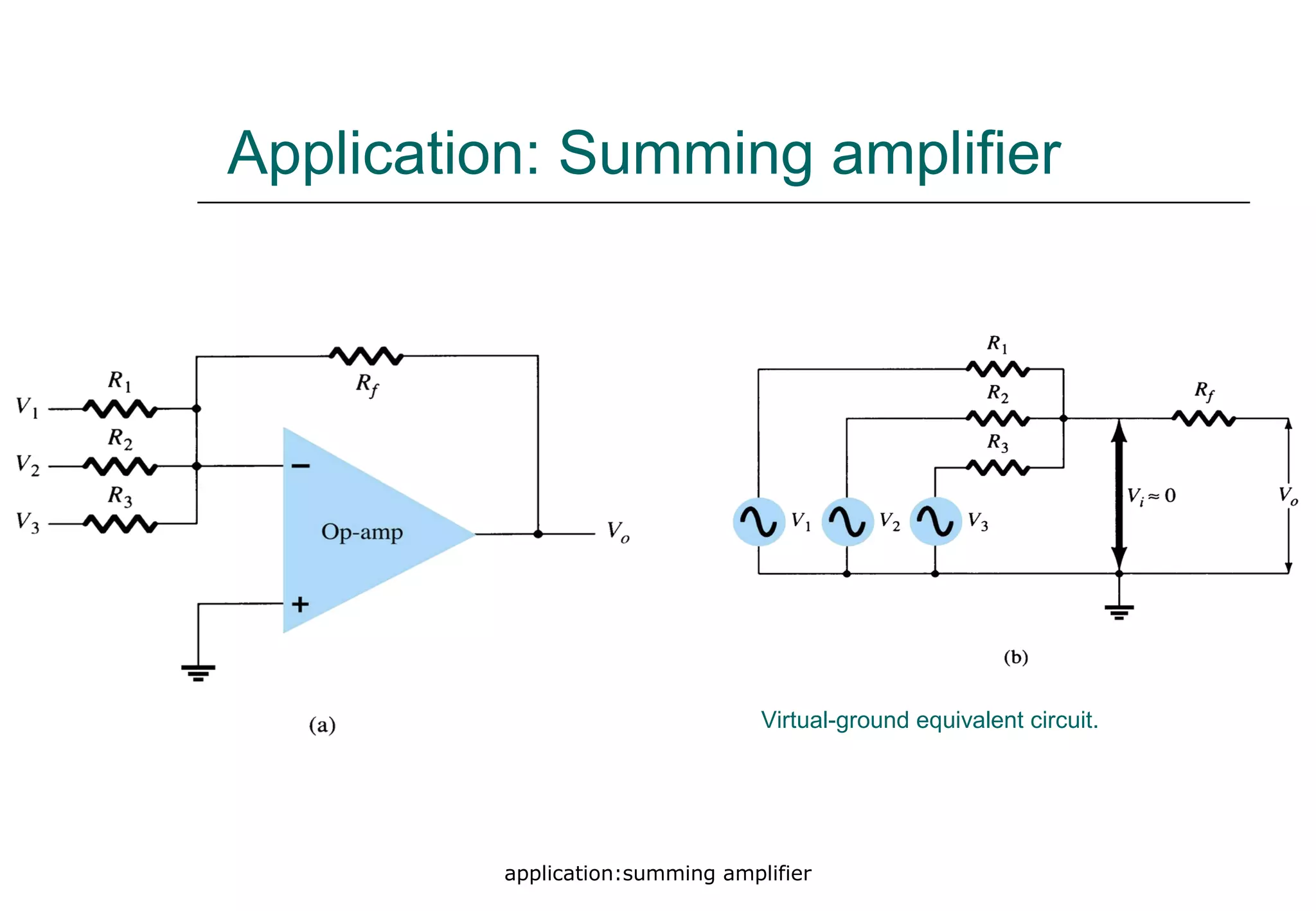
 Summing Amplifier
application
 Inverting Amplifier
 Non-Inverting Amplifier
 Summing Amplifier
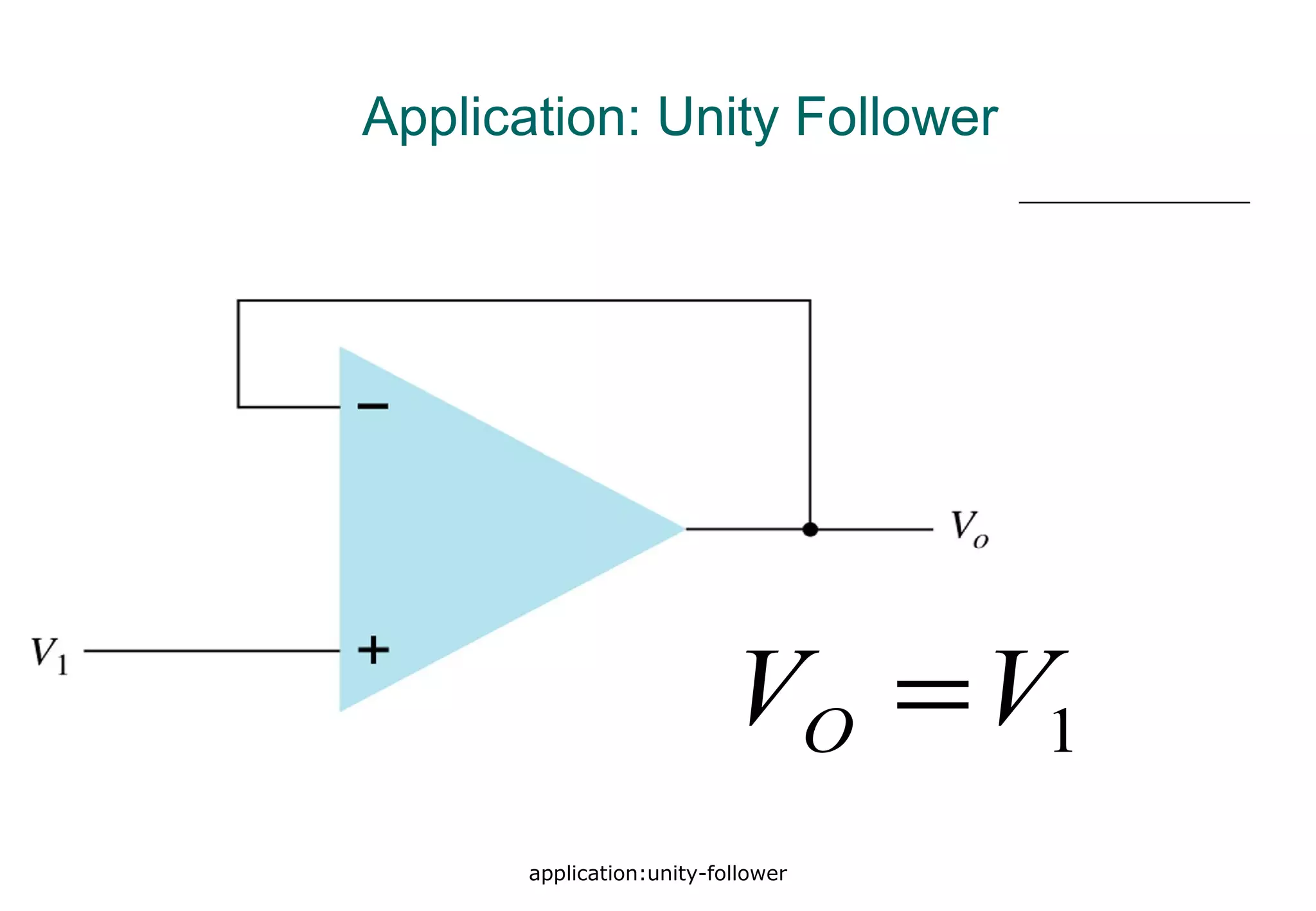
 Unity Follower
 Difference Amplifier
 Integrators
 Differentiators
Op-amp Circuit Application
application:inverting amplifier
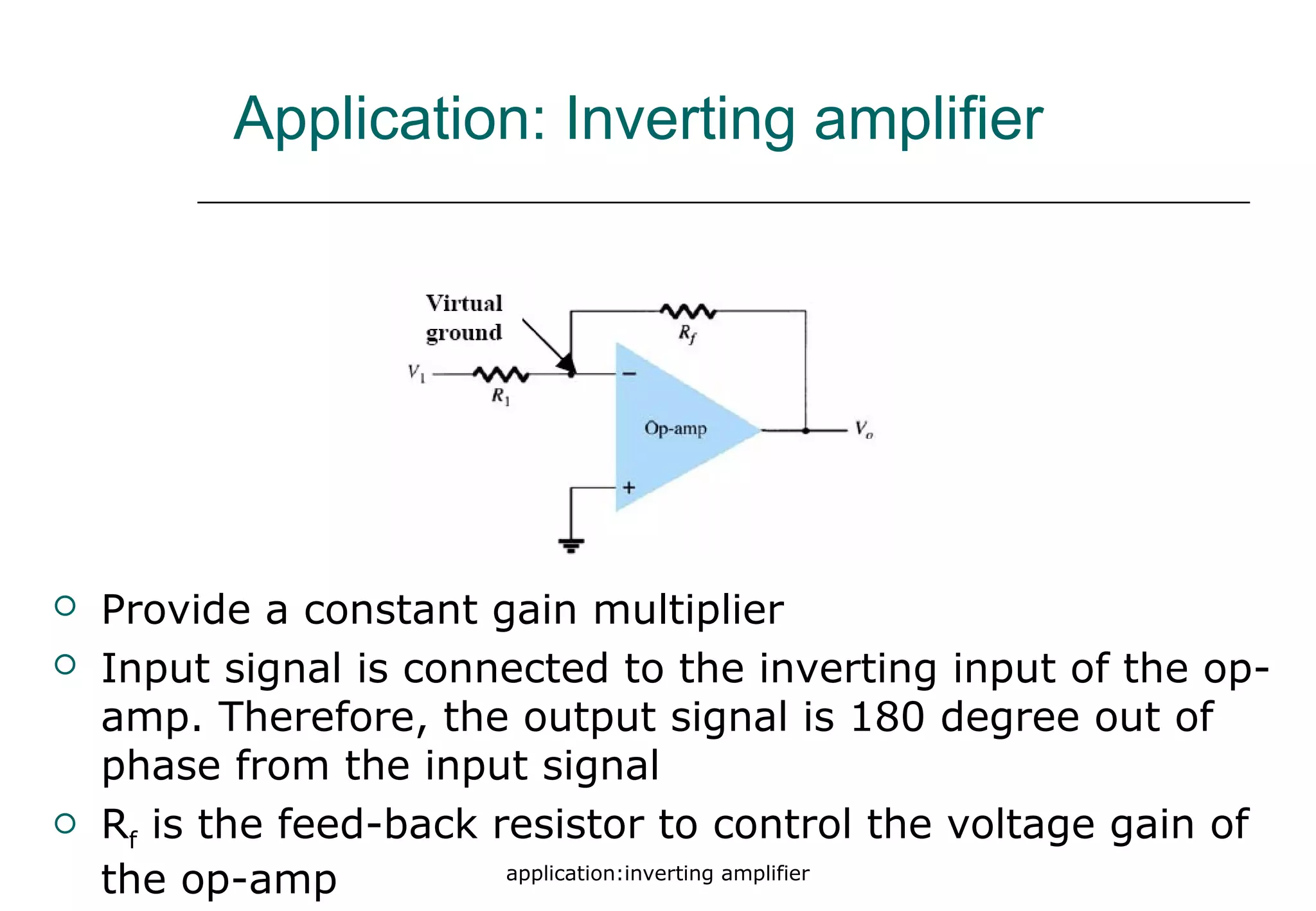
Application: Inverting amplifier
 Provide a constant gain multiplier
 Input signal is connected to the inverting input of the op-
amp. Therefore, the output signal is 180 degree out of
phase from the input signal
 Rf is the feed-back resistor to control the voltage gain of
the op-amp
application:inverting amplifier
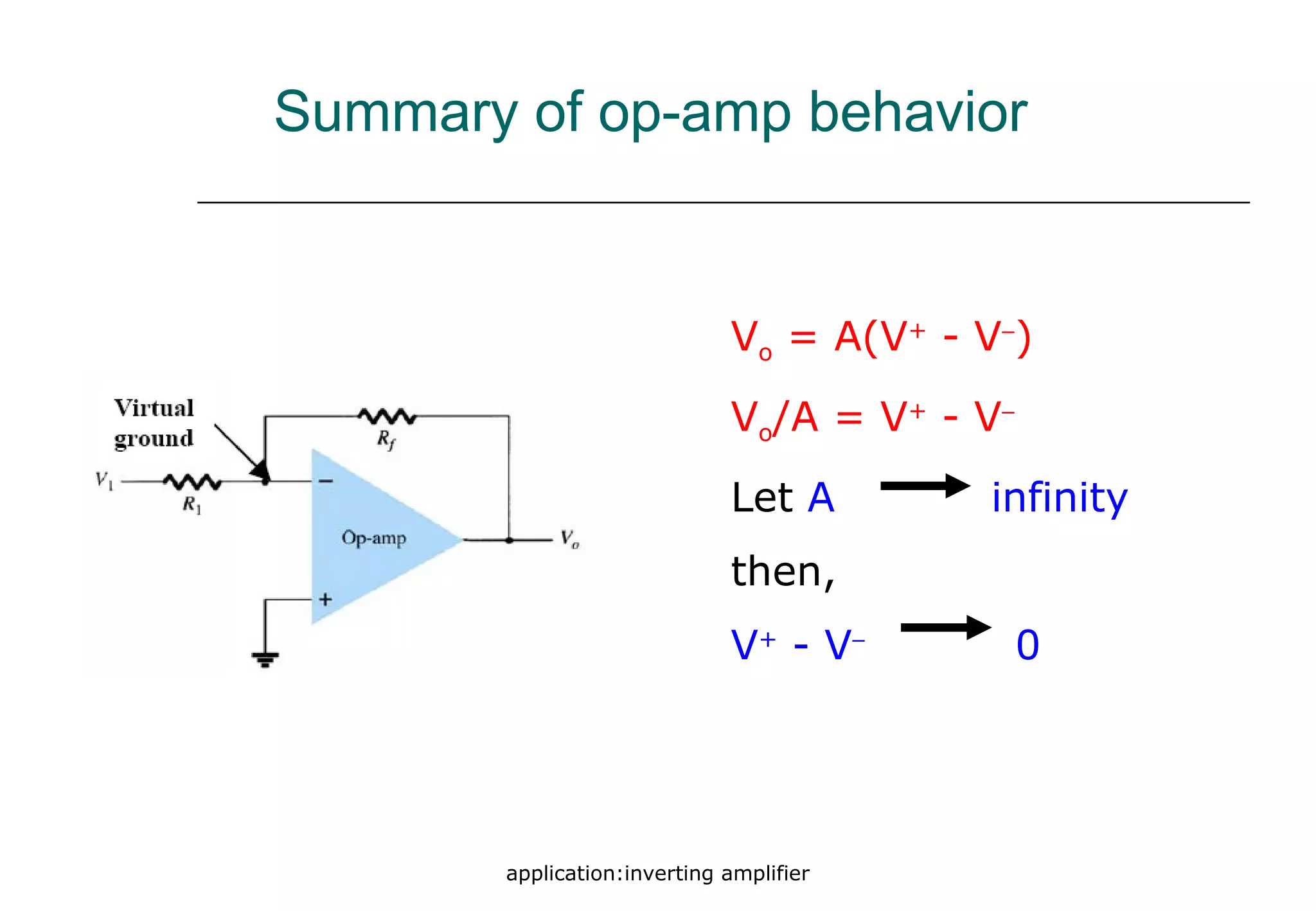
Summary of op-amp behavior
Vo = A(V+
- V−
)
Vo/A = V+
- V−
Let A infinity
then,
V+
- V−
0
application:inverting amplifier
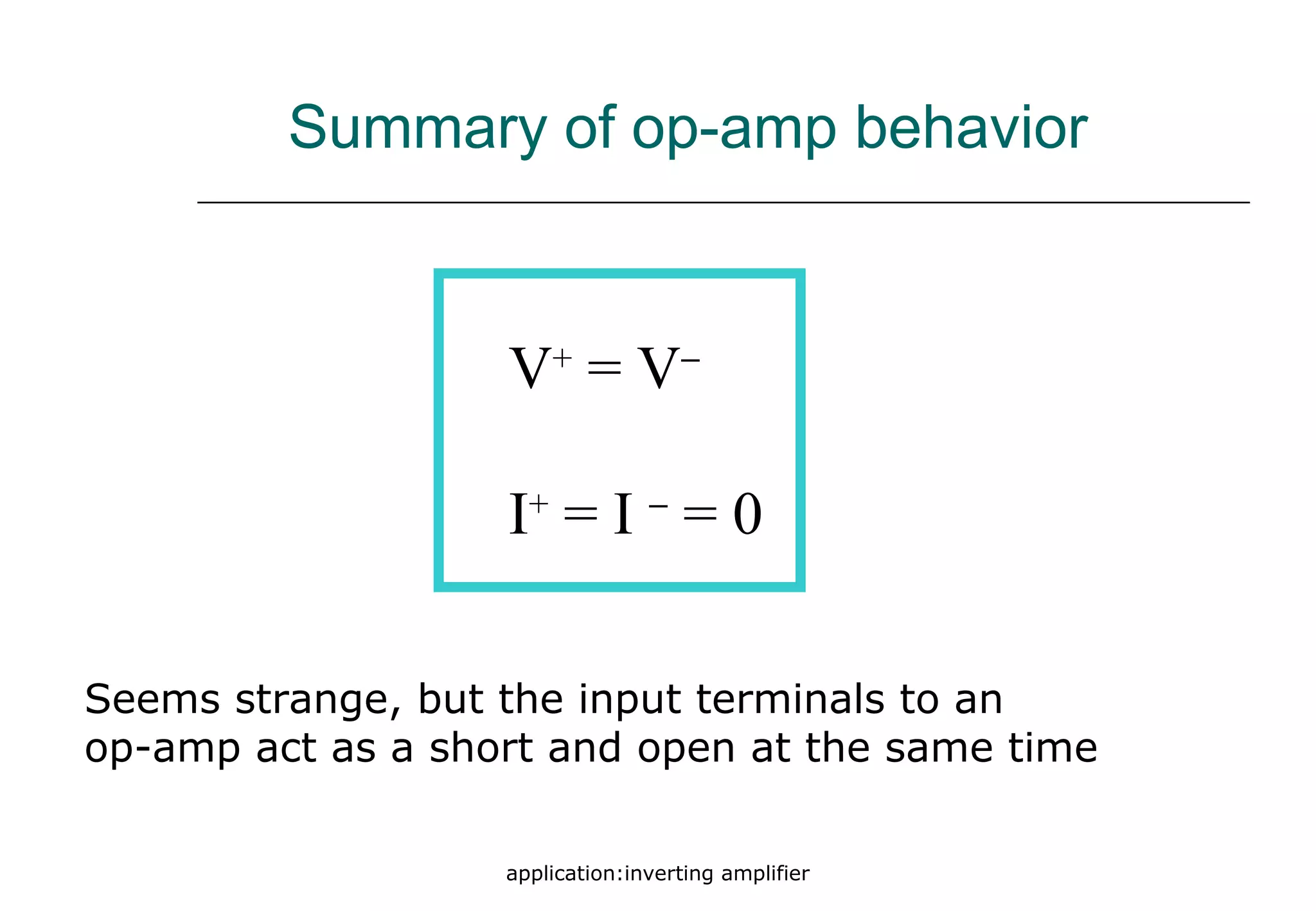
V+
= V−
I+
= I −
= 0
Seems strange, but the input terminals to an
op-amp act as a short and open at the same time
Summary of op-amp behavior
application:inverting amplifier
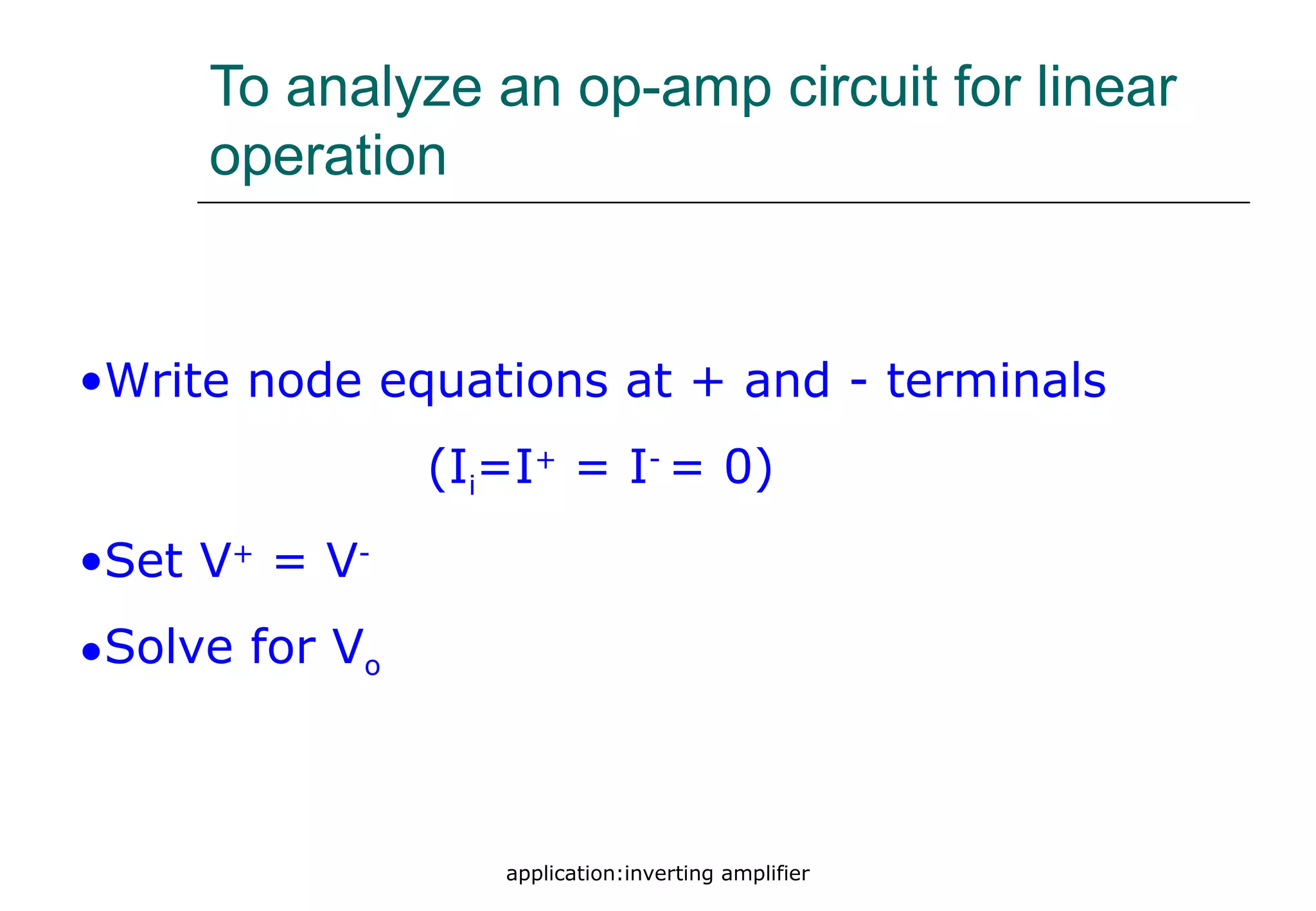
To analyze an op-amp circuit for linear
operation
•Write node equations at + and - terminals
(Ii=I+
= I-
= 0)
•Set V+
= V-
•Solve for Vo
application:inverting amplifier
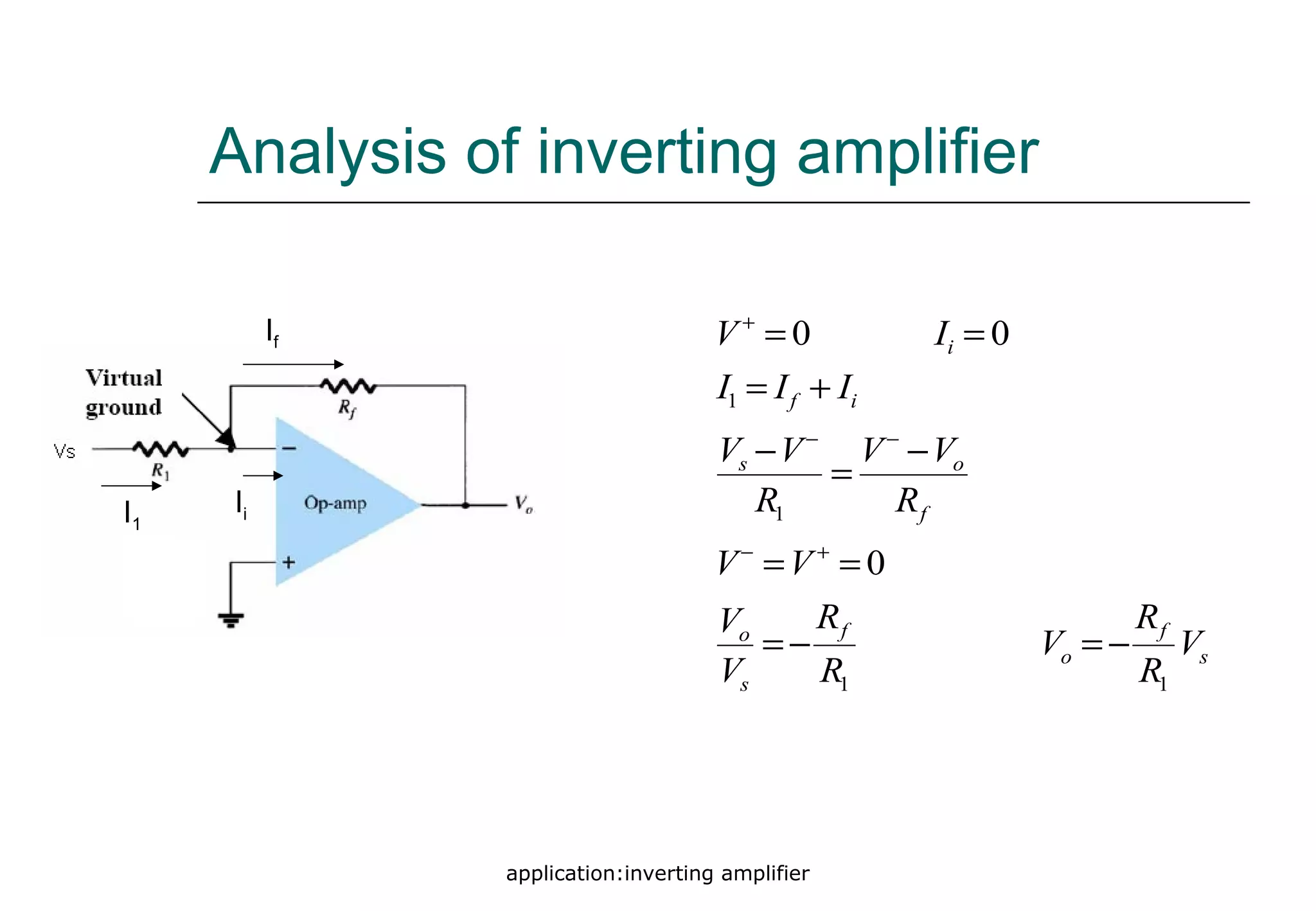
Analysis of inverting amplifier
I1
If
Ii
V+
= 0 Ii = 0
I1 = If + Ii
Vs −V−
R1
=
V−
−Vo
Rf
V−
=V+
= 0
Vo
Vs
= −
Rf
R1
Vo = −
Rf
R1
Vs
application:non-inverting amplifier
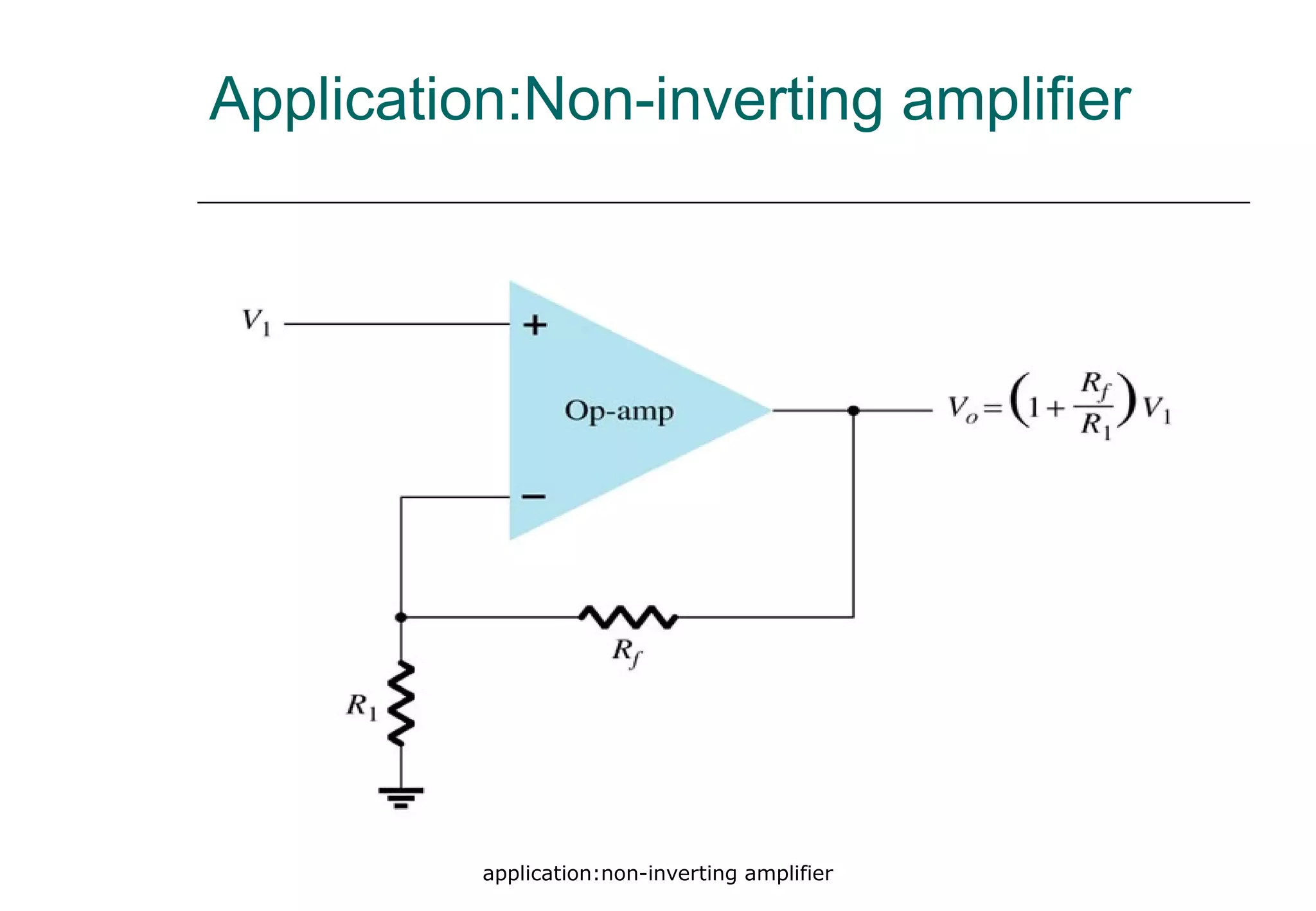
Application:Non-inverting amplifier
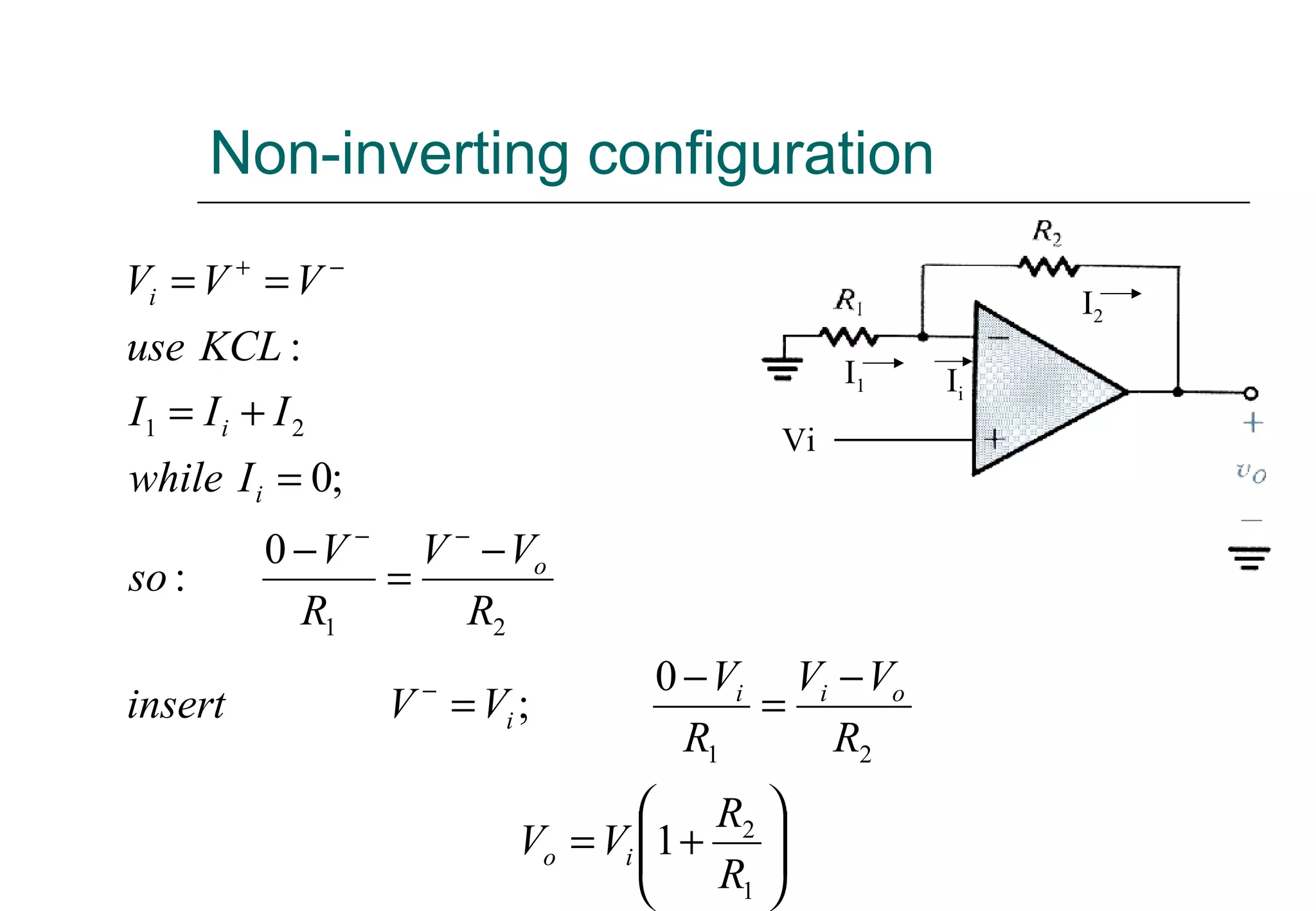
Non-inverting configuration






+=
−
=
−
=
−
=
−
=
+=
==
−
−−
−+
1
2
21
21
21
1
0
;
0
:
;0
:
R
R
VV
R
VV
R
V
VVinsert
R
VV
R
V
so
Iwhile
III
KCLuse
VVV
io
oii
i
o
i
i
i
Vi
I1
I2
Ii
application:summing amplifier
Application: Summing amplifier
Virtual-ground equivalent circuit.
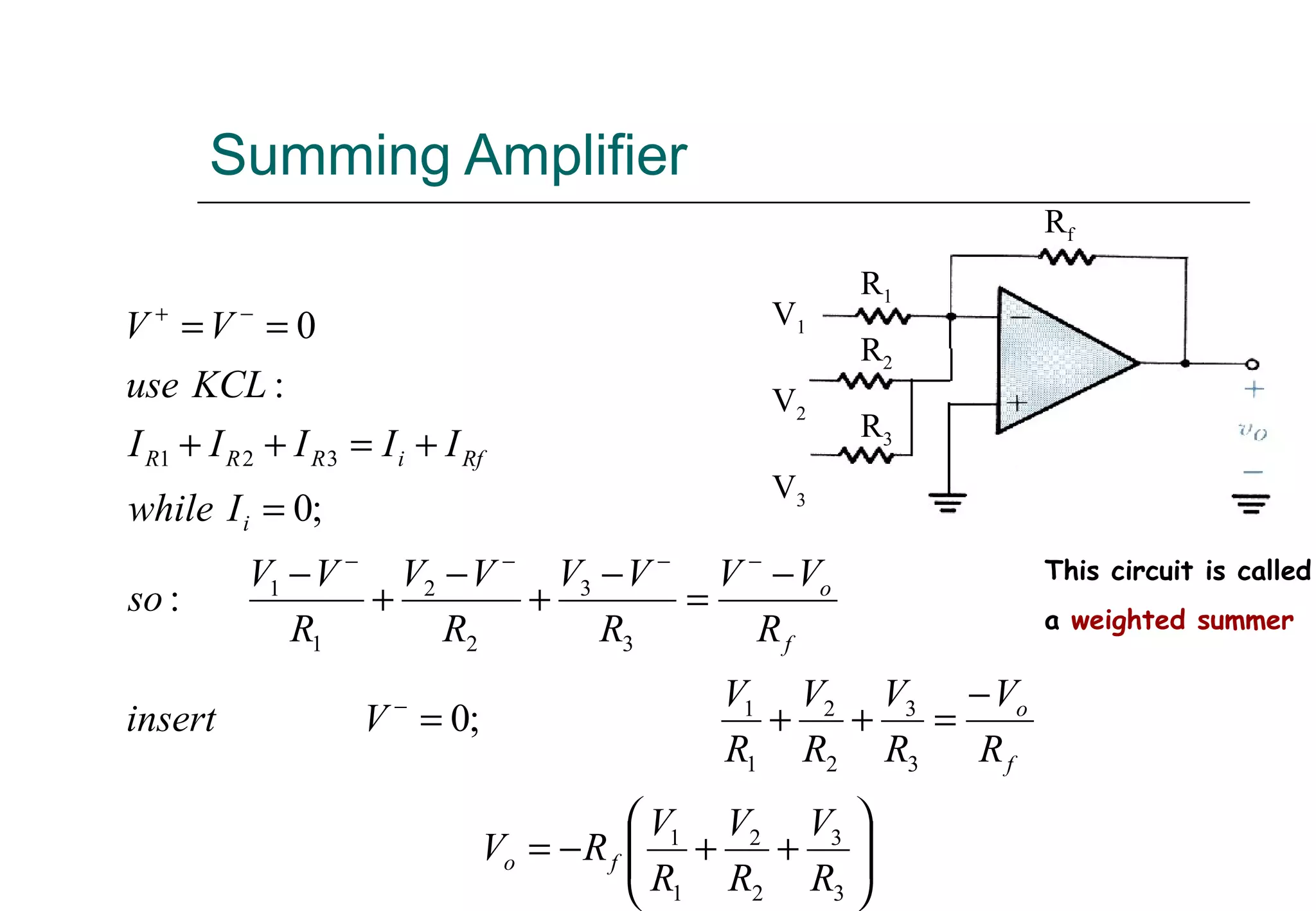
Summing Amplifier
V1
V2
V3
R1
R2
R3
Rf
This circuit is called
a weighted summer






++−=
−
=++=
−
=
−
+
−
+
−
=
+=++
==
−
−−−−
−+
3
3
2
2
1
1
3
3
2
2
1
1
3
3
2
2
1
1
321
;0
:
;0
:
0
R
V
R
V
R
V
RV
R
V
R
V
R
V
R
V
Vinsert
R
VV
R
VV
R
VV
R
VV
so
Iwhile
IIIII
KCLuse
VV
fo
f
o
f
o
i
RfiRRR
application:unity-follower
Application: Unity Follower
1VVO =
application:difference amplifier
Application: Difference amplifier
)( 21
2
4
VV
R
R
VO −=
43
21
RR
RR
=
=
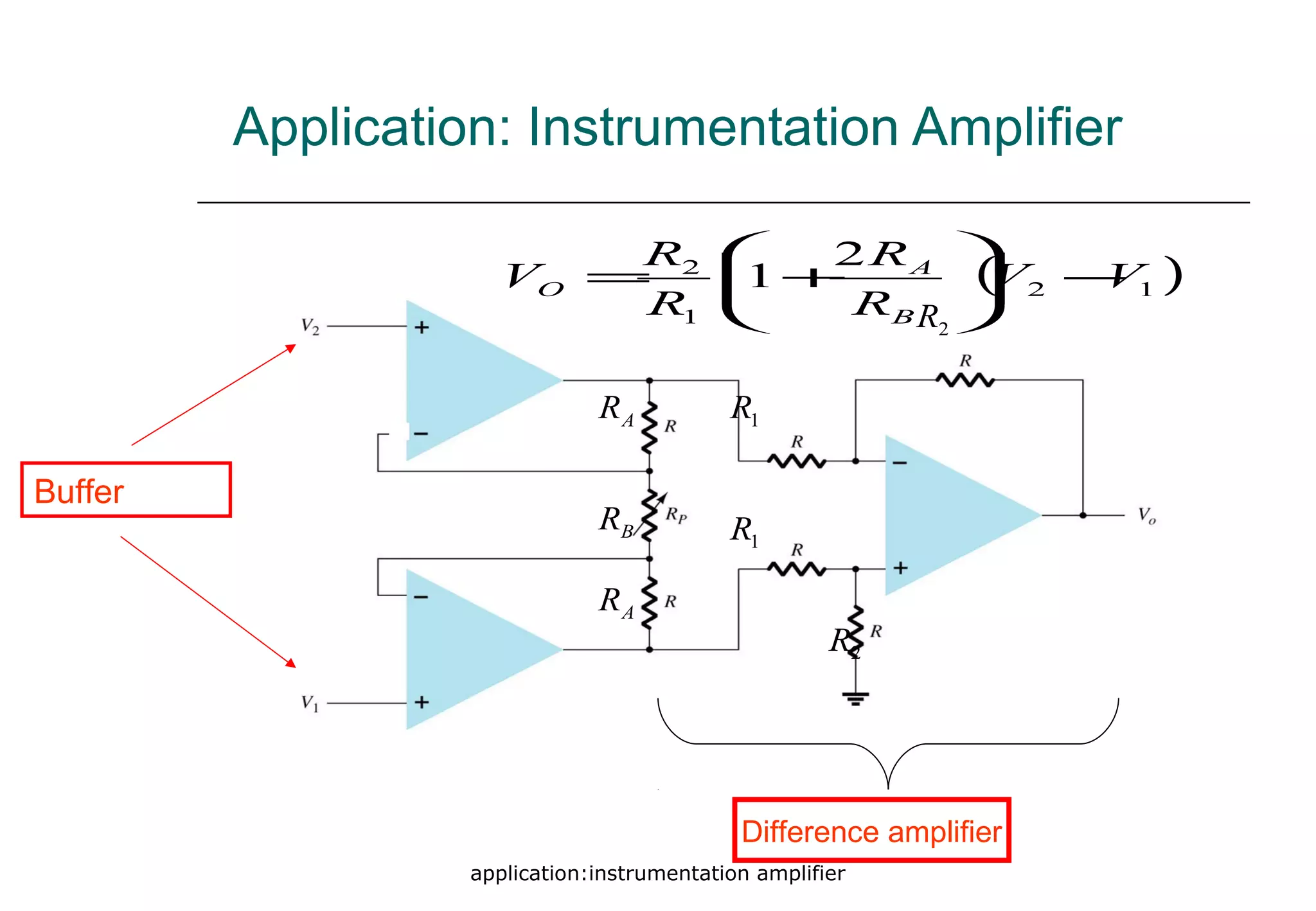
application:instrumentation amplifier
Application: Instrumentation Amplifier
2R
Buffer
2R
1R
1R
AR
BR
AR
Difference amplifier
( )12
1
2 2
1 VV
R
R
R
R
V
B
A
O −





+=
2R
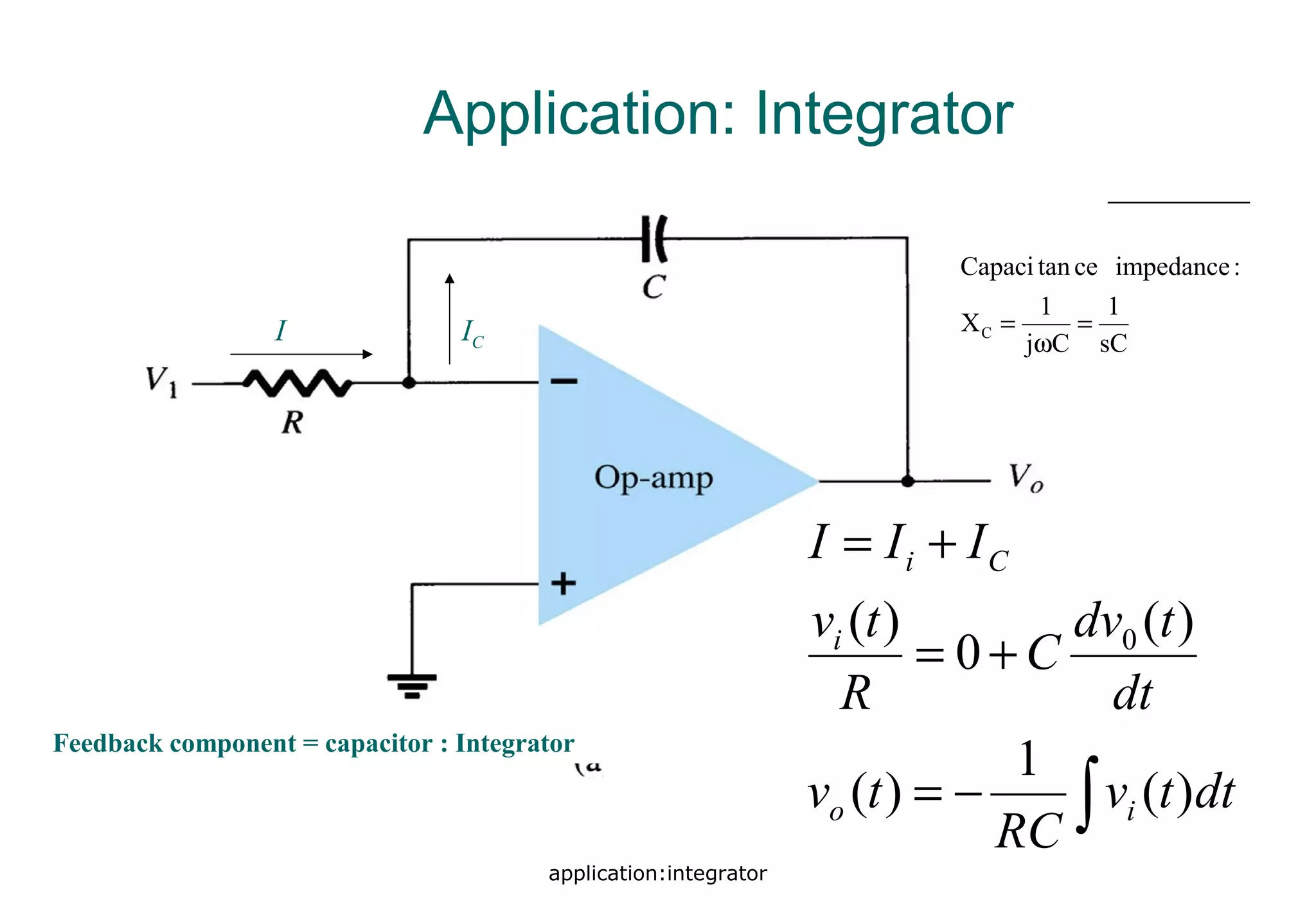
application:integrator
Application: Integrator
Feedback component = capacitor : Integrator
I IC
∫−=
+=
+=
dttv
RC
tv
dt
tdv
C
R
tv
III
io
i
Ci
)(
1
)(
)(
0
)( 0
sC
1
Cj
1
X
:impedancecetanCapaci
C =
ω
=
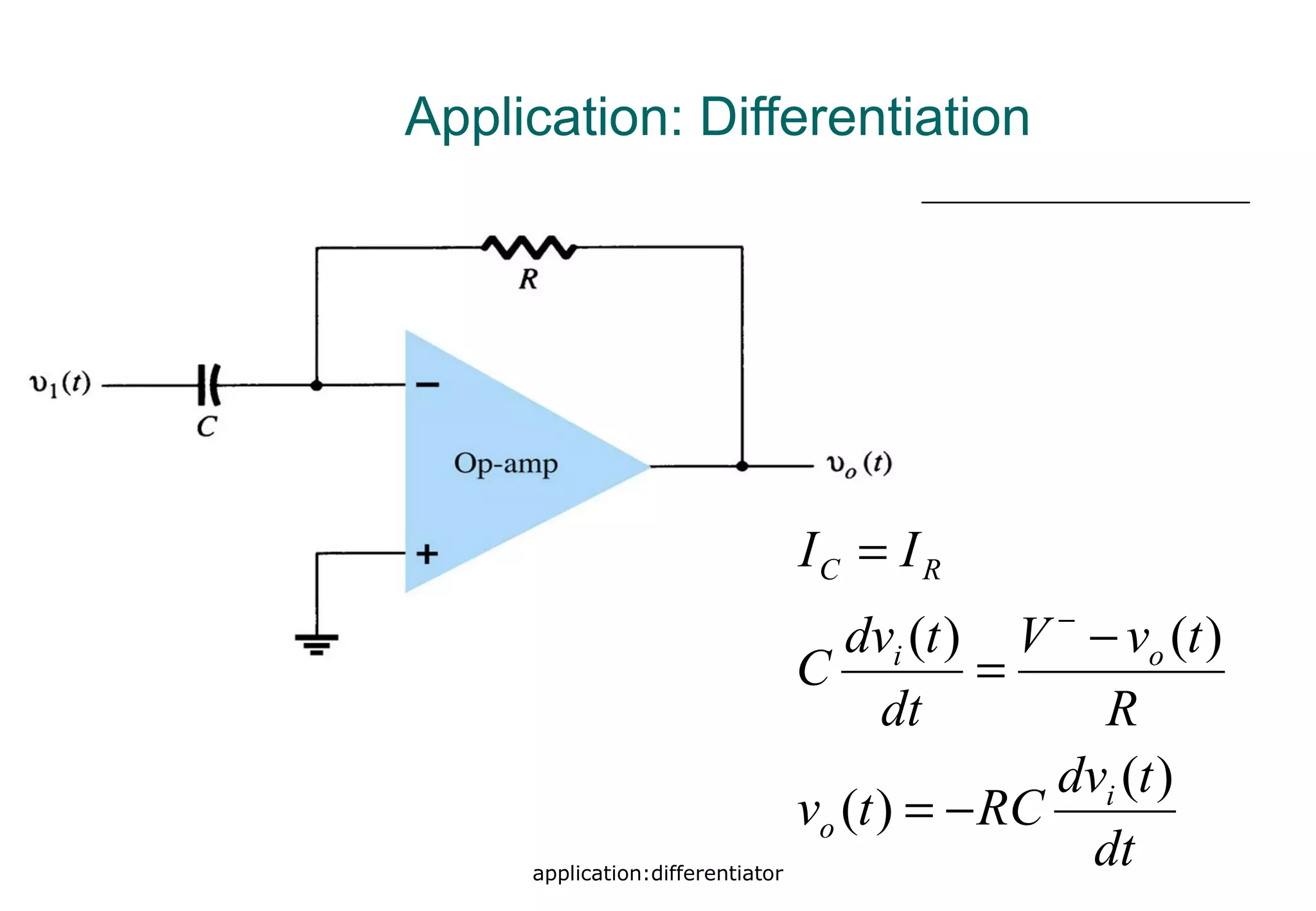
application:differentiator
Application: Differentiation
dt
tdv
RCtv
R
tvV
dt
tdv
C
II
i
o
oi
RC
)(
)(
)()(
−=
−
=
=
−
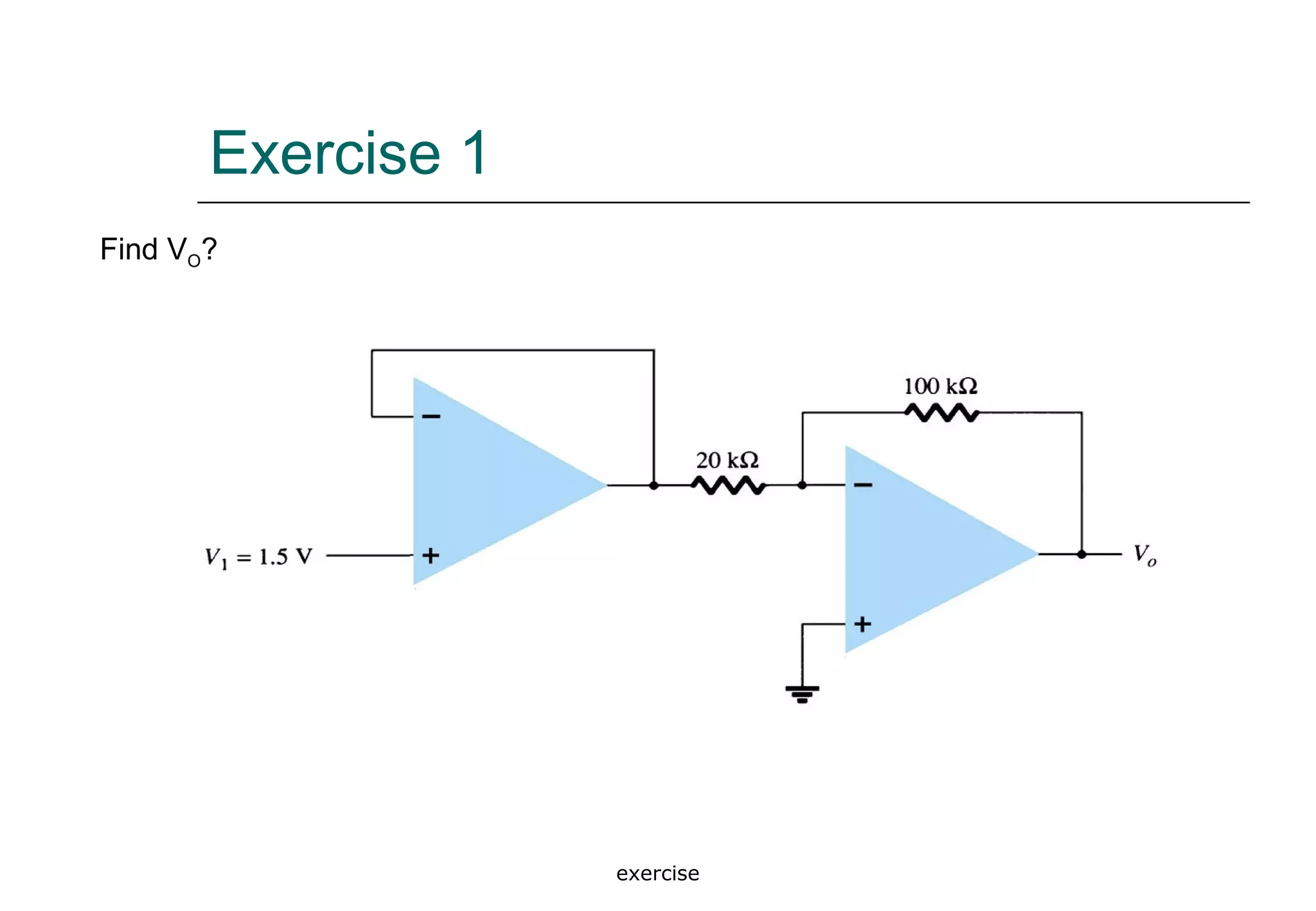
exercise
Exercise 1
Find VO?
exercise
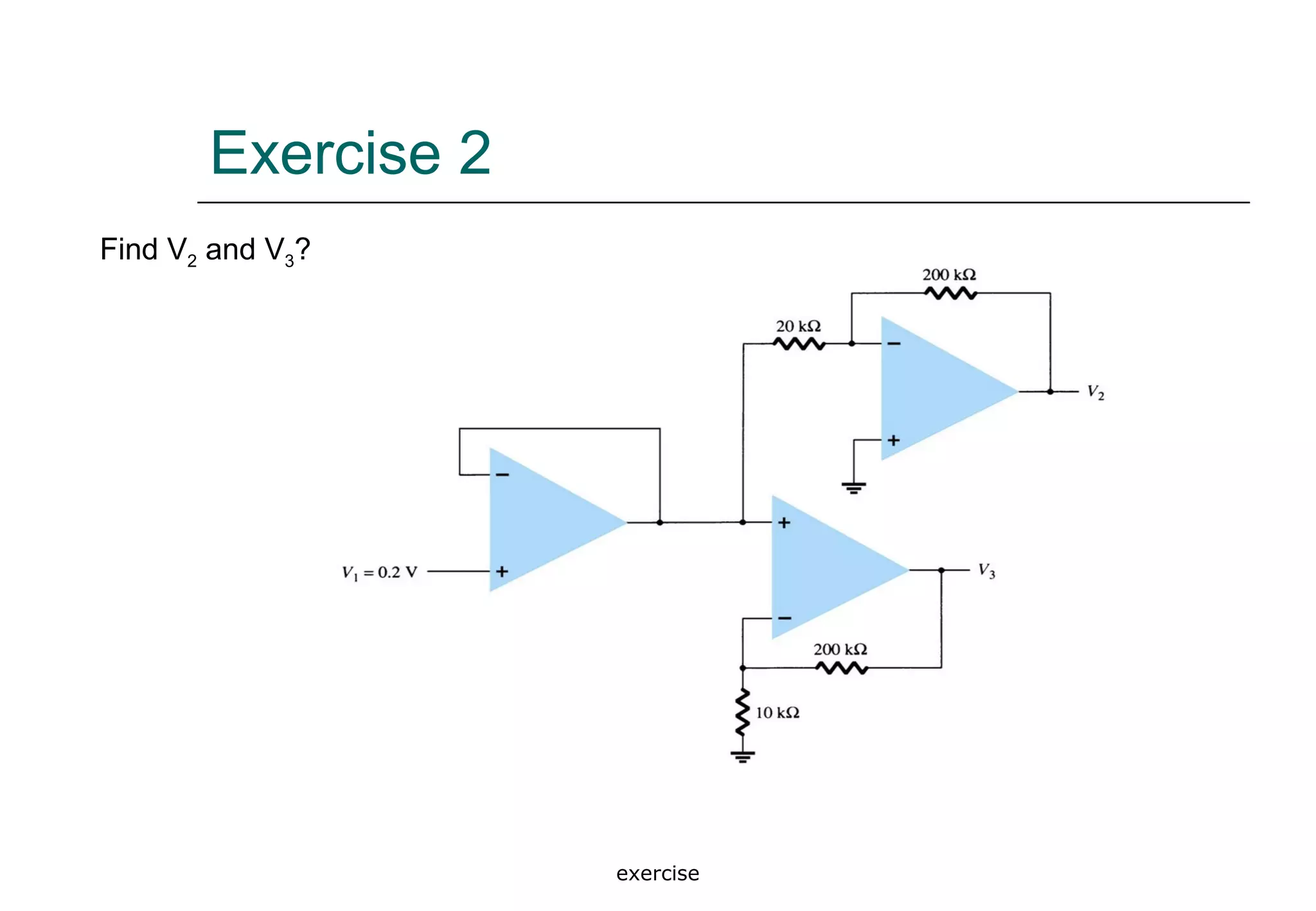
Exercise 2
Find V2 and V3?
exercise
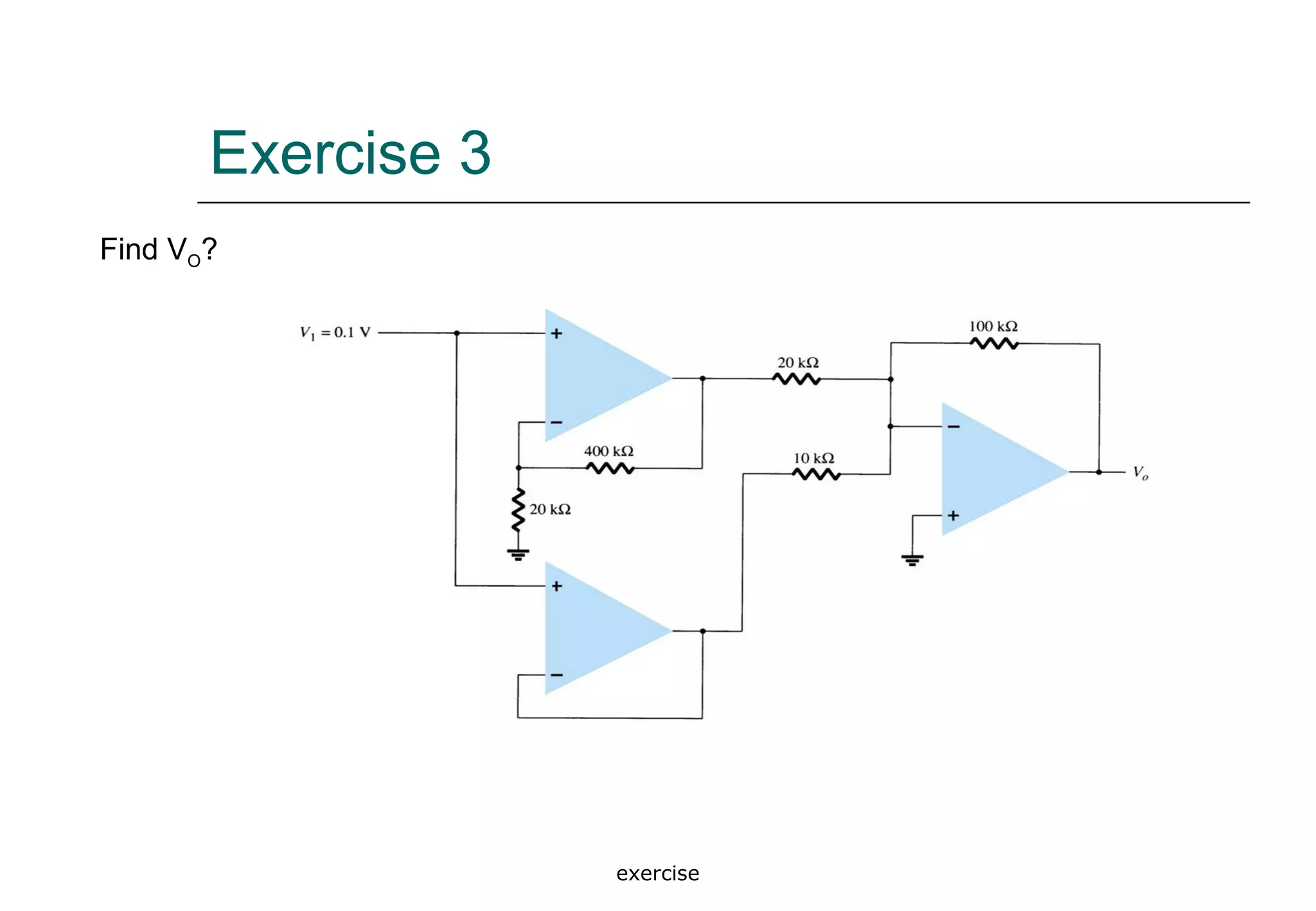
Exercise 3
Find VO?
exercise
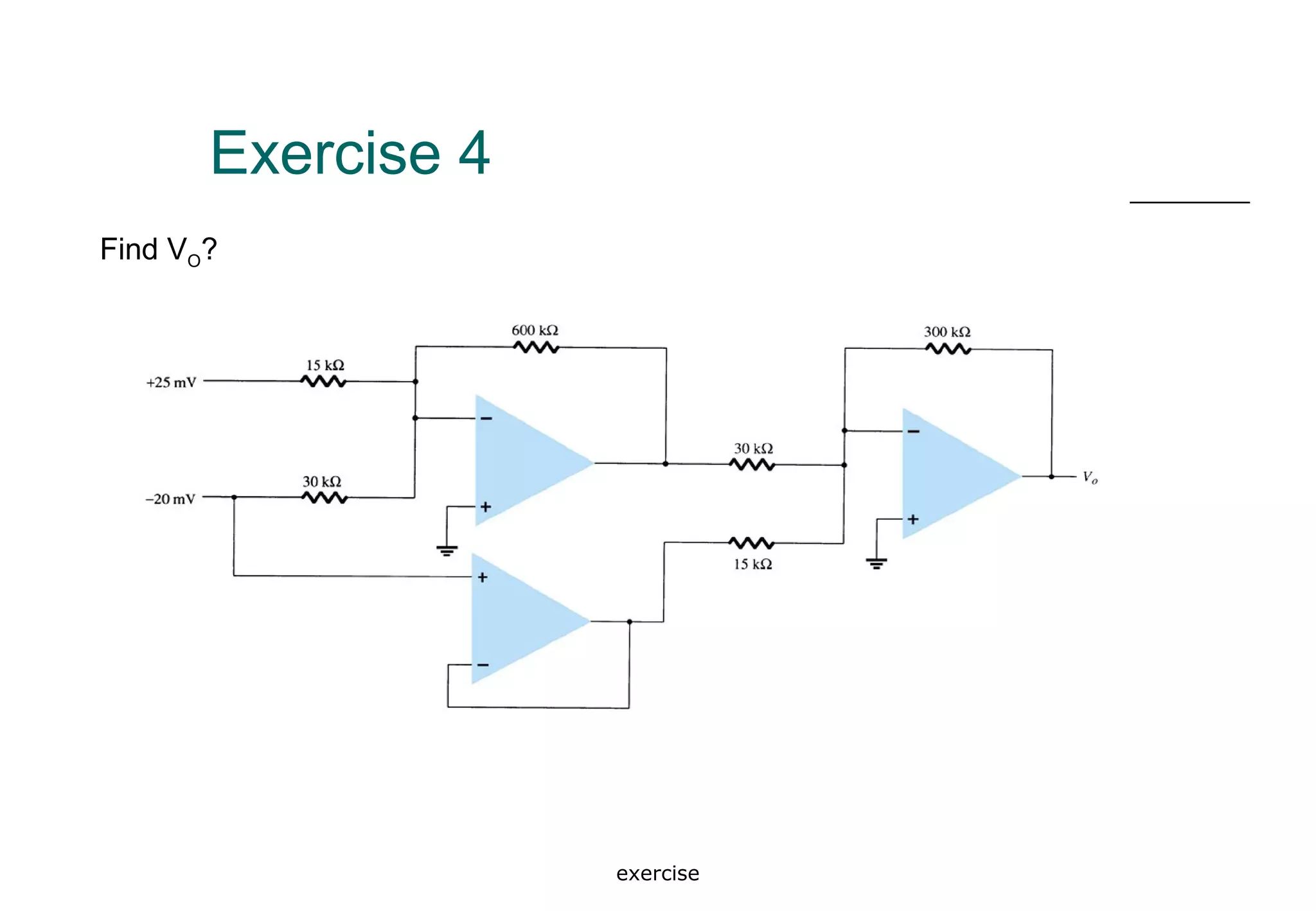
Exercise 4
Find VO?
non-linear application
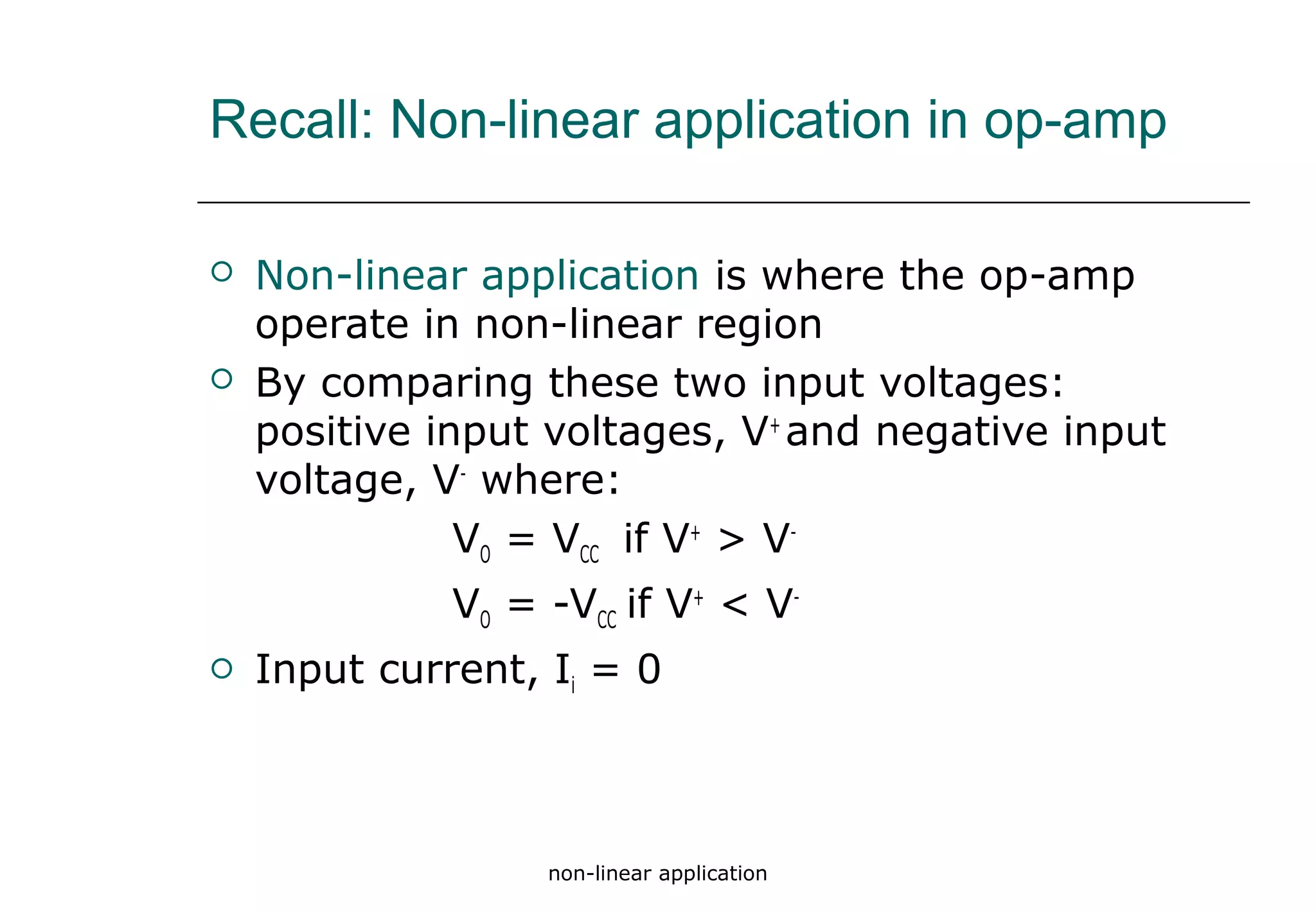
 Non-linear application is where the op-amp
operate in non-linear region
 By comparing these two input voltages:
positive input voltages, V+
and negative input
voltage, V-
where:
VO = VCC if V+
> V-
VO = -VCC if V+
< V-
 Input current, Ii = 0
Recall: Non-linear application in op-amp
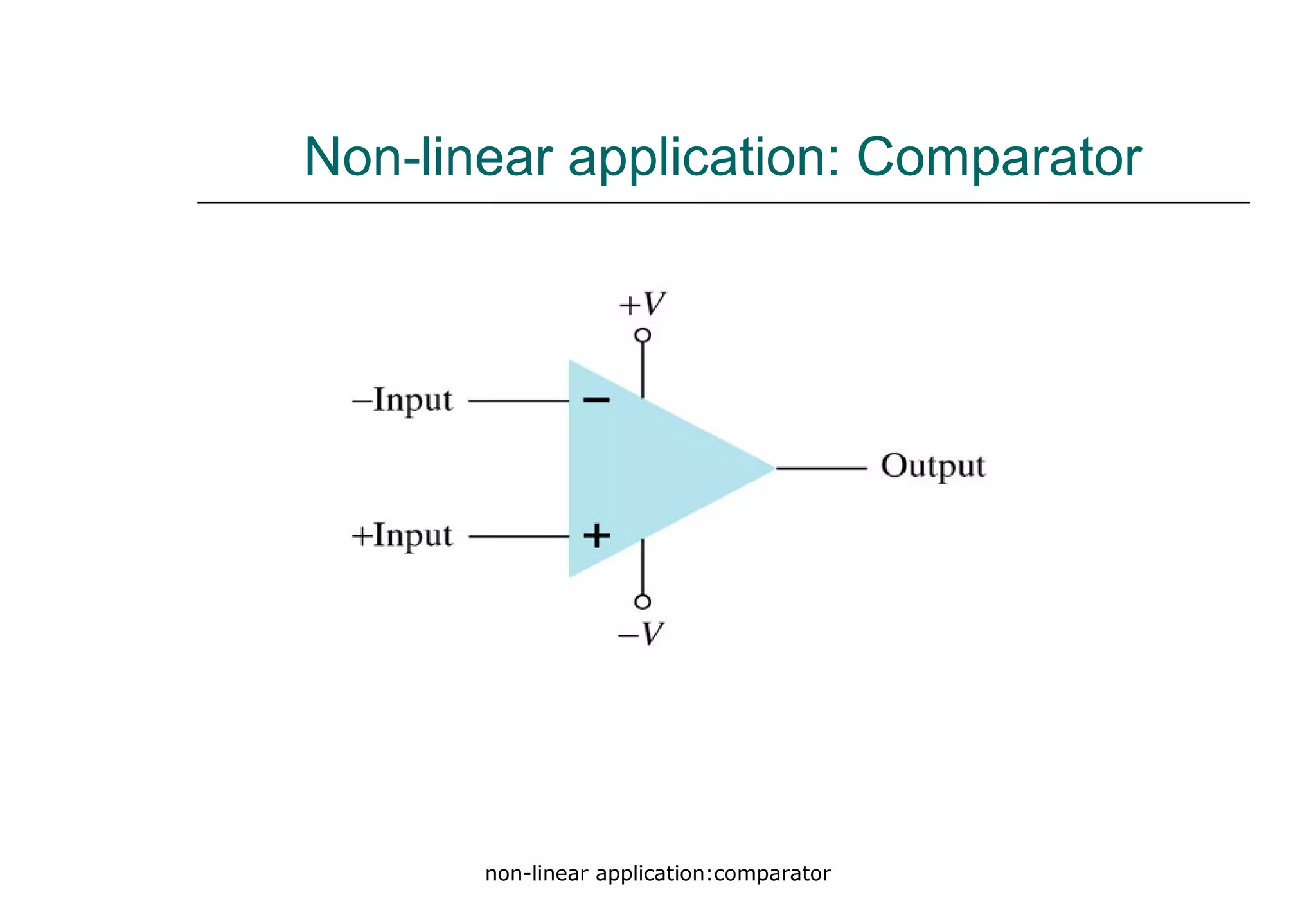
non-linear application:comparator
Non-linear application: Comparator

Operational Amplifiers

Editor's Notes

  • #2 Fig 12-1 a&amp;b op-amp schem. symbols
  • #3 Fig 12-1 a&amp;b op-amp schem. symbols
  • #14 Fig 12-2a&amp;b ideal and practical op-amp