THE MEDIEVAL AGES 
A B R I E F OVE RVI EW
PEACE AND PROSPERITY FACTORS 
• Revitalization of the Church (Crusades) 
• Agricultural revolution and rise of feudalism 
• Revival of trade and the urban revolution 
• Rise of national monarchies 
• Development of universities 
• Architecture: cathedrals 
and castles 
King John 
of England 
Flying 
Buttress
THE CRUSADES 1095-1291 CE 
• Effects 
• Reduced internal warring in Europe 
• Papacy gains prestige as defender of Christendom 
• Rise of trade in Italy (transporting men, supplies) 
• Contact with Muslims 
• New foods, bathing, fine Asian goods 
• Scientific and cultural knowledge 
• Islamic learning schools established in France and Spain
THE BUBONIC PLAGUE 
• Aka – the black death/bubonic plague 
• 1300’s killed between ¼ and 1/3 of population in 
Europe 
• Estimates of death toll: 75-200 million people 
• Came from ships that originated from the orient, 
carried by fleas on black rats 
• Symptoms: Buboes (swollen lymph nodes) would 
appear in the groin, neck and armpits 
• Oozed puss and blood when opened 
• Next the sick would develop a fever and vomit 
blood 
• Most victims died two to seven days after infection
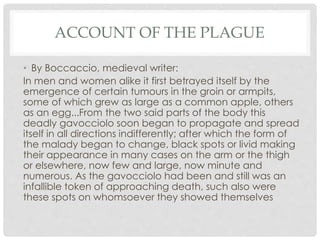
ACCOUNT OF THE PLAGUE 
• By Boccaccio, medieval writer: 
In men and women alike it first betrayed itself by the 
emergence of certain tumours in the groin or armpits, 
some of which grew as large as a common apple, others 
as an egg...From the two said parts of the body this 
deadly gavocciolo soon began to propagate and spread 
itself in all directions indifferently; after which the form of 
the malady began to change, black spots or livid making 
their appearance in many cases on the arm or the thigh 
or elsewhere, now few and large, now minute and 
numerous. As the gavocciolo had been and still was an 
infallible token of approaching death, such also were 
these spots on whomsoever they showed themselves
THE BUBONIC PLAGUE 
• Its spread: 
http://en.wikipedia.org/wiki/Black_Death#mediavie 
wer/File:Blackdeath2.gif 
• Poor sanitation and lack of bathing meant it spread 
quickly 
• Jews, foreigners, beggars, pilgrims and Roma were 
all blamed and persecuted 
• Most of the art and literature from the time focus on 
the effects of the plague.
MEDIEVAL KNIGHTS 
• Medieval Warriors on horseback, most sought after 
military weapon, bought by Lord 
• Had Armour (chain mail and plate) 
• Lived by a Code of Chivalry 
• Moral Code tied to religion 
• Squire: Knight’s aid 
• Watch: Terry Jones' Medieval Lives: The Knight 
• Take notes on other aspects of the life of a 
Medieval Knight 
• https://www.youtube.com/watch?v=NhWFQtzM4r0 
• https://www.youtube.com/watch?v=HtjSS5FmQc0
CHURCH AND KINGS 
Church 
• Was granted favours by 
Roman Emperors/Kings 
• land 
• exemption from taxes 
• immunity in courts 
• positions in courts 
• In return church helped 
kings secure control of 
territory 
• Most influential 
organization in Europe 
Kings 
• Got a supply of 
educated administrators 
from Church 
• In return kings would 
enforce laws that 
prohibited other religions
MONASTICISM 
• Most dynamic and significant institution in the Early 
Middle Ages 
• Impulse to withdraw from the world and devote 
one’s self to God 
• Regarded as the most perfect form of the Christian 
life 
• “And every man that has forsaken home, or 
brothers, or sisters, or father, or mother, or wife, or 
children, or lands for my name’s sake, shall receive 
his reward a hundredfold, and obtain everlasting 
life.” Matt. 19:29
MONASTICISM 
• Started with St. Anthony from Egypt 
• Retired to the desert to live the ascetic life of 
a good hermit 
• A colony of would-be ascetics gathered 
around him to draw inspiration from his 
holiness 
• The colony lived together but did not 
communicate to one another 
• Soon other colonies grew in Egypt and other 
areas of the Roman Empire 
• St. Simeon Stylites lived atop a 60 ft 
pillar for 30 years!
MONASTICISM 
• St. Benedict of Nurisa (c. 480-544) 
added common sense 
• Changed from severe fasting, hair shirts, 
and lashings 
• Benedict was born into a rich family 
and had keen psychological insight 
• Well organized and learned from 
experiences 
• Founded a number of monasteries 
(Monte Cassino) 
• Became a model monastery 
• Focused on comprehensive, practical 
and compassionate rule
MONASTICISM 
AND SAINTS 
• Monasteries grew 400 -700 CE 
• centres of education, literacy and 
learning 
Saints 
• performs miracles as evidence of a 
special relationship with God 
• Must be canonized after death 
• St. Augustine 
• wrote “Confessions” 
• ideas of ethics, self knowledge, and 
the role of free will 
• Wrote treatise allowing violence against 
heretics – the “just war”
THE FLAGELLANTS 
• Religious sect seeking 
salvation through self 
abuse 
• Tied to Christianity, 
used psalms, hymns 
• Spread word as an 
act of piety 
• Worked towards 
spiritual goals through 
our actions in this world
THE CHURCH TAKES CHARGE 
• Peace of God: 989 CE 
• No stealing from church 
• No assaulting clerics, women, peasants 
• Excommunication 
• Truce of God: 1027 CE 
• No fighting Thursday to Monday, feast days, holy 
days 
• No killing Christians 
• Led to justification for Crusades 
Truce created a paradox: Peace & Truce of God 
created to bring order and civility to society, yet 
this peace movement also contributed to idea of 
the righteousness of holy war.
CHURCH TAKES CHARGE, CONT’D 
• Church Schism: 1054 CE 
• Pope and Patriarch excommunicate each other 
• Roman Catholic and Greek Orthodox split 
• War of Investitures: 1075 CE 
• Who gets to appoint bishops? Pope or King? 
• 50 years of bloodshed 
• Concordat of Worms: 1112 CE 
• King appoint bishops and abbots as vassal 
of empire 
• Pope then gives staff and ring 
• Kings gave up religious influence
CHURCH TAKES CHARGE, CONT’D 
• Pope Innocent III 
• Believed in supreme power of the papacy 
• Emperors and kings were servants of the church 
• Involved himself in disputes all over Europe 
• Freely used his power of excommunication 
• Placed kings in France and England were 
placed under interdict (removing sacramental 
and burial privileges). 
• Other kings were overthrown and replaced by 
rulers of his choice 
• Innocent started the trend of using the 
faith of various kings to their people to their 
advantage
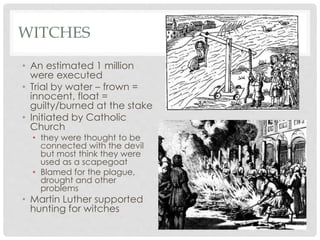
WITCHES 
• An estimated 1 million 
were executed 
• Trial by water – frown = 
innocent, float = 
guilty/burned at the stake 
• Initiated by Catholic 
Church 
• they were thought to be 
connected with the devil 
but most think they were 
used as a scapegoat 
• Blamed for the plague, 
drought and other 
problems 
• Martin Luther supported 
hunting for witches
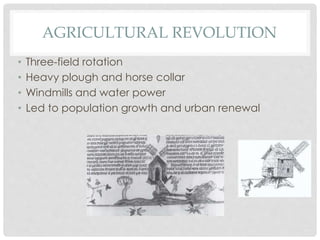
AGRICULTURAL REVOLUTION 
• Three-field rotation 
• Heavy plough and horse collar 
• Windmills and water power 
• Led to population growth and urban renewal
AGRICULTURAL REVOLUTION
TRADE AND URBANIZATION 
Rise of 
Guilds 
Medieval 
Street 
Increased 
Trade 
Walled City 
of 
Carcassone, 
France
UNIVERSITIES 
12th century 
Renaissance 
• Greek and Roman 
classics rediscovered 
• Universities 
established in 
Bologne, Paris, Oxford 
• Trivium (grammar, 
logic, rhetoric) and 
Quadrivium (math, 
geometry, music, 
astronomy)
ARCHITECTURE 
• Romanesque to Gothic 
San 
Pantaleo 
Italy 
Last 
Judgement at 
Conques, 
France 
Flying 
Buttress 
Chartres 
Cathedral 
, France
MEDIEVAL CASTLES 
• Defensive fortress of 
Kings and Lords 
• Fight by laying “siege” 
(towers/rams/ladders) 
• Defended with hot 
oil/water, arrows, 
catapults 
• Catapults: fire dead 
animals, heads, 
burning objects
CASTLES 
Motte & Bailey 
Castle 
Stone Castles 
Bamburgh 
Castle, England 
https://www.youtube.com/watch?v=F 
qGZbJEL21Q
100 YEARS WAR: ENGLAND VS FRANCE 
• Edward III of England claimed the throne of France 
• Edward married the king’s daughter but rules state it 
can’t be passed down through the female line 
• England won early battles at Crecy, Poitiers and 
Agincourt with longbow 
• In 1429, 17 yr old Joan of Arc was inspired by God to 
save France 
• Defeated the English at the Battle of Orleans 
• She was captured by the English and burnt at the stake 
for heresy, her legend grew 
• War lasted from 1337-1453 and had 4 stages 
• End result was that the French Kept their land
100 YEARS WAR

The Medieval Ages

  • 1.
    THE MEDIEVAL AGES A B R I E F OVE RVI EW
  • 2.
    PEACE AND PROSPERITYFACTORS • Revitalization of the Church (Crusades) • Agricultural revolution and rise of feudalism • Revival of trade and the urban revolution • Rise of national monarchies • Development of universities • Architecture: cathedrals and castles King John of England Flying Buttress
  • 3.
    THE CRUSADES 1095-1291CE • Effects • Reduced internal warring in Europe • Papacy gains prestige as defender of Christendom • Rise of trade in Italy (transporting men, supplies) • Contact with Muslims • New foods, bathing, fine Asian goods • Scientific and cultural knowledge • Islamic learning schools established in France and Spain
  • 4.
    THE BUBONIC PLAGUE • Aka – the black death/bubonic plague • 1300’s killed between ¼ and 1/3 of population in Europe • Estimates of death toll: 75-200 million people • Came from ships that originated from the orient, carried by fleas on black rats • Symptoms: Buboes (swollen lymph nodes) would appear in the groin, neck and armpits • Oozed puss and blood when opened • Next the sick would develop a fever and vomit blood • Most victims died two to seven days after infection
  • 5.
    ACCOUNT OF THEPLAGUE • By Boccaccio, medieval writer: In men and women alike it first betrayed itself by the emergence of certain tumours in the groin or armpits, some of which grew as large as a common apple, others as an egg...From the two said parts of the body this deadly gavocciolo soon began to propagate and spread itself in all directions indifferently; after which the form of the malady began to change, black spots or livid making their appearance in many cases on the arm or the thigh or elsewhere, now few and large, now minute and numerous. As the gavocciolo had been and still was an infallible token of approaching death, such also were these spots on whomsoever they showed themselves
  • 6.
    THE BUBONIC PLAGUE • Its spread: http://en.wikipedia.org/wiki/Black_Death#mediavie wer/File:Blackdeath2.gif • Poor sanitation and lack of bathing meant it spread quickly • Jews, foreigners, beggars, pilgrims and Roma were all blamed and persecuted • Most of the art and literature from the time focus on the effects of the plague.
  • 8.
    MEDIEVAL KNIGHTS •Medieval Warriors on horseback, most sought after military weapon, bought by Lord • Had Armour (chain mail and plate) • Lived by a Code of Chivalry • Moral Code tied to religion • Squire: Knight’s aid • Watch: Terry Jones' Medieval Lives: The Knight • Take notes on other aspects of the life of a Medieval Knight • https://www.youtube.com/watch?v=NhWFQtzM4r0 • https://www.youtube.com/watch?v=HtjSS5FmQc0
  • 9.
    CHURCH AND KINGS Church • Was granted favours by Roman Emperors/Kings • land • exemption from taxes • immunity in courts • positions in courts • In return church helped kings secure control of territory • Most influential organization in Europe Kings • Got a supply of educated administrators from Church • In return kings would enforce laws that prohibited other religions
  • 10.
    MONASTICISM • Mostdynamic and significant institution in the Early Middle Ages • Impulse to withdraw from the world and devote one’s self to God • Regarded as the most perfect form of the Christian life • “And every man that has forsaken home, or brothers, or sisters, or father, or mother, or wife, or children, or lands for my name’s sake, shall receive his reward a hundredfold, and obtain everlasting life.” Matt. 19:29
  • 11.
    MONASTICISM • Startedwith St. Anthony from Egypt • Retired to the desert to live the ascetic life of a good hermit • A colony of would-be ascetics gathered around him to draw inspiration from his holiness • The colony lived together but did not communicate to one another • Soon other colonies grew in Egypt and other areas of the Roman Empire • St. Simeon Stylites lived atop a 60 ft pillar for 30 years!
  • 12.
    MONASTICISM • St.Benedict of Nurisa (c. 480-544) added common sense • Changed from severe fasting, hair shirts, and lashings • Benedict was born into a rich family and had keen psychological insight • Well organized and learned from experiences • Founded a number of monasteries (Monte Cassino) • Became a model monastery • Focused on comprehensive, practical and compassionate rule
  • 13.
    MONASTICISM AND SAINTS • Monasteries grew 400 -700 CE • centres of education, literacy and learning Saints • performs miracles as evidence of a special relationship with God • Must be canonized after death • St. Augustine • wrote “Confessions” • ideas of ethics, self knowledge, and the role of free will • Wrote treatise allowing violence against heretics – the “just war”
  • 14.
    THE FLAGELLANTS •Religious sect seeking salvation through self abuse • Tied to Christianity, used psalms, hymns • Spread word as an act of piety • Worked towards spiritual goals through our actions in this world
  • 15.
    THE CHURCH TAKESCHARGE • Peace of God: 989 CE • No stealing from church • No assaulting clerics, women, peasants • Excommunication • Truce of God: 1027 CE • No fighting Thursday to Monday, feast days, holy days • No killing Christians • Led to justification for Crusades Truce created a paradox: Peace & Truce of God created to bring order and civility to society, yet this peace movement also contributed to idea of the righteousness of holy war.
  • 16.
    CHURCH TAKES CHARGE,CONT’D • Church Schism: 1054 CE • Pope and Patriarch excommunicate each other • Roman Catholic and Greek Orthodox split • War of Investitures: 1075 CE • Who gets to appoint bishops? Pope or King? • 50 years of bloodshed • Concordat of Worms: 1112 CE • King appoint bishops and abbots as vassal of empire • Pope then gives staff and ring • Kings gave up religious influence
  • 17.
    CHURCH TAKES CHARGE,CONT’D • Pope Innocent III • Believed in supreme power of the papacy • Emperors and kings were servants of the church • Involved himself in disputes all over Europe • Freely used his power of excommunication • Placed kings in France and England were placed under interdict (removing sacramental and burial privileges). • Other kings were overthrown and replaced by rulers of his choice • Innocent started the trend of using the faith of various kings to their people to their advantage
  • 18.
    WITCHES • Anestimated 1 million were executed • Trial by water – frown = innocent, float = guilty/burned at the stake • Initiated by Catholic Church • they were thought to be connected with the devil but most think they were used as a scapegoat • Blamed for the plague, drought and other problems • Martin Luther supported hunting for witches
  • 19.
    AGRICULTURAL REVOLUTION •Three-field rotation • Heavy plough and horse collar • Windmills and water power • Led to population growth and urban renewal
  • 20.
  • 21.
    TRADE AND URBANIZATION Rise of Guilds Medieval Street Increased Trade Walled City of Carcassone, France
  • 22.
    UNIVERSITIES 12th century Renaissance • Greek and Roman classics rediscovered • Universities established in Bologne, Paris, Oxford • Trivium (grammar, logic, rhetoric) and Quadrivium (math, geometry, music, astronomy)
  • 23.
    ARCHITECTURE • Romanesqueto Gothic San Pantaleo Italy Last Judgement at Conques, France Flying Buttress Chartres Cathedral , France
  • 24.
    MEDIEVAL CASTLES •Defensive fortress of Kings and Lords • Fight by laying “siege” (towers/rams/ladders) • Defended with hot oil/water, arrows, catapults • Catapults: fire dead animals, heads, burning objects
  • 25.
    CASTLES Motte &Bailey Castle Stone Castles Bamburgh Castle, England https://www.youtube.com/watch?v=F qGZbJEL21Q
  • 26.
    100 YEARS WAR:ENGLAND VS FRANCE • Edward III of England claimed the throne of France • Edward married the king’s daughter but rules state it can’t be passed down through the female line • England won early battles at Crecy, Poitiers and Agincourt with longbow • In 1429, 17 yr old Joan of Arc was inspired by God to save France • Defeated the English at the Battle of Orleans • She was captured by the English and burnt at the stake for heresy, her legend grew • War lasted from 1337-1453 and had 4 stages • End result was that the French Kept their land
  • 27.