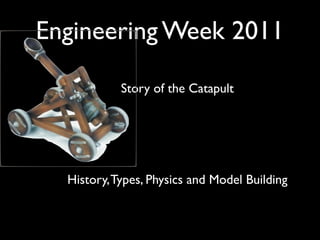
Engineering Week 2011

            Story of the Catapult


  History, Types, Physics and Model Building
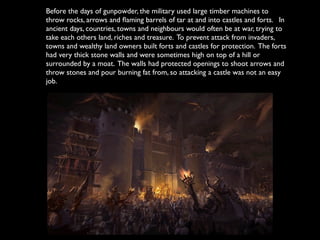
Before the days of gunpowder, the military used large timber machines to
throw rocks, arrows and flaming barrels of tar at and into castles and forts. In
ancient days, countries, towns and neighbours would often be at war, trying to
take each others land, riches and treasure. To prevent attack from invaders,
towns and wealthy land owners built forts and castles for protection. The forts
had very thick stone walls and were sometimes high on top of a hill or
surrounded by a moat. The walls had protected openings to shoot arrows and
throw stones and pour burning fat from, so attacking a castle was not an easy
job.
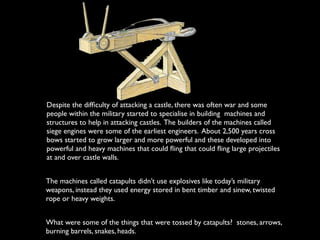
Despite the difficulty of attacking a castle, there was often war and some
people within the military started to specialise in building machines and
structures to help in attacking castles. The builders of the machines called
siege engines were some of the earliest engineers. About 2,500 years cross
bows started to grow larger and more powerful and these developed into
powerful and heavy machines that could fling that could fling large projectiles
at and over castle walls.


The machines called catapults didn’t use explosives like today’s military
weapons, instead they used energy stored in bent timber and sinew, twisted
rope or heavy weights.


What were some of the things that were tossed by catapults? stones, arrows,
burning barrels, snakes, heads.
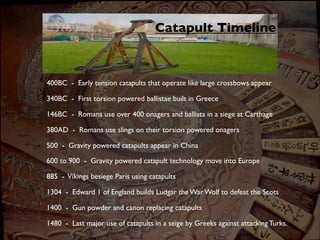
Catapult Timeline


400BC - Early tension catapults that operate like large crossbows appear

340BC - First torsion powered ballistae built in Greece

146BC - Romans use over 400 onagers and ballista in a siege at Carthage

380AD - Romans use slings on their torsion powered onagers

500 - Gravity powered catapults appear in China

600 to 900 - Gravity powered catapult technology move into Europe

885 - Vikings besiege Paris using catapults

1304 - Edward 1 of England builds Ludgar the War Wolf to defeat the Scots

1400 - Gun powder and canon replacing catapults

1480 - Last major use of catapults in a seige by Greeks against attacking Turks.
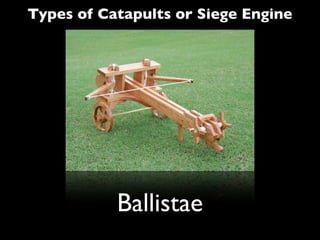
Types of Catapults or Siege Engine


           Ballistae
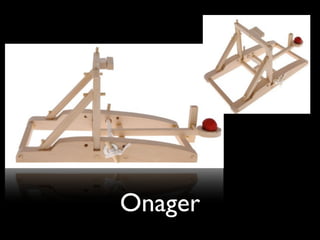
Onager
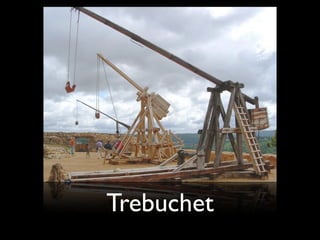
Trebuchet
Trebuchet
Catapult Power


• pumpkin catapult record 620m (trebuchet)
• largest trebuchet currently in operation
  18m high
Catapult Physics
Energy Source
• Tension spring
•   Torsion spring

•   Gravity
Mechanisms
•   Lever - mechanical advantage

•   Pulley
    Wheel & axle

Catapults

  • 1.
    Engineering Week 2011 Story of the Catapult History, Types, Physics and Model Building
  • 2.
    Before the daysof gunpowder, the military used large timber machines to throw rocks, arrows and flaming barrels of tar at and into castles and forts. In ancient days, countries, towns and neighbours would often be at war, trying to take each others land, riches and treasure. To prevent attack from invaders, towns and wealthy land owners built forts and castles for protection. The forts had very thick stone walls and were sometimes high on top of a hill or surrounded by a moat. The walls had protected openings to shoot arrows and throw stones and pour burning fat from, so attacking a castle was not an easy job.
  • 3.
    Despite the difficultyof attacking a castle, there was often war and some people within the military started to specialise in building machines and structures to help in attacking castles. The builders of the machines called siege engines were some of the earliest engineers. About 2,500 years cross bows started to grow larger and more powerful and these developed into powerful and heavy machines that could fling that could fling large projectiles at and over castle walls. The machines called catapults didn’t use explosives like today’s military weapons, instead they used energy stored in bent timber and sinew, twisted rope or heavy weights. What were some of the things that were tossed by catapults? stones, arrows, burning barrels, snakes, heads.
  • 4.
    Catapult Timeline 400BC -Early tension catapults that operate like large crossbows appear 340BC - First torsion powered ballistae built in Greece 146BC - Romans use over 400 onagers and ballista in a siege at Carthage 380AD - Romans use slings on their torsion powered onagers 500 - Gravity powered catapults appear in China 600 to 900 - Gravity powered catapult technology move into Europe 885 - Vikings besiege Paris using catapults 1304 - Edward 1 of England builds Ludgar the War Wolf to defeat the Scots 1400 - Gun powder and canon replacing catapults 1480 - Last major use of catapults in a seige by Greeks against attacking Turks.
  • 5.
    Types of Catapultsor Siege Engine Ballistae
  • 6.
  • 7.
  • 8.
  • 10.
    Catapult Power • pumpkincatapult record 620m (trebuchet) • largest trebuchet currently in operation 18m high
  • 11.
    Catapult Physics Energy Source •Tension spring • Torsion spring • Gravity Mechanisms • Lever - mechanical advantage • Pulley Wheel & axle

Editor's Notes