The Middle Ages
Fall of the Roman Empire
•   Political Weakness—bad leaders
•   Economic Problems—no $$$$
•   Military Decline—no army
•   Invasion--barbarians
Justinian the Great
          The Byzantine Empire
• After the fall of the Roman Empire, the
  Western half fell into chaos.
• The Eastern half became the Byzantine
  Empire.
• The size varied but under Justinian it
  reconquered much of the old Roman Empire.
• Greatest achievement was the Code of
  Justinian—all of roman laws under one code
Byzantine Church
• The Byzantine empire was united by their own
  form of Christianity—Eastern Orthodoxy—
  separate from the Catholic Church.
• They do not recognize the Pope
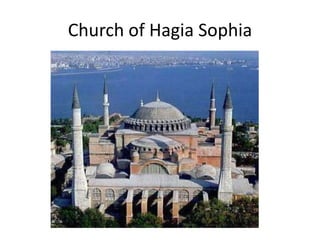
• Church of Hagia Sophia
Church of Hagia Sophia
Western Europe in Turmoil
             Middle Ages
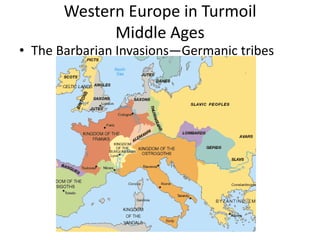
• The Barbarian Invasions—Germanic tribes
Feudalism
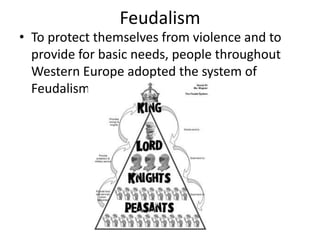
• To protect themselves from violence and to
  provide for basic needs, people throughout
  Western Europe adopted the system of
  Feudalism
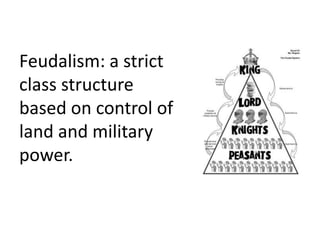
Feudalism: a strict
class structure
based on control of
land and military
power.
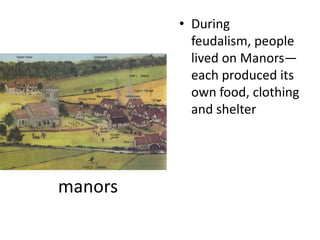
• During
           feudalism, people
           lived on Manors—
           each produced its
           own food, clothing
           and shelter


manors
Catholic Church
• During the Middle Ages, the Roman Catholic
  Church remained the most powerful
  organization in Western Europe.
• The head of the Church was the Pope in
  Rome.
• Catholics believed the Pope took the place of
  St. Peter in running the Church.
Reasons for the Church’s Power
• The Role of Faith—believed the Church held
  the power to send people to Heaven or Hell
• Power and Wealth—grew wealthy as many
  nobles left their land to the church to gain
  entry to Heaven
• Center of learning-church officials were often
  the only people who could read and write
Two Christian Thinkers
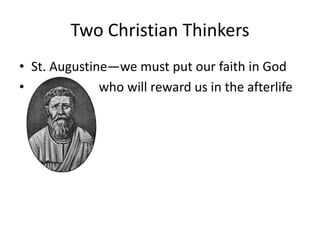
• St. Augustine—we must put our faith in God
•             who will reward us in the afterlife
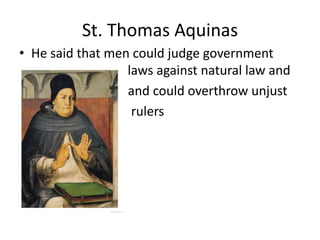
St. Thomas Aquinas
• He said that men could judge government
  laws            laws against natural law and
•                 and could overthrow unjust
•                  rulers
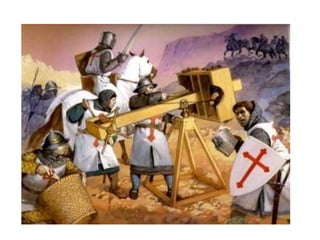
The Crusades
• Christians had been traveling to the Holy Land
  for hundreds of years. But in 1095 the Seljuk
  Turks took control of the Holy land and drove
  out Christians.
• Pope Urban II called on all Christians in Europe
  to unite and fight a holy Crusade—a war to
  recapture the Holy land. The church promised
  salvation to all who participated
Effects of the Crusades
• The Crusades were a failure in that the Holy
  City was never recaptured HOWEVER it
  changed Europe:
New Ideas and Products
• The use of zero in math
• Silk, rice, spices, coffee.
  Perfumes, cotton, raisins, glass mirrors
Increased in Trade
• Because now Europe had seen good stuff they
  wanted to trade with the Middle East and the
  rest of the world and new inventions from the
  Chinese and the Muslims like the
  Compass, astrolabe—made sailing less scary.
Growth of Intolerance
• The Crusades led to the Christian persecution
  of Jews and Muslims, as well as to the Muslim
  persecution of Christians---Not a good thing
English Political Traditions
• In 1215, the English nobles rebelled against
  the taxes and forced loans being collected by
  King John and forced him to sign the Magna
  Carte—guaranteeing free men certain rights
The Black Death
• Rats with fleas carrying the disease entered
  Europe from Asia on trading ships. Between
  1347-1351 25 million people died. About 1/3
  of Europe's population.
• Many questioned the Church
• Many blamed the Jews
• The Black Death created a labor shortage in
  Europe
The Hundred Years War (1337-1453)

• The Hundreds Years war broke out between
  France and England when the French king died
  without an heir, and the King of England
  claimed the French throne.
• Joan of Arc: a young French maiden, rallied
  French troops and turned the tide by driving
  out the English out of the French city of
  Orleans. She was captured and burned at the
  stake by the English.
The middle ages

The middle ages

  • 1.
  • 2.
    Fall of theRoman Empire • Political Weakness—bad leaders • Economic Problems—no $$$$ • Military Decline—no army • Invasion--barbarians
  • 3.
    Justinian the Great The Byzantine Empire • After the fall of the Roman Empire, the Western half fell into chaos. • The Eastern half became the Byzantine Empire. • The size varied but under Justinian it reconquered much of the old Roman Empire. • Greatest achievement was the Code of Justinian—all of roman laws under one code
  • 4.
    Byzantine Church • TheByzantine empire was united by their own form of Christianity—Eastern Orthodoxy— separate from the Catholic Church. • They do not recognize the Pope • Church of Hagia Sophia
  • 5.
  • 6.
    Western Europe inTurmoil Middle Ages • The Barbarian Invasions—Germanic tribes
  • 7.
    Feudalism • To protectthemselves from violence and to provide for basic needs, people throughout Western Europe adopted the system of Feudalism
  • 8.
    Feudalism: a strict classstructure based on control of land and military power.
  • 9.
    • During feudalism, people lived on Manors— each produced its own food, clothing and shelter manors
  • 10.
    Catholic Church • Duringthe Middle Ages, the Roman Catholic Church remained the most powerful organization in Western Europe. • The head of the Church was the Pope in Rome. • Catholics believed the Pope took the place of St. Peter in running the Church.
  • 11.
    Reasons for theChurch’s Power • The Role of Faith—believed the Church held the power to send people to Heaven or Hell • Power and Wealth—grew wealthy as many nobles left their land to the church to gain entry to Heaven • Center of learning-church officials were often the only people who could read and write
  • 12.
    Two Christian Thinkers •St. Augustine—we must put our faith in God • who will reward us in the afterlife
  • 13.
    St. Thomas Aquinas •He said that men could judge government laws laws against natural law and • and could overthrow unjust • rulers
  • 14.
    The Crusades • Christianshad been traveling to the Holy Land for hundreds of years. But in 1095 the Seljuk Turks took control of the Holy land and drove out Christians. • Pope Urban II called on all Christians in Europe to unite and fight a holy Crusade—a war to recapture the Holy land. The church promised salvation to all who participated
  • 16.
    Effects of theCrusades • The Crusades were a failure in that the Holy City was never recaptured HOWEVER it changed Europe:
  • 17.
    New Ideas andProducts • The use of zero in math • Silk, rice, spices, coffee. Perfumes, cotton, raisins, glass mirrors
  • 18.
    Increased in Trade •Because now Europe had seen good stuff they wanted to trade with the Middle East and the rest of the world and new inventions from the Chinese and the Muslims like the Compass, astrolabe—made sailing less scary.
  • 19.
    Growth of Intolerance •The Crusades led to the Christian persecution of Jews and Muslims, as well as to the Muslim persecution of Christians---Not a good thing
  • 20.
    English Political Traditions •In 1215, the English nobles rebelled against the taxes and forced loans being collected by King John and forced him to sign the Magna Carte—guaranteeing free men certain rights
  • 21.
    The Black Death •Rats with fleas carrying the disease entered Europe from Asia on trading ships. Between 1347-1351 25 million people died. About 1/3 of Europe's population. • Many questioned the Church • Many blamed the Jews • The Black Death created a labor shortage in Europe
  • 22.
    The Hundred YearsWar (1337-1453) • The Hundreds Years war broke out between France and England when the French king died without an heir, and the King of England claimed the French throne. • Joan of Arc: a young French maiden, rallied French troops and turned the tide by driving out the English out of the French city of Orleans. She was captured and burned at the stake by the English.