With a partner, come up with a list of how 
citizens can create change in society. 
› Think of different ways they can be involved or 
influence the democratic system. 
What did you come up with?
Power is the ability to change the ability of 
others and to get things done. 
What are groups in society that have power 
over us? 
› Government, schools, peer groups, parents, etc. 
Two types of power: 
› Hard power – used to force people to do things 
out of fear or threats of punishment. 
› Soft power – change behaviours through 
persuasion and influence.
Authority – formal position or role that comes 
with specific powers and abilities (Prime 
Minister, MPs, principals, police). 
Reward – capacity to reward people. 
Material (money/privilege) or emotional 
(affection/acknowledgement/praise) can be 
found in the corporate world. 
Force – capacity to threaten, harm and 
punish. Examples are physical (armies), 
economic (financial loss), or emotional 
(abuse).
Knowledge – specialized knowledge and 
skills. (scientists, professionals) 
Respect – people who are highly trusted, 
respected and admired. Elders, friends and 
family. Some can be religious. 
Power is neither good nor bad – it is HOW 
people use or abuse power that matters. 
Citizens and democratic societies need to be 
aware of who has power, how it is used, and 
how it can be used for positive change.
Active Citizenship 
Knowing who has 
power 
Identifying abuses of 
power 
Getting and using 
power for positive 
change
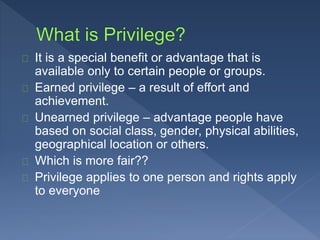
It is a special benefit or advantage that is 
available only to certain people or groups. 
Earned privilege – a result of effort and 
achievement. 
Unearned privilege – advantage people have 
based on social class, gender, physical abilities, 
geographical location or others. 
Which is more fair?? 
Privilege applies to one person and rights apply 
to everyone
What are some groups that have privilege in 
Canada? 
Watch the following video: 
https://www.youtube.com/watch?v=- 
VZxwY523Ok 
What are your thoughts on what happened in 
the video?
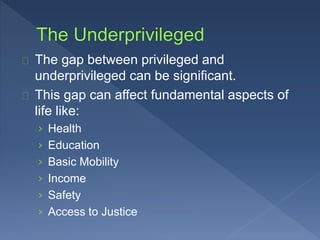
The gap between privileged and 
underprivileged can be significant. 
This gap can affect fundamental aspects of 
life like: 
› Health 
› Education 
› Basic Mobility 
› Income 
› Safety 
› Access to Justice
Often people with fewer advantages have 
difficulty breaking the cycle of these 
conditions. 
Social programs, such as financial aid for 
education, are designed to help overcome 
these barriers. 
What are other social programs that can do 
this?
When power and privilege reinforce each 
other they can create injustice. 
People who have power often try to hold 
onto it. 
The more they want to keep it, the more it 
will be kept at the expense of others. 
There are many examples of people giving 
up their unearned privileges and using their 
power to help others.
In a democracy, it is important that everyone 
feels they are treated fairly. 
This requires balancing a lot of competing 
needs and interests. 
Is it fair that students who are the first in their 
families to go to college or university may be 
eligible for special funding from the 
government? Yes or No? 
Yes – students from these families face more 
barriers to continuing their education than 
others. 
No – not fair to other students who are in 
financial difficulties but don’t qualify.
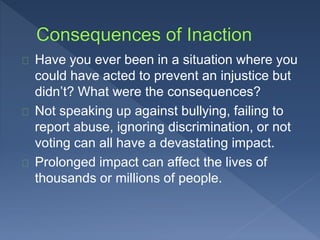
Have you ever been in a situation where you 
could have acted to prevent an injustice but 
didn’t? What were the consequences? 
Not speaking up against bullying, failing to 
report abuse, ignoring discrimination, or not 
voting can all have a devastating impact. 
Prolonged impact can affect the lives of 
thousands or millions of people.
Residential Schools 
› Starting in the 1800s, 150,000 Aboriginal children were 
taken from homes and sent to government run schools 
› Forbidden to speak their own language, destroyed 
culture 
› Saw family only a few months a year 
› Many were subjected to physical, emotional and sexual 
abuse 
› In spite of calls to end the schools, the Government of 
Canada continued to operate them for decades. 
› Results were devastating and the government finally 
made an apology in June 2008
Rwandan Genocide 
› UN Peacekeeping mission to the African country 
› Goal was to keep peace between the Hutu and Tutsi 
tribes 
› Hutu extremists slaughtered Tutsis and moderate 
Hutus 
› 12 peacekeepers were murdered and many nations 
pulled their soldiers out of the country 
› Despite pleas for more troops, the UN refused, 
argued and ultimately did nothing 
› After 100 days of massacre there was 800,000 dead
1. Should people be punished for failing to 
act? Why or why not? 
› Consider witnessing: bullying, theft, murder 
2. Is government inaction more significant than 
individual inaction? 
3. How do you decide when to get involved? 
What would motivate you to act?
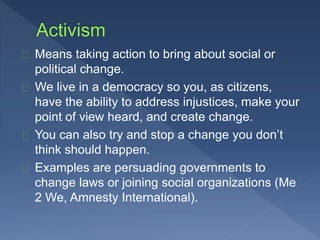
Means taking action to bring about social or 
political change. 
We live in a democracy so you, as citizens, 
have the ability to address injustices, make your 
point of view heard, and create change. 
You can also try and stop a change you don’t 
think should happen. 
Examples are persuading governments to 
change laws or joining social organizations (Me 
2 We, Amnesty International).
What are some other ways that you can be 
an activist in a democratic society? 
Examples: 
› Sign a petition 
› Write your government (letter, e-mail) 
› Charitable work or donation 
› Wear a t-shirt (pink for anti-bullying) 
› Social Media – posts, likes, tweets 
When you make your voice heard or 
advocate for what you believe, you are 
taking civic action.
Complete the ‘Options for Action’ sheet
Donate money, clothing, food 
Donate your time/volunteer 
Fundraise 
Buy Ethical Goods 
Positive – Builds on what others have 
accomplished 
Negative – Leaves decision-making to others
Educate yourself or others 
Stage a media event 
Lead or organized group events 
Positive – Great foundation for future change 
Negative – Takes time
Speak your mind 
Wear a T-shirt 
Raise Awareness online (social media, blog) 
Create posters, flyers, art, music, or an ad 
campaign 
Vote 
Positive – Directly influences others 
Negative – Must be willing to accept criticism 
from others and respond
Sign a petition 
Join a march, rally or protest 
Boycott or support a business 
Organize a protest 
Positive – Gets a lot of attention 
Negative – Can only convey a simple 
message
Are people aware? Is the story hidden, ignored, 
not affecting people? 
Do people understand? Is the story 
overwhelming, not well known or only seen by 
one perspective? 
Are people committed? Story conflicts with 
beliefs/values or isn’t significant, not concerned 
with results of inaction, think someone else will 
fix it. 
Are people taking action? They don’t know what 
to do or who can fix it, feel powerless, no clear 
objectives or plans.
Key Questions 
› Why aren’t people 
more aware? 
› Who needs to be 
more aware and 
where are they? 
› What activities will 
best raise 
awareness? 
Possible Actions 
› Tweet 
› March 
› Email 
› Protest Share 
› Photograph 
› Record Video 
› Advertise
Key Questions 
› What facts are people 
missing? 
› What evidence will be 
most compelling? 
› What different 
perspectives should 
be considered? 
Possible Actions 
› Write 
› Blog 
› Publish 
› Report 
› Post 
› Visit
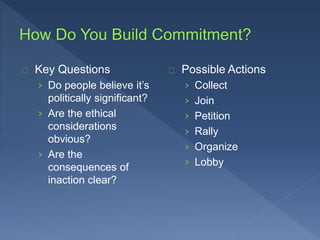
Key Questions 
› Do people believe it’s 
politically significant? 
› Are the ethical 
considerations 
obvious? 
› Are the 
consequences of 
inaction clear? 
Possible Actions 
› Collect 
› Join 
› Petition 
› Rally 
› Organize 
› Lobby
Key Questions 
› What do you want 
other people to do? 
› Are the objectives 
state and 
understood? 
› Is everyone clear on 
the intended results? 
Possible Actions 
› Plan 
› Share 
› Anticipate 
› Communicate 
› Measure
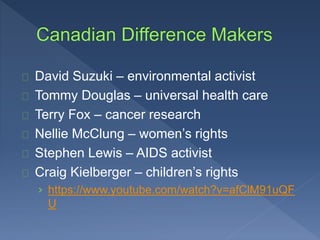
David Suzuki – environmental activist 
Tommy Douglas – universal health care 
Terry Fox – cancer research 
Nellie McClung – women’s rights 
Stephen Lewis – AIDS activist 
Craig Kielberger – children’s rights 
› https://www.youtube.com/watch?v=afClM91uQF 
U
Would you, or have you, ever choose to 
break a rule or law? 
Under what circumstances do you think it is 
acceptable to break the law? 
If someone broke a law to fight an injustice 
they cared about but you strongly disagreed, 
how would you react?
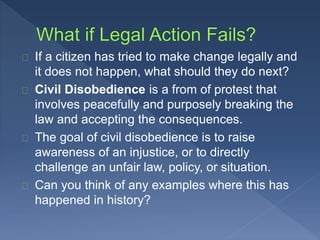
If a citizen has tried to make change legally and 
it does not happen, what should they do next? 
Civil Disobedience is a from of protest that 
involves peacefully and purposely breaking the 
law and accepting the consequences. 
The goal of civil disobedience is to raise 
awareness of an injustice, or to directly 
challenge an unfair law, policy, or situation. 
Can you think of any examples where this has 
happened in history?
Occupation – Rosa Parks refusing to give up 
her seat to a white man. 
Blockade – Mohawk First Nation barricaded a 
road near Oka, Quebec to protest a golf course 
being built on sacred land. 
Public Disturbance – Greenpeace dumped 
tonnes of tuna heads in front of the Ministry of 
Agriculture in France to draw attention to the 
devastation of illegal fishing. 
Illegal Protest – Student protests in Quebec in 
2012 were banned but the government which 
resulted in citizens of all ages taking to the 
streets.
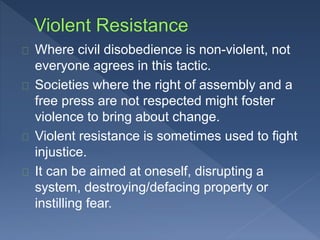
Where civil disobedience is non-violent, not 
everyone agrees in this tactic. 
Societies where the right of assembly and a 
free press are not respected might foster 
violence to bring about change. 
Violent resistance is sometimes used to fight 
injustice. 
It can be aimed at oneself, disrupting a 
system, destroying/defacing property or 
instilling fear.
Self-harm – A street vendor in Tunisia was frustrated 
with the local police so he set himself on fire and 
started the Arab Spring. 
Sabotage – Anonymous is a group that is anti-surveillance 
and anti-censorship. They attacked many 
US gov’t sites after a file sharing site was shut down. 
Vandalism – Protestors at the G20 summit in Toronto 
resorted to vandalism to protest inequality in the 
world. 
Terrorism – The FLQ Terrorist group used terrorism to 
further their goal of Quebec separation.
“When a man is denied the right to live the life he 
believes in, he has no choice but to become an 
outlaw” Nelson Mandela 
“Non-violence is the greatest force at the disposal 
of mankind. It is mightier than the mightiest 
weapon of destruction devised by the ingenuity of 
man.” Mahatma Gandhi 
It is criminal to teach a man not to defend himself 
when he is the constant victim of brutal attacks.” 
Malcolm X
You have the ability to create change. 
You can create change locally, provincially, 
federally or globally. 
All it takes is a passion and commitment to a 
cause. 
Do not sell yourself short and do not be 
afraid to stand up for what you believe in. 
Don’t be afraid to stand up for those in 
society who cannot stand up for themselves 
either.
Civics and Citizenship by Canadian 
Investigations

Activism in Canada

  • 2.
    With a partner,come up with a list of how citizens can create change in society. › Think of different ways they can be involved or influence the democratic system. What did you come up with?
  • 3.
    Power is theability to change the ability of others and to get things done. What are groups in society that have power over us? › Government, schools, peer groups, parents, etc. Two types of power: › Hard power – used to force people to do things out of fear or threats of punishment. › Soft power – change behaviours through persuasion and influence.
  • 4.
    Authority – formalposition or role that comes with specific powers and abilities (Prime Minister, MPs, principals, police). Reward – capacity to reward people. Material (money/privilege) or emotional (affection/acknowledgement/praise) can be found in the corporate world. Force – capacity to threaten, harm and punish. Examples are physical (armies), economic (financial loss), or emotional (abuse).
  • 5.
    Knowledge – specializedknowledge and skills. (scientists, professionals) Respect – people who are highly trusted, respected and admired. Elders, friends and family. Some can be religious. Power is neither good nor bad – it is HOW people use or abuse power that matters. Citizens and democratic societies need to be aware of who has power, how it is used, and how it can be used for positive change.
  • 6.
    Active Citizenship Knowingwho has power Identifying abuses of power Getting and using power for positive change
  • 7.
    It is aspecial benefit or advantage that is available only to certain people or groups. Earned privilege – a result of effort and achievement. Unearned privilege – advantage people have based on social class, gender, physical abilities, geographical location or others. Which is more fair?? Privilege applies to one person and rights apply to everyone
  • 8.
    What are somegroups that have privilege in Canada? Watch the following video: https://www.youtube.com/watch?v=- VZxwY523Ok What are your thoughts on what happened in the video?
  • 9.
    The gap betweenprivileged and underprivileged can be significant. This gap can affect fundamental aspects of life like: › Health › Education › Basic Mobility › Income › Safety › Access to Justice
  • 10.
    Often people withfewer advantages have difficulty breaking the cycle of these conditions. Social programs, such as financial aid for education, are designed to help overcome these barriers. What are other social programs that can do this?
  • 11.
    When power andprivilege reinforce each other they can create injustice. People who have power often try to hold onto it. The more they want to keep it, the more it will be kept at the expense of others. There are many examples of people giving up their unearned privileges and using their power to help others.
  • 12.
    In a democracy,it is important that everyone feels they are treated fairly. This requires balancing a lot of competing needs and interests. Is it fair that students who are the first in their families to go to college or university may be eligible for special funding from the government? Yes or No? Yes – students from these families face more barriers to continuing their education than others. No – not fair to other students who are in financial difficulties but don’t qualify.
  • 13.
    Have you everbeen in a situation where you could have acted to prevent an injustice but didn’t? What were the consequences? Not speaking up against bullying, failing to report abuse, ignoring discrimination, or not voting can all have a devastating impact. Prolonged impact can affect the lives of thousands or millions of people.
  • 14.
    Residential Schools ›Starting in the 1800s, 150,000 Aboriginal children were taken from homes and sent to government run schools › Forbidden to speak their own language, destroyed culture › Saw family only a few months a year › Many were subjected to physical, emotional and sexual abuse › In spite of calls to end the schools, the Government of Canada continued to operate them for decades. › Results were devastating and the government finally made an apology in June 2008
  • 15.
    Rwandan Genocide ›UN Peacekeeping mission to the African country › Goal was to keep peace between the Hutu and Tutsi tribes › Hutu extremists slaughtered Tutsis and moderate Hutus › 12 peacekeepers were murdered and many nations pulled their soldiers out of the country › Despite pleas for more troops, the UN refused, argued and ultimately did nothing › After 100 days of massacre there was 800,000 dead
  • 16.
    1. Should peoplebe punished for failing to act? Why or why not? › Consider witnessing: bullying, theft, murder 2. Is government inaction more significant than individual inaction? 3. How do you decide when to get involved? What would motivate you to act?
  • 17.
    Means taking actionto bring about social or political change. We live in a democracy so you, as citizens, have the ability to address injustices, make your point of view heard, and create change. You can also try and stop a change you don’t think should happen. Examples are persuading governments to change laws or joining social organizations (Me 2 We, Amnesty International).
  • 18.
    What are someother ways that you can be an activist in a democratic society? Examples: › Sign a petition › Write your government (letter, e-mail) › Charitable work or donation › Wear a t-shirt (pink for anti-bullying) › Social Media – posts, likes, tweets When you make your voice heard or advocate for what you believe, you are taking civic action.
  • 19.
    Complete the ‘Optionsfor Action’ sheet
  • 20.
    Donate money, clothing,food Donate your time/volunteer Fundraise Buy Ethical Goods Positive – Builds on what others have accomplished Negative – Leaves decision-making to others
  • 21.
    Educate yourself orothers Stage a media event Lead or organized group events Positive – Great foundation for future change Negative – Takes time
  • 22.
    Speak your mind Wear a T-shirt Raise Awareness online (social media, blog) Create posters, flyers, art, music, or an ad campaign Vote Positive – Directly influences others Negative – Must be willing to accept criticism from others and respond
  • 23.
    Sign a petition Join a march, rally or protest Boycott or support a business Organize a protest Positive – Gets a lot of attention Negative – Can only convey a simple message
  • 24.
    Are people aware?Is the story hidden, ignored, not affecting people? Do people understand? Is the story overwhelming, not well known or only seen by one perspective? Are people committed? Story conflicts with beliefs/values or isn’t significant, not concerned with results of inaction, think someone else will fix it. Are people taking action? They don’t know what to do or who can fix it, feel powerless, no clear objectives or plans.
  • 25.
    Key Questions ›Why aren’t people more aware? › Who needs to be more aware and where are they? › What activities will best raise awareness? Possible Actions › Tweet › March › Email › Protest Share › Photograph › Record Video › Advertise
  • 26.
    Key Questions ›What facts are people missing? › What evidence will be most compelling? › What different perspectives should be considered? Possible Actions › Write › Blog › Publish › Report › Post › Visit
  • 27.
    Key Questions ›Do people believe it’s politically significant? › Are the ethical considerations obvious? › Are the consequences of inaction clear? Possible Actions › Collect › Join › Petition › Rally › Organize › Lobby
  • 28.
    Key Questions ›What do you want other people to do? › Are the objectives state and understood? › Is everyone clear on the intended results? Possible Actions › Plan › Share › Anticipate › Communicate › Measure
  • 29.
    David Suzuki –environmental activist Tommy Douglas – universal health care Terry Fox – cancer research Nellie McClung – women’s rights Stephen Lewis – AIDS activist Craig Kielberger – children’s rights › https://www.youtube.com/watch?v=afClM91uQF U
  • 30.
    Would you, orhave you, ever choose to break a rule or law? Under what circumstances do you think it is acceptable to break the law? If someone broke a law to fight an injustice they cared about but you strongly disagreed, how would you react?
  • 31.
    If a citizenhas tried to make change legally and it does not happen, what should they do next? Civil Disobedience is a from of protest that involves peacefully and purposely breaking the law and accepting the consequences. The goal of civil disobedience is to raise awareness of an injustice, or to directly challenge an unfair law, policy, or situation. Can you think of any examples where this has happened in history?
  • 32.
    Occupation – RosaParks refusing to give up her seat to a white man. Blockade – Mohawk First Nation barricaded a road near Oka, Quebec to protest a golf course being built on sacred land. Public Disturbance – Greenpeace dumped tonnes of tuna heads in front of the Ministry of Agriculture in France to draw attention to the devastation of illegal fishing. Illegal Protest – Student protests in Quebec in 2012 were banned but the government which resulted in citizens of all ages taking to the streets.
  • 33.
    Where civil disobedienceis non-violent, not everyone agrees in this tactic. Societies where the right of assembly and a free press are not respected might foster violence to bring about change. Violent resistance is sometimes used to fight injustice. It can be aimed at oneself, disrupting a system, destroying/defacing property or instilling fear.
  • 34.
    Self-harm – Astreet vendor in Tunisia was frustrated with the local police so he set himself on fire and started the Arab Spring. Sabotage – Anonymous is a group that is anti-surveillance and anti-censorship. They attacked many US gov’t sites after a file sharing site was shut down. Vandalism – Protestors at the G20 summit in Toronto resorted to vandalism to protest inequality in the world. Terrorism – The FLQ Terrorist group used terrorism to further their goal of Quebec separation.
  • 35.
    “When a manis denied the right to live the life he believes in, he has no choice but to become an outlaw” Nelson Mandela “Non-violence is the greatest force at the disposal of mankind. It is mightier than the mightiest weapon of destruction devised by the ingenuity of man.” Mahatma Gandhi It is criminal to teach a man not to defend himself when he is the constant victim of brutal attacks.” Malcolm X
  • 36.
    You have theability to create change. You can create change locally, provincially, federally or globally. All it takes is a passion and commitment to a cause. Do not sell yourself short and do not be afraid to stand up for what you believe in. Don’t be afraid to stand up for those in society who cannot stand up for themselves either.
  • 37.
    Civics and Citizenshipby Canadian Investigations